Non-existence of antipodal cages of even girth
Slobodan Filipovski

TL;DR
This paper proves that antipodal $(k,g)$-cages with even girth $g \,\geq\,14$ and small excess do not exist, using spectral analysis of their adjacency and distance matrices.
Contribution
It establishes the non-existence of certain antipodal cages with even girth and small excess through spectral analysis methods.
Findings
Proves non-existence of antipodal $(k,g)$-cages for $g\geq14$ and small excess.
Provides spectral relations between adjacency and distance matrices.
Extends previous results on bipartite cages and antipodal properties.
Abstract
The Moore bound is a lower bound on the order of -regular graphs of girth (denoted -graphs). The excess of a -graph of order is the difference A -cage is a -graph with the fewest possible number of vertices, among all -graphs. A graph of diameter is said to be antipodal if, for any vertices such that and , it follows that or In [4] Biggs and Ito proved that any -cage of even girth and excess is a bipartite graph of diameter In this paper we treat the -cages of even girth and excess Based on a spectral analysis we give a relation between the eigenvalues of the adjacency matrix and the distance matrix of such cages. Moreover, following the methodology used in [4] and [13], we prove the…
Click any figure to enlarge with its caption.
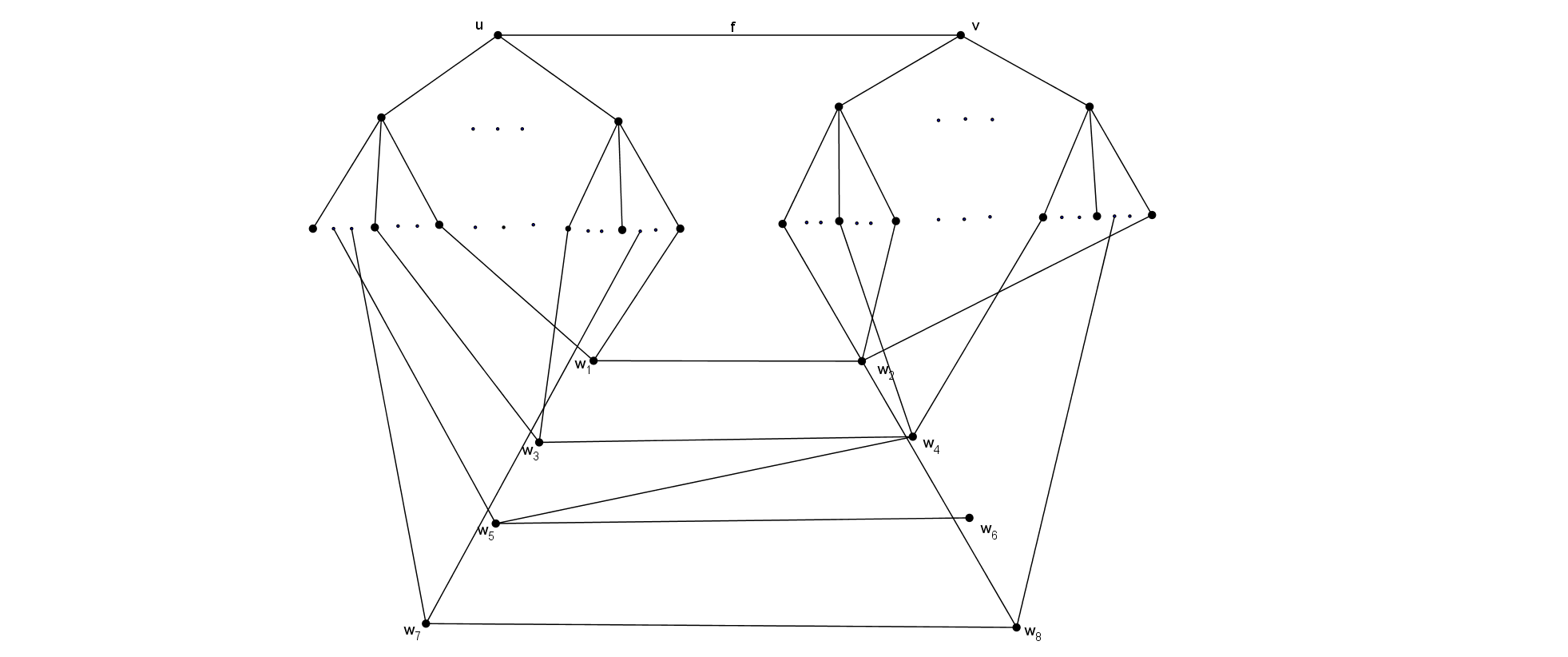 Figure 1
Peer Reviews
No public reviews on file for this paper yet. If you reviewed it on a platform where reviews are public (OpenReview, ICLR, NeurIPS, ICML), you can paste yours below so the community can read it here.
Videos
No videos yet. Explain this paper in a talk, walkthrough, or lecture? Add one.
Non-existence of antipodal cages
of even girth
Slobodan Filipovski
University of Primorska
Koper, Slovenia
[email protected] Supported in part by the Slovenian Research Agency (research program P1-0285 and Young Researchers Grant).
Abstract
The Moore bound is a lower bound on the order of -regular graphs of girth (denoted -graphs). The excess of a -graph of order is the difference A -cage is a -graph with the fewest possible number of vertices, among all -graphs. A graph of diameter is said to be antipodal if, for any vertices such that and , it follows that or In [4] Biggs and Ito proved that any -cage of even girth and excess is a bipartite graph of diameter In this paper we treat -cages of even girth and excess Based on a spectral analysis we give a relation between the eigenvalues of the adjacency matrix and the distance matrix of such cages. Moreover, following the methodology used in [4] and [13], we prove the non-existence of the antipodal -cages of excess , where and
Keywords: -regular graphs, antipodal cages, excess, multiplicities
1 Introduction
A -graph is a -regular graph having girth . A -cage is a -graph of smallest order. The Cage Problem or Degree/Girth Problem calls for finding cages; Tutte was the first to study -cages, [16]. A -graph exists for any pair where and , see [8] and [14]. It is well known that the -graphs have at least vertices, where
[TABLE]
If is a -graph of order , then we define the excess of to be The graphs whose orders are equal to (excess [math]) are called Moore graphs. Their classification has been completed except for the case and The Moore graphs exist if and , and , and , and , or and a generalized -gon of order exists, see [1], [7] and [9].
The following three results concern the graphs of even girth.
Theorem 1.1** (Biggs and Ito [4])**
Let be a -cage of girth and excess . If , then is even and is bipartite of diameter .
It is known that these graphs are partially distance-regular. More about almost-distance-regular graphs, see [5]. For the next theorem, let denote the incidence graph of a symmetric -design.
Theorem 1.2** (Biggs and Ito [4])**
Let be a -cage of girth and excess . Then , is a double-cover of , and .
Theorem 1.3** (Jajcayová, Filipovski and Jajcay [12])**
Let and . No -graphs of excess exist for parameters satisfying at least one of the following conditions:
, with a prime number, and ;
- 2)
* such that , and is divisible by but not by ;*
- 3)
, with a prime number, and and even;
- 4)
, with a prime number, and ;
- 5)
, and
Let and let be a -cage of excess and order . Due to Theorem 1.1, we conclude that is a bipartite graph of diameter Let be its adjacency matrix. For the integers with , the -distance matrix of is an matrix such that the entry in position is if the distance between the vertices and is , and zero otherwise. Using the spectral considerations as in [10], in Section 2 we prove that the eigenvalues of , other than , are the roots of the polynomial ; Theorem 2.3. Here, is the Dickson polynomial of the second kind with parameter and degree , and is an eigenvalue of the distance matrix .
A graph of diameter is said to be antipodal if, for any vertices such that and , it follows that or (see [3]).
Among the trivially antipodal graphs let us mention the -dimensional cubes . These graphs are bipartite and have the antipodal property, since every vertex of has a unique vertex at maximum distance from it. Also, for , the complete bipartite graph is antipodal. Here the antipodal partition is the same as the bipartition. The dodecahedron is an example of trivially antipodal, but not bipartite graph. Examples of graphs which are non-trivially antipodal and not bipartite are the complete tripartite graphs , which have diameter , and the line graph of Petersen’s graph, which has diameter . Motivated by Theorem 1.4, in this paper we address the question of the existence of the antipodal -cages of even girth and excess Employing the methodology used in [2], [4] and [13], we prove the non-existence of the antipodal -cages of excess , with and Theorem 4.2.
Theorem 1.4** (Bannai and Ito [2])**
For there exist no antipodal regular graphs with diameter and girth
2 On -cages of even girth and excess
Let and be positive integers such that and . Let be a -cage of excess ; Theorem 1.1 asserts that is even and is a bipartite graph of diameter Let be an arbitrary edge of . Let be the subgraph of induced by the set of vertices such that and . It is easy to see that is a tree of depth rooted at . In the same way we can define the tree to be the subgraph of induced by the set of vertices such that and . Since is of girth , the trees and are disjoint. Let be the union of the trees and and the edge . We call the graph a Moore tree of rooted at . The graph must contain additional vertices , which do not belong to , that is, and , for each We call these vertices the excess vertices with respect to and denote this set ; we call the edges not contained in the Moore tree of horizontal edges. Since is a bipartite graph, it contains no odd cycle; consequently there exists no edge between the excess vertices of the same partite set. Moreover, in order to balance the Moore tree and paring out the horizontal edges of , we easily observe that half () of the excess vertices belong to the first, and the other half to the second partite set of It implies that for each vertex of there exist exactly vertices at distance from it.
In order to study the spectral properties of , we define the following polynomials:
[TABLE]
The above defined polynomials have a close connection to the properties of a graph . Namely, for , the element counts the number of paths of length joining vertices and of . Moreover, counts the number of paths of length at most joining pairs of vertices in . For more information about these polynomials see [15].
The next lemma is a generalization on Lemma 5 from [10], where it is considered cages of even girth and excess .
Lemma 2.1
Let and and let be a -cage of excess . If is the adjacency matrix of , then
[TABLE]
Proof. Let be a base edge of the Moore tree and let be the edges of the subgraph induced by . Also, let us assume that and Let be the number of edges between and the leaves of and , where We consider the case when the excess vertices do not share common neighbour among the leaves of and . The opposite case one can prove in a similar way. By the definition of , we have , for each odd , Considering the vertices at distance from , there are also the leaves of . For of these vertices, there exist paths of length from to them. Namely, they are the vertices adjacent to or For all the other leaves, there are paths between them and . Thus, if , if is a leaf of and not adjacent to , if is a leaf of and adjacent to one of , and , for each odd ; For the matrix we have if and if Now, let be a vertex of such that and is adjacent to one of If is a vertex among the vertices , then it is easy to see that On the other hand, since is adjacent to through different horizontal edges, it follows that, between the branches of , there exists one sub-branch that is not adjacent to through a horizontal edge. Let be the root of that sub-branch. Then, and , which implies and Let , be the remaining vertices at distance from . Because all neighbours of , except , are at distance smaller than from , we have and for Thus If is a vertex of such that and is not adjacent to , then the distance between and the neighbours of is . In this case, If , then the distance between and the neighbours of is different from , and therefore The required identity follows from summing up the above conclusions.
Based on the previous lemma and the properties of the polynomials , and , we obtain the next two results. Theorem 2.3 is the main result in this section; it gives a relationship between the eigenvalues of the matrices and . We omitted their proofs because they follow analoglously like in Lemma 6 and Theorem 7 from [10].
Lemma 2.2
Let and , and let be a -cage of excess . If is the adjacency matrix of and is the all-ones matrix, then
[TABLE]
Theorem 2.3
If is an eigenvalue of , then
[TABLE]
where is an eigenvalue of .
3 Spectral analysis of the antipodal cages of even girth and small excess
In this section we study the spectral properties of the antipodal -cages of even girth and excess at most . Let be such graph, be its adjacency matrix and let be the order of . Recall, is a bipartite graph of diameter . Let and be the partitions of . If is an even number, then any two vertices of at distance belong to a different partite set. Clearly, this case is not possible considering antipodal bipartite graphs. Therefore, for the rest of the paper we assume odd. Since for each vertex there exist exactly vertices at diameter distance , (they are the excess vertices of the same partite set), we observe that the antipodal graph of is a disjoint union of -complete graphs, and consequently, the distance matrix is an adjacency matrix of a disjoint union of -complete graphs. Let be the number of such complete graphs. Obviously The spectrum of the disjoint union of complete graphs of order is known and determined by (see Propos. 6 in [6]). Applying this result in Theorem 2.3, we are in a position to determine the spectrum of .
Theorem 3.1
If is an eigenvalue of , then
[TABLE]
where .
The roots of are equal to for , (see [15]). Therefore we assume . Let Then we have
[TABLE]
Putting , as suggested in [2] and [4], we transform the equation (3) as follows
[TABLE]
where The following result follows similarly as Lemma 3.3 from [4] and Lemma 2.2 from [13].
Lemma 3.2
The equation (3) has distinct roots , with If we set then
* if *
* if *
* if *
* if *
From the bounds of we derive the bounds of as follows.
* if ;*
* if ;*
* if *
* if *
We claim that for where
[TABLE]
is the intersection matrix of a Moore bipartite graph of degree , diameter and of girth , (see [13]). If , the number of closed walks of length that start from a fixed vertex is independent of the vertex and the excess. Furthermore, the entry gives this number, where is the -entry of (see [11]). The number of closed walks of length in is given by . Since is a bipartite graph, it follows that contains no closed walk of odd length. Thus, for Moreover, since the girth of is we obtain for
Theorem 3.3
Let be a root of The multiplicity of in , , is given by
[TABLE]
Proof. In order to compute the multiplicity of an eigenvalue of , we employ the same approach from [2], [4] and [13]. Let and Since it follows
As we obtain that . Therefore, let us assume Hence,
[TABLE]
Since for , we have
[TABLE]
The polynomial is a minimal polynomial of , (see [15]). It implies
[TABLE]
Setting for , we get
[TABLE]
Therefore,
Calculating the derivative of , that is, , we have Thus
[TABLE]
In [13] was proven that Substituting it in the previous expression we obtain
[TABLE]
3.1 Multiplicities as function of
Let be a root of and let . We express the multiplicity of , , as a function of . For that purpose we define the following functions and
[TABLE]
[TABLE]
[TABLE]
[TABLE]
Lemma 3.4
For either value of , if we set for , then
[TABLE]
[TABLE]
[TABLE]
Proof. The derivative of is computed in [13]. We have
[TABLE]
Substituting and in (5), we obtain
[TABLE]
The equation (4) yields . Hence
[TABLE]
By equation (4) and Lemma 3.2, as , it follows that if or then Similarly, if or , then Therefore , and thus, . It implies
[TABLE]
Using the formulas for and we get the desired result.
The following two lemmas concern the monotonicity of and The first lemma is given in [4] and [13] (Lemma 3.5 and Lemma 4.1).
Lemma 3.5
For and the function is even and concave down.
Lemma 3.6
For , and , the monotonicity of and behave as follows.
- (1)
* is monotonic increasing;*
- (2)
* is monotonic decreasing;*
- (3)
* is monotonic increasing;*
Proof.
- (1)
It is suffice to prove that is positive on the interval . We have
[TABLE]
- (2)
In this case we prove that is negative on the interval .
[TABLE]
Since and , we easily conclude that and .
- (3)
It follows from the same reasoning as (2).
4 Main result
Let be the roots of , and let be the roots of
Lemma 4.1
Let and be defined as above. If and is an odd number, then
- (1)
* and , for ;*
- (2)
* for , and , for *
Proof.
- (1)
If is odd . Therefore is a root of , if and only if, is a root of (see [1]). Then . By checking (5) and using , we obtain and for each .
- (2)
Since is a root of , we have According to Lemma 3.2 let us set , for . In this case Since we obtain Now, for , we have . Since is even and concave down function we have
[TABLE]
The inequality and the fact that is a monotonic increasing function yield .
Therefore, for , we conclude
[TABLE]
We proceed similarly when is a root of . In this case and Again let for . Following the same reasoning as above we have for .
Now, let be an odd number such that . For such we note . Hence is a monotonic decreasing, and therefore, yields Thus, for odd such that we have
[TABLE]
Since occurs for each
Based on Lemma 4.1, we are ready to give the main result in this paper.
Theorem 4.2
Let and be fixed. There exists no antipodal -cage of excess .
Proof. Since for and , we obtain that and are either conjugate quadratic irrationals or integers. Therefore, is an integer. Analogously, is an integer. Hence is an integer number. By Lemma 3.2 we have
[TABLE]
[TABLE]
Then, as and , we have that Furthermore, as and , we have that
[TABLE]
[TABLE]
[TABLE]
[TABLE]
[TABLE]
Since it is suffices to prove that Using and , we obtain
[TABLE]
The reference list from the paper itself. Each links out to its DOI / PubMed record.
- 1[1] E. Bannai and T. Ito. On finite Moore graphs. J. Fac. Sci. Tokyo Sect. 1A, 20 (1973) 191-208.
- 2[2] E. Bannai and T. Ito. Regular graphs with excess one. Discrete Math. 37 (1981) 147-158.
- 3[3] N. L. Biggs. Algebraic Graph Theory. Cambridge University Press , Second Edition, Great Britain (1993).
- 4[4] N. L. Biggs and T. Ito. Graphs with even girth and small excess. Math. Proc. Camb. Philos. Soc. 88 (1980) 1-10.
- 5[5] C. Dalfó, E. R. van Dam, M. A. Fiol, E. Garriga and B. L. Gorissen. On almost distance-regular graphs. J. Combin. Theory Ser. A 118 (2011) 1094-1113.
- 6[6] E. V. Damm, W. H. Haemers. Which graphs are determined by their spectrum? Linear Algebra Appl. (2003) 241-272
- 7[7] R. M. Damerell. On Moore graphs. Proc. Cambridge Phil. Soc. 74 (1973) 227-236.
- 8[8] P. Erdős and H. Sachs. Reguläre Graphen gegebener Taillenweite mit minimaler Knotenzahl. Wiss. Z. Uni. Halle (Math. Nat.) 12 (1963) 251-257.