A Study of Topological Quantum Phase Transition and Majorana Localization Length for the Interacting Helical Liquid System
Dayasindhu Dey, Sudip Kumar Saha, P. Singha Deo, Manoranjan Kumar and, Sujit Sarkar

TL;DR
This paper investigates topological quantum phase transitions and Majorana localization in an interacting helical liquid system, revealing stability differences under attractive and repulsive interactions and edge-dominant excitations.
Contribution
It provides a comprehensive DMRG study of phase transitions across the entire parameter space, highlighting the role of interactions and chemical potential on Majorana modes.
Findings
Topological phase transition occurs for repulsive interactions.
Topological phase is more stable under attractive interactions.
Majorana localization length varies with chemical potential.
Abstract
We consider a helical spin liquid system which shows majorana fermion modes at the edge. The interaction between the quasiparticles in this system induces phase transition, Majorana-Ising transition. We comply the density matrix renormalization group method to study this phase transition for the entire regime of the parameter space. We observe the presence of topological quantum phase transition for repulsive interaction, however this phase is more stable for the attractive interaction. The length scale dependent study shows many new and important results and we show explicitly that the major contribution to the excitation comes from the edge of the system when the system is in the topological state. We also show the dependence of Majorana localization length for various values of chemical potential.
Click any figure to enlarge with its caption.
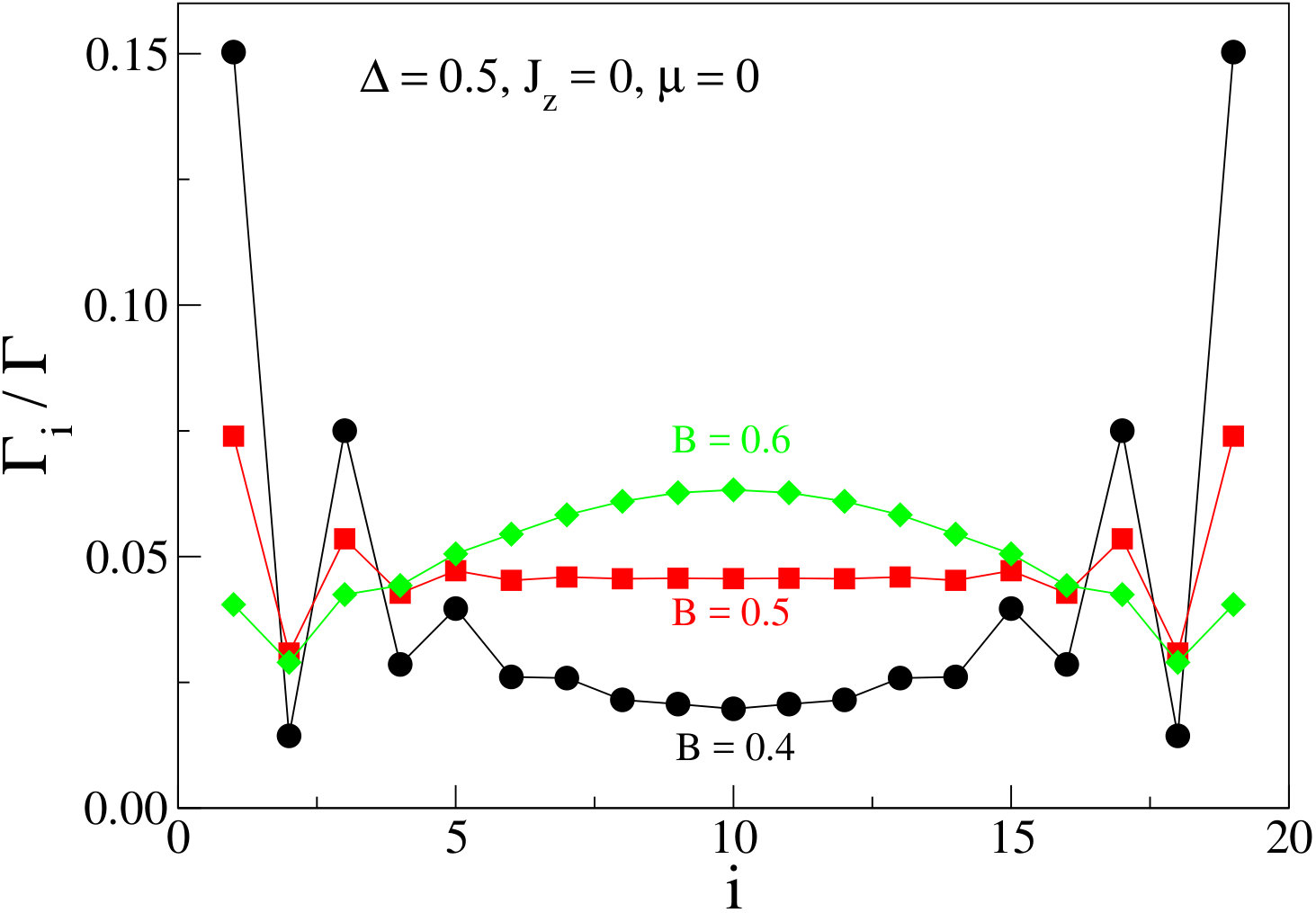 Figure 1
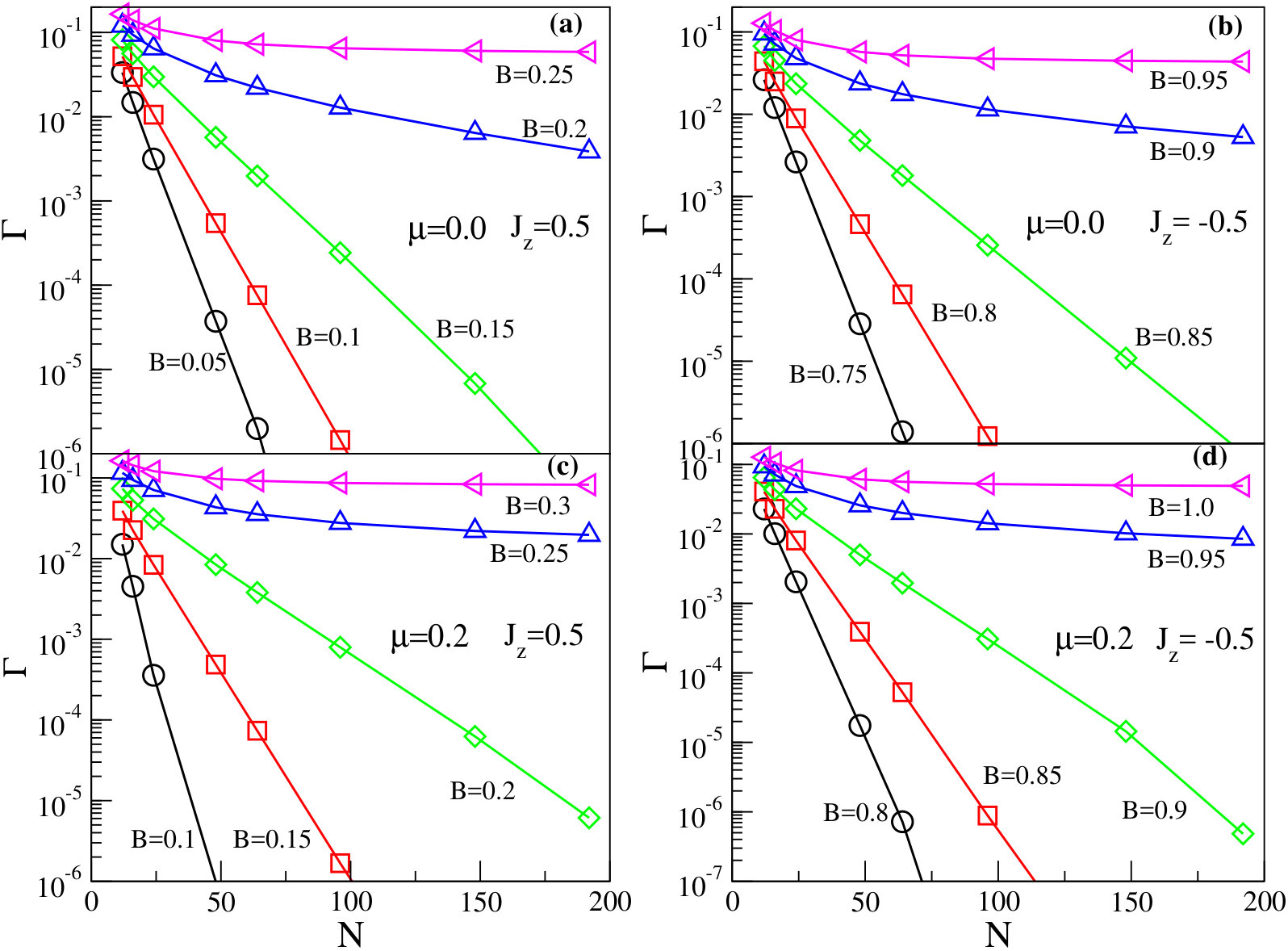 Figure 2
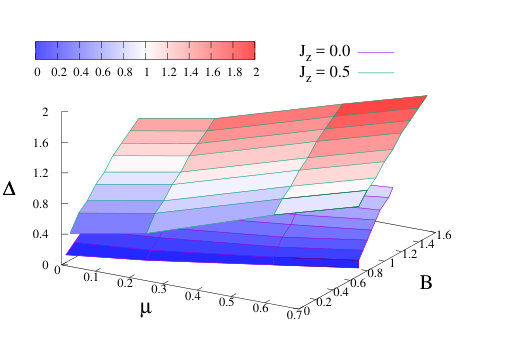 Figure 3
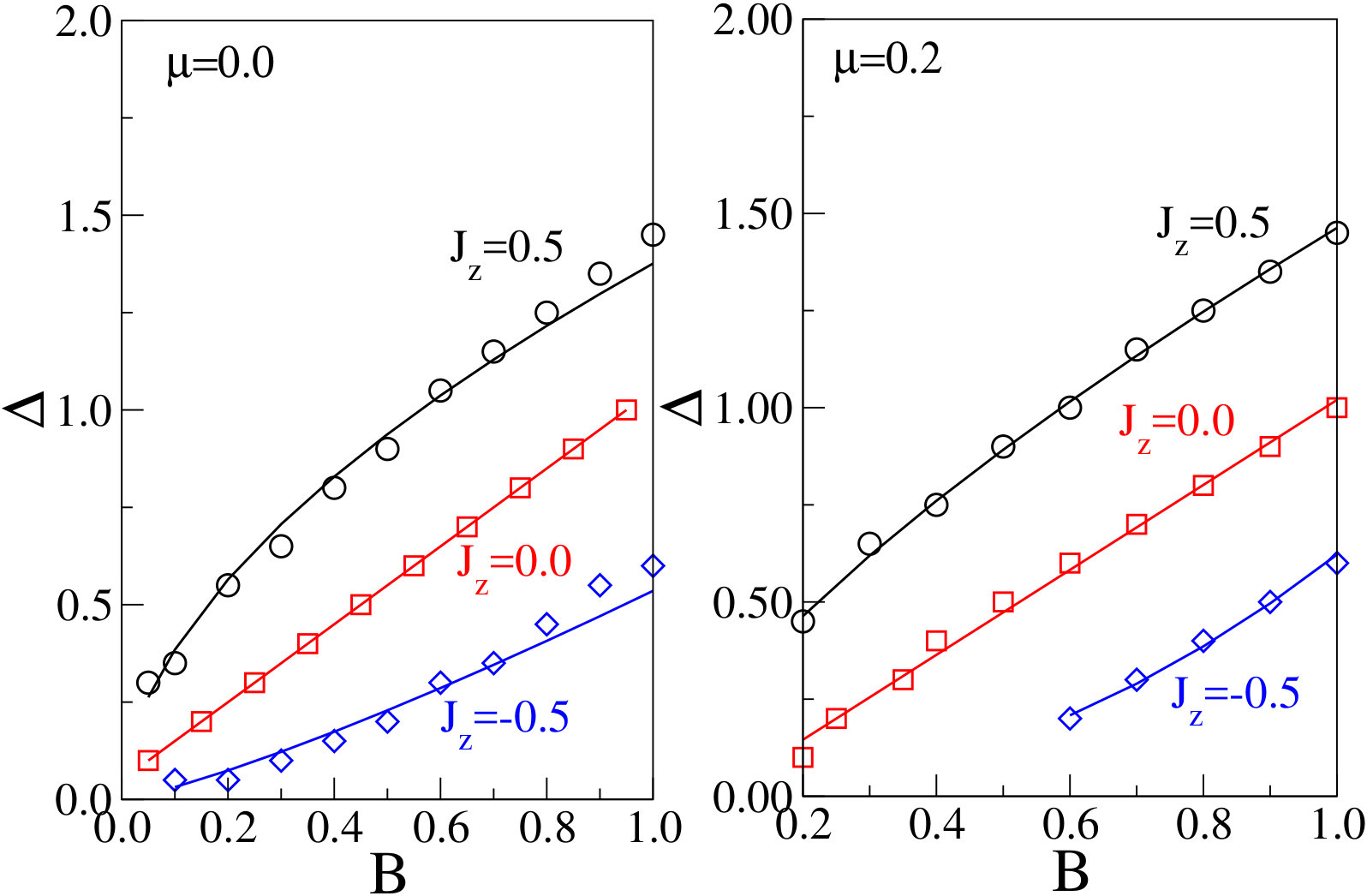 Figure 4
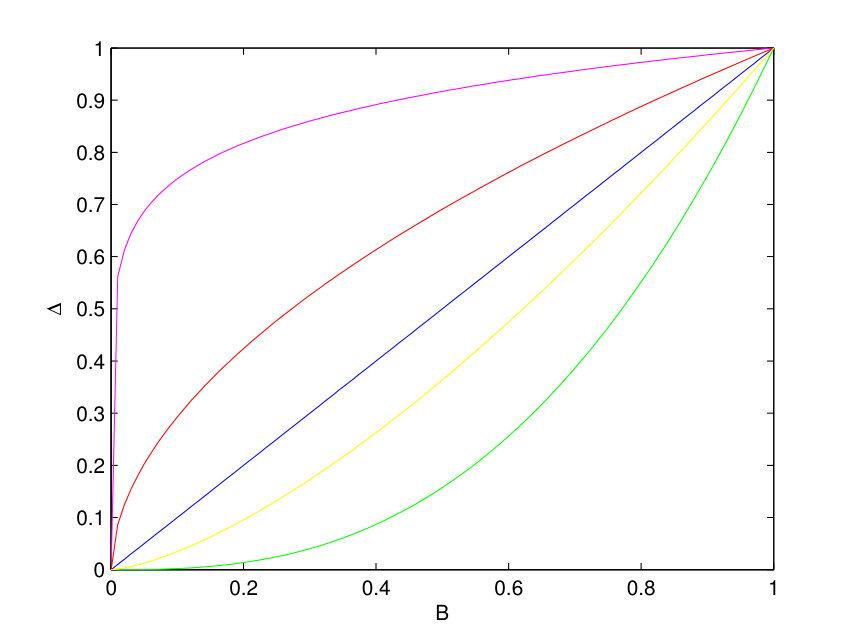 Figure 5
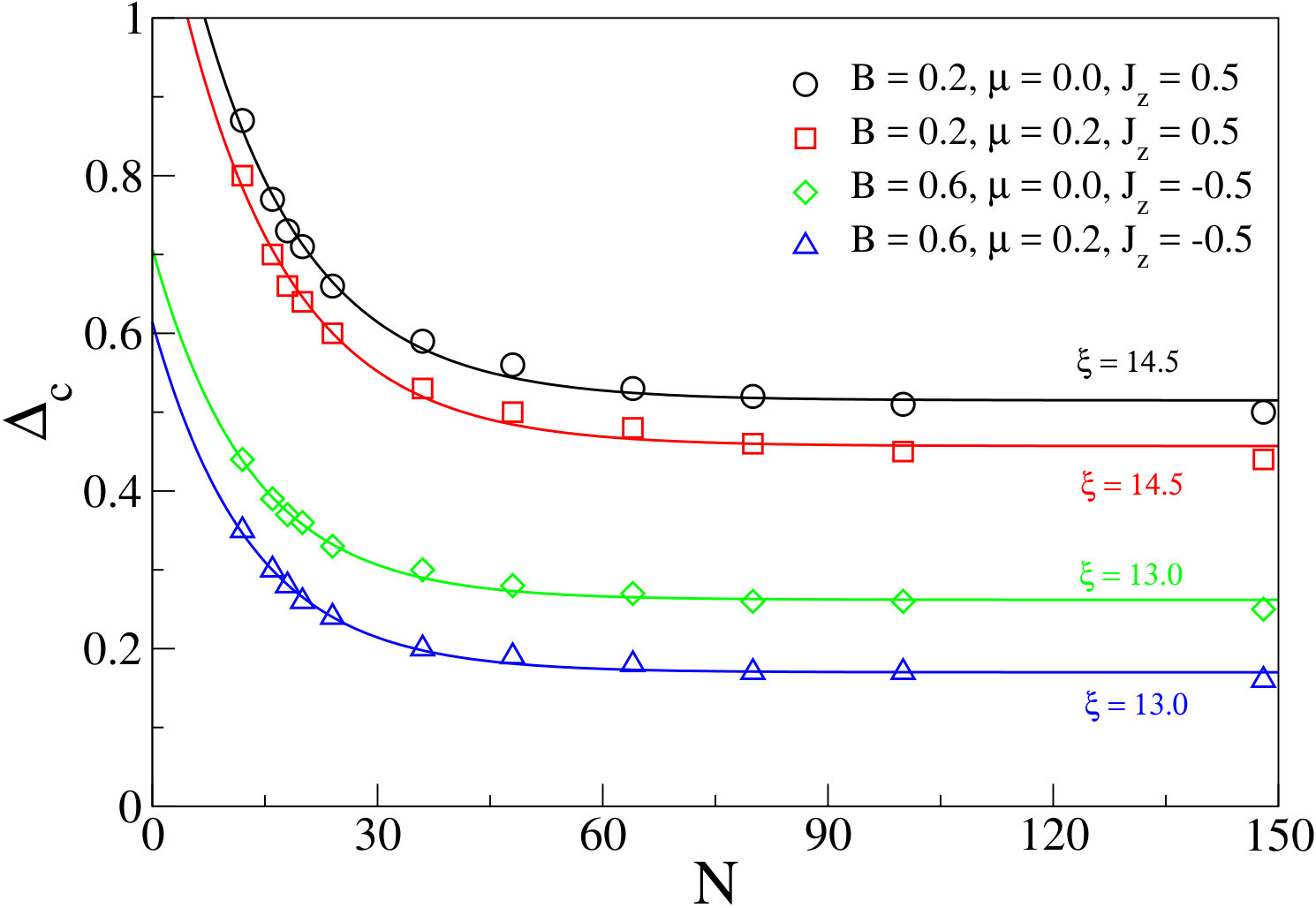 Figure 6
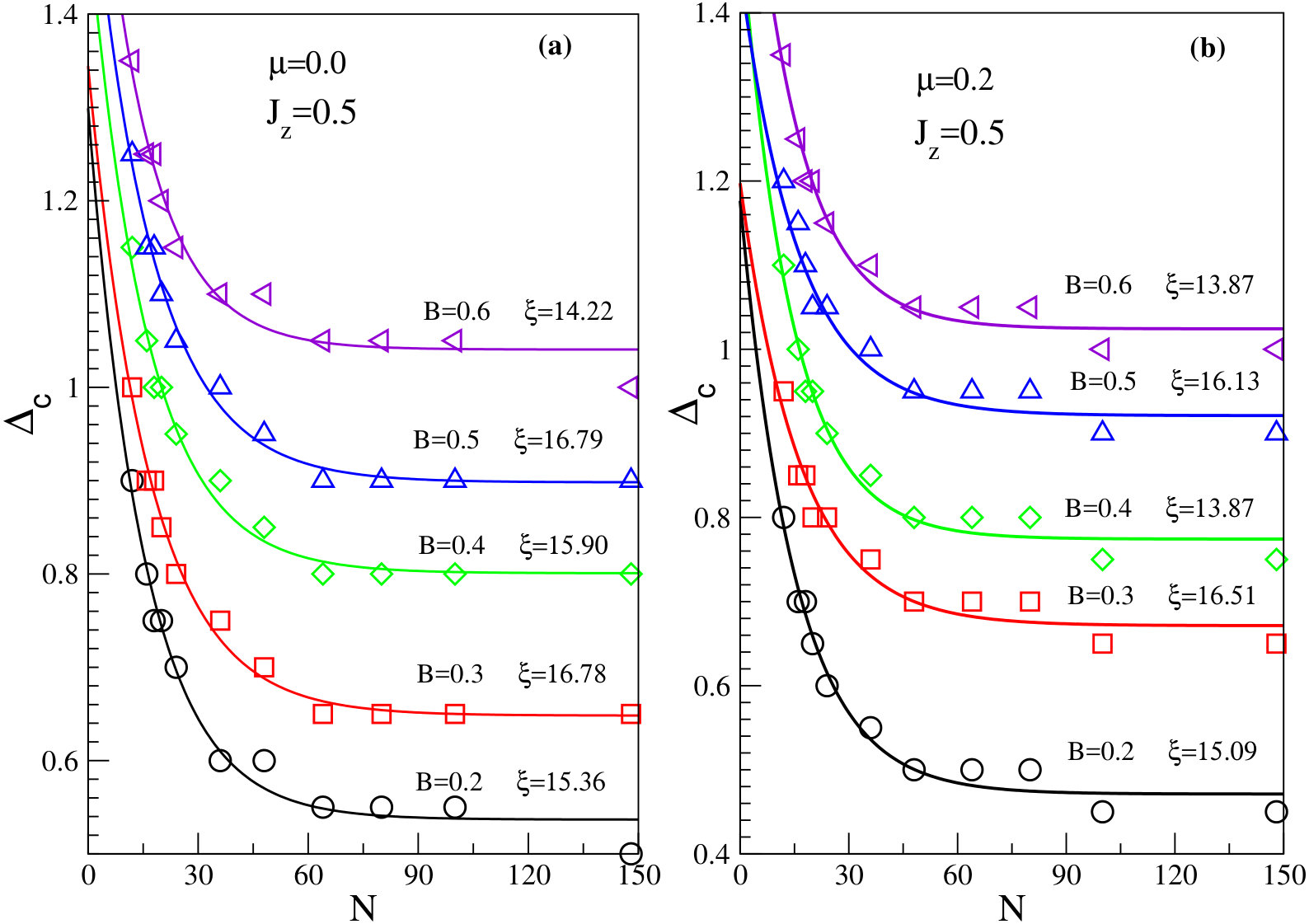 Figure 7
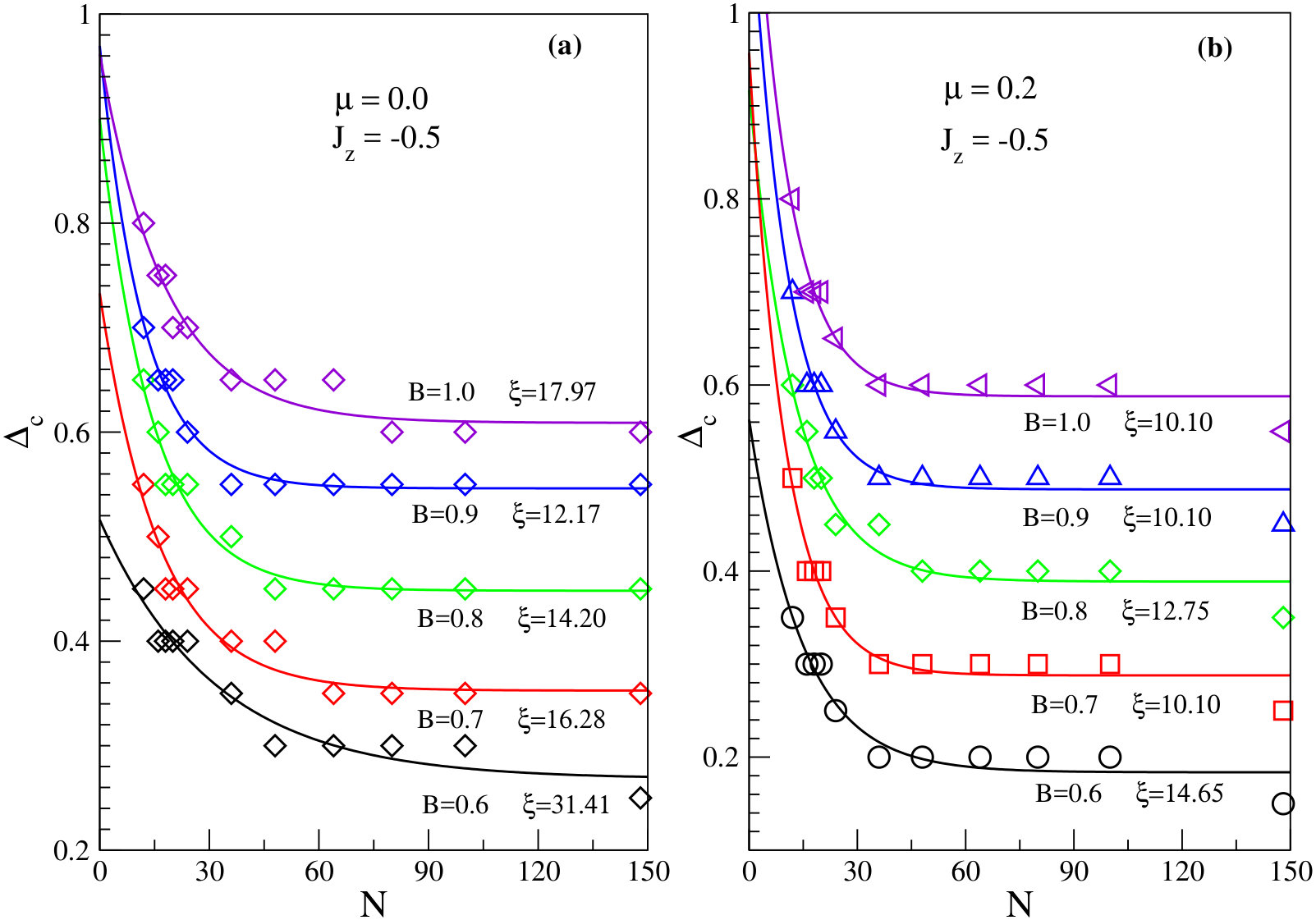 Figure 8
Peer Reviews
No public reviews on file for this paper yet. If you reviewed it on a platform where reviews are public (OpenReview, ICLR, NeurIPS, ICML), you can paste yours below so the community can read it here.
Videos
No videos yet. Explain this paper in a talk, walkthrough, or lecture? Add one.
A Study of Topological Quantum Phase Transition
and Majorana Localization Length for the Interacting Helical Liquid System
Dayasindhu Dey
S. N. Bose National Centre for Basic Sciences, Block - JD, Sector - III, Salt Lake, Kolkata - 700098, India
Sudip Kumar Saha
S. N. Bose National Centre for Basic Sciences, Block - JD, Sector - III, Salt Lake, Kolkata - 700098, India
P. Singha Deo
S. N. Bose National Centre for Basic Sciences, Block - JD, Sector - III, Salt Lake, Kolkata - 700098, India
Manoranjan Kumar
S. N. Bose National Centre for Basic Sciences, Block - JD, Sector - III, Salt Lake, Kolkata - 700098, India
Sujit Sarkar
Poornaprajna Institute of Scientific Research, 4 Sadashivanagar, Bangalore 5600 80, India
Abstract
We consider a helical spin liquid system which shows majorana fermion modes at the edge. The interaction between the quasiparticles in this system induces phase transition, Majorana-Ising transition. We comply the density matrix renormalization group method to study this phase transition for the entire regime of the parameter space. We observe the presence of topological quantum phase transition for repulsive interaction, however this phase is more stable for the attractive interaction. The length scale dependent study shows many new and important results and we show explicitly that the major contribution to the excitation comes from the edge of the system when the system is in the topological state. We also show the dependence of Majorana localization length for various values of chemical potential.
Topological Insulator, Helical Liquid, Topological Quantum Phase Transition
I Introduction
The physics of Majorana fermion is the subject of intense research in quantum many-body systems over a decade Wilczek (2009); Majorana (1937); Bernevig and Hughes (2013) which appears in the topologically ordered state. The presence of this particle is not only searched in neutrino physics, supersymmetry and dark matter, but it also appears as an emergent particle in condensed matter systems, such as one-dimensional superconductor Ivanov (2001); Kraus et al. (2009); Wimmer et al. (2010); Sato and Fujimoto (2016), semiconductor quantum wire Mourik et al. (2012); Deng et al. (2012); Rokhinson et al. (2012); Das et al. (2012); Finck et al. (2013); Jafari et al. (2017), proximity induced topological superconductor Kitaev (2001); Fu and Kane (2008, 2009); Alicea (2010, 2012); Sau et al. (2010a); Potter and Lee (2010); Stoudenmire et al. (2011); Fukui and Fujiwara (2010), the cold atom trapped in one-dimension Zhang et al. (2008); Jiang et al. (2011). The exotic physics of this topological state and its application in non-abelian quantum computation are few of the important features of the Majorana modes Nayak et al. (2008); Sau et al. (2010b); Alicea et al. (2011).
In this paper, we look for the Majorana fermion modes in a model Hamiltonian system which presents the physics of an interacting helical liquid. It generally originates in a quantum spin Hall system with or without Landau levels. In this system the counterpropagating fields with opposite spin orientations are confined to the edge. The spin and momentum degrees of freedom are coupled together in this phase. However, unlike chiral Luttinger liquid, the time reversal symmetry in this phase is preserved. The basic physical aspects of helical spin liquid are discussed in Refs. Sela et al. (2011); Sarkar (2016); Qi and Zhang (2010, 2011).
The existence of Majorana modes in proximity induced topological superconductor is modelled using a fermionic model Kitaev (2001); Fu and Kane (2008, 2009); Alicea (2010, 2012); Sau et al. (2010a); Potter and Lee (2010); Stoudenmire et al. (2011); Sela et al. (2011); Sarkar (2016); Qi and Zhang (2011). The field theoretical calculation by the authors of Refs. Sela et al. (2011); Sarkar (2016) shows that Majorana fermion modes in a helical liquid posses a higher degree of stability. Scattering processes between the two constituent fermion bands help the helical liquid to retain the properties by opening a gap in presence of the interaction. The strong interaction may induce decoherence in the Majorana modes Gangadharaiah et al. (2011); Stoudenmire et al. (2011); Sela et al. (2011); Sarkar (2016). However, the proximity gap generates the Majorana excitation Sela et al. (2011). The presence of Majorana modes and length dependence on various parameters are studied using renormalization group method by one of our co-author Sarkar (2016). However, there is no estimation of numerical values of phase boundary in previous work Sela et al. (2011); Sarkar (2016). Therefore, we use the density matrix renormalization group (DMRG) method to calculate accuratly the phase boundary of Majorana-Ising topological phase transition accurately.
II Brief description of the model Hamiltonian
For the completeness of the paper here we describe in brief the one-dimensional helical system in terms of the field operators. We also derive the Hamiltonian of the system in terms of the field operators. It is well known in literature that the low energy excitation in the one dimensional quantum many body system occurs in the region adjacent to the Fermi points. Therefore, one can write the fermionic field operator as Qi and Zhang (2010)
[TABLE]
where is the cut-off around the Fermi momentum (). We may consider the first term as a right mover () and the second term as a left mover (). One can write the fermionic field with spin as . For the low energy elementary excitations one can write the Hamiltonian as
[TABLE]
where and are the field operators for spin up right moving and spin down left moving electrons respectively. The terms within the parenthesis are the respective Kramer’s pairs. One of these Kramer’s pairs is in the upper edge and the other one is in the lower edge of the system. The total fermionic field of this system is, . This is the simple picture of a helical liquid, where the spin is determined by the direction of the particle. The non-interacting part of the helical liquid for a single edge in terms of spinor field is
[TABLE]
Now we introduce the model Hamiltonian of the present study. The model Hamiltonian describes a low-dimensional quantum many body system of topological insulator in the proximity of s-wave superconductor and an external magnetic field along the edge of this system. The additional terms in the Hamiltonian is
[TABLE]
where is the proximity induced superconducting gap and is the applied magnetic field along the edge of the sample. The Hamiltonian is time reversal invariant, however the Hamiltonian breaks the time reversal symmetry.
Now we consider the generic interaction which preserves time reversal symmetry. The authors of Ref. Sela et al. (2011); Sarkar (2016), have considered the two-particle forward and umklapp scattering. The forward scattering is described as
[TABLE]
We write the umklapp scattering term for the half filling in a point splitted form, following the Wu, Bernevig and Zhang Wu et al. (2006). The point splitted version can be described as a regularization of the theory. Therefore, the umklapp term becomes
[TABLE]
where is the lattice constant. This analytical expression gives a regularized theory using the lattice constant as an ultraviolet cut-off. We use the first order Taylor series expansion of the fermionic field
[TABLE]
Using this expansion in the umklapp scattering term we produce the analytical expression for umklapp in a conventional form of the authors of Ref. Wu et al. (2006).
[TABLE]
Therefore the total Hamiltonian of the system is
[TABLE]
Now we can write the above Hamiltonian as, Sela et al. (2011).
[TABLE]
where and and .
III Construction of Kitaev’s chain for this system
In this section we map the model Hamiltonian of the present problem to the Kitaev’s chain. Considering the limit , the Hamiltonian in Eq. 10 reduces to the transverse Ising model for and a rotation of alternate spins Sela et al. (2011). If we write the transverse Ising model Hamiltonian in terms of Pauli spin operators, the Hamiltonian reduces to
[TABLE]
We change the sign of the magnetic field without loss of generality. One can write the Hamiltonian in Eq. 11 in terms of spinless fermion operators after a Jordan-Wigner transformation. To do so, we use the relation: , . The Hamiltonian, , becomes,
[TABLE]
Here is the creation(annihilation) operator for spinless fermion at the site . After the Fourier transformation, the Hamiltonian, , reduces to,
[TABLE]
where is the creation (annihilation) operator of the spinless fermion of momentum . in Eq. 13 is written in terms of Kitaev’s chain as
[TABLE]
where is the hopping matrix element, is the chemical potential and is the magnitude of the superconducting gap. , and .
The authors of Ref. Greiter et al. (2014) also study the one dimensional Ising model and topological order in Kitaev’s chain. The authors study the and limit of Kitaev’s chain. They find the explicit eigenstate of the open chain in terms of fermion operators and also show that the states as well as the energy eigen values are equivalent to those of an Ising chain.
In the present study we obtain the model Hamiltonian in the form of a transverse Ising model for a certain regime of parameter space, and finally we map this model to the Kitaev’s chain. Therefore, the perspective of this study is different from the previous study of Ref.32.
The bulk properties of Hamiltonian can be studied in the momentum space. One can write down the Hamiltonian in momentum space as.
[TABLE]
{H(k)}=\left(\begin{array}[]{cc}{\epsilon}(k)&2{{\Delta}}^{*}(k)\\ 2{\Delta}(k)&-{\epsilon}(k)\end{array}\right) where, and . These Hamiltonians correspond to the p-wave superconducting phase, one can understand this in the following way. One can also write down the above Hamiltonian in Bogoliubov energy spectrum,
[TABLE]
Here is the energy spectrum in bulk and and are the Bogoliubov quasiparticles operators. It is well known in the literature that the Kitaev’s chain consists of topological properties. Here we discuss it very briefly following the Refs. Bernevig and Hughes (2013) and Kitaev (2001).
One can express the Dirac Hamiltonian of the system in terms Majorana fermion modes which are linear combination of fermionic operators.
and and the anticommutation relation between the Majorana fermion modes is . The non-topological phase of the Kitaev’s chain appears for the following limit.
(A). and ,
. For the present problem the above Hamiltonian becomes as
.
In this phase Majorana operators couple on each site and there is no intersite coupling.
(B). The topological phase and : The Kitaev’s chain reduces to
.
For the present problem the above Hamiltonian is reduced to
.
It is clear from this analytical relation that the intersite Majorana fermions are coupled in the lattice however, and are not coupled to the rest of the chain and they are unpaired. For this case, zero modes are localized at the ends of the chain.
In present numerical studies the topological quantum phase transitions are studied for all the regime of parameters. Before going to the numerical section, let us discuss the condition for appearance of Majorana fermion edge mode briefly: In a nanowire or at the edge of topological insulator where the helical spin liquid appears, the zero mode Majorana edge state appears as the particle-hole bound state at both ends of the wire or edge with localization length () Sarkar (2016); Gangadharaiah et al. (2011); Thakurathi et al. (2015). The overlap of the Majorana wave functions is proportional to , is the length of the system. The existence of the Majorana fermion zero mode can also be characterised by exponential decay of lowest excitation gap with system size. There are many numerical studies on the Kitaev or interacting Majorana chain, topological superconducting wire and others Gergs et al. (2016); Rahmani et al. (2015); Stoudenmire et al. (2011); Zhu et al. (2015); Ejima and Fehske (2015).
IV DMRG study based results for Majorana-Ising transition
and Majorana localization length
In this section, we numerically solve the Hamiltonian mentioned in Eq. 10 using the DMRG method. This method is a state of the art numerical technique for 1D system, and it is based on the systematic truncation of irrelevant degrees of freedom in the Hilbert space White (1992); *white-prb93. This numerical method is best suited to calculate accurate ground state (GS) and a few low lying energy excited states of strongly interacting quantum systems. For ladders and long range interaction systems the DMRG is further improved by modifying conventional DMRG method to solve chain with periodic boundary condition Dey et al. (2016a), zigzag chains Kumar et al. (2010), the Y-junction systems Kumar et al. (2016) and Bethe lattice Kumar et al. (2012) etc. The left and right block symmetry of DMRG algorithm for a XYZ model of a spin-1/2 chain in a staggered magnetic field (Eq. 10) is broken. Therefore, we use conventional unsymmetrized DMRG algorithm, where the left and right block are unequal in general. This model does not conserve the total , therefore superblock dimension is large. We keep eigenvectors corresponding to the highest eigenvalues of the density matrix to maintain excellent accuracy of eigenvalues and eigenvectors of the superblock. The truncation error of density matrix eigenvalues is less than . The energy convergence is better than after five finite DMRG sweeps. We carry out the DMRG calculation for various parameter regimes of the system up to with open boundary condition (OBC).
The DMRG method is used to get a better understanding of phase transition and accurate phase boundary of the Majorana-Ising topological quantum phase transition in various parameter regime. In this section we show the Majorana-Ising phase boundary in Fig. 1. And based on these boundaries we construct the 3D phase diagram in -- parameter space (in Fig. 2). We show the lowest excitation gap decays as a function of system size in Fig. 3. The Majorana edge mode survives at the edge of system if a system of size holds the condition where and are superconducting gap and velocity of collective modes of the system. If the localization length is defined as Alicea (2012); Sarkar (2016); Gangadharaiah et al. (2011); Thakurathi et al. (2015), then the condition is reduced to . We calculate as a function of to calculate as conserves exponentially and show that . At the end of this section we explain the origin of the excitation in different phases using a local excitation energy gap .
In Fig. 1, the left and right panel is for the and respectively. We consider for repulsive interaction, for attractive interaction, and for non-interacting limit. For , in Fig. 1, behaviour is almost same for two sets of chemical potentials, and the behaviour is linear similar to the Fig. 1 of Ref. Sarkar (2016). In the presence of repulsive interaction (), the phase boundary of this transition follows the power law variation with positive exponent less than one, but the phase transition line is shifted towards the higher values of for . For the attractive interaction (), the values of powers are higher than one, and it is consistent with the quantum field theoretical study. We notice that the power law exponent increases with . The explicit and chemical potential dependence are absent in Fig. 1 of Ref. Sarkar (2016). We note that the repulsive interaction shifts the phase boundary to the higher values of , but the attractive interaction shifts the phase boundary to the lower values of .
In Fig. 2, we present the three dimensional plot, which depicts the Majorana-Ising phase transition explicitly. The phase digram in terms of , and is not possible from the study of anomalous scaling of dimensional analysis of Ref. Sarkar (2016). In this figure, we use a wider range of , and . We observe the sharp difference of phase boundary between the Majorana and the Ising phase for both interacting and non-interacting case.
Fig. 3 consists of four panels (a,b,c,d), the first two panels (a and b) are for and the other two (c and d) are for the respectively. Here we present the results for the lowest excitation gap in different phases. At first, we present the results for for both repulsive (, panel a) and attractive (, panel b) interaction for different values of B. In this study, we present as a function of the system size and also show that if the is the Majorana mode excitation, it decays exponentially with system size , it follows power law otherwise. The exponential decay of the lowest excitation gap is very similar to the existence of edge states in spin-1 Heisenberg antiferromagnetic chains Haldane (1983); *dd2016b. It reveals from our study that for attractive interactions the system shows the existence of Majorana fermion mode for the larger values of () for the larger length scale, but in the presence of the repulsive interaction the elementary excitation gap becomes finite for small values of external magnetic field (). We present the results for finite in the lower panels. In panel c and d results are shown for the repulsive interaction and the attractive interaction . We note that for finite the excitations gap shows the gapless excitations for higher values of compared to the case whether is positive or negative. In the above parameter regime, perturbative RG methods can not be applied and it is extremely difficult to calculate the excitation gap with this analytical method.
In Fig. 4, the variation of the critical values of the superconducting proximity () with the system size () is shown for two chemical potentials () with for and for . For all the cases decays exponentially with to a constant value . The values of depend on the set of the parameters considered. We fit the calculated with the equation where is the localization length for the Majorana mode for a given parameter. The average value of is approximately which is much smaller than the system size . As mentioned in the second paragraph of this section, the condition for existence of Majorana mode is . The results for few representative values of , and are shown in Fig. 4. depends on the parameters and for a fixed value of . For a typical value of and the behaviour of curve is similar. However, varies linearly with .
To show the existence of Majorana modes more explicitly we calculate the contribution of local bond and site energy to the lowest excitation energy gap . The local excitation energy gap is the difference between in the GS and the lowest excited state:
[TABLE]
where is defined in Eq. 10, and and are the GS and the first excited state, and and are the local energies in the GS and the first excited state respectively. We normalize this local excitation gap by the total energy gap such that the sum of the ratios is unity. In Fig. 5, is shown where, the case is considered. Three parameter regimes near the phase boundary are shown in Fig. 5 for and = 0.6, 0.5 and 0.4. It is clear from the curves that the contribution to the excitations comes mainly from the edge of the chain in the Majorana phase. Whereas, in Ising limit excitation energy contribution comes mainly from the bulk. The critical point shows the intermediate behaviour.
V Conclusion
We have studied the Majorana-Ising quantum phase transition of helical spin liquid system using the DMRG method. We have calculated the Majorana localization length in various parameter regimes. The exponential decay of the gap with N has been shown. We have also showed that the major contribution to the lowest excitation gap in the topological state is from the edge, whereas it comes from the bulk in the Ising phase.
Acknowledgements.
SS thanks the DST (SERB, SR/S2/LOP-07/2012) fund and also the library of RRI for extensive support. MK thanks DST for a Ramanujan Fellowship SR/S2/RJN-69/2012 and funding computation facility through SNB/MK/14-15/137.
The reference list from the paper itself. Each links out to its DOI / PubMed record.
- 1Wilczek (2009) F. Wilczek, Nat. Phys. 5 , 614 (2009) . · doi ↗
- 2Majorana (1937) E. Majorana, Nuovo Cimento 14 , 171 (1937) . · doi ↗
- 3Bernevig and Hughes (2013) B. A. Bernevig and T. L. Hughes, Topological Insulators and Topological Superconductors (Princeton University Press, Princeton, 2013).
- 4Ivanov (2001) D. A. Ivanov, Phys. Rev. Lett. 86 , 268 (2001) . · doi ↗
- 5Kraus et al. (2009) Y. E. Kraus, A. Auerbach, H. A. Fertig, and S. H. Simon, Phys. Rev. B 79 , 134515 (2009) . · doi ↗
- 6Wimmer et al. (2010) M. Wimmer, A. R. Akhmerov, M. V. Medvedyeva, J. Tworzydło, and C. W. J. Beenakker, Phys. Rev. Lett. 105 , 046803 (2010) . · doi ↗
- 7Sato and Fujimoto (2016) M. Sato and S. Fujimoto, J. Phys. Soc. Jpn. 85 , 072001 (2016) . · doi ↗
- 8Mourik et al. (2012) V. Mourik, K. Zuo, S. M. Frolov, S. R. Plissard, E. P. A. M. Bakkers, and L. P. Kouwenhoven, Science 336 , 1003 (2012) . · doi ↗