Pencilled regular parallelisms
Hans Havlicek, Rolf Riesinger

TL;DR
This paper characterizes pencilled hyperflock determining line sets in projective spaces over any field, providing a construction method, classification, and algebraic conditions for their existence, and relating them to regular parallelisms.
Contribution
It introduces a construction and classification of pencilled hfd line sets, linking them to regular parallelisms and providing algebraic existence conditions.
Findings
All pencilled hfd line sets are determined by the presented construction.
Regular parallelisms correspond to pencilled hfd line sets.
Necessary and sufficient algebraic conditions for existence are established.
Abstract
Over any field , there is a bijection between regular spreads of the projective space and -secant lines of the Klein quadric in . Under this bijection, regular parallelisms of correspond to hyperflock determining line sets (hfd line sets) with respect to the Klein quadric. An hfd line set is defined to be \emph{pencilled} if it is composed of pencils of lines. We present a construction of pencilled hfd line sets, which is then shown to determine all such sets. Based on these results, we describe the corresponding regular parallelisms. These are also termed as being \emph{pencilled}. Any Clifford parallelism is regular and pencilled. From this, we derive necessary and sufficient algebraic conditions for the existence of pencilled hfd line sets.
Click any figure to enlarge with its caption.
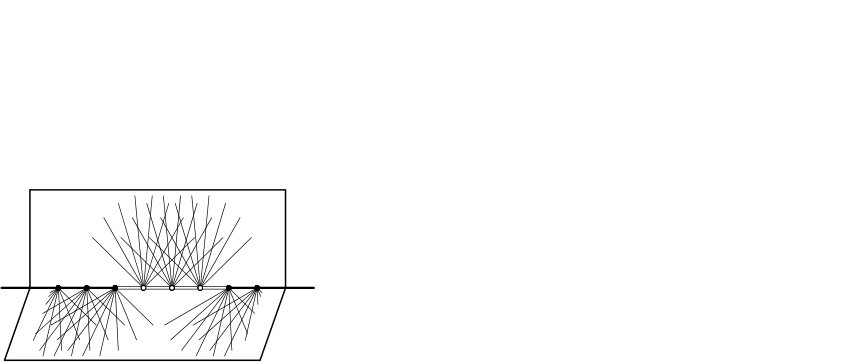 Figure 1
Peer Reviews
No public reviews on file for this paper yet. If you reviewed it on a platform where reviews are public (OpenReview, ICLR, NeurIPS, ICML), you can paste yours below so the community can read it here.
Videos
No videos yet. Explain this paper in a talk, walkthrough, or lecture? Add one.
Taxonomy
Topicsgraph theory and CDMA systems · Finite Group Theory Research · Coding theory and cryptography
Pencilled regular parallelisms
Hans Havlicek and Rolf Riesinger
(In memoriam Walter Benz)
Abstract
Over any field , there is a bijection between regular spreads of the projective space and [math]-secant lines of the Klein quadric in . Under this bijection, regular parallelisms of correspond to hyperflock determining line sets (hfd line sets) with respect to the Klein quadric. An hfd line set is defined to be pencilled if it is composed of pencils of lines. We present a construction of pencilled hfd line sets, which is then shown to determine all such sets. Based on these results, we describe the corresponding regular parallelisms. These are also termed as being pencilled. Any Clifford parallelism is regular and pencilled. From this, we derive necessary and sufficient algebraic conditions for the existence of pencilled hfd line sets.
Mathematics Subject Classification: 51A15 51M30
Keywords: pencilled regular parallelism; hyperflock determining line set; Clifford parallelism; linear flock
1 Introduction
The topic of our research is parallelisms in a three-dimensional projective space , which we interpret as a point-line geometry with point set and line set ; the ground field is arbitrary. Recall that a spread is a partition of by (disjoint) lines, whereas parallelism is a partition of by (disjoint) spreads. A spread is also called a parallel class of . Parallelisms are known as packings, when is a finite field. For further information about parallelisms we refer to [17], [19], [21], and the exhaustive monograph [20], the last being an indispensable source.
It seems that there is little to say about parallelisms in general. So, in order to obtain “interesting” results about parallelisms, it is common to impose extra constraints, e.g. by specifying the ground field or by adding topological conditions. Recent contributions in this spirit are [2], [3], and [27]; see also the references at the end of Section 2. In the present article we are concerned with regular parallelisms, that is, parallelisms that are made from regular spreads. We follow the terminology from [20, Ch. 26], that is, we drop the adverb “totally” appearing in [6] and several other articles. In Section 2 we recall a bijection between regular parallelisms in and hyperflock determining line sets (hfd line sets for short) in ; the latter projective space is always understood as the ambient space of the Klein quadric representing the lines of . We make use of this bijection and confine ourselves to regular parallelisms whose corresponding hfd line set is composed of pencils of lines. Regular parallelisms and hfd line sets of this kind are said to be pencilled; see Definition 2.1. Examples of pencilled regular parallelisms (with being the field of real numbers) can be found in [6], even though the term “pencilled” does not appear there. One of our aims is to unify these findings by creating a common basis. Another aim is to develop the theory from its very beginning over an arbitrary ground field rather than over the real numbers only.
The article is organised as follows. We describe the necessary background and definitions in Section 2. Next, in Section 3, we state the main results about pencilled hfd line sets and their corresponding pencilled regular parallelisms. In order to get started, we establish a construction of pencilled hfd line sets in Theorem 3.1. Then we present an explicit description of all hfd line sets in the Main Theorem 3.4. Theorem 3.8 provides necessary and sufficient algebraic conditions in terms of for the existence of pencilled regular parallelisms in . Also some examples are given and a link with the classical Clifford parallelism is established. All proofs and several auxiliary lemmas are postponed to Section 4, which should be read in consecutive order. The final sections 5 and 6 are devoted to the description of pencilled regular parallelisms and to phenomena that arise only in case of characteristic two.
2 Preliminaries
Throughout this paper we stick as close as possible to the notions and the terminology in [8], even though we work over an arbitrary ground field rather than over . By we denote Klein’s correspondence of line geometry, whose image is the Klein quadric in . There is a widespread literature on this topic. See [4, Sect. 2], [16, Sect. 2] or [22, 2.1] for a short introduction and [9, Sect. 11.4], [17, Sect. 15.4], [25, Ch. 34] and [26, Ch. xv] for detailed expositions.
The polarity of associated with is denoted by . A subquadric of the Klein quadric is the section of by an -dimensional subspace of , ; such a subquadric will usually be denoted by some capital letter with lower index . We are mainly concerned with three kinds of subquadric. If , then is a tangent hyperplane, which gives rise to the subquadric . This subquadric is a quadratic cone with vertex and with projective index . If , then is a regular quadric with projective index . Over the real numbers is known to be a model for Lie circle geometry, whence it is commonly referred to as the Lie quadric [1, p. 155], [12, p. 15]. We maintain this name in the general case, even though there need not be any relationship to circle geometry. Consequently, will be called a Lie subquadric of . On the other hand, the points and lines of constitute one of the classical generalised quadrangles over any field [28, p. 57]. If is a solid such that is a regular quadric with projective index [math], then is said to be elliptic. Planes having empty intersection with play also an essential role. Such planes are called zero planes (e.g. in [6]) or external planes to the Klein quadric (e.g. in [16]). We adopt the second terminology.
The regular spreads in correspond under precisely to the elliptic subquadrics of . As a consequence, the -image of a regular parallelism is a hyperflock of the Klein quadric , that is, a partition of by (disjoint) elliptic subquadrics [6]. It has proved advantageous to replace such a hyperflock by an equivalent object, namely a certain set of lines in the ambient space of the Klein quadric [6], [17, p. 69]. This approach is based on the following bijection from the set of all regular spreads of onto the set of all [math]-secants (i.e. external lines) of :
[TABLE]
The following results from [6], where , are easily seen to hold over an arbitrary ground field. By [6, Thm. 1.3], the -image of a regular parallelism of is a hyperflock determining line set (hfd line set), that is, a set of [math]-secants of the Klein quadric such that each tangent hyperplane of contains exactly one line of ; cf. [6, Def. 1.2]. Conversely, each hfd line set represents a regular parallelism, and thus the construction of regular parallelisms of is equivalent to the construction of hfd line sets in [6, Thm. 1.3]; see also [23].
An hfd line set allows us to read off and define properties of the corresponding regular parallelism , for instance its dimension is simply the dimension of the subspace of spanned by the union of all lines in .
Given a point and an incident plane in , , we write for the pencil of lines with vertex and carrier plane . The crucial notion of the present article is as follows:
Definition 2.1**.**
An hfd line set is said to be pencilled if is composed of line pencils, in other words, if each element of belongs to at least one pencil of lines in . A regular parallelism of is called pencilled if the hfd line set is pencilled.
The reader will easily check that the parallelisms constructed in [6] are pencilled; using [6, Rem. 2.9] one shows that also the parallelisms from [4] are pencilled. We observe that over pencilled regular parallelisms of dimension , , , and are known. On the other hand, there exist also regular parallelisms that are not pencilled [5, Ex. 16 and 22]. We shall establish in Proposition 3.6 that the Clifford parallelism is a pencilled regular parallelism. To this end we need some facts about Clifford parallelism, which we briefly summarise below.
The following is taken from [21, § 14]: Let be a field and let be a -algebra such that one of the subsequent conditions, (A) or (B), is satisfied:
[TABLE]
We now take as the underlying vector space of the projective space . Every element determines the left translation . All left translations constitute a group, which acts on the line set in a natural way. The orbits of this group action on are defined to be the classes of left parallel lines. In this way a first parallelism is obtained. Right parallel lines are defined via right translations and give rise to a second parallelism. These two parallelisms turn into a projective double space; they coincide precisely when (B) applies. Note also that (B) implies that the characteristic of is two and that is a purely inseparable extension of .
More generally, a parallelism of an arbitrary projective space is said to be Clifford if the underlying vector space of can be made into a -algebra , subject to (A) or (B), in such a way that coincides with the left or right parallelism arising from [16, Def. 3.4]. We refer to [7], [10], [11], [13], [15], [16], [19, pp. 112–115], [21, § 14] and [24] for surveys, recent results, and a wealth of references on Clifford parallelism.
3 Main results and examples
First, we present a construction of pencilled hfd line sets. We thereby generalise and unify Theorems 5.1, 5.5, and 5.6 in [6]. These theorems are more explicit than our result, but tailored to real projective spaces; see also [8, Rem. 8.1].
Theorem 3.1** (Construction of pencilled hfd line sets).**
In , let be a line such that
[TABLE]
is non-empty. Then, upon choosing any mapping , the union
[TABLE]
is a pencilled hfd line set.
In ) there is always a line such that ; see [6, Sect. 5]. Over an arbitrary field this need not be the case. We shall return to this matter after Theorem 3.8. So, for the time being, it remains open whether or not there exists a line in such that .
Example 3.2**.**
If the mapping in Theorem 3.1 is constant, then the image of contains a single plane, say . Consequently, is the plane of lines in and is just one of the lines in . Therefore the set contains also pencils other than those appearing in (4). Indeed, any point of is the vertex of a unique pencil in . The dimension of is two.
Example 3.3**.**
Let the image of the mapping in Theorem 3.1 consist of two distinct planes only. In a certain way this is the simplest case apart from Example 3.2. The mapping decomposes the line into two non-empty subsets and , namely the pre-images of and , respectively. By (4), the corresponding hfd line set can be written in the form
[TABLE]
The dimension of is three.
The set may comprise a single point, or any finite number of distinct points etc. Over the real numbers, can be chosen in such a way that is a connected component of with respect to the standard topology in . Then is also connected; such a set is illustrated in Figure 1.
Further extensions and generalisations of the preceding examples are obvious. The main result is a geometric description of all pencilled hfd line sets.
Theorem 3.4** **(Main theorem on pencilled hfd line sets).
In , let be a pencilled hfd line set. Denote by the set of all vertices and by the set of all planes of the pencils in . Then the following hold.
- (i)
All planes of are external to the Klein quadric . 2. (ii)
There exists a surjective mapping that assigns to each a plane that is incident with and such that
[TABLE] 3. (iii)
If is a set of non-collinear points, then is a plane, , and is the set of lines in the plane . 4. (iv)
If is a set of collinear points, then is a line, , and . 5. (v)
.
The mapping allows us to write
[TABLE]
Remark 3.5**.**
From Theorem 3.4 (ii), the construction in Theorem 3.1 produces all pencilled hfd line sets. Indeed, in order to get an appropriate mapping as in Theorem 3.1 for a given pencilled hfd line set , it suffices to select some line and to define . Clearly, Example 3.2 corresponds to the situation in Theorem 3.4 (iii) and vice versa. On the other hand, Example 3.3, where , is a very particular case of the more general setting in Theorem 3.4 (iv).
So far we have focussed on pencilled hfd line sets in . We now use the inverse of the bijection from (1) in order to obtain results about the corresponding pencilled regular parallelisms in . (See Section 5 for additional details.) Also, to develop further our theory, we shall make use of results about Clifford parallelism. The following characterisation generalises [6, Lemma 2.7], which is limited to the case , to an arbitrary ground field.
Proposition 3.6**.**
A parallelism of is Clifford if, and only if, is a pencilled regular parallelism and its corresponding hfd line set is a plane of lines in .
We add in passing that our proof of the proposition above uses [16, Thm. 4.8], which in turn is based upon a series of other results about Clifford parallelism. It would be favourable to have a shorter, more direct proof for the fact that being a plane of lines forces to be Clifford. The point is, of course, to construct from a -algebra that makes it possible to verify that is Clifford.
Remark 3.7**.**
The pencilled hfd line sets from Example 3.2 (based on constant mappings ) are precisely the ones that correspond under to the Clifford parallelisms of . This is immediate from Remark 3.5 and Proposition 3.6.
On the other hand, the pencilled regular parallelism arising from (5) is not Clifford by Proposition 3.6; one might call a piecewise Clifford parallelism (with two pieces).
By the above considerations and in view of the results from [6], Clifford parallelism is just a very particular case within our general theory. Nevertheless, Clifford parallelism is a relevant part of our investigation, because it is used below to establish an algebraic criterion for the existence of arbitrary pencilled regular parallelisms.
Theorem 3.8**.**
Given any field the following assertions are equivalent.
- (i)
In there exists a pencilled regular parallelism that is not Clifford. 2. (ii)
In there exists a Clifford parallelism. 3. (iii)
There exists an algebra over the field such that one of the conditions, (A) or (B), in equation (2) is satisfied.
Remark 3.9**.**
Theorem 3.8 shows, as a by-product, that pencilled regular parallelisms (pencilled hfd line sets) do not exist when is quadratically closed or finite, since such a does not satisfy Theorem 3.8 (iii). However, this can be seen directly: If is quadratically closed, then there are no [math]-secants of . If is finite, then [math]-secants of do exist, but external planes to the Klein quadric do not; see the proof of Lemma 4.9. Thus in both cases there cannot be pencilled hfd line sets.
We read off from Proposition 3.6 that Theorem 3.8 (i) holds if, and only if, there is a line in such that . So, again using Theorem 3.8, the construction of a pencilled hfd line set in Example 3.3 can be carried out, precisely when the algebraic condition in Theorem 3.8 (iii) is satisfied by . We therefore have shown that under this condition there exist, in , pencilled regular parallelisms with dimension and with dimension . However, we did not undertake a study of the cases with . According to [6], pencilled regular parallelisms of the latter dimensions exist over the real numbers; future work should address these cases in the setting of Theorem 3.8 (iii).
4 Proofs
We start with three auxiliary lemmas.
Lemma 4.1**.**
Let be a subspace of . There exists a tangent hyperplane of the Klein quadric with if, and only if, there exists a subspace of satisfying
[TABLE]
Proof.
As we noted in Section 2, a tangent hyperplane of the Klein quadric meets along a quadratic cone with projective index . Any other hyperplane of intersects in a Lie subquadric, which has projective index . So, a hyperplane of is tangent to the Klein quadric precisely when contains a plane that lies on .
If is contained in a tangent hyperplane , then there is a plane . The subspace clearly satisfies the first condition from (8) and also the second one, since gives
[TABLE]
Conversely, if there is a subspace subject to (8), then there is a plane of , say , that contains . So, since , we obtain
[TABLE]
This implies that is contained in a hyperplane of , which is tangent to by the above-noted characterisation. ∎
Corollary 4.2**.**
In , any subspace with is contained in at least one tangent hyperplane of the Klein quadric .
Lemma 4.3**.**
In , if a plane is external to the Klein quadric , then so is the polar plane .
Proof.
The plane contains no point of . Hence, by Lemma 4.1, there is no tangent hyperplane of containing . Application of gives that there is no point of incident with . ∎
Lemma 4.4**.**
In , let be a point incident with a line . Then there exists with and .
Proof.
From and it follows that . Now is a Lie subquadric of and therefore . This shows the existence of a point that is not incident with the solid . Applying shows that has the required properties. ∎
We proceed with our first proof.
Proof of Theorem 3.1.
Since all planes of are external to , all lines of are [math]-secants of . There is a point , say. We read off from (3) that , whence (4) shows . This gives
[TABLE]
Next, choose any tangent hyperplane of , say . From Lemma 4.1, no plane of is contained in , that is,
[TABLE]
If , then by (10), for all . Using (9), we now see that is the only line of that is incident with .
If , then is a point, say . From (3), for all there is a unique line of passing through , namely the line , which also is an element of . Therefore, (4) gives
[TABLE]
From (10), is a line incident with . More precisely, is the only line of the pencil lying in . According to (11), all lines of contain some point of other than ; therefore none of these lines is contained in . Hence is the only line of being incident with .
To sum up, we have shown that is an hfd line set that, by its definition, is pencilled. ∎
In the next four lemmas we adopt the assumptions and notations from Theorem 3.4: is a pencilled hfd line set, is the set of all vertices, and is the set of all planes of the pencils in .
Lemma 4.5**.**
The following hold: (i) ; (ii) .
Proof.
and are immediate from the definition of a pencilled hfd line set and the fact that tangent hyperplanes of do exist. Next, assume to the contrary that . So, from , we obtain . This implies that all lines of share a common point , say. Since is an hfd line set, the point belongs to all tangent hyperplanes of , an absurdity. ∎
Lemma 4.6**.**
If are distinct coplanar lines, then the plane is external to the Klein quadric .
Proof.
From the definition of an hfd line set, we deduce that there exists no tangent hyperplane of with . Now we apply Lemma 4.1 to and obtain that is the only subspace of being contained in . Therefore . ∎
Lemma 4.7**.**
Let be a pencil. Then
[TABLE]
Proof.
Assume, by way of contradiction, that there exists a line satisfying and . Then is an external plane to for all according to Lemma 4.6. This implies that , which has dimension , contains no point of . On the other hand, by Corollary 4.2, there is a point such that the tangent hyperplane contains the line . This means , an absurdity. ∎
Lemma 4.8**.**
Let and be distinct pencils of lines that belong to . Then the following hold: (i) ; (ii) ; (iii) .
Proof.
(i) would imply , which would contradict Lemma 4.7.
(ii) and (iii). By Corollary 4.2, there is a tangent hyperplane of such that . Since is an hfd line set, this cannot contain any of the planes , . Therefore each of the intersections is a line, which clearly passes through and hence belongs to . Since is incident with a unique line of , we finally obtain . ∎
We are now in a position to prove the Main Theorem 3.4.
Proof of Theorem 3.4.
(i) Given any plane there is a point with . As all lines of the pencil are external to the Klein quadric, so is the plane .
(ii) Taking into account Lemma 4.8, we define a mapping as follows: For each there is a unique plane with , and so we let . Lemma 4.7 shows that satisfies (6). By the definition of , the mapping is surjective.
(iii) There exist non-collinear vertices spanning a plane, say . By (ii), there are well defined planes . For all with both lines and are incident with the plane according to (6), hence
[TABLE]
Let be an arbitrary line of . As is pencilled, so there exists a pencil with . Without loss of generality, we may assume that form a triangle. Using (6), we deduce as above: . Therefore and by (12), . Consequently, is contained in the plane of lines in .
Conversely, let be a line of . By Corollary 4.2, there is a tangent hyperplane of containing . From (12) and (i), the plane is external to . Now Lemma 4.1 shows that . This means that . Since all lines of are incident with the plane and is incident with one of these, we obtain .
Summing up, is the set of lines in the plane , whence and .
(iv) By Lemma 4.5 (ii), there are distinct points , whence is the only line containing . Let be an arbitrary point. Lemma 4.8 (iii) shows , and so . Lemma 4.4 implies that there exists a tangent hyperplane of with and ; hence . By the properties of an hfd line set, there exists a line of in and, consequently, some vertex lies in . Since , we obtain , that is, .
Now we establish that
[TABLE]
From (ii), the mapping is surjective. So, given any plane there is a point with . By the foregoing, we have . Thus follows from Lemma 4.7. There is a plane according to Lemma 4.5 (i). We cannot have , since then, by (ii), we would obtain
[TABLE]
that is, would comprise all lines in , which in turn would imply that , a contradiction to the collinearity of . So, there are distinct planes . Hence , which verifies (13) and implies .
(v) If is collinear, then (13) applies, otherwise the assertion is obvious from (iii). ∎
Proof of Proposition 3.6.
Let be a pencilled regular parallelism of such that is a plane of lines; we denote this plane by . From Lemma 4.3, applied to , we obtain that is also external to . Furthermore, by the action of on the lattice of subspaces of , we obtain
[TABLE]
This description of in terms of the Klein correspondence coincides with the definition of a parallelism in [16, Def. 4.2], which relies on the choice of an external plane to ; in our context this distinguished external plane is . Finally, by [16, Thm. 4.8], the parallelism is Clifford.
Conversely, let be Clifford. From [16, Thm. 5.1] there is an external plane to such that, in our present notation, (14) holds with to be replaced by . By the last observation, all parallel classes of are regular spreads, that is, is regular. From (1), the polarity sends the set of solids of that contain to the hfd line set , which therefore is the set of lines in the plane . ∎
The following lemma will be used in order to accomplish the proof of Theorem 3.8.
Lemma 4.9**.**
In , let be an external plane to the Klein quadric . Then there exists a plane that is external to and such that is a line.
Proof.
There is a -secant (tangent) of . This is not contained in any external plane to . By Lemma 4.3, the plane is also external to . So,
[TABLE]
The existence of an external plane to is guaranteed by and forces to be an infinite field; cf. the classification quadrics in , finite, [18, p. 2]. Therefore and by (15), there is a point that is off the set . This is the centre of a perspectivity of order two that stabilises ; the axis of is the hyperplane . We infer from that does not contain the centre of and from that is not contained in the axis of . Hence and so is a line, that is, has the required properties. ∎
Proof of Theorem 3.8.
(i) (ii). Let be a pencilled regular parallelism of that is not Clifford. We denote the corresponding pencilled hfd line set by and adopt the terminology of the Main Theorem 3.4. So, there is a plane and this is external to . (There is more than one plane in , but this fact will not be used.) We now choose some line and observe . We therefore can carry out the construction of Theorem 3.1 using the constant mapping ; cf. Example 3.2. This gives an hfd line set that equals the set of lines in . Proposition 3.6 yields that the parallelism is Clifford.
(ii) (i). Let be a Clifford parallelism of . By Proposition 3.6, is the set of all lines in an external plane to , say . Next, we apply Lemma 4.9 and obtain a plane that is external to and such that is a line. This in turn allows us to proceed as in Example 3.3 in order to obtain a pencilled hfd line set other than a plane of lines. According to Proposition 3.6, is a pencilled regular parallelism that is not Clifford .
(ii) (iii). This follows from [16, Thm. 4.8] and [16, Thm. 5.1]. ∎
5 Back to
Our first aim is to state several properties of the bijection . From (1), for any [math]-secant of we obtain the regular spread as follows:
[TABLE]
Here is a solid and denotes an elliptic subquadric of . For any point , we may proceed in the same way. This yields
[TABLE]
The hyperplane of is not tangent to . Thus is a Lie subquadric of and is a general linear complex of lines in . It is known that (17) defines a bijection of the set onto the set of all general linear complexes of lines in .
We continue with two definitions. A flock of a Lie subquadric is a partition of by (disjoint) elliptic subquadrics. Such a flock is said to be linear if the members of the flock span solids that constitute a pencil in the ambient space of . For our purposes, it is enough to define a linear flock of a general linear complex as the preimage under the Klein correspondence of a linear flock of the Lie subquadric .
Next, let be an external plane to and let . Clearly, contains only [math]-secants of and . By Lemma 4.3, the plane is also external to . The polarity takes the pencil to a pencil of solids, namely the set of all solids that contain and are contained in the hyperplane . By the previous definition and (16), the set
[TABLE]
is a linear flock of the Lie subquadric . Application of yields a set of regular spreads:
[TABLE]
So, the set in (18) is a linear flock of . It is straightforward to reverse our foregoing arguments. To sum up, we have:
Proposition 5.1**.**
Under the bijection from equation (1), the linear flocks of general linear complexes of lines in are mapped to pencils of [math]-secants of the Klein quadric in , and vice versa.
By the above, our definitions and results on hfd line sets in are readily translated to the language of line geometry in .
For example, let us consider a pencilled hfd line set other than a plane of lines. From Proposition 3.6, the pencilled regular parallelism is not Clifford. Using the Main Theorem 3.4 and the notation from there, we obtain the following description: The hfd line set contains the distinguished line . From (17), the range of points on yields
[TABLE]
this is a distinguished pencil of general linear complexes in related with . According to (18), each of the pencils , , yields a linear flock of the general linear complex . The distinguished parallel class of is the only regular spread that belongs to all these linear flocks. The special role of is also illustrated by
[TABLE]
Finally, we translate (7) and obtain .
6 Aspects of characteristic two
In , let be a fixed external plane to and let be any line of . If , then the polarity of the Klein quadric is orthogonal, so that every external subspace to is skew to its -polar subspace. Indeed, any common point of these subspaces would be on . In particular, we always have and .
On the other hand, let us now assume that . Here is a null polarity and the situation is less uniform than before. For any subspace of the difference \dim S-\dim\bigl{(}S\cap\pi_{5}(S)\bigr{)} is an even number, since the rank of any alternating bilinear form (on some subspace of ) is even. We therefore have to distinguish two cases.
Case 1. is a point: Letting it is straightforward to verify that
[TABLE]
Therefore may be contained in its polar solid or be skew to it.
Case 2. : Here we have .
Thus, for , there may be two kinds of external plane to and two kinds of [math]-secant of . As a further consequence, we obtain:
Proposition 6.1**.**
In case of , every pencil of an hfd line set contains at least one line such that .
If is given as above, then is an elliptic subquadric of and the line is its nucleus; that is, all tangent planes of contain the line .
Next, we sketch, for any characteristic, an algebraic counterpart of the foregoing. So, as before, denotes a fixed external plane to and is any line of . By Proposition 3.6, the set of all lines in corresponds under to a Clifford parallelism of . Hence can be described in terms of a four-dimensional -algebra subject to (2). We assume that the parallel classes of are the classes of left parallel lines; otherwise the order of factors in the subsequent formula (20) has to be altered.
From now on we consider as the underlying vector space of . The regular spread sends a unique line through that point of being spanned by the vector . This particular line corresponds to a two-dimensional -subspace of , which actually is a proper intermediate field of and . In terms of the -vector space , the regular spread can be represented as
[TABLE]
This implies that coincides with the spread that is associated with the quadratic field extension ; see, for example, [14]. Hence we obtain for : satisfies condition (A) in (2) and is Galois. Otherwise, one of the following applies:
Case 1. and satisfies (A): Here is a quaternion skew field. Some proper intermediate fields of and are Galois extensions of , while others are not. (A characterisation of these intermediate fields among all quadratic extension fields of can be found in [11, Thm. 2.2].) Thus, may be Galois or not.
Case 2. and satisfies (B): Here all proper intermediate fields of and are inseparable over . Therefore is not Galois.
The announced connection with our previous discussion is as follows: From [14, Lemma 1], is Galois precisely when the intersection of all tangent planes of the subquadric is empty; this in turn is equivalent to . Therefore, for only, satisfies (A) if, and only if, is point, whereas (B) means .
Finally, it is straightforward to reverse our arguments for any characteristic. As varies in the set of all planes of that are external to , we obtain (up to -linear isomorphisms) all -algebras subject to (2). Furthermore, in any such algebra the proper intermediate fields of and are precisely the two-dimensional -subspaces of that contain .
The reference list from the paper itself. Each links out to its DOI / PubMed record.
- 1[1] W. Benz, Classical Geometries in Modern Contexts . Birkhäuser, Basel 2007.
- 2[2] A. Betten, The packings of PG ( 3 , 3 ) PG 3 3 {\rm PG}(3,3) . Des. Codes Cryptogr. 79 (2016), 583–595.
- 3[3] D. Betten, R. Löwen, Compactness of the automorphism group of a topological parallelism on real projective 3 3 3 -space. Preprint (ar Xiv:1702.02837), 2017.
- 4[4] D. Betten, R. Riesinger, Topological parallelisms of the real projective 3-space. Results Math. 47 (2005), 226–241.
- 5[5] D. Betten, R. Riesinger, Constructing topological parallelisms of PG ( 3 , ℝ ) PG 3 ℝ {\rm PG}(3,\mathbb{R}) via rotation of generalized line pencils. Adv. Geom. 8 (2008), 11–32.
- 6[6] D. Betten, R. Riesinger, Hyperflock determining line sets and totally regular parallelisms of PG ( 3 , ℝ ) PG 3 ℝ {\rm PG}(3,\mathbb{R}) . Monatsh. Math. 161 (2010), 43–58.
- 7[7] D. Betten, R. Riesinger, Clifford parallelism: old and new definitions, and their use. J. Geom. 103 (2012), 31–73.
- 8[8] D. Betten, R. Riesinger, Automorphisms of some topological regular parallelisms of PG ( 3 , ℝ ) PG 3 ℝ {\rm PG}(3,\mathbb{R}) . Results Math. 66 (2014), 291–326.