Impurity-induced magnetic droplet in unconventional superconductors near magnetic instability: Application to Nd doped $\mathbf{CeCoIn_5}$
Shi-Zeng Lin, Jian-Xin Zhu

TL;DR
This paper demonstrates that magnetic impurities in unconventional d-wave superconductors near magnetic instability can induce localized SDW droplets, affecting neutron scattering signals and magnetic properties.
Contribution
It introduces a phenomenological and microscopic model showing how impurities induce SDW droplets in Pauli limited d-wave superconductors near SDW instability.
Findings
Impurities create SDW droplets without long-range order.
Magnetic field suppresses SDW droplets and stabilizes long-range SDW.
Results align with recent neutron scattering and thermal conductivity data.
Abstract
Beside the spin density wave (SDW) order inside the superconducting phase in at high magnetic fields, recent neutron scattering measurements have found Bragg peaks in Nd doped at low fields. The intensity of Bragg peaks in low fields is suppressed by increasing field. Based on the phenomenological and microscopic modeling, we show that for the Pauli limited -wave superconductors in the vicinity of SDW instability relevant for , magnetic impurities locally induce droplets of SDW order. Because of the strong anisotropy in the momentum space in the spin fluctuations guaranteed by the -wave pairing symmetry, sharp peaks in spin structure factor at s are produced by the impurities, even when the droplets of SDW do not order. At zero field, the Nd impurity spins are along the axis due to the coupling to the…
Click any figure to enlarge with its caption.
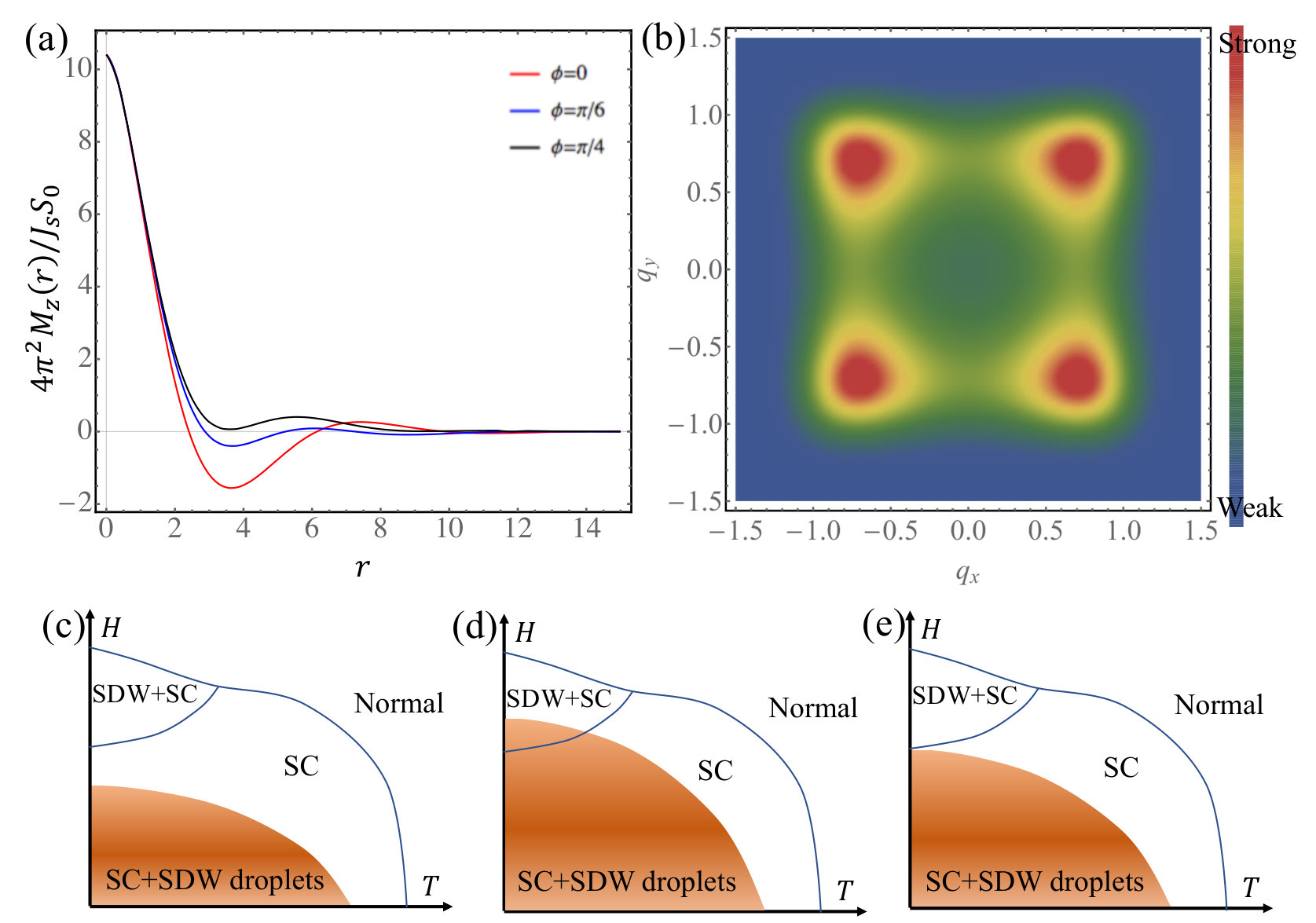 Figure 1
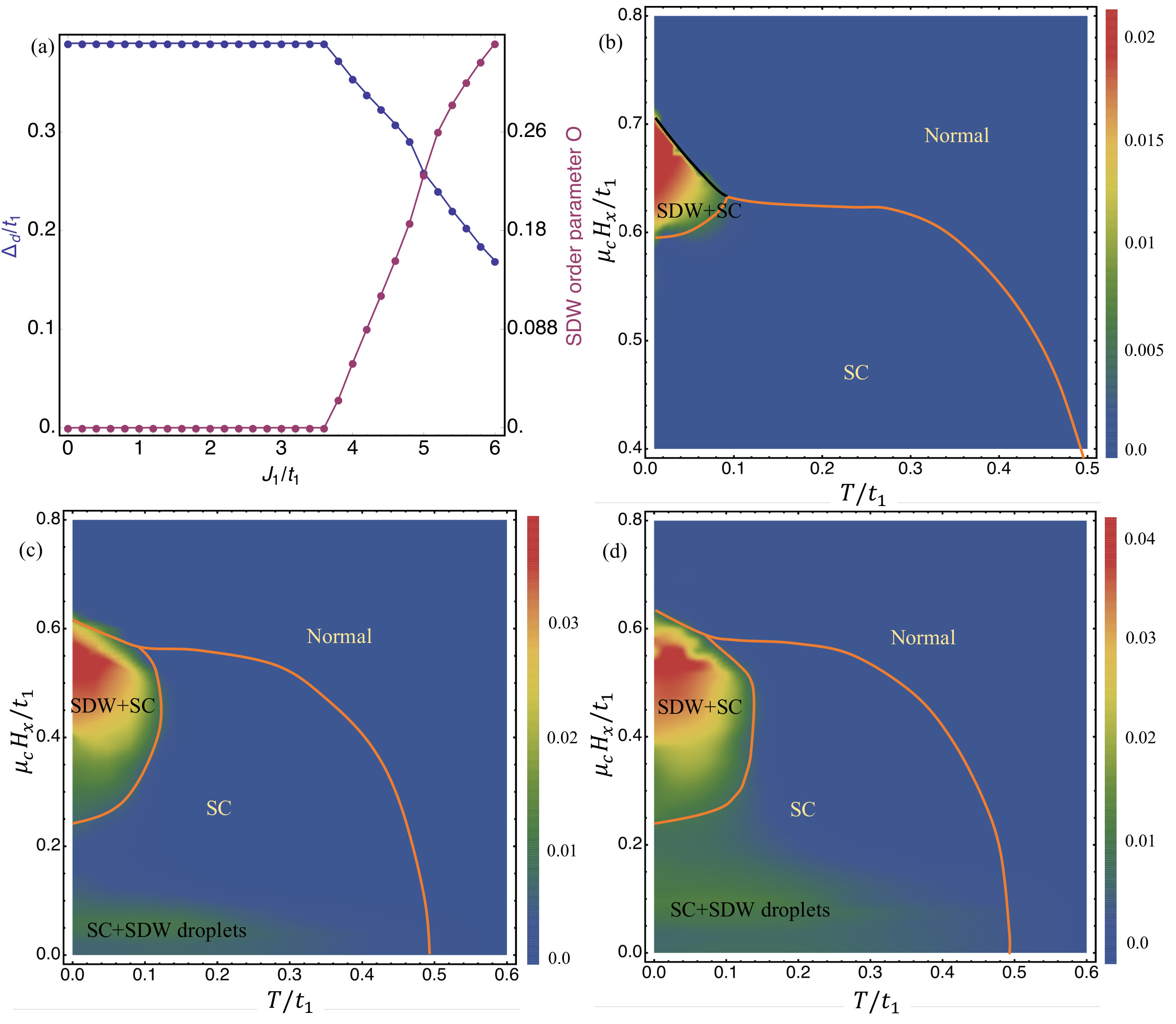 Figure 2
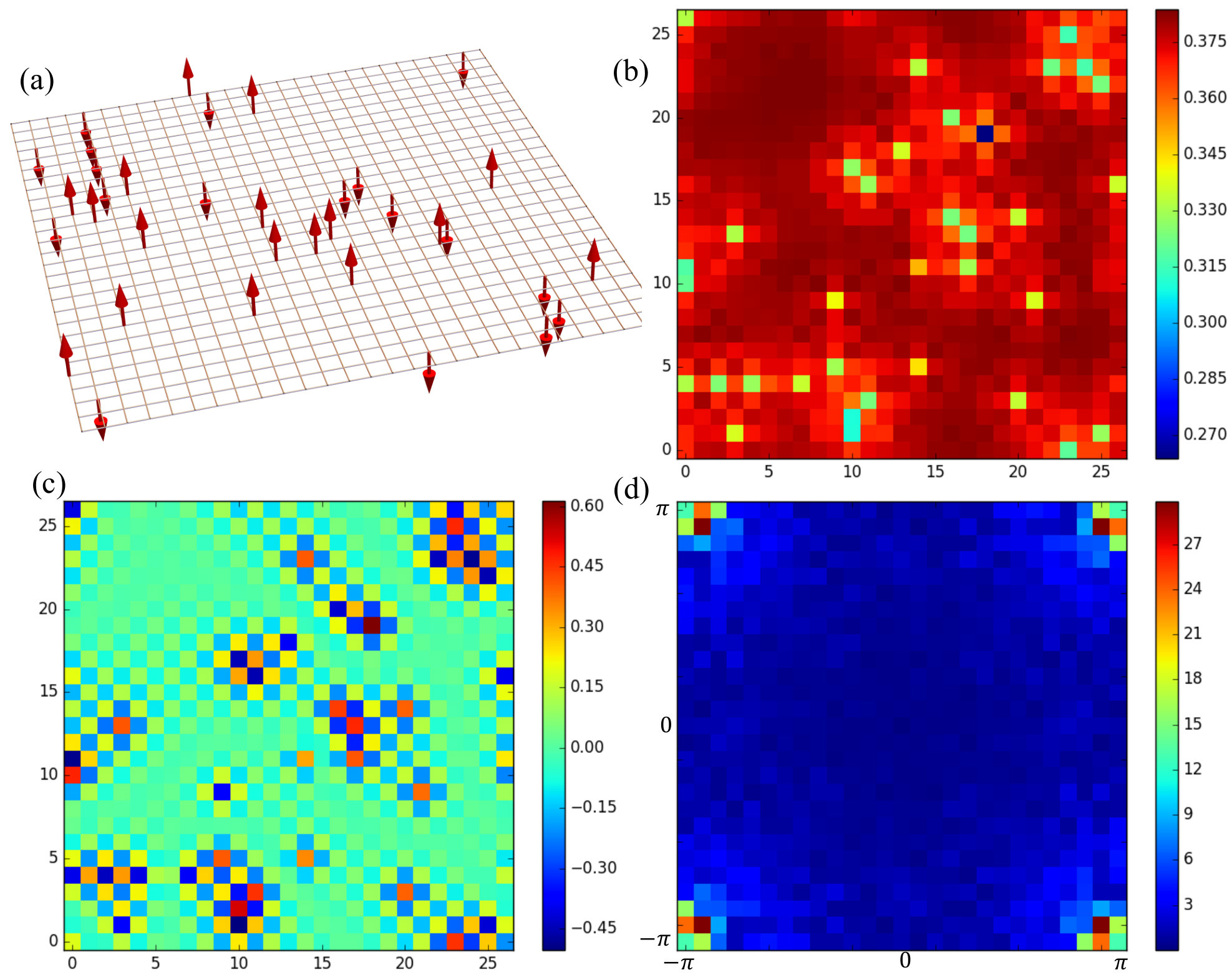 Figure 3
Peer Reviews
No public reviews on file for this paper yet. If you reviewed it on a platform where reviews are public (OpenReview, ICLR, NeurIPS, ICML), you can paste yours below so the community can read it here.
Videos
No videos yet. Explain this paper in a talk, walkthrough, or lecture? Add one.
Taxonomy
TopicsRare-earth and actinide compounds · Physics of Superconductivity and Magnetism · Magnetic and transport properties of perovskites and related materials
Impurity-induced magnetic droplet in unconventional superconductors near magnetic instability: Application to Nd doped
Shi-Zeng Lin
Theoretical Division, T-4 and CNLS, Los Alamos National Laboratory, Los Alamos, New Mexico 87545, USA
Jian-Xin Zhu
Theoretical Division and Center for Integrated Nanotechnologies, Los Alamos National Laboratory, Los Alamos, New Mexico 87545, USA
Abstract
Beside the spin density wave (SDW) order inside the superconducting phase in at high magnetic fields, recent neutron scattering measurements have found Bragg peaks in Nd doped at low fields. The intensity of Bragg peaks in low fields is suppressed by increasing field. Based on the phenomenological and microscopic modeling, we show that for the Pauli limited -wave superconductors in the vicinity of SDW instability relevant for , magnetic impurities locally induce droplets of SDW order. Because of the strong anisotropy in the momentum space in the spin fluctuations guaranteed by the -wave pairing symmetry, sharp peaks in spin structure factor at s are produced by the impurities, even when the droplets of SDW do not order. At zero field, the Nd impurity spins are along the axis due to the coupling to the conduction electrons with an easy axis, besides their own crystal field effect. The in-plane magnetic field cants the impurity moments toward the plane, which suppress the droplets of SDW order. At high fields, the long-range SDW inside the superconducting phase is stabilized as a consequence of magnon condensation. Our results are consistent with the recent neutron scattering and thermal conductivity measurements.
Introduction – The intricate interplay between magnetism and superconductivity represents one of main challenges in strongly correlated electronic systems. The -wave heavy-fermion superconductor is one prototypical system Petrovic et al. (2001); D. Thompson and Fisk (2011) to study the relationship between magnetism and superconductivity in Pauli-limited superconductors. Conventionally, superconductivity is stabilized through suppression of magnetism by pressure, chemical doping etc. The discovery that in a spin density wave (SDW) emerges only inside the superconducting phase by external field of the order of comes as a big surprise Kenzelmann et al. (2008, 2010); Young et al. (2007). This experiment immediately triggers enormous experimental and theoretical efforts to understand the origin of the SDW phase and the role of superconductivity. Neutron scattering studies revealed that the propagation wave vector is , which coincides with the nodal direction of pairing symmetry. The fully developed magnetic moment is and the magnetic moment is along the axis. Here is the Bohr magneton. The ordering wave vector of SDW along the two perpendicular nodal direction can be switched sensitively by rotating the in-plane magnetic field Gerber et al. (2014); Kim et al. (2016). The neutron study in the superconducting phase at low fields has revealed plenty of magnetic fluctuations of nodal quasiparticle at the same and spin anisotropy as those in the SDW phase Stock et al. (2008); Raymond and Lapertot (2015); Stock et al. (2012). This implies that the SDW is due to the condensation of these magnetic fluctuatios.
Meanwhile several theoretical proposals have been put forward to understand the origin of high field SDW phase. These theories highlight the importance of vortex lattice Suzuki et al. (2011), Pauli pair breaking effect Ikeda et al. (2010); Hatakeyama and Ikeda (2011), the Fulde-Ferrell-Larkin-Ovchinnikov (FFLO) state, superconducting pairing density wave Agterberg et al. (2009); Yanase and Sigrist (2009); Miyake (2008); Aperis et al. (2010), and improved Fermi surface nesting by magnetic field Kato et al. (2011, 2012); Martiny et al. (2015), in stabilizing the SDW phase. Using the tight-binding parameters obtained by density functional calculations with renormalized bandwidth, it was shown that the in-plane magnetic field enhances the transverse magnetic susceptibility, in the Pauli-limited -wave superconductors Michal and Mineev (2011). Using the argument based on the random phase approximation (RPA), the enhanced susceptibility triggers the SDW instability when , where is the Coulomb interaction. In these theories, it is assumed that is in the vicinity of the SDW instability, which can be inferred from various measurements Bianchi et al. (2003); Paglione et al. (2003); Ronning et al. (2006); Hu et al. (2012); Kawasaki et al. (2003); Stock et al. (2008); Raymond and Lapertot (2015); Stock et al. (2012).
It is well known that the response of superconductors to impurity is a powerful signature to understand the pairing mechanism in unconventional superconductors Balatsky et al. (2006); Tsuchiura et al. (2001); Wang and Lee (2002); Zhu et al. (2002); Chen and Ting (2004); Harter et al. (2007); Andersen et al. (2007, 2010); Gastiasoro and Andersen (2014); Gastiasoro et al. (2016). Previously work on Cd doped , , has revealed interesting interplay between magnetism and superconductivity Nicklas et al. (2007); Pham et al. (2006); Urbano et al. (2007); Nair et al. (2010); Seo et al. (2014). Recently, an anomaly in specific heat has been observed in the superconductor for Hu et al. (2008). The compound with has been studied by neutron scattering recently Raymond et al. (2013), where Bragg peaks at the same SDW ordering wave vector, , have been observed at zero magnetic field. The magnon fluctuations are gapped with a gap of . Mazzone et al. (2017a) Further neutron studies find that the Bragg peaks at four s have the same intensity Mazzone et al. (2017b, c). The peak intensity in the low-field region is suppressed by increasing the in-plane magnetic field and eventually disappears before the high-field SDW phase emerges. Thermal conductivity measurement on the Nd doped shows a jump in conductivity at high magnetic fields when the field is rotated along the axis, similar to that in the undoped Kim et al. (2016), suggesting a long-range SDW phase. The jump in thermal conductivity disappears at low magnetic field, indicating a different magnetic response of distinct origin Kim et al. (2017a).
Assuming that the Nd doping has negligible effect on the Fermi surface, and the Nd atoms serve as magnetic impurities in the -wave superconductivity, a minimal model based on a quasi-nested Fermi surface was proposed to understand these experiments, where the magnetic impurity induces a locally SDW pattern at low field Martiny et al. (2015). It is argued that these local SDW patterns cooperate to form a long-range SDW order, as a consequence of the Ruderman-Kittel-Kasuya-Yosida (RKKY)-like interaction between magnetic impurities. The phase region of the high-field SDW phase becomes wider in the presence of magnetic impurities. However it is unclear how the low-field SDW region is suppressed by magnetic field.
In this work, we present a theory on the magnetic properties in Nd doped . Our theory are based on the following experimentally established facts: (1) the system is close to the SDW instability; (2) the SDW at high fields is formed by the nodal quasiparticles and the ordering wavevector is along the nodal directions of the -wave superconductivity; (3) the moment of SDW order is along the axis. Within the phenomenological and microscopic modeling, we show that magnetic impurities generate local droplets of SDW oscillation at low fields, which oscillate and decay in space. Because of the -wave pairing symmetry, the random impurities can produce peaks in the spin structure factor, even when they do not order magnetically. The impurity moments experience an easy axis anisotropy due to the conduction electrons, besides the anisotropy generated by crystal field. When an in-plane magnetic field is applied, the impurity moments are canted toward the -plane, accompanying the reduction of induced local SDW order. At high field, the long-range SDW sets in.
Phenomenological model – Here we present the physical picture based on a phenomenological model. We consider a paramagnetic region inside the superconducting phase, where we keep the free energy expansion of magnetization density up to the quadratic order. It is sufficient to consider the magnetization inside one layer because of antiferromagnetic order between layers. The total free energy density is Kim et al. (2017b)
[TABLE]
where , is the impurity moment and is the in-plane magnetic field. Here is the spin anisotropy for the impurities, which arises from their coupling to the conduction electrons with easy axis anisotropy and crystal field environment. For , , the of the SDW is . We have expanded the anisotropy of in the plane up to represented by the term, where is the angle between and the crystal axis. For a stronger anisotropy, one needs to include higher order expansion in . We have neglected the spin-orbit interaction of the conduction electrons that is responsible for the switching of of the SDW order by rotating magnetic field Kim et al. (2017b).
That the system is close to the SDW instability means that the magnetic susceptibility
[TABLE]
is positive and close to divergence. Microscopic theories show that increases with . At a critical field, diverges and the magnons condense to form the SDW.
For a single impurity located at the origin, , the induced local SDW pattern at zero field is
[TABLE]
Here oscillates and then decays as a function of distance as depicted in Fig. 1 (a), where both the oscillation period and decay length depend on the angle between and the axis. The decay is slow because the is close to divergence.
We then consider random distribution of impurities with the correlation and . We introduce an effective saturation field to describe the canting of impurity spin by magnetic field. Therefore, we have when and otherwise. A self-consistent treatment of the impurity moment direction will be presented in the microscopic model. The spin structure factor is
[TABLE]
The impurity induced is maximal at four s, , with equal intensity, because of the strong anisotropy in the orientation of , see Fig. 1 (b), even for randomly distributed impurities. In , increases with magnetic field while decreases with field. Depending on the relative strength of these two competing factors, can increase or decrease monotonically, or show nonmonotonic behavior as a function of in the paramagnetic phase. Taking the high field SDW phase into account, we can schematically draw the magnetic response of the Pauli limited -wave superconducting phase in the vicinity of SDW to magnetic impurities, as shown in Fig. 1 (c-e). Because the system is close to the SDW instability, the induced SDW droplets decay slowly in space, which may be helpful to achieve a long-range order of the SDW droplets Gastiasoro et al. (2016); Martiny et al. (2015); Gastiasoro and Andersen (2014). The low-field phase can overlap with the long-range SDW phase or they can separate, or accidentally touch the SDW phase at a point, depending on the saturation field for the impurities.
Microscopic model – We present microscopic model calculations to support the phenomenological model. The mean-field Hamiltonian reads
[TABLE]
where the spin of the conduction electrons is . and are the magnetic moments for the conduction electrons and impurity spins. The self-consistent condition for the anisotropic molecular field and pairing potential are and . The electron density for up and down spin are and . Here , , and are the -th eigen vector and eigen energy of the Bogoliubov-de Gennes equation associated with Eq. (5) Zhu (2016). We consider electron hopping on a square lattice with the dispersion , where , and are the nearest neighbor (NN), the second NN (along diagonal) and the third NN (along bond) hopping amplitude respectively. To ensure the SDW order at , we use (NN antiferromagnetic interaction) and (third NN interaction) competing interactions with . We take the band structure obtained by DFT calculations Tanaka et al. (2006) , and the average electronic occupation is fixed at . To stabilize the -wave pairing symmetry, we focus on the NN pairing potential with in the calculations. The -wave order parameter is given by , where and are the unit vectors in the and direction respectively Soininen et al. (1994). We neglect the crystal field effect for the impurities, and the spin anisotropy for the magnetic impurities is only contributed from the conduction electrons. We calculate self-consistently by fixing . We use the periodic boundary condition and the system size is chosen to be commensurate with the wavelength of SDW.
As shown in Fig. 2(a), for a large , SDW order emerges and coexists with superconductivity. We tune the system close to the SDW instability by choosing , close to the critical value for the onset of the SDW order. For a clean system, the transverse susceptibility increases with . At high field, a SDW phase inside the superconducting phase with either along or is stabilized, see Fig. 2(b). The transition between the SDW phase and normal phase is of the first order, while the other phase transitions are of the second order. Our self-consistent calculations thus confirm the expectation from the RPA argument in Ref. Michal and Mineev, 2011. To obtain the experimental phase diagram, it is required that , and are in the same order of magnitude, which highlights the uniqueness of heavy-fermion superconductors for the observation of the field-included SDW order.
We then introduce randomly distributed magnetic impurities into the system. For the impurity coupling , as shown in Fig. 3(a), the impurity moment is along the axis, due to the anisotropic RKKY interaction mediated by conduction electrons with moments in the axis. The dilute impurity moments do not develop long-range order because of the weak RKKY interaction. The -wave order parameter [see Fig. 3(b)] and the superconducting transition temperature is weakly suppressed. Nevertheless, the impurities nucleate droplets of SDW order, which interfere with each other, see Fig. 3(c). The spin structure clearly develops Bragg peaks, which preserve the rotation symmetry because of the strong anisotropy in s, as displayed in Fig. 3(d), even though the magnetic impurities do not order.
The fully self-consistent calculations enable us to construct field-temperature phase diagrams in the presence of magnetic impurities. In Fig. 2(c-d), we depict the phase diagram obtained by and SDW order parameter with the number of lattice sites. There is a long-range SDW phase at high field and low temperature. Compared to the clean system, the upper critical field is suppressed by impurities, while the the phase region for the SDW phase increases, because of the suppression of superconductivity by impurities, which in turn favors its competitor, the SDW phase. The strong first-order phase transition between the SDW phase and normal phase is weakened to the second order in our two-dimensional model. In three dimensions, the transition could remain to be first order. At low fields, the impurities induce droplets of local SDW. The induced magnetization decreases with the magnetic field because of the canting of impurity moments in the presence of the field. For a weak saturation field, the region with induced SDW droplet in the phase diagram is separated from the long-range SDW phase [Fig. 2(c)]. When the saturation field is increased, these two regions overlap [Fig. 2(d)]. The phase diagram is consistent with that expected from the phenomenological model.
Discussions – The amplitude of induced droplet of SDW is proportional to the impurity moment along the easy axis of the conduction electron spins. For magnetic impurity with strong easy-plane anisotropy in the tetragonal crystal, such as Gd, the local exchange interaction between conduction electron spins becomes negligible, therefore no droplets of SDW would be produced. This is consistent with the recent experiment on Gd doped , where the impurity induced anomaly in specific heat observed in Nd doped becomes extremely weak for the Gd doped compound Rosa et al. (2017). To induce SDW droplets, one may cant the Gd moments toward the easy axis by applying magnetic field in the axis. The long-range high-field SDW order does not emerge for this field orientation Blackburn et al. (2010), and the magnetization is due to the SDW droplets.
We have neglected the spin-orbit interaction. As a consequence, the spin structure factor associated with droplets of SDW have four sharp peaks with equal intensity. The spin-orbit interaction couples of magnon fluctuations to the in-plane magnetic field Mineev (2017); Kim et al. (2017b), therefore favors a pair of s along the diagonal that is as perpendicular to the magnetic field as possible over the other pair for a nonzero field.
To summarize, based on both phenomenological and microscopic models, we have provided a theoretical understanding of the effects of magnetic impurity in unconventional Pauli limited superconductors in the brink of SDW instability, and have applied it to the Nd doped . Impurities with magnetic moment parallel to that of conduction electron spins locally induce droplets of SDW, whose amplitude decays in space. Even when these droplets do not order, the spin structure factor exhibits sharp peaks at the same s as those of the long-range SDW at high field, because of the strong anisotropy in enforced by the -wave pairing symmetry. With increasing in-plane magnetic field, the impurity moments are canted and the amplitude of the droplets of SDW decreases. At high fields, the long-range SDW inside the superconducting phase is stabilized as a consequence of magnon condensation. Our results are consistent with the recent neutron scattering data and thermal conductivity measurements. The SDW droplets can be probed by NMR measurements.
Acknowledgements.
SZL is indebted to Roman Movshovich, Duk Y. Kim, Priscila F. S. Rosa and Yuan-Yen Tai for helpful discussions. The work was carried out under the auspices of the U.S. DOE Contract No. DE-AC52-06NA25396 through the LDRD program, and supported in part by the Center for Integrated Nanotechnologies, a U.S. DOE Office of Basic Energy Sciences user facility.
The reference list from the paper itself. Each links out to its DOI / PubMed record.
- 1Petrovic et al. (2001) C. Petrovic, P. G. Pagliuso, M. F. Hundley, R. Movshovich, J. L. Sarrao, J. D. Thompson, Z. Fisk, and P. Monthoux, “Heavy-fermion superconductivity in Ce Co In 5 subscript Ce Co In 5 \mathrm{Ce Co In_{5}} at 2.3 K,” J. Phys. Condens. Matter 13 , L 337 (2001) . · doi ↗
- 2D. Thompson and Fisk (2011) Joe D. Thompson and Zachary Fisk, “Progress in Heavy-Fermion Superconductivity: Ce 115 and Related Materials,” J. Phys. Soc. Jpn. 81 , 011002 (2011) . · doi ↗
- 3Kenzelmann et al. (2008) M. Kenzelmann, Th Strässle, C. Niedermayer, M. Sigrist, B. Padmanabhan, M. Zolliker, A. D. Bianchi, R. Movshovich, E. D. Bauer, J. L. Sarrao, and J. D. Thompson, “Coupled Superconducting and Magnetic Order in Ce Co In 5 subscript Ce Co In 5 \mathrm{Ce Co In_{5}} ,” Science 321 , 1652–1654 (2008) . · doi ↗
- 4Kenzelmann et al. (2010) M. Kenzelmann, S. Gerber, N. Egetenmeyer, J. L. Gavilano, Th. Strässle, A. D. Bianchi, E. Ressouche, R. Movshovich, E. D. Bauer, J. L. Sarrao, and J. D. Thompson, “Evidence for a magnetically driven superconducting Q phase of Ce Co In 5 subscript Ce Co In 5 \mathrm{Ce Co In_{5}} ,” Phys. Rev. Lett. 104 , 127001 (2010) . · doi ↗
- 5Young et al. (2007) B.-L. Young, R. R. Urbano, N. J. Curro, J. D. Thompson, J. L. Sarrao, A. B. Vorontsov, and M. J. Graf, “Microscopic evidence for field-induced magnetism in Ce Co In 5 subscript Ce Co In 5 \mathrm{Ce Co In_{5}} ,” Phys. Rev. Lett. 98 , 036402 (2007) . · doi ↗
- 6Gerber et al. (2014) Simon Gerber, Marek Bartkowiak, Jorge L. Gavilano, Eric Ressouche, Nikola Egetenmeyer, Christof Niedermayer, Andrea D. Bianchi, Roman Movshovich, Eric D. Bauer, Joe D. Thompson, and Michel Kenzelmann, “Switching of magnetic domains reveals spatially inhomogeneous superconductivity,” Nat. Phys. 10 , 126–129 (2014) . · doi ↗
- 7Kim et al. (2016) Duk Y. Kim, Shi-Zeng Lin, Franziska Weickert, Michel Kenzelmann, Eric D. Bauer, Filip Ronning, J. D. Thompson, and Roman Movshovich, “Intertwined orders in heavy-fermion superconductor Ce Co In 5 subscript Ce Co In 5 \mathrm{Ce Co In_{5}} ,” Phys. Rev. X 6 , 041059 (2016) . · doi ↗
- 8Stock et al. (2008) C. Stock, C. Broholm, J. Hudis, H. J. Kang, and C. Petrovic, “Spin resonance in the d 𝑑 d -wave superconductor Ce Co In 5 subscript Ce Co In 5 \mathrm{Ce Co In_{5}} ,” Phys. Rev. Lett. 100 , 087001 (2008) . · doi ↗