Probing the Electroweakino Sector of General Gauge Mediation at the LHC
Jong Soo Kim, Manuel E. Krauss, Victor Martin-Lozano

TL;DR
This paper investigates how LHC searches for photons and missing energy can constrain electroweakino production in gauge mediation models, revealing complementary insights beyond dedicated analyses.
Contribution
It demonstrates the effectiveness of existing LHC analyses in probing electroweakino scenarios within general gauge mediation, providing new constraints on the parameter space.
Findings
LHC analyses designed for other scenarios can constrain electroweakino models.
Photon and missing energy signatures are key indicators for these models.
The paper maps out the parameter space constraints from current LHC data.
Abstract
We consider pair-production of electroweakinos promptly decaying to light gravitinos in general gauge mediation scenarios within the minimal supersymmetric standard model. Typically the presence of photons and missing transverse momentum is the key signature for this kind of scenarios. We highlight where LHC analyses which have originally been designed to probe different scenarios provide complementary constraints with respect to the dedicated searches and we present the constraints on the parameter space.
Click any figure to enlarge with its caption.
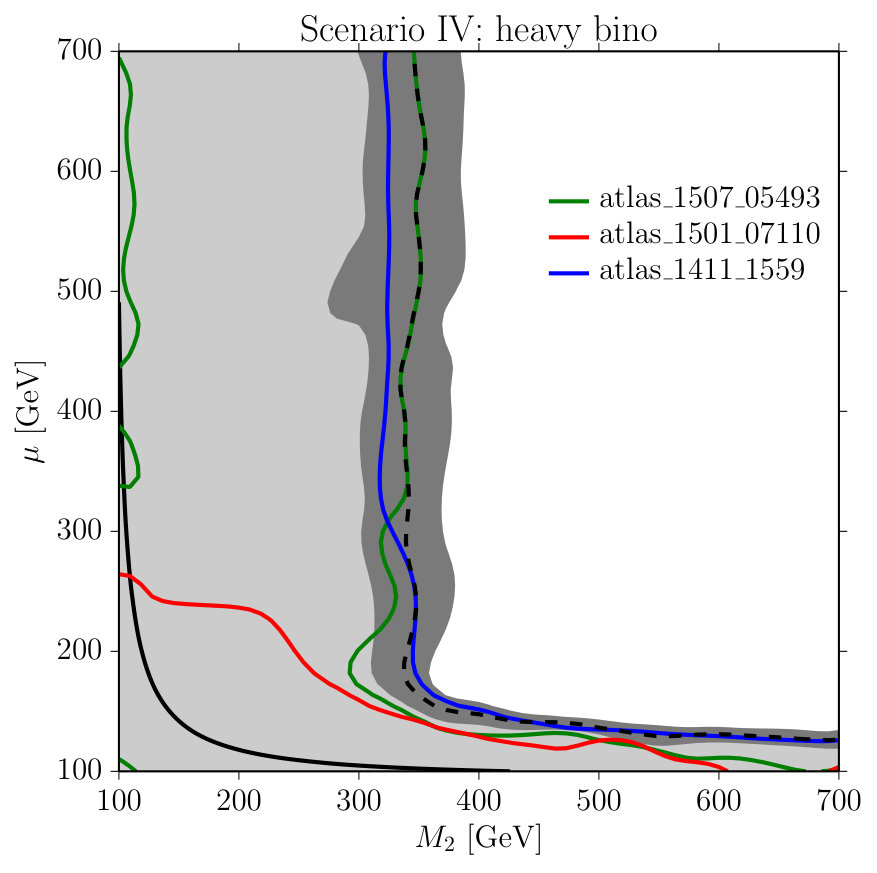 Figure 1
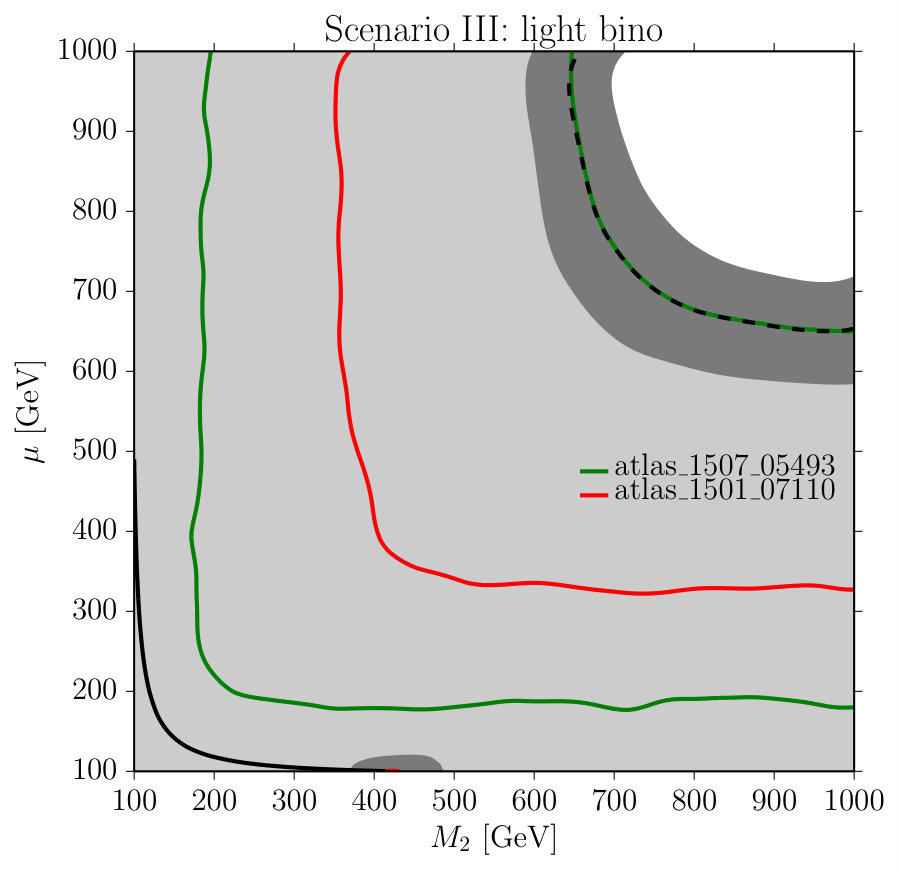 Figure 2
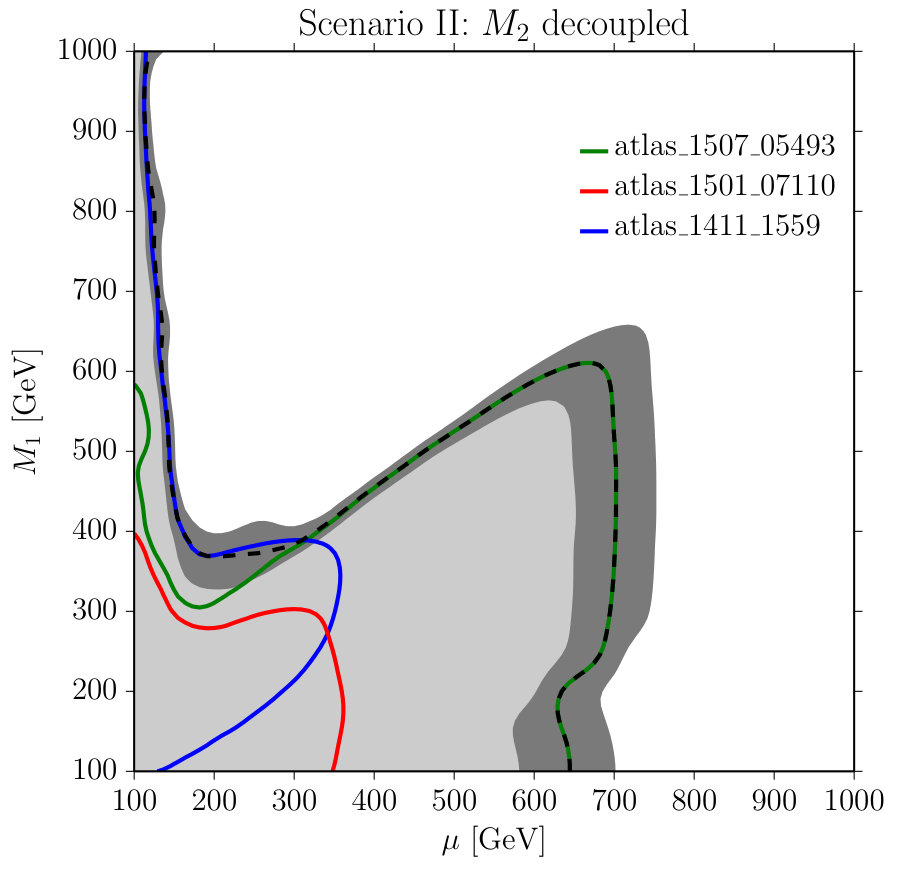 Figure 3
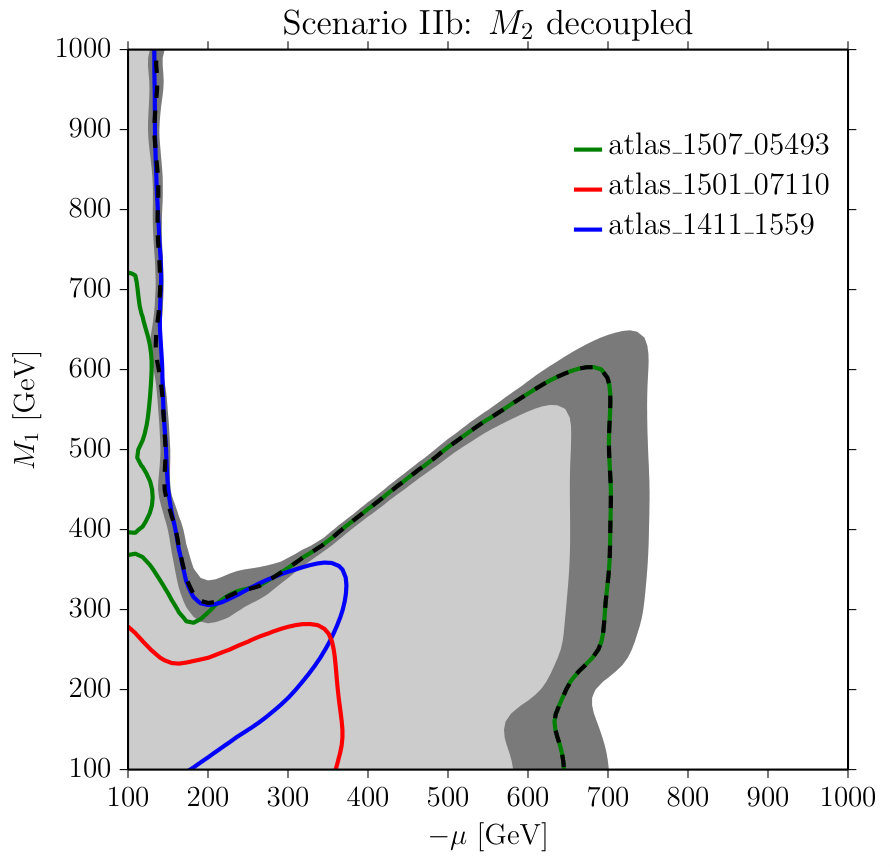 Figure 4
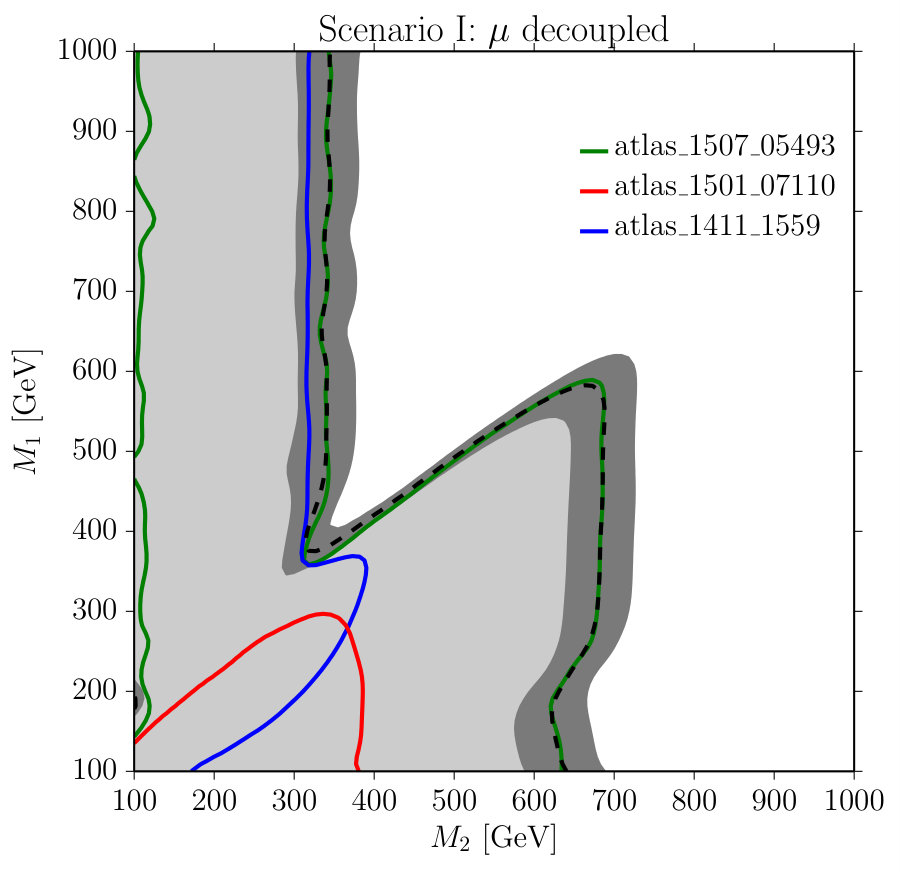 Figure 5
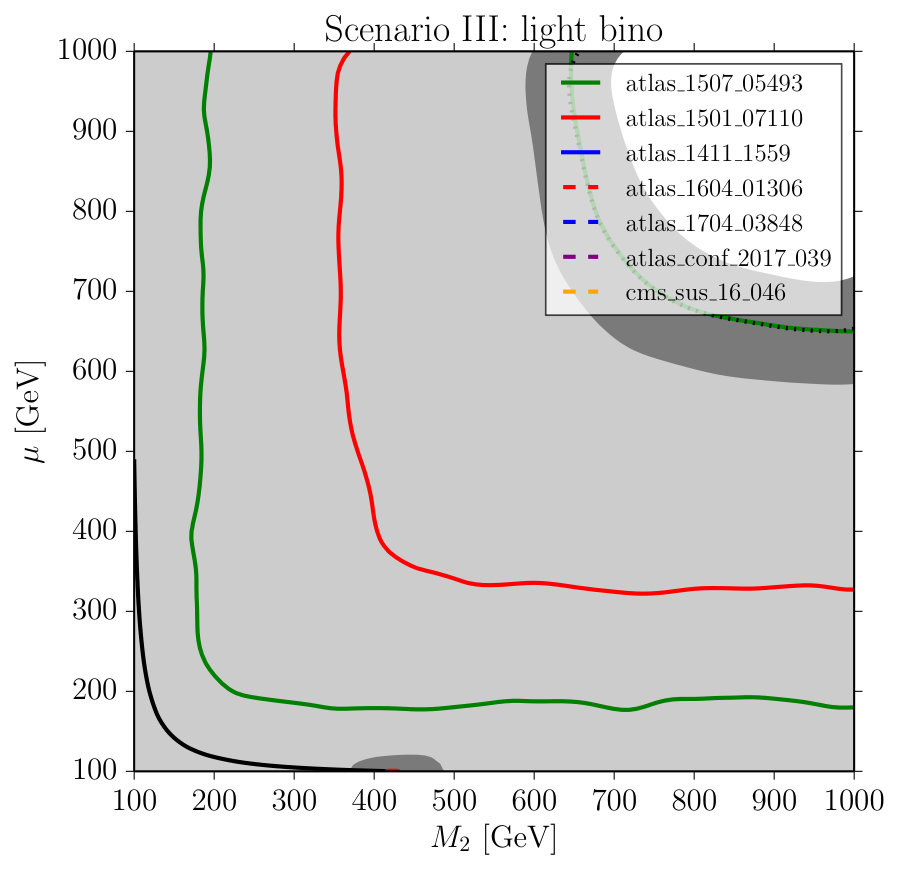 Figure 6
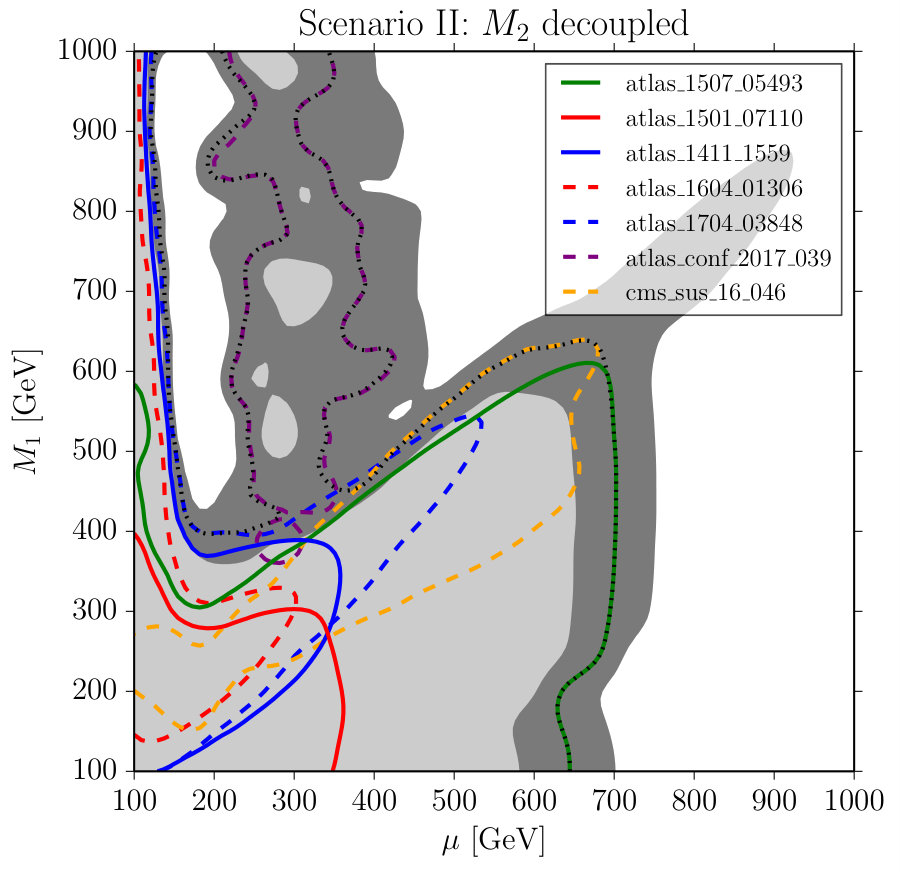 Figure 7
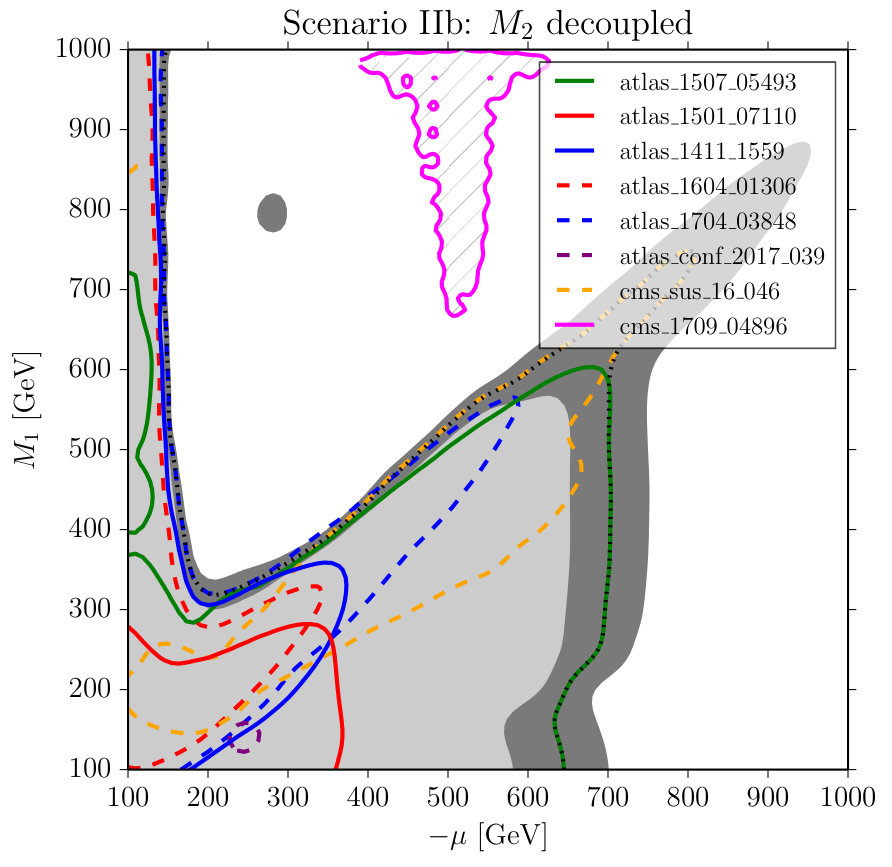 Figure 8
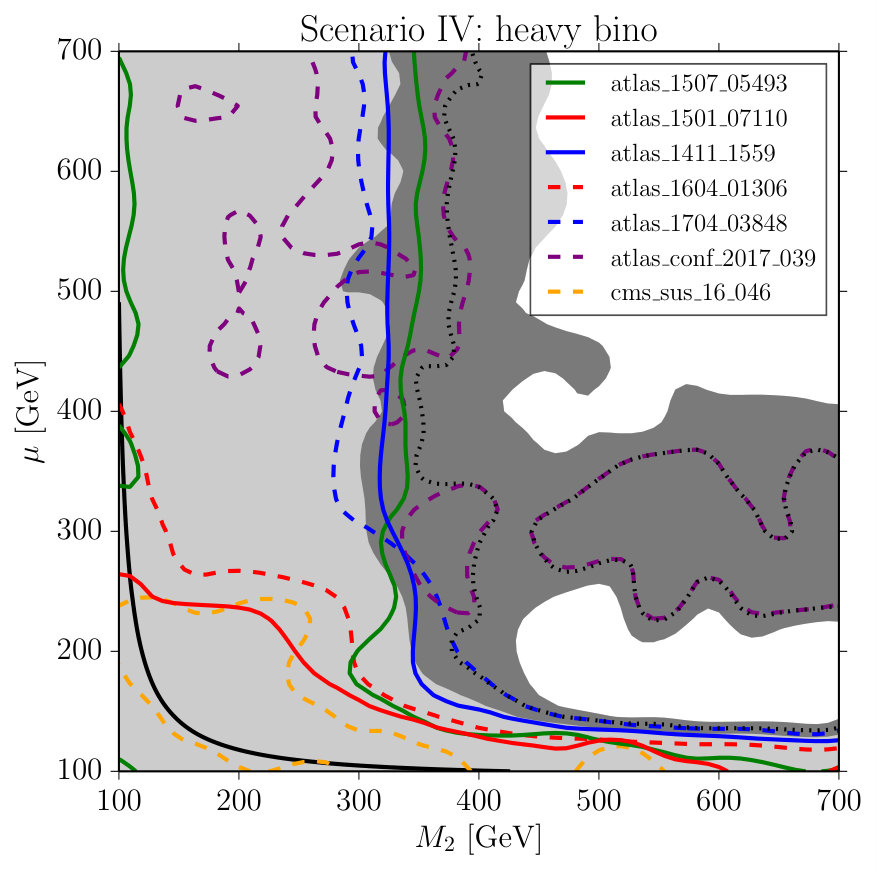 Figure 9
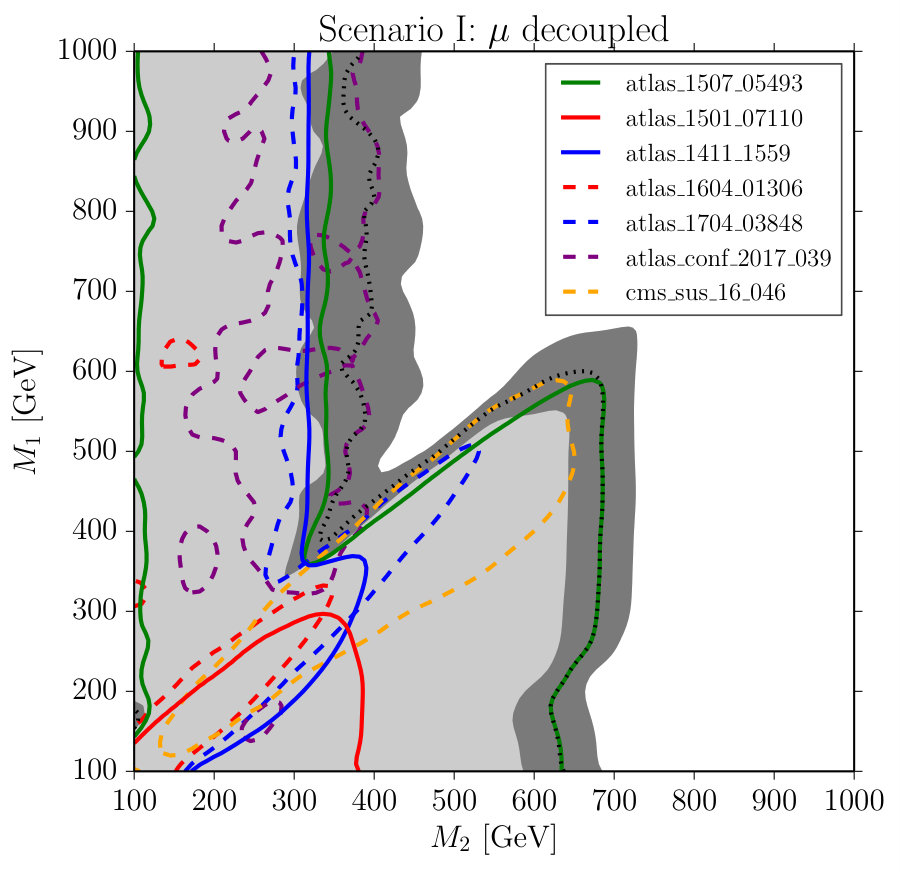 Figure 10
| Reference | Final State | [fb-1] | |
|---|---|---|---|
| 8 TeV | 1507.05493 (ATLAS) Aad et al. (2015a) | 20.3 | |
| +(b)-jets+ | |||
| 1411.1559 (ATLAS) Aad et al. (2015b) | 20.3 | ||
| 1501.07110 (ATLAS) Aad et al. (2015c) | 20.3 | ||
| 1403.4853 (ATLAS) Aad et al. (2014b) | 2+ | 20.3 | |
| 1404.2500 (ATLAS) Aad et al. (2014c) | SS 2 or 3 | 20.3 | |
| 1405.7875 (ATLAS) Aad et al. (2014d) | jets + | 20.3 | |
| 1407.0583 (ATLAS) Aad et al. (2014e) | 1+() jets+ | 20.0 | |
| 1402.7029 (ATLAS) Aad et al. (2014f) | 3+ | 20.3 | |
| 1501.03555 (ATLAS) Aad et al. (2015d) | 1+jets+ | 20.3 | |
| 1405.7570 (CMS) Khachatryan et al. (2014) | 1, SS-OS2, 3, 4 | 20.3 | |
| 13 TeV | 1709.04896 (CMS) CMS (2017b); Sirunyan et al. (2017) | 35.9 | |
| CMS-PAS-SUS-16-46 CMS (2017a) | 35.9 | ||
| ATLAS-CONF-2017-039 ATLAS (2017) | 36.1 | ||
| 1704.03848 (ATLAS) Aaboud et al. (2017) | high-en. | 36.1 | |
| ATLAS-CONF-2016-096 ATLAS (2016b) | 13.3 | ||
| 1604.01306 (ATLAS) Aaboud et al. (2016a) | 3.2 |
| Scenario | [GeV] | [GeV] | [GeV] | Description |
|---|---|---|---|---|
| I | [100, 1000] | [100, 1000] | 2000 | decoupled |
| II | [100, 1000] | 2000 | [100, 1000] | decoupled |
| IIb | [100, 1000] | 2000 | [-1000, -100] | decoupled |
| III | 50 | [100, 1000] | [100, 1000] | light bino |
| IV | 2000 | [100, 700] | [100, 700] | heavy bino |
Peer Reviews
No public reviews on file for this paper yet. If you reviewed it on a platform where reviews are public (OpenReview, ICLR, NeurIPS, ICML), you can paste yours below so the community can read it here.
Videos
No videos yet. Explain this paper in a talk, walkthrough, or lecture? Add one.
Probing the Electroweakino Sector of General Gauge Mediation at the LHC
Jong Soo Kim
Bethe Center for Theoretical Physics & Physikalisches Institut der Universität Bonn,
Nußallee 12, 53115 Bonn, Germany
National Institute for Theoretical Physics,
School of Physics and Mandelstam Institute for Theoretical Physics,
University of the Witwatersrand, Johannesburg, Wits 2050, South Africa
Manuel E. Krauss
Bethe Center for Theoretical Physics & Physikalisches Institut der Universität Bonn,
Nußallee 12, 53115 Bonn, Germany
Víctor Martín Lozano
Bethe Center for Theoretical Physics & Physikalisches Institut der Universität Bonn,
Nußallee 12, 53115 Bonn, Germany
Abstract
We consider pair-production of electroweakinos promptly decaying to light gravitinos in general gauge mediation scenarios within the minimal supersymmetric standard model. Typically the presence of photons and missing transverse momentum is the key signature for this kind of scenarios. We highlight where LHC analyses which have originally been designed to probe different scenarios provide complementary constraints with respect to the dedicated searches and we present the constraints on the parameter space.
††preprint: BONN-TH-2017-04
I Introduction
After the discovery of a Higgs boson at the LHC in 2012 Aad et al. (2012); Chatrchyan et al. (2012), theorist’s expectations for signs of new physics at the TeV scale have so far not been met. Instead, many models beyond the Standard Model (BSM) such as models of supersymmetry (SUSY) where the abundant production of squarks and gluinos has been long anticipated, suffer from severe constraints because of the perpetual null results. In a combined global fit Bechtle et al. (2016), those already led to the first 90% confidence level (C.L.) exclusion of the constrained minimal supersymmetric standard model, which assumes Planck-scale mediated SUSY breaking Nilles (1984); Drees et al. (2004). An attractive alternative way of breaking SUSY is gauge-mediated SUSY breaking (GMSB) Dine and Fischler (1982); Dine et al. (1981); Dimopoulos and Raby (1981); Nappi and Ovrut (1982); Alvarez-Gaume et al. (1982); Dine and Nelson (1993); Dine et al. (1993, 1995, 1996) where SUSY is broken in a hidden sector and the breaking is transmitted to the visible world by so-called messenger-fields. Being charged under the gauge group of the model, those couple to the matter fields through gauge interactions. Because of the flavour-blindness of gauge mediation, there is no SUSY flavour problem. The mass scale of SUSY breaking as well as of the messenger fields is typically considerably smaller than the Planck scale. Consequently, the SUSY-breaking mass of the longitudinal mode of the graviton partner, the gravitino, is so small that it is the lightest supersymmetric particle (LSP).
If -parity is conserved, the gravitino is a viable candidate for dark matter (DM) Pagels and Primack (1982); Khlopov and Linde (1984). In general thermal scenarios, the gravitino could thermalise giving the correct relic abundance for masses below a keV, corresponding to warm DM. However, in this scenario one should be aware of the impact of such a light candidate in astrophysical and cosmological observations Viel et al. (2005). The lower mass bound is avoided if the gravitino has never been in thermal equilibrium which is possible for low reheating temperatures Choi et al. (1999), e.g. obtained by gaugino scattering Moroi et al. (1993). Furthermore, in Ref. Cheung et al. (2011) it was pointed out that the gravitino can be produced through the freeze-in mechanism, resulting in the correct relic abundance for masses below 10 GeV. Recently, it has been shown that this scenario can also be fulfilled up to large values of the SUSY breaking scale Benakli et al. (2017).
In the minimal gauge mediation models 111For an overview, see Refs. Giudice and Rattazzi (1999); Martin (1997) and references therein., the masses of the SUSY scalars and of the fermionic partners of the gauge bosons (gauginos) are tightly connected. As the Higgs mass constraint requires masses of the stop squarks in the multi-TeV range Draper et al. (2012); Ajaib et al. (2012), this means that the hope for discovering this kind of models at the LHC is small. However, in more general scenarios of gauge mediation which also encompass models with direct mediation, this statement is not true any more. These models are referred to as general gauge mediation (GGM) Meade et al. (2009); Cheung et al. (2008). A comprehensive analysis of GGM scenarios after imposing the Higgs mass constraint which also takes into account different scenarios for the next-to-lightest supersymmetric particle (NLSP) is for instance provided in Refs. Knapen et al. (2016); Knapen and Redigolo (2017).
Refs. Ambrosanio et al. (1996); Feng and Moroi (1998); Stump et al. (1996); Dimopoulos et al. (1996); Baer et al. (2000); Kim and Sedello (2011); Hiller et al. (2009) investigated the discovery potential of models based on gauge mediation with light gravitinos at LEP, Tevatron and the LHC. In this letter, we shall focus on the case where the masses of the SUSY partners of the electroweak gauge and Higgs bosons reside below a TeV whereas the rest of the spectrum is considerably heavier. In that case, coloured production does not lead to any discovery prospects but one has to consider electroweak production. Analyses and interpretations in that direction have for instance been done in Refs. Aad et al. (2015a); ATLAS (2016a). In that respect, Ref. Aad et al. (2015a) sets bounds on the electroweak production of wino pairs for both wino and bino NLSPs. Ref. ATLAS (2016a) is a recast of experimental analyses which look for either two photons or multi-lepton signatures, considering weak-scale winos and higgsinos for fixed NLSP mass of 150 GeV and decoupled binos in a GGM setting.
Lately, there has been an increased effort in the phenomenological community to provide tools which make use of actual experimental results and provide the possibility of recasting them in custom models, see e.g. Refs. Caron et al. (2017); Drees et al. (2015); Conte et al. (2013); Papucci et al. (2014); Kraml et al. (2014); Bechtle et al. (2017), and for recent examples of recasting Refs. Arina et al. (2016); Deutschmann et al. (2017); Beuria et al. (2017); Cerna-Velazco et al. (2017). For this project we make use of the public tool CheckMATE Drees et al. (2015); Dercks et al. (2016) for which we have implemented the analyses of Refs. Aad et al. (2015a); CMS (2017a) and made them available for public usage. Using this implementation as well as all other analyses included in CheckMATE, we expand upon the GGM analyses of Refs. Aad et al. (2015a); ATLAS (2016a) to provide a full coverage of the electroweakino sector, for instance also considering bino-higgsino NLSPs. We further show where other relevant signatures from analyses which are not specifically designed for GGM models like the mono-photon searches of Refs. Aad et al. (2015b); Aaboud et al. (2017) or the multilepton analysis of Ref. ATLAS (2017) provide complementary bounds.
II General Gauge Mediation Models
In the minimal GMSB scenario, the spectrum of supersymmetric particles is determined by their respective quantum numbers along with the SUSY breaking scale and the properties of the messenger sector. Typically one assumes the messenger fields to form complete multiplets under SU(5) so that gauge coupling unification is trivially preserved. Once the messenger sector and the ratio of the up- and down-type Higgs vevs are fixed, the hierarchy of the spectrum is determined. In particular, the same messenger fields which fix the masses of the scalar particles also determine the gaugino spectrum, with the fixed ratio of bino, wino and gluino masses of at the messenger scale .222Note that this relation uses the GUT-normalized U(1) gauge coupling .
In general gauge mediation models, in turn, a more general messenger sector is considered and interactions between matter and messenger fields are included. Consequently, the spectra of GGM models can differ quite significantly from minimal GMSB models, although some features such as small softbreaking trilinear couplings (-terms) and sum rules for soft SUSY-breaking masses remain Meade et al. (2009). In addition, the gravitino typically remains the LSP.
The MSSM gaugino and sfermion soft masses can be written, to leading order, as Buican et al. (2009)
[TABLE]
where labels the gauge groups, the MSSM matter representations and is the quadratic Casimir invariant of the scalar field with respect to the gauge group . In Ref. Buican et al. (2009), it was shown that one can construct weakly-coupled messenger theories in such a way that the complete parameter space of the parameters and is covered.333See also Refs. Rajaraman et al. (2009); Komargodski and Seiberg (2009) for an exploration of the GGM parameter space. In addition to and , the remaining free parameters at the weak scale are the higgsino mass term as well as . Consequently, the hierarchy among the electroweakinos is undetermined. Moreover, any one of them could be the NLSP with masses well below a TeV while having at the same time large enough such that the stops are in the multi-TeV range as required from the Higgs mass constraint in conjunction with small -terms.444This problem can, however, be alleviated by certain types of messenger-matter interactions Grajek et al. (2013); Byakti and Ray (2013); Evans and Shih (2013); Craig et al. (2013); Abdullah et al. (2013); Albaid and Babu (2013); Evans et al. (2012, 2011); Shadmi and Szabo (2012); Kang et al. (2012) or extra tree-level contributions to the Higgs mass Krauss et al. (2013). If also the rest of the scalar sector and the gluinos are heavy, the first (and possibly the only) SUSY particles accessible at the LHC would be the electroweakinos.
In the following, we will investigate this scenario, treating , , and as free parameters. We further assume that the sfermions as well as the gluino are heavy enough to not (yet) be accessible at the LHC in the near future.
Once produced, the NLSP will undergo the decay , depending on the NLSP nature. The partial decay width into is for instance given by Ambrosanio et al. (1996)
[TABLE]
and the corresponding ratios of partial widths can be approximated as 555These relations do not hold near threshold, i.e. when for instance is small.
[TABLE]
where
[TABLE]
Here we have used , subscript refers to the weak mixing angle and is the mixing angle in the CP-even Higgs sector. is the neutralino mixing matrix in the basis . Since , a bino NLSP will predominantly decay into while a pure wino NLSP mostly decays into as long as . For a pure higgsino state, the photonic mode is absent and so it decays into both or , with the ratio depending on the model parameters.
We will in the following restrict ourselves to prompt neutralino decays 666For discussions on long-lived neutralinos, see e.g. Refs. Feng et al. (2010); Dreiner et al. (2012a) and Ref. Aad et al. (2014a) for an experimental search for displaced vertices motivated by long-lived neutralino scenarios within GMSB. which we assure by fixing eV in the remainder of this letter. In this case the gravitino is still a good candidate for DM, however it should coexist with other different candidates in order to account for the total relic density Viel et al. (2005). Note however that the exact gravitino mass value is irrelevant for the subsequent study due to .
III Recasting the experimental searches
We generated benchmark points with the spectrum generator SPheno 4.0.0 Porod (2003); Porod and Staub (2012); Staub and Porod (2017) using the scanning tool SSP1.2.3 Staub et al. (2012). The truth level MC events are generated with the help of Pythia 8.219 Ball et al. (2013) employing the default parton distribution function (PDF) NNPDF 2.3 set Ball et al. (2013) while keeping the default values in the MC tools. We interfaced the truth level events to CheckMATE 2.0.2 Dercks et al. (2016); Kim et al. (2015); Drees et al. (2015); Tattersall et al. (2016) which is based on the fast detector simulation Delphes 3.4.0 de Favereau et al. (2014) and the jet reconstruction tool Fastjet 3.2.1 Cacciari et al. (2012). CheckMATE tests a model point against current ATLAS and CMS searches at confidence level.777CheckMATE contains a number of high luminosity searches which allows the user to estimate the potential discovery reach, e.g. Kim et al. (2016). In addition, with the help of the AnalysisManager new search strategies can be implemented Rolbiecki and Tattersall (2015); Kim and Ray (2015). We take the leading order cross section from Pythia 8 and normalise it with a conservative factor of 20%. We do not generate MC events with at least one additional parton at matrix element level and matched with the ordered parton shower of Pythia 8. In principle, our approach might be problematic for compressed spectra Dreiner et al. (2012b); Dreiner et al. (2013); Drees et al. (2012). However, in this letter the effects are negligible, since the decay of the NLSP into the gravitino will dominate the final state topology.
We have performed several grid scans in the softbreaking parameters of the electroweakino sector as well as with the SM-like Higgs mass fixed to GeV. In Table 2, we list all scenarios and the scan parameters. They will be discussed in more detail further below. For each grid point, events have been generated.
We test each grid point against all relevant ATLAS and CMS searches implemented into CheckMATE. The most relevant searches of which are summarised in Table 1. The implementations of Refs. Aad et al. (2015a); CMS (2017a) into CheckMATE have been done for this project and are now publicly available within the standard CheckMATE repository. All listed analyses are fully validated, and validation information is provided on the official webpage888https://checkmate.hepforge.org/ for the interested reader.
Every analysis covers a large number of signal regions which provides sensitivity to a vast range of mass hierarchies and final state multiplicities. For each search, the best signal region corresponds to the signal region with the best expected exclusion potential. This approach is again followed to choose the best search. As a result, the best observed limit is not always used to determine the limit and thus naively, the limits might be weaker. However, on the other hand, our limits are insensitive to downward fluctuations in the data which we would expect taking into account the huge number of signal regions. We select the best search and then compare our estimate of number of signal events with the observed limit at 95% confidence level Read (2002),
[TABLE]
where , , and denotes the number of signal events, the uncertainty due to MC errors and the 95 confidence level limit on the number of signal events, respectively. We only consider the statistical uncertainty due to the finite Monte Carlo sample with . The value is only calculated for the expected best signal region. Note that a combination of signal regions is currently not yet possible in CheckMATE, therefore the limits we derive in the following are conservative. A model point is excluded if is larger than one. However, here we define a point as allowed for and excluded for . Benchmark points which fall in the region might be excluded or allowed but due to missing higher order corrections and other systematic errors, we do not classify them as excluded or allowed.
Before presenting our numerical results, we first want to provide a rough overview of the relevant Run 1 and Run 2 searches and their current status. ATLAS and CMS have presented a vast number of studies covering a large selection of final state topologies. We want to investigate the impact on our GGM scenario by taking into account all relevant 8 TeV and 13 TeV searches since only a few dedicated GGM studies have been on the market so far. In Table 1 we list all relevant searches implemented in CheckMATE, divided into analyses performed on 8 TeV and 13 TeV data.
III.1 8 TeV analyses
The search Aad et al. (2015a) is a tailor made study targeting GGM inspired models and provides the backbone of our suit of LHC analyses. The authors search for events with high energetic isolated photons and large transverse momentum in the full data set of Run 1. The analysis contains ten signal regions which can roughly be divided into four classes. The first class demands diphoton final states with large transverse momentum targeting gluino and wino pair production channels with subsequent decays into binolike NLSPs. The remaining signal regions only require a single high energetic photon in the event topology which are further classified in ()-jet multiplicity signal regions. This class of search channels probes scenarios with gluinos and higgsinos and subsequent cascade decays into bino NLSPs. Finally, signal regions requiring an isolated electron or muon in the final state are designed to focus on wino NLSP scenarios. Ref. Aad et al. (2015b) is designed to look for events with a single large transverse momentum photon balancing large missing transverse energy. The search targets models of simplified dark matter where pair-produced dark matter recoils against a photon of SUSY-inspired scenarios with compressed spectra where pair produced squarks are produced in association with a photon. The SM backgrounds of the mono-photon signal can be suppressed by demanding a high momentum photon and large missing transverse momentum while requiring a strict lepton veto. As we will see, Ref. Aad et al. (2015c) performs pretty well in certain regions of parameter space. This analysis searches for chargino–neutralino pairs decaying into a boson and Higgs boson final state. Here, the authors exploit the emerging lepton of the boson decay as well as the diphoton, bottom pairs and the final state of the Higgs decay to isolate the signal from the countless SM events. We also employed many other SUSY searches which might be sensitive to our GGM scenario such as multi–lepton searches Aad et al. (2014b, f) and studies covering multi jet plus lepton final states Aad et al. (2014e).
III.2 13 TeV analyses
Most 13 TeV analyses are designed to maximise the sensitivity in the high mass region, and GGM-focused searches are quite rare. This is in particular the case for ATLAS for which CheckMATE is optimized, as is also represented in the catalogue of implemented searches. Ref. Aaboud et al. (2016b) searches for two photons and large transverse momentum and they interpret their results in GGM models. Its signal regions resemble the diphoton signal regions of the 8 TeV study Aad et al. (2015a) aiming at very heavy gluinos cascade decaying into diphoton final states. Due to the heavy masses involved, they can demand a very tight cut on the effective mass of TeV to separate the diphoton signal from the large SM backgrounds. This analysis is therefore not sensitive to the comparably small cross sections we are dealing with here. The other search is a conference note ATLAS (2016c) looking for photons, jets and large missing transverse momentum in the final state. Again, they demand a very large cut TeV. The situation is different for CMS where two analyses look for electroweakino production in a GMSB context. Ref. CMS (2017b); Sirunyan et al. (2017) looks for higgsino pair production with the subsequent decay into each. Signal events must feature GeV, 4-5 jets out of which two pass tight -tagging requirements, and no leptons. The data is interpreted within a simplified model assuming that 100% of the decay into as well as that both and decay into , i.e. that each produced higgino results in a Higgs final state. Neither the former nor the latter is usual in a realistic GMSB model, see for instance Eqs. (II.3) and (II). In fact, depending on and sign(), typically the final state is much more abundant, and only for small and negative , a branching ratio of of up to is possible.999This issue is considered in the CMS electroweakiono combination CMS (2017c) where the higgsino mass bound is shown as a function of the branching fraction into . The charged higgsino state, in turn, is only slightly heavier than so that the decays into the latter are phase-space suppressed. Depending on the gravitino couplings to matter (and therefore its mass), will almost exclusively decay into if is small ( or less) or dominantly into if is larger ( or more). As the production cross section of higgsinos is dominated by the associated production of , this means that the actual rates of through higgsino production are reduced by many orders of magnitude if eV, making the search insensitive, or only a factor of if is larger.101010Note that prompt NLSP decays are still possible for gravitino masses of . This strong dependence on the model parameters is in contrast to the 8 TeV search Aad et al. (2015c) which assumes a more realistic setting, only requiring one Higgs in the final state.
Although we have implemented CMS (2017b); Sirunyan et al. (2017) into CheckMATE, we will not make use of this implementation in what follows. The reason is that the -tagging efficiency in CMS cannot be modelled accurately enough in CheckMATE to date.111111In CheckMATE, it is currently only possible to define one -tagging efficiency curve. The CMS analysis, however, uses several working points of very different shapes. An averaging over these curves did not satisfactorily reproduce the results of CMS (2017b); Sirunyan et al. (2017). Therefore, we estimate the bounds coming from this search by rescaling the production cross sections by the respective higgsino properties and compare them directly to the observed exclusion obtained in Sirunyan et al. (2017).
Ref. CMS (2017a) is designed for GMSB scenarios with at least one NLSP decay into . Accordingly, it looks for at least one high- photon together with at least 300 GeV of . The analysis is divided into four different signal regions depending on the value of , with a lower cut of 600 GeV. Beside coloured production mechanisms, the results are also interpreted in terms of wino-like neutralino-chargino production, assuming and with 100% branching ratio each. Also here, the results have to be confronted with a more realistic scenario in which a neutral wino is much more likely to decay into instead. Unlike the comparison to the 8 TeV search of Ref. Aad et al. (2015a) (which assumes a realistic scenario), we therefore expect a significant loss of experimental reach when comparing our scenarios with this analysis.
In addition to these searches, we further test against other, non-dedicated searches. Those include two dark matter-inspired searches from ATLAS looking for a photon and Aaboud et al. (2016a, 2017), which are similar to the 8 TeV analysis in Ref. Aad et al. (2015b). Note that Ref. Aaboud et al. (2017) uses large thresholds for both the photon as well as the missing transverse momentum of 150 GeV each. In addition, we include searches for two or three leptons in the context of ‘conventional’ (i.e. without gauge mediation) electroweakino production and decay ATLAS (2016b, 2017).
IV Numerical Results
In order to study the phenomenology of the GGM models we focus on a set of scenarios reflecting all possible mass hierarchies in the electroweakino sector while assuming that the gravitino is always the LSP. As discussed before we have two input parameters in the gaugino soft breaking sector namely and as well as and . We consider scenarios with bino, wino, higgsino NLSP scenarios as well as mixed eigenstates NLSP candidates. We explicitly checked that our limits on the model parameters are barely sensitive to the exact value of and thus we fix in the remainder of our letter. In the case where differences appear for other choices, we discuss them and show the respective results. In the following, we perform several two-dimensional grid scans while fixing the remaining input parameters. We have chosen four scenarios which are summarised in Table 2. These four scenarios are sufficient to consider all possible mass orderings in the electroweakino sector with a gravitino LSP. In our first scenario I we concentrate on light binos and winos while decoupling the higgsino sector. Since the production cross section for purely bino-like eigenstates is negligible, the signal rate is governed by the production channels of electroweakinos with large wino composition. Analogously in scenario II, we consider light binos and higgsinos while the winos are decoupled. Similar to scenario I only higgsino-like final states have a sufficiently large cross section which can be probed at the LHC. In scenario III, we take a closer look at scenarios with simultaneous presence of light higgsinos and winos. In addition, we assume a light bino. The presence of a light bino with a mass of 50 GeV in the mass spectrum warrants a bino NLSP. Finally, in scenario IV we consider higgsinos and winos which can be kinematically accessed at the LHC. However, we factor out the impact of the bino on the collider phenomenology by setting its mass to 2 TeV.
Scenario I
In Fig. 1, we show the best exclusion limit at 95% confidence level denoted by the black dashed curve in the – plane while is fixed to 2 TeV. The dark gray shaded area corresponds to our theoretical uncertainty while the light gray one represents the excluded region. We also present the exclusion potential of the three most important 8 TeV searches in green Aad et al. (2015a), blue Aad et al. (2015b) and red Aad et al. (2015c) full lines and of the four most important 13 TeV searches in red Aaboud et al. (2016a), blue Aaboud et al. (2017), purple ATLAS (2017) and orange CMS (2017a) dashed lines. Of the 8 TeV searches, Ref. Aad et al. (2015a) provides the best sensitivity which is hardly surprising since this search is targeting GGM scenarios with bino and wino NLSPs. In particular, the signal regions optimised to the diphoton states are powerful. Here, the kinematical selection cuts are optimized to isolate events with wino production channels with subsequent decays into binos. They demand at least two photons with GeV each and GeV for low (high) mass bino NLSPs. The latter cut allows to be sensitive to compressed mass spectra as well as to scenarios with large mass splitting between the wino and the bino NLSP. Our results nicely agree with the results in Ref. Aad et al. (2015a). The experimental analysis presents mass limits in the wino–bino mass plane with a bino NLSP and their limit is relatively insensitive to the mass difference between wino and bino with the upper mass limit of roughly 700 GeV for the wino eigenstates which we are able to reproduce within the systematic uncertainty. Moreover, they present limits for a wino NLSP scenario. The most sensitive signal region requires at least one photon with GeV, GeV and the presence of an isolated electron or muon. Here, they derive a limit of roughly 350 GeV on the wino mass. Again, we agree with their results within the theoretical uncertainty. The main contribution to the relevant signal comes from a production of a wino-like neutralino together with a wino-like chargino. While the photon comes from the neutralino decay, the isolated lepton comes from the direct chargino decay and the corresponding leptonic decay. The 13 TeV GMSB analysis CMS (2017a) is less sensitive than Ref. Aad et al. (2015a) almost throughout the plane, except that it cuts a little deeper into the region with both and large. The reason for the worse performance in the remaining area can be found in the comparatively large cuts on the photon momentum and the .
Fig. 1 demonstrates that also Ref. Aad et al. (2015b) performs very well in the wino NLSP region. The kinematical cuts on the transverse momentum of the photon and the missing transverse momentum are similar. However, they demand a lepton veto and thus no further cuts on kinematic quantities requiring a lepton are demanded. Nevertheless, similar limits are obtained compared to the GGM search of Ref. Aad et al. (2015a). Moreover, while Ref. Aad et al. (2015a) becomes insensitive to low values (see the green vertical line at GeV), the usage of Ref. Aad et al. (2015b) enables us to exclude also this low-mass region with LHC data.
Finally, in the region around GeV and (corresponding to a wino NLSP), the multilepton analysis ATLAS (2017) becomes sensitive. This is the case since the dominant decays of the neutral and charged winos are into and , respectively, leading to signatures of as well as, more importantly, . Both types of signatures are probed by Ref. ATLAS (2017). Due to the large cuts of at least 100 GeV in the jets signal regions, the search loses sensitivity below GeV.
Scenario II
We present our limits of scenario II in Fig. 2. The shape of the excluded region is very similar to scenario I for GeV. The diphoton signal regions in Ref. Aad et al. (2015a) are relatively insensitive to the details of the decay products of the heavy neutralino states into the lightest neutralino and thus similar efficiencies in the signal regions are expected for wino and higgsino induced diphoton final states. The upper limit on the higgsino mass might be somewhat surprising since the production cross section for higgsino mass eigenstates are considerably smaller than for wino eigenstates. On the other hand, we have two higgsino eigenstates which are close in mass and therefore compensate for the smaller production cross section. As in Scenario 1, the GMSB-specific 13 TeV analysis of Ref. CMS (2017a) only adds mildly to the excluded region on the diagonal of the plot and becomes insensitive towards lower bino masses.
Benchmark points with higgsino NLSPs in the region GeV and GeV are very weakly constrained by both Run 1 and 2 data. We can clearly see that the limits on the higgsino mass parameter are substantially smaller than in the wino NLSP case with a limit very close to the LEP II bound Olive et al. (2014). In the higgsino NLSP region, the decay is only possible through the small bino admixture present in the NLSP state. Consequently, as soon as the bino mass is considerably larger than , the photonic decay is suppressed by the much larger branching ratio into and . Therefore,whenever the decay into is kinematically accessible, BR() ranges below a per-cent, making the signal efficiency in the diphoton signal regions negligible. The enhancement of the final states leads to possible multi-lepton signatures which are captured by searches like Ref. ATLAS (2017) as seen in the purple dashed lines. The corresponding enclosed area is analogous to the wino NLSP case of Fig. 1 There are, however, two effects through which the single-photon searches of Refs. Aad et al. (2015a, b) become sensitive at least in the small- region. Firstly, due to the small mass splitting between the lighter and the next heavier higgsino state, the decay of down to the NLSP is mainly into a three-body final state but also a significant fraction of typically a few per-cent decays into . Secondly, for small enough , the decay mode becomes kinematically suppressed, leading to a relative enhancement of the photonic mode . We further see that, with increasing , corresponding to a decreasing bino admixture within , the experimental searches become insensitive to the higgsino NLSP scenario accordingly. In the region with both low and low where the NLSP is made of a significant bino-higgsino mixture, the mono-photon search of Ref. Aad et al. (2015b) is actually providing the best 8 TeV limits, and similarly Ref. Aaboud et al. (2017) with the best 13 TeV limits. In this region, the NLSP decay into ranges around 10 % so that the analysis is quite sensitive to a pair of neutralinos where one decays into and the other into and two jets or two neutrinos from the decay.
Finally note also that the decay properties of the higgsino are quite sensitive to the exact value of and also the sign of : if is small, then using Section II, the partial decay width of the higgsino into is enhanced if . Correspondingly, both the branching ratios into and are suppressed. This scenario is depicted in Fig. 3 where we repeat the scan of Fig. 2 with and while keeping the Higgs mass at the observed value. One can clearly see that the above-mentioned region with significant higgsino-bino mixing is less constrained by existing searches, in particular Ref. Aad et al. (2015b) looses sensitivity. In addition, the multilepton search ATLAS (2017) becomes inefficient because of the decreased branching ratio into final states. However, in the narrow band of small but large , there are only very small differences in the exclusion bounds with respect to Fig. 2. The reason here is simply that the lightest higgsino is slightly lighter for than for , so that the region of kinematical suppression of the decay is already reached for slightly higher values of .
Finally, we present in Fig. 3 the projected limits from the di-Higgs search Ref. Sirunyan et al. (2017) in magenta, the hatched region being excluded by this analysis. Note that for this line we have used a different gravitino mass of 100 eV which ensures that the decay dominates over , which is the decay which occurs in the so-far studied case of GeV. Limits on the latter scenario do not exist because of the reduced Higgs abundance in the final state. As discussed in section III.2, a proper recast with CheckMATE is not possible, so that we projected the unfolded limits on cross section times branching fraction onto the scenario at hand. As expected, this analysis can only exclude rather pure higgsino states (i.e. the excluded region grows with decreasing bino fraction) in the regions of its best sensitivity, i.e. between roughly 400 and 600 GeV. This is in contrast to the much stronger limits on the less realistic simplified model considered in Ref. Sirunyan et al. (2017) where higgsino masses between 230 and 770 GeV have been excluded.
Scenario III
Now, we investigate how mixed wino–higgsino states can be constrained by Run-1 data. Fig. 4 presents the excluded region in the – plane. Here, we fix the bino mass to 50 GeV. The excluded region extends to roughly 600 GeV for pure higgsinos, winos as well as for mixed states. Our result is consistent with Fig. 1 and 2 of scenarios I and II. In the previous two subsections, we showed that the upper mass limit for higgsinos and winos with a bino NLSP is almost independent of the mass splitting since the search Aad et al. (2015a) has two signal regions covering the low and high mass neutralino LSP range. We can observe that, as also seen in Fig. 1, the search Aad et al. (2015a) looses sensitivity in the very low mass region GeV or GeV since the signal regions are optimized for heavier masses. However, Ref. Aad et al. (2015c) shows sensitivity in the respective regions and is able to exclude the remaining parameter space for low and . This search is optimized for neutralino–chargino pair production with the heavy neutralino decaying into a Higgs boson. In particular, the diphoton signal regions are very sensitive in this region of parameter space. The selections cuts require an isolated lepton and two photons with GeV. In addition, they demand a moderate cut on missing transverse momentum of 40 GeV. Finally, they apply cuts to enhance sensitivity to leptonically decaying bosons.
As is seen in Fig. 1, none of the 13 TeV analyses constrains the light-bino scenario. This is due to the fact that the signal in this case is heavily reduced compared to the previous scenarios whereas all relevant 13 TeV analyses use strong cuts of or higher.
Scenario IV
In Fig. 5, we present the limits in the – plane while decoupling the bino from the electroweakino mass spectrum. As expected, the limits are substantially weaker with the absence of the bino NLSP since the main source of generating isolated photons is lost. Instead, while the wino still decays into , cf. Eqs. II.3 and II, the higgsinos decay into as also in the upper left corner of Fig. 2. The shape of the excluded region can easily be understood from our discussion of scenarios I and II and the results summarised in Figs. 1 and 2. We can read off the limits for decoupled higgsinos or winos in the region where the bino is not the NLSP candidate. Analogously to Fig. 1, a wino NLSP is excluded up to GeV. In the wino decoupled scenario, we observe that GeV is excluded, similar to Fig. 2. Moreover, we can see that in the bino decoupled scenario, the GGM search Aad et al. (2015a) as well as the DM/compressed SUSY searches Aad et al. (2015b); Aaboud et al. (2017) have comparable sensitivity while the electroweakino search Aad et al. (2015c), the GMSB analysis CMS (2017a) and the generic search Aaboud et al. (2016a) cover the low-mass region in the lower left corner of Fig. 5. As is also seen in scenario II in the mixed higgsino-bino region, the mixed higgsino-wino region in Fig. 5 is also best covered by the non-dedicated mono-photon searches Aad et al. (2015b); Aaboud et al. (2017). Finally, as already visible in Figs. 1-2, the (also non-dedicated) multilepton analysis of Ref. ATLAS (2017) is sensitive to the regions with wino as well as higgsino NLSPs with masses around 300 GeV. As is seen in the dark grey shading, the results are not very conclusive yet for this analysis, however searches of this type will become important probes of these parameter regions once more data is accumulated.
V Conclusions
In this letter we have presented limits on the electroweakino sector of different scenarios of general gauge mediation models. We have also demonstrated that although dedicated analyses which have been optimised for GGM models are very effective in constraining the parameter space, other searches which have not specifically been designed for this kind of scenarios are important as well and provide complementary constraints. In the case where is large and small we observe that is excluded for GeV, while this limit weakens to GeV when is large. We further observe that in the case of light we can exclude GeV. If, however, the higgsino is lighter than both wino and bino, we find that dedicated GGM searches cannot exclude more parameter space than what is already ruled out by LEP II. Including other experimental analyses as well, we can at least exclude higgsino masses smaller than the Higgs mass as long as the bino is not fully decoupled from the spectrum. Furthermore, multilepton analyses are now beginning to probe both bino and higgsino NLSPs with masses larger than about 200 GeV. Concluding, we have presented the current LHC bounds on pair-produced electroweakinos while highlighting and making use of the complementarity between both dedicated and non-dedicated analyses.
Acknowledgments
J.S.K would like to thank M. Drees and H. Dreiner and the University of Bonn for support and hospitality while this manuscript was prepared. M.E.K is supported by the DFG Research Unit 2239 “New Physics at the LHC” and thanks Giovanni Zevi Della Porta for interesting discussions. V.M.L acknowledges the support of the Consolider-Ingenio 2010 programme under grant MULTIDARK CSD2009-00064, the European Union under the ERC Advanced Grant SPLE under contract ERC-2012-ADG-20120216- 320421 and the BMBF under project 05H15PDCAA. V.M.L would like to thank Toby Opferkuch for valuable help and comments.
The reference list from the paper itself. Each links out to its DOI / PubMed record.
- 1Aad et al. (2012) G. Aad et al. (ATLAS), Phys. Lett. B 710 , 49 (2012), eprint 1202.1408.
- 2Chatrchyan et al. (2012) S. Chatrchyan et al. (CMS), Phys. Lett. B 710 , 26 (2012), eprint 1202.1488.
- 3Bechtle et al. (2016) P. Bechtle et al., Eur. Phys. J. C 76 , 96 (2016), eprint 1508.05951.
- 4Nilles (1984) H. P. Nilles, Phys. Rept. 110 , 1 (1984).
- 5Drees et al. (2004) M. Drees, R. Godbole, and P. Roy, Theory and phenomenology of sparticles: An account of four-dimensional N=1 supersymmetry in high energy physics (2004).
- 6Dine and Fischler (1982) M. Dine and W. Fischler, Phys. Lett. B 110 , 227 (1982).
- 7Dine et al. (1981) M. Dine, W. Fischler, and M. Srednicki, Nucl. Phys. B 189 , 575 (1981).
- 8Dimopoulos and Raby (1981) S. Dimopoulos and S. Raby, Nucl. Phys. B 192 , 353 (1981).