Enhanced chiral discriminatory van der Waals interactions mediated by chiral surfaces
Pablo Barcellona, Hassan Safari, A. Salam, Stefan Yoshi Buhmann

TL;DR
This paper predicts and analyzes how chiral surfaces can enhance or suppress van der Waals interactions between molecules, enabling discrimination between enantiomers and potential separation techniques.
Contribution
It generalizes the van der Waals interaction to include chiral media and demonstrates how chiral surfaces influence molecular interactions in novel ways.
Findings
Chiral media modify van der Waals forces via many-body effects.
Chiral interactions can distinguish between enantiomers.
A geometric configuration isolates chiral contributions to the force.
Abstract
We predict a discriminatory interaction between a chiral molecule and an achiral molecule which is mediated by a chiral body. To achieve this, we generalize the van der Waals interaction potential between two ground-state molecules with electric, magnetic and chiral response to non-trivial environments. The force is evaluated using second-order perturbation theory with an effective Hamiltonian. Chiral media enhance or reduce the free interaction via many-body interactions, making it possible to measure the chiral contributions to the van der Waals force with current technology. The van der Waals interaction is discriminatory with respect to enantiomers of different handedness and could be used to separate enantiomers. We also suggest a specific geometric configuration where the electric contribution to the van der Waals interaction is zero, making the chiral component the dominant…
Click any figure to enlarge with its caption.
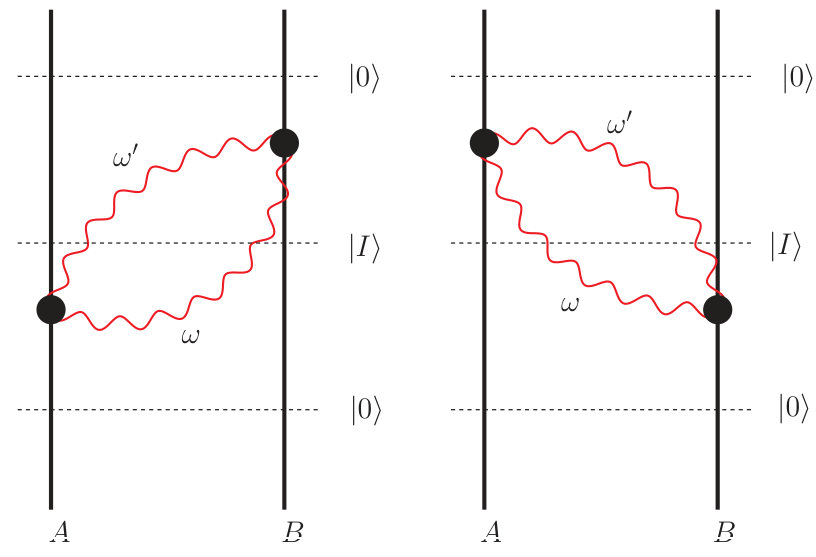 Figure 1
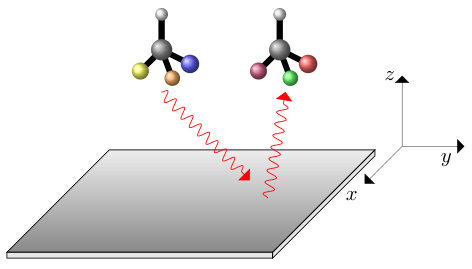 Figure 2
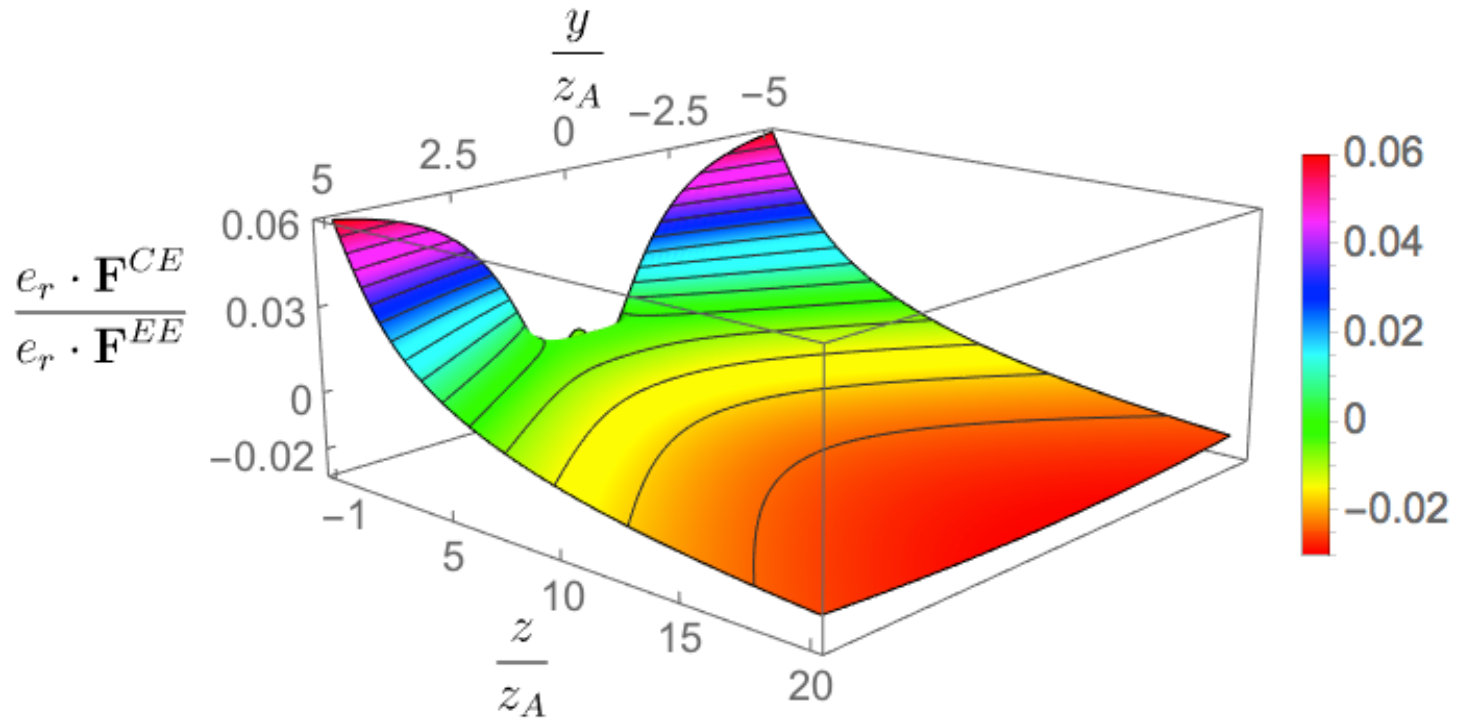 Figure 3
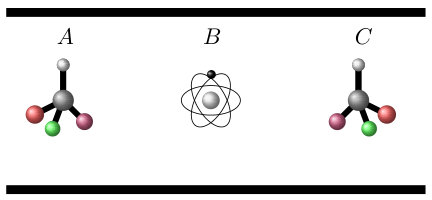 Figure 4
Peer Reviews
No public reviews on file for this paper yet. If you reviewed it on a platform where reviews are public (OpenReview, ICLR, NeurIPS, ICML), you can paste yours below so the community can read it here.
Videos
No videos yet. Explain this paper in a talk, walkthrough, or lecture? Add one.
Enhanced chiral discriminatory van der Waals interactions mediated by chiral surfaces
Pablo Barcellona
Physikalisches Institut, Albert-Ludwigs-Universität Freiburg, Hermann-Herder-Str. 3, 79104 Freiburg, Germany
Hassan Safari
Physics and Photonics Department, Graduate University of Advanced Technology, P.O. Box 76315-117, Mahan, Kerman, Iran
A. Salam
Department of Chemistry, Wake Forest University, Winston-Salem, NC 27109, USA
Stefan Yoshi Buhmann
Physikalisches Institut, Albert-Ludwigs-Universität Freiburg, Hermann-Herder-Str. 3, 79104 Freiburg, Germany
Freiburg Institute for Advanced Studies, Albert-Ludwigs-Universität Freiburg, Albertstr. 19, 79104 Freiburg, Germany
Abstract
We predict a discriminatory interaction between a chiral molecule and an achiral molecule which is mediated by a chiral body. To achieve this, we generalize the van der Waals interaction potential between two ground-state molecules with electric, magnetic and chiral response to non-trivial environments. The force is evaluated using second-order perturbation theory with an effective Hamiltonian. Chiral media enhance or reduce the free interaction via many-body interactions, making it possible to measure the chiral contributions to the van der Waals force with current technology. The van der Waals interaction is discriminatory with respect to enantiomers of different handedness and could be used to separate enantiomers. We also suggest a specific geometric configuration where the electric contribution to the van der Waals interaction is zero, making the chiral component the dominant effect.
pacs:
34.20.Cf, 33.55.+b, 33.80.-b,42.50.Nn
††preprint: APS/123-QED
Introduction.
Casimir and van der Waals (vdW) forces are electromagnetic interactions between neutral macroscopic bodies and/or molecules due to the quantum fluctuations of the electromagnetic field Casimir48 ; CasimirPolder48 ; Milonni94 . In particular, the attractive vdW potential between two electrically polarisable particles was first derived by Casimir and Polder using the minimal-coupling Hamiltonian CasimirPolder48 . Molecules can also exhibit magnetic Mavroyannis ; feinberg ; feinberg2 ; safari2 and chiral polarisabilities Mavroyannis ; jenkins ; salam and their contribution to the vdW force can be repulsive.
The aim of this work is the study of the interaction between chiral molecules in the presence of a chiral magneto-dielectric body. Chiral molecules lack any center of inversion nor plane of symmetry. Hence they exist as two distinct enantiomers, left-handed and right-handed, which are related to space inversion. Due to their low symmetry they have distinctive interactions with light. In a chiral solution the refractive indices for circularly polarized light of different handedness are different. Hence a chiral solution can rotate the plane of polarization of light with an angle related to the concentration of the solution (optical rotation) Rosenfeld ; Atkins ; Powerchiral2 , or absorb left- and right-circularly polarised light at different rates (circular dichroism) Powerchiral . All of these phenomena are related to the optical rotatory strength, defined in terms of electric () and magnetic () dipole moment matrix elements craig :
[TABLE]
The rotatory strength changes sign under spatial inversion. Hence the contributions of the vdW force containing the rotatory strength are discriminatory with respect to the handedness of enantiomers jenkins ; butcher ; Buhmann . According to the Curie dissymmetry principle curie , the handedness of an enantiomer can only be detected by means of a second reference object which is also chiral (”It takes a thief to catch a thief”). This second object can be either a second chiral molecule, or in our case, a chiral medium.
Such discriminatory features could play an important role in the separation of enantiomers butcher , which nowadays is achieved with other methods like Coulomb explosion imaging pitzer , rotational spectroscopy shubert , and liquid chromatography kimata .
Previously, the vdW interaction between two chiral molecules was considered in free space jenkins . In this scenario the chiral part of the vdW force is several orders of magnitude smaller than the purely electric contribution. We will show that this is no longer true when the chiral molecules are near a magneto-dielectric body which exhibits chiral properties. Chiral media can be realized experimentally using tunable metamaterials soukoulis , made from structures such as a gold helix gansel or a twisted woodpile rill , where large optical activity requires the lack of a mirror plane parallel to the substrate. These media will enhance or reduce the vdW potential via many-body interactions shajesh ; milton . Note that evidence for three-body dispersion forces has recently been found for the critical Casimir effect gambassi .
The article is organized as follows. We first develop an effective Hamiltonian in order to derive the vdW potential between two chiral molecules near magneto-dielectric bodies. We then study the interaction between two chiral molecules in free space and subsequently introduce a chiral plate in order to enhance the chiral contribution.
Van der Waals potential.
In order to consider the vdW interaction of chiral molecules with a generic body, field quantization in an absorbing chiral medium is required butcher . We introduce the vector field as the bosonic annihilation operator for the electric () and magnetic () excitations, respectively. They obey the commutation relation . Denoting by the vacuum state of the electromagnetic field, the excited photonic states are obtained by repeated action of the creation operator on the vacuum state. For instance, a two-photon excited state is given as Introducing the frequency component of the fields by , which for the free field in the Heisenberg picture are simply Fourier components, we may write the electric field in terms of the bosonic annihilation operators as
[TABLE]
and with the tensors being defined in terms of the Green’s tensor G according to Ref. butcher . The Green’s tensor contains all geometrical as well as magneto-dielectric properties of the environment via the frequency-dependent relative permittivity, relative permeability and chiral susceptibility. It satisfies a useful integral relation with the mode-tensors :
[TABLE]
where is the vacuum permeability.
The interaction between atoms (or molecules) and the field may be described by an effective interaction Hamiltonian passante , which represents processes where two photons are created or annihilated at the same time:
[TABLE]
where is the electric polarizability and represents the chiral polarizability. It can be expressed in terms of the electric and magnetic dipole moments:
[TABLE]
where is the transition frequency between the excited state and the ground state. In writing the effective Hamiltonian we have considered chiral molecules which respect time-reversal symmetry. In this case, Lloyd’s theorem states that electric dipole moments are real, while magnetic dipole moments are purely imaginary lloyd . We thus have . The chiral polarizability describes a mixed electric-magnetic response where an applied magnetic field contributes to an electric dipole moment in the atom:
[TABLE]
Thus the direction of the electric dipole moment is slightly rotated with respect to the direction of the electric field. The chiral polarizability is discriminatory since it changes sign between different enantiomers. It vanishes for achiral molecules because of parity.
With the interaction Hamiltonian being quadratic in the fundamental operators and , it is seen that the energy shift describing the interaction between the two molecules A and B can be obtained from second order perturbation theory
[TABLE]
where and . The intermediate state corresponds to a state in which both molecules are in their ground state with two virtual photons being present. The relevant two-photon processes are represented by the Feynman diagrams in Fig. 1.
The collective sum in Eq. (7) runs over both discrete and continuous parameters. Using the interaction Hamiltonian (17), making use of the integral relation (15), and simplifying the resulting expression using contour integral technique in the complex frequency plane, the purely electric and electric-chiral energy shifts take the final forms
[TABLE]
Resonant terms in the molecular frequencies have been avoided by means of infinitesimal imaginary shifts. The purely electric (achiral) contribution is well known in literature safari2 ; safari3 . Other terms contributing to the total van der Waals interaction are given in the supplementary material.
Chiral molecules in free space.
To apply our general results to free space, one uses the bulk Green’s tensor
[TABLE]
where is the speed of light, , , , , and .
The order of magnitude of a specific contribution of the vdW energy is roughly given by the respective polarizability, and thus depends on the numbers of electric and magnetic dipole moments. An electric dipole has an order of magnitude of , where is the Bohr radius, while the magnetic moment has an order of magnitude of the Bohr magneton . Hence is of the order of the fine-structure constant. The leading order contribution is that from the purely electric term, which contains four electric dipole moments.
The next-to-leading term is the chiral-electric contribution, , which contains three electric and one magnetic dipole moments. However, if the chiral polarizability of the molecule is isotropic, . This vanishing interaction is a consequence of the Curie dissymmetry principle curie : the vdW potential cannot distinguish the handedness of the chiral molecule if the other molecule is not chiral.
The next-order terms contain two electric and two magnetic dipole moments: and . For isotropic polarizabilities, it has been shown that jenkins ; salam :
[TABLE]
where and is the vacuum permittivity. The interaction scales as in the non-retarded limit, but decreases more rapidly in the far-zone () due to the finite velocity of light. This result can be obtained in our formalism by using the vacuum Green’s tensor.
Because the purely electric energy contains four electric dipole moments and contains two electric and two magnetic dipole moments, the latter is roughly four orders of magnitude smaller than the former. This shows the necessity to use magneto-dielectric bodies to make the chiral contribution appreciable. While is strictly zero in free space for isotropic molecules, this is no longer true with general material environments, which exhibit chiral properties.
Chiral molecules near a perfect chiral plate.
With the introduction of a body, the fluctuations of the electromagnetic field are influenced by the presence of the boundary. The interaction between chiral molecules is a two-photon exchange, where photons can be reflected by the body’s surface (Fig. 2). The total Green’s tensor is the sum of the bulk (free-space) Green’s tensor and the scattering Green’s tensor of the plate , that accounts for the reflection of the electromagnetic field from surfaces: .
If one species is chiral and the other one is achiral we need a chiral surface to observe a discriminatory effect. The simplest surface is a perfect chiral plate which reflects a -polarized wave to an -polarized wave and vice versa with reflection coefficients and . This is a limit of a chiral plate, which may approached for metamaterials with large optical activity. In other words, it rotates the polarisation of an incoming wave by an angle of when looking along the direction of the wave vector. Its scattering Green’s tensor reads:
[TABLE]
where , , and we have introduced the polarization unit vectors , . The parallel and perpendicular components of the wave vector, and , are related via . For a plate of positive chirality , , and for a plate of negative chirality , .
The perfect chiral plate has no influence on the purely electric contribution, which reduces to the well-known electric van der Waals interaction in free space. Instead, it influences the leading-order chiral contribution, which in the non-retarded limit (all distances much lower than the relevant atomic transition wavelength) reads:
[TABLE]
where . If the two species are chiral, there is another discriminatory term which is however much smaller than .
Consider, for example, the interaction between a Rubidium atom and the chiral molecule 3-methylcyclopentanone (3-MCP) steck ; kroner . The molecule 3-MCP has a particularly small electric dipole moment and a magnetic dipole moment comparable to the Bohr magneton; this kind of system is suitable to observe enhanced chiral effects.
We suppose the position of the molecule A is fixed and we write the resulting energy in terms of the interparticle separation, ; . The total force acting on B is and its direction differs from because of the presence of the additional surface. We choose, without loss of generality, a coordinate system such that the plate corresponds to the plane, both species lie in the plane with the coordinates of molecule being . The degree of attractiveness is quantified by using the parameter , where .
A three-dimensional plot shows the relative importance between electric and chiral contributions for a plate of negative chirality (see Fig. 3).
The chiral contribution is maximally enhanced when both species are aligned parallel to the surface (), having a large distance along the -direction (). In this case the chiral contribution is attractive and one order of magnitude smaller than the purely electric contribution (). When both species are aligned perpendicular to the surface () and have a large distance along the -direction (), the chiral contribution is repulsive and two orders of magnitude smaller than the electric contribution ().
Our chiral contribution could be observed in Rydberg molecules, which have large dipole moments and therefore strong van der Waals interactions crosse . We expect a strongly enhanced interaction between a Rydberg molecule and a chiral molecule, which does not have to be in a Rydberg state. On the other hand it has been recognized that it is possible to create chiral Rydberg molecules, exciting moving Rydberg atoms of Rubidium by two right- or two left-circularly polarized photons hammer . Such systems could be used in a proof-of-principle experiment. If two identical chiral Rydberg molecules are exposed to a resonant laser, the laser can cause the system to oscillate between the ground state and the excited states. From the oscillations of the molecular populations it is possible to deduce the van der Waals interaction. The experiment has been performed with Rubidium atoms where (van der Waals coefficient of the energy ) has been determined with an accuracy of for the excited Rydberg state beguin . Note that if one molecule is absorbed onto the surface the strength of the interaction is even higher because of the influence of the substrate on the molecular polarizability, as shown in Ref. kawai .
Most importantly, the chiral contribution is discriminatory: it changes sign if we substitute a chiral molecule with its enantiomer or a positive chiral plate with a negative one. Hence by determining whether the free interaction is enhanced or reduced by the presence of the plate, it could be possible to identify the handedness of the chiral molecule. This discriminatory effect also suggests configurations, where the non-chiral contributions of the van der Waals force completely vanish, but not the chiral contributions. Fig. 4 shows such possible geometry.
Three species are in the symmetry axis of a cavity composed of two identical chiral plates. We are interested in the force acting on the middle achiral atom . This experiment allows us to establish if the two chiral molecules and have the same handedness. If and have the same handedness then the force acting on is strictly zero; this is no longer true if they are opposite enantiomers because of chiral discriminatory contributions of the vdW force. This interaction is enantiomer selective because atom will be attracted or repelled from molecule A depending on the handedness of the latter. Hence if we know the handedness of one chiral molecule we are able to determine the handedness of the other one with this experiment. Note that the recently predicted exponential suppression of the electric vdW potential in a parallel mirror cavity melo or in a planar waveguide haak might further assist the observability of the chiral component. Three-body discriminatory chiral contributions are also present in the cavity configuration, however they are smaller with respect to the analyzed two-body contributions.
Alternatively, in scattering experiments one commonly has molecular beams of chiral molecules containing both enantiomers in equal proportions. This molecular beam can travel near a gas of chiral molecules of one handedness, prepared for example with liquid chromatography. The interactions with the gas molecules will lead to a separation of the trajectories of the molecules in the beam, depending on their handedness. This trajectory imaging technique has been already used for Rubidium Rydberg atoms thaicharoen .
Conclusions.
Our model, which combines time-independent perturbation theory with an effective-Hamiltonian approach, has allowed us to study the influence of material environments on the vdW interaction involving chiral molecules.
We see that surfaces with chiral properties can significantly enhance chiral contributions. The chiral contribution can be repulsive unlike the purely electric force which is always attractive. For some positions the plate enhances the free interaction (attractive chiral contribution) and for other positions it reduces the interaction (repulsive chiral contribution).
Secondly, the chiral force is discriminatory with respect to enantiomers of different handedness, thus opening an interesting perspective on the separation of enantiomers. We suggest symmetric configurations where we selectively cancel the purely electric contribution, but not the chiral components: this selective cancellation is a direct consequence of the non-discriminatory nature of electric and magnetic interactions, and the discriminatory nature of the chiral components.
Acknowledgement.–
This work was supported by the Deutsche Forschungsgemeinschaft (Grants BU 1803/3-1 and GRK 2079/1) and the Freiburg Institute for Advanced Studies (FRIAS).
Supplementary material
Van der Waals potential in absorbing media.
In order to consider the vdW interaction of chiral molecules with a generic body, field quantization in an absorbing chiral medium is required butcher . In order to achieve a compact notation, let us represent electric and magnetic quantities, by numeric labels 0 and 1, respectively.
For example, we introduce dual electromagnetic fields as and , and the frequency component of the fields by
[TABLE]
we may write the fields in terms of the bosonic annihilation operators as
[TABLE]
with the tensors being defined in terms of the Green’s tensor G according to Ref. butcher . They satisfiy the useful integral relation with the mode-tensors :
[TABLE]
In addition, the superscripts used in Eq. (14) and Eq. (15), for an arbitrary tensor are defined as follows:
[TABLE]
The interaction between atoms (molecules) and field may be described by an effective interaction Hamiltonian passante ,
[TABLE]
where represents the ground-state electric (), magnetic () or chiral () polarizability of the molecule. With the assignments , the polarizabilities can be written in a general form:
[TABLE]
where is the transition frequency between the excited state and the ground state. We will consider time-reversal symmetric systems, for which the electric dipole elements are real and the magnetic dipole elements are purely immaginary. Note that the Hamiltonian, in Eq. 17, generalizes the effective Hamiltonian in the main text for dynamical polarizabilities.
The energy shift describing the interaction between the two molecules A and B can be obtained from second order perturbation theory. The two-photon matrix element reads:
[TABLE]
Using the integral relation Eq. (15) and the transpose properties of the Green’s tensors and polarizabilities we find:
[TABLE]
The rotation of the integral in the imaginary axis gives:
[TABLE]
Resonant terms in the molecular polarisabilities have been avoided by means of infinitesimal imaginary shifts.
The interaction is obviously duality invariant, or in other words symmetric over a simultaneous global exchange of electric and magnetic properties duality . In particular can be obtained from () by using a duality transformation duality .
Restricting our consideration to non-chiral molecules reduces Eq. (22) to the known results in Ref. safari2 , which correspond to the terms with and . Doing so, the abandoned terms are indeed the contributions from the chirality of one or both molecules which are the focus of this paper.
The purely electric contribution and the chiral contribution are stated in the main text. The chiral contribution reads:
[TABLE]
Scattering Green’s tensor.
The scattering Green’s tensor for a a chiral plate is introduced in the main text. In the non-retarded limit the parallel and orthogonal components of the wave-vector coincide, leading to the following scattering Green’s tensor :
[TABLE]
where the positive sign is for a positive chiral plate, and the negative sign for a negative chiral plate. Furthermore .
In general the non-retarded limit does not commute with the curl operation. We must take the curl of the full Green’s tensor and only after make the non-retarded limit. The action of the curl is equivalent to the action of on the left side, where . Taking into account , the curl of the Green’s tensor reads:
[TABLE]
In the non-retarded limit:
[TABLE]
The reference list from the paper itself. Each links out to its DOI / PubMed record.
- 1(1) H. B. G. Casimir, Proc. K. Ned. Akad. Wet. 51 , 793 (1948).
- 2(2) H. B. G. Casimir and D. Polder, Phys. Rev. 73 , 360 (1948).
- 3(3) P. W. Milonni, The Quantum Vacuum , Academic Press, San Diego, 1994.
- 4(4) C. Mavroyannis and M. J. Stephen, Mol. Phys. 5 , 629 (1962).
- 5(5) G. Feinberg and J. Sucher, J. Chem. Phys. 48 , 3333 (1968).
- 6(6) G. Feinberg and J. Sucher, Phys. Rev. A 2 , 2395 (1970).
- 7(7) H. Safari, D.-G. Welsch, S. Y. Buhmann, and S. Scheel, Phys. Rev. A. 78 , 062901 (2008).
- 8(8) J. K. Jenkins, A. Salam, and T. Thirunamachandran, Phys. Rev. A 50 , 4767 (1994).