Absence of the Pauli-Paramagnetic Limit in a Superconducting U$_6$Co
Masahiro Manago, Kenji Ishida, Dai Aoki

TL;DR
This study uses NMR measurements to show that U$_6$Co superconductors do not exhibit the Pauli-paramagnetic limit, supporting a full-gap s-wave pairing mechanism with negligible spin susceptibility changes.
Contribution
It provides the first NMR evidence that U$_6$Co lacks the Pauli-paramagnetic limit, indicating unique superconducting properties related to its small spin susceptibility.
Findings
Negligible change in the spin part of the Knight shift in the SC state.
Absence of the Pauli-paramagnetic effect in U$_6$Co.
Exponential behavior of $1/T_1$ at low temperatures supports full-gap s-wave pairing.
Abstract
We performed Co nuclear magnetic resonance (NMR) measurements of single-crystalline UCo. There is a small decrease in the Knight shift in the superconducting (SC) state, but this change mainly arises from the SC diamagnetic effect. The negligible change of the spin part of the Knight shift, together with the absence of the Pauli-paramagnetic effect in the SC UCo, is understood as a consequence of the small spin susceptibility. The nuclear spin-lattice relaxation rate is also measured in the SC state under the magnetic field, and exhibits a tiny Hebel-Slichter peak just below the SC transition temperature and exponential behavior at lower temperatures. These behaviors are in agreement with the full-gap s-wave pairing in UCo.
Click any figure to enlarge with its caption.
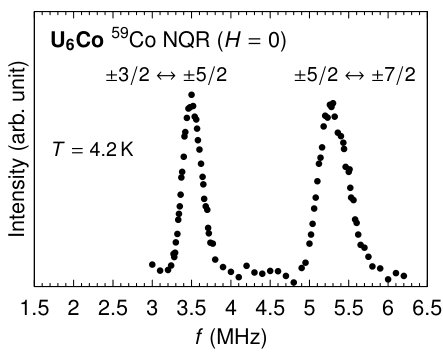 Figure 1
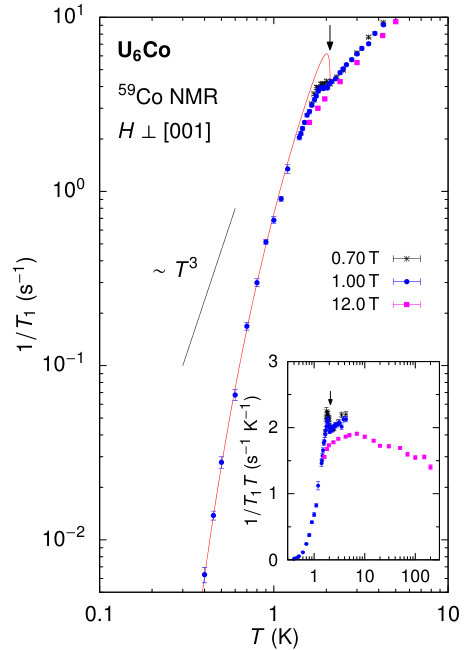 Figure 2
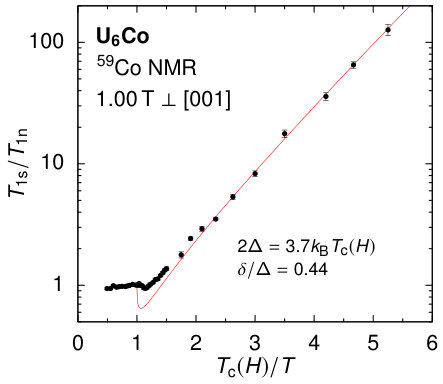 Figure 3
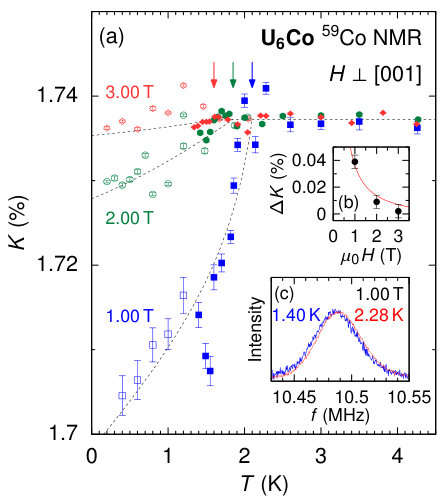 Figure 4
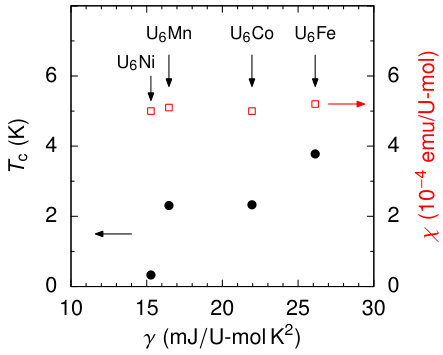 Figure 5
Peer Reviews
No public reviews on file for this paper yet. If you reviewed it on a platform where reviews are public (OpenReview, ICLR, NeurIPS, ICML), you can paste yours below so the community can read it here.
Videos
No videos yet. Explain this paper in a talk, walkthrough, or lecture? Add one.
Absence of the Pauli-Paramagnetic Limit in a Superconducting
UCo
Masahiro Manago
Kenji Ishida
Department of Physics, Graduate School of Science, Kyoto University, Kyoto 606-8502, Japan
Dai Aoki
IMR, Tohoku University, Oarai, Ibaraki 311-1313, Japan
INAC/PHELIQS, CEA-Grenoble, 38054 Grenoble, France
Abstract
We performed 59Co nuclear magnetic resonance (NMR) measurements of single-crystalline UCo. There is a small decrease in the Knight shift in the superconducting (SC) state, but this change mainly arises from the SC diamagnetic effect. The negligible change of the spin part of the Knight shift, together with the absence of the Pauli-paramagnetic effect in the SC U6Co, is understood as a consequence of the small spin susceptibility. The nuclear spin-lattice relaxation rate is also measured in the SC state under the magnetic field, and exhibits a tiny Hebel-Slichter peak just below the SC transition temperature and exponential behavior at lower temperatures. These behaviors are in agreement with the full-gap -wave pairing in U6Co.
Uranium compounds U6X (X = Mn, Fe, Co, and Ni) are superconductors with relatively high superconducting (SC) transition temperatures among the uranium-based compounds.Chandrasekhar and Hulm (1958); Hill and Matthias (1968) Contrary to other uranium-based heavy-fermion systems including ferromagnetic superconductors,Aoki and Flouquet (2012) electrons in U6X compounds exhibit an itinerant nature even at room temperature, and do not exhibit magnetic ground states. The SC properties are consistent with the conventional one: for instance, the full-gap superconductivity of U6Co ( K) has been indicated by the penetration depth,Hou et al. (1987) nuclear spin-lattice relaxation rate ,Kohori et al. (1987) and more recently, by specific heat measurements.Aoki et al. (2016) Thus, at present, these compounds are good reference systems for the uranium-based unconventional superconductors.
It has been suggested that the superconductivity of U6X might be close to ferromagnetism,DeLong et al. (1985) because the total magnetic susceptibility of these compounds is so large that it is comparable to that of the nearly ferromagnetic metal Pd. This can be interpreted as a sign of the strongly enhanced electronic spin susceptibility owing to the electronic correlation. However, the magnetic properties of U6X in the normal state are quite different from those of ferromagnetic superconductors,Aoki and Flouquet (2012) in which ferromagnetic instability is commonly observed, while it is usually unfavorable for conventional superconductivity. Therefore, it is necessary to determine whether U6X compounds are close to the ferromagnetism and to consider the origin of the large magnetic susceptibility in them.
It is also noteworthy that SC U6Co has a large upper critical field for . In spin-singlet superconductors, the superconductivity is limited by the Pauli-paramagnetic effect under a magnetic field. This is because the spin susceptibility decreases in the SC state, and the energy difference between the SC and the normal states reduces under a larger magnetic field due to the magnetic energy in the normal state. The Pauli-limiting field is expressed as in the weak-coupling BCS model, where is the -factor. If this is applied to U6Co assuming , T is obtained. However, along the and directions in U6Co in the tetragonal structure is 7.85 and 6.56 T, respectively,Aoki et al. (2016) and both of them exceed 4.3 T. The Pauli-paramagnetic effect is actually absent in U6Co. The large value has been considered to originate from the small -factor.Aoki et al. (2016)
In this paper, we report 59Co NMR measurements of U6Co, which are performed to further investigate the electronic spin susceptibility from a microscopic point of view. We found that the NMR Knight shift exhibits a small decrease in the SC state. This result suggests that the spin susceptibility of U6Co is not a dominant term in the total susceptibility, but that the Van Vleck term is a main term.
We used a single-crystalline UCo sample with K for the NMR study. The sample was cooled using liquid 4He or a 3He-4He dilution refrigerator. 59Co NMR was performed with the magnetic field perpendicular to the direction, and the Knight shift and were measured. Since the 59Co nucleus has spin and the Co site does not have cubic symmetry, the NMR spectrum splits into 7 lines owing to a nuclear quadrupole interaction. All the NMR data were measured at the central line (). The magnetic field was calibrated using a 63Cu signal arising from the NMR coil. In addition to NMR measurements, we performed nuclear quadrupole resonance (NQR) measurements of a powdered single-crystalline sample to obtain information about the homogeneity of the crystal structure.
Figure 1 shows the 59Co NQR spectrum of the powdered sample. The quadrupole frequency is estimated as MHz for the present sample. The asymmetric parameter is almost [math], which is consistent with the fact that the electric field gradient at the Co site has axial symmetry with respect to the direction. The value of in this sample is slightly larger and the line width is broader than those in the previous NQR study.Kohori et al. (1987) Nevertheless, a clear SC anomaly is observed in the single-crystalline sample, as mentioned later, and thus, the present samples are suitable for studying the superconductivity of U6Co.
The values in UCo at 1.00 T are shown in Fig. 2. A Hebel-Slichter (HS) peak is found just below as observed in the previous NQR measurement under zero magnetic field,Kohori et al. (1987) although the HS peak is more strongly suppressed than that in the previous NQR. This result again indicates that UCo is an -wave superconductor. The HS peak is slightly larger at 0.70 T than at 1.00 T, indicating that the peak is suppressed by the magnetic field. Figure 3 shows against , where () is the relaxation rate in the SC (normal) state. An exponential decrease of is observed at lower temperatures, although the relaxation curves have a short- component in the SC state arising from the vortex core. The value shown in Figs. 2 and 3 corresponds to a longer- component. The behavior in U6Co is evidence of a nodeless gap.
The solid curves in Figs. 2 and 3 are a result of the calculation based on the -wave full-gap model, and they reproduce the experimental result in . The density of states (DOS) in the SC state is broadened by a rectangle function with a width of and a height of for the calculation of . The calculated and DOS are expressed as follows:
[TABLE]
The SC gap is set to from Ref. Aoki et al., 2016, and . The strong suppression of the HS peak just below is not reproduced even with the relatively large and may be ascribed to the magnetic field. Recently, the Doppler shift effect, or the so-called Volovik effect, has been proposed as a mechanism of the suppression of the HS peak of the -wave superconductor under the magnetic field.Ding et al. (2016) The Volovik effect has been regarded as a minor effect on the low-energy excitation of quasiparticles in the case of full-gap superconductors, but this cannot be neglected for the HS peak, because it is sensitive to the edge form of the SC DOS particularly just below . Therefore, it is considered that the suppression of the peak in U6Co under the magnetic field could be explained by the Volovik effect.
of U6Co in the normal state exhibits the Korringa relation with just above , as seen in the inset of Fig. 2, and this value is not strongly enhanced compared with other uranium-based heavy-fermion systems. For instance, this is quite smaller than that of the itinerant ferromagnetic superconductor UCoGe: – in the paramagnetic state under zero magnetic field depending on the temperature.Ohta et al. (2010) Instead, of U6Co is close to that of 59Co in YCoGe, which is a nonmagnetic reference compound of UCoGe: (Ref. Karube et al., 2011). The ordinary value in the normal state implies that the SC phase of U6Co is not in proximity to the ferromagnetic ground state.
The Knight shifts of UCo at several fields below 4.2 K are shown in Fig. 4 (a), and the NMR spectra at 1.00 T are shown in Fig. 4 (c). The decrease in the Knight shift extrapolated to is % (1.00 T), % (2.00 T), and % (3.00 T), and these values are much smaller than the total Knight shift of %. In general, the Knight shift decreases due to a diamagnetic field as well as a decrease in the spin susceptibility in the SC state. is roughly expressed as (defined as positive), where , is the external field, is a Ginzburg-Landau parameter, and is the lower critical field.Tinkham (1996) Therefore, the diamagnetic shift is strongly suppressed with increasing . On the other hand, the spin part of the Knight shift is at lower fields ( is close to unity), and thus the Knight-shift change arising from the spin part does not strongly depend on as long as . The experimental Knight-shift decrease is suppressed with increasing even well below and this is qualitatively similar to the behavior of . In addition, the field dependence of the Knight-shift decrease is roughly reproduced with a theoretical formula of the diamagnetic field, which is valid in a wide range of the fields,Brandt (2003) as shown in Fig. 4 (b). Here, we adopt for the best fit of the experiment, which is close to estimated from and the thermodynamic field.Aoki et al. (2016) This also suggests that the diamagnetic effect is a dominant origin of the Knight-shift change in UCo.
The magnitude of could not be properly determined in this study, but there is a constraint on the value of , as discussed below. Noting that decreases faster than against , and assuming that for , then in the normal state satisfies . The lower limit is not quite strict because the concrete form of is not assumed, and the upper limit is obtained by the Knight-shift change at 3.00 T. Therefore, this constraint on does not necessarily mean that a negative is more likely than a positive one.
Here, we attempt to estimate how the Knight shift would behave when the Pauli-paramagnetic effect is absent in U6Co. Since the magnetic susceptibility is temperature-independent in the normal state,Aoki et al. (2016) the hyperfine coupling constant cannot be determined through a comparison between the susceptibility and the Knight shift. Thus, we tentatively adopt for the 59Co hyperfine coupling constant in U6Co, which is a typical value for 59Co in uranium-based compounds such as UCoGeIhara et al. (2010) and UCoAl.Nohara et al. (2011) This is based on the assumption that the U electrons are transferred to the Co electrons, and the contribution of the Co electrons is relatively small. Considering the absence of the Pauli-paramagnetic effect, satisfies , where is the decrease of the spin susceptibility in the SC state (a volume susceptibility in SI units for calculating ) and is the thermodynamic field. Using T at 0 K (Ref. Aoki et al., 2016) and the lattice parametersEngelhardt (1975) of U6Co, is deduced, which is much smaller then the total value .Aoki et al. (2016) Thus the Knight-shift change in a spin part is estimated as %, where is Avogadro’s number, and is the Bohr magneton. The actual change of the Knight shift after subtracting the diamagnetic effect is sufficiently less than this limit.
It is known that the Knight-shift decrease is suppressed by spin-orbit scattering in the dirty-limit superconductors.Anderson (1959); Miyake and Asayama (2000) In the case of UCo, since the mean free path is estimated to be on the same order of the BCS coherence length,Aoki et al. (2016) this mechanism plays a minor role in the suppression of the Knight shift change. Although the above discussion is based on the assumption that is positive and not very small, the small spin susceptibility is a promising origin of the small Knight-shift change in UCo. The absence of the Pauli-paramagnetic effect is closely related to the Knight-shift behavior in the SC state in U6Co.
In some uranium-based superconductors such as UPt3Tou et al. (1998) and URu2Si2Hattori et al. (2016), the Knight-shift change due to SC pairing is much smaller than the total value. This means that the large part of the Knight shift is not related to the quasiparticles at the Fermi energy . This also applies to U6Co: slightly depends on the temperature as seen in the inset of Fig. 2, reflecting the structure of the DOS around , while such a temperature-variation is not seen at all in the magnetic susceptibility of U6CoAoki et al. (2016) and in the present Knight shift at 12.0 T (not shown). This indicates that the spin part of the Knight shift and spin susceptibility are quite small in total. Therefore, the spin state of the SC pairing should be carefully discussed when the Knight-shift change is absent in uranium-based superconductors.
The small spin susceptibility of U6Co is also inferred from a comparison among U6X compounds. The discussion here is based on Table VII in Ref. DeLong et al., 1985, and some of the data are shown in Fig. 5. The electronic specific heat coefficient of U6X varies between –, and the compound with a larger has a higher . This tendency is consistent with the BCS theory, in which a larger DOS at is more favorable for the superconductivity. However, the total susceptibilities of U6X compounds are similar (approximately in the powder samples), and this suggests that most of the susceptibility is independent of the quasiparticles around . It seems that the Van Vleck term should make a dominant contribution to the susceptibility in these systems. The small spin susceptibility is consistent with the small -factor,Aoki et al. (2016) and this is not surprising if the strong spin-orbit coupling in actinides is taken into consideration.Moore and van der Laan (2009)
Finally, we comment on the present Knight shift in U6Co. A positive and thus, positive are assumed in the above discussion for simplicity, but this is not actually evident since the Co -electronic spins would lead to negative hyperfine coupling owing to core polarization if they have finite DOS at . If the core polarization is a dominant mechanism in the spin part of the Knight shift, should be negative. In this case, the Knight shift could shift to larger values in the SC state depending on the magnitude of , which is not experimentally detected in the present field ranges. There is even a possibility that the positive Co and negative contributions cancel out each other, as seen in V metal,Noer and Knight (1964) and the spin part of the Knight shift might remain constant in the SC state even if the spin susceptibility is sufficiently large for the Pauli-paramagnetic effect to occur. As for the orbital part of the 59Co Knight shift in U6Co, this does not necessarily originate only from the U Van Vleck terms. Co electrons also produce the orbital part of the Knight shift depending on the band occupancy. These issues can be resolved if the band structure of U6Co is clarified.
In summary, we performed 59Co NMR measurements on a single crystal of UCo, and found that the Knight-shift change in the SC state is small compared with the total Knight shift. This result, as well as the large upper critical field, can be understood to occur because the spin susceptibility is much smaller than the total susceptibility. The absence of the Pauli-paramagnetic effect is likely to be associated with the negligible change in the Knight shift in this system. The value of the expected Knight-shift change in the SC state was estimated by using the plausible value of the hyperfine coupling constant. The behavior in the SC state is in good agreement with the -wave full gap of U6Co.
The authors would like to thank K. Okamoto and T. Urai for contributing to the experiment. They would also like to thank Y. Yanase, S. Kitagawa, Y. Maeno, S. Yonezawa, H. Harima, and H. Ikeda for their valuable discussions. One of the authors (MM) is a research fellow of the Japan Society for the Promotion of Science (JSPS). This work was supported by Kyoto University LTM Center, and by a Grant-in-Aid for Scientific Research (Grant No. JP15H05745) and Grant-in-Aids for Scientific Research on Innovative Areas “J-Physics” (Grants No. JP15H05882, No. JP15H05884, and No. JP15K21732) from JSPS.
The reference list from the paper itself. Each links out to its DOI / PubMed record.
- 1Chandrasekhar and Hulm (1958) B. S. Chandrasekhar and J. K. Hulm, J. Phys. Chem. Solids 7 , 259 (1958) . · doi ↗
- 2Hill and Matthias (1968) H. H. Hill and B. T. Matthias, Phys. Rev. 168 , 464 (1968) . · doi ↗
- 3Aoki and Flouquet (2012) D. Aoki and J. Flouquet, J. Phys. Soc. Jpn. 81 , 011003 (2012) . · doi ↗
- 4Hou et al. (1987) M. K. Hou, C. Y. Huang, and C. E. Olsen, Solid State Commun. 61 , 101 (1987) . · doi ↗
- 5Kohori et al. (1987) Y. Kohori, T. Kohara, Y. Kitaoka, K. Asayama, M. B. Maple, and M. W. Mc Elfresh, J. Phys. Soc. Jpn. 56 , 1645 (1987) . · doi ↗
- 6Aoki et al. (2016) D. Aoki, A. Nakamura, F. Honda, D. Li, and Y. Homma, J. Phys. Soc. Jpn. 85 , 073713 (2016) . · doi ↗
- 7De Long et al. (1985) L. E. De Long, R. P. Guertin, S. Hasanain, and T. Fariss, Phys. Rev. B 31 , 7059 (1985) . · doi ↗
- 8Ding et al. (2016) Q.-P. Ding, P. Wiecki, V. K. Anand, N. S. Sangeetha, Y. Lee, D. C. Johnston, and Y. Furukawa, Phys. Rev. B 93 , 140502 (2016) . · doi ↗