A maser based on dynamical backaction on microwave light
L. D. T\'oth, N. R. Bernier, A. K. Feofanov, T. J. Kippenberg

TL;DR
This paper demonstrates a novel microwave maser driven by dynamical backaction in a superconducting circuit, reversing typical optomechanical roles, and achieves stabilized, low-noise maser operation through injection locking.
Contribution
It introduces a new regime where mechanical dissipation dominates, enabling dynamical backaction on microwave light and demonstrating maser action with stabilization techniques.
Findings
Achieved maser oscillation driven by mechanical backaction.
Demonstrated injection locking to stabilize maser frequency.
Reversed the typical optomechanical dissipation hierarchy.
Abstract
The work of Braginsky introduced radiation pressure dynamical backaction, in which a mechanical oscillator that is parametrically coupled to an electromagnetic mode can experience a change in its rigidity and its damping rate. The finite cavity electromagnetic decay rate can lead to either amplification or cooling of the mechanical oscillator, and lead in particular to a parametric oscillatory instability, associated with regenerative oscillations of the mechanical oscillator, an effect limiting the circulating power in laser gravitational wave interferometers. These effects implicitly rely on an electromagnetic cavity whose dissipation rate vastly exceeds that of the mechanical oscillator, a condition naturally satisfied in most optomechanical systems. Here we consider the opposite limit, where the mechanical dissipation is engineered to dominate over the electromagnetic one,…
Click any figure to enlarge with its caption.
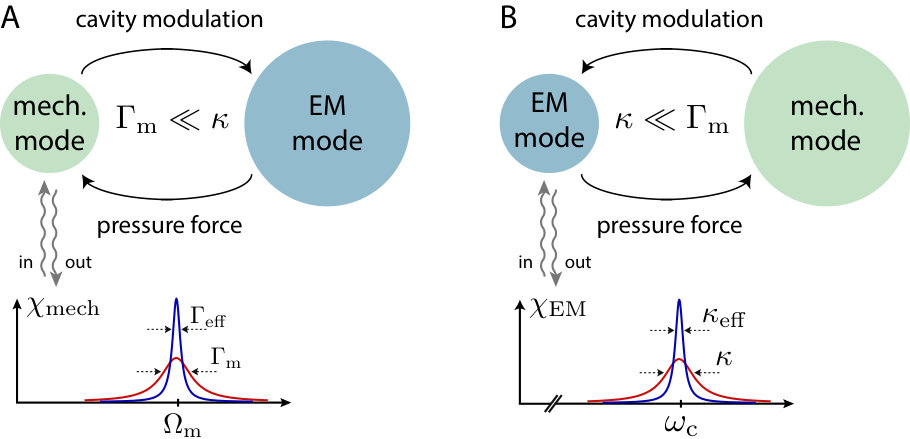 Figure 1
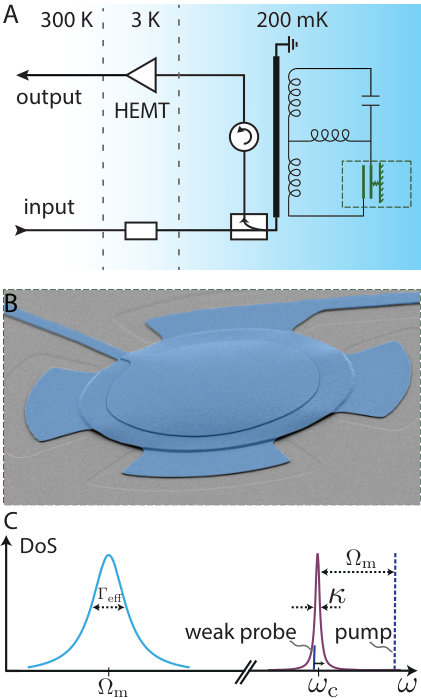 Figure 2
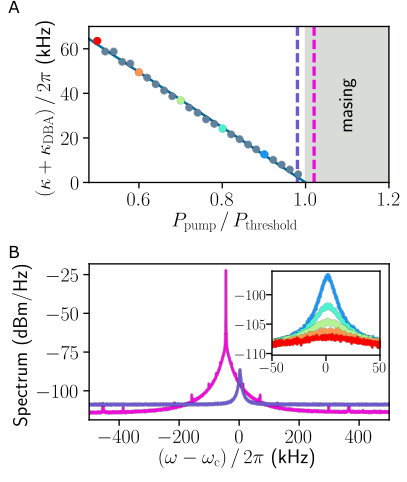 Figure 3
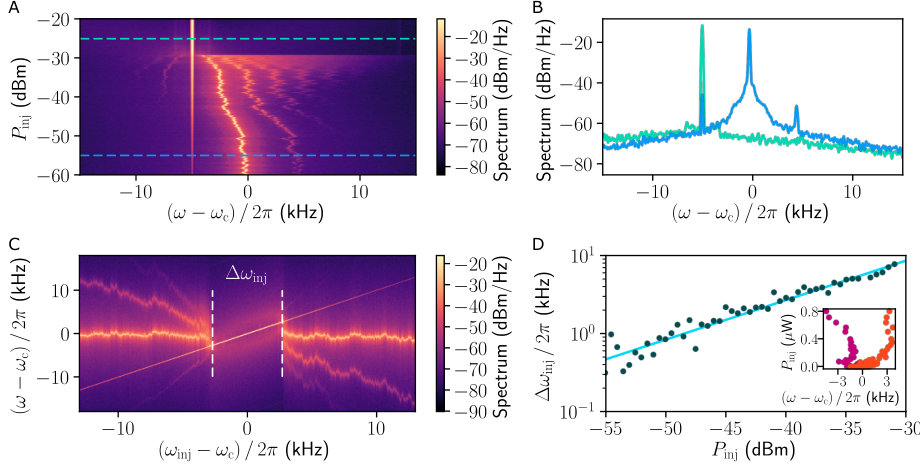 Figure 4
Peer Reviews
No public reviews on file for this paper yet. If you reviewed it on a platform where reviews are public (OpenReview, ICLR, NeurIPS, ICML), you can paste yours below so the community can read it here.
Videos
No videos yet. Explain this paper in a talk, walkthrough, or lecture? Add one.
††thanks: These authors contributed equally to this work††thanks: These authors contributed equally to this work
A maser based on dynamical backaction on microwave light
L. D. Tóth
N. R. Bernier
Institute of Physics, École Polytechnique Fédérale de Lausanne, Lausanne 1015, Switzerland
A. K. Feofanov
Institute of Physics, École Polytechnique Fédérale de Lausanne, Lausanne 1015, Switzerland
T. J. Kippenberg
Institute of Physics, École Polytechnique Fédérale de Lausanne, Lausanne 1015, Switzerland
Abstract
The work of Braginsky introduced radiation pressure dynamical backaction, in which a mechanical oscillator that is parametrically coupled to an electromagnetic mode can experience a change in its rigidity and it’s damping rate. The finite cavity electromagnetic decay rate can lead to either amplification or cooling of the mechanical oscillator, and lead in particular to a parametric oscillatory instability, associated with regenerative oscillations of the mechanical oscillator, an effect limiting the circulating power in laser gravitational wave interferometers. These effects implicitly rely on an electromagnetic cavity whose dissipation rate vastly exceeds that of the mechanical oscillator, a condition naturally satisfied in most optomechanical systems. Here we consider the opposite limit, where the mechanical dissipation is engineered to dominate over the electromagnetic one, essentially reversing role of electromagnetic and mechanical degree of freedom. As a result, the electromagnetic field is now subject to dynamical backaction: the mechanical oscillator provides a feedback mechanism which modifies the damping rate of the electromagnetic cavity. We describe this phenomenon in the spirit of Braginsky’s original description, invoking finite cavity delay and highlighting the role of dissipation. Building on previous experimental work, we demonstrate this dynamical backaction on light in a superconducting microwave optomechanical circuit. In particular, we drive the system above the parametric instability threshold of the microwave mode, leading to maser action and demonstrate injection locking of the maser, which stabilizes its frequency and reduces its noise.
More than 50 years ago, the seminal work of Braginsky Braginski and Manukin (1967); Braginsky et al. (1970) introduced the notion of radiation pressure dynamical backaction, in the context of a mechanical oscillator coupled parametrically to an electromagnetic mode. This arrangement enables to measure mechanical motion with high precision as required in particular for gravitational wave detectors, but radiation pressure can constitute a limitation. As the cavity field adjusts to the oscillator motion, the radiation pressure force it generates acts as a feedback force which can acquire an out-of-phase component due to the finite cavity delay and modify the mechanical damping rate. This dynamical backaction poses a limitation to the circulating power in Fabry-Perot interferometers, due the parametric oscillatory instability, in which amplification compensates the intrinsic mechanical losses, leading to regenerative oscillations of the mechanical end mirror. Radiation pressure parametric instability, as proposed by Braginsky Braginsky et al. (2001) was first observed in toroid micro-resonators in 2005 Kippenberg et al. (2005), and gives rise to a rich nonlinear dynamics Marquardt et al. (2006). Soon thereafter, dynamical backaction cooling, an effect Braginsky predicted Braginsky and Vyatchanin (2002) to occur for red-detuned laser excitation, was demonstrated Gigan et al. (2006); Arcizet et al. (2006); Schliesser et al. (2006). Although the parametric instability was first analyzed for a single electromagnetic mode coupled to a mechanical oscillator, the effect can also occur for multi-mode systems in which modes are spaced by the mechanical frequencies Kells and D’Ambrosio (2002), a scenario in which the parametric oscillator stability in advanced LIGO at the Livingston observatory Evans et al. (2015) was observed. Although undesirable in the context of LIGO, the ability to amplify and cool mechanical motion using dynamical backaction is at the heart of the advances in cavity opto- and electromechanics over the past decade Aspelmeyer et al. (2014) that have enabled mechanical systems to be controlled at the quantum level. Dynamical backaction control over mechanical oscillators has enabled to cool micro- and nanomechanical oscillators to unprecedentedly low entropy states Verhagen et al. (2012); Teufel et al. (2011a); Chan et al. (2011), and thereby opened a path to study optomechanical quantum effects ranging from optomechanical squeezing, mechanical squeezed states, sideband asymmetry, to entanglement of mechanical motion with microwaves Safavi-Naeini et al. (2013); Purdy et al. (2013); Sudhir et al. (2017); Nielsen et al. (2017); Wollman et al. (2015); Palomaki et al. (2013); Pirkkalainen et al. (2015); Lecocq et al. (2015); Riedinger et al. (2016).
It is interesting to highlight the role of dissipation in dynamical backaction. Indeed dissipation determines the resulting modification of the mechanical and optical susceptibility due to the optomechanical interaction. In almost all optomechanical systems ranging from gravitational wave observatories to nano-optomechanical systems, the electromagnetic dissipation dominates over the mechanical one, leading to the above mentioned optomechanical phenomena. In contrast, if the mechanical oscillator is more dissipative than the electromagnetic mode, the roles are reversed Nunnenkamp et al. (2014). In this situation, (but still obeying the condition that the mechanical dissipation occurs on a timescale that is long compared to the mechanical oscillator period, or equivalently stated the mechanical quality factor is still exceeding unity), the dynamical backaction that occurs for detuned laser excitation causes a feedback force that is applied to the electromagnetic mode, resulting in amplification or damping. This electromagnetic dynamical backaction leads to a parametric oscillatory instability that now corresponds to the action of a maser. (i.e. the stimulated emission of microwaves). Here we describe an experiment in which we realize such a maser based on the dynamical backaction amplification of microwave light. We design a microwave optomechanical circuit Teufel et al. (2011b) with two microwave cavities coupled to the same mechanical oscillator, formed by a vacuum gap capacitor Cicak et al. (2010). The auxiliary (low Q) microwave mode is used to sideband-cool the mechanical mode until its dissipation rate dominates over the main (high Q) microwave mode. With a strong blue-detuned tone, the main mode is coupled to the mechanical mode, resulting in microwave gain from dynamical backaction and masing. We proceed to perform injection locking of this maser.
Mathematical description of Dynamical Backaction
We start by reformulating Braginsky’s original derivation of dynamical backaction Braginski and Manukin (1967); Braginsky et al. (2001) for the case of a blue-detuned pump, in a way that showcases how the process is reversed in the case of an opposite dissipation hierarchy. Consider an electromagnetic mode with frequency and energy dissipation rate coupled, via the standard optomechanical coupling, to a mechanical mode with resonant frequency and energy dissipation rate . While Braginsky considered the limit to derive the delayed feedback force experienced by the mechanical oscillator due to the electromagnetic field, we consider here the sideband-resolved regime Marquardt et al. (2007); Wilson-Rae et al. (2007); Schliesser et al. (2008) , relevant for our experiment. We consider the equations of motion parametrically coupling the mechanical oscillator to the electromagnetic cavity. These (for simplicity classical and linearized) equations can be written in a rotating frame for the phasors of the two modes; in the case of a pump driving the system on the upper motional sideband at a detuning
, they are given by the coupled-modes equations
[TABLE]
where describes the state of the mechanical mode of mass , is the phasor for the electromagnetic mode and is the vacuum optomechanical coupling rate enhanced by the field of the blue-detuned pump. In the rotating frame, the variables describe the slowly changing amplitude and phase of the rapidly oscillating field and oscillator, at and . Each of the two harmonic oscillators is subject to a “force” (denoted by and ) proportional to the state of the other harmonic oscillator, establishing a feedback mechanism: cavity intensity fluctuations create a radiation pressure force acting on the mechanical oscillator, while mechanical displacement modulates the cavity resonance frequency. The symmetry of the relationship is broken by the different scales of the dissipation rates.
Braginsky originally considered the case where electromagnetic dissipation dominates (). This is natural in most systems as the quality factors are commensurate for the electromagnetic and mechanical modes, while there is a large (many orders of magnitude) separation of scales in their respective frequencies. In this limit, the electromagnetic field envelope almost instantly adapts to the mechanical displacement () and becomes proportional to it such that . The field then exerts a force on the mechanical oscillator proportional to the state of the latter, given by . Therefore, the interaction can be viewed as a simple feedback loop. The factor represents a delay of a quarter period for the feedback force acting on the mechanical oscillator. This delay means that the force, acting in quadrature, increases the amplitude of the phasor, equivalent to a decrease in mechanical damping or gain. If the pump detuning does not fall exactly on the sideband, the delay is not exactly and the force has an in-phase component, modifying the frequency of the mechanical oscillator (this effective change of the mechanical spring constant is called the optical spring effect). The amplification process can be understood as a positive feedback that measures the state of the mechanical oscillator and returns it with a delay as a force, i.e. a dynamical backaction (see fig. 1 A). For sufficiently high coupling strength , this leads to a parametric oscillatory instability, that causes regenerative oscillations of the mechanical oscillator, and thus limits the maximal circulating power for a gravitational wave detector Braginsky et al. (2001).
In this letter, we study the converse process, where the mechanical dissipation rate dominates (). Now the envelope of mechanical oscillations nearly instantly adjusts to the state of the electromagnetic field () and is proportional to it such that . The field is then subject to an in-quadrature “force” proportional to its own state where , introducing the multiphoton cooperativity . Similarly to above, the force has a delay of a quarter period and increases the amplitude of electromagnetic oscillations, compensating for damping by an amount given by , such that the effective energy decay rate of the cavity is . A change in detuning would again slightly modify this delay and create components of the in-phase force component, changing the speed of oscillations, and displacing the resonance frequency of the cavity (thus creating a mechanical spring effect). This is equivalent to a feedback loop for the electromagnetic mode (see fig. 1 B), and implies that the mechanical oscillator is responsible for dynamical backaction on light. As above, the positive feedback can lead to a parametric instability. For , the anti-damping caused by this feedback exactly compensates the losses (both intrinsic and external) of the electromagnetic mode, and the cavity develops self-sustained oscillations i.e. acts as a maser. The intrinsic optomechanical nonlinearity sets the maximum amplitudes of the oscillations Nunnenkamp et al. (2014) and the dynamics is no longer captured by the linearized eqs. 1 and 2. Experimentally, this dynamical backaction on the microwave mode can be observed by measuring the emission spectrum of the electromagnetic mode. Below the masing threshold, one expects amplified noise at the output of the device in a bandwidth which is commensurate with the effective energy decay rate . At the threshold, this bandwidth collapses to zero and a strong, spectrally pure signal emerges from the cavity.
Experimental realization
We experimentally explore dynamical backaction on an electromagnetic (EM) mode from a mechanical oscillator and the resulting maser action in a microwave optomechanical circuit. The circuit, made of thin-film aluminium on a sapphire substrate, supports two EM modes in the microwave regime (we denote them as primary and auxiliary modes with resonance frequencies GHz and GHz, respectively). One of the elements in the circuit is a parallel-plate vacuum-gap capacitor with a suspended top electrode, forming the mechanical oscillator (fig. 2 B). The resonance frequency of the fundamental flexural mode is , whose motion is coupled to both EM modes with a vacuum electromechanical coupling strength . The device is cooled to 200 mK in a dilution refrigerator (see fig. 2 A) and can be probed in reflection using a vector network analyzer or its spectrum can be measured at the output port using a spectrum analyzer. The input line is filtered and attenuated at various temperature stages to eliminate extraneous Johnson- and phase-noise and the output line is amplified using a commercial HEMT amplifier at 3 K. Using a strong pump on the lower motional sideband of the auxiliary EM mode, the mechanical mode is damped to kHz, or times the energy dissipation rate of the primary EM mode.
Then, we couple the mechanical motion to the primary EM mode using a pump placed on the upper motional (blue) sideband (see fig. 2 C). This coupling introduces dynamical backaction on the microwave mode, changing its susceptibility (i.e. resonance frequency and damping rate) as we increase the pump power. A prominent manifestation of this change, in the case of a pump on the upper motional sideband, is the narrowing of the linewidth of the electromagnetic resonance, corresponding to a decrease in the energy decay rate (anti-damping). The apparent decay rate of the cavity becomes , where is linearly proportional to the power of the tone at the blue sideband. We monitor the output spectrum of the cavity for different pump powers, as shown in fig. 3 A and observe that the width of the resonance decreases in a linear fashion, as expected. Above a certain pump power, the feedback mechanism introduced by dynamical backaction compensates the intrinsic loss of the microwave mode and the system acts as an amplifier with net gain (the inset of fig. 3 B shows amplified noise emerging from the cavity for different pump powers). At sufficiently high pump power, for unit cooperativity , dynamical backaction compensates the total energy decay rate of the EM mode (, where is the external coupling rate), and the system undergoes a transition into the self-sustained oscillatory regime. The microwave cavity, now acting as a maser, emits a single, pure tone at its resonance frequency (fig. 3 B), orders of magnitude ( dB) stronger than just below the threshold.
Injection locking
We now demonstrate the locking of our maser with a weak injected tone. Injection locking is a synchronization phenomenon of lasers and masers Siegman (1986), and has been demonstrated in many systems, including recently in a trapped-ion phonon laser Knünz et al. (2010), a quantum cascade laser St-Jean et al. (2014), a quantum-dots maser Liu et al. (2015) as well as an AC Josephson junction maser Cassidy et al. (2017). A weak tone of frequency close to the maser emission frequency will compete for gain with it in a way that effectively couples the two oscillations and permits synchronization. The phenomenon is generally described by the Adler equation Adler (1946)
[TABLE]
which models the dynamics of the relative phase of the two oscillations. If the injected tone falls within a locking range of width centered around the masing frequency , the two tones lock and the phase difference becomes constant. This range depends on the ratio between the injected tone power , attenuated by factor at the input of the cavity, and the maser emission power . Outside this range, the Adler equation predicts that the maser frequency is pulled towards the injected tone and that distortion sidebands appear due to the two tones beating and the intrinsic nonlinearity Adler (1946). We first study this phenomenon by placing the injected tone 5 kHz away from the maser and monitoring the output spectrum while the injected power is varied (fig. 4 A). The maser emission is pulled towards the injected tone and finally locks at an injected power threshold corresponding here to about -30 dBm. As the two tones become comparable in strength, distortion sidebands from the beating increase in amplitude. In the locked region, the noise surrounding the peak is considerably suppressed compared to the free-running case and the frequency jitter (originating from frequency instability of the cavity and the mechanical mode) is eliminated (fig. 4 B). We proceed to measure the locking range , by fixing the injected power and sweeping its frequency across the maser frequency (fig. 4 C). When the frequency difference is below , the two tones lock. The noise around the peak is suppressed and the frequency jitter of the maser ceases. Repeating the measurement at different injected powers , the locking range is shown to obey the expected scaling law (fig. 4 D). Finally, as an inset, the limit points of locking are shown as a function of power, drawing the so-called Arnold tongue Pikovsky et al. (2003). The asymmetric shape is due to drift of the masing frequency during the measurement, which do not affect the locking range .
Summary
In conclusion, we have described how dynamical backaction relies on the dissipation hierarchy between an electromagnetic (e.g. optical or microwave) mode and a mechanical mode. By modifying and reversing this hierarchy of dissipation dynamical backaction occurs on the electromagnetic mode, leading to amplification of microwaves, and eventually an instability, i.e. maser action. We realize and exploit this novel backaction mechanism in a superconducting circuit electromechanical system. When the system is pumped on the upper motional sideband of the cavity mode, backaction provides a positive feedback loop, leading to amplification and, when this feedback compensates the total energy decay rate of the cavity, to parametric instability. This results in maser action: a strong, spectrally pure tone emerges at the resonance frequency of the microwave cavity. We have measured injection locking of the maser, reducing its noise and stabilizing its frequency and have shown that the injection locking range as a function of input power follows Adler’s theory.
Acknowledgements.
The authors declare no competing financial interests. This work was supported by the SNF, the NCCR Quantum Science and Technology (QSIT), the European Union Seventh Framework Program through iQUOEMS (grant no. 323924) and Marie Curie ITN cQOM (grant no. 290161). TJK acknowledges financial support from an ERC AdG (QuREM). All samples were fabricated in the Center of MicroNanoTechnology (CMi) at EPFL.
The reference list from the paper itself. Each links out to its DOI / PubMed record.
- 1Braginski and Manukin (1967) V. B. Braginski and A. B. Manukin, Sov. Phys. JETP 25 , 653 (1967).
- 2Braginsky et al. (1970) V. B. Braginsky, A. B. Manukin, and M. Y. Tikhonov, Soviet Journal of Experimental and Theoretical Physics 31 , 829 (1970).
- 3Braginsky et al. (2001) V. B. Braginsky, S. E. Strigin, and S. P. Vyatchanin, Physics Letters A 287 , 331 (2001) . · doi ↗
- 4Kippenberg et al. (2005) T. J. Kippenberg, H. Rokhsari, T. Carmon, A. Scherer, and K. J. Vahala, Physical Review Letters 95 , 033901 (2005) . · doi ↗
- 5Marquardt et al. (2006) F. Marquardt, J. Harris, and S. Girvin, Physical Review Letters 96 , 103901 (2006) . · doi ↗
- 6Braginsky and Vyatchanin (2002) V. B. Braginsky and S. P. Vyatchanin, Physics Letters A 293 , 228 (2002) . · doi ↗
- 7Gigan et al. (2006) S. Gigan, H. R. Böhm, M. Paternostro, F. Blaser, G. Langer, J. B. Hertzberg, K. C. Schwab, D. Bäuerle, M. Aspelmeyer, and A. Zeilinger, Nature 444 , 67 (2006) . · doi ↗
- 8Arcizet et al. (2006) O. Arcizet, P.-F. Cohadon, T. Briant, M. Pinard, and A. Heidmann, Nature 444 , 71 (2006) . · doi ↗