Complete classification of generalized crossing changes between GOF-knots
Kai Ishihara, Matt Rathbun

TL;DR
This paper classifies all possible generalized crossing changes between genus one fibered knots by analyzing monodromies with specific arc properties, providing a complete understanding of when such transformations preserve fiberedness.
Contribution
It offers a complete classification of generalized crossing changes between genus one fibered knots based on monodromy analysis, extending prior partial results.
Findings
Identified all manifolds with genus one fibered knots undergoing generalized crossing changes
Determined conditions under which such crossing changes preserve fiberedness
Provided a comprehensive list of all such transformations
Abstract
We analyze all monodromies of genus one fibered knots that possess clean or once-unclean arcs, and use this to determine all manifolds containing genus one fibered knots with generalized crossing changes resulting in another genus one fibered knot, and classify all such generalized crossing changes between two genus one, fibered knots.
Click any figure to enlarge with its caption.
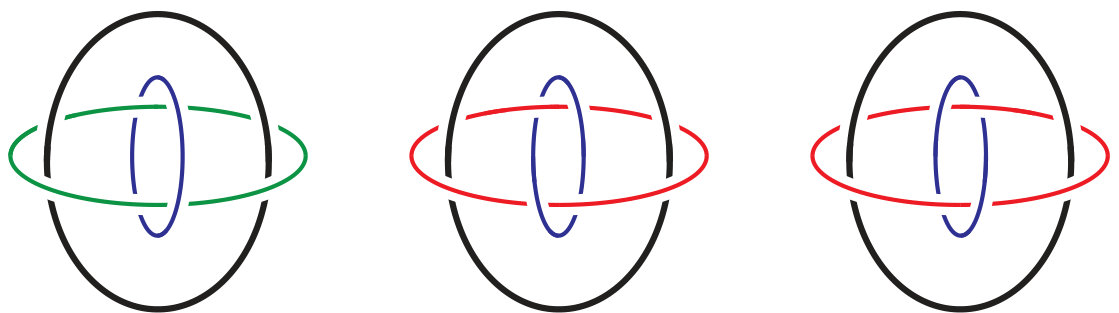 Figure 1
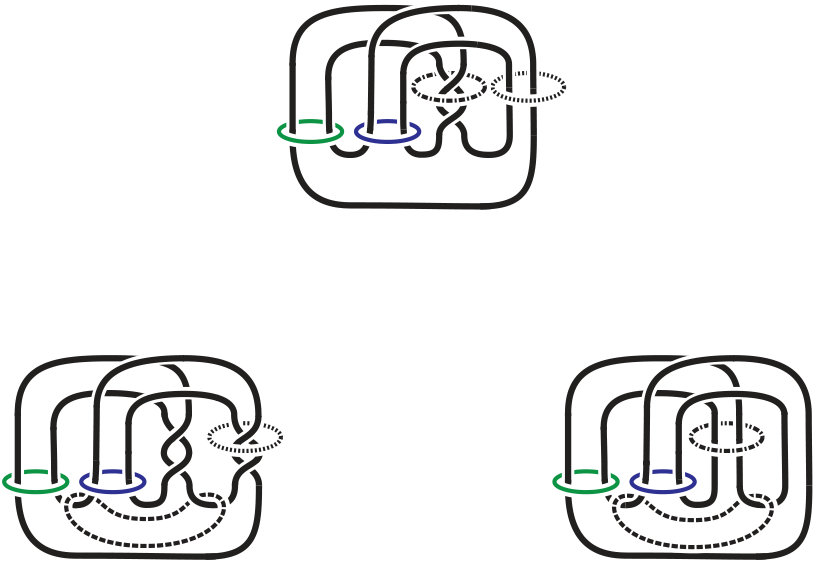 Figure 2
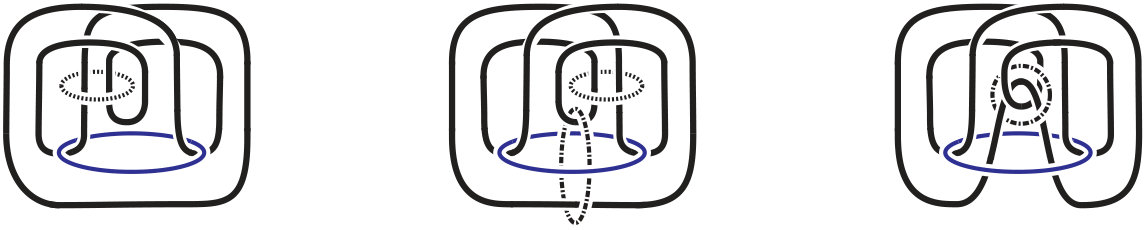 Figure 3
 Figure 4
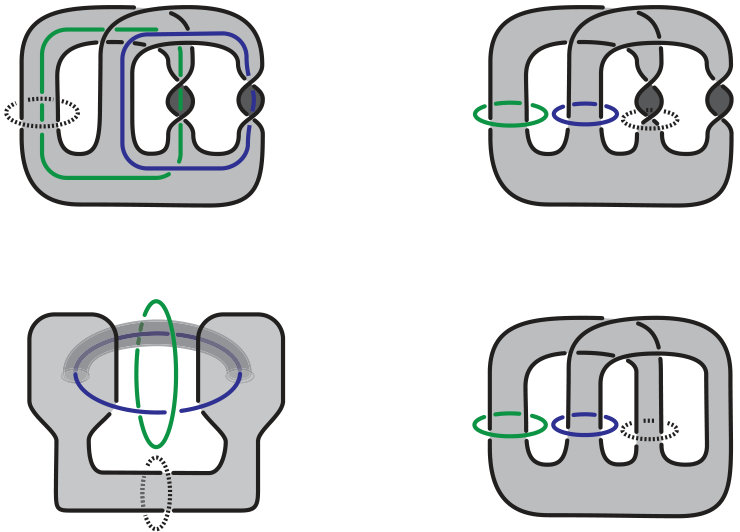 Figure 5
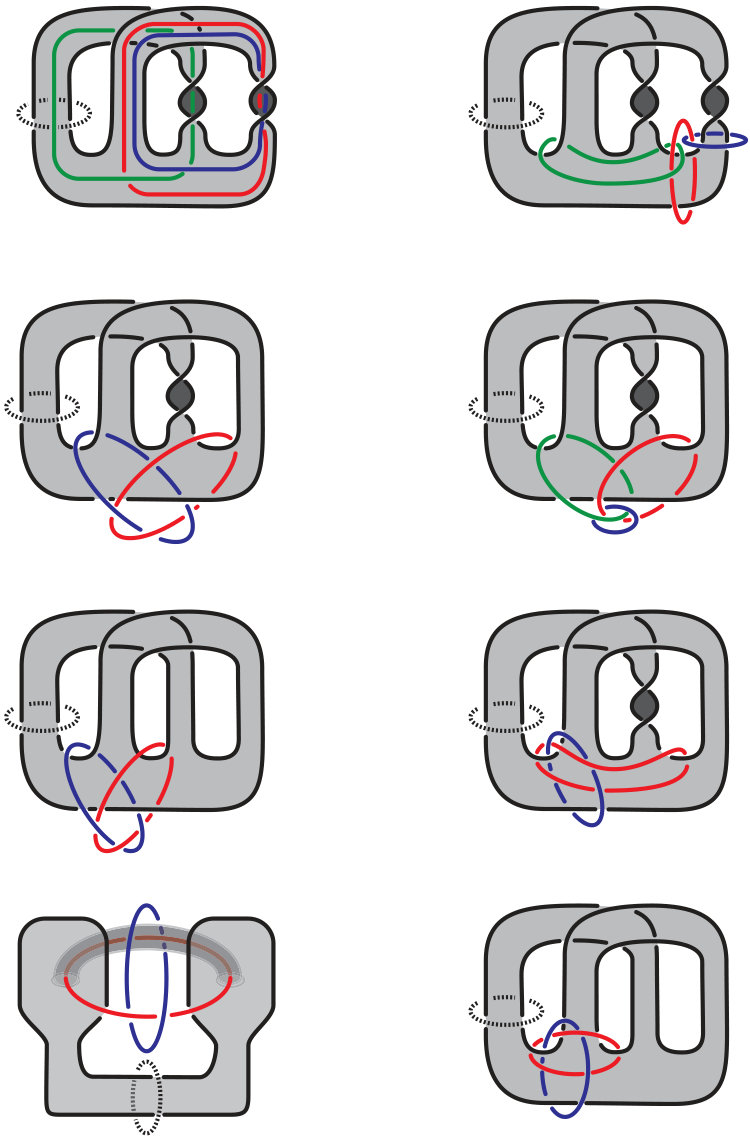 Figure 6
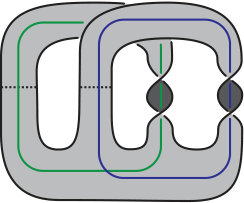 Figure 7
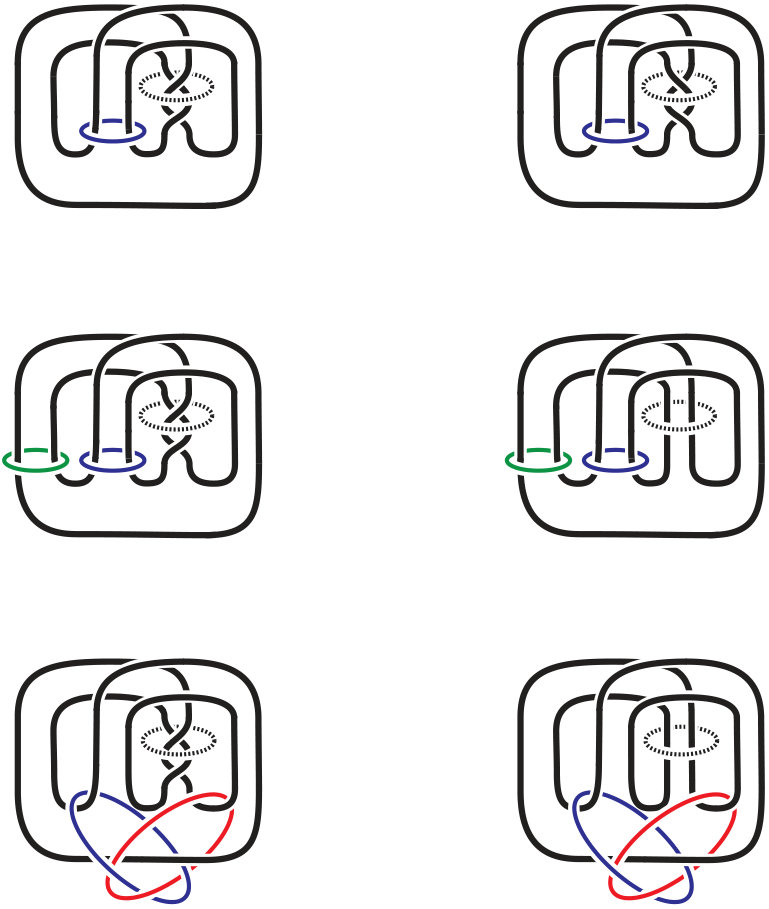 Figure 8
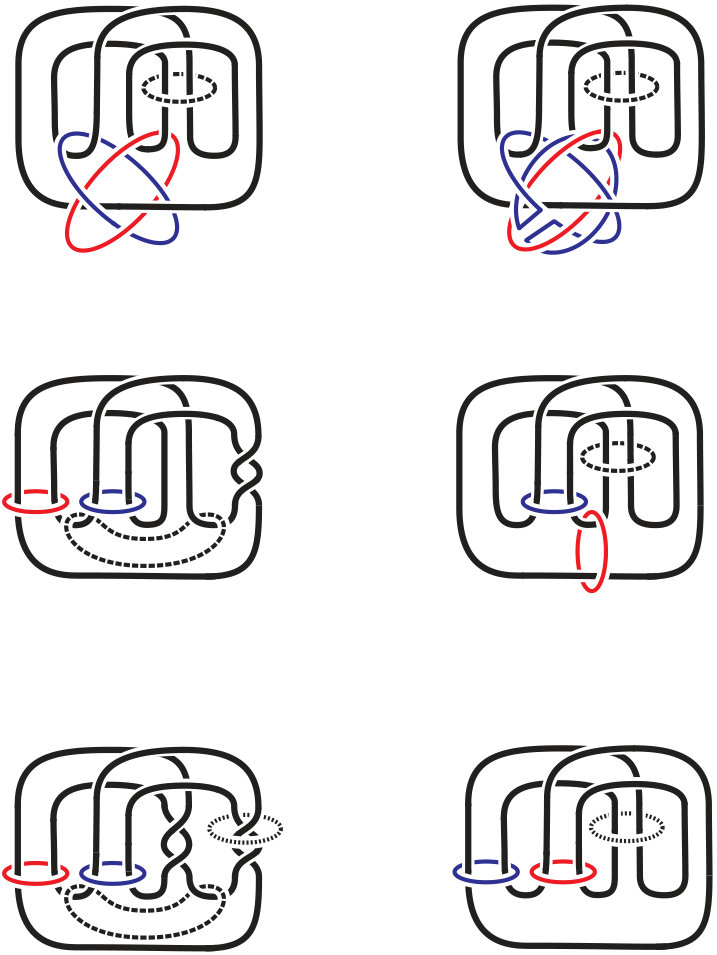 Figure 9
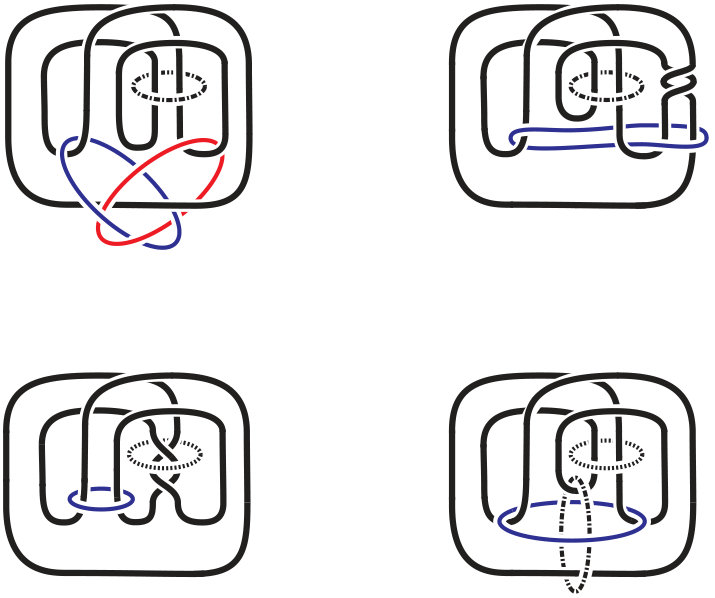 Figure 10
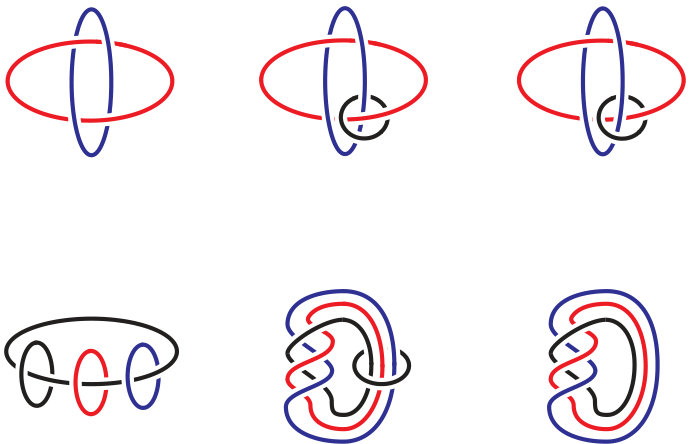 Figure 11
| Classification | Monodromy |
|---|---|
| Periodic | |
| Reducible | |
| Pseudo-Anosov | () () |
| () |
| Monodromy | -equivalence classes of clean or once-unclean arcs |
|---|---|
| 1 once-unclean arc | |
| 1 clean arc, 1 once-unclean arc | |
| 1 once-unclean arc | |
| 3 once-unclean arcs | |
| 1 once-unclean arc |
Peer Reviews
No public reviews on file for this paper yet. If you reviewed it on a platform where reviews are public (OpenReview, ICLR, NeurIPS, ICML), you can paste yours below so the community can read it here.
Videos
No videos yet. Explain this paper in a talk, walkthrough, or lecture? Add one.
Taxonomy
TopicsGeometric and Algebraic Topology · Homotopy and Cohomology in Algebraic Topology · Botulinum Toxin and Related Neurological Disorders
1112000 Mathematics Subject Classification. Primary 57M25; Secondary 57N10.
This work was supported by JSPS KAKENHI Grant Number 17K14190.
COMPLETE CLASSIFICATION OF
GENERALIZED CROSSING CHANGES BETWEEN GOF-KNOTS
Kai Ishihara and Matt Rathbun
Kai Ishihara
Yamaguchi University
1677-1 YoshidaYamaguchi 753-8513
Japan
e-mail: [email protected]
Matt Rathbun
California State University, Fullerton
Fullerton, CA
USA
e-mail: [email protected]
Abstract
We analyze all monodromies of genus one fibered knots that possess clean or once-unclean arcs, and use this to determine all manifolds containing genus one fibered knots with generalized crossing changes resulting in another genus one fibered knot, and classify all such generalized crossing changes between two genus one, fibered knots.
1 Introduction
Every closed, orientable -manifold contains a fibered knot, a knot whose exterior fibers over the circle with the knot bounding the fibers. A genus one fibered knot, or GOF-knot, is a fibered knot whose fiber is a once-punctured torus.
A crossing circle for a link is a circle that bounds a disk intersecting in two points with opposite orientations. We refer to the disk as a crossing disk. Then, a generalized crossing change along of order is a Dehn surgery on , with . Since bounds a disk, the ambient manifold does not change, but the link may. When , this is just an ordinary crossing change.
Let and be links in closed oriented -manifolds and , respectively. We say and are equivalent, denoted , if there is an orientation preserving homeomorphism from to which maps onto . Let and be crossing circles for and , respectively. We say the generalized crossing change on along of order and that on along of order are equivalent if and . Note that the resulting links are equivalent if the generalized crossing changes are equivalent. It is well known that any GOF-knot in the -sphere is equivalent to a (left-hand or right-hand) trefoil knot or a figure eight knot [6]. Morimoto [18] investigated how many GOF-knots are in a lens space, and Baker [2] completes this investigation by giving a criterion for determining the exact number of GOF-knots in each lens space. It is also known that there is no classical (order ) crossing change between any two of the three GOF-knots in . In this paper, we classify all generalized crossing changes between GOF-knots in any -manifold.
For the classification of generalized crossing changes between GOF-knots, we introduce families of GOF-knots, see Fig. 1: For any two integers and , a knot in a -manifold is obtained from the Borromean rings by and surgeries on two components. For any integer , a knot in a -manifold is obtained from in the Thistlethwaite link table (the mirror image of in the Rolfsen table[20]) by [math] and surgeries on the sub-link that is a -torus link. is the mirror image of .
Theorem 1.1**.**
Any order generalized crossing change between distinct GOF-knots is equivalent to one of the following for some integer , see Fig. 2.
- (1)
, a generalized crossing change between and ,
- (2)
, a (classical) crossing change between and ,
- (3)
, a (classical) crossing change between and .
As a result of identifying the manifolds and in which and sit (Theorem 3.9), we have the following corollary.
Corollary 1.2**.**
Every GOF-knot with a non-classical generalized crossing change resulting in another GOF-knot is in for some . 2. 2.
Every GOF-knot with a classical crossing change resulting in another GOF-knot is in for some , , or a prism manifold.
Here and refer to and , respectively, and denotes the connected sum of two manifolds.
Non-classical generalized crossing changes (resp., classical crossing changes) between GOF-knots must occur at specific arcs in the genus one fiber surface, which are called clean and alternating arcs (resp., once-unclean and alternating arcs) (Lemma 3.1). When such arcs are present, we will be able to factorize monodromies in specific ways (Lemmas 3.2, 3.3 and 3.4) to prove Theorem 1.1. Further, we will identify when there are arcs that may give rise to inequivalent generalized crossing changes, and prove the following corollary.
Corollary 1.3**.**
Any GOF-knot has at most two equivalence classes of generalized crossing changes which produce another GOF-knot. Moreover, when has two generalized crossing changes, is equivalent to one of the following:
* ( a figure-eight knot) in .* 2. 2.
* () or *
* () in .* 3. 3.
* () in .* 4.
* () in .* 5. 4.
* () or *
* () in .*
Remark 1.4**.**
For the homeomorphism indicated in item (3), see Fig. 14, and for the first homeomorphism indicated in item (4), see Fig. 15, both in the Appendix.
Example 1**.**
The -manifolds , , and each have three distinct GOF-knots up to equivalence. The manifold has four distinct GOF-knots (two mirror pairs) up to equivalence. In each case, all these GOF-knots are related by generalized crossing changes, see Figs. 3, 4, 5, and 6.
Remark 1.5**.**
By translating the monodromies listed here into elements of , it can be shown that the knots in Fig. 4 (from left to right) correspond to , , and from [18]. A particularly interesting observation, then, is that there is a crossing change between the knots and in [18].
We provide precise definitions of relevant terms in Section 2. In Section 3 we will discuss monodromies giving rise to clean or once-unclean arcs and we will identify the manifolds in which the relevant GOF-knots sit, and classify generalized crossing changes between GOF-knots, proving Corollary 1.2 and Theorem 1.1. In Section 4, we prove Corollary 1.3. In the Appendix, we provide additional surgery descriptions to show that certain manifolds are homeomorphic.
2 Definitions and Background
2.1 Automorphisms
Let be a compact, connected, oriented surface with boundary. Suppose is an arc properly embedded in the surface , and is a homeomorphism so that the restriction of to the boundary is the identity. As fixes the boundary pointwise, and necessarily share their endpoints. For this reason, whenever we say that two arcs and properly embedded in a surface are disjoint, we shall mean that they are disjoint on their interiors.
Thus, an arc is said to be clean (with respect to ) if and are disjoint, (i.e., ). We will also say that is once-unclean (with respect to ) if .
Assume that and have been isotoped (fixing endpoints) to intersect minimally. In general, will be a curve in with self-intersections. We may move the endpoints slightly into the interior of to obtain a curve immersed in the interior of . Choose an orientation on . There is an induced orientation on so that has a coherent orientation that agrees with the orientation of . Then the intial point of is the terminal point of and vice versa. Say that is right-veering if the orientations induced by the tangent vectors to then are opposite the orientation on at both endpoints of the arcs. We say that is left-veering if these orientations agree with the orientation on at both endpoints of the arcs. In either case, we say that the arc is alternating, as approaches on alternate sides at the endpoints. Otherwise, we say that is non-alternating. See Fig. 7.
Further, we will refer to a self-intersection point of , as a crossing. We say that the crossing is positive if the orientation induced by the tangent vectors to and then agrees with the orientation on , and negative if this orientation disagrees with that of . See Fig. 8.
2.2 Surface bundles, open book decompositions, and monodromy maps
Let be the unit interval . Given a homeomorphism as above, we can form , where for all , the surface bundle over . The map is called the monodromy of the bundle, and the bundle can also be denoted . Each copy of arising from is called a fiber. The resulting manifold is well-defined up to conjugation of in the mapping class group of , and Dehn-twisting along curves in parallel to boundary components of .
The surface bundle formed above has a toroidal boundary component arising from each boundary component of . If we fill each toral boundary component with a solid torus so that each loop in the torus arising from bounds a disk in the solid torus, where , the result is a closed -manifold, . The union of the cores of all so-filled solid tori forms a link in this -manifold. This link is often referred to as a fibered link in . In this language, each copy of the surface is again called a fiber. Alternatively, the link is called the binding of an open book decomposition of . In this language, each copy of the surface is called a page. For the purposes of this paper, we will largely use the terms interchangably, often preferring the language of fibrations or surface bundles for ease of exposition.
Given a particular page in an open book decomposition, and an arc properly embedded in , let denote a regular neighborhood of in . Then there is a unique loop in that bounds a disk in the manifold intersecting the page in exactly the arc . We will call an -loop for the page .
2.3 The arc complex and isometric actions on
The arc complex of a surface with boundary is a simplicial complex whose vertices correspond to the proper isotopy classes of (essential) arcs properly embedded in , and whose vertices span a simplex if the vertices correspond to isotopy classes of arcs that can be made pairwise disjoint (on their interiors) in .
Suppose is a once-punctured torus. In this case, is two-dimensional. In fact, by shrinking the boundary of , isotopy classes of essential arcs in are in one-to-one correspondence with essential simple closed curves in the torus, which, in turn, are in one-to-one correspondence with , the set of slopes on the torus. Further, two arcs in the punctured torus can be istoped to intersect minimally in points (in their interiors) if and only if their corresponding ratios and (in lowest terms, or ) satisfy: (see, for instance, [15]).
It is well known that the -skeleton of the arc complex of a once-punctured torus is the Farey graph, and that the complex has a very useful embedding into , the Gromov compactification of the hyperbolic plane. Each -dimensional simplex embeds as an ideal triangle, and each -simplex embeds as a geodesic line. There is also an associated dual tree , which embeds in by taking a vertex at the orthocenter of each triangle of , and joining two vertices arising from triangles in sharing an edge. (See [10].)
Suppose two essential arcs and properly embedded in are disjoint and non-isotopic. They correspond to two vertices spanning a -simplex of , and cutting open along results in a disk. Then by Alexander’s Trick, an automorphism of is determined up to free isotopy by the images of and under .
Further, an orientation-preserving homeomorphism of , which can be identified with an element of , induces an automorphism of , an automorphism of , and an orientation-preserving isometry of which extends to a continous map of , agreeing with the actions on and .
So, in particular, the monodromy map induces an isometry . By a slight (and common) abuse of notation, we will refer to both the isometry on and its extension to by . By the classification of hyperbolic isometries, is one of three classes: (1) elliptic, (2) parabolic, or (3) loxidromic, which correspond exactly to being (1) periodic, (2) reducible, or (3) pseudo-Anosov [23].
Another observation clarifies an important distinction between automorphisms of the once-puctured torus and the induced automorphisms on the arc complex for the once-punctured torus. The vertices of the arc complex are unoriented arcs. The oriented arc complex has vertices represented by oriented arcs in . Then double-covers , and there is a short exact sequence relating the automorphism groups,
[TABLE]
The hyper-elliptic involution, , is a non-trivial automorphism, even up to free isotopy, but preserves all free isotopy classes of arcs set-wise, reversing their orientations. Thus, the induced action of on generates the kernel of . This involution does not fix the boundary of , so it is not a monodromy map.
3 Crossing Changes
In this section, we will characterize all generalized crossing changes between two GOF-knots. We will first establish a correspondence between such generalized crossing changes and clean or once-unclean arcs in a fiber. Then we will classify all monodromies giving rise to such arcs. We will next describe the ambient spaces in which the fibered knots with these monodromies lie. Finally, we will classify all generalized crossing changes between GOF-knots.
3.1 Clean and once-unclean arcs
Baker, Johnson, and Klodginski classify once-punctured torus bundles that have tunnel number one, showing that they must be knot complements in lens spaces, [4]. This is closely related to once-punctured torus bundles with a clean arc with respect to the monodromy. Coward and Lackenby ([8]) have shown that if a GOF-knot has a clean arc that is alternating, then there are at most two distinct such arcs, up to monodromy equivalence. In [7], the authors with Buck and Shimokawa, investigate the related class of once-unclean arcs in fiber surfaces, and give a geometric characterization of when such arcs arise.
We recall that a crossing circle for a knot (or link) is a circle that bounds a disk intersecting in two points with opposite orientations. We refer to the disk as a crossing disk. Then, a generalized crossing change along of order is a Dehn surgery on , with . Since bounds a disk, the ambient manifold does not change, but the knot may. When , this is just an ordinary crossing change. Also, refers to the maximal Euler characteristic of all Seifert surfaces for , and a Seifert surface for is said to be taut if its Euler characteristic realizes .
Lemma 3.1**.**
If is a GOF-knot with fiber , is a crossing circle for , and the result of an order generalized crossing change (-twist) along is another GOF-knot, then bounds a disk that intersects in a single arc . Moreover, one of the following holds:
, is clean and alternating (not fixed) with respect to the monodromy of , or 2. 2.
, is once-unclean (and alternating) with respect to the monodromy of .
Proof..
Our method is similar to the proofs in from [16] and [22], relying on an important result of Gabai in [13]. Evidently, . Suppose that is a taut surface bounded by in the complement of . From the local picture, the crossing disk must intersect in a single arc. Let and be the images of and , respectively, after the generalized crossing change, and note that . By Corollary 2.4 of [13], at least one of or is taut for or . But then they both realize , so, in particular, must be taut for . There are no Euler characteristic surfaces in a once-punctured torus bundle besides the fiber, so , and the first part of the statement is established.
Now, in exactly the same way as obtaining Theorem 5 from Theorem 3 in [7], we have that if a crossing disk intersects a fiber surface in an arc, and the result of the generalized crossing change is another fiber bundle, then one of the two cases in the statement of the lemma occurs, or the arc is clean and non-alternating. However, Lemma 3.2 excludes the latter possibility. ∎
The converse of the first statement also holds – for a given arc properly embedded in a fiber surface, there is a uniquely determined crossing circle so that bounds a disk intersecting the fiber surface in . We call such a crossing circle an -loop, denoted by . Lemma 3.1 implies that non-classical generalized crossing changes (resp., classical crossing changes) between GOF-knots must occur at -loops for arcs that are clean and alternating (resp., once-unclean and alternating). Hence, it suffices to look at clean or once-unclean (and alternating) arcs.
3.2 Monodromies
Lemma 3.2**.**
Suppose is an automorphism of a once-punctured torus that is the identity on the boundary. Let be any essential arc in the surface. Then is non-alternating if and only if .
Proof..
It is clear that an arc fixed pointwise by is non-alternating. Suppose, then, that is not isotopic fixing endpoints to , but has been isotoped fixing endpoints to intersect minimally. Then cutting the surface along cuts into disjoint arcs, properly embedded in an annulus with endpoints contained in the two sub-arcs of the boundary corresponding to , say . Observe that none of the are parallel into either of , because and intersected minimally.
Every intersection between and in the interior of these arcs corresponds to one endpoint of on each of . Call an arc a -arc, -arc or -arc, depending on the locations of the endpoints of . Suppose that is non-alternating. Then, without loss of generality, the number of -endpoints is exactly two greater than the number of -endpoints. Every essential arc in the annulus will be a -arc, so there must be at least one -arc.
Consider, now, and , the arcs incident to each of the endpoints of . (Of course, , or else is an inessential arc in both the annulus and the punctured torus, while was essential in the punctured torus.) If were a -arc, then it would be essential in the annulus, and there could be no -arcs, for they would have to be parallel into , which is impossible. On the other hand, if were a -arc, then it would be inessential in the annulus and would have one endpoint at an endpoint of and the other endpoint in the interior of . Then would separate the annulus, and would be parallel into , which is still impossible. ∎
Now, suppose is an oriented once-punctured torus. For any essential arc properly embedded in , there is a uniquely determined (up to isotopy) essential loop in disjoint from . Let denote the right-handed Dehn twist along the curve . Take a pair of disjoint essential arcs and in that together cut into a disk. Any orientation preserving self-homeomorphism of can be represented by a composition of and . In particular, represents a unique homeomorphism regardless of the choice of and . It is freely isotopic to the hyper-elliptic involution, We denote by , since is isotopic to a single Dehn twist around a curve parallel to the boundary of . Any two monodromy maps that are freely isotopic differ by some power of . Then we have the following two lemmas by using this representation.
Lemma 3.3**.**
*If is a clean arc with respect to an orientation preserving self-homeomorphism of a once-punctured torus , then for some arc in disjoint from and some integer . *
Proof..
Suppose is an arc in a once-punctured torus that is clean with respect to . Observe that the punctured torus cut along is an annulus. Thus, any homeomorphism that actually fixes must be for some .
So, if is fixed, then let , and the result holds.
Otherwise, by Lemma 3.2, is an alternating arc. Since is clean and alternating, is a simple closed curve (we may take it to be in the interior of the surface by moving the two points slightly into the interior). There is a unique arc, , in the surface distinct from and disjoint from , and . Now fixes , so is equal to for some . ∎
When an orientation preserving automorphism, , has a once-unclean arc, , recall that can be considered an immersed curve with a single crossing, and that orienting (either way) gives a well-defined sign to the crossing because of an induced orientation on . There are then two ways of resolving this crossing. The resolution that is consistent with the orientations results in two simple closed curves. Call these curves and . The other resolution results in a single simple closed curve. Call this curve .
Lemma 3.4**.**
If is a once-unclean arc with respect to an orientation preserving self-homeomorphism of a once-punctured torus , then one of the following holds:
The arc is either right-veering with a negative crossing, or is left-veering with a positive crossing, is trivial, are both essential loops isotopic to for some essential arc disjoint from , and for some . 2. 2.
The arc is either right-veering with a positive crossing, or is left-veering with a negative crossing, is parallel to the boundary of , are both essential loops disjoint from and , and for some .
Proof..
First suppose that is right-veering with a negative crossing or left-veering with a positive crossing. See Fig. 9.
Since both and intersect exactly once, they must be essential, but and are also disjoint, so they must be isotopic. So, and are equal to for some essential arc disjoint from . Now, as and are isotopic, they cobound an annulus in , and the curve is the boundary of the disk obtained by cutting this annulus along an essential arc, so is trivial. Finally, observe that is obtained from precisely by twisting twice positively (respectively, negatively) around when is right-veering (respectively, left-veering). So is equal to for some .
Next, suppose that is right-veering with a positive crossing or left-veering with a negative crossing. See Fig. 10.
It is clear from the Fig. 10 that and are both disjoint from and , and neither is boundary parallel. If either of them were trivial, then could be isotoped fixing endpoints across the disk bounded by the curve to intersect fewer times, and then would be clean instead of once-unclean. As there cannot be disjoint essential curves in a once-punctured torus, is isotopic to .
Since and are non-trivial, the geometric intersection number between and is exactly two, so cannot be trivial. But, on a once-punctured torus, the geometric intersection number of any essential simple closed curve with an essential arc is the absolute value of the algebraic intersection number, while the algebraic intersection number between and is zero, so cannot be an essential curve. Thus, must be nontrivial but inessential, so it is boundary parallel.
Finally, since is boundary parallel, but traces the path of , observe that the half-twist around the boundary, (respectively, ), carries to when is right-veering with a positive crossing (respectively, left-veering with a negative crossing). Hence fixes , so is equal to for some . ∎
The following lemma describes how the monodromy is changed by a generalized crossing change between GOF-knots. Recall that the monodromy of a fibered knot is defined up to conjugation.
Lemma 3.5**.**
Assume the hypotheses of Lemma 3.1.
If is a clean and alternating arc of intersection between the crossing disk and the fiber, then an order generalized crossing change along the -loop changes the monodromy by composition with .
[TABLE] 2. (2-1)
If is a once-unclean arc of intersection between the crossing disk and the fiber, and there is an essential arc disjoint from , then an order classical crossing change along the -loop changes the monodromy by composition with .
[TABLE] 3. (2-2)
If is a once-unclean arc of intersection between the crossing disk and the fiber, and there is no essential arc disjoint from , then an order classical crossing change along the -loop changes the monodromy by composition with .
[TABLE]
Proof..
If is a clean and alternating arc, then by Lemma 3.3 the monodromy has the form . The -loop is isotopic to in the surface bundle . Then the conclusion (1) holds by Lemma 3.1 and Proposition 1.4 of [19]. 2. 2.
If is a once-unclean arc, then the conclusions of (2-1) or (2-2) follow from Lemma 3.4 and Corollary 5 of [7] which is based on Proposition 1.4 of [19]. ∎
Recall that an orientation preserving automorphism induces an isometry , that can be identified with an element of .
Lemma 3.6**.**
Let , , and be essential arcs properly embedded in . Suppose and (resp., and ) are disjoint and not isotopic. Then automorphisms
, , and
can be represented by
, , and , respectively.
Proof..
Let and be disjoint and non-isotopic essential arcs in . Since the first homology of generated by and , we put and . Then the automorphisms and are represented by either and , or and , according to the choice of orientations of and . Applying this for the arcs and (resp., and ) we have the conclusion. ∎
Using Lemmas 3.3, 3.4, and 3.6, together with the classification of orientation-preserving automorphisms of the once-punctured torus by the trace of the induced element of , we immediately have the following corollary.
Corollary 3.7**.**
Every orientation preserving automorphism of the once-punctured torus that fixes the boundary pointwise and admits an arc that is either clean or once-unclean appears in Table 1, up to inverses and conjugation.
Remark 3.8**.**
We note that there is redundancy in Table 1. For instance, when in , we may instead think of as a once-unclean arc , relabel as , and recognize this as the monodromy , which is the inverse of for . This points to the facts that the monodromies can be factored in multiple ways, and that a single monodromy might have multiple -equivalence classes of clean and/or once-unclean arcs. This final subtlety will be addressed in Section 4.
3.3 Manifolds
We can use Lemmas 3.3 and 3.4 to give a link-surgery description of every GOF-knot with a clean arc or once-unclean arc, and describe the manifolds in which the GOF-knots sit.
Theorem 3.9**.**
Every once-punctured torus bundle with a clean arc is the complement of a GOF-knot in for some . 2. 2.
Every once-punctured torus bundle with a once-unclean arc is the complement of a GOF-knot in a prism manifold, , or for some .
Proof..
Let and be GOF-knots with monodromy and , respectively, and let and , respectively, be the manifolds in which they sit.
We will describe the resulting knot complement as the result of a particular Dehn surgery on the trefoil knot in . With disjoint arcs and in a once-punctured torus , the monodromy of the trefoil knot is represented by . Namely, the exterior of the trefoil knot is homeomorphic to the manifold which is obtained from by identifying two points and , and the meridian corresponds to for a point in , see Fig. 11. For a loop in , we consider -surgery along , where is the linking number of with a loop parallel to in . This surgery corresponds to the operation of cutting the fiber bundle along and gluing it again after twisting -times along . Then the resulting manifold is a new once-punctured torus bundle, whose monodromy is changed by from the original one, where is a Dehn twist along . We will use this method multiple times to give surgery descriptions of in and in . Note that if or .
In the case of in , which has a monodromy , we use two loops and to provide a surgery description. The surgery coefficient are for respectively. Then the resulting manifold is a once-punctured torus bundle with the monodromy , which is conjugate to . Let be the -loop for the fiber . By the Kirby calculus, we have a surgery description of , together with the -loop, , see Fig. 12. The manifold is homeomorphic to . In particular,
In the case of in , which has a monodromy , we use three loops for a surgery description. The surgery coefficients are for respectively. Then the resulting manifold is a once-punctured torus bundle with the monodromy , which is conjugate to . Let be the -loop for the fiber . By the Kirby calculus, we have a surgery description of , together with the -loop, , see Fig. 13. As the exterior of the -torus link is a Seifert fibered space over the annulus with one exceptional fiber of multiplicity , and the regular fibers intersect the [math]- and -slopes 2 and times, respectively, the result of Dehn filling is the Seifert fibered space over the sphere with three exceptional fibers, having Seifert invariants . (See also Fig. 16 the Appendix.) In particular then (see [5]),
In the case of in , which has a monodromy , we have a surgery description by taking the mirror image of the case of in . The manifold is homeomorphic to the Seifert fibered space having Seifert invariants . ∎
Lemma 3.1, then, provides an immediate corollary to Theorem 3.9.
See 1.2
Recall from Theorem 3.9 that and refer to the GOF-knots with monodromy and .
Since a (generalized) crossing change taking one GOF-knot to another must be around a crossing circle bounding a disk that intersects the fiber in an arc, the crossing change is a Dehn surgery along the curve formed by the union of the arc and its image. To see this, start with the arc and its image , sitting in a fiber . Push them off of slightly (in the direction of in the bundle). Fixing the endpoints, pull back through the monodromy, and the resulting arc sits just above , but on the other side of . The two sub-arcs together form the crossing circle. Then, [19] describes the way that the monodromy must change when the crossing change is performed. Combining this with Lemma 3.4, we have Theorem 1.1 immediately.
4 Classes of clean or once-unclean arcs
Let be a compact, oriented, connected surface with boundary, and let be an orientation preserving self-homeomorphism of such that the restriction of to the boundary is the identity. We say two arcs properly embedded in are -conjugate or monodromy conjugate if there exists an orientation preserving self-homeomorphism of which sends one arc to the other and commutes with (i.e., ). We also say two arcs in are -equivalent or monodromy equivalent if the image of one arc by some power of is isotopic to the other arc. By definition, two arcs are -conjugate if they are -equivalent.
Lemma 4.1**.**
Let be a fibered knot with fiber and monodromy . If two arcs and in are -conjugate, then the two links and are equivalent.
Proof..
Suppose that the arcs and in are -conjugate. By definition, there exists an orientation preserving self-homeomorphism of such that and . Since , the map can be naturally extended into an orientation preserving self-homeomorphism of the surface bundle , that is the exterior of . For each point , the loop is a meridian of and is invariant under the extended map. Hence it can be further extended into an orientation preserving self-homeomorphism of the ambient -manifold. This map shows that and are equivalent. ∎
One GOF-knot might be transformed into multiple different GOF-knots by crossing changes when there are multiple clean or once-unclean arcs in a fiber. This would correspond, for instance, to a monodromy having multiple factorizations into the forms of Lemmas 3.3 and 3.4 (see Remark 3.8). In this section, we will show that there are at most two -conjugacy classes of arcs that are clean, or once-unclean, when there are two they can be realized disjointly in the fiber, and we will describe when this occurs.
This was proven for clean arcs in GOF-knots in [8]. We follow the arguments found in [8], and modify them to the purpose of finding once-unclean arcs in addition to clean arcs.
Let be a directed arc in , directed from endpoint to , both in . Following [8], say that two distinct vertices of are on the same side of if their corresponding vertices in are not interleaved with the endpoints of . If and are distinct points of on the same side of , then if and are interleaved. This defines a total order on points of one side of .
Suppose is an arc in that is clean with respect to the monodromy . Let . Either , in which case is a power of a Dehn twist (around , see Lemma 3.3), or there is an edge in the arc complex between the vertices corresponding to and .
Now, consider the 1-complex , and let be a regular neighborhood of in . Also, consider the two resolutions of the interior intersection between and . One of the resulting 1-complexes will be connected, , and the other will not, . Let be a regular neighborhood in of the (). By Lemma 3.4, there are two cases.
In Case (1), the frontier of consists of one closed loop (bounding a disk in ), and two arcs properly embedded in . That these arcs will be essential and isotopic follows from the proof of Lemma 3.4; call either of them . The frontier of consists of two closed loops (essential in ), and two arcs properly embedded in . These arcs will also be essential and isotopic; call either of them . The arcs and are disjoint from each other, and each can be made disjoint from both and . Then, in the arc complex, , there is a simplex , whose vertices correspond to , and , and there is a simplex , whose vertices correspond to , and . In particular, and share an edge (the edge between the vertices corresponding to and ). In this case, we say that the vertices corresponding to and are simplex-adjacent, and call the edge between the vertices corresponding to and the common edge. (Equivalently, we could say that there exist -simplices associated with and whose corresponding vertices in are adjacent. In this case, the edge between these vertices in corresponds to the common edge in .)
In Case (2), two boundary curves of are embedded in the interior of , and the remaining boundary curve intersects in two arcs. In this case, the frontier of consists of two simple closed curves, and again two arcs. One of these arcs is inessential, as it is parallel into the boundary of , and the other, call it , is essential and disjoint from both and . Note in this case that, while and intersect once, from the perspective of the arc complex and represent vertices connected by an edge, because is properly isotopic to an arc disjoint from , so the vertices representing , , and form a simplex in .
Theorem 4.2**.**
If has at least two distinct -equivalence classes of arcs which are either once-unclean or clean, then one of the following hold:
* (resp., ). In this case, all arcs are clean (fixed) (resp., once-unclean) and -conjugate.* 2. 2.
, where are disjoint arcs and . In this case, and are representatives of all -equivalence classes of such arcs. 3. 3.
, where are mutually disjoint arcs and . In this case, and are representatives of all -equivalence classes of such arcs, and are -conjugate. 4. 4.
, where are disjoint arcs and . In this case, and are representatives of all -equivalence classes of such arcs. 5. 5.
, where are mutually disjoint arcs and . In this case, and are representatives of all -equivalence classes of such arcs, and are -conjugate. 6. 6.
, where are disjoint arcs and . In this case, and are representatives of all -equivalence classes of such arcs. 7. 7.
, where are disjoint arcs and . In this case, and are representatives of all -equivalence classes of such arcs. 8. 8.
, where are disjoint arcs and . In this case, and are representatives of all -equivalence classes of such arcs.
In particular, has at most two -conjugacy classes of arcs which are either once-unclean or clean.
Remark 4.3**.**
In Theorem 4.2, , (resp., ) are clean arcs (resp., once-unclean arcs). The multiple factorizations of in (2)-(8) follow from the well-known formula for any automorphism and any arc . In case (3), commutes with and , thus and are -conjugate. Similarly, in case (5), commutes with and , thus and are -conjugate.
Proof..
If (resp., ), it is clear that all arcs are clean (resp., once-unclean), and that all arcs are -conjugate, since any orientation preserving homeomorphism commutes with . Otherwise, we consider separately the three homeomorphism types of the monodromy .
Case 1. is periodic.
In this case, the induced automorphism of the tree fixes a point in , which must either be a vertex, or a midpoint of an edge.
If the fixed point is a vertex of , then this vertex corresponds to a -simplex in , and this corresponds to an ideal triangle in . So induces a rotation of around the center of this ideal triangle. Label the ideal vertices of this triangle and , so that sends to (mod 3). Then each is a clean arc (in the same equivalence class, as observed in [8]). Consider, then, a vertex other than the vertices of the ideal triangle. Without loss of generality, we have with respect to the edge from to . Then, and are on opposite sides of both the edge between and , and the edge between and , so they cannot be joined by an edge and cannot be simplex-adjacent. The first conclusion guarantees that is not clean, and the two conclusions together guarantee that is not once-unclean. Thus, there is one equivalence class of clean arcs, and no once-unclean arcs.
If, on the other hand, the fixed point is a midpoint of an edge of , say , then the automorphism fixes set-wise, and acts as rotation around the midpoint. Let be the edge in corresponding to . Let the endpoints of be and . Then is an edge between two -simplices and in , each with a third vertex, and , respectively. Since the endpoints of are interchanged by the automorphism, and is fixed, and must be interchanged. Note that since is elliptic, and cannot be fixed, so they must be interchanged as well. Thus, and correspond to a single monodromy equivalence class of clean arcs, and and are simplex-adjacent with common edge , so they correspond to a monodromy equivalence class of once-unclean arcs. For any vertex off of , and are on opposite sides of , so they cannot be joined by an edge, and the only way that and could be simplex-adjacent would be if were the common edge between them. So, there is exactly one -equivalence class of clean arcs, as observed in [8], and there is exactly one -equivalence class of once-unclean arcs, and these two classes can be realized disjointly since, say, and are joined by an edge. The periodic monodromies from Table 1 with order 2 are and , which are conjugate, and each admits one clean arc and one once-unclean arc. In fact, putting for disjoint arcs , we have
[TABLE]
Hence we have conclusion (2).
Case 2. is reducible.
Then leaves an essential arc in fixed, up to isotopy, and is parabolic. Hence, as an element of , is conjugate to
[TABLE]
with . For any homeomorphism of ,
[TABLE]
so is clean or once-unclean with respect to if and only if is clean or once-unclean, respectively, with respect to . Thus, conjugation will not affect the properties in the theorem, so we may assume that is given by the matrix above.
Thus or for some , up to free isotopy, where is the arc represented by , fixed by .
Let us first consider . An arc represented by will be sent to the arc represented by . The arc represented by is, in fact, fixed by , regardless of the value of . The only way there can exist a second clean arc is if , in which case, all arcs represented by an integer are clean and -equivalent, and there are no once-unlcean arcs. Otherwise, an arc is once-unclean only if , so , , and there are two -equivalence classes of vertices corresponding to once-unclean arcs, represented disjointly by the arcs corresponding to and . Thus, for the two disjoint once-unclean arcs and . The homeomorphism sends to (or vice versa), and commutes with the monodromy , so the -conjugacy class of once-unclean arcs is unique. This is conclusion (3).
On the other hand, to understand , let us consider the effect of composing with . An arc that is fixed by will be once-unclean with respect to . A clean left-veering arc (hence ) will become a clean right-veering arc with respect to , but a clean right-veering arc (hence ) will have two intersections with its image when composed with as the boundary twist reinforces the veer. A once-unclean left-veering arc (hence ) will become a once-unclean right-veering arc with respect to , but a once-unclean right-veering arc (hence ) will have three intersections with its image when composed with as the boundary twist reinforces the veer even more. Arcs that are neither fixed, clean, nor once-unclean with respect to will be neither fixed, clean, nor once-unclean with respect to . Hence, the number of classes of arcs that are either fixed, clean, or once-unclean with respect to is less than or equal to the number of such classes for . The analysis of how clean and once-unclean arcs with respect to extends to is summarized in Table 2.
Consider the two cases of Table 2 with more than one class of arcs that are clean or once-unclean.
For the monodromy , putting for disjoint arcs , we have
[TABLE]
where the third step follows from the braid relation, since the curves and intersect once.
Then we have conclusion (4).
The only remaining reducible monodromy, then, admitting multiple -equivalence classes of clean or once-unclean arcs, , with three once-unclean arcs (one of which is ), must be able to be re-factorized as a product of two squares of Dehn twists, as in Table 1. In fact, one can verify that , where are mutually disjoint arcs, each once-unclean with respect to the monodromy, and . Further, the homeomorphism sends to , and commutes with the monodromy, so there are only two -conjugacy classes of once-unclean arcs. Thus we have conclusion (5).
Case 3. is pseudo-Anosov.
In this case, the induced action on is loxidromic, having two fixed points on . The fixed points cannot be vertices of , because is not reducible. A loxidromic mapping class has a set-wise fixed axis, which we will call , whose endpoints and on are the fixed points of , where is a repelling point, and is an attracting point.
Then is an edge directed from to , which defines a total order on on either side of , as defined above, which is preserved by .
Again from [8], a vertex is said to be visible from if is adjacent in to a vertex on the opposite side of .
Coward and Lackenby showed that if a vertex and its image are joined by an edge, then both vertices must be visible from , and that there are at most two equivalence classes of such vertices, one for each side of . We will show also that if and are simplex-adjacent, then is visible from the axis . Suppose that is not visible from . Then, every simplex of which is a vertex has all vertices on the same side of . Further, since is not visible from , there exists such a simplex with vertices , and , so that . Now, , since moves points along the circle away from and towards . Since and both form the endpoints of edges, they cannot be interleaved. In this case, in order for and to be simplex-adjacent, it would need to be true that the edge between and is the common edge of and . But then we would have , since preserves the order, so the edge between and precludes the existence of an edge between and . Thus, it is impossible for and to be simplex-adjacent.
Next, we will show that there are at most two -equivalence classes of arc that are either clean or once-unclean in . To prove this, we will construct a fundamental domain for the action of on , and examine the points visible from such a domain. Suppose and are simplex-adjacent, and are therefore both visible from . Call the common edge , and call its endpoints and . Then separates and , but and cannot be on the same side of since both and are visible from . Say is on the same side of as , and is on the opposite side. Because there is an edge between and , there is also an edge between and . Then a fundamental domain for the action of on is the interval between the edge from to and the edge from to . This interval is divided into three sub-intervals by the edge (from to ) and the edge from to . For each point in the first sub-interval, the only vertices visible on the same side as are and ; for each point in the second sub-interval, the only vertices visible on the same side as are and ; for each point the third sub-interval, the only vertex visible on the same side as is . Thus, and are the only vertices in distinct -equivalence classes that are visible from on this side of . Now, if and were simplex-adjacent, the common edge between them would have to be the edge between and . This would imply that , which is impossible as is pseudo-Anosov. Hence, determines a unique -equivalence class of vertices on one side of corresponding to once-unclean arcs.
Further, the edge from to prevents from being joined to by an edge, so that does not represent a clean arc. So, if there is a vertex on one side of that is simplex-adjacent to its image under , then there is not a vertex on the same side of representing a clean arc.
Thus, either has at most two -equivalence classes of clean arcs, and no once-unclean arcs; at most two -equivalence classes of once-unclean arcs, and no clean arcs; or at most one -equivalence class of clean arcs and at most one -equivalence class of once-unclean arcs, and in all cases the arcs can be realized disjointly.
Finally, if we can identify an arc that is clean, , its image , and two arcs and that are each disjoint from and that intersect each other once, then the monodromy has a second arc that is either clean or once-unclean exactly when one of or is clean or once-unclean.
Similarly, if we can identify an arc that is once-unclean , its image , and two arcs and that are each disjoint from and and from each other, then the monodromy has a second arc that is either clean or once-unclean exactly when one of or is clean or once-unclean.
Thus, for each pseudo-Anosov monodromy in Table 1, we can identify the required arcs and . There are two -equivalence classes of arcs that are both clean for , where can be seen to be clean, giving rise to conclusion (6). There are -equivalence classes of arcs that are clean and once-unclean for , where can be seen to be clean, giving rise to conclusion (7). And there are two -equivalence classes of arcs that are once-unclean for , where can be seen to be once-unclean, giving rise to conclusion (8). ∎
Corollary 1.3 now follows immediately from Theorem 4.2, Lemma 4.1, and Theorem 3.9.
Appendix
Fig. 14 shows us the two knots and are equivalent in .
Fig. 15 shows us the two knots and are equivalent in .
Fig. 16 discribes the -manifold by the Kirby calculus.
The reference list from the paper itself. Each links out to its DOI / PubMed record.
- 1[1] S. Baader and M. Ishikawa: Legendrian graphs and quasipositive diagrams , Ann. Fac. Sci. Toulouse Math. (6), 18 (2) (2009), 285–305.
- 2[2] K. L. Baker: Counting genus one fibered knots in lens spaces , Michigan Math. J. 63 (3) (2014), 553–569.
- 3[3] K. L. Baker, J. B. Etnyre, and Jeremy Van Horn-Morris: Cabling, contact structures and mapping class monoids , J. Differential Geom. 90 (1) (2012), 1–80.
- 4[4] K. L. Baker, J. E. Johnson, and E. A. Klodginski: Tunnel number one, genus-one fibered knots , Comm. Anal. Geom. 17 (1) (2009), 1–16.
- 5[5] W. Ballinger, C. Ching-Yun Hsu, W. Mackey, Y. Ni, T. Ochse, and F. Vafaee: The prism manifold realization problem , Ar Xiv e-prints, December 2016.
- 6[6] G. Burde, H. Zieschang, and M. Heusner: Knots , De Gruyter, Berlin (2014).
- 7[7] D. Buck, K. Ishihara, M. Rathbun, and K. Shimokawa: Band surgeries and crossing changes between fibered links , J. Lond. Math. Soc. 94 (2) (2016), 557–582.
- 8[8] A. Coward and M. Lackenby: Unknotting genus one knots , Comment. Math. Helv. 86 (2) (2011), 383–399.