A quasi-isometry invariant and thickness bounds for right-angled Coxeter groups
Ivan Levcovitz

TL;DR
This paper introduces the hypergraph index, a new quasi-isometry invariant for 2D right-angled Coxeter groups, which helps classify these groups and bounds their geometric properties, providing new insights into their thickness and divergence.
Contribution
The paper defines the hypergraph index for right-angled Coxeter groups, enabling classification into quasi-isometry classes and establishing bounds on their geometric properties.
Findings
Hypergraph index partitions groups into infinitely many classes.
Hypergraph index can be computed from the defining graph.
Examples of groups with different thickness and algebraic thickness orders.
Abstract
We introduce a new quasi-isometry invariant of 2-dimensional right-angled Coxeter groups, the hypergraph index, that partitions these groups into infinitely many quasi-isometry classes, each containing infinitely many groups. Furthermore, the hypergraph index of any right-angled Coxeter group can be directly computed from the group's defining graph. The hypergraph index yields an upper bound for a right-angled Coxeter group's order of thickness, order of algebraic thickness and divergence function. Finally, given an integer n>1, we give examples of right-angled Coxeter groups which are thick of order n, yet are algebraically thick of order strictly larger than n, answering a question of Behrstock-Drutu-Mosher.
Click any figure to enlarge with its caption.
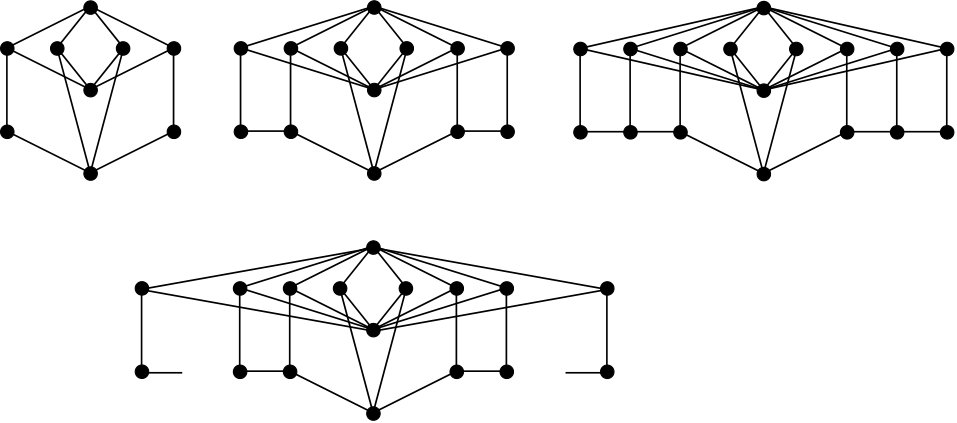 Figure 1
 Figure 2
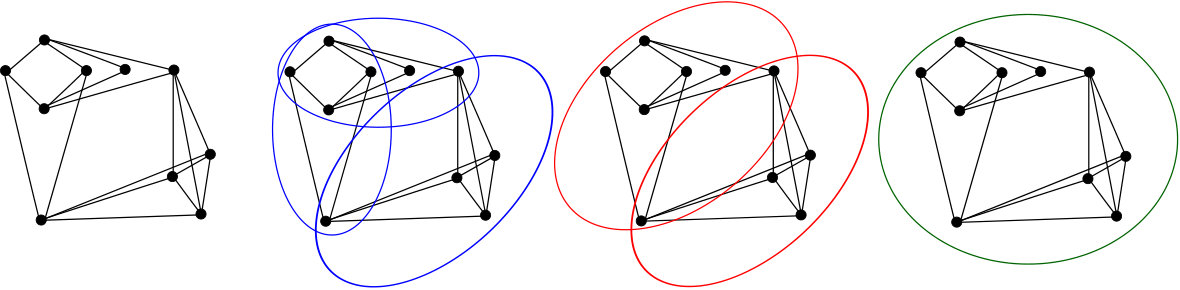 Figure 3
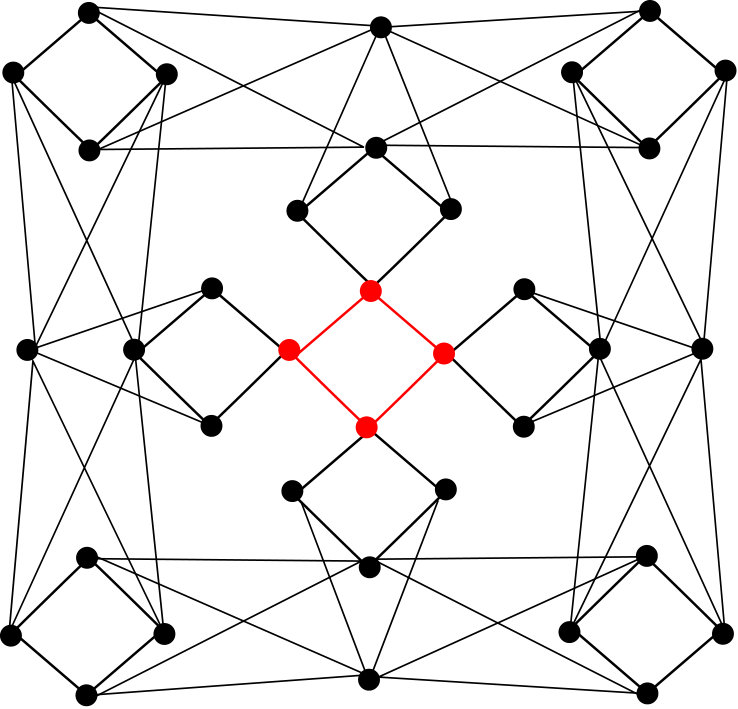 Figure 4
Peer Reviews
No public reviews on file for this paper yet. If you reviewed it on a platform where reviews are public (OpenReview, ICLR, NeurIPS, ICML), you can paste yours below so the community can read it here.
Videos
No videos yet. Explain this paper in a talk, walkthrough, or lecture? Add one.
\title
A quasi-isometry invariant and thickness bounds for right-angled Coxeter groups \authorIvan Levcovitz \date
Abstract
We introduce a new quasi-isometry invariant of –dimensional right-angled Coxeter groups, the hypergraph index, that partitions these groups into infinitely many quasi-isometry classes, each containing infinitely many groups. Furthermore, the hypergraph index of any right-angled Coxeter group can be directly computed from the group’s defining graph. The hypergraph index yields an upper bound for a right-angled Coxeter group’s order of thickness, order of algebraic thickness and divergence function. Finally, given an integer , we give examples of right-angled Coxeter groups which are thick of order , yet are algebraically thick of order strictly larger than , answering a question of Behrstock-Druţu-Mosher.
1 Introduction
Recently there has been considerable interest in the quasi-isometric classification of right-angled Coxeter groups [CS15] [BHS] [BHS17] [BFRHS] [DST] [DT15] [DT17] [Lev18]. As every right-angled Artin group is finite index in some right-angled Coxeter group [DJ00], results on the quasi-isometric classification of right-angled Artin groups are steps in the classification of right-angled Coxeter groups as well [BC12] [BKS08] [BN08] [BNJ10] [Hua17b] [Hua17a] [BH16].
The right-angled Coxeter group, , has a presentation consisting of an order generator for each vertex of a simplicial graph with the relation that two generators commute if there is an edge between the corresponding vertices of . We introduce the hypergraph index, which takes the value of a non-negative integer or infinity, of a right-angled Coxeter group. The group is called –dimensional if does not contain a –cycle. We show the hypergraph index gives a decomposition of –dimensional right-angled Coxeter groups into distinct quasi-isometry classes:
Theorem A**.**
The hypergraph index is a quasi-isometry invariant of –dimensional right-angled Coxeter groups.
A right-angled Coxeter group has infinite hypergraph index if and only if it is relatively hyperbolic. However, in this case the spectrum of hypergraph indexes of the maximal peripheral subgroups provides a more refined quasi-isometry invariant (see Corollary 5.1.1).
The hypergraph index of a right-angled Coxeter group is obtained through an easily computable graph-theoretic construction on the group’s defining graph, , that outputs a sequence of hypergraphs, , each having the same vertex set as . The hyperedges of the first hypergraph, , are subgraphs of which are certain types of graph joins. The hyperedges of are certain unions of hyperedges of . The hypergraph index of is the smallest integer such that some hyperedge of contains every vertex (see Figure 1 for an example). If no such exists, then we set . The computation time of the hypergraph index is always bounded by the number of vertices of , even when the hypergraph index happens to be infinite.
Other invariants have been used to study the quasi-isometric classification of right-angled Coxeter groups. The Bowditch boundary has been recently used to understand certain classes of –dimensional hyperbolic right-angled Coxeter groups [DT17] [DST]. The authors of [CS15] also use their notion of a contracting boundary to differentiate between certain relatively hyperbolic right-angled Coxeter groups.
When the tools of relative hyperbolicity are not available, there are still a few quasi-isometry invariants to distinguish between these groups. Two such invariants are the order of thickness of a group, and the group’s divergence function, a measure of how quickly geodesic rays in the group’s Cayley graph can stray apart.
The authors of [BHS17] show every right-angled Coxeter group that is not relatively hyperbolic must be thick of some order. On the other hand, the authors of [DT15] and [Lev18], provide criteria to determine the divergence of certain right-angled Coxeter groups. However, despite a few exceptions, the exact order of thickness and the divergence function of most right-angled Coxeter groups is unknown. An advantage of the hypergraph index over these invariants is that it is always computable. Furthermore, we show the hypergraph index is strongly related with the order of thickness and the divergence of these groups:
Theorem B**.**
Suppose the right-angled Coxeter group, , has hypergraph index , then is thick of order at most and the divergence of is bounded above by a polynomial of degree .
The hypergraph index also provides an upper bound on the order of algebraic thickness of a right-angled Coxeter group (see Theorem 6.4).
For both and , in the class of right-angled Coxeter groups, thickness of order , algebraic thickness of order , polynomial divergence of degree and hypergraph index are all equivalent notions (see section 6 for an overview). Actually, the following conjecture seems to hold for all groups whose divergence and thickness we can compute:
Conjecture 1.1**.**
Let be a simplicial graph and the corresponding right-angled Coxeter group. The following are equivalent:
* has hypergraph index .* 2. 2.
* is thick of order .* 3. 3.
The divergence of is a polynomial of degree .
One may then ask if algebraic thickness of order and thickness of order are equivalent notions in right-angled Coxeter groups, as this is true for and . In fact, in the paper where thick groups are originally defined, the authors ask if the order of algebraic thickness of any finitely generated group is equivalent to the group’s order of thickness [BDM09, Question 7.7]. Sisto provided a negative answer to this question by demonstrating an example of a group which is thick of order but is not algebraically thick of order [BD14]. We give a negative answer to this question for the case of higher orders of thickness (see Theorem 7.2 for a more detailed statement):
Theorem C**.**
Given any integer , there are right-angled Coxeter groups which are thick of order , but are algebraically thick of order strictly larger than .
The paper is organized as follows. Section 2 reviews some of the necessary background. We define the lambda hypergraphs and the hypergraph index associated to a right-angled Coxeter group in section 3 where we also prove some essential results regarding these constructions. We define the notion of coarse intersection degree, an important notion for many of the results in this paper in section 4. In section 5 we prove Theorem A. In section 6, we review how the hypergraph index relates to some known classes of right-angled Coxeter groups, and we prove Theorem B. Finally, section 7 is devoted to proving Theorem C.
Acknowledgements: I would like to thank my advisor, Jason Behrstock, for his extremely helpful guidance and excellent suggestions. I also thank Ruth Charney, Mike Davis, Pallavi Dani, Mark Hagen, Jean-François Lafont, Emily Stark, Tim Susse, Anne Thomas and Hung Cong Tran for helpful discussions regarding the quasi-isometric classification of right-angled Coxeter groups. I am also grateful to the anonymous referee for the many helpful suggestions and corrections.
2 Background
Throughout the text, given a metric space and a subspace, we denote the –neighborhood of by .
Let and be metric spaces. A (, )–quasi-isometry is a (not necessarily continuous) function , such that for all we have:
[TABLE]
Furthermore, we require to be coarsely surjective so that . Quasi-isometries provide a natural notion of equivalence in a coarse geometric setting. For a detailed background on quasi-isometries and geometric group theory in general, see [BH16].
2.1 Graphs and hypergraphs
We summarize the common graph constructions we use throughout the paper. will always denote a simplicial graph. and are respectively the vertex set and edge set of .
A clique is a graph with the property that any two vertices are adjacent. A –clique is a clique with vertices. is a join if there are subgraphs , such that , and every vertex in is adjacent to every vertex in . Graph joins are written as: .
Given a graph and a subset of its vertices, , the subgraph induced by is the graph with vertex set and with the property that two vertices are adjacent if and only if they are adjacent in .
Given a vertex , the link of is the set, . The star of is the set, .
A hypergraph, , consists of a set of vertices, , and a set of hyperedges, . A hyperedge, , is a subset of consisting of any number of vertices. Note that a graph is a hypergraph whose hyperedges each contain two vertices.
2.2 Right-angled Coxeter groups
Given a simplicial graph with vertex set and edge set , the corresponding right-angled Coxeter group is given by the presentation:
[TABLE]
We refer the reader to [BB05] and [Dav08] for a nice background on Coxeter groups. All results from this subsection are proved in these references.
Definition 2.1** (Special subgroup).**
Let be a right-angled Coxeter group with generating set . For , let be the subgroup of generated by the induced subgraph of . is called a special subgroup.
The notation in the above definition is justified by the following result:
Lemma 2.2**.**
Let be a right-angled Coxeter group with generating set . Given , let be the subgraph induced by . is isomorphic to . Furthermore, is convex with respect to the word metric of .
It is readily checked that , is finite if and only if is a clique. Furthermore, given induced subgraphs , , if and only if
2.3 The Davis complex, , of a right-angled Coxeter group
Given a right-angled Coxeter group, , we describe its Davis complex, , a natural CAT(0) cube complex on which acts geometrically. We again refer the reader to [Dav08] for a detailed background on the Davis complex.
The –skeleton of is the Cayley graph of where edges are given unit length. For every –clique, , the subgroup is isomorphic to the product of copies of . It follows that the Cayley graph of is isometric to a unit –cube. For each coset, , where is a –clique, we glue a unit –cube, , to .
Much like the Cayley graph of , we will assume that -cells of are labeled by letters of corresponding to the associated generator. Furthermore, vertices of are labeled by group elements of .
The –skeleton of inherits the word metric of the Cayley graph of . This is known as the combinatorial metric, and it is quasi-isometric to the CAT(0) metric induced by the Euclidean cubes (see [CS11] for instance). When we refer to a geodesic in , we always mean this to be a geodesic in the –skeleton with respect to the combinatorial metric.
2.4 Hyperplanes in
The following discussion of hyperplanes and cube complexes holds in the much more general setting of CAT(0) cube complexes. We refer the reader to [Wis11] for a general reference. For simplicity, we state the relevant definitions and facts in terms of the Davis complex .
A midcube is the restriction of a coordinate of a give cube, , of to [math]. A hyperplane is a subspace of with the property that for each cube, , in , is a midcube or . consists of exactly two distinct components. A –cell, , is dual to a hyperplane if . The carrier of a hyperplane, , is the set of all cubes in which have non-trivial intersection with .
Given a hyperplane, , in , it is readily checked that -cells dual to are labeled a common letter . Accordingly, we say is of type . Furthermore, is isometric to , where is a -cell labelled by the generator and is the Davis complex corresponding to . Let and be hyperplanes of types respectively and . It follows that if intersects , then is adjacent to in .
2.5 Disk diagrams in
A disk diagram, , is a contractible finite –dimensional cube complex with a fixed planar embedding . By compactifying , , we can extend to the map , giving a cellulation of . The boundary path of , , is the attaching map of the cell in this cellulation containing . Note that this is not necessarily the topological boundary.
is a disk diagram in , if is a disk diagram and there is a fixed continuous combinatorial map of cube complexes . By a lemma of Van Kampen, for every null-homotopic closed combinatorial path , there exists a disk diagram in such that .
Suppose is a disk diagram in and is a –cell of . A dual curve, , dual to is a concatenation of midcubes in that contains a midcube that intersects . Every edge in is dual to exactly one maximal dual curve. The image of under the map lies in some hyperplane .
2.6 Thick spaces
This subsection gives an overview of the definitions of a thick and algebraically thick space. The background here will not be necessary until Sections 6 and 7, so the reader may wish to skip this subsection until then.
We work with the “strong” thickness definitions from [BD14]. As we will never make reference to the weaker notions of thickness, we will drop the word “strongly” from our definitions.
will denote a metric space and a subspace. is –path connected if for any there exists a path from to in . is –quasi-convex if for any , there exists an –quasi-geodesic in connecting and .
Roughly, forms a tight network of spaces with respect to the subsets if these subsets coarsely cover . Furthermore, any two subsets can be connected by a sequence of subsets such that consecutive subsets in this sequence coarsely intersect in an infinite diameter set. This is formally defined below.
Definition 2.3** (Tight network of subspaces).**
[BD14, Definition 4.1]
Given and , is a –tight network with respect to a collection of subsets if the following hold:
a)
Every with the induced metric is –quasi-convex
b)
c)
For every and any such that intersects both and , there exists a sequence of length
[TABLE]
with such that for all , is of infinite diameter, –path connected and intersects .
A metric space is wide if every one of its asymptotic cones has cutpoints, and, additionally, every point in the space is uniformly near to a –quasi-geodesic. The following definition provides a uniform version of this notion.
Definition 2.4** (Uniformly wide).**
[BD14, Definition 4.11] A collection of metric spaces, , is –uniformly wide if:
There exists such that for every and for every , is in the neighborhood of some bi-infinite –quasi-geodesic in . 2. 2.
Given any sequence of metric spaces in , any ultrafilter , any sequence of scaling constants and any sequence of basepoints with , it follows that the ultralimit does not have cut-points.
Metric thickness of a space , defined below, provides an inductive decomposition of into tight network of spaces. The base case consists of a set of uniformly wide spaces.
Definition 2.5** (Metric thickness).**
[BD14, Definition 4.13] A family of metric spaces is –thick of order zero if it is –uniformly wide.
Given and we say that a metric space is * –thick of order at most with respect to a collection of subsets * if
is a –tight network with respect to . 2. 2.
The subsets in endowed with the restriction of the metric on compose a family of spaces that are –thick of order at most .
Furthermore, is said to be thick of order k (with respect to ) if it is –thick of order at most (with respect to ) and for no choices of and is X –thick of order at most .
The following definitions give an algebraic version for thickness. The algebraic condition often implies stronger results (see [BD14]).
Definition 2.6** (Tight algebraic network of subgroups).**
[BD14, Definition 4.1] Let , a finitely generated group and a set of subgroups of . is a –tight algebraic network with respect to if the following hold:
a)
Every is –quasi-convex
b)
The union of all subgroups in generates a finite index subgroup of .
c)
For every , there exists a sequence
[TABLE]
with such that for all , is infinite and is –path connected.
By [BD14, Proposition 4.3], if admits a tight algebraic network of subgroups with respect to then is a tight network of subspaces with respect to the left cosets of groups in .
Definition 2.7** (Algebraic thickness).**
[BD14, Definition 4.13] Let be a finitely generated group. is algebraically thick of order zero if it is wide. Given , is * –algebraically thick of order at most with respect to a finite collection of subgroups * if
is a –tight algebraic network with respect to . 2. 2.
Every is algebraically thick of order at most .
G is algebraically thick of order if it is algebraically thick of order at most and is not algebraically thick of order .
3 Lambda hypergraphs and the hypergraph index
We describe a sequence of hypergraphs associated to a simplicial graph. Using this construction we define the hypergraph index of a right-angled Coxeter group.
Definition 3.1** (Wide and strip subgraphs).**
Let be a simplicial graph. Let denote the set of induced subgraphs of such that given , where and are induced subgraphs which each contain a pair of non-adjacent vertices. Furthermore, is maximal in , i.e. if for some , then . The subgraphs in are the wide subgraphs of .
Let denote the set of induced subgraphs of such that given , where is a set of two non-adjacent vertices and is a non-empty clique. Furthermore, we require that if for any then . The subgraphs in are the strip subgraphs of .
Remark 3.1.1*.*
By [BFRHS], characterizes all maximal special subgroups of which are wide (see section 2.6 for the relevant definition). The term “strip subgraphs” is used since given , the Cayley graph of is isometric to , where is isometric to a cube of dimension .
Remark 3.1.2*.*
Given any wide subgraph, , decomposes as where the (possibly empty) set of all vertices in which are adjacent to every other vertex of . It follows that is a clique. Note that given any , there is always some such that is not adjacent to . These observations will be used throughout the paper.
Remark 3.1.3*.*
For distinct strip subgraphs, it follows that . For if , by the maximal property of strip subgraphs, there must be vertices and such that and are not adjacent in . Hence, is contained in some subgraph of , which is not allowed by the definition of strip subgraphs.
Definition 3.2** (Lambda hypergraphs).**
For each integer , we define the hypergraph inductively. For each , the vertex set of is , the same as that of .
For every , is a hyperedge of . 2. 2.
For , set if there are hyperedges
[TABLE]
such that for each , , contains a pair of non-adjacent vertices. A hyperedge of is the union of the vertices of a maximal set of pairwise -equivalent hyperedges of .
For an example of these hypergraphs, see Figure 1. The following definition creates a tree poset structure on the set of hyperedges of the lambda hypergraphs.
Definition 3.3** (Membership).**
A hyperedge is a member of the hyperedge if was constructed from the equivalence class of . Additionally, if there is a sequence of hyperedges
[TABLE]
such that for , is a member of , then we also say is a member of . It follows that given integers , and a hyperedge, , then is a member of an unique hyperedge of .
Remark 3.3.1*.*
A subtle point of the membership definition is that given a hyperedge , all vertices of may be contained in the hyperedge , but does not necessarily have to be a member of .
Consider, for instance, the graph in Figure 2. is a hyperedge of . Note also that the intersection of with any other hyperedge of does not contain a pair of non-adjacent vertices. It follows there is a hyperedge of .
It can also be readily checked, that some other hyperedge of contains every vertex of . In particular, the vertices and are also in . However, is a member of , but is not a member of .
A pair of non-adjacent vertices uniquely determines a hyperedge in :
Lemma 3.4**.**
Let be two non-adjacent vertices. There is an unique hyperedge, , of such that any hyperedge of that contains and is a member of .
Proof.
Let be a hyperedge of containing and . is a member of some unique formed by the equivalence class of . Suppose some other hyperedge of , , contains and . By definition, and are in the same equivalence class. Thus, is well-defined and unique. ∎
Given a hyperedge of , we define as the special subgroup of induced by the vertices of .
Definition 3.5** (Hypergraph Index).**
has hypergraph index , if some hyperedge in contains every vertex of and no hyperedge of contains every vertex of . Additionally, it is required that the set of wide subgraphs, , is not empty. If there is no such or is empty, then we say has infinite hypergraph index. The hypergraph index of a right-angled Coxeter group, , is the hypergraph index of .
Remark 3.5.1*.*
It is not difficult to show, given the results of [BHS17], that has hypergraph index if and only if is relatively hyperbolic.
We define the realization of . These are cosets of special subgroups of corresponding to hyperedges of , but excluding hyperedges corresponding to strip subgroups.
Definition 3.6**.**
The realization of a graph is the set of cosets
[TABLE]
Recall is the set of hyperedges of . By , we mean that the subgraph of induced by vertices of is not in . We often think of the cosets in as geometric subsets of the Davis complex .
We extend the membership definition to the realization cosets as follows. Given and , is a member of if is a member of and . It readily follows that if is a member of then the coset representatives can be chosen such that .
Recall that two subsets , of some metric space are –Hausdorff close if and . and are Hausdorff close if they are –Hausdorff close for some . The following lemma shows that distinct cosets in are not Hausdorff close.
Lemma 3.7**.**
Let and be cosets in the realization . If and are Hausdorff close as subsets of , then .
Proof.
Suppose and are –Hausdorff close for some . Without loss of generality, let and with hyperedges of and . Set and , where contains every which is adjacent to every other vertex in . Similarly, contains every which is adjacent to every other vertex in . and are (possibly empty) cliques.
Fix . It follows there is a such that and are not adjacent in (since ). The sequence of vertices, , and the edges connecting consecutive vertices in this sequence, forms a ray, , in the Davis complex . is geodesic by Tit’s solution to the word problem (see [Dav08]) and is contained in .
Choose vertices such that . Let be the segment of from to . Let be a geodesic from to some vertex and be a geodesic from to some vertex . We can choose and so that . Let be a geodesic from to contained in (this is possible since is convex). Let be a disk diagram with boundary .
There are exactly occurrences of the letter in . Furthermore, at most curves dual to in can intersect . It follows that some curve dual to an edge of labeled by must intersect . Since is contained in , it follows that . As was an arbitrarily chosen letter of , it follows that . By repeating the argument and switching the roles of and , we conclude that .
We next show and are the same. Let be a member of . By Remark 3.1.2, we can write where contains all vertices of which are adjacent to every other vertex of . It follows that . We will now show that . Let and suppose . Since and , is adjacent to every vertex of . However, this implies that is a wide subgraph, contradicting the maximality of as a wide subgraph. Hence, and, consequently, as is a member of . We can similarly conclude that . It follows that . For the remainder of the proof, set .
To show , we need to show the coset representative of can be chosen to be the identity. For a contradiction, assume there is some generator, , in a minimal expression for such that . Let be a hyperplane in through the letter in . separates from .
Suppose is a member of , where contains every vertex of that is adjacent to every other vertex of . There must be some such that and are not adjacent in . For if not, is a wide subgraph, contradicting the maximality of . Let be such that is not adjacent to . Consider the infinite ray formed by concatenating the vertices , for , which is contained in . Every hyperplane dual to an edge labelled by cannot cross . Since any path from to must cross each of these pairwise non-intersecting hyperplanes, it follows that . However, this implies there are points in which are arbitrarily far from , a contradiction. ∎
An important consequence of the next lemma is that if a neighborhood of a coset in intersects another coset in in an infinite diameter set, then both these cosets are members of a common coset of .
Lemma 3.8**.**
Let and be cosets in , thought of as subsets of . Suppose for some , is an infinite diameter subset of , then the following are true:
Either has infinite diameter or there is some and such that and each have infinite diameter. 2. 2.
There is some coset such that and each have infinite diameter, where is a constant one larger than the maximal clique size of . 3. 3.
* and , as above, are all members of a common coset in .*
Proof.
We start by proving the first statement. Let be one larger than the maximal clique size in . Let and be geodesics in the –skeleton of from to such that and such that and are at a distance at least apart. Let be a geodesic in from the start of to the start of , and let be a geodesic in from the endpoint of to the endpoint of . These geodesics exist since special subgroups are convex. Let be a disk diagram with boundary .
By [Wis11, Lemma 2.6], we can choose and such that two distinct curves dual to in do not intersect each other. At most curves dual to can intersect . It follows there are consecutive curves dual to which intersect . At most dual curves to can intersect . By the pigeonhole principle, there must be a set of consecutive dual curves to which is also a set of consecutive dual curves to . It follows there is a subdiagram, , of which is isometric to an euclidean rectangle connecting with opposite sides on and . where is a subpath of and is a geodesic from to . Additionally, it follows that .
Let be the set of generators in which appear as a letter of and the set of generators of which appear as a letter of . Since is a geodesic and its length is larger than the maximal clique size in , it follows by Tits solution to the word problem (see [Dav08]) that must contain two non-adjacent vertices, say and . Set .
Let be a geodesic in from the identity element to the start point of . If is empty ( is a vertex), it follows that the vertex is contained in both and for all positive integers . Thus, claim 1 is true for this case. On the other hand, consider the case where is nonempty. In this case, is contained in and is contained in for all positive integers . It follows that is a subgraph of some maximal graph . Furthermore, intersects both and in an infinite diameter set. Hence, claim 1 also follows for this other case as well.
We now show that claim 1 implies claim 2. If then claim 2 follows by setting . Otherwise, if , then is a member of some and claim 2 follows.
We now show that claim 3 follows from claim 2. Consider first the following fact. Let and be induced subgraphs of and . Furthermore, suppose that has infinite diameter. As and are convex, contains a geodesic of length greater than . By Tit’s solution to the word problem, it follows that there must be two non-adjacent vertices that appear as edges of this geodesic. Hence, contains two non-adjacent vertices, namely and .
Set and . By the proof of claim 2, there is an induced subgraph and such that and are infinite. By the above fact, and each contain two non-adjacent vertices. Thus, and are in a common hyperedge of .
If we had set . Otherwise, and we found containing the member . In either case, and are all members of a common coset in as and are in a common hyperedge of . Claim 3 then follows. ∎
4 Coarse intersection degree
In this section we define the coarse intersection degree of a collection of subspaces, , of a metric space. The coarse intersection degree is closely related to the notion of a tight network, defined in section 2.6. We then explore the relationship between the coarse intersection degree of the realization and the hypergraph index of .
Definition 4.1**.**
Let be a metric space and a collection of subspaces of . The coarse intersection degree of is the smallest integer such that there are collections of subspaces and a constant satisfying:
Given , there is a collection of elements of , , such that and . Given , we refer to as a piece of . 2. 2.
If are pieces of some , then there is a sequence of pieces of , , such that has infinite diameter and is path connected for . 3. 3.
There is some such that given any , it follows that .
We call a coarse intersection constant for and a coarse intersection sequence.
Remark 4.1.1*.*
Suppose is a quasi-isometry, and is a collection of subspaces of . Let be any constant. The coarse intersection degree of is the same as that of the collection of subspaces, , of .
Remark 4.1.2*.*
Suppose is a coarse intersection sequence for . It follows that the coarse intersection degree of is .
Lemma 4.2**.**
Let be a simplicial graph with hypergraph index , then the coarse intersection degree of the realization , regarded as a collection of subspaces of the Davis complex , is .
Proof.
We show that satisfies definition 4.1 where the pieces of an element of are its members in . Let be a constant one larger than the maximal clique size of . We use as the coarse intersection constant.
We first show that with these choices the first criteria of definition 4.1 is satisfied. To see this, let and a group element in . Either for some member of , , or lies on a coset where is a strip subgraph and . In the latter case, by the definition of the Lambda hypergraphs and Remark 3.1.3, there is some such that contains the two non-adjacent vertices of . It follows that . Hence is contained in the neighborhood of its members. Furthermore, every member of is contained in . The first criteria thus holds.
We now show the third criteria of definition 4.1 is satisfied. Since is the hypergraph index of , by definition some hyperedge of contains every vertex of . It then follows that . Hence the third criteria is satisfied.
We now prove the second criteria of definition 4.1. Given , such that , let and any two members of . Let and be points in the –skeleton of . Let , for , be a geodesic connecting and which lies in (this is possible by the convexity of special subgroups, Lemma 2.2).
For there is a sequence of hyperedges such that is a member of (where ), contains a pair of non-adjacent vertices, and . Furthermore, we can choose these sequences such that . (We note for later use that is bounded by a constant only depending on .)
Let be the subsequence of obtained by deleting elements which are strip subgraphs. By Remark 3.1.3, no two consecutive elements are deleted. Furthermore, for , has infinite diameter and is path connected.
Let be a geodesic from the identity element to . For each , we can define the sequence of members of :
[TABLE]
The concatenation of the sequences: satisfies the second criteria of definition 4.1.
We now claim that is the smallest integer satisfying definition 4.1. Suppose we have a sequence satisfying definition 4.1 with coarse intersection constant and minimal. Without loss of generality we may assume . We induct on , for , to show there is a constant, , such that given any , then for some . This fact will then imply the claim, since (condition 3) for some and , only when . To see this, suppose with and that . Since , there is some vertex not contained in . Furthermore, is not adjacent to some letter (or else is in every wide subgraph and thus in ). Let . Given an integer , and are distance at least apart, since every hyperplane intersecting at an edge labelled by cannot intersect or . However, this implies some cosets in are not contained in , a contradiction.
The base case of the induction, , trivially holds as . Now, assume and the claim is true for . Let and be the collection of pieces of . Fix . By the induction hypothesis, there is some and some constant , such that . Let be the unique coset that is a member of.
Given any other piece of , it follows there is a sequence of pieces of :
[TABLE]
such that has infinite diameter. By the induction hypothesis we then get a sequence of cosets in :
[TABLE]
such that . Furthermore, has infinite diameter. By Lemma 3.8, this implies is also a member of . Hence, . Since , it follows that . We then just set , and the induction step holds. ∎
The following corollary immediately follows from Lemma 4.2 and Remark 4.1.2.
Corollary 4.2.1**.**
Let be the hypergraph index of a simplicial graph . The coarse intersection degree of is .
5 A QI-invariant for 2-dimensional right-angled Coxeter groups
A graph is triangle-free if it does not contain any –cycles. The goal of this section is to prove the following theorem:
Theorem 5.1**.**
Let and be triangle-free graphs. If the right-angled Coxeter groups and are quasi-isometric, then and have the same hypergraph index.
Although the hypergraph index of a relatively hyperbolic right-angled Coxeter group is always infinite, we can still define a more refined quasi-isometry invariant for these groups. Given a right-angled Coxeter group, , let be the collection of maximal special subgroups of with finite hypergraph index (i.e., if is a special subgroup with finite hypergraph index, then for some unique ). Define the hypergraph index spectrum of as the set of unique hypergraph indexes, , of the groups . Note that when is not relatively hyperbolic, the hypergraph index spectrum and the hypergraph index coincide.
Corollary 5.1.1**.**
Let and be triangle-free graphs. If the right-angled Coxeter groups and are quasi-isometric, then and have the same hypergraph index spectrum.
Proof.
By [BHS17, Theorem I] every relatively hyperbolic right-angled Coxeter group is relatively hyperbolic with respect to its maximal special subgroups of finite hypergraph index. By [BDM09, Theorem 4.8] and Theorem 5.1, such a quasi-isometry induces a bijective function, taking identity values, between the hypergraph index spectrums of and . ∎
For the remainder of this section and this section only, we assume and are triangle-free simplicial graphs associated to the right-angled Coxeter groups and with corresponding Davis complexes and . We assume there exists a quasi-isometry:
[TABLE]
We also fix the following hypergraphs and their realizations as defined in section 3:
[TABLE]
A flat, , is the image of an isometric embedding of . When we consider a flat in a Davis complex, it is implied this is a flat with respect to the CAT(0) metric. The next two lemmas describe the behavior of flats in . The first of which shows a flat must be contained in a coset of , while the second lemma shows cosets of contain many flats.
Lemma 5.2**.**
Let be a flat in . is contained in a coset of , where and are each a set of pairwise non-adjacent vertices of of size at least . Hence, for some .
Proof.
First observe that must contain some point in the interior of a –cell of , and, consequently, must contain all of . Since is isometric to the Euclidean plane, it follows that for each vertex, , contains exactly four –cells adjacent at which together form a square composed of a grid of four smaller squares.
Repeating this process, we can deduce that is exactly a subcomplex of which is the product of two combinatorial bi-infinite geodesics and . Let be the set of generators which appear in and the set of generators which appear in . Since and are infinite, it follows . Furthermore, since a hyperplane dual to an edge of must cross every hyperplane through , and vice versa, it follows every generator in commutes with every generator in . Hence, for some . No pair of vertices in are adjacent since is triangle-free. Similarly, contains no pair of adjacent vertices. ∎
Remark 5.2.1*.*
Let where is an embedded –cycle. It follows where and each consist of two non-adjacent vertices, say . The Cayley graph of is the product , where is the bi-infinite geodesic and is the bi-infinite geodesic . As special subgroups are convex in right-angled Coxeter groups, is a flat in .
Lemma 5.3**.**
Given , considered as a subset of , and a vertex , there is an embedded -cycle, , and such that is a flat, and .
Proof.
Let (we may pick the identity element as the coset representative without loss of generality) where . As , must contain some pair of non-adjacent vertices, say and . Similarly, must contain some pair of non-adjacent vertices, say and . Let be the subgraph induced by and . By Remark 5.2.1, is an embedded isometric copy of . Let be a geodesic word from the identity element to which is contained in (this is possible since is convex). It follows that is a flat satisfying the desired properties. ∎
The following theorem from [Hua17b] is stated in terms of our given setting. It is an important ingredient in the proof of Theorem 5.1.
Theorem 5.4** ([Hua17b, Corollary 5.18]).**
There is a constant , depending only on the quasi-isometry constants of , such that given any flat , there is a flat which is –Hausdorff close to .
Definition 5.5**.**
Define the map
[TABLE]
as follows. Given, , let be a flat contained in ( exists by Lemma 5.3). Let be some flat which is Hausdorff close to (such a flat always exists by Theorem 5.4). By Lemma 5.2 there is some which contains . Furthermore, there is a unique of which is a member of (uniqueness follows by Lemma 3.4).
For the remainder of the section, fix the map as above. The following lemma shows, amongst other facts, that is well-defined.
Lemma 5.6**.**
* is well-defined. Furthermore, the following is true. Let where is the constant in Theorem 5.4 and is one larger than the maximal clique size of . Given a coset , there is a collection of cosets such that*
** 2. 2.
Every is a member of . 3. 3.
For each , there is a sequence such that , for each and has infinite diameter for each .
Proof.
Let where . Note that is infinite. By Lemma 5.3, choose a flat contained in where is a bi-infinite geodesic. Since is triangle-free, it follows that, with possibly reordering indices, .
We first show that does not depend on the choice of a flat in . Let and be flats in , each Hausdorff close to . It follows that is Hausdorff close to . By Lemma 3.4, there are cosets which respectively contain and . Hence, some finite neighborhood of intersects in an infinite diameter set. By Lemma 3.8(3), and are members of an unique coset (uniqueness follows by Lemma 3.4).
We next show that does not depend on the choice of flat . Additionally, the work done in proving this sets up the proof for the other claims of the lemma. Let and be as before, and let be another flat in with a bi-infinite geodesic in .
There is a bi-infinite geodesic in which intersects both and (one can readily check has the geodesic extension property). Similarly, there is a bi-infinite geodesic in which intersects both and . Consider now the following series of flats:
[TABLE]
[TABLE]
has infinite diameter for . By Theorem 5.4, there is a constant depending only on so that for flats in . Furthermore, by Lemma 5.2, for each , for some . By Lemma 3.8(2), we may form the following sequence of cosets in :
[TABLE]
such that is infinite for each , . Furthermore, by Lemma 3.4 there is a unique such that is a member of for each , . Hence, is well-defined.
Given , define as follows:
[TABLE]
By Lemma 5.3, every is contained in a flat, so claim 1 of the lemma follows. By the work done above, satisfies claims 2 and 3 of the lemma. ∎
We now extend to a new map, .
Definition 5.7**.**
Define the map
[TABLE]
as follows. Given , choose such that is a member of . Set .
Lemma 5.8**.**
* is well defined.*
Proof.
Let and let be members of . We will show that .
Since and are both members of , by Lemma 4.2, there is an finite sequence of elements in starting with and ending with so that the neighborhood of an element of this sequence has infinite diameter intersection with the next element of the sequence. Therefore, it is enough to show the claim for the case when has infinite diameter.
Suppose and , for . Let and be members respectively of and , as in Lemma 5.6, so that and . Let and . Since has infinite diameter, there is a constant so that has infinite diameter.
Let be points in distance apart from one another for large enough (to be later determined). Let and be points in distance at most from and respectively. Let be a geodesic from to and a geodesic from to .
As in Lemma 5.6, let be a sequence of cosets in such that , , has infinite diameter and . Let be a sequence of geodesics such that for odd and for even, and such that the concatenation of geodesics is a path from to . Let be the geodesic obtained by deleting generators in the given expression of (this is possible by the deletion criteria of Coxeter groups, see for instance [BB05, Theorem 1.5.1]). Define a sequence of elements in , , and the geodesic similarly.
Consider the disk diagram with boundary path , and let be a constant one larger than the maximal clique size of . Assuming was chosen sufficiently large it follows that dual curves to intersect , for some odd integers and . Let be a minimal subdiagram of which contains each of these dual curves. Let denote the boundary path of , and let and respectively be the subpaths of and which are contained in .
By applying [Wis11, Lemma 2.6] twice, we can find another disk diagram , with boundary path the same as that of , except that and are replaced respectively with geodesics and . Furthermore, these choices can be made so that no two dual curves to intersect one another in , no two dual curves to intersect one another, and curves dual to still intersect . By Tit’s solution to the word problem applied to right-angled Coxeter groups (see for instance [Dav08], Chapter 3.4), the words and are just a reordering of the generators in the given expression for respectively and . Hence the image of and in are contained respectively in and .
It follows the image of in contains an Euclidean rectangle with a side of length contained in and the opposite side contained in . By the same argument as used in Lemma 3.8, it follows that and are members of the same coset of . Hence, , and this proves the claim. ∎
Lemma 5.9**.**
There is a constant , only depending on the quasi-isometry constants of , such that given , is –Hausdorff close to .
Proof.
Let be one larger than the maximal clique size of . Since is contained in the neighborhood of its members in , by Lemma 5.6 and Lemma 5.8, .
Let be a member of and a flat in . Let be a flat –Hausdorff close to and be a member of containing . Let be the quasi-isometric inverse of . We define and similarly as to and . It follows that is –Hausdorff close to , for some . Hence, we have that and . Therefore, for some . This proves the claim. ∎
Lemma 5.10**.**
* is a bijection.*
Proof.
To prove is injective, suppose for . By Lemma 5.9, and are Hausdorff close. By Lemma 3.7, .
To show is surjective, let and be a flat in . is Hausdorff close to some flat contained in some . Therefore, . ∎
We can now prove the main theorem of this section:
Proof of Theorem 5.1.
Suppose first the hypergraph index of is . By Remark 3.5.1, is relatively hyperbolic. It follows by [BHS17, Theorem I] and [BDM09, Theorem 4.8] that relative hyperbolicity is a quasi-isometry invariant in the setting of right-angled Coxeter groups. Therefore, is relatively hyperbolic and its hypergraph index is as well.
For the next case, suppose the hypergraph index of is [math]. Wide right-angled Coxeter groups (see sections 2.6 and 6 for background) are precisely those with hypergraph index [math] [BHS17, Proposition 2.11]. Wideness of a group is a quasi-isometry invariant, thus it follows is also wide and has hypergraph index [math] as well.
For the general case, we may assume that the hypergraph index of is , where . By Lemma 5.10 we have a bijection and by Lemma 5.9, sends any element –Hausdorff close to . By Remark 4.1.1, the coarse intersection degree of is the same as that of . By Lemma 4.2, and have the same hypergraph index. ∎
6 Thickness bounds
We show the hypergraph index of the right-angled Coxeter group yields upper bounds on the group’s order of thickness, order of algebraic thickness and divergence. Throughout, will always denote a simplicial graph, and is the associated right-angled Coxeter group. We emphasize that for the remainder of the paper, no restrictions are placed on .
The next two theorems summarize results in the literature that show there are many equivalent ways of describing thick of order 0 and thick of order 1 right-angled Coxeter groups. The proof follows from work in [BHS17], [BFRHS], [DT15] and [Lev18]. For a definition of a CFS graph, see [BFRHS]. For the definition of divergence used, see [Lev18].
Theorem 6.1** (Thick of order 0 classification).**
The following are equivalent:
, with and each containing a pair of non-adjacent vertices 2. 2.
* is algebraically thick of order 0* 3. 3.
* is thick of order 0* 4. 4.
The divergence of is linear 5. 5.
* has hypergraph index 0*
Proof.
The implications are either obvious or follow from [BHS17]. follows from the definition of hypergraph index. ∎
Theorem 6.2** (Thick of order 1 classification).**
The following are equivalent:
* is CFS and , with and each containing a pair of non-adjacent vertices* 2. 2.
* is algebraically thick of order 1* 3. 3.
* is thick of order 1* 4. 4.
The divergence of is quadratic 5. 5.
* has hypergraph index 1*
Proof.
The implication are either obvious or follow from [BHS17] and [BFRHS]. follows from [Lev18]. follows from Theorem 6.3 below. is an easy exercise. ∎
The hypergraph index yields an upper bound for the order of thickness:
Theorem 6.3**.**
If has hypergraph index , then is thick of order at most .
Proof.
Subspaces in are uniformly wide as they consist of finitely many isometry classes of products of infinite groups. For any , the elements of are convex by Lemma 2.2. Therefore, Lemma 4.2 shows that is a tight network of subspaces with respect to . Finally, consists of all of . It follows that is thick of degree at most . ∎
The next corollary follows from the above theorem and [BD14, Corollary 4.17].
Corollary 6.3.1**.**
If has hypergraph index , then the divergence of is bound above by a polynomial of degree .
The hypergraph index also provides an upper bound on the order of algebraic thickness:
Theorem 6.4**.**
If has hypergraph index , then is algebraically thick of order at most .
Proof.
The proof will be by induction. The base case when follows from Theorem 6.2.
Assume the claim is true for graphs of hypergraph index and suppose has hypergraph index . Let be hyperedges of which are not strip subgraphs ( is the hypergraph from Definition 3.2). By the induction hypothesis, the subgroups are algebraically thick of order at most . Let be hyperedges of corresponding to strip subgraphs.
Since has hypergraph index and by Remark 3.1.3, for each there is some such that contain two non-adjacent vertices. Set . By [BHS17, Proposition A.2], it follows that is thick of order at most . is then algebraically thick of order at most is respect to the special subgroups:
[TABLE]
∎
7 Thickness algebraic thickness
As described in the introduction, there are known examples of groups which are thick of order , but are not algebraically thick of order . However, by Theorem 6.2 we know for the class of right-angled Coxeter groups thickness of order is equivalent to algebraic thickness of order . The following natural question suggests itself: for at least the class of right-angled Coxeter groups, is algebraic thickness of order equivalent to thickness of order ?
The goal of this section is to provide a negative answer to the above question: for each positive integer , there exists a right-angled Coxeter group that is thick of order but is not algebraically thick of order . This is the main content of Theorem 7.2 stated below. The proof of this theorem relies on some preliminary lemmas which we first prove. We begin by recalling the definition from [Lev18] of a rank pair.
Definition 7.1** (Rank pair).**
Given distinct vertices , is a non-commuting pair if is not adjacent to in . A non-commuting pair is rank 1 if are not contained in some induced square of . Additionally are rank if either every non-commuting pair , with , is rank or every non-commuting pair , with , is rank .
Theorem 7.2**.**
Given an integer , let be a graph satisfying the following hypotheses:
There is a subgraph, such that is just two vertices: and . 2. 2.
* has hypergraph index * 3. 3.
* is two non-adjacent vertices of . Similarly, is two non-adjacent vertices of .* 4. 4.
For all , is a rank pair. Similarly, for all , is a rank pair.
It follows the divergence of is a polynomial of degree , is thick of order , and is algebraically thick of order , where . Furthermore, for every such a graph, , exists.
Figure 3 gives a family of graphs which can be readily checked to satisfy the hypotheses of Theorem 7.2. This family of graphs proves the last statement of the theorem, namely the existence of such graphs.
For the remainder of this section we fix an integer and a graph satisfying the hypotheses of Theorem 7.2. Furthermore we fix as in the statement of the theorem.
decomposes as the amalgamated product . It follows from Bass-Serre theory that acts on a tree , with fundamental domain the graph of groups shown in figure 4. Fix this tree .
Given a minimal length expression of a word in , let be the number of occurrences of the generator in .
Lemma 7.3**.**
Let be a hyperbolic isometry of the Bass-Serre tree . The bi-infinite geodesic , in the Davis complex , has polynomial divergence of degree .
Proof.
Since is hyperbolic, by putting a reduced expression of into normal form, we see that either or grows linearly with . Without loss of generality, assume grows linearly with . Given a reduced expression, , of , it follows that given two occurrences of in there must exist some , which is not adjacent to , between these occurrences (i.e. ). Since for any such , forms a rank pair by a hypothesis of Theorem 7.2, by a slight modification of the proof of [Lev18, Theorem 7.9], it follows that the bi-infinite geodesic has polynomial divergence of degree . ∎
Lemma 7.4**.**
Any quasi-isometrically embedded thick of order subgroup is contained in a conjugate of .
Proof.
Let be such a thick of order quasi-isometrically embedded subgroup of . Given , cannot act as a hyperbolic isometry of the Bass-Serre tree , for then by Lemma 7.3, would have divergence at least a polynomial of degree which is not possible since thick of order groups have divergence at most by [BD14, Corollary 4.17]. It follows that any acts elliptically on .
Since two elliptic isometries with disjoint fixed point set generate a hyperbolic element (see [CM87, 1.5]), we have that every element of is contained in some conjugate of , some conjugate of or some conjugate of . However, and are both virtually and so cannot contain a thick of order subgroup. Thus, must be contained in some conjugate of . ∎
Lemma 7.5**.**
Let be a finite set of subgroups contained in a conjugate of . The subgroup, , generated by is infinite index in .
Proof.
Let and the canonical generators of . Define the homomorphism by the map on generators: , , and for .
Let . We can write where for each . It follows that .
For a contradiction, suppose is finite index in . It follows for some large enough, must contain a word of one of the following forms: , , or , However, for each of these cases, , a contradiction. ∎
We are now in a position to prove Theorem 7.2:
Proof of Theorem 7.2.
Given an integer , a graph satisfying the hypotheses of the theorem exists by the family of examples given in Figure 3. In fact, one can construct many such families. Fix such a graph .
It is immediate has hypergraph index , as has hypergraph index and consists of the addition of two strip subgraphs to . By Theorem 6.3, is thick of order at most . By Lemma 7.3, has divergence a polynomial of degree . By the lower bound on thickness provided by the divergence function, is thick of order exactly .
By Lemma 7.4 and Lemma 7.5, cannot be algebraically thick of order since no finite set of thick of order at most subgroups generate a finite index subgroup of . By Theorem 6.4, is algebraically thick of order where . ∎
The reference list from the paper itself. Each links out to its DOI / PubMed record.
- 1[BB 05] Anders Bjorner and Francesco Brenti, Combinatorics of Coxeter groups , Graduate Texts in Mathematics, vol. 32, Springer, 2005.
- 2[BC 12] Jason Behrstock and Ruth Charney, Divergence and quasimorphisms of right-angled Artin groups , Mathematische Annalen 352 (2012), 339–356.
- 3[BD 14] Jason Behrstock and Cornelia Druţu, Divergence, thick groups, and short conjugators , Illinois J. Math. 58 (2014), no. 4, 939–980. MR 3421592
- 4[BDM 09] Jason Behrstock, Cornelia Druţu, and Lee Mosher, Thick metric spaces, relative hyperbolicity, and quasi-isometric rigidity , Mathematische Annalen 344 (2009), 543–595.
- 5[BFRHS] Jason Behrstock, Victor Falgas-Ravry, Mark F. Hagen, and Timothy Susse, Global structural properties of random graphs , ar Xiv:1505.01913, to appear in International Mathematics Research Notices.
- 6[BH 16] Jason Behrstock and Mark F. Hagen, Cubulated groups: thickness, relative hyperbolicity, and simplicial boundaries , Groups, Geometry, and Dynamics 10 (2016), no. 2, 649–707.
- 7[BHS] Jason Behrstock, Mark F. Hagen, and Alessandro Sisto, Quasiflats in hierarchically hyperbolic spaces , Preprint, ar Xiv:1704.04271.
- 8[BHS 17] , Thickness, relative hyperbolicity, and randomness in Coxeter groups , Algebraic & Geometric Topology 17 (2017), 795–740, With an appendix written jointly with Pierre-Emmanuel Caprace.