Robust short-range-ordered nematicity in FeSe evidenced by high-pressure NMR
P. S. Wang, P. Zhou, S. S. Sun, Y. Cui, T. R. Li, Hechang Lei, Ziqiang, Wang, Weiqiang Yu

TL;DR
This study uses high-pressure NMR to reveal long-lived, inhomogeneous electronic nematicity in FeSe that persists over a wide temperature range and is robust against pressure, offering new insights into nematic fluctuations in iron-based superconductors.
Contribution
It provides direct evidence of long-lived, short-range-ordered nematicity in FeSe under high pressure, expanding understanding of nematic fluctuations in iron-based superconductors.
Findings
NMR linewidth broadening indicates inhomogeneous nematicity
Nematic order persists up to eight times the structural transition temperature
Nematicity remains robust against pressure changes
Abstract
We report high-pressure Se NMR studies on FeSe single crystals that reveal a prominent inhomogeneous NMR linewidth broadening upon cooling, with the magnetic field applied along the tetragonal [110] direction. The data indicate the existence of short-range-ordered, inhomogeneous electronic nematicity, which has surprisingly long time scales over milliseconds. The short-range order survives temperatures up to times the structural transition temperature, and remains robust against pressure, in contrast to the strong pressure-dependence of the orbital ordering, structural transition, and the ground state magnetism. Such an extended region of static nematicity in the (,) space of FeSe indicates an enormously large fluctuating regime, and provide fresh insights and constraints to the understanding of electronic nematicity in iron-based superconductors.
Click any figure to enlarge with its caption.
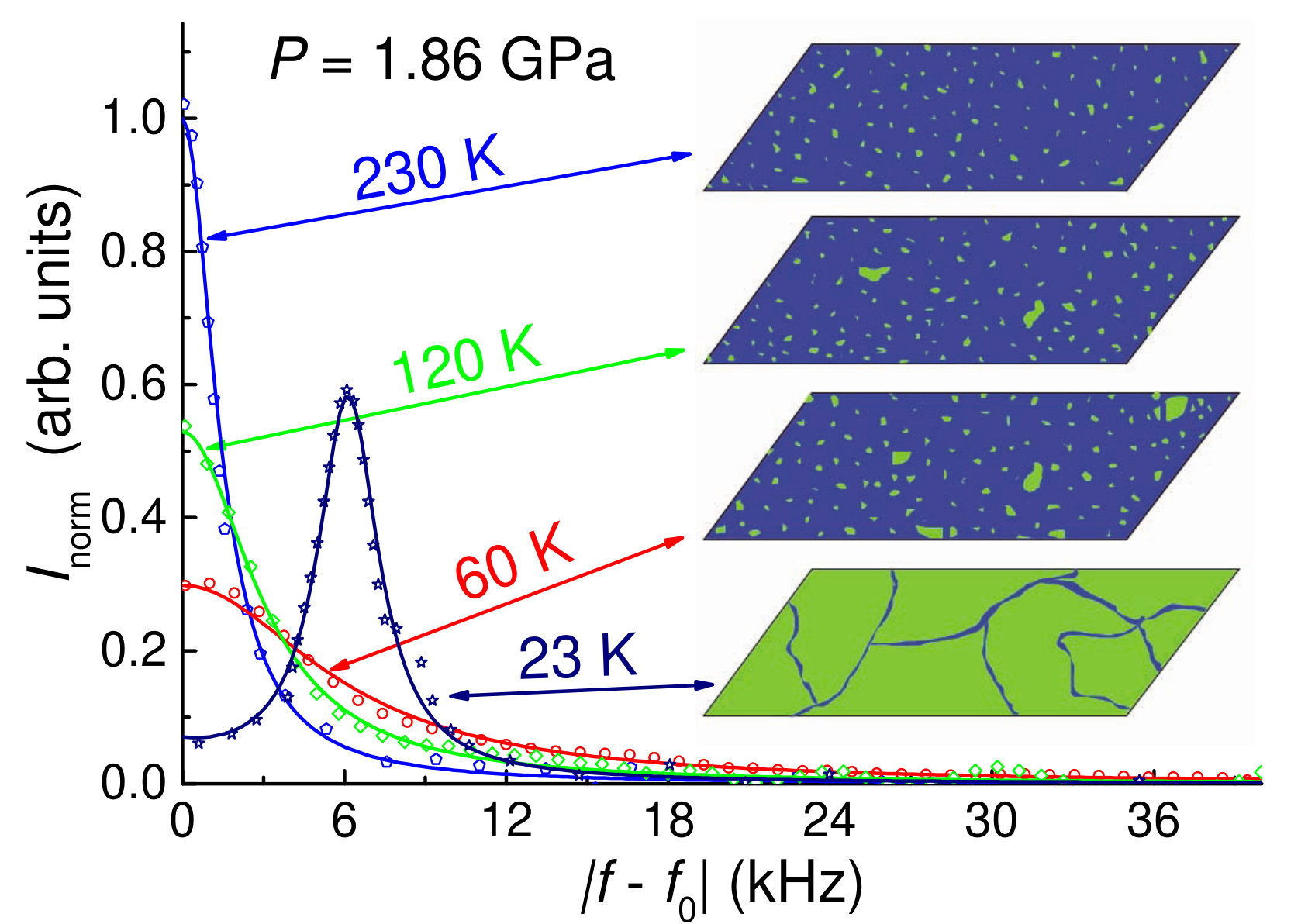 Figure 1
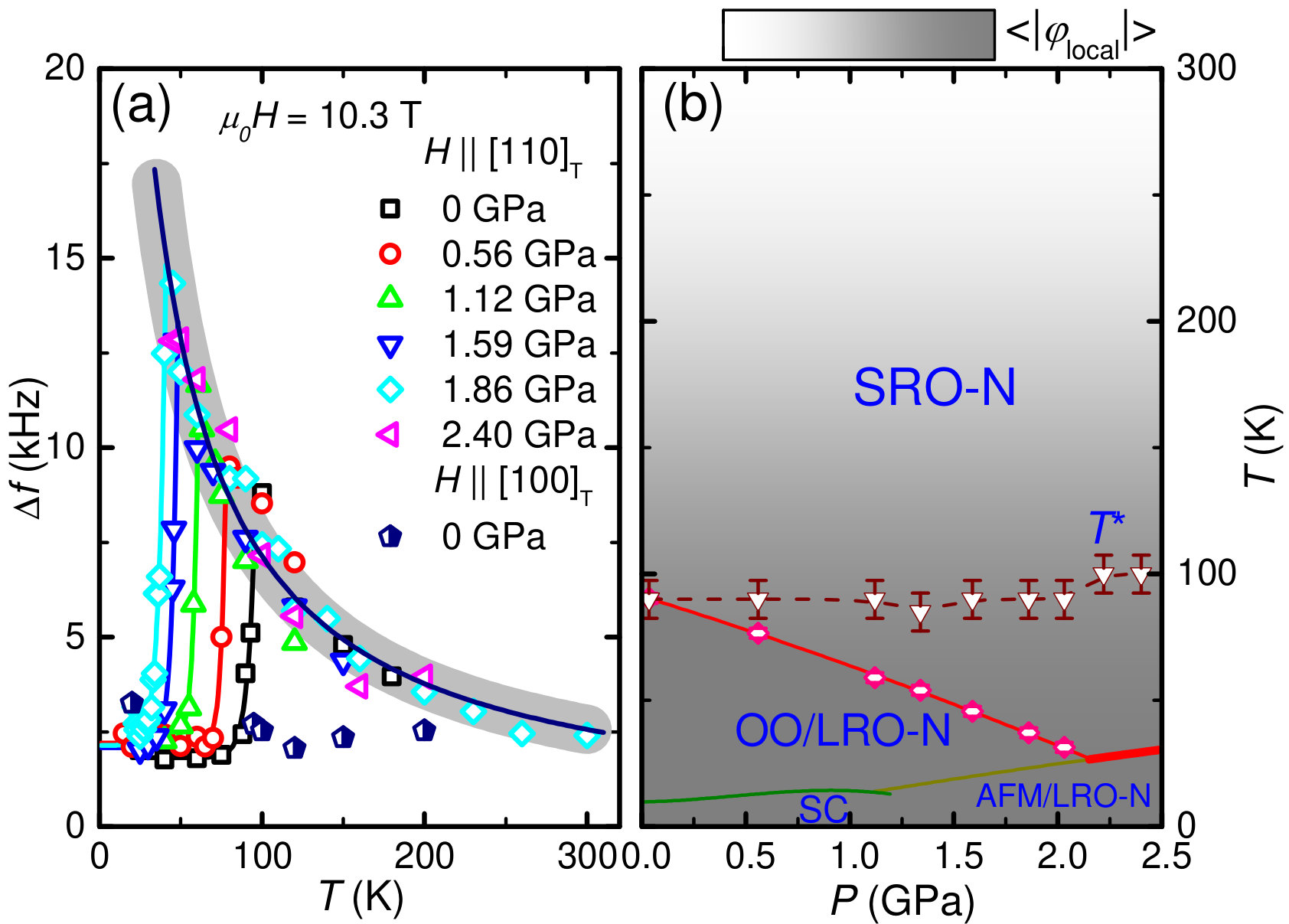 Figure 2
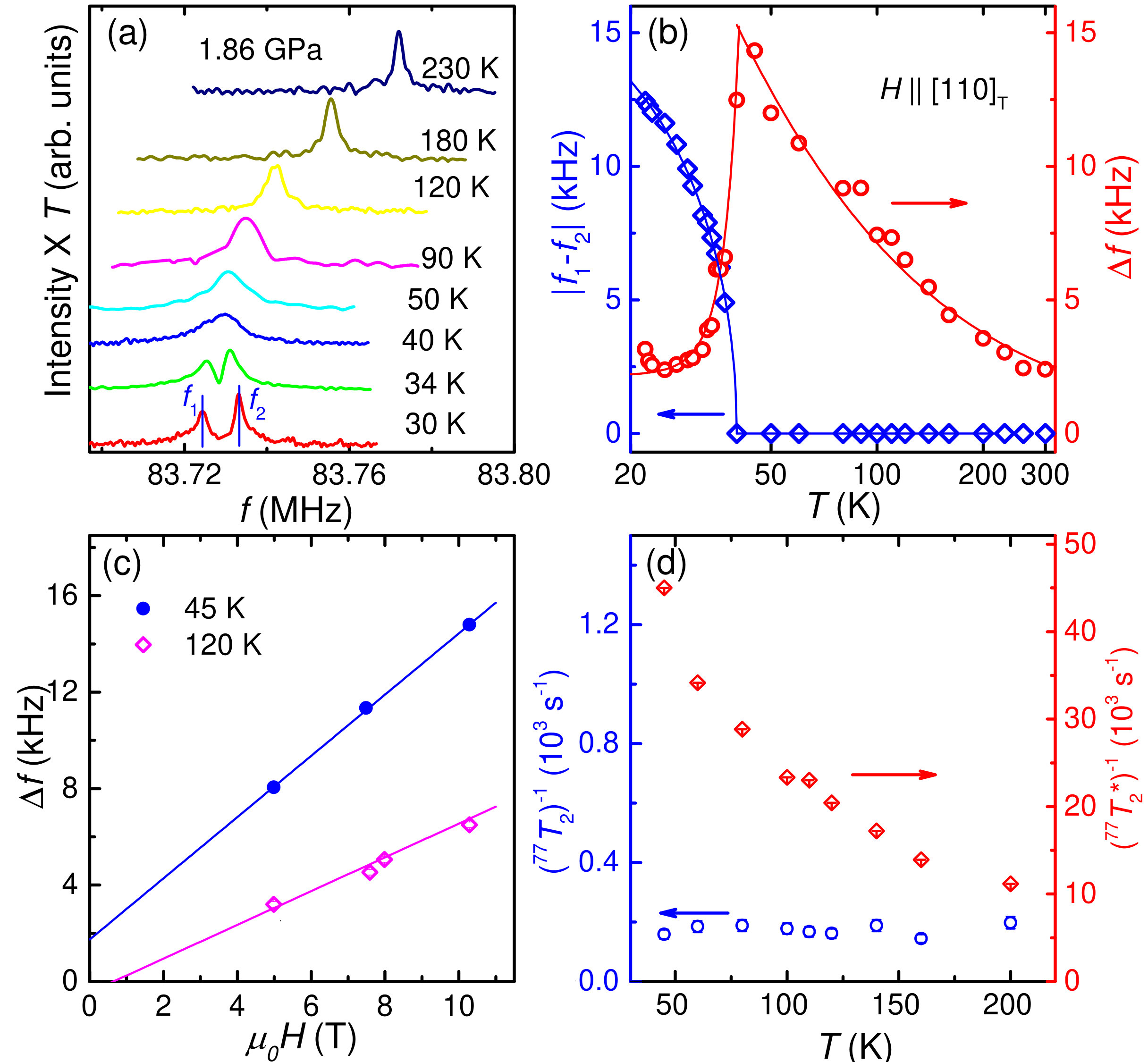 Figure 3
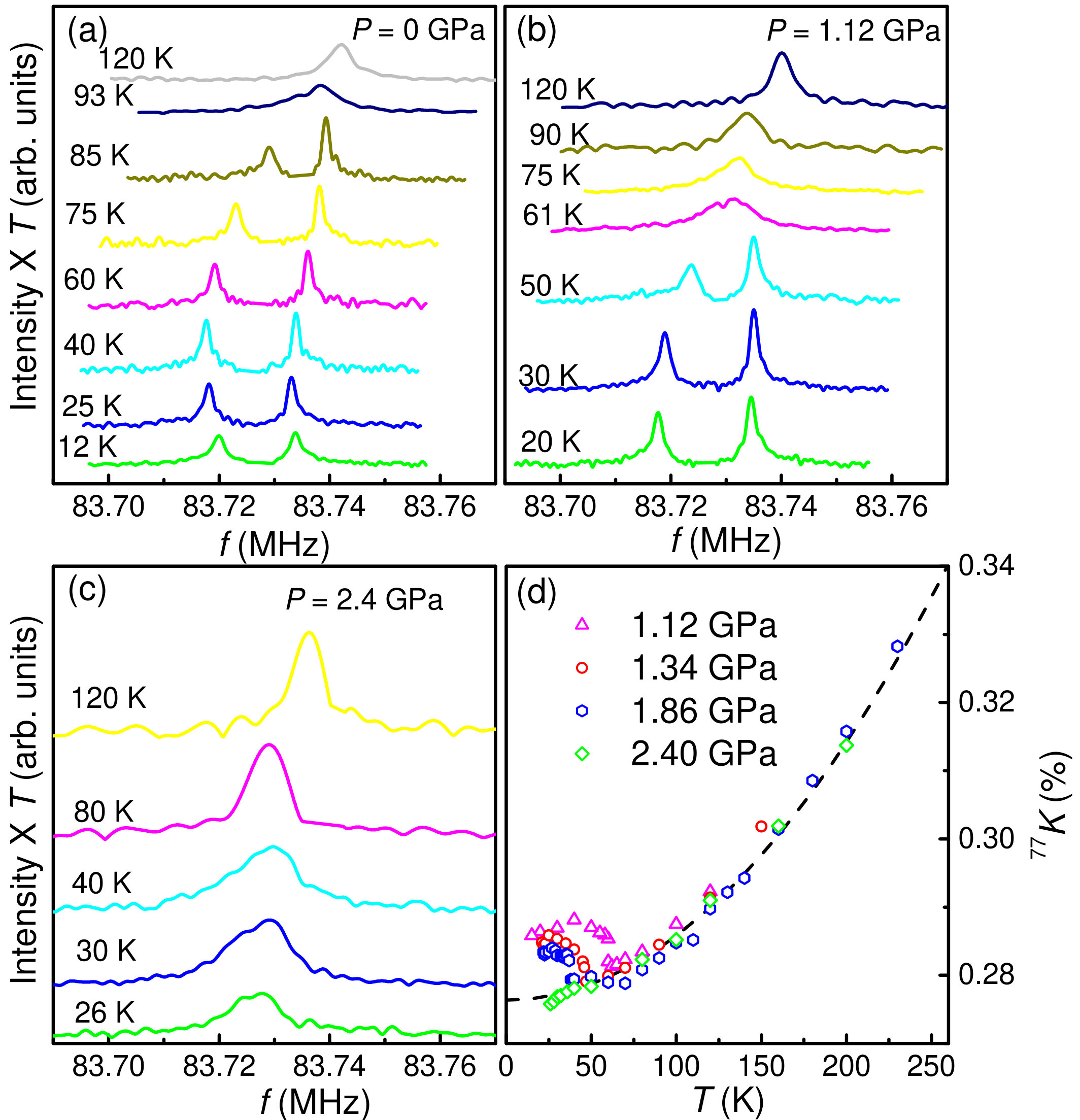 Figure 4
Peer Reviews
No public reviews on file for this paper yet. If you reviewed it on a platform where reviews are public (OpenReview, ICLR, NeurIPS, ICML), you can paste yours below so the community can read it here.
Videos
No videos yet. Explain this paper in a talk, walkthrough, or lecture? Add one.
Robust short-range-ordered nematicity in FeSe evidenced by high-pressure NMR
P. S. Wang
Department of Physics and Beijing Key Laboratory of Opto-electronic Functional Materials Micro-nano Devices, Renmin University of China, Beijing, 100872, China
P. Zhou
Department of Physics and Beijing Key Laboratory of Opto-electronic Functional Materials Micro-nano Devices, Renmin University of China, Beijing, 100872, China
S. S. Sun
Department of Physics and Beijing Key Laboratory of Opto-electronic Functional Materials Micro-nano Devices, Renmin University of China, Beijing, 100872, China
Y. Cui
Department of Physics and Beijing Key Laboratory of Opto-electronic Functional Materials Micro-nano Devices, Renmin University of China, Beijing, 100872, China
T. R. Li
Department of Physics and Beijing Key Laboratory of Opto-electronic Functional Materials Micro-nano Devices, Renmin University of China, Beijing, 100872, China
Hechang Lei
Department of Physics and Beijing Key Laboratory of Opto-electronic Functional Materials Micro-nano Devices, Renmin University of China, Beijing, 100872, China
Ziqiang Wang
Department of Physics, Boston College, Chestnut Hill, Massachusetts 02467, USA
Weiqiang Yu
Department of Physics and Beijing Key Laboratory of Opto-electronic Functional Materials Micro-nano Devices, Renmin University of China, Beijing, 100872, China
Department of Physics and Astronomy, Shanghai Jiaotong University, Shanghai 200240, China and
Collaborative Innovation Center of Advanced Microstructures, Nanjing 210093, China
Abstract
We report high-pressure 77Se NMR studies on FeSe single crystals that reveal a prominent inhomogeneous NMR linewidth broadening upon cooling, with the magnetic field applied along the tetragonal [110] direction. The data indicate the existence of short-range-ordered, inhomogeneous electronic nematicity, which has surprisingly long time scales over milliseconds. The short-range order survives temperatures up to times the structural transition temperature, and remains robust against pressure, in contrast to the strong pressure-dependence of the orbital ordering, structural transition, and the ground state magnetism. Such an extended region of static nematicity in the (,) space of FeSe indicates an enormously large fluctuating regime, and provide fresh insights and constraints to the understanding of electronic nematicity in iron-based superconductors.
The rotational symmetry breaking electronic nematicity Emery_Nematic_Nature_1998 has been widely observed in the cuprates Lavrov_PRL_2002 ; Keimer_Science_2008 ; Vojta_AdvP_2009 ; Taillefer_Nature_2010 and the iron-based superconductors (FeSCs) Fisher_Science_2010 ; Davis_Science_2010 ; FengDL_PRB_2012 . In the FeSCs, the onset of the long-range nematic order is usually companied by a tetragonal-to-orthorhombic structural transition. Since the large anisotropy of the in-plane resistivity in the nematic phase cannot be accounted for by the rather small anisotropy of the in-plane lattice parameter, this structural transition is likely triggered by the nematic order of the electronic state Fisher_Science_2010 ; Prozorov_PRB_2010 . However, the physical origin of the electronic nematicity is still highly debated in the FeSCs Fenandes2014 . In the iron pnictides, the stripe-ordered magnetism DaiPC_Nat_2008 sets in at or just below the nematic ordering transition, fueling the debate between a magnetic-driven spin-nematic Kivelson_PRB_2008 ; Xu_nematic_PhysicaC_2012 and the ferro-orbital order Phillips_PRB_2009 ; KuW_PRL_2009 ; Buchner_NatM_2015 ; Bohmer_PRL_2015 scenarios.
Recent studies on bulk FeSe WuMK_PNAS_2008 find that the nematic order Takahashi_PRL_2014 ; Prozorov_PRL_2016 occurs simultaneously with orbital ordering Takahashi_PRL_2014 ; Coldea_PRB_2015 ; DingH_PRB_2015 at the structural transition 90 K McQueen_PRL_2009 , whereas the stripe-ordered magnetism is absent at the ambient pressure Takano_PhysC_2010 . These findings support the orbital-order driven electronic nematicity in bulk FeSe, with possible momentum space anisotropy DingH_PRB_2015 ; WangZQ_PRB_2016 . However, there are also controversies on the origin of nematicity in FeSe. It was proposed that the absence of the striped magnetic order in FeSe could be caused by the competing tendencies of magnetism DHLee_NatP_2015 ; QSi_PRL_2015 ; Valenti_NatP_2015 ; TXiang_PRB_2016 . Under pressure, the temperature of the structural transition and the nematic order is first suppressed at low pressures, but rises again with an emergent antiferromagnetic order Khasanov_PRL_2010 ; Cheng_NatC_2016 ; Bohmer_NatC_2016 that is confirmed to be the stripe type YuWQ_PRL_2016 . One way to test the different scenarios is to study nematic responses beyond the parameter regimes of other types of intervening ordering Xu_nematic_PhysicaC_2012 ; Fradkin_prb2014 . Indeed, in iron pnictides, anisotropic resistivity studies revealed a Curie-Weiss type singularity above when an external uniaxial stress is applied Fisher_Science_2010 ; Schmalian_NematicFluc_PRL_2010 ; inelastic neutron scattering DaiPC_Neutron_PRB_2011 and STM measurements Pasupathy_NatP_NaFeAs_2014 found signatures of nematicity at finite energies; and nuclear magnetic resonance (NMR) studies observed features of line splitting and inhomogeneous spin-lattice relaxation rates ZhengGQ_BaFeNiAs_NatC_2013 ; Matsuda_BaFeAsP_JPSJ_2015 ; Curro_PRL_2016 . Recent ARPES DingH_PRB_2015 , optical-pumped conductivity measurements Vasiliev_Pump_arXiv_2016 and Raman scattering Massata_PNAS in FeSe also revealed nematicity signatures well above the structural transition or orbital ordering temperature. However, the time/energy scale of these nematic responses at high-temperatures remains elusive.
In this paper, we report a high-pressure NMR study on FeSe, whose narrow 77Se NMR line turns out to be essential for resolving the nematic response at high-temperatures. We found a prominent increase of the linewidth of the 77Se spectra upon cooling toward , with field applied along the tetragonal [110] direction, but not along the [100] direction. This indicates an in-plane anisotropy of the Knight shift in the system, since 77Se is a spin-1/2 nucleus which only detects magnetic responses. By comparing with , a static, spatially inhomogeneous distribution of nematic response is concluded with time scales over milliseconds, consistent with short-range-ordered (SRO) nematicity. The static nematicity survives temperatures up to and does not change with pressure up to 2.4 GPa. Our observation of robust SRO nematicity against temperature and pressure, in contrast to the prominent pressure-dependence of orbital order and magnetic order, provides new insights and strong constrains on the theory of electronic nematicity in FeSe.
The FeSe single crystals were synthesized by an assisted-flux method, whose high quality was demonstrated by our previous high-pressure NMR study on its magnetic structure YuWQ_PRL_2016 . The sample was loaded in a piston cell with Daphne oil 7373 as the pressure medium, and the cell was heated to 80 *∘*C when pressurizing to above 2 GPa for better pressure hydrostaticity YuWQ_PRL_2016 . The low-temperature pressure was determined at 5 K by the 63Cu NQR frequency of Cu2O powders loaded in the pressure cell Thompson_Cu2O_NQR_HP . We verified that pressure barely changes with temperature below 100 K. For NMR measurements, a constant field of 10.3 T was primarily applied along one tetragonal [110] direction of the sample, which becomes the or the -axis in the twinned orthorhombic phase Ma_NaFeAs ; Imai_PRL_2012 ; Buchner_NatM_2015 ; Bohmer_PRL_2015 . The 77Se NMR signals were accumulated with the standard spin-echo technique. The spin-spin relaxation rates are measured by the standard Hahn spin-echo sequence, and the decay is nicely fit by a single exponential function of the interpulse delay time.
The 77Se NMR spectra at a typical pressure of 1.86 GPa are shown in Fig. 1(a). At 230 K, a single-peaked NMR line is observed. Upon cooling, the spectra first shift to low frequencies with an obvious increase of the NMR linewidth. Further cooling below 40 K, the spectra split into double peaks (with peak frequency and respectively), which is an evidence for the tetragonal-to-orthorhombic structural transition, with twinned orthorgonal structure domains below Ma_NaFeAs . The frequency splits between the two peaks, denoted by , is proportional to the field Buchner_NatM_2015 ; Bohmer_PRL_2015 ; YuWQ_PRL_2016 , illustrating a two-fold anisotropy of the Knight shift in the orthorhombic phase. Fig. 1(b) plots as a function of temperature, which behaves as an order parameter of nematicityBuchner_NatM_2015 ; Bohmer_PRL_2015 below 40 K. This structural transition corresponds to the orbital order Takahashi_PRL_2014 ; Coldea_PRB_2015 ; DingH_PRB_2015 and the nematic order Prozorov_PRL_2016 revealed at the ambient pressure.
The full-width-at-half-maximum (FWHM) of each peak, denoted by , is obtained by the Lorentz fit to the line and plotted as a function of temperature in Fig. 1(b). It first increases from 2.5 kHz at 300 K to 14 kHz at 45 K, and then drops sharply below , reaching a small value of 2.5 kHz again at 25 K. Detailed NMR lineshape analysis for temperatures from 230 K down to reveals that i) each line above has a single peak (Fig. 1(a)) and is well fit with a simple Lorentz function (see Fig. 2). By contrast, the double-line fitting with six parameters, used in iron pnictides ZhengGQ_BaFeNiAs_NatC_2013 ; Matsuda_BaFeAsP_JPSJ_2015 , does not give converging fitting parameters in our FeSe system. ii) The FWHM at 45 K is comparable to the line split at 25 K (13 kHz); iii) The at 200 K is comparable to the FWHM of each split peak at 25 K, but increases by about four times at 45 K.
The is further measured as a function of field at typical temperatures above as shown in Fig. 1(c). A nearly linear-field dependence is clearly seen, which indicates that the line broadening is caused by a distribution of the local susceptibility rather than a field-induced effect, similar to the linear field-dependence of the line splitting below . Given the narrow linewidth below , and the close values between the (below ) and (just above ), the high-temperature line broadening should be considered as a mixing of nematicity with distributed amplitudes across the sample. In fact, since the line broadening only occurs with field applied along the tetragonal [110] direction, and not along the [100] direction (see Fig. 4(a)), such an in-plane anisotropy is a direct evidence for nematicity.
To check whether the nematicity above is a dynamic effect or a static phenomenon, the spin-spin relaxation rate is measured and plotted as a function of temperature in Fig. 1(d). stays nearly constant in the measured temperature range. By contrast, the (={\pi}$${\Delta}f) increases by 25 to 250 times of when cooled with temperatures from 200 K down to 45 K (Fig. 1(d)). In general, for s=1/2 nuclei, where detects the homogenous broadening of spectra due to dynamical magnetic fluctuations, and is the spatial field inhomogeneity which has a time scale longer than at the nuclear sites.
Such a strongly temperature-dependent concomitant with the small and constant indicates a spatially inhomogeneous electronic environment across the sample, rather than a dynamical fluctuating one, responsible for the line broadening. The lower bound of the time scale for this spatial inhomogeneity is thus given by the value of , that is, 5 milliseconds for all temperatures (see Fig. 1(d)), since no change of the spin dynamics within this time scale is seen upon cooling. With such a long time scale in an electronic system, the nematicity response should be taken as a static phenomenon for temperatures over 200 K.
In the following, we apply a spectra analysis to reveal a possible real-space distribution of the SRO nematicity. Since the line splitting below is proportional to the amplitude of the nematic order parameter Buchner_NatM_2015 ; Bohmer_PRL_2015 , we introduce a local “order” parameter of nematicity, , measured by the distance from the NMR resonance frequency () to the center of the spectrum () at each temperature, i.e. . The 77Se spectrum thus maps out the relative volume fraction at each which varies across the sample. Following this, the relative spectral intensity as functions of is presented in Fig. 2 for typical temperatures, with the total spectral weight normalized to the same value for all temperatures. From 230 K down to 23 K, each data set can be fit with a simple Lorentzian (solid lines). Above , the spectral weight remains peaked at , but broadens toward higher with a wider distribution upon cooling. Below , a narrow peak is formed at a finite . We emphasize that our determination of the inhomogeneous SRO nematicity takes advantage of the narrow NMR linewidth far below .
The above spectral distribution corresponds to the volume distribution of at each temperature. The wide distribution of local “order” at temperatures up to 200 K should already indicate the formation of inhomogeneous nematicity, or bubbles of the nematic phase. It is reasonable to assume that the amplitude of increases with the domain size of the nematic phase, when the long-range-ordered (LRO) nematicity is not formed. Therefore, the wide distribution of above indicates a form of SRO nematicity with non-uniform domain sizes across the sample. On the other hand, the formation of LRO nematicity is shown by the nearly divergent nematic susceptibility, which coincides with the structural transition and the orbital order at , as shown at ambient pressure Coldea_PRB_2015 ; Prozorov_PRL_2016 . With this, schematic drawings of the nematic phases at different temperatures are presented as color maps in Fig. 2: inhomogeneous, local static nematic order already occurs far above (shown at 230 K), with decreasing volume fraction for large domains; upon cooling, the volume fraction of the large domains grows until a uniform, LRO phase develops sharply below (shown at 23 K).
The NMR spectra at three other pressures are further shown in Figs. 3(a)-(c). The structural transitions are observed at 0 GPa and 1.12 GPa as well, by the line splitting at low temperatures. The NMR Knight shift , defined as , with the gyromagnetic ratio 8.118 MHz/T and under the external field , are presented in Fig. 3(d). The can also be identified by the kink features in the .
The FWHM of the NMR spectra at different pressures are summarized as functions of temperature in Fig. 4(a). For all pressures, large increases of the linewidth are observed when the sample is cooled toward . Below , a similar 2.5 kHz is achieved at the lowest temperatures. In fact, all data follow an identical temperature dependence above , which can be fit by a single Curie-Weiss function, , with K and negligibly small, as shown by the solid navy line in Fig. 4. This remarkable result indicates that the amplitude of SRO nematicity at a given temperature is nearly independent of pressure.
As an important check, we measured the NMR spectra (not shown) with field applied along the tetragonal [100] direction at ambient pressure. The obtained linewidth is shown in Fig. 4(a) which remains a small constant with 2.5 kHz down to . The absence of line broadening upon cooling under this field orientation (the orthorhombic [110]) direction) verifies the same nematic orientation as below Buchner_NatM_2015 .
For comparison, the obtained evidence of SRO nematicity at the ambient pressure is consistent with the ARPES DingH_PRB_2015 and optical-pump conductivity Vasiliev_Pump_arXiv_2016 data, and further reveals a very low energy-scale of nematicity by our observation of its long time scale. The nematic susceptibility at ambient pressure was reported to follow a Curie-Weiss (CW) form Fisher_NematicSus_Science_2012 , but with a positive () Coldea_PRB_2015 ; Prozorov_PRL_2016 . The difference in the values can be understood by the fact that our measures the spatial distribution of the local order parameter, whereas the nematic susceptibility measures the temporal correlations associated with the low-energy dynamics.
Finally, we sketch a phase diagram with the SRO nematic phase determined from the current study in Fig. 4(b). A schematic color map is also plotted in Fig. 4(b) to illustrate the averaged value of (or ) by the spectral weight (see Fig. 2). The orbital ordered phase, the magnetically ordered phase, and the superconducting phase from previous NMR experiments YuWQ_PRL_2016 are also presented in the studied pressure regime. The grows for all pressures upon cooling below 200 K, which suggests that the onset temperature of the SRO nematicity is enormously high. In particular for 2.15 GPa, the linewidth broadening is also seen at 200 K, even though the structural transition and the stripe-order magnetism emerge only below 25 K YuWQ_PRL_2016 . This marks an unusual high onset temperature () of SRO nematicity.
The observation of the SRO nematicity with very long time scales at such high temperatures is unexpected, since it requires slow short-range fluctuations. It is generally known that, close to the LRO phase, the short-range fluctuations can be slowed down by pinning effects from quenched disorder and/or residual stress after the crystal growth LiY_PRL_2015 . However, the very small observed at 200 K suggests that the quenched disorder/stress should be very weak in FeSe. In order to account for the static local nematicity at such high temperatures, a strong pinning effect to nematicity may have to be introduced, even in the presence of weak disorder/stress.
We should point out that our spin recoveries from the spin-lattice relaxation () are well fit by a single exponential function across the entire spectra above YuWQ_PRL_2016 . It is known that the in-plane spin dynamics is anisotropic in the stripe phase Takigawa_JPSJ_2008 ; Hosono_PRB_2010 . The observation of a single component of above could be a challenge to the scenario of static nematicity. However, even at the ambient pressure, the anisotropy of is only detectable at temperatures far below Buchner_NatM_2015 , which suggests that the anisotropy of is not a sensitive probe of nematicity in FeSe.
That the observed SRO nematicity or nematic fluctuation is not affected by pressure in bulk FeSe is striking and further constrains microscopic theories on the nature of electron nematicity in FeSCs. Recently, it was proposed that the nematicity in FeSe may be caused by local Hund’s rule couplings KuW_PRL_2015 , or by interatomic Coulomb repulsion WangZQ_PRB_2016 . It remains to be seen how such microscopic interaction parameters, as well as the wavefunction overlap that governs the electronic structure, are affected by hydrostatic pressure. It is worthwhile to note that the low-energy spin fluctuations in FeSe become prominent below a specific temperature at each pressure Buchner_NatM_2015 ; YuWQ_PRL_2016 . Interestingly, also does not change much with pressure, as shown in Fig. 4(b). These similar pressure behaviors draw a possible correlation between nematicity and low-energy spin fluctuations, and challenge the scenario of the orbital-driven nematicity Buchner_NatM_2015 .
By contrast, the onset temperatures of the LRO nematicity, the orbital ordering, and the magnetic orderings change dramatically with pressure (Fig. 4(b)). In particular, the LRO nematicity occurs just below the orbital ordering temperature at low pressures, and below the magnetic transition temperature at high pressures YuWQ_PRL_2016 ; Bohmer_PRL_2015 , We think that these coincidences may be understood on a mean-field level, where the formation of the LRO nematicity is helped by other types of orderings which also break the symmetry.
In summary, we observed a prominent NMR linewidth broadening upon cooling in bulk FeSe in a large pressure range, which is a direct evidence for the existence of inhomogeneous, SRO nematicity. The time scale for the SRO nematicity is surprisingly long, over milliseconds even at temperatures far above the LRO phase. The SRO nematicity also stays robust against pressure, despite of the dramatic change of the ground-state properties. Our results also draw a possible correlation between nematicity and the low-energy spin fluctuations whose onset temperature also barely changes with pressure. These distinctive electronic properties will help understand the microscopic origin of nematicity and its relation to magnetism in the iron-based superconductors.
We acknowledge encouraging discussions with Prof. Rong Yu and Wei Ku. Work at Renmin University of China is supported by the National Natural Science Foundation of China (NSFC) (Grant Nos. 11374364 and 11574394), the Ministry of Science and Technology of China (Grant Nos. 2016YFA0300504), and the Fundamental Research Funds for the Central Universities and the Research Funds of Renmin University of China (Grant Nos. 15XNLF06 and 15XNLQ07). ZW is supported by U.S. Department of Energy, Basic Energy Sciences Grant DE-FG02-99ER45747.
The reference list from the paper itself. Each links out to its DOI / PubMed record.
- 1(1) S. A. Kivelson, E. Fradkin, and V. J. Emery, Nature 393 , 550-553 (1998).
- 2(2) Yoichi Ando, Kouji Segawa, Seiki Komiya, and A. N. Lavrov, Phys. Rev. Lett. 88 , 137005 (2002).
- 3(3) V. Hinkov, D. Haug, B. Fauqué, P. Bourges, Y. Sidis, A. Ivanov, C. Bernhard, C. T. Lin, and B. Keimer, Science 319 , 597-600 (2008).
- 4(4) M. Vojta, Adv. Phys. 58 , 699 (2009).
- 5(5) R. Daou, J. Chang, David Le Boeuf, Olivier Cyr-Choinière, Francis Laliberté, Nicolas Doiron-Leyraud, B. J. Ramshaw, Ruixing Liang, D. A. Bonn, W. N. Hardy, and Louis Taillefer, Nature 463 , 519-522 (2010).
- 6(6) J.-H. Chu, J. G. Analytis, K. D. Greve, P. L. Mc Mahon, Z. Islam, Y. Yamamoto, and I. R. Fisher, Science 329 , 824 (2010).
- 7(7) T.-M. Chuang, M. P. Allan, Jinho Lee, Yang Xie, Ni Ni, S. L. Bud’ko, G. S. Boebinger, P. C. Canfield, and J. C. Davis, Science 327 , 181 (2010).
- 8(8) Y. Zhang, C. He, Z. R. Ye, J. Jiang, F. Chen, M. Xu, Q. Q. Ge, B. P. Xie, J. Wei, M. Aeschlimann, X. Y. Cui, M. Shi, J. P. Hu, and D. L. Feng, Phys. Rev. B 85 , 085121 (2012).