Constraining unparticle physics from $CP$ violation in Cabibbo-favored decays of D mesons
Mohammadmahdi Ettefaghi, Reza Moazzemi, Mohsen Rousta

TL;DR
This paper uses experimental $CP$ asymmetry measurements in charm meson decays to place constraints on unparticle physics as a potential source of new $CP$ violation beyond the standard model.
Contribution
It introduces a novel approach to constrain unparticle physics using $CP$ violation data from charm meson decays.
Findings
Constraints on unparticle parameters derived from $CP$ asymmetry measurements.
No significant deviation from standard model $CP$ conservation observed.
Provides limits on unparticle contributions to charm meson decay processes.
Abstract
According to the standard model, the Cabibbo-favored (CF) decays are conserve at tree level. Observation of any finite asymmetry can be received as a signal of new physics. In CF charm meson decays, and , the following experimental values for their asymmetry are reported, respectively: () % and () %. The value of the later can be attributed to the mixing of and , however, its contribution is about () %. In this paper, we use these experimental results to constrain the unparticle stuff as a new physics which may contribute to these asymmetries.
Click any figure to enlarge with its caption.
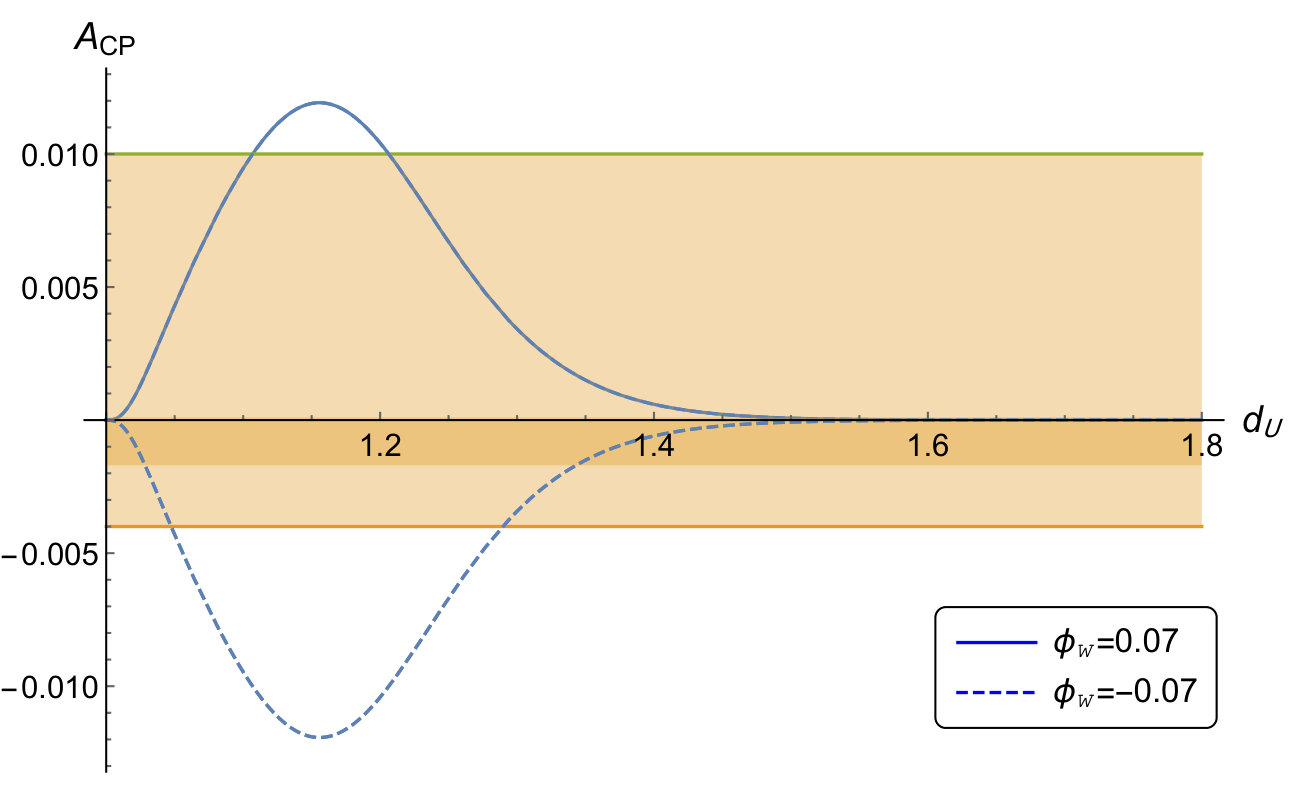 Figure 1
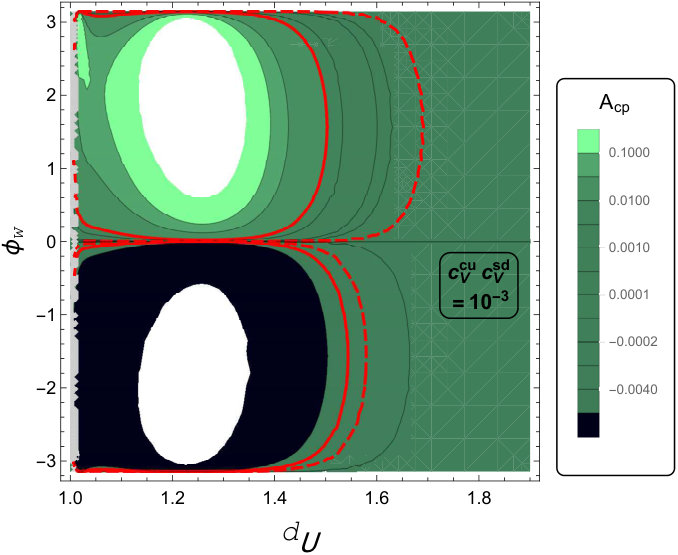 Figure 2
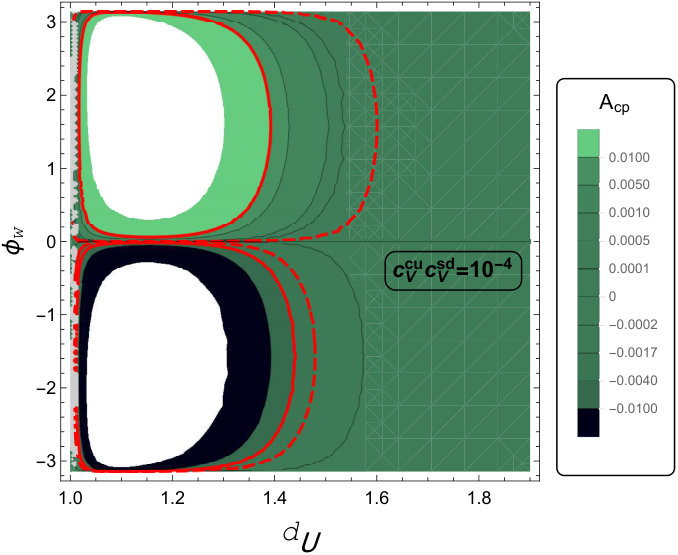 Figure 3
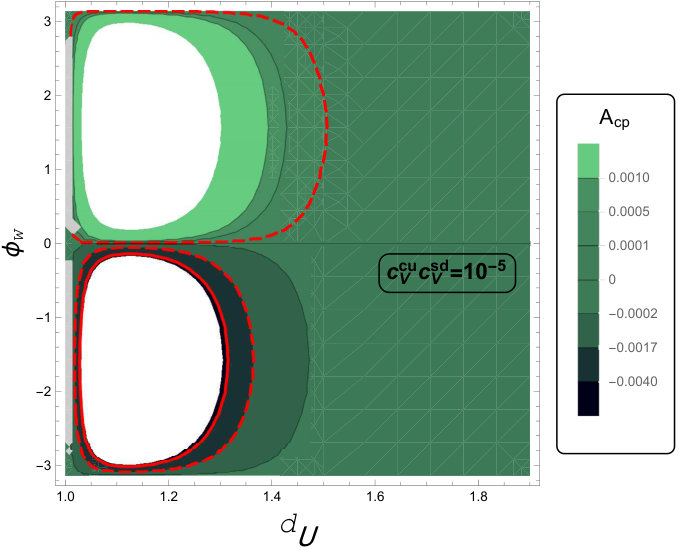 Figure 4
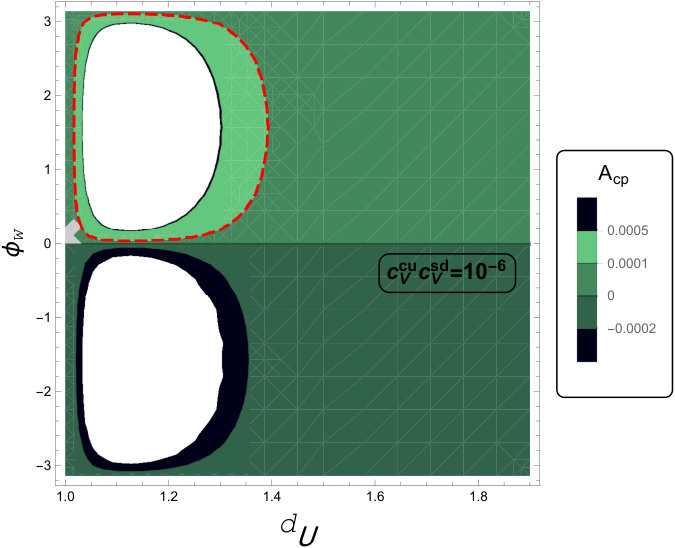 Figure 5
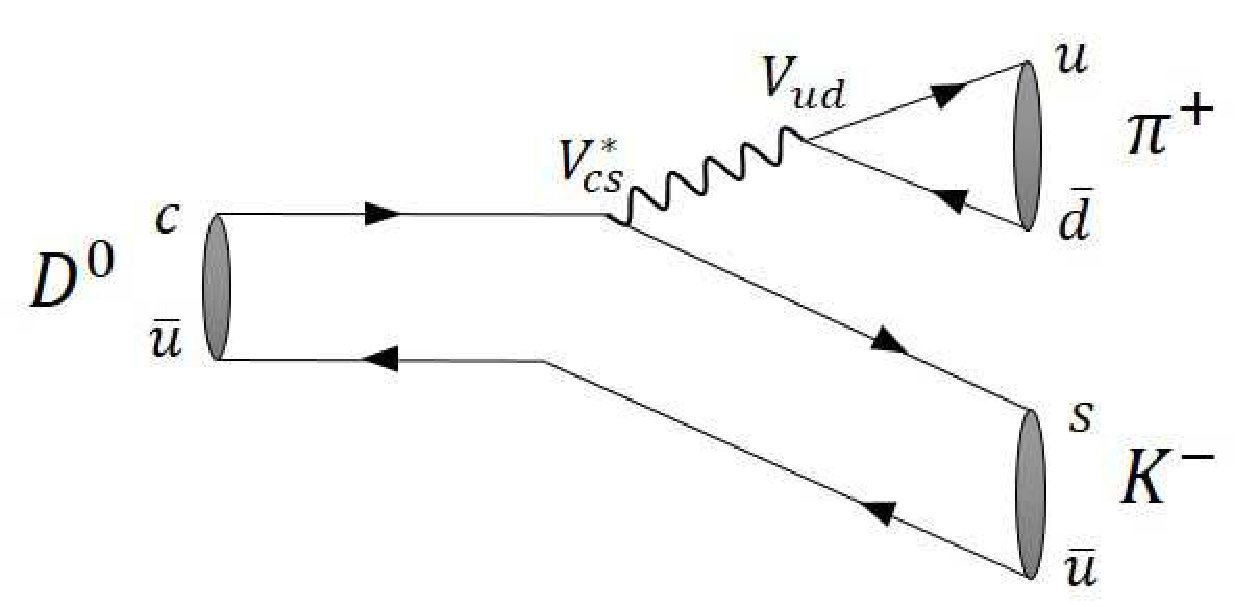 Figure 1
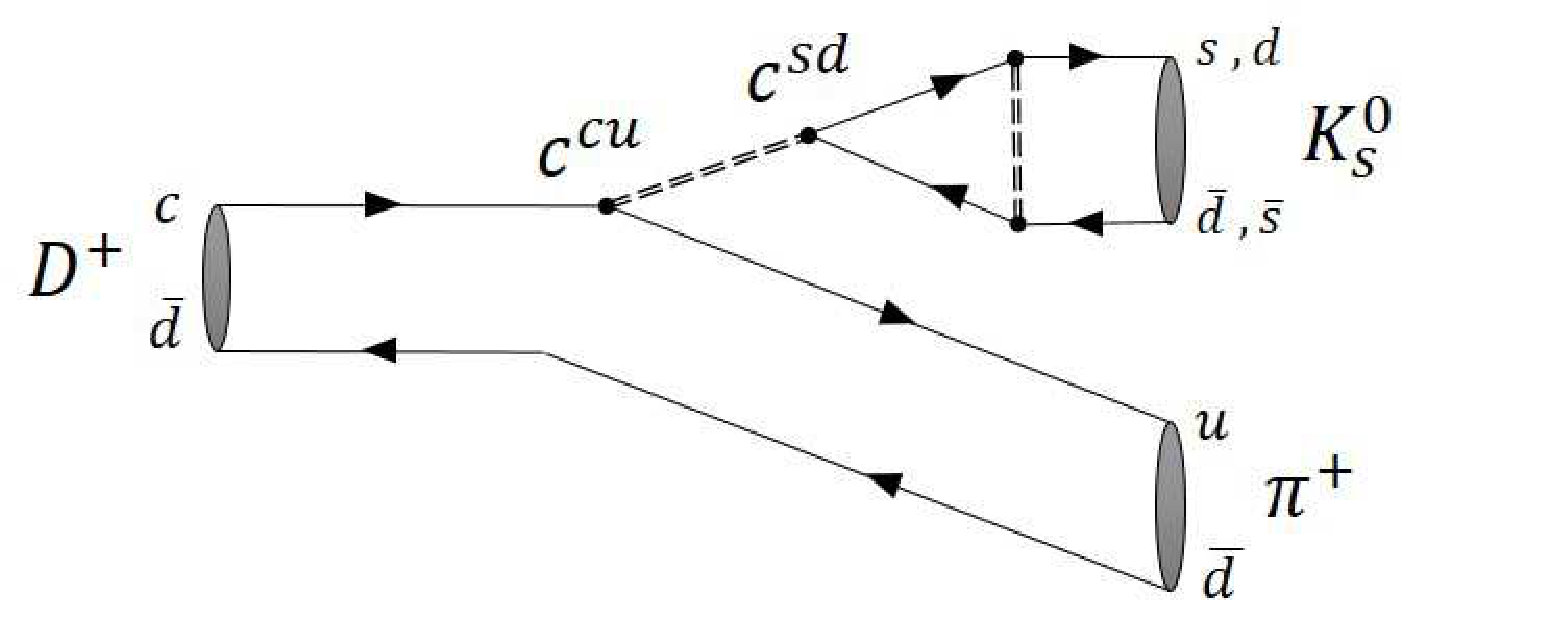 Figure 10
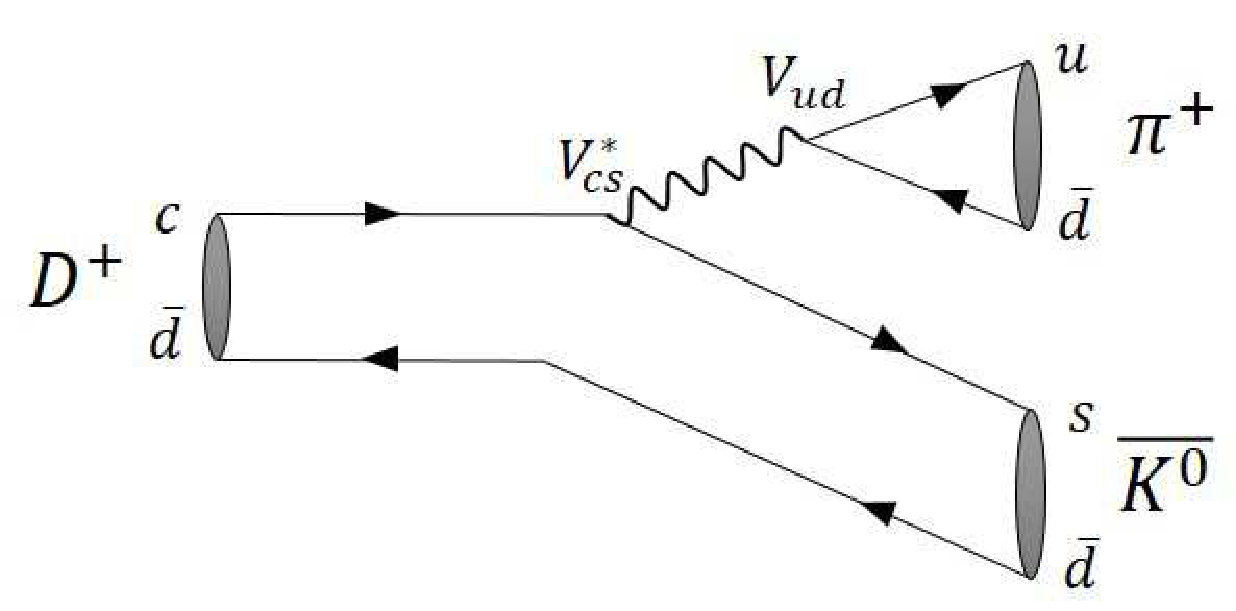 Figure 21
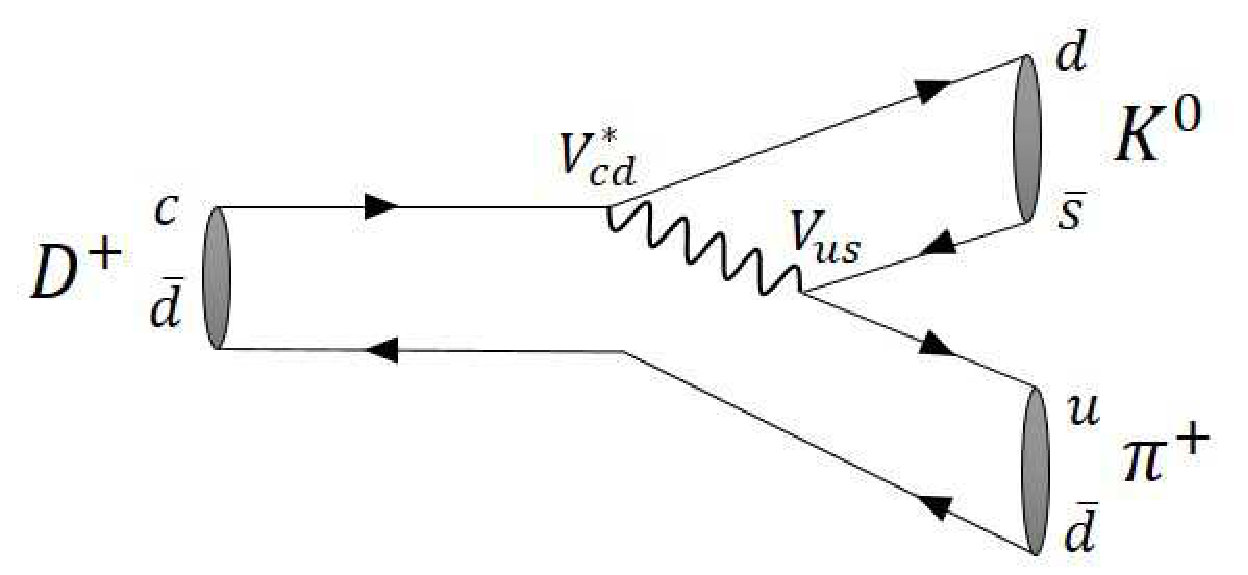 Figure 22
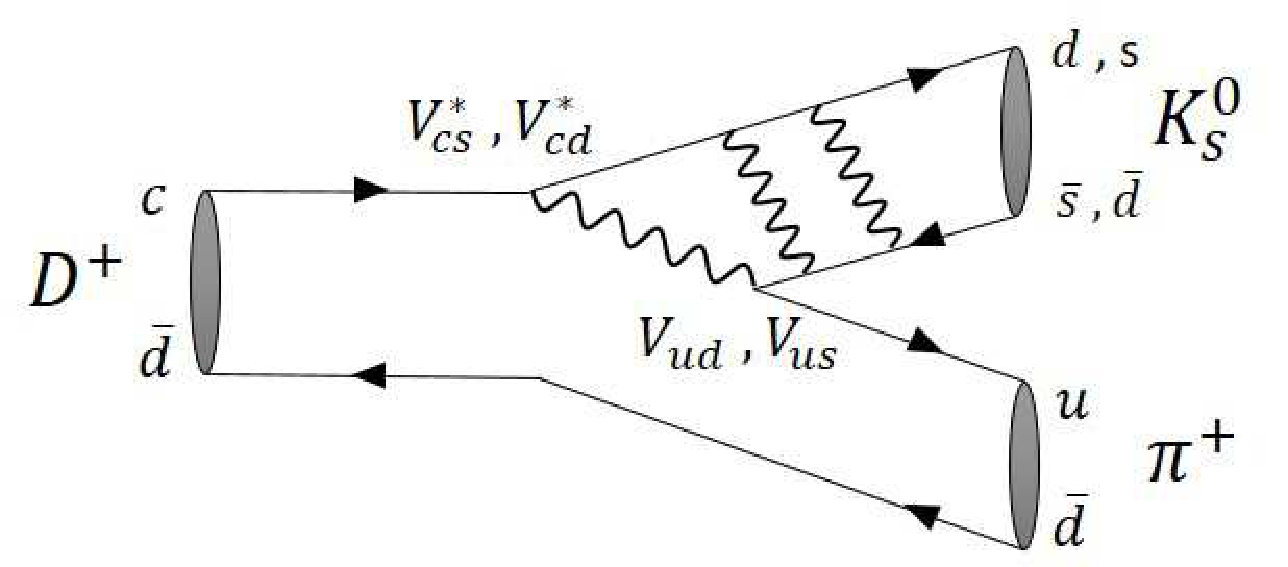 Figure 3
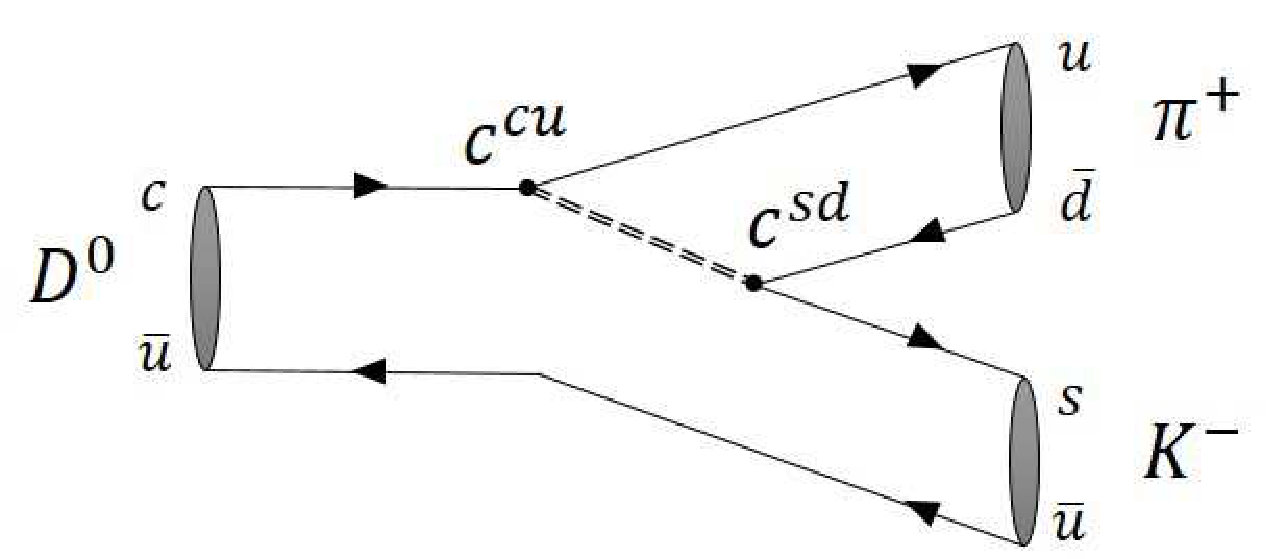 Figure 4
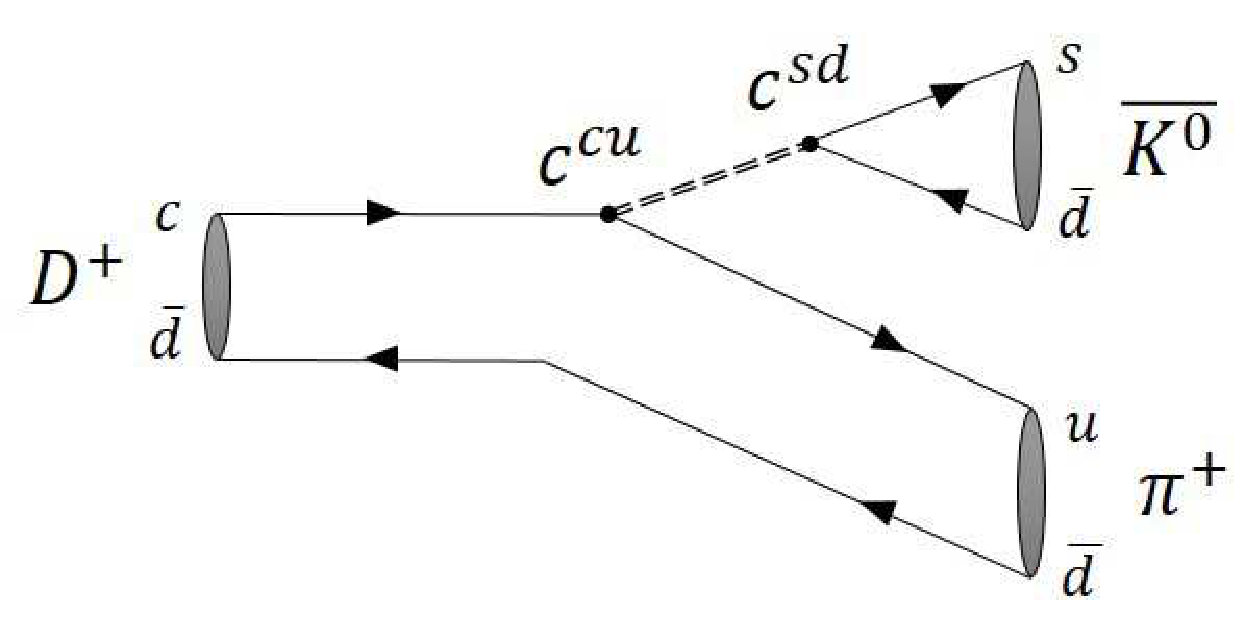 Figure 9
| Experiment | |
|---|---|
| FOCUS | -1.6 1.5 0.9 |
| CLEO | -1.3 0.7 0.3 |
| BaBar | -0.44 0.13 0.10 |
| Belle | -0.363 0.094 0.067 |
| New world average | -0.41 0.09 |
Peer Reviews
No public reviews on file for this paper yet. If you reviewed it on a platform where reviews are public (OpenReview, ICLR, NeurIPS, ICML), you can paste yours below so the community can read it here.
Videos
No videos yet. Explain this paper in a talk, walkthrough, or lecture? Add one.
Constraining unparticle physics from violation in Cabibbo-favored decays of D mesons
Mohammadmahdi Ettefaghi
Reza Moazzemi
Mohsen Rousta
Department of Physics, The University of Qom, Ghadir Blvd., Qom 371614-611, I. R. Iran
Abstract
According to the standard model, the Cabibbo-favored (CF) decays are conserve at tree level. Observation of any finite asymmetry can be received as a signal of new physics. In CF charm meson decays, and , the following experimental values for their asymmetry are reported, respectively: () and () . The value of the later can be attributed to the mixing of and , however, its contribution is about () . In this paper, we use these experimental results to constrain the unparticle stuff as a new physics which may contribute to these asymmetries.
I Introduction
In the standard model (SM), violation comes from the complex valued nature of the Cabibbo-Kobayashi-Maskawa (CKM) matrix, and in fact from a residual imaginary phase kobayashi1973cp . There are two types of violation: direct violation ( violation in decay) and indirect violation ( violation with mixing). In charged mesons (such as ), since there is no mixing with their antiparticles, only direct violation observes. The direct asymmetry for typical decay is defined as:
[TABLE]
where and are the partial decay width and decay amplitude, respectively. To have a violation, we need two amplitudes, and , with different -conserved phase and also different -violated phase. Rewriting as and defining and , Eq. (1) can be written as
[TABLE]
This equation also confirms that to have a nonvanishing violation in decay, two amplitudes with two nonzero -conserved and -violated phase differences are needed. For latter uses we introduce the ratio of and by .
Historically, violation discovered and observed in 1964 for K mesons by Cronin and Fitch christenson1964evidence . Then, it observed in many decays for B mesons (see for instancecarter1981cp ; abe2001observation ). But in the standard model, for D mesons, violation is predicted to be very small, grossman2007new . In fact, this issue is also obvious from the CKM matrix which is, up to order , written as
[TABLE]
[TABLE]
Since in D mesons we deal only with the first and second generations, the imaginary part of the relevant elements in the above matrix are of order . There was also no experimental observation of violation for D mesons till 2012 when LHCb reported a asymmetry for this meson’s family fringscp , though the recent LHCb measurement shows no evidence for violation lhcb2016 . However, the large uncertainties which exist in these measurements allow one to assume a new physics (NP) beyond the SM for explaining a possible deviation from SM and(or) putting some constrains on the parameter space of such NP.
Unparticle is a subjective theory that Georgi introduced in 2007 georgi2007unparticle . In addition to the experimental searches skh ; vkh ; vkh2 ; ams , unparticle physics is widely considered in various topics of high energy physics, such as in cosmology davoudiasl2007constraining ; lewis2007cosmological ; mcdonald2009cosmological , astronomy freitas2007astro ; hannestad2007unparticle ; deshpande2008long , neutrino oscillation boyanovsky2010oscillation and even in solid state and atomic physics pwphil ; ali ; klimph ; jpfl ; klim ; akar ; mfwon etc. In particular, it is involved in the study of various decays and scatterings, beyond the SM georgi2007another ; bhattacharyya2007unraveling ; chen2009constraints ; wei2009interpretation ; mdah ; jplee ; abol ; mden . Also many papers study the presence of unparticle in violation, such as luo. ; li2007unparticle ; chen2007unparticle ; mohanta2007possible ; zwicky2008unparticles ; huang2008direct ; chen2008flavors ; chen2010charge ; ren2011large . The effect of unparticle physics on the mixing of and have been considered in luo. and li2007unparticle , respectively. In Ref. chen2007unparticle authors have been found that the phases in unparticle propagators have a great impact on violation. Also, authors of Ref. huang2008direct found that the direct violation in the decay, which is zero in SM, can show up due to the conserving phase intrinsic in unparticle physics. The effect of unparticle physics on violation for decay have been also considered by Zwicky zwicky2008unparticles .
In our discussion, unparticle physics contributes to one of the two amplitudes which are necessary for violation. Here, we first review the asymmetries for and decays in the SM and consider their reported values from various experiments. The first decay is Cabibbo-favored (CF). The second is a combination of and which are , respectively, CF and Doubly-Cabibbo-Suppressed (DCS) that is negligible. In the SM, for CF decays of D mesons there is only one amplitude with neither conserved-, nor violated-phase, so there is no predicted violation for such decays. Here, we implement unparticle stuff to contribute as a second amplitude which can give us both conserved- and violated-phase differences. Using these decays, we try to constrain the relevant parameter space of unparticle physics.
We organized the paper as follows: in Sec. II we study the and decays in the SM briefly and review the various experimental works on them. Then the unparticle effects for these decays is considered in Sec. III. In the last section we conclude our results.
II and decays in the Standard Model and experiment
II.1 decay
The main contributions to this decay are the tree level quark contribution, exchange quark diagrams (box contribution) and color-suppressed quarks diagrams (di-penguins contribution). The tree level quark contribution is CF (see Fig. 1).
The direct asymmetry is then delepine2013observation
[TABLE]
where is the partial decay width. Due to the very smallness of this value, observation of a violation for this decay can be a smoking gun of new physics.
Note that, the contribution of the indirect violation for this decay is negligible. The experimentally reported value for the asymmetry in this decay, accepted by PDG, is pdg2016 .
II.2 decay
The first evidence of violation in charmed particles reached after the FOCUS link2002search , CLEO mendez2010measurements , Belle ko2010search , and BaBar del2011search measurements for the decay . The first world average for the asymmetry of this decay was (). This decay is performed through two steps; initially decays to or , then mixing occurs. For the asymmetry of this decay we have
[TABLE]
One can write, by a simple calculation,
[TABLE]
where and denote asymmetries in the charm decay () and in mixing in the SM, respectively xing1995effect ; bigi1995interference .
Amplitudes of two processes contribute to this decay; decay which is CF, Fig. 2(a), and decay which is DCS, Fig. 2(b).
Mixing of and in the final state leads to . The combination of these two scenarios have been shown in Fig. (3).
On the other hand, for D decays, penguin diagrams, which we need for violation as a second amplitude, contribute only to the singly Cabibbo suppressed (SCS) decays. Hence, focusing on CF decays, we have no violation in charm sector. Consequently, all of the asymmetry in must be due to mixing, which is measured to be () from semileptonic decays () nakamura2010review . The asymmetry values for this decay from various experiments are shown in Table 1. The new world average reported by PDG is pdg .
Therefore, comparing the mixing contribution reported from semileptonic decays, and the new world average, we see about ()% of asymmetry difference. Consequently, the contribution of any possible NP, such as unparticle, in asymmetry of charm sector should lie in this interval. Hereby, we can constrain the parameter space of unpartcle stuff.
III and with unparticle
In this section we first, briefly, review the unparticle physics which is a new scale invariant sector introduced firstly by Georgi georgi2007unparticle . The propagator of a scalar (vector) unparticle , is
[TABLE]
where
[TABLE]
are the scaler and vector propagators, respectively. Here, is the unparticle dimension, and
[TABLE]
Then, the unparticle couplings with quarks will be given by the following effective Lagrangian:
[TABLE]
where are dimensionless parameters and is an energy scale in which unparticles will appear. The first (second) term in this Lgrangian is related to the vector (scalar) unparticle. Unparticle with scale dimension treats as nonintegral number of invisible massless particle.
III.1 decay with tree level unparticle amplitude
Now, we investigate the decay with unparticle. As mentioned in Sec. II.1, in the SM, this decay has only a CF amplitude at tree level with no penguin diagram. The unparticle diagram for this decay is shown in Fig. 4 (Here we consider an uncharged unparticle). This new amplitude can give us strong (-conserved) and weak (-violated) phase differences needed for violation. The total amplitude now becomes
[TABLE]
where and are -violated and -conserved phase differences, respectively (knowing that the SM phases are zero). Here, is the SM amplitude zwicky2008unparticles
[TABLE]
and is the ratio of unparticle and SM amplitudes,
[TABLE]
where is a function which depends on the meson mass and QCD detail, that finally removed in Eq. (2). Here, is the effective Wilson coefficient buchalla , is the color number and with . We can ignore the scalar unparticle contributions, since they are suppressed by . Therefore, the Eq. (2) becomes
[TABLE]
Note that, in this case, as we mentioned before, up to order in the Wolfenstein CKM matrix there is no CKM weak phase and here (-violated phase) comes completely from the complex valued nature of unparticle couplings.
Here, we try to illustrate the role of the various parameters in some figures in such a way . There are, in principle, four independent parameters: the unparticle scale , the scaling dimension , the net resultant phase of the coupling constants , the absolute value of couplings product, . We fix the scale of unpartcle about 15 TeV, due to the recent energy achievement in LHC. The dependence of to is also trivial (linear), in the regime where we expect the perturbation works and also corrections to the SM are small111The upper bound of have been fixed from mixing at for li2007unparticle .. Therefore the main parameters which may play important roles are and .
In Fig. 7, we have plotted in terms of for two different . In this figure, the allowed region has been colored and we have fixed . This figure shows that for some regions, around , is larger than all allowed values. Since the weak and strong phases play important roles in violation, we try to study the related parameter space for some various values of product through contour plots of Fig. 8. In these contour plots the vertical axes shows the weak phase, and the horizontal axes is devoted to dimension of the unparticle which determines the strong phase. Here, the color shows the .
As a result of this figure, in TeV, there exist some regions which are excluded by this process for , while in the case of , or weaker couplings, the whole of parameter space is allowed. In other words, for as well as stronger couplings, the unparticle physics contribution can be explored by experimental test which is more accurate than the recent data while for the values less than about , it is far from recent precisions and is not testable.
III.2 decay with tree level unparticle amplitude
Here in this section, we apply unparticle theory as a second amplitude to explain the ()% asymmetry related to the charm sector. As mentioned before, this value is due to the difference between the world average asymmetry for decay and the corresponding value for mixing ().
Again, for this decay we have no penguin diagram and in tree level it has both CF and DCS amplitudes which we neglect DCS one grossman2012cp . Unparticle stuff can give a diagram which leads to the strong and weak phase differences between two amplitudes (corresponding to SM and unparticle). One could see the diagram of and with unparticle in Figs. 5 and 6, respectively.
This decay is the same as , if one changes the observer quark to and also adds a mixing in final state. To write the total we note that, we are seeking for a asymmetry in addition to the contribution of SM mixing, as mentioned before. Moreover, the unparticle contribution in mixing is negligible chen2009constraints . Therefore, the total amplitude becomes
[TABLE]
where
[TABLE]
and
[TABLE]
where is defined similar to . Consequently, the direct asymmetry becomes
[TABLE]
As it is obvious from the above equation, the second term in the right-hand side is exactly the same as Eq. (14). Therefore, our general phenomenological discussion do not alter, however, here we should be careful about the allowed regions in parameter space (see Figs. 7 and 8). In particular, according to Fig. 8, for , while the whole region is allowed in the case of first process, some region with positive value of is excluded by the recent process.
IV Conclusions
The new world averages for violation in and decays reported by PDG are () and () respectively. In , the value () is due to the mixing of and mesons in the final state. Subtracting this contribution, one can conclude that any possible NP gives, at most, a asymmetry in the interval () . Interaction between a scale invariant sector, called unparticle by Georgi georgi2007unparticle , and the SM fields, as a NP, can induce a asymmetry chen2007unparticle .
In this paper, we have studied the unparticle induced asymmetry in both processes and decays. More explicitly, both phase differences (weak and strong), needed for violation, come from unparticle diagrams. Note that, these two decays are CF (in charm sector), which has no predicted asymmetry in the SM at tree level. Here, in addition to the scale of unparticle physics , three important parameters play role; the net resultant weak phase of unparticle , the dimension of unparticle which determines the strong phase and the product of couplings . The asymmetry with respect to the for a fixed value of and is plotted for TeV in Fig. 7. With choosing and , for instance, the absolute value of asymmetry gets a maximum in , in which the asymmetry exceeds of experimental bounds. We have also demonstrated the parameter space of this theory through some contour plots for TeV and various values of . We see excluded regions in all selected , which correspond to the pick regions of asymmetry diagram.
The reference list from the paper itself. Each links out to its DOI / PubMed record.
- 1(1) M. Kobayashi and T. Maskawa, “ C P 𝐶 𝑃 CP -violation in the renormalizable theory of weak interaction”, Progr. Theor. Exp. Phys. , 49 (1973) 652.
- 2(2) J. Christenson, J. Cronin and V Fitch, “Evidence for the 2 π 𝜋 \pi Decay of the K 2 0 superscript subscript 𝐾 2 0 K_{2}^{0} Meson”, Phys. Rev. Lett. , 13 (1964) 138.
- 3(3) A.B. Carter and A.I. Sanda “ C P 𝐶 𝑃 CP violation in B-meson decays”, Phys. Rev. D 23 (1981) 1567.
- 4(4) K. Abe et al. “Observation of large C P 𝐶 𝑃 CP violation in the neutral B meson system”, Phys. Rev. Lett. 87 (2001) 091802.
- 5(5) Y. Grossman, A.L. Kagan, and Y. Nir “New physics and C P 𝐶 𝑃 CP violation in singly Cabibbo suppressed D decays”, Phys. Rev. D 75 (2007) 036008.
- 6(6) LH Cb Collaboration, R. Aaij et al. , “Evidence for C P 𝐶 𝑃 CP violation in time-integrated D → h + h − subscript 𝐷 → superscript ℎ superscript ℎ D_{\to}h^{+}h^{-} decay rates”, Phys. Rev. Lett. 108 (2012) 111602, [ar Xiv:1112.0938].
- 7(7) LH Cb Collaboration, R. Aaij et al. , “Measurement of the difference of time-integrated C P 𝐶 𝑃 CP asymmetries in D 0 → K + K − → superscript 𝐷 0 superscript 𝐾 superscript 𝐾 D^{0}\rightarrow K^{+}K^{-} and D 0 → π + π − → superscript 𝐷 0 superscript 𝜋 superscript 𝜋 D^{0}\rightarrow\pi^{+}\pi^{-} decays”, Phys. Rev. Lett. 116, 191601 (2016).
- 8(8) H. Georgi, “Unparticle physics”, Phys. Rev. Lett. 98 (2007) 221601.