Reversed Currents in Charged Liquid Bridges
Klaus Morawetz

TL;DR
This paper reanalyzes the velocity profile in charged water bridges, revealing that a radial charge distribution can cause a sign change in mass flow, with implications for understanding electrohydrodynamic phenomena.
Contribution
It introduces a model considering radial charge distribution in water bridges, predicting flow reversal phenomena not previously described.
Findings
Radial charge distribution can reverse flow direction.
Analytical solutions show sign change in mass flow.
Surface potential analogous to Zeta potential influences flow.
Abstract
The velocity profile in a water bridge is reanalyzed. Assuming hypothetically that the bulk charge has a radial distribution, a surface potential is formed that is analogous to the Zeta potential. The Navier Stokes equation is solved, neglecting the convective term; then, analytically and for special field and potential ranges, a sign change of the total mass flow is reported caused by the radial charge distribution.
Click any figure to enlarge with its caption.
 Figure 1
 Figure 2
 Figure 3
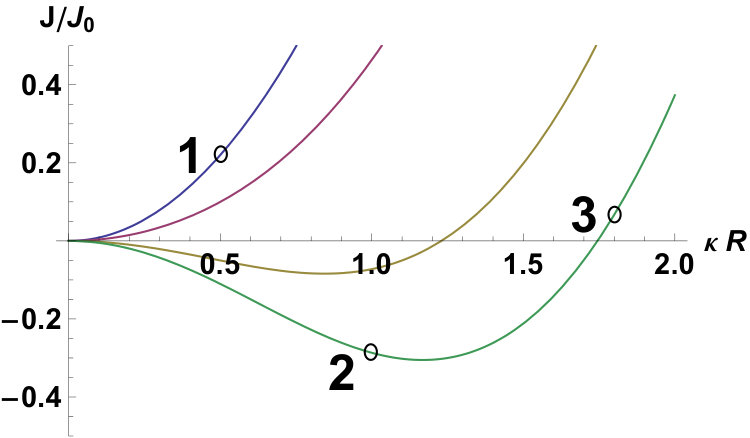 Figure 4
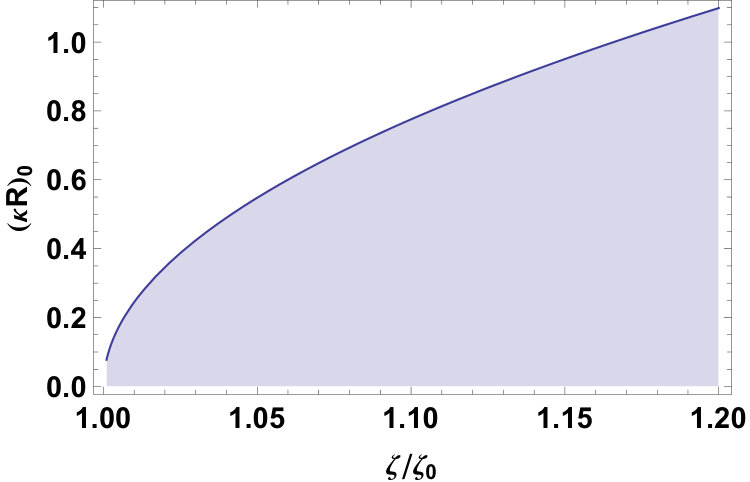 Figure 5
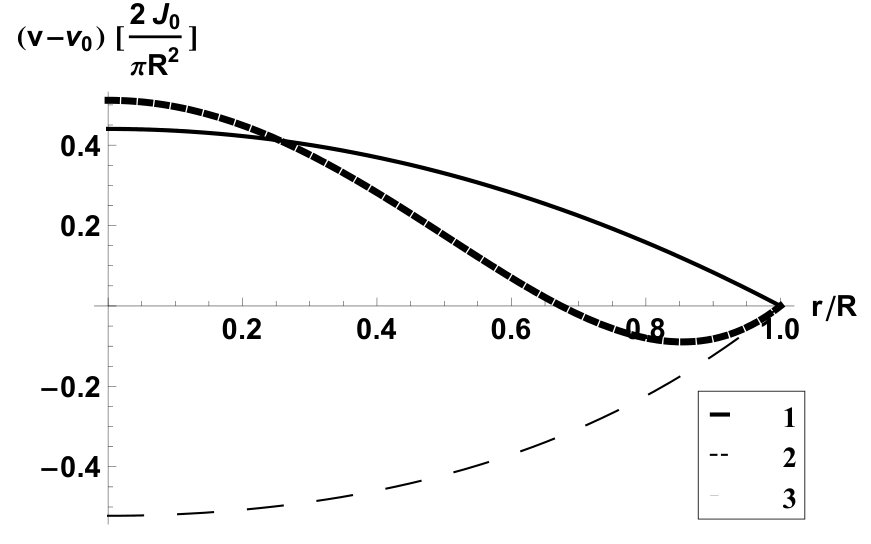 Figure 6
 Figure 7
Peer Reviews
No public reviews on file for this paper yet. If you reviewed it on a platform where reviews are public (OpenReview, ICLR, NeurIPS, ICML), you can paste yours below so the community can read it here.
Videos
No videos yet. Explain this paper in a talk, walkthrough, or lecture? Add one.
Abstract
The velocity profile in a water bridge is reanalyzed. Assuming hypothetically that the bulk charge has a radial distribution, a surface potential is formed that is analogous to the Zeta potential. The Navier–Stokes equation is solved, neglecting the convective term; then, analytically and for special field and potential ranges, a sign change of the total mass flow is reported caused by the radial charge distribution.
keywords:
classical transport; electrokinetic effects; electrohydrodynamics; electrorheological fluids; Navier–Stokes equations
\articlenumber
x \doinum10.3390/—— \pubvolumexx
\externaleditorAcademic Editors: Elmar Christof Fuchs, Jakob Woisetschläger, Adam D. Wexler and Astrid H. Paulitsch-Fuchs \historyReceived: 24 March 2017; Accepted: 15 May 2017; Published: date \TitleReversed Currents in Charged Liquid Bridges \AuthorKlaus Morawetz 1,2,3
\corresCorrespondence: [email protected]
\PACS05.60.Cd; 47.57.jd;47.65.-d; 83.80.Gv
1 Introduction
Although it has been known for over 100 years Armstrong (1893), the formation of a water bridge between two beakers under high voltage has not lost its fascination. It is interesting to understand the underlying electrohydrodynamics of such water bridges at nanoscale since liquid bridging is not restricted to water but can also be observed in other liquids Saija et al. (2010) and is characteristic of polar dielectric liquids Wexler et al. (2014). Therefore, its cause might be in electrohydrodynamics Melcher and Taylor (1969) rather than in molecular-specific structures.
Applications can be found in atomic force microscopy Sacha et al. (2006); phenomena in micro-fluidics Squires and Quake (2005); up to electrowetting problems Oh et al. (2010) to confine chemical reactions Garcia-Martin and Garcia (2006). Molecular dynamical simulations Chen et al. (2010) help to understand the underlying mechanism, especially what leads a water filament to overcome the surface tension Cramer et al. (2008). The formation of a water bridge across the lipid bilayer is considered as the first stage of electroporation for the intrusion of individual water molecules into the membrane interior Ho et al. (2013). The dynamics of charged liquids is also used for capillary jets Ganancalvo (1997). Some current applications include ink printers and electrosprays Gamero-Castano (2010); Higuera (2010) and the breakup dynamics of free surfaces and flows Eggers (1993, 1997).
Such water bridges can even be stretched and used for flexible nanofluids Chen et al. (2016). Water bridges exhibit viscoelastic behavior with the possibility to measure its Young modulus Teschke et al. (2013). There is an interplay between field-induced polarization, surface tension, and condensation Gómez-Monivas et al. (2003); Cramer et al. (2008) such that the forces of dielectric and surface tensions simultaneously hold the bridge against gravity Montazeri Namin et al. (2013). For an overview of the different forces occurring in microelectrode structures, see Ramos et al. (1998).
In the absence of bulk charges, the forces on the water stream are caused by the pressure of the polarizability of water due to the high dielectric susceptibility . This pressure leads to the catenary form of the water bridge—like a hanging chain Widom et al. (2009). While the simplified model of Saija et al. (2010), employing a capacitor picture, already leads to a critical field strength for the formation of the water bridge, the catenary model Widom et al. (2009) or a charged catenary Morawetz (2012) allows the determination of the static and dynamical stability conditions where charged liquid bridges are possible. The creeping height, the bridge radius and length as well as the shape of the bridge were calculated, showing an asymmetric profile in agreement with observations Woisetschlager et al. (2010); Marin and Lohse (2010). The flow profile was obtained from the Navier–Stokes equation leading to a mean velocity which combines charge transport with neutral mass flow Morawetz (2012). It shows that even the uncharged catenary provides a minimal critical field strength for the water bridge formation in dependence on the length of the bridge. This critical field strength is modified if charges are present in the bridge Morawetz (2012). The occurrence of charges due to dissociation has also been used to explain the I–V hysteresis reported in Oshurko et al. (2014).
In this paper, it is assumed that the charge carriers play an important role, such that surface charges might be formed. This hypothetical assumption is analyzed and leads to a surface potential which essentially influences the charge transport. Since both mass and charge transport are coupled, here we find the possibility that the mass transport might show a reverse behavior dependent on the parameters. This study is motivated by the bidirectional flow visualized recently in Wexler et al. (2017) and measured with mass and charge transfer in Fuchs et al. (2010).
2 Velocity Profile with Bulk Charges
The link between the Ohm picture of a constant current density of charged particles and the dependence of the mass flow on the cross-area for incompressible fluids has been found in a combined flow expression Morawetz (2012). Possible charges with density in water move according to the applied electric field and will create a mean mass motion of density . Such access charge has been found in Teschke et al. (2016); Fuchs et al. (2016). Let us first recall the main steps for such a transport picture and then investigate how a radial charge distribution changes the results.
In the stationary case and neglecting the nonlinear convection, the Navier–Stokes equation Chandrasekharaiah (1994) reads
[TABLE]
with the gradient of the electric pressure given in the direction of the bridge of length by
[TABLE]
with the dielectric constant and introducing the creeping height
[TABLE]
For details about the gradient of the electric pressure, see Equations (8) and (22) of Morawetz (2012). This leads from (1) to the equation for the radial-dependent velocity
[TABLE]
where we have introduced the dimensionless ratio of the force density on the charges by the field, , to the gravitational force density, , in the form
[TABLE]
The solution of (4) provides the velocity profile in the direction of the bridge as
[TABLE]
where is the radius of the bridge and the characteristic velocity reads
[TABLE]
In Morawetz (2012), it was assumed that the undetermined velocity at the surface of the bridge vanishes.
3 Surface Potential
The direction of the flux not only depends on the applied electrostatic field but also on the relative electronegativity of the electrodes Giuliani et al. (2015). A complex bi-directional mass transfer pattern has been found in such bridges Wexler et al. (2014, 2017). Especially in the latter paper, the bidirectional flow was observed by charged isotopes. The light water flows above the heavier water. Thus, it is justified to assume bulk charges. Already in Melcher and Taylor (1969), it was considered that the bulk charges might be realized in a surface sheet. Ionized charges at the anode migrate to the outer surface of the bridge Teschke et al. (2016). Therefore, the migration of charges to the surface should be considered to be forming a charged surface sheet which will be an extension of Morawetz (2012). Now, let us develop step by step the idea of a surface charge and the corresponding potential.
The force on an ionic charge in an electric field with small velocities can be well approximated by the Stokes force
[TABLE]
where is the radius and the viscosity. With the conductivity , the potential can be defined from the velocity
[TABLE]
and can be written in two forms
[TABLE]
This potential actually describes the electric potential at the surface of the bridge which we will now see from the analogous idea as one describes electro-osmose. We assume that the charge density in the bridge consists of a homogeneous bulk charge ,
[TABLE]
and a radial-dependent modulation of the charge density according to a distribution that is analogous to the screening cloud. This is a purely hypothetical assumption which we will justify by the observation that it leads exactly to the finite potential at the surface. In other words, in the case that the surface potential of the bridge is at the boundary between liquid and air, the following considerations are the result. The Poisson equation for the electrostatic potential in that case reads
[TABLE]
with the squared inverse screening length . Here, we have assumed that the integrated spatial inhomogeneous charge density modulation is zero such that besides the homogeneous no total access charge remains. The Poisson Equation (12) is readily solved for a radial dependence
[TABLE]
with the potential at the surface and the Bessel function . From (12), we obtain the radial dependence of the spatial modulation of the charge density
[TABLE]
from which the additional body force follows
[TABLE]
4 Velocity Profile with Bulk and Surface Charges
Now we are ready to solve the Navier–Stokes Equation (1) including this additional force density (15)
[TABLE]
The bridge extends in the -direction with the following geometry
[TABLE]
as well as a constant pressure gradient of (2) This leads to a simple equation for the radial dependence that is analogous to (4)
[TABLE]
Demanding that the solution is finite at , one can integrate (18) and instead of (6), we obtain
[TABLE]
This gives the velocity profile in dependence on the radius if a surface potential is present. The first part without such potential, (6), has been obtained in Morawetz (2012) considering the bulk charges and the dielectric pressure due to the electric field. The second term is the new contribution arising from the surface charge.
The total volume flow relative to the surface flow can be calculated from (19) as
[TABLE]
with
[TABLE]
The result is presented in Figure 1 and one can see that the flow can change the direction if the potential exceeds a critical value. This value can be found by observing in Figure 1 that the sign change appears for small leading to a zero in at . Therefore, from an expansion of (20) for , the sign change can appear for
[TABLE]
with (10) and (21). The zero nonlinear in dependence on the potential is plotted in Figure 2. The region of inverse flow is given for values of which are smaller than indicated by the shaded area.
With the help of (21), the radial velocity profile (19) can be recast into the form
[TABLE]
and is presented in Figure 3. We plot the radial velocity profile of the three numbered points in Figure 1. One sees that point 3 of Figure 1 leads to a sign change in the profile such that the total mass flow has an opposite sign. Of course, this is only the ideal case when the velocity at the surface vanishes . Otherwise, we have to add the value to the mass flow (20), which we assume to be small.
5 Summary
As motivated by the recent visualizations of bidirectional flow Wexler et al. (2017), we have considered, in addition to bulk charges, a spatial modulation of the radial charge distribution such that a surface potential occurs. Solving the Navier–Stokes equation leads to a modified mass flow through the bridge. Dependent on the parameters, one can find a range where the flow is changing its direction. The observation here is that a surface potential can cause a line of zero velocity, i.e., a stagnation line of mass flow, and can lead to a sign reversal of the total mass current. One will most probably observe bi-directional mass transfer patterns. The surface potential can be thought of as being created by polar water molecules and charges separated from neutral air. In order to keep the total charge density constant, such a surface potential could balance the access charges. This is so far a purely hypothetical scenario.
\conflictsofinterest
The authors declare no conflict of interest.
The reference list from the paper itself. Each links out to its DOI / PubMed record.
- 1Armstrong (1893) Armstrong, W.G. The Electrical Engineer ; The Newcastle Literary and Philosophical Society: New Castle, UK, 1893; pp. 154–155.
- 2Saija et al. (2010) Saija, F.; Aliotta, F.; Fontanella, M.E.; Pochylski, M.; Salvato, G.; Vasi, C.; Ponterio, R.C. Communication: An extended model of liquid bridging. J. Chem. Phys. 2010 , 133 , 081104.
- 3Wexler et al. (2014) Wexler, A.; López Sàenz, M.; Schreer, O.; Woisetschläger, J.; Fuchs, E. The Preparation of Electrohydrodynamic Bridges from Polar Dielectric Liquids. J. Vis. Exp. 2014 , 91 , e 51819.
- 4Melcher and Taylor (1969) Melcher, J.R.; Taylor, G.I. Electrohydrodynamics: A review of role of interfacial shear stresses. Ann. Rev. Fluid Mech. 1969 , 1 , 111–146.
- 5Sacha et al. (2006) Sacha, G.M.; Verdaguer, A.; Salmeron, M. Induced water condensation and bridge formation by electric fields in atomic force microscopy. J. Phys. Chem. B 2006 , 110 , 14870–14873.
- 6Squires and Quake (2005) Squires, T.M.; Quake, S.R. Microfluidics: Fluid physics at the nanoliter scale. Rev. Mod. Phys. 2005 , 77 , 977–1026.
- 7Oh et al. (2010) Oh, J.M.; Ko, S.H.; Kang, K.H. Analysis of electrowetting-driven spreading of a drop in air. Phys. Fluids 2010 , 22 , 032002.
- 8Garcia-Martin and Garcia (2006) Garcia-Martin, A.; Garcia, R. Formation of nanoscale liquid menisci in electric fields. Appl. Phys. Lett. 2006 , 88 , 123115.