TL;DR
This paper introduces a new neural network model that jointly performs POS tagging and dependency parsing, leveraging shared features from bidirectional LSTMs, and achieves state-of-the-art results across 19 languages.
Contribution
The novel model effectively combines POS tagging and dependency parsing using shared bidirectional LSTM features, surpassing previous neural network approaches.
Findings
Outperforms existing models on 19 languages
Achieves new state-of-the-art accuracy
Open-source code and pre-trained models available
Abstract
We present a novel neural network model that learns POS tagging and graph-based dependency parsing jointly. Our model uses bidirectional LSTMs to learn feature representations shared for both POS tagging and dependency parsing tasks, thus handling the feature-engineering problem. Our extensive experiments, on 19 languages from the Universal Dependencies project, show that our model outperforms the state-of-the-art neural network-based Stack-propagation model for joint POS tagging and transition-based dependency parsing, resulting in a new state of the art. Our code is open-source and available together with pre-trained models at: https://github.com/datquocnguyen/jPTDP
Click any figure to enlarge with its caption.
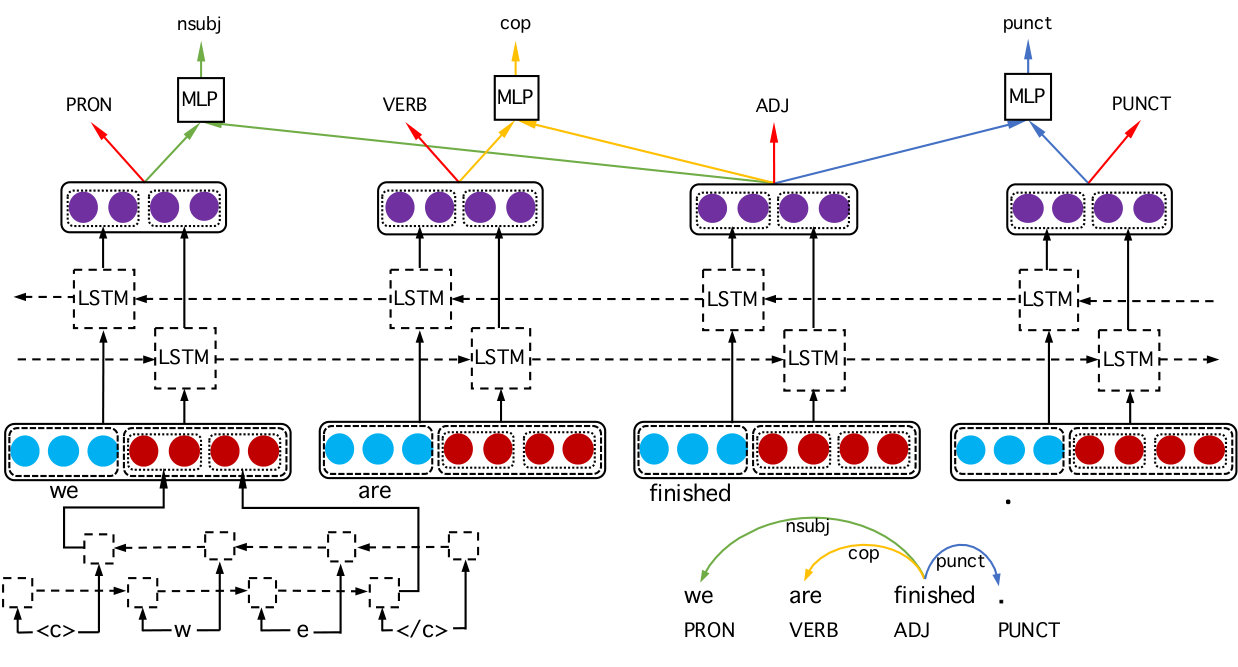 Figure 1
| Method | ar | bg | da | de∙ | en | es | eu∙ | fa | fi∙ | fr | hi | id | it | iw | nl | no | pl∙ | pt | sl∙ | AVG |
|---|---|---|---|---|---|---|---|---|---|---|---|---|---|---|---|---|---|---|---|---|
| 10.3 | 12.3 | 15.6 | 11.9 | 9.1 | 7.3 | 17.8 | 8.2 | 24.4 | 5.7 | 4.6 | 13.8 | 5.7 | 10.9 | 18.8 | 11.2 | 23.1 | 10.0 | 19.9 | 12.7 | |
| Part-of-speech tagging | ||||||||||||||||||||
| UDPipe | 98.7 | 97.8 | 95.8 | 90.7 | 94.5 | 95.0 | 93.1 | 96.9 | 94.9 | 95.9 | 95.8 | 93.6 | 97.2 | 94.8 | 89.2 | 97.2 | 96.0 | 97.4 | 95.6 | 95.3 |
| TnT [] | 97.8 | 96.8 | 94.3 | 92.6 | 92.7 | 94.6 | 93.4 | 96.0 | 93.6 | 94.5 | 94.5 | 93.2 | 96.2 | 93.7 | 88.5 | 96.3 | 95.6 | 96.3 | 94.9 | 94.5 |
| CRF [] | 97.6 | 96.4 | 93.8 | 91.4 | 93.4 | 94.2 | 91.6 | 95.7 | 90.3 | 95.1 | 96.0 | 93.0 | 96.4 | 93.6 | 90.0 | 96.2 | 94.0 | 96.3 | 94.8 | 94.2 |
| BiLSTM-aux | 98.9 | 98.0 | 96.2 | 92.6 | 94.5 | 95.1 | 94.7 | 97.2 | 94.9 | 95.8 | 96.2 | 93.1 | 97.6 | 95.8 | 93.3 | 97.6 | 96.4 | 97.5 | 97.6 | 95.9 |
| Stack-prop | - | - | - | - | - | - | - | - | - | - | - | - | - | - | - | - | - | - | - | 95.4 |
| Our jPTDP | 98.8 | 97.4 | 95.8 | 92.7 | 94.7 | 95.9 | 93.7 | 96.8 | 94.6 | 96.0 | 96.4 | 93.1 | 97.5 | 95.5 | 91.4 | 97.4 | 96.3 | 97.5 | 97.1 | 95.7 |
| 3.1 | 2.4 | 3.9 | 2.3 | 1.6 | 0.8 | 4.3 | 0.8 | 5.4 | 1.1 | 0.3 | 3.7 | 1.4 | 1.6 | 6.6 | 2.7 | 4.7 | 3.1 | 5.7 | 2.9 | |
| Dependency parsing | ||||||||||||||||||||
| UDPipe | 76.0 | 84.7 | 74.8 | 71.8 | 80.2 | 79.7 | 69.7 | 79.7 | 76.3 | 77.8 | 87.5 | 73.9 | 85.7 | 77.1 | 71.3 | 84.5 | 79.4 | 81.3 | 80.2 | 78.5 |
| B’15 [*] | 75.6 | 83.1 | 69.6 | 72.4 | 77.9 | 78.5 | 67.5 | 74.7 | 73.2 | 77.4 | 85.9 | 72.3 | 84.1 | 73.1 | 69.5 | 82.4 | 78.0 | 79.9 | 80.1 | 76.6 |
| Pipeline[*] | 73.7 | 83.6 | 72.0 | 73.0 | 79.3 | 79.5 | 63.0 | 78.0 | 66.9 | 78.5 | 87.8 | 73.5 | 84.2 | 75.4 | 70.3 | 83.6 | 73.4 | 79.5 | 79.4 | 76.6 |
| RBGParser [*] | 75.8 | 83.6 | 73.9 | 73.5 | 79.9 | 79.6 | 68.0 | 78.5 | 65.4 | 78.9 | 87.7 | 74.2 | 84.7 | 77.6 | 72.4 | 83.9 | 75.4 | 81.3 | 80.7 | 77.6 |
| Stack-prop | 77.0 | 84.3 | 73.8 | 74.2 | 80.7 | 80.7 | 70.1 | 78.5 | 74.5 | 80.0 | 88.9 | 74.1 | 85.8 | 77.5 | 73.6 | 84.7 | 79.2 | 80.4 | 81.8 | 78.9 |
| Our jPTDP | 79.0 | 83.9 | 75.8 | 75.8 | 82.0 | 82.4 | 73.2 | 81.5 | 75.0 | 80.0 | 87.3 | 75.7 | 86.4 | 79.2 | 66.8 | 84.9 | 82.5 | 79.3 | 81.7 | 79.6 |
| 3.8 | 4.1 | 4.5 | 3.6 | 1.4 | 2.3 | 12.0 | 1.1 | 11.1 | 0.2 | 0.3 | 4.1 | 1.9 | 1.9 | 5.4 | 2.3 | 10.6 | 3.4 | 9.2 | 4.4 | |
| System | All | Big | PUD | Sma. | Sur. | R |
|---|---|---|---|---|---|---|
| (81) | (55) | (14) | (8) | (4) | ||
| UDPipe 1.2 | 69.528 | 74.389 | 69.009 | 53.759 | 35.9614 | 8 |
| UDPipe 1.1 | 68.3513 | 73.0417 | 68.3313 | 51.8015 | 37.0711 | 15 |
| MQuni | 68.0514 | 74.0312 | 69.288 | 51.5817 | 14.4828 | 10 |
| ltcode | UPOS | UAS | LAS | ltcode | UPOS | UAS | LAS | ltcode | UPOS | UAS | LAS |
|---|---|---|---|---|---|---|---|---|---|---|---|
| ar_pud | 79.34 | 68.78 | 56.81 | fr_partut | 95.34 | 84.75 | 80.68 | lv | 90.27 | 69.28 | 61.50 |
| ar | 95.18 | 84.16 | 77.82 | fr_pud | 89.85 | 83.50 | 78.14 | nl_lassysmall | 95.82 | 79.74 | 75.29 |
| bg | 97.49 | 88.53 | 84.20 | fr_sequoia | 97.27 | 86.00 | 83.25 | nl | 91.15 | 78.47 | 71.39 |
| bxr | 43.21 | 28.79 | 14.04 | fr | 96.70 | 87.69 | 84.51 | no_bokmaal | 97.43 | 88.25 | 85.33 |
| ca | 98.10 | 88.62 | 85.59 | ga | 88.35 | 73.43 | 62.24 | no_nynorsk | 97.07 | 86.30 | 83.12 |
| cs_cac | 98.53 | 87.52 | 83.47 | gl_treegal | 92.83 | 75.45 | 68.46 | pl | 96.18 | 88.60 | 82.70 |
| cs_cltt | 97.20 | 79.61 | 74.84 | gl | 96.86 | 83.77 | 80.40 | pt_br | 97.64 | 90.40 | 88.32 |
| cs_pud | 95.96 | 85.26 | 79.83 | got | 94.27 | 77.78 | 70.27 | pt_pud | 88.41 | 81.49 | 75.15 |
| cs | 98.41 | 88.03 | 84.35 | grc_proiel | 94.73 | 73.25 | 67.34 | pt | 96.58 | 87.88 | 84.54 |
| cu | 92.81 | 81.96 | 73.22 | grc | 86.97 | 54.87 | 47.57 | ro | 96.72 | 87.04 | 81.37 |
| da | 95.80 | 80.87 | 76.89 | he | 95.53 | 86.65 | 80.91 | ru_pud | 86.26 | 78.88 | 70.15 |
| de_pud | 85.62 | 78.34 | 71.34 | hi_pud | 85.19 | 64.54 | 51.97 | ru_syntagrus | 98.11 | 89.73 | 87.08 |
| de | 92.83 | 80.16 | 75.66 | hi | 96.41 | 90.68 | 86.71 | ru | 95.31 | 82.14 | 77.12 |
| el | 96.18 | 85.07 | 81.55 | hr | 96.19 | 85.46 | 79.32 | sk | 94.48 | 81.26 | 75.51 |
| en_lines | 94.67 | 79.21 | 74.60 | hsb | 51.13 | 29.88 | 17.06 | sl_sst | 88.84 | 63.25 | 55.01 |
| en_partut | 94.17 | 81.25 | 76.56 | hu | 91.81 | 74.05 | 66.82 | sl | 96.87 | 84.75 | 81.25 |
| en_pud | 94.74 | 85.49 | 81.64 | id | 93.10 | 83.41 | 76.84 | sme | 33.12 | 22.80 | 8.23 |
| en | 94.82 | 85.29 | 81.64 | it_pud | 93.51 | 89.30 | 85.58 | sv_lines | 94.73 | 81.52 | 76.19 |
| es_ancora | 98.28 | 88.48 | 85.50 | it | 97.62 | 90.28 | 87.26 | sv_pud | 91.60 | 77.73 | 72.05 |
| es_pud | 88.59 | 87.55 | 80.28 | ja_pud | 97.08 | 94.40 | 93.26 | sv | 96.05 | 83.35 | 78.85 |
| es | 96.32 | 87.66 | 84.05 | ja | 96.56 | 94.07 | 92.41 | tr_pud | 72.60 | 57.14 | 35.50 |
| et | 87.62 | 69.44 | 59.15 | kk | 51.11 | 44.25 | 22.91 | tr | 93.42 | 67.39 | 59.14 |
| eu | 93.15 | 77.86 | 72.56 | kmr | 47.72 | 31.59 | 18.79 | ug | 72.49 | 57.79 | 39.48 |
| fa | 96.38 | 85.98 | 81.91 | ko | 93.47 | 79.89 | 74.75 | uk | 88.09 | 71.03 | 61.03 |
| fi_ftb | 92.63 | 82.48 | 76.54 | la_ittb | 97.44 | 78.81 | 74.65 | ur | 92.96 | 86.05 | 79.27 |
| fi_pud | 96.15 | 83.15 | 79.31 | la_proiel | 94.23 | 71.75 | 64.78 | vi | 86.78 | 64.88 | 55.63 |
| fi | 94.95 | 81.89 | 77.50 | la | 83.26 | 57.79 | 44.60 | zh | 92.36 | 78.57 | 72.99 |
Peer Reviews
No public reviews on file for this paper yet. If you reviewed it on a platform where reviews are public (OpenReview, ICLR, NeurIPS, ICML), you can paste yours below so the community can read it here.
Code & Models
Videos
No videos yet. Explain this paper in a talk, walkthrough, or lecture? Add one.
A Novel Neural Network Model for Joint POS Tagging and
Graph-based Dependency Parsing
Dat Quoc Nguyen, Mark Dras
Mark Johnson
Department of Computing
Macquarie University, Australia
{mark.dras, mark.johnson}@mq.edu.au
Abstract
We present a novel neural network model that learns POS tagging and graph-based dependency parsing jointly. Our model uses bidirectional LSTMs to learn feature representations shared for both POS tagging and dependency parsing tasks, thus handling the feature-engineering problem. Our extensive experiments, on 19 languages from the Universal Dependencies project, show that our model outperforms the state-of-the-art neural network-based Stack-propagation model for joint POS tagging and transition-based dependency parsing, resulting in a new state of the art. Our code is open-source and available together with pre-trained models at: https://github.com/datquocnguyen/jPTDP.
Keywords: Neural network, POS tagging, Dependency parsing, Bidirectional LSTM, Universal Dependencies, Multilingual parsing.
1 Introduction
Dependency parsing has become a key research topic in NLP in the last decade, boosted by the success of the CoNLL 2006, 2007 and 2017 shared tasks on multilingual dependency parsing Buchholz and Marsi (2006); Nivre et al. (2007a); Zeman et al. (2017). McDonald and Nivre (2011) identify two types of data-driven methodologies for dependency parsing: graph-based approaches Eisner (1996); McDonald et al. (2005); Koo and Collins (2010) and transition-based approaches Yamada and Matsumoto (2003); Nivre (2003). Most traditional graph- or transition-based parsing approaches manually define a set of core and combined features associated with one-hot representations (McDonald and Pereira, 2006; Nivre et al., 2007b; Bohnet, 2010; Zhang and Nivre, 2011; Martins et al., 2013; Choi and McCallum, 2013). Recent work shows that using deep learning in dependency parsing has obtained state-of-the-art performances. Several authors represent the core features with dense vector embeddings and then feed them as inputs to neural network-based classifiers (Chen and Manning, 2014; Weiss et al., 2015; Pei et al., 2015; Andor et al., 2016). In addition, others propose novel neural architectures for parsing to handle feature-engineering (Dyer et al., 2015; Cheng et al., 2016; Zhang et al., 2016; Wang and Chang, 2016; Kiperwasser and Goldberg, 2016a, b; Dozat and Manning, 2017; Ma and Hovy, 2017; Peng et al., 2017).
Part-of-speech (POS) tags are essential features used in most dependency parsers. In real-world parsing, those dependency parsers rely heavily on the use of automatically predicted POS tags, thus encountering error propagation problems. Li et al. (2011), Straka et al. (2016) and Nguyen et al. (2016) show that parsing accuracies drop by 5+% when utilizing automatic POS tags instead of gold ones. Some attempts have been made to avoid using POS tags during dependency parsing (Dyer et al., 2015; Ballesteros et al., 2015), however, these approaches still additionally use the automatic POS tags to achieve the best accuracy. Alternatively, joint learning both POS tagging and dependency parsing has gained more attention because: i) more accurate POS tags could lead to improved parsing performance and ii) the the syntactic context of a parse tree could help resolve POS ambiguities (Li et al., 2011; Hatori et al., 2011; Lee et al., 2011; Bohnet and Nivre, 2012; Qian and Liu, 2012; Wang and Xue, 2014; Zhang et al., 2015; Alberti et al., 2015; Johannsen et al., 2016; Zhang and Weiss, 2016).
In this paper, we propose a novel neural architecture for joint POS tagging and graph-based dependency parsing. Our model learns latent feature representations shared for both POS tagging and dependency parsing tasks by using BiLSTM—the bidirectional LSTM Schuster and Paliwal (1997); Hochreiter and Schmidhuber (1997). Not using any external resources such as pre-trained word embeddings, experimental results on 19 languages from the Universal Dependencies project show that: our joint model performs better than strong baselines and especially outperforms the neural network-based Stack-propagation model for joint POS tagging and transition-based dependency parsing (Zhang and Weiss, 2016), achieving a new state of the art.
2 Our joint model
In this section, we describe our new model for joint POS tagging and dependency parsing, which we call jPTDP. Figure 1 illustrates the architecture of our new model. We learn shared latent feature vectors representing word tokens in an input sentence by using BiLSTMs. Then these shared feature vectors are further used to make the prediction of POS tags as well as fed into a multi-layer perceptron with one hidden layer (MLP) to decode dependency arcs and another MLP to predict relation types for labeling the predicted arcs.
BiLSTM-based latent feature representations:
Given an input sentence consisting of word tokens , we represent each word in by an embedding . Plank et al. (2016) and Ballesteros et al. (2015) show that character-based representations of words help improve POS tagging and dependency parsing performances. So, we also use a sequence BiLSTM () to compute a character-based vector representation for each word in . For a word type consisting of characters , the input to the sequence BiLSTM consists of character embeddings in which each embedding vector represents the character in ; and the output is the character-based embedding of the word type , computed as:
[TABLE]
For the word in the input sentence , we create an input vector which is a concatenation () of the corresponding word embedding and character-based embedding vectors:
[TABLE]
Then, we feed the sequence of input vectors with an additional index corresponding to a context position into another BiLSTM (), resulting in shared feature vectors representing the words in the sentence :
[TABLE]
POS tagging:
Using shared BiLSTM-based latent feature vector representations, then we follow a common approach to compute the cross-entropy objective loss , in which and are the sequence of predicted POS tags and sequence of gold POS tags of words in the input sentence , respectively (Goldberg, 2016; Plank et al., 2016).
Arc-factored graph-based parsing:
Dependency trees can be formalized as directed graphs. An arc-factored parsing approach learns the scores of the arcs in a graph (Kübler et al., 2009). Then, using an efficient decoding algorithm (in particular, we use the Eisner (1996)’s algorithm), we can find a maximum spanning tree—the highest scoring parse tree—of the graph from those arc scores:
[TABLE]
where is the set of all possible dependency trees for the input sentence while measures the score of the arc between the head word and the modifier word in . Following Kiperwasser and Goldberg (2016b), we score an arc by using a MLP with one-node output layer () on top of the :
[TABLE]
where and are the shared BiLSTM-based feature vectors representing the and words in , respectively. We then compute a margin-based hinge loss with loss-augmented inference to maximize the margin between the gold unlabeled parse tree and the highest scoring incorrect tree (Kiperwasser and Goldberg, 2016b).
Dependency relation types are predicted in a similar manner. We use another MLP on top of the for predicting relation type of an head-modifier arc. Here, the number of the nodes in the output layer of this MLP () is the number of relation types. Given an arc , we compute a corresponding output vector as:
[TABLE]
Then, based on MLP output vectors , we also compute another margin-based hinge loss for relation type prediction, using only the gold labeled parse tree.
Joint model training:
The final training objective function of our joint model is the sum of the POS tagging loss , the structure loss and the relation labeling loss . The model parameters, including word embeddings, character embeddings, two BiLSTMs and two MLPs, are learned to minimize the sum of the losses.
Discussion:
Prior neural network-based joint models for POS tagging and dependency parsing are feed-forward network- and transition-based approaches (Alberti et al., 2015; Zhang and Weiss, 2016), while our model is a BiLSTM- and graph-based method. Our model can be considered as a two-component mixture of a tagging component and a parsing component. Here, the tagging component can be viewed as a simplified version without the additional auxiliary loss for rare words of the BiLSTM-based POS tagging model proposed by Plank et al. (2016). The parsing component can be viewed as an extension of the graph-based dependency model proposed by Kiperwasser and Goldberg (2016b), where we replace the input POS tag embeddings by the character-based representations of words.
3 Experiments
3.1 Experimental setup
Following Zhang and Weiss (2016) and Plank et al. (2016), we conduct multilingual experiments on 19 languages from the Universal Dependencies (UD) treebanks111http://universaldependencies.org/ v1.2 (Nivre et al., 2015), using the universal POS tagset (Petrov et al., 2012) instead of the language specific POS tagset.222 Zhang and Weiss (2016) and Plank et al. (2016) experimented on 19 and 22 languages, respectively. For consistency, we use 19 languages as in Zhang and Weiss (2016). For dependency parsing, the evaluation metric is the labeled attachment score (LAS). LAS is the percentage of words which are correctly assigned both dependency arc and relation type.
3.2 Implementation details
Our jPTDP is implemented using dynet v2.0 (Neubig et al., 2017).333https://github.com/clab/dynet We optimize the objective function using Adam (Kingma and Ba, 2014) with default dynet parameter settings and no mini-batches. We use a fixed random seed, and we do not utilize pre-trained embeddings in any experiment. Following Kiperwasser and Goldberg (2016b) and Plank et al. (2016), we apply a word dropout rate of 0.25 and Gaussian noise with . For training, we run for 30 epochs, and evaluate the mixed accuracy of correctly assigning POS tag together with dependency arc and relation type on the development set after each training epoch. We perform a minimal grid search of hyper-parameters on English. We find that the highest mixed accuracy on the English development set is when using 64-dimensional character embeddings, 128-dimensional word embeddings, 128-dimensional BiLSTM states, 2 BiLSTM layers and 100 hidden nodes in MLPs with one hidden layer.444On English, carried out on a computer with 2.2 GHz Core i7 processor, jPTDP took 6 hours for training with these hyper-parameters, and then obtained a joint tagging and parsing speed of 700 words/second. We then apply those hyper-parameters to all 18 remaining languages.
3.3 Main results
Table 1 compares the POS tagging and dependency parsing results of our model jPTDP with results reported in prior work, using the same experimental setup.
Regarding POS tagging, our joint model jPTDP generally obtains similar POS tagging accuracies to the BiLSTM-aux model (Plank et al., 2016). Our model also achieves higher averaged POS tagging accuracy than the joint model Stack-propagation (Zhang and Weiss, 2016). There are slightly higher tagging results obtained by BiLSTM-aux when utilizing pre-trained word embeddings for initialization, as presented in Plank et al. (2016). However, for a fair comparison to both Stack-propagation and our jPTDP, we only compare to the results reported without using the pre-trained word embeddings.
In terms of dependency parsing, in most cases, our model jPTDP outperforms Stack-propagation. It is somewhat unexpected that our model produces about 7% absolute lower LAS score than Stack-propagation on Dutch (nl). A possible reason is that the hyper-parameters we selected on English are not optimal for Dutch. Another reason is due to a large number of non-projective trees in Dutch test set (), while we use the Eisner’s decoding algorithm, producing only projective trees (Eisner, 1996). Without taking “nl” into account, our averaged LAS score over all remaining languages is 1.1% absolute higher than Stack-propagation’s.
One reason for our better LAS is probably because jPTDP uses character-based representations of words, while Stack-propagation uses feature representations for suffixes and prefixes which might not be as useful as character-based representations for capturing unknown words. The last row in Table 1 shows an absolute LAS improvement of 4.4% on average when comparing our jPTDP with its simplified version of not using character-based representations: specifically, morphologically rich languages get an averaged improvement of 9.3 %, vice versa 2.6% for others.555To determine a morphologically rich language, we take as a proxy for morphological richness the number of noun cases , with this value obtained from WALS (http://wals.info/) where available or Wikipedia otherwise. So, our jPDTP is particularly good for morphologically rich languages, with 1.7% higher averaged LAS than Stack-propagation over these languages.
4 MQuni at the CoNLL 2017 shared task
Our team MQuni participated with jPTDP in the CoNLL 2017 shared task on multilingual parsing from raw text to universal dependencies (Zeman et al., 2017). Training data are 60+ universal dependency treebanks for 40+ languages from UD v2.0 (Nivre et al., 2017a). We do not use any external resource, and we use a fixed random seed and a fixed set of hyper-parameters as presented in Section 3.2 for all treebanks.666Except for the biggest treebank UD_Czech (cs) consisting of 68K training sentences, due to a limited computation resource, we used 64-dimensional word embeddings and 32-dimensional character embeddings. Then it took 30 hours to complete training process for UD_Czech. For each treebank, we train a joint model for universal POS tagging and dependency parsing. We evaluate the mixed accuracy on the development set after each training epoch, and select the model with the highest mixed accuracy. Note that for each “surprise” language where there are only few sample sentences with gold-standard annotation or a “small” treebank whose development set is not available, we simply split its sample or training set into two parts with a ratio 4:1, and then use the larger part for training and the smaller part for development.
For parsing from raw text to universal dependencies, we utilize CoNLL-U test files pre-processed by the baseline UDPipe 1.1 (Straka et al., 2016). These pre-processed CoNLL-U test files are available to all participants who do not want to train their own models for any steps preceding the dependency analysis, including: tokenization, word segmentation, sentence segmentation, POS tagging and morphological analysis. Note that we only employ the tokenization, word and sentence segmentation, and we do not care about the POS tagging and morphological analysis pre-processed by UDPipe 1.1. Recall that we perform universal POS tagging and dependency parsing jointly. In addition, when we encounter an additional parallel test set in a language where multiple training treebanks exist, i.e. a parallel test set marked with language code suffix “_pud” such as “ar_pud”, “cs_pud” and “de_pud”, we simply use the model trained for its corresponding language code prefix, e.g., “ar”, “cs” and “de”.
Table 2 presents our official parsing results from the CoNLL 2017 shared task on UD parsing (Zeman et al., 2017). We obtain 1% absolute higher averaged scores than the baseline UDPipe 1.1 (Straka et al., 2016) in both categories: big treebank test sets (denoted as Big in Table 2) and parallel test sets (denoted as PUD in Table 2). Specifically, we obtain a highest rank at 8 place for the PUD category, showing that our parsing model jPTDP is particularly good when it is applied to a real practical application in out-of-domain data. Unlike the baseline UDPipe 1.1 and others, for each surprise language, we simply train a joint model just on the sample data of few sentences with gold-standard annotation provided before the test phase, i.e., we utilize neither external resources nor a cross-lingual technique nor a delexicalized parser. So, it is not surprising that we obtain a very low averaged score over the 4 surprise language test sets. When the 4 surprise language test sets are not taken into account, we obtain a rank in top-10 participating systems.
In fact, it is hard to make a clear comparison between our jPTDP and the parsing models used in other top participating systems. This is because other systems use various external resources and/or better pre-processing modules and/or construct ensemble models for dependency parsing.777Combining multiple treebanks available for a language or similar languages to obtain larger training data is also considered as a manner of exploiting external data. For example, UDPipe 1.2 only extends the word and sentence segmenters of the baseline UDPipe 1.1. Consequently, UDPipe 1.2 obtains 0.1% absolute higher in the macro-averaged word segmentation score888Word segmentation results are available at:
http://universaldependencies.org/conll17/results-words.html and 0.2% higher in the macro-averaged sentence segmentation score999Sentence segmentation results are available at:
http://universaldependencies.org/conll17/results-sentences.html than the baseline UDPipe 1.1, resulting in 1+% better in the macro-averaged LAS F1 score though they use exactly the same parsing model. See Zeman et al. (2017) for an overview of the methods, algorithms, resources and software used for all other participating systems.101010Outlined at: http://universaldependencies.org/conll17/systems-in-a-nutshell.html
It is worth noting that for universal POS tagging, we obtain a highest rank at 4 place for the Big category (i.e., 4 on average over 55 big treebank test sets).111111Universal POS tagging results are available at:
http://universaldependencies.org/conll17/results-upos.html In this Big category, we also obtain better rank than both UDPipe 1.2 and 1.1.
5 Conclusion
In this paper, we describe our novel model for joint POS tagging and graph-based dependency parsing, using bidirectional LSTM-based feature representations. Experiments on 19 languages from the Universal Dependencies (UD) v1.2 show that our model obtains state-of-the-art results in both POS tagging and dependency parsing.
With our joint model, we participated in the CoNLL 2017 shared task on UD parsing (Zeman et al., 2017). Given that we followed a strict closed setting while other top participating systems did not, we still obtained very competitive results. So, we believe our joint model can serve as a new strong baseline for further models in both POS tagging and dependency parsing tasks.
For future comparison, we provide in Table 3 the POS tagging, UAS and LAS accuracies with respect to gold-standard segmentation on the UD v2.0—CoNLL 2017 shared task test sets (Nivre et al., 2017b). Our code is open-source and available at: https://github.com/datquocnguyen/jPTDP.
Acknowledgments
This research was supported by a Google award through the Natural Language Understanding Focused Program, and under the Australian Research Council’s Discovery Projects funding scheme (project number DP160102156). This research was also supported by NICTA, funded by the Australian Government through the Department of Communications and the Australian Research Council through the ICT Centre of Excellence Program. The first author was supported by an International Postgraduate Research Scholarship—which is an Australian Government Research Training Program Scholarship—and a NICTA NRPA Top-Up Scholarship.
The reference list from the paper itself. Each links out to its DOI / PubMed record.
- 1Alberti et al. (2015) Chris Alberti, David Weiss, Greg Coppola, and Slav Petrov. 2015. Improved Transition-Based Parsing and Tagging with Neural Networks. In Proceedings of EMNLP . pages 1354–1359.
- 2Andor et al. (2016) Daniel Andor, Chris Alberti, David Weiss, Aliaksei Severyn, Alessandro Presta, Kuzman Ganchev, Slav Petrov, and Michael Collins. 2016. Globally Normalized Transition-Based Neural Networks. In Proceedings of ACL . pages 2442–2452.
- 3Ballesteros et al. (2015) Miguel Ballesteros, Chris Dyer, and Noah A. Smith. 2015. Improved Transition-based Parsing by Modeling Characters instead of Words with LST Ms. In Proceedings of EMNLP . pages 349–359.
- 4Bohnet (2010) Bernd Bohnet. 2010. Very high accuracy and fast dependency parsing is not a contradiction. In Proceedings of COLING . pages 89–97.
- 5Bohnet and Nivre (2012) Bernd Bohnet and Joakim Nivre. 2012. A Transition-Based System for Joint Part-of-Speech Tagging and Labeled Non-Projective Dependency Parsing. In Proceedings of EMNLP-Co NLL . pages 1455–1465.
- 6Brants (2000) Thorsten Brants. 2000. Tn T: A Statistical Part-of-Speech Tagger. In Proceedings of ANLP . pages 224–231.
- 7Buchholz and Marsi (2006) Sabine Buchholz and Erwin Marsi. 2006. Co NLL-X shared task on multilingual dependency parsing. In Proceedings of Co NLL . pages 149–164.
- 8Chen and Manning (2014) Danqi Chen and Christopher Manning. 2014. A fast and accurate dependency parser using neural networks. In Proceedings of EMNLP . pages 740–750.
