Scale-invariant magnetoresistance in a cuprate superconductor
P. Giraldo-Gallo, J. A. Galvis, Z. Stegen, K. A. Modic, F. F, Balakirev, J. B. Betts, X. Lian, C. Moir, S. C. Riggs, J. Wu, A. T., Bollinger, X. He, I. Bozovic, B. J. Ramshaw, R. D. McDonald, G. S. Boebinger,, A. Shekhter

TL;DR
This study reveals that the metallic state in cuprate superconductors exhibits a scale-invariant, linear magnetoresistance up to 80T, linking it to quantum criticality and strange metal behavior.
Contribution
It provides direct evidence of scale-invariant magnetoresistance in cuprates, connecting high-field behavior to quantum criticality and the strange metal state.
Findings
Magnetoresistance is linear in magnetic field up to 80T.
High-field slope of magnetoresistance is temperature-independent.
Linear-in-temperature resistivity correlates with quantum criticality.
Abstract
The anomalous metallic state in high-temperature superconducting cuprates is masked by the onset of superconductivity near a quantum critical point. Use of high magnetic fields to suppress superconductivity has enabled a detailed study of the ground state in these systems. Yet, the direct effect of strong magnetic fields on the metallic behavior at low temperatures is poorly understood, especially near critical doping, . Here we report a high-field magnetoresistance study of thin films of \LSCO cuprates in close vicinity to critical doping, . We find that the metallic state exposed by suppressing superconductivity is characterized by a magnetoresistance that is linear in magnetic field up to the highest measured fields of T. The slope of the linear-in-field resistivity is temperature-independent at very high fields. It mirrors the magnitude and doping…
Click any figure to enlarge with its caption.
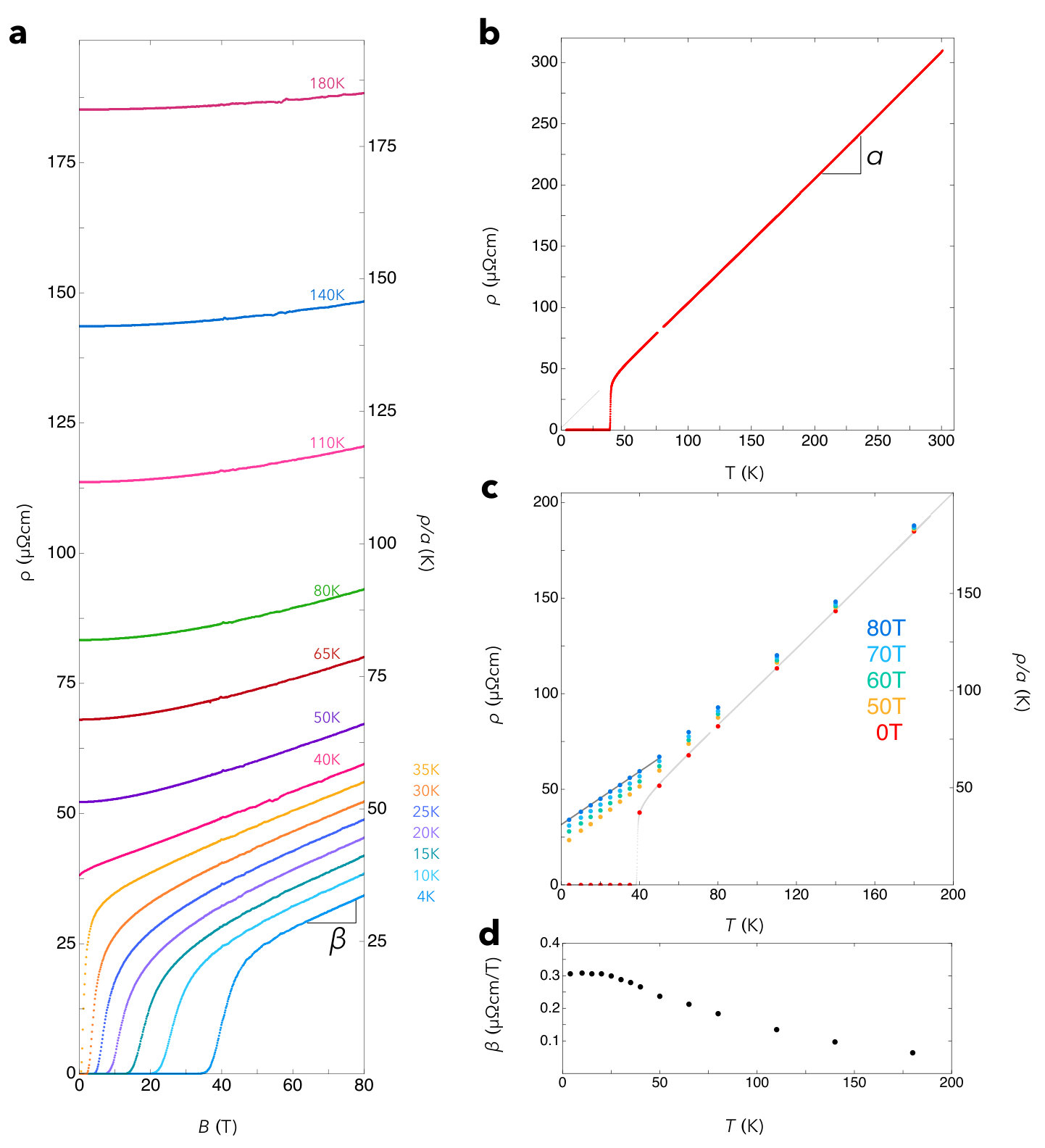 Figure 1
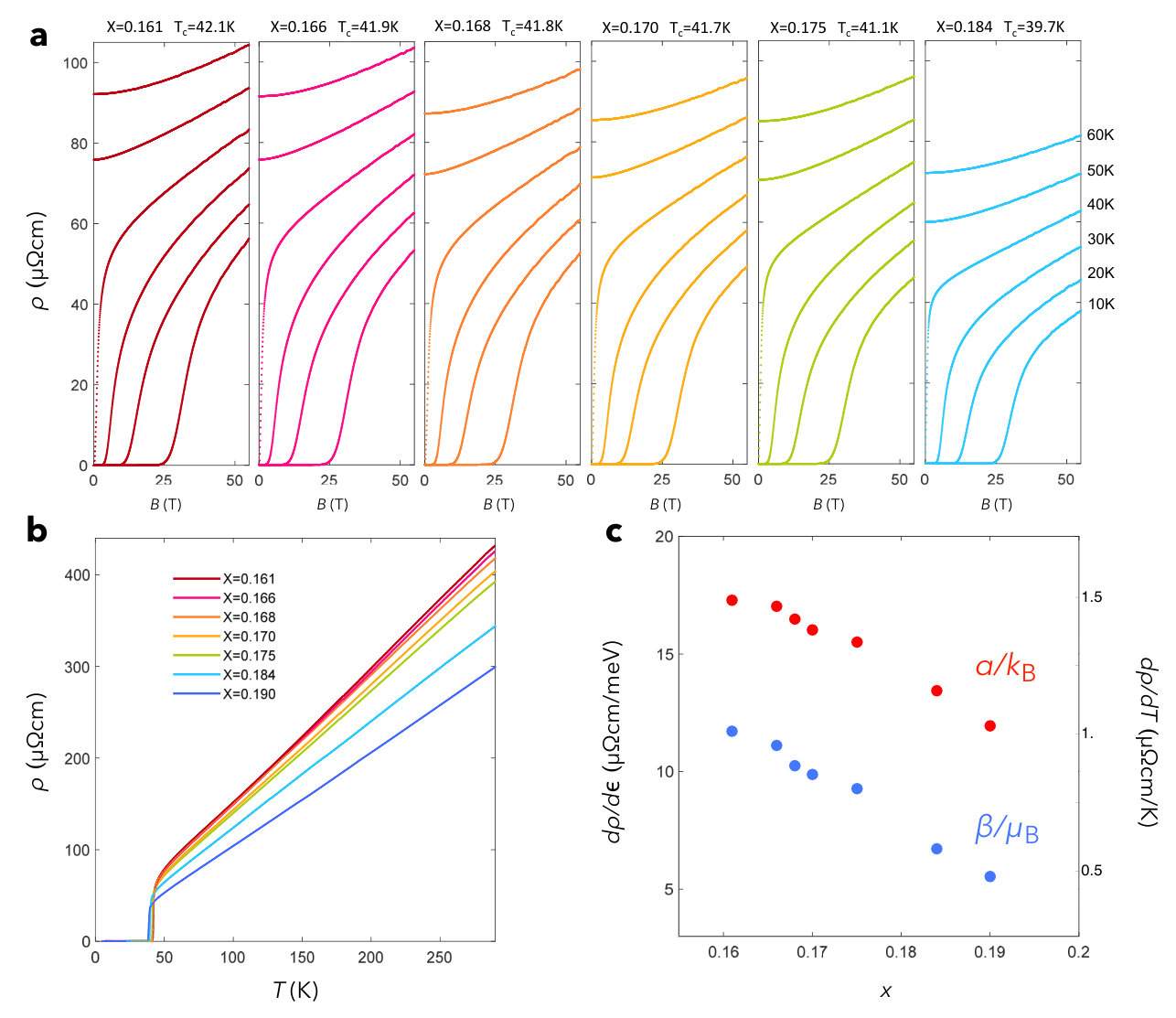 Figure 2
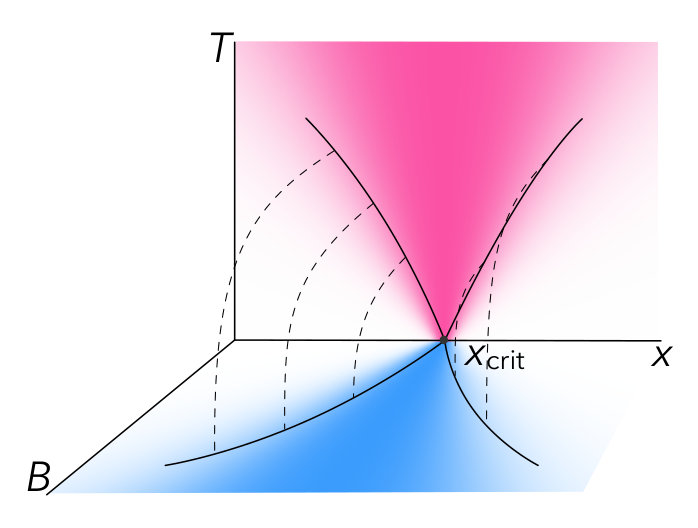 Figure 3
Peer Reviews
No public reviews on file for this paper yet. If you reviewed it on a platform where reviews are public (OpenReview, ICLR, NeurIPS, ICML), you can paste yours below so the community can read it here.
Videos
No videos yet. Explain this paper in a talk, walkthrough, or lecture? Add one.
Taxonomy
TopicsPhysics of Superconductivity and Magnetism · Theoretical and Computational Physics · High-pressure geophysics and materials
††thanks: These authors contributed equally††thanks: These authors contributed equally
Present address: ]Northrop Grumman Corporation, Linthicum, MD 21090, USA
Scale-invariant magnetoresistance in a cuprate superconductor
P. Giraldo-Gallo
National High Magnetic Field Laboratory (NHMFL), Florida State University, Tallahassee, FL 32310, USA
Department of Physics, Universidad de Los Andes, Bogotá 111711, Colombia
J. A. Galvis
National High Magnetic Field Laboratory (NHMFL), Florida State University, Tallahassee, FL 32310, USA
Departamento de Ciencias Naturales, Facultad de Ingenierıa y Ciencias Basicas, Universidad Central, Bogotá 110311, Colombia.
Z. Stegen
[
National High Magnetic Field Laboratory (NHMFL), Florida State University, Tallahassee, FL 32310, USA
Department of Physics, Florida State University, Tallahassee, FL 32310, USA
K. A. Modic
Max-Planck-Institute for Chemical Physics of Solids, Noethnitzer Strasse 40, D-01187, Dresden, Germany
F. F Balakirev
J. B. Betts
Los Alamos National Laboratory, Los Alamos, NM 87545, USA
X. Lian
C. Moir
S. C. Riggs
National High Magnetic Field Laboratory (NHMFL), Florida State University, Tallahassee, FL 32310, USA
J. Wu
A. T. Bollinger
Brookhaven National Laboratory (BNL), Upton, New York 11973-5000, USA.
X. He
I. Božović
Brookhaven National Laboratory (BNL), Upton, New York 11973-5000, USA.
Applied Physics Department, Yale University, New Haven, Connecticut 06520, USA.
B. J. Ramshaw
Los Alamos National Laboratory, Los Alamos, NM 87545, USA
Laboratory for Atomic and Solid State Physics, Cornell University, Ithaca, NY 14853, USA
R. D. McDonald
Los Alamos National Laboratory, Los Alamos, NM 87545, USA
G. S. Boebinger
National High Magnetic Field Laboratory (NHMFL), Florida State University, Tallahassee, FL 32310, USA
Department of Physics, Florida State University, Tallahassee, FL 32310, USA
A. Shekhter
National High Magnetic Field Laboratory (NHMFL), Florida State University, Tallahassee, FL 32310, USA
Abstract
The anomalous metallic state in the high-temperature superconducting cuprates is masked by superconductivity near a quantum critical point. Applying high magnetic fields to suppress superconductivity has enabled detailed studies of the normal state. Yet, the direct effect of strong magnetic fields on the metallic state is poorly understood. We report the high-field magnetoresistance of thin-film cuprate in the vicinity of the critical doping, . We find that the metallic state exposed by suppressing superconductivity is characterized by magnetoresistance that is linear in magnetic fields up to 80 tesla. The magnitude of the linear-in-field resistivity mirrors the magnitude and doping evolution of the well-known linear-in-temperature resistivity that has been associated with quantum criticality in high-temperature superconductors.
High-temperature superconductivity in the cuprates is born directly out of a “strange” metallic state that is characterized by linear-in-temperature resistivity up to the highest measured temperatureslinear-BiSCCO ; Anderson-science ; Hussey-pheno ; Zaanen-review . In conventional metals, current is carried by long-lived electronic quasiparticles, which requires the scattering length not to be significantly shorter than the de Broglie wavelength IoffeRegel ; Mott1972 ; bad-metals ; Hussey2004-MIR . In contrast, the resistivity in the strange metal state of the cuprates does not saturate or exhibit a crossover at the temperature where the inferred quasiparticle scattering length is comparable to the electronic wavelength. This behavior is sometimes referred to as “Planckian dissipation”, which suggests that the transport relaxation rate, , (where is the reduced Planck constant and is the relaxation time) is limited directly by the thermal energy scale (where is the Boltzmann constant and is absolute temperature), rather than by quasi-particle interactions and lattice disorderVarma1989 ; Phillips2004 ; Mackenzie2013 ; Zaanen-planckian ; Zaanen-review ; AjiVarma ; Zaanen-string ; Kivelson2017 ; Hussey2009 . This calls into question the very existence of quasi-particles in the strange metal state. More important, it indicates scale-invariant dynamics (i.e., the lack of an intrinsic energy scale). This behavior is observed in both classes of high-Tc superconductors –- the cuprates and the pnictides Fisher2014 ; Hayes2016 –- but its microscopic origin and implications for superconductivity have yet to be fully understood.
Scale-invariant transport is commonly associated with metallic quantum criticality. A characteristic energy scale is continuously tuned by an external parameter and vanishes when the tuning parameter crosses a critical value Zaanen-review . For hole dopings below the critical point, , the Hall effect in (19) and quantum oscillations in Taillefer-QO ; Ramshaw-mass-Science2015 provide evidence for a small carrier pocket, believed to be associated with a charge density waveCDW-Xray-Hayden-2012 ; CDW-Xray-Damascelli-2014 ; CDW-LSCO-Hayden . By contrast, above the critical doping, , quantum oscillations in Vignolle-over-2008 indicate a large hole-like Fermi surface, in agreement with band structure calculations OKA . Measurements of Hall resistivity Boebinger2009 ; Boebinger-BLSCO-nature-2003 ; Taillefer-lsco-ybco-2016 ; Hussey-pheno , the upper-critical magnetic field Taillefer-Hc2 and the quasiparticle effective mass Taillefer-QO ; Ramshaw-mass-Science2015 ; Vignolle-over-2008 , as well as the zero-temperature collapse of a line of phase transitionsBourges ; Kerr ; ultrasound ; dichroism ; secondharmonic , suggest a quantum critical point near . At this doping the linear-in-temperature resistivity extends to the lowest temperatures Hussey2009 ; Boebinger1996 ; Zaanen-review and therefore one might expect to access the anomalous behavior in the strange metal state in the broadest range of magnetic fields.
Magnetic fields have been instrumental in the study of both conventional and correlated metals because they couple directly to the charge carriers. Previous studies of the cuprates have made use of magnetic fields as a way of suppressing superconductivity to reveal the normal ground state properties through the magnetoresistance and quantum oscillations Taillefer-QO ; Ramshaw-mass-Science2015 ; Vignolle-over-2008 ; Hussey2009 ; Proust2016 ; LSCO-logT ; Boebinger1996 ; Boebinger-BLSCO-nature-2003 ; Boebinger2009 ; Taillefer-lsco-2016 ; Taillefer-lsco-ybco-2016 . The linear-in-temperature resistivity, however, suggests a strong interaction between the metallic state and the critical fluctuations associated with the quantum critical point. What has been missing is a study of how the magnetic field affects these fluctuations and thus the metallic state. To this end, we studied the electrical transport of in high magnetic fields for a range of compositions near the critical doping, . We found a scale-invariant response to the magnetic field that is distinct from the well-understood response of charged quasi-particles to the Lorentz force in conventional metals Abrikosov ; Pippard . Strikingly, linear-in-field resistivity at high fields, together with linear-in-temperature resistivity at high temperatures, emerges as an intrinsic characteristic of the strange metal state in a cuprate superconductor.
Figure 1 shows the in-plane resistivity () of a thin-film cuprate sample at Bozovic2009 ; Bozovic2016 ; Bozovic2009 ; Bozovic2015 ; Takagi1989 ; Liang-doping ; valueofp in magnetic fields aligned along the crystallographic c-axis up to T. Linear-in-temperature resistivity down to the superconducting transition temperature, K (Figure 1E), indicates close proximity to the critical doping. Figure 1A shows that the magnetoresistance below K is linear in magnetic field over the entire normal-state field range. To quantify this observation we define the field-slope, . We observe that at T, saturates below K (Figures 1, B and C, and Figure S3) which suggests that linear-in-field resistivity is an intrinsic property of the strange metal state. The saturation value of at low temperature and high fields in natural energy units is cm/meV where is the Bohr magneton. This is comparable in magnitude to the temperature-slope, , which is cm/meV in energy units.
In conventional metals, magnetoresistance originates from the motion of electron quasi-particles around the Fermi surface under the action of the Lorentz force Abrikosov ; Pippard . For a given Fermi surface morphology the strength of magnetoresistance is controlled by the product of the cyclotron frequency, (where is quasiparticle mass), and the quasi-particle relaxation time . Magnetoresistance generally decreases in conventional metals as τ decreases with increasing temperature. This is in contrast to what we observe in at (Figure 1). At T, and between and kelvin we observe nearly a factor of increase in resistivity, suggesting a factor of decrease in (Figs. 1, A and D) ybco-comment , and yet the strength of the magnetoresistance [] at T between and kelvin is independent of temperature (Fig. 1 B and C). This indicates that at very high magnetic fields the transport relaxation rate is set directly by the magnetic field through . A mechanism other than the traditional picture of orbiting quasi-particles must therefore underlie the high-field magnetoresistance in . One conclusion is that the magnetic field directly affects the dynamics of critical fluctuations that are responsible for the relaxation time Zaanen-review ; Zaanen-planckian ; AjiVarma ; Zaanen-string ; Kivelson2017
The smooth evolution of the temperature-slope across the critical doping Hussey2009 ; Ando2004 is another indication of a lack of well-defined quasi-particles in the strange metal phase at high temperatures in contrast to the divergence of quasi-particle effective mass approaching the critical doping at low temperatures Ramshaw-comment . The doping evolution of the magnitude of may provide further insight into the character of transport in the strange metal state. We measured the ab-plane resistivity in magnetic fields along the c-axis up to T in over the range of dopings to (Figure 2). All samples in this doping range exhibit linear-in-temperature resistivity at high temperatures (Fig. 2B). The saturation value of is shown in Fig. 2C along with in natural energy units. Both and decrease monotonically with doping in this doping range and evolve at a similar rate. The weak doping dependence of and approaching critical doping is in apparent contrast to the rapid increase in the Hall coefficient Taillefer-lsco-2016 ; Boebinger2009 ; Boebinger-BLSCO-nature-2003 and the divergence of the effective mass Ramshaw-mass-Science2015 as the critical doping is approached at low temperature and high magnetic fields. This again indicates that, despite the observation of quantum oscillations at low temperatures [in Taillefer-QO ; Ramshaw-mass-Science2015 and Vignolle-over-2008 ], the high-field, high temperature magnetoresistance in cuprates has a non–quasi-particle origin.
It is well known that the transport relaxation rate is linear-in-temperature, , in the fan-shaped region of the temperature-doping plane (Figure 3, magenta) emerging from the critical point Ando2004 . Our results (Figure 2) suggest that an analogous fan-shaped region exists in the magnetic field–doping plane (Figure 3, blue) where the relaxation rate is linear-in-field, . This extends a quantum critical region in field, temperature, and doping where the transport relaxation rate is set by the dominant energy scale, , as illustrated in Figure 3 subdominant .
These measurements establish the linear magnetoresistance at very high fields as a fundamental property of the strange metal state in the cuprates. A linear dependence on an external energy scale is not the only possible outcome of scale invariance near quantum critical point: in principle, any power-law dependence is possible. It is therefore striking that the temperature and field dependence of the resistivity in assumes the simplest possible form. Both the cuprates and the pnictides Hayes2016 , exhibit this simple form of scale invariance, revealing another universal characteristic of high-temperature superconductors.
Acknowledgments: We thank J. Analytis, J.-H. Chu, N. Doiron-Leyraud, A. Finkel’stein, I. Fisher, S. Hartnoll, I. Hayes, S. Kivelson, J. Paglione, L. Taillefer, C. Varma, and J. Zaanen for discussions, and the entire 100 T operations team at the NHMFL Pulsed Field Facility for their support during the experiment. A.S. acknowledges the hospitality of the Aspen Center for Physics. The high-field resistivity measurements were performed in the 60 T long-pulse and 100 T magnet systems at the NHMFL Pulsed Field Facility, which is supported by NSF grant DMR-1157490 and the U.S. Department of Energy, Basic Energy Sciences (DOE/BES) “Science at 100 T” grant. Molecular beam epitaxy synthesis, lithography, and characterization of the samples were done at BNL, which is supported by DOE/BES, Materials Sciences and Engineering Division. X.H. was supported by the Gordon and Betty Moore Foundation’s EPiQS Initiative through grant GBMF4410. Aspen Center for Physics is supported by NSF grant PHY-1066293.
Appendix A Supplementary Materials
A.1 Sample Preparation
High-quality single-crystal thin film were grown by the combinatorial molecular beam epitaxy (COMBE) technique Bozovic2015 . The substrates are cm cm mm LaSrAlO4 single crystals cut perpendicular to the crystallographic [001] direction. A copper-oxide superconductor film (of nm thickness for the highest dopings and nm for the rest) is patterned into a high-aspect-ratio ( m × mm) strip with a strontium gradient along the longer edge of the strip. The Sr content changes by 4% from one end to the other. Current leads are attached to the opposite ends of the strip. A total of voltage leads, separated from one another by m, are patterned on the sides of the strip, allowing longitudinal voltage measurements on segments along the strip with different strontium content.
The high magnetic field measurements were done at the Pulsed Field Facility of the National High Magnetic Field Laboratory, at Los Alamos National Laboratory. Two different magnet systems were used for our measurements. The large gradient samples were measured in the T Controlled Magnet Waveform system with a mm size bore, that achieved T tesla pulses of several seconds duration during our magnet run. We have then chosen a sample closest to the critical doping () for the measurements in the T Multi-shot Magnet system. This magnet system has a smaller bore ( mm) and shorter pulse (few microseconds), therefore a smaller segment of the sample (about mm mm) was cut out for measurements.
Figure S1A shows the superconducting transition temperatures for nominal strontium compositions, , in the range from to . Here, is defined as the maximum in the temperature-derivative of resistivity (Figure S1B). For the compositions studied in this work, Tc tracks closely the empirical formula Takagi1989 ; Liang-doping , where K is the maximum critical temperature for thin-film and is obtained from best fit to the data (shown in red in Figure S1 A). The value of hole-doping p for each sample is obtained from Tc using best fit formula as described above. The actual difference between nominal value of x (nominal strontium content) and the inferred value of hole doping is in fact quite small small, less than 0.005 (Figure S1A).
The half-width at half-maximum of the temperature derivative of the resistivity curve is around 1 K for all samples studied in this work (Figure S1B for two samples). All samples show small residual resistance (less than cm - Figure S1c) as determined by extrapolation of the linear-in-temperature fit in the range between K and K.
Figure S2 shows the resistivity plotted as a function of for multiple compositions and temperatures, a superset of the data presented in Figure 2 of the main text. In the sample, a -magnetoresistance over the entire field range ( T) is observed only at the highest measured temperatures ( K and K). All lower temperatures the magnetoresistance shows clear negative curvature, a direct consequence of a slower-than- increase at high magnetic fields.
A.2 Running-window slope analysis
For the sample where we have measured magnetoresistance up to T, the field-slope saturates at low temperatures well before the field limit is reached (Figure 1b,d and Figure S3). For all other samples the high-field magnetoresistance was only measured up to T – not high enough for to reach saturation at low temperatures. The comprehensive magnetoresistance dataset at multiple temperatures in these samples is redundant enough for reliable estimate of the saturation value of the field-slope . The simplest method using no modeling at all takes for the value of at the highest field for temperatures in the interval between K and K ( in Figure S4). In this temperature interval the magnetoresistance is linear-in-field in the broadest field range in all measured samples: superconductivity becomes important at lower temperatures while the competition between magnetic field and temperature kicks in at higher temperatures. Fig. 2C of the main text uses the values of estimated using this simple method.
Estimates of saturation values of (for samples measured up to T) using a more quantitative analysis supports this qualitative estimate. Figure S3 illustrates three different quantitative estimates. is obtained through the value of at T (black circles), which for samples other than can be well approximated by extending the measured data using an empirical formula . is obtained through the value of at T (red diamonds). is only calculated for the sample, via a linear fit for in the field interval T and T, for which this quantity is either field-independent or depends weakly on field for all measured temperatures (blue squares). The zero-temperature limit of all βi=1..4(T) can be estimated by fitting each to an Interpolating formula , which captures correctly the behavior at both limits and satisfactorily interpolates the behavior of in the sample in the entire field range up to T. Figure S4 shows the values of plotted vs hole-doping .
A.3 Temperature Dependence of Resistivity at High-Field
Figure S5 shows resistivity as a function of temperature for all compositions studied in this work (the plots are identical to Figure 2A of the main text except here each composition is shown on a separate panel). Resistivity as a function of temperature for (Figure 1 E of the main text) is not shown here. The red curve shows the zero-field resistivity. The resistivity curves are in good agreement with a previous study in bulk crystals by Cooper et al Hussey2009 . Superposed on each plot is at T (blue circles) which shows monotonic decrease in resistivity with decreasing temperature for all studied samples Taillefer-lsco-2016 .
The reference list from the paper itself. Each links out to its DOI / PubMed record.
- 1(1) S. Martin, A. T. Fiory, R. M. Fleming, L. F. Schneemeyer, J. V. Waszczak, Normal-state transport properties of Bi 2 Sr 2 Ca Cu 2 O 8 + δ subscript Bi 2 subscript Sr 2 subscript Ca Cu 2 subscript O 8 𝛿 \text{Bi}_{2}\text{Sr}_{2}\text{Ca Cu}_{2}\text{O}_{8+\delta} crystals, Phys. Rev. B 41 , 846(R) (1990). doi:10.1103/Phys Rev B.41.846 · doi ↗
- 2(2) P. W. Anderson, Experimental Constraints on the Theory of High-Tc Superconductivity, Science 256 , 1526 (1992). doi:10.1126/science.256.5063.1526 · doi ↗
- 3(3) N. E. Hussey, Phenomenology of the normal state in-plane transport properties of high-Tc cuprates, J. Phys. Condens. Matter 20 , 123201 (2008). doi:10.1088/0953-8984/20/12/123201 · doi ↗
- 4(4) B. Keimer, S. A. Kivelson, M. R. Norman, S. Uchida, J. Zaanen, From quantum matter to high-temperature superconductivity in copper oxides, Nature 518 , 179 (2015). doi:10.1038/nature 14165 · doi ↗
- 5(5) A. F. Ioffe, and A.R. Regel, Non-crystalline, amorphous, and liquid semiconductors, Prog. Semicond. 4 , 237 (1960).
- 6(6) N. F. Mott, Conduction in non-crystalline systems IX. the minimum metallic conductivity, Phil. Mag. 26 , 1015 (1972). doi:10.1080/14786437208226973 · doi ↗
- 7(7) V. J. Emery, S. A. Kivelson, Superconductivity in Bad Metals, Phys. Rev. Lett. 74 , 3253 (1995). doi:10.1103/Phys Rev Lett.74.3253 · doi ↗
- 8(8) N. E. Hussey, K. Takenaka, H. Takagi, Universality of the Mott-Ioffe-Regel limit of metals, Phil. Mag. 84 , 2847 (2004). doi:10.1080/14786430410001716944 · doi ↗