Separability criterion for three-qubit states with a four dimensional norm
Lin Chen, Kyung Hoon Han, Seung-Hyeok Kye

TL;DR
This paper introduces a new separability criterion for three-qubit states based on a four-dimensional norm derived from anti-diagonal entries, enabling easier determination of entanglement.
Contribution
It provides a complete characterization of separability for states with only diagonal and anti-diagonal entries using a novel norm-based criterion.
Findings
Norm computed explicitly in several cases
Criterion allows routine separability checks
Complete characterization for specific state classes
Abstract
We give a separability criterion for three qubit states in terms of diagonal and anti-diagonal entries. This gives us a complete characterization of separability when all the entries are zero except for diagonal and anti-diagonals. The criterion is expressed in terms of a norm arising from anti-diagonal entries. We compute this norm in several cases, so that we get criteria with which we can decide the separability by routine computations.
Click any figure to enlarge with its caption.
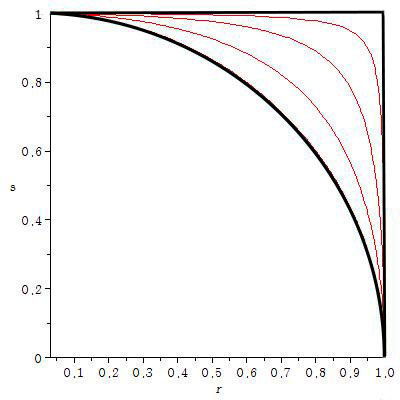 Figure 2
Peer Reviews
No public reviews on file for this paper yet. If you reviewed it on a platform where reviews are public (OpenReview, ICLR, NeurIPS, ICML), you can paste yours below so the community can read it here.
Videos
No videos yet. Explain this paper in a talk, walkthrough, or lecture? Add one.
Separability criterion for three-qubit states
with a four dimensional norm
Lin Chen, Kyung Hoon Han and Seung-Hyeok Kye
Lin Chen, School of Mathematics and Systems Science, Beihang University, Beijing 100191, China
International Research Institute for Multidisciplinary Science, Beihang University, Beijing 100191, China
Kyung Hoon Han, Department of Mathematics, The University of Suwon, Gyeonggi-do 445-743, Korea
Seung-Hyeok Kye, Department of Mathematics and Institute of Mathematics, Seoul National University, Seoul 151-742, Korea
Abstract.
We give a separability criterion for three qubit states in terms of diagonal and anti-diagonal entries. This gives us a complete characterization of separability when all the entries are zero except for diagonal and anti-diagonals. The criterion is expressed in terms of a norm arising from anti-diagonal entries. We compute this norm in several cases, so that we get criteria with which we can decide the separability by routine computations.
Key words and phrases:
three-qubit X-states, separability criterion, norm
1991 Mathematics Subject Classification:
81P15, 15A30
LC was supported by Beijing Natural Science Foundation (4173076), the NNSF of China (Grant No. 11501024), and the Fundamental Research Funds for the Central Universities (Grant Nos. KG12001101, ZG216S1760 and ZG226S17J6). Both KHH and SHK were partially supported by NRF-2017R1A2B4006655, Korea
1. introduction
In the current quantum information and quantum computation theory, the notion of entanglement is a very important resource. But, it is very difficult to distinguish entanglement from separability, and a complete characterization is known in the literature for very few cases. For example, separability for , states and states with low ranks is known to be equivalent to positivity of partial transposes [1, 2, 3, 4, 5, 6]. In the three qubit cases, separability of Greenberger-Horne-Zeilinger diagonal states has been completely characterized recently by the second and third authors [7]. Note that separability problem is known to be an -hard problem in general [8]. We recall that a state is said to be separable if it is the convex sum of pure product states. A state which is not separable is called entangled.
GHZ diagonal states are typical kinds of X-states, the states whose entries are zero except for diagonal and anti-diagonal entries. Multi-qubit X-states arise in various contexts in quantum information theory. See [9, 10, 11, 12, 13, 14, 15], for example. The purpose of this paper is to provide a complete characterization for the separability of three qubit X-states. Because the X-part of a separable three qubit state is again separable [7], our characterization gives rise to a necessary separability criterion in terms of diagonal and anti-diagonal entries for general three qubit states.
Gühne [16] gave a necessary condition for separability of three qubit states, together with a numerical evidence that this is also sufficient for GHZ diagonal states. On the other hand, the second and third authors gave a characterization of three qubit X-shaped entanglement witnesses [17]. They also proved [7] that a complicated expression in the Gühne’s criterion can be replaced by a simpler formula in [17], and the Gühne’s criterion is actually sufficient for separability of GHZ diagonal states.
In this paper, we first prove that Gühnes’s criterion gives rise to a sufficient condition for separability of general three qubit X-states. In this characterization, the quantity determined by anti-diagonal entries turns out to be the dual norm of a norm for which is determined by the phase difference in [18] as well as magnitudes of entries. See below for the definition of phase difference. In this way, we see that the phase difference plays a key role, as it was found in [18].
We consider three qubit objects as matrices with the lexicographic order of indices, and so a three qubit self-adjoint X-shaped matrix is of the form
[TABLE]
for vectors and . We recall that a state is GHZ diagonal if and only if it is an X-state of the form with and . We also write with and . The separability of depends heavily on the phase difference defined by
[TABLE]
as it was discussed in [18]. This is determined by the anti-diagonal part , and will be denoted by sometimes.
Gühne [16] showed that if a three qubit state with its X-part is separable then the inequality
[TABLE]
holds for every , where
[TABLE]
On the other hand, it was shown in [17] that a three qubit X-shaped non-positive self-adjoint matrix is an entanglement witness if and only if the equality holds, where
[TABLE]
Later, it was shown in [7] that the complicated formula of is simplified as
[TABLE]
and Gühne’s condition (1) is actually sufficient for the separability of three qubit GHZ diagonal states. In the next section, we show that the inequality (1) actually characterizes separability of general three qubit X-shaped states.
It is important to note that defines a norm on the four dimensional space , and so we will use the norm notation
[TABLE]
for the number . The norm is determined by the phase difference and the magnitudes . We will see in Section 3 that a state is separable if and only if the inequality
[TABLE]
holds with the dual norm of the norm in (4). We exhibit some elementary properties of the norm and its dual norm . They have some interesting properties: They are determined by the phase differences and magnitudes of entries; they are invariant under eight kinds of permutations; the norm is decreasing as the phase difference increase from [math] to .
In Section 4, we compute the dual norm in several cases:
- •
all the entries are real,
- •
at least one of the entries is zero,
- •
entries are partitioned into two groups of two entries with common magnitudes.
The dual norm has an obvious lower bound . We also provide a condition under which we have . These results give us complete operational separability criteria for those X-states. In Section 5, we give several estimates for the norms and . Among them, lower bounds for will give rise to necessary criteria for the separability of general three qubit states.
One merit of our separability criterion is that we do not have to decompose a state into the sum of pure product states in order to show that a given state is separable. This was possible through the duality between tri-partite separability and positivity of bi-linear maps [19]. Nevertheless, it is another interesting problem to get a decomposition, even though we already know that a given state is separable. We close the paper to discuss this problem.
2. Separability criterion of X-states
This section will be devoted to prove the following:
Theorem 2.1**.**
A three qubit X-state is separable if and only if the inequality (1) holds for every .
We begin with the following lemma which computes the number in (2) in some special cases. Throughout this note, we use the notation .
Lemma 2.2**.**
For , we have the following:
- (i)
if , then ; 2. (ii)
if , then .
*Proof. * (i) We have
[TABLE]
We first consider the case of . The first term has the minimum
[TABLE]
when . Similarly, the second term has the minimum when . From , we see that both terms have their minimums simultaneously. If one of or is zero, we may check directly.
(ii) We also have
[TABLE]
The sum of the first and the last has the minimum when . The sum of the middle two terms has the minimum when . From , we see that they have their minimums simultaneously.
We define two subsets and of by
[TABLE]
and subsets by
[TABLE]
Here, denotes the canonical basis of . We see that and by Lemma 2.2.
Lemma 2.3**.**
Every vector in is a convex combination of vectors in , and every vector in is a convex combination of vectors in .
*Proof. * For , we have by Lemma 2.2 (i), and so the convex combination
[TABLE]
is obtained. For , we have by Lemma 2.2 (ii). We put
[TABLE]
then we have the convex combination with and .
We recall that the X-part of a three qubit entanglement witness is again an entanglement witness by Proposition 3.1 of [7], and so we see that a three qubit X-state is separable if and only if for every X-shaped entanglement witness . In this characterization, we may assume that by the identity
[TABLE]
since and for . The next proposition explains the relations between two inequalities and in various situations.
Proposition 2.4**.**
For a three qubit X-state , we have the following:
- (i)
for , we have for every X-shaped witness with if and only if for every ; 2. (ii)
* for every X-shaped witness with if and only if for every ;* 3. (iii)
* for every X-shaped witness with if and only if for every ;* 4. (iv)
* for every X-shaped witness with if and only if for every ;* 5. (v)
* for every X-shaped witness with if and only if for every .*
*Proof. * We may assume that for an entanglement witness . For a given , we will put . Then we have by (3), and
[TABLE]
Therefore, we have if and only if . By Lemma 2.2, the statements (i), (ii) and (iii) follow from the identities
[TABLE]
The statements (iv) and (v) follows from (i), (ii), (iii) and Lemma 2.3.
For , we define by
[TABLE]
Lemma 2.5**.**
For every three qubit X-shaped self-adjoint matrix and , we have the following:
- (i)
* is again X-shaped of the form . The vectors satisfy the relations , and ;* 2. (ii)
if , then there exist unique so that for each ; 3. (iii)
if , then there exist unique so that and .
*Proof. * We check directly that with
[TABLE]
from which the required relations follow. For the statement (ii), we put
[TABLE]
Then we have
[TABLE]
and for , similarly. From the relation in (i), we also see that . For the uniqueness, we multiply two relations and from (6). For (iii), we put
[TABLE]
Then we have by a direct computation. From the relation , we also have . Uniqueness also follows in a similar way as in (ii).
The following lemma is the main part of the proof, which shows that the inequality (1) implies the separability when the diagonal entries of satisfy some identities.
Lemma 2.6**.**
Suppose that or . Then a three qubit X-state is separable if and only if the inequality (1) holds for every .
*Proof. * It suffices to prove the sufficiency. Recall that is separable if and only if for every X-shaped entanglement witness . So, we assume the inequality (1) for every and will show that for every X-shaped entanglement witness . We prove the assertion separately.
[Case I: ]: For a three qubit X-shaped self-adjoint matrix , we define
[TABLE]
with the local unitary and . Note that has symmetric diagonal entries and shares the anti-diagonal part with . Furthermore, we have if and only if . We apply Lemma 2.5 (ii) to take so that has symmetric diagonals, that is, satisfies . Let be an arbitrary three qubit X-shaped entanglement witness. With notation , we have
[TABLE]
It follows that
[TABLE]
Write by Lemma 2.5 (i). Since has symmetric diagonal entries, and satisfy the relation by Lemma 2.5 (i) again. Furthermore, our assumption implies by the relation . Therefore, the inequalities in the right side of Proposition 2.4 (iv) hold, and we have finally by Proposition 2.4 (iv). Therefore, we conclude that is separable.
[Case II: ]: In this case, our assumption implies similarly, and so we have the inequalities in the right side of Proposition 2.4 (v). We consider the symmetric unitaries
[TABLE]
with the identity and as above, and the partial transposes
[TABLE]
on with . For a given three qubit X-shaped self-adjoint matrix , we define the matrix by
[TABLE]
with the two families of uniform diagonal entries
[TABLE]
Note that shares the anti-diagonal part with . We also have if and only if and .
We apply Lemma 2.5 (iii) to take so that has two families of uniform diagonal entries, that is, satisfies . Then we have
[TABLE]
One can verify that the relations and hold for product matrices and , hence for any tensors and . Therefore, we have
[TABLE]
which implies . Now, we write . Since has two families of uniform diagonal entries, we have by Lemma 2.5 (i). Therefore, we have by Proposition 2.4 (v). This completes the proof.
Now, we are ready to prove Theorem 2.1. Suppose that is a three qubit X-state satisfying the inequality (1) for every . Applying Proposition 2.4 to the witness , we have for . If then the inequality (1) implies that is diagonal, and so is separable. Let . We may assume without loss of generality that and by the symmetry. We consider two cases separately.
We first consider the case . In this case, we have . Put
[TABLE]
which are nonnegative. Then we have , and , and so
[TABLE]
We put and . Then is an X-state satisfying for and . Therefore, we have for every . By the relation and Lemma 2.6, we see that is separable. Therefore, we can conclude that is separable.
Next, we consider the case . Define the continuous functions by
[TABLE]
The assumption implies
[TABLE]
and . By the intermediate value theorem, there exists such that . We put and . Then, is an X-state satisfying and . Therefore, we have for every . By the identity and Lemma 2.6, we see that is separable. By the relation
[TABLE]
we conclude that is separable. This completes the proof of Theorem 2.1.
3. Norms arising from separability problem
In this section, we introduce the norm and its dual norm on the four-dimensional space , and discuss how these norms are related to the separability problem. We also investigate their elementary properties. Theorem 2.1 shows that a three qubit X-state is separable if and only if the inequality
[TABLE]
holds. Since , we see that the right hand side is equal to
[TABLE]
Therefore, it is natural to consider , as it was defined by (4). We write with . From the relation
[TABLE]
we have
[TABLE]
Therefore, we have the following:
[TABLE]
for . Because for a complex scalar , we have . This equality can be seen also directly from the definition. The inequality is clear, and so we see that is really a norm on the vector space . We list up several elementary properties of the norm without proof. We use the standard notations for norms; and .
Proposition 3.1**.**
For , we have the following:
- (i)
; 2. (ii)
if one entry of is zero then we have ; 3. (iii)
if then .
If , then we can evaluate in terms of entries by a result in [7]. To explain this, we define
[TABLE]
Then by Proposition 5.1 of [7], we have
[TABLE]
whenever , where
[TABLE]
For , we can also compute the norm. To do this, we note
[TABLE]
We fix two points and on the complex plane, and move around the point along the circle with the radius . Then the maximum in the above formula is taken when the three points , and make an isosceles triangle, or equivalently when is located at or with . See Figure 1. Therefore, we have
[TABLE]
Especially, if the entries share a common magnitude then we have
[TABLE]
With the bi-linear form , we see that the right-hand side of (7) becomes the dual norm as follows:
[TABLE]
By Theorem 2.1, we have the following:
Theorem 3.2**.**
A three qubit X-state is separable if and only if the inequality holds.
It is also possible to describe the dual norm in terms of separability. For given and , Theorem 3.2 tells us that the state is separable if and only if , where . We denote by the convex cone of all unnormalized separable states. Then, we have
[TABLE]
This formula tells us that the dual norm is nothing but the order unit norm of in the ordered -vector space equipped with the positive cone and the order unit . For the general information on the order unit and the order unit norm, we refer to [20] and [21]. The formula (14) is also useful to investigate the properties of the dual norm. For example, we will use the notion of separability to prove that the dual norm is invariant under the same phase difference.
Proposition 3.3**.**
Suppose that satisfy for each and . Then is separable if and only if is separable. Especially, if one of anti-diagonals of an X-state is zero, then the remaining three phases are irrelevant to the separability.
*Proof. * Write for . Define the product unitary matrix by
[TABLE]
One can verify that where . Similarly, we can find a product unitary matrix such that , where . If then . If then . In either case, is separable if and only if is separable, because the separability is unchanged under product unitary transformation.
It remains to prove the last assertion. If one of anti-diagonals of an X-state is zero, one can find another product unitary matrix , such that the other three anti-diagonals of are nonnegative and real. So, their phases are irrelevant to the separability.
Proposition 3.4**.**
For , we have the following:
- (i)
if for each and then ; 2. (ii)
; 3. (iii)
if one of entries of is zero then we have .
*Proof. * The statements (i) and (iii) follow from Proposition 3.3 and (14). The identity (ii) is a special case of (i).
We mention here that Proposition 3.4 (i) can be proved directly without using Proposition 3.3. We now consider the question which permutations of entries preserve the norms and . We will use the notation for a permutation on . For example, will denote the identity permutation. For , we will define . It is clear by definition that when is one of the following eight permutations:
[TABLE]
Proposition 3.5**.**
For a permutation on , the following are equivalent:
- (i)
* for every ;* 2. (ii)
* for every ;* 3. (iii)
* for every ;* 4. (iv)
* is one of the permutations listed in (15).*
*Proof. * We have already seen the implication (iv) (i), and the equivalence between (i) and (ii) follows by the duality. Consider . Then we have
[TABLE]
by (13), and so we also have
[TABLE]
Suppose that (i) holds. For a given , we write , and put . Then implies by (16). This proves the direction (i) (iii). If (iii) is true then we have the relation
[TABLE]
holds for every and . Therefore, we see that either or must hold. This shows that is one of permutations listed in (15).
It is clear by Proposition 3.5 that the eight permutations in (15) make a group. It turns out that this is isomorphic to the dihedral group of order eight. We note that , , and are even permutations, and the others are odd. These four even permutations reflect the fact that the separability is invariant under partial transposes. Indeed, if we denote by and the partial transposes with respect to the , and systems, respectively, then we have
[TABLE]
On the other hand, if we interchange the and systems then becomes
[TABLE]
This reflects the odd permutation in (15). The remaining permutations in (15) are composition of and the others. If we interchange - and - systems, then the state becomes
[TABLE]
respectively. We note that the phase differences are invariant in both case.
Proposition 3.6**.**
We have the following identities:
- (i)
; 2. (ii)
.
*Proof. * The identities in (i) follow from (17) and (14). We denote , and . Note that is the dual norm of by the duality. Therefore, we have
[TABLE]
by (i). The same argument is applied for .
Theorem 3.7**.**
Let . If there exists a partition such that and , then .
*Proof. * We first consider the case and . This is just (12). If and then the identity follows from the first case and Proposition 3.5 with . Finally, if and then we get the result by Proposition 3.6.
We close this section to see how the norm depends on the phase difference. To do this, we fix nonnegative ’s, and define the function
[TABLE]
Note that is an even function by (9). The relation (12) suggests that the function might be decreasing on . This is the case, in general.
Proposition 3.8**.**
The function is strictly decreasing on the interval if and only if for .
*Proof. *The ”only if” part follows from the definition of , or Proposition 3.1 (ii). To prove the ”if” part, suppose for . We consider the following two variable function
[TABLE]
Then . We assume that . Suppose that . Then we have
[TABLE]
and . So, we have , and see that the maximum occurs when .
We fix with , and consider two functions and by
[TABLE]
Then both and are differentiable at and , respectively, with . The function is increasing on and decreasing on . is decreasing on . Therefore, the maximum of occurs at with . Now, suppose that . Then we have
[TABLE]
This implies that
[TABLE]
In short, we conclude that for every there exists such that
[TABLE]
Suppose that . Because is continuous, it has the maximum on the compact interval which must be taken at by the above conclusion. Therefore, we have .
Corollary 3.9**.**
Suppose that for every . Then we have if and only if .
4. Dual norm and separability criterion
Theorem 3.2 tells us that the separability problem reduces to computing the dual norm. For example, we have , and so the X-state given by
[TABLE]
is separable if and only if and if and only if . It was shown in [10] that is a necessary condition for separability of . Theorem 3.2 shows that this is also sufficient for separability, without decomposing into the sum of product states.
In this section, we compute the dual norm in terms of entries in various cases. We first deal with the vectors with real entries. To do this, we consider the convex subset of the unit ball where the dual norm is taken. More precisely, we define
[TABLE]
for a given . The set is convex and nonempty, and implies . Suppose that is a real number for each . Then we have . Take any . Since , we have and so, we have . If then we have shown that there exists such that , and so this gives us the formula
[TABLE]
which has been already calculated in Section 5 of [7]. In order to explain this, we define the real numbers
[TABLE]
determined by , and consider the following three cases:
- (A)
, 2. (B)
and , 3. (C)
, and .
The discussion in Section 5 of [7] can be summarized as follows:
Proposition 4.1**.**
If is a real number for each , then we have the following:
- (i)
in case of (A) or (B), we have ; 2. (ii)
in case of (C), we have , where is in (11).
Applying Proposition 3.4 (iii), we can compute when at least one entry of is zero except for three entries, say . In this case, it is easily seen that the condition (A) for is satisfied if and only if the three numbers and do not make a triangle. Indeed, we have
[TABLE]
when . Furthermore, the condition (B) for holds if and only if make an obtuse or right triangle, and the condition (C) for holds if and only if they make an acute triangle. Therefore, we have the following:
Theorem 4.2**.**
Suppose that at least one entry of is zero except for three entries . Then we have the following:
- (i)
if the three numbers and do not make a triangle or make an obtuse or right triangle, then we have ; 2. (ii)
if the three numbers and make an acute triangle, then we have
[TABLE]
Corollary 4.3**.**
If at least two entries of are zero, then .
Now, we look for the formula of the dual norm when the four entries are partitioned into two groups with two entries with the common magnitudes. This is, of course, the counterpart of Theorem 3.7. Actually, the following lemma makes it possible to use Theorem 3.7 for our purpose.
Lemma 4.4**.**
For , we have
[TABLE]
*Proof. * For a given , put . Then we see that , and . Therefore, the inequality
[TABLE]
gives the required result. Here, the last identity follows from Proposition 3.5.
Theorem 4.5**.**
Let with . If there exists a partition such that and with , then we have
[TABLE]
where . If then .
*Proof. * By the exactly same argument as in the proof of Theorem 3.7, we may assume that and . Furthermore, we have
[TABLE]
by Proposition 3.4 (i), so we may assume without loss of generality. Let with and . Then we have
[TABLE]
by Theorem 3.7. We also have
[TABLE]
We put and . Then and , and so we may assume that . We define by
[TABLE]
It remains to find the maximum of on the domain . Note that is not differentiable on the ray .
We first consider on the open domain , where we have
[TABLE]
Let and be the numerators of and , respectively. From
[TABLE]
we obtain a unique critical point
[TABLE]
where the function vanishes. When , we substitute to get
[TABLE]
Since does not lie in , the function does not have a critical point on the open domain .
Next, we investigate the function on the boundaries and , and on the ray . Since
[TABLE]
the maximum of occurs on the ray when , and on the ray when . We substitute in the above to get
[TABLE]
Solving the equation, we have
[TABLE]
This completes the proof when , because . For the last case of , the function has the maximum when or equivalently when . Note that our assumption does not cover the case . In this case, we obtain the maximum by the symmetry. Alternatively, the case also comes out from Proposition 4.1.
Suppose that for each . Then we have in Theorem 4.5 and we have . Compare with (13). Therefore, we see that an X-state is separable if and only if
[TABLE]
when all the anti-diagonals have the magnitude . This recover the result in [18] without a decomposition. We also consider the state
[TABLE]
Theorem 3.2 tells us that is separable if and only if and is separable if and only if , because by Theorem 4.5 or Proposition 4.1. Note that Theorem 4.5 gives a interpolation between these two cases, and . See Figure 2.
It seems to be very difficult to compute the dual norm in general cases. Because is a lower bound for the dual norm by (26), it is natural to look for condition under which the equality holds.
Proposition 4.6**.**
For each , we have .
*Proof. * It suffices to prove the second inequality. Let and . We have
[TABLE]
for every . Here, the second inequality holds since we have by Proposition 3.8.
We can obtain the closed formula of using Proposition 4.1. In particular, if satisfies the condition (A) or (B), then by Proposition 4.6. In order to find this condition, we consider the case of with positive ’s. In this case, the numbers and in (19) determined by become and as follows.
[TABLE]
We also consider the form
[TABLE]
with positive variables and . This is invariant under all the permutations of variables and . We have
[TABLE]
where . By elementary calculus, we see that the function has exactly one root in the interval , and
[TABLE]
It is easy to check that
[TABLE]
which implies
[TABLE]
If (), then we have . Therefore, two of ’s cannot be non-positive, and so we conclude that all of ’s are positive or exactly one of them is non-positive. It is also clear that holds if and only if .
Proposition 4.7**.**
Let for . Suppose that and are defined by (22). Then we have the following:
- (i)
* if and only if ’s make a quadrangle if and only for each ;* 2. (ii)
* satisfies the condition (A) or (B) if and only if exactly one of ’s in (23) is non-positive.*
*Proof. * Let . The sum of any two is positive. Statement (i) is easy to check. For the ‘only if’ part of (ii), we first consider the condition (A), namely . Then we have for some , that is, . Since , we have . Suppose that . Then the condition (B) holds if and only if or if and only if one of is non-positive.
For the ‘if’ part of (ii), suppose that , , and . Then we have . If , then ’s do not make a quadrangle. If , then they make a quadrangle and satisfy the condition (B). This completes the proof.
We combine Proposition 4.6 and the Proposition 4.7 to get a sufficient condition on under which the equality holds.
Theorem 4.8**.**
Suppose that for . Define the real numbers by
[TABLE]
for . Then we have the following:
- (i)
either all of ’s are positive or exactly one of them is non-positive; 2. (ii)
if one of ’s is non-positive, then ; 3. (iii)
if ’s does not make a quadrangle, then one of ’s is non-positive.
5. Estimates of the norms
In the previous section, we have computed the dual norm in some cases in order to provide necessary and sufficient criteria for separability which is ready to apply with routine calculations. The formulae are too complicated to understand in some cases. For example, see the formula given in Theorem 4.5. Furthermore, it seems to be hopeless to get exact formula for the dual norm in general cases. In this sense, it is worthwhile to estimate the dual norm. Especially, lower bounds for the dual norm will give necessary criteria for separability. In this section, we try to estimate the norms and .
Theorem 4.5 itself is quite useful to estimate the dual norm. For a given , we consider
[TABLE]
Then we have
[TABLE]
by Proposition 3.4 (i) and Proposition 3.5. By Theorem 3.2, we have the following:
Proposition 5.1**.**
If an X-state is separable, then is also separable.
Note that satisfies the assumption of Theorem 4.5. The X-part of a separable three qubit state is again separable [7]. Thus, we may get a necessary criterion for a three qubit state whose X-part is given by for arbitrary . Applying Theorem 4.5 directly, we have the necessary criterion by the inequality
[TABLE]
where , and . By the exactly same argument as in the proof of Theorem 3.7, this inequality also holds when , . If we put a suitable in the function in (20), then we may get interesting separability criteria. We exhibit two applications in this direction.
Proposition 5.2**.**
Suppose that is a three qubit state with the X-part . If is separable then the inequality
[TABLE]
holds for and .
*Proof. * We first consider the case when and , and get a necessary condition
[TABLE]
By Proposition 5.1, the assertion holds when and . The other cases follow by the same argument as in the proof of Theorem 3.7.
If the anti-diagonals share a common magnitude , then Proposition 5.2 enables us to recover the ‘only if’ part of (21). The next one has an interesting geometric interpretation.
Proposition 5.3**.**
Let be a three qubit state with the X-part . Suppose that the triangle with two sides , and the internal angle is acute. If is separable, then we have
[TABLE]
where is the radius of the circumscribed circle.
*Proof. * We first consider the case when and . Since the triangle is acute, we have and . We take
[TABLE]
and put in in (20). We get the condition
[TABLE]
By the laws of sines and cosines, the right hand side is equal to . For general cases, we use the same argument as in the proof of Proposition 5.2.
Now, we turn our attention to estimate the norm . First of all, the following inequality
[TABLE]
is clear by the definition of the norm. We have already seen that the upper bound is sharp in several cases by Proposition 3.1. In order to get other lower bounds, we consider the natural projection map from onto -dimensional space by taking entries whose indices belong to , where denotes the cardinality of . For example, maps to .
Proposition 5.4**.**
If then the map is norm decreasing. That is, we have the inequality for every .
*Proof. * If then we have . Let . We write . Evidently , and so the inequality holds when or . For the remaining cases, we note
[TABLE]
by (8). If then the inequalities hold by choosing . If then the inequalities also hold by choosing . Finally, we have the inequalities by choosing when .
Proposition 5.4 does not hold when . For example, we have by (10) or (13), and . We also have by Proposition 3.1 (ii). So, it should be noted that may exceed . Proposition 5.4 suggests to introduce
[TABLE]
It is easily checked that is a norm on the vector space . In fact, we have . Then Proposition 5.4 can be written by the inequality .
Using Proposition 5.4, we can prove Corollary 4.3 by duality, To see this, we note that the dual map of is the natural embedding, for example, . It is also norm-decreasing from to , by Proposition 5.4. If at least two entries of is zero then we can take and such that . Then we have . The other inequality follows from
[TABLE]
which is the dual statement of (24).
Proposition 3.8 shows that the function takes the minimum at , and so it is natural to seek for lower bounds of two expressions in (10) in order to find lower bounds for . For the second expression, we consider the function with and , which appears in the Appendix of [7] with . It was shown in [7] that has the maximum on the ray . This shows the inequality
[TABLE]
where the equality holds if and only if . On the other hand, we have the inequality
[TABLE]
from the identity
[TABLE]
For the first expression in (10), we also note that
[TABLE]
Indeed, for , the assumption part of (29) implies
[TABLE]
from which we get the conclusion part of (29). We have by Proposition 3.8. Therefore, the formula (10) together with (27), (28) and (29) implies the following:
Proposition 5.5**.**
For every , we have the following:
- (i)
; 2. (ii)
.
The lower bound in Proposition 5.5 (ii) is stronger than that in Proposition 5.4. Further, the lower bounds in Proposition 5.4 and Proposition 5.5 (i) are independent. For example, we consider with real numbers and . When and share the same sign, we have by Proposition 3.1 (iii). When their signs are different, we evaluate the norm with the formula (10). Then we see that if and only if , and , and are empty. Furthermore, if then if and only if . With this information, we may figure out the region of so that belongs to the unit ball with respect to the norm . See Figure 3.
Next, we consider the relation between the norm and its dual norm . This will gives us lower bounds for the dual norm in terms of .
Proposition 5.6**.**
For each , we have .
*Proof. * We take with and , for given and . By definition we have . Note that
[TABLE]
and so, it follows that by Proposition 3.6 (ii). Because the phase difference of is given by , we also have by (13).
If we take , then we have the following estimate:
[TABLE]
We close this section to give two upper bounds for the dual norm , which are sharper than . If , then we use Proposition 5.4 to obtain
[TABLE]
So, we have an upper bound whenever . Finally, we have another upper bound by Proposition 5.5 (i) and the duality.
6. Discussion
The duality between tensor products and linear maps plays a central role in the separability problem through the bi-linear pairing , as it was found by Horodecki’s [5]. See also [22]. Here, the bi-linear pairing can be described in terms of Choi matrix of the map through . This duality tells us that a state is separable if and only if for every positive linear map . In other words, a state is entangled if and only if there exists a positive linear map such that .
Therefore, this duality is very useful to detect entanglement, and this has been formulated as the notion of entanglement witnesses [23], which is nothing but the Choi matrix of a positive linear map. On the other hand, we have to know all positive linear maps, in order to show that a given state is separable with this duality. This was done for and cases by the classical results of Størmer [1] and Woronowicz [2], as they showed that every positive linear map between and matrices is a decomposable positive map, which has an exact form.
The above mentioned duality between bi-partite separable states and positive linear maps has been extended [19] to the duality between -partite separable states and positive multi-linear maps with variables. In the three qubit case, we know [17] the condition for an X-shaped self-adjoint matrices under which they are Choi matrices of a positive bi-linear maps. This enables us to show that the inequality (5) is a sufficient condition for separability. This is one of very few cases to find a sufficient condition without decomposition into the sum of pure product states, as it was mentioned in Introduction.
Nevertheless, it is of an independent interest to look for decomposition. For some separable three qubit X-states, we already know decompositions. This is the case for most GHZ-diagonal states [16], for those whose rank is less than or equal to six [18], for those whose anti-diagonal entries share a common magnitude [18]. We exhibit one more case. We have shown that the state defined in (18) is separable if and only if . In order to decompose these states, we note that
[TABLE]
is a product vector for , when with the seventh root of unity. That is, is an order-seven discrete Fourier transform. One can verify the identity
[TABLE]
which tells us that can be decomposed into the sum of seven pure product states. Because has rank seven, this is an optimal decomposition, that is, the number of pure product states is smallest among all the possible decompositions. Note that two states and are equivalent under the local invertible operator whenever . Therefore, we can also get an optimal decomposition of into the sum of seven product states.
We recall that the length of a separable state is defined by the number of pure product states appearing in an optimal decomposition. The length should be greater than or equal to the rank of . It was shown in [24, 25] that the length of a or separable state is given by the maximum of and , and the length of an separable state may exceed the whole dimension when . Later, and separable states with length ten have been constructed in [26, 27]. In the case of , we see that both the rank and the length are seven. If a three qubit separable X-state has rank four then it was shown in [18] that length is also four. In case of a separable X-state of rank five (respectively six), the length is given by or (respectively , or ) [18]. It is not known that if there exists a three qubit state whose length exceeds the whole dimension . In this regard, three qubit X-states might be the first possible target to find such states, because we already know the separability condition.
The reference list from the paper itself. Each links out to its DOI / PubMed record.
- 1[1] E. Størmer, Positive linear maps of operator algebras, Acta Math. 110 (1963), 233–278.
- 2[2] S. L. Woronowicz, Positive maps of low dimensional matrix algebras, Rep. Math. Phys. 10 (1976), 165–183.
- 3[3] M.-D. Choi, Positive linear maps, Operator Algebras and Applications (Kingston, 1980), pp. 583–590, Proc. Sympos. Pure Math. Vol 38. Part 2, Amer. Math. Soc., 1982.
- 4[4] A. Peres, Separability Criterion for Density Matrices, Phys. Rev. Lett. 77 (1996), 1413–1415.
- 5[5] M. Horodecki, P. Horodecki and R. Horodecki, Separability of mixed states: necessary and sufficient conditions, Phys. Lett. A 223 (1996), 1–8.
- 6[6] B. Kraus, J. I. Cirac, S. Karnas, M. Lewenstein, Separability in 2x N composite quantum systems, Phys. Rev. A 61 (2000), 062302.
- 7[7] K. H. Han and S.-H, Kye, Separability of three qubit Greenberger-Horne-Zeilinger diagonal states, J. Phys. A: Math. Theor. 50 (2017), 145303.
- 8[8] L. Gurvits, Classical complexity and quantum entanglement, J. Comput. System Sci. 69 (2004), 448–484.