Isolating the chiral magnetic effect from backgrounds by pair invariant mass
Jie Zhao, Hanlin Li, Fuqiang Wang

TL;DR
This paper proposes a novel method to isolate the chiral magnetic effect in heavy ion collisions by analyzing the pair invariant mass dependence of charge correlations, aiming to reduce background interference.
Contribution
It introduces a differential measurement approach based on pair invariant mass to distinguish the CME signal from background effects in experimental data.
Findings
Model studies show the method's feasibility.
High invariant mass regions reduce background influence.
The approach enhances CME detection sensitivity.
Abstract
Topological gluon configurations in quantum chromodynamics induce quark chirality imbalance in local domains, which can result in the chiral magnetic effect (CME)--an electric charge separation along a strong magnetic field. Experimental searches for the CME in relativistic heavy ion collisions via the charge-dependent azimuthal correlator () suffer from large backgrounds arising from particle correlations (e.g. due to resonance decays) coupled with the elliptic anisotropy. We propose differential measurements of the as a function of the pair invariant mass (), by restricting to high thus relatively background free, and by studying the dependence to separate the possible CME signal from backgrounds. We demonstrate by model studies the feasibility and effectiveness of such measurements for the CME search.
Click any figure to enlarge with its caption.
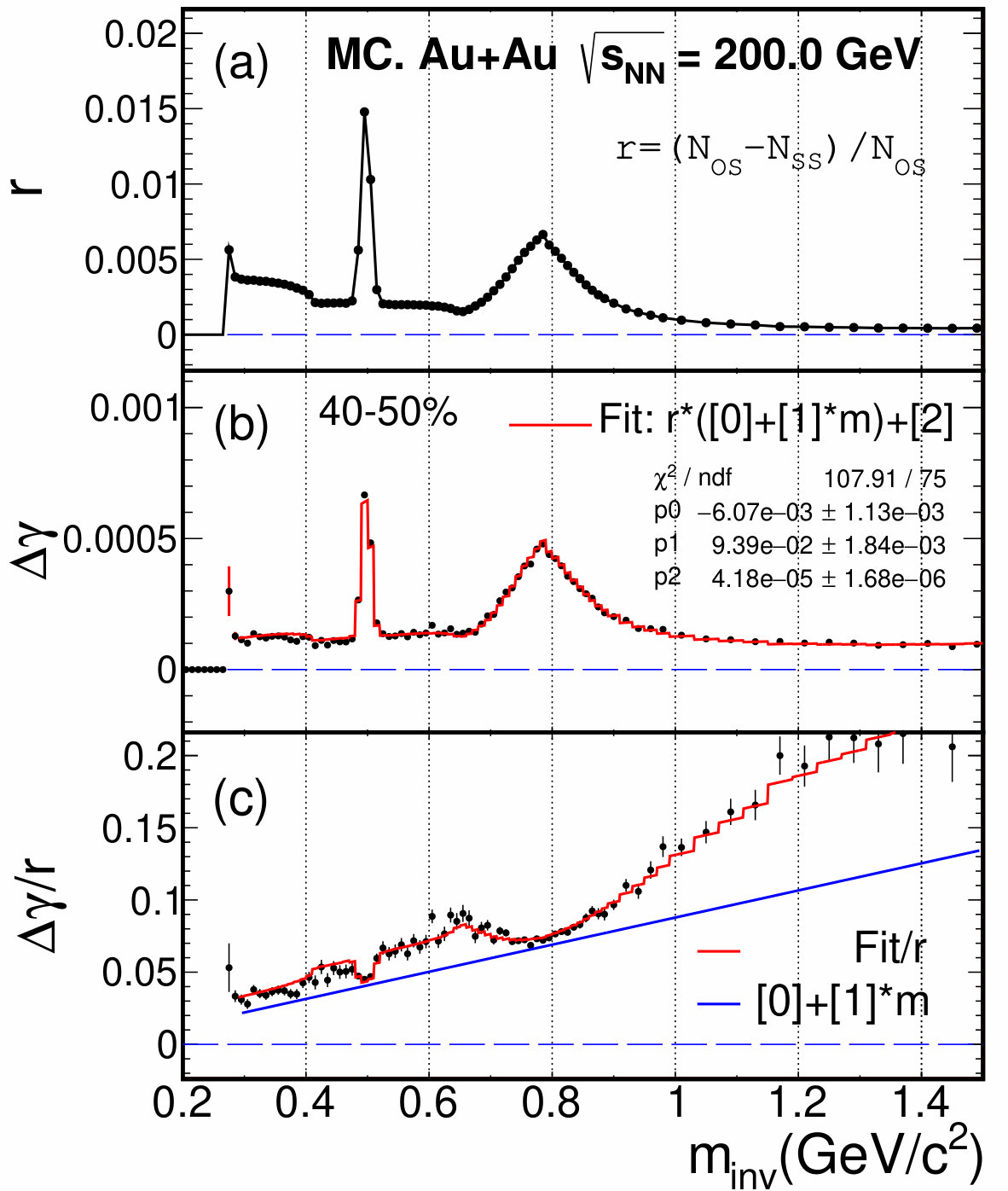 Figure 1
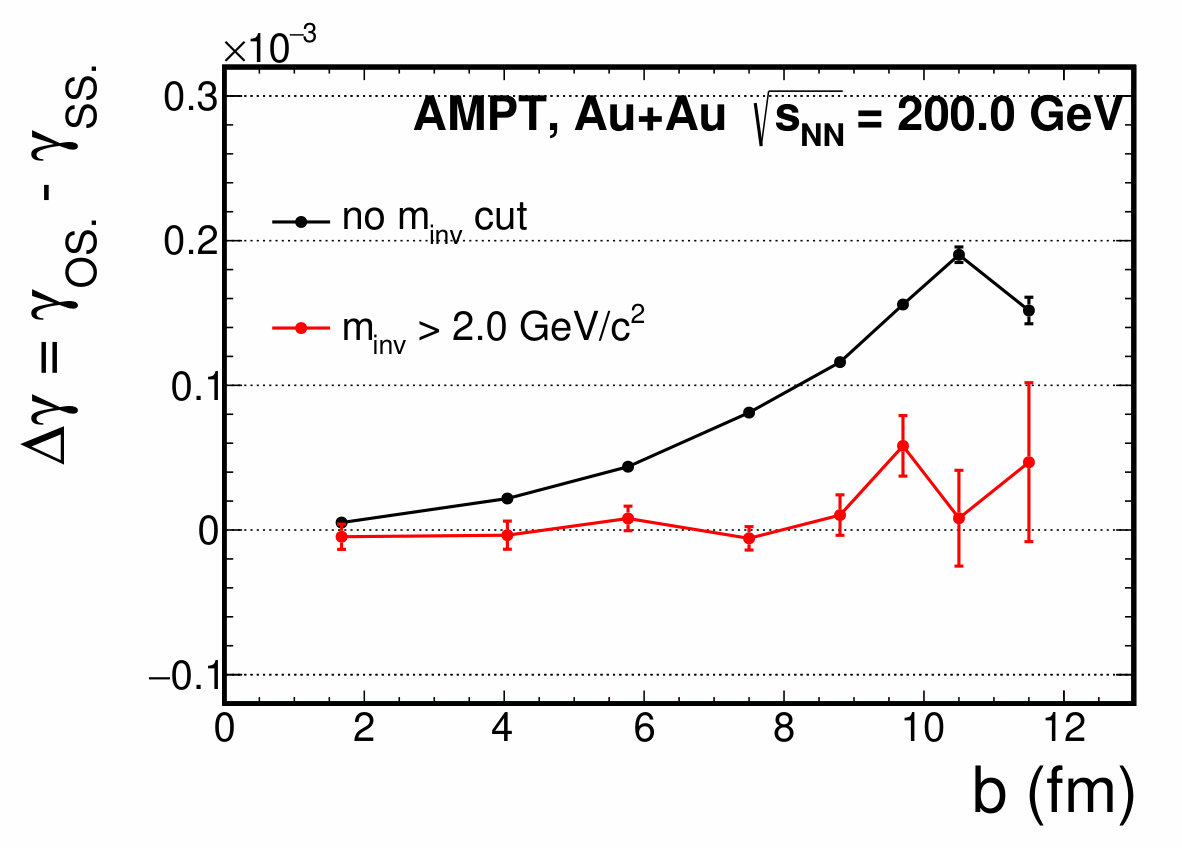 Figure 2
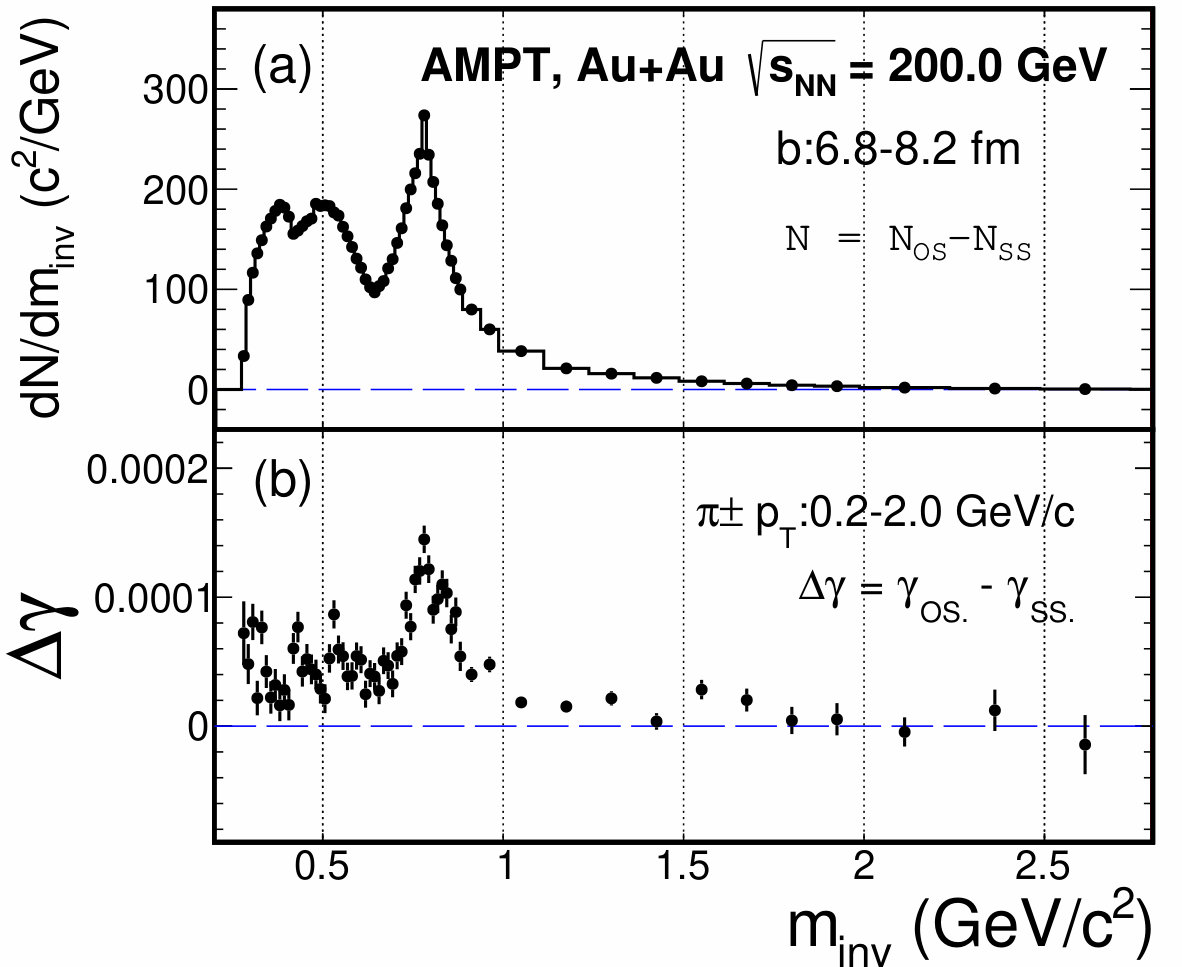 Figure 3
Peer Reviews
No public reviews on file for this paper yet. If you reviewed it on a platform where reviews are public (OpenReview, ICLR, NeurIPS, ICML), you can paste yours below so the community can read it here.
Videos
No videos yet. Explain this paper in a talk, walkthrough, or lecture? Add one.
Isolating the chiral magnetic effect from backgrounds by pair invariant mass
Jie Zhao
Department of Physics and Astronomy, Purdue University, West Lafayette, Indiana 47907, USA
Hanlin Li
Department of Physics and Astronomy, Purdue University, West Lafayette, Indiana 47907, USA
College of Science, Wuhan University of Science and Technology, Wuhan, Hubei 430065, China
Fuqiang Wang
Department of Physics and Astronomy, Purdue University, West Lafayette, Indiana 47907, USA
School of Science, Huzhou University, Huzhou, Zhejiang 313000, China
Abstract
Topological gluon configurations in quantum chromodynamics induce quark chirality imbalance in local domains, which can result in the chiral magnetic effect (CME)–an electric charge separation along a strong magnetic field. Experimental searches for the CME in relativistic heavy ion collisions via the charge-dependent azimuthal correlator () suffer from large backgrounds arising from particle correlations (e.g. due to resonance decays) coupled with the elliptic anisotropy. We propose differential measurements of the as a function of the pair invariant mass (), by restricting to high thus relatively background free, and by studying the dependence to separate the possible CME signal from backgrounds. We demonstrate by model studies the feasibility and effectiveness of such measurements for the CME search.
Chiral magnetic effect, invariant mass, QGP, QCD
pacs:
25.75.-q, 25.75.Gz, 25.75.Ld, 25.75.Ag
I Introduction
Vacuum fluctuations in quantum chromodynamics (QCD) can result in metastable local domains of gluon fields with non-vanishing topological charges Lee:1974ma ; Kharzeev:1998kz ; Kharzeev:1999cz . Interactions with those gluon fields can, under the approximate chiral symmetry restoration, change the overall chirality of quarks in those domains Kharzeev:2007tn ; Kharzeev:2007jp . The chirality imbalance yields an electric charge separation under a strong magnetic field, a phenomenon called the chiral magnetic effect (CME) Fukushima:2008xe ; Muller:2010jd ; Liu:2011ys . Strong magnetic fields are generated at early times by the spectator protons in relativistic heavy ion collisions, raising the possibility to detect the CME in those collisions Voloshin:2004vk ; Kharzeev:2004ey . An observation of the CME would confirm a fundamental property of QCD and is therefore of great importance Kharzeev:2015znc . CME-like phenomena are not specific only to QCD and may have been observed in condense matter physics Li:2014bha .
A commonly used variable to measure the CME-induced charge separation in heavy ion collisions is the three-point correlator Voloshin:2004vk ,
[TABLE]
where and are the azimuthal angles of two particles and is that of the reaction plane (span by the beam and impact parameter directions of the colliding nuclei). Charge separation along the magnetic field (), which is perpendicular to on average, would yield different values of for particle pairs of same-sign (SS) and opposite-sign (OS) charges: . However, there exist background correlations unrelated to the CME Voloshin:2004vk ; Wang:2009kd ; Bzdak:2009fc ; Liao:2010nv ; Bzdak:2010fd ; Schlichting:2010qia ; Pratt:2010zn ; Petersen:2010di ; Toneev:2012zx . For example, transverse momentum conservation induces correlations among particles enhancing back-to-back pairs Bzdak:2009fc ; Liao:2010nv ; Bzdak:2010fd ; Schlichting:2010qia ; Pratt:2010zn . This background is independent of particle charges, affecting SS and OS pairs equally and cancels in the difference, . Recent experimental searches have thus focused on the observable Kharzeev:2015znc ; Zhao:2018ixy ; Zhao:2018skm ; the CME would yield . There are, however, also mundane physics that differ between SS and OS pairs. One such physics is resonance/cluster decays Voloshin:2004vk ; Wang:2009kd ; Bzdak:2009fc ; Liao:2010nv ; Bzdak:2010fd ; Schlichting:2010qia ; Pratt:2010zn , more significantly affecting OS pairs than SS pairs. Backgrounds arise from the coupling of elliptical anisotropy (, a common phenomenon in heavy ion collisions Heinz:2013th ) of resonances/clusters and the angular correlations between their decay daughters (nonflow) Voloshin:2004vk ; Wang:2009kd ; Bzdak:2009fc ; Schlichting:2010qia . Take as an example. The background is , where is the relative abundance of -decay pairs over all OS pairs, and quantifies the decay angular correlations coupled with its Voloshin:2004vk ; Wang:2016iov ; Zhao:2018ixy ; Zhao:2018skm .
Experimentally, significant positive values have been observed at the Relativistic Heavy Ion Collider (RHIC) and the Large Hadron Collider (LHC) Abelev:2009ac ; Abelev:2009ad ; Abelev:2012pa ; Adamczyk:2013hsi ; Adamczyk:2014mzf . The relative background and CME contributions are under extensive debate QM17 . The recent observations of comparable in small system collisions Khachatryan:2016got ; Sirunyan:2017quh ; Zhao:2017ckp ; ZhaoJieQM17 ; Zhao:2017wck ; Zhao:2018pnk , where any CME signals would average to zero Khachatryan:2016got ; Belmont:2016oqp , challenge the CME interpretation of the measured in heavy ion collisions. The major difficulty in distinguishing CME from backgrounds with the observable is their similar behaviors with respect to the event multiplicity ZhaoJieQM17 ; Zhao:2017wck ; Zhao:2018pnk . This is because the magnetic field strength, to which the CME is sensitive, has a similar dependence as the (backgrounds) on the event multiplicity Kharzeev:2004ey ; Bzdak:2011yy ; Deng:2012pc ; Bloczynski:2012en ; Chatterjee:2014sea . There have been various proposals and attempts to reduce or eliminate the backgrounds Ajitanand:2010rc ; Bzdak:2011np ; Adamczyk:2013kcb ; Wang:2016iov ; Wen:2016zic ; Acharya:2017fau ; Sirunyan:2017quh . The central idea is to “hold” the magnetic field fixed (in a narrow centrality) and vary the event-by-event from statistical and dynamical fluctuations Voloshin:2010ut ; Adamczyk:2013kcb ; Chatterjee:2014sea . The first attempt was carried out by STAR Adamczyk:2013kcb where a charge asymmetry observable was analyzed as a function of the observed event-by-event . A linear dependence was observed, expected from background, and the intercept was extracted representing a background-suppressed signal. ALICE Acharya:2017fau divided their data in each collision centrality according to in one phase space, and found the to be approximately proportional to the in the phase space of the measurement, consistent with background contributions. However, as recently pointed out by two of us Wang:2016iov , those methods suppressing background may not completely eliminate it. Another way to help search for the CME is to compare isobaric collisions Voloshin:2010ut , where the magnetic fields differ and the backgrounds are expected to be the same Deng:2016knn . However, these simple expectations may not be correct because of the non-identical isobaric nuclear structures Xu:2017zcn .
A new method to search for the CME, as we demonstrate in this article, is to eliminate the resonance background contributions using particle pair invariant mass () by (i) applying a lower cut on the , (ii) fitting the low region by a two-component (TC) model, and (iii) fitting the low region by a two-component model aided by event-shape engineering (TC+ESE). We illustrate our method using the AMPT (A Multi-Phase Transport) model Zhang:1999bd and a toy Monte Carlo (MC) simulation. In both, the resonance masses are sampled from Breit-Wigner distributions Agashe:2014kda ; Lin:2014tya . We use pions within pseudorapidity and GeV/, except otherwise specified.
It is worthwhile to note here, since the CME is generally a low phenomenon, that large region may not be the best place to search for it. If no CME is found at large , it does not necessarily mean that CME does not exist at low . However, if a finite signal is observed at large , where background sources diminish, it could be a strong evidence for the possible existence of the CME that would call for further investigations. It is also worthwhile to note that our low fitting procedure is not without assumptions. Although the background shape may be assessed by the ESE method, there is still the question of the CME shape as function of . In principle, if the CME and the background have the same shape, then our invariant mass method would not be able to distinguish the two contributions. Theoretical inputs are much needed in this respect. Nevertheless, our method provides a potentially powerful way to extract the CME with reasonable assumptions of the dependence of the CME, which can be gauged to some extent by the fitting quality.
The rest of the paper is organized as follows. Section II presents the AMPT and toy-model studies by applying a lower cut to extract the in the high region. Section III describes a two-component model fit to the . Section IV extends the fitting method further by using ESE to determine the background shape to help extract the CME signal. Section V puts our methods into experimental context and summarizes the paper.
II High- region
II.1 A transport model study with null CME
AMPT is a parton transport model Zhang:1999bd . It consists of a fluctuating initial condition, parton elastic scatterings, quark coalescence for hadronization, and hadronic interactions. The initial condition is taken from HIJING Gyulassy:1994ew . The string melting version Lin:2001zk is used in this study. Two-body elastic parton scatterings are treated with Zhang’s Parton Cascade Zhang:1997ej , where the parton scattering cross section is set to 3 mb. After partons stop interacting, a simple quark coalescence model is applied to describe the hadronization process that converts partons into hadrons Lin:2004en . Subsequent interactions of these formed hadrons are modeled by a hadron cascade Lin:2004en . However, it is known that this version of the hadron cascade does not conserve charge, which is critical to the charge correlation study here. The hadronic scatterings, while responsible for the majority of the mass splitting, are unimportant for the main development of Li:2016flp ; Li:2016ubw , and thus may not be critical for the CME backgrounds. We thus turn off hadronic cascade in AMPT for our study here, as was done in Ref. Ma:2011uma . AMPT has been quite successful in describing variety of heavy ion data Lin:2014tya . It reproduces approximately the measured particle yields and distributions, and therefore should approximately describe those of resonances as well, which is relevant to the CME background study here. We simulate Au+Au collisions at GeV of various impact parameter () ranges. For simplicity we use the known reaction plane in our analysis, fixed at .
Figure 1(a) shows the distribution of the excess OS over SS pion pairs (), with -8.2 fm (corresponding to the 20-30% centrality of Au+Au collisions Abelev:2008ab , and average pion multiplicities within ). The peak is evident; the lower mass peaks are from Dalitz decays of and mesons (the is kept stable in AMPT). Figure 1(b) shows the as a function of . The contribution is clearly seen in the mass region. Since no CME is present in AMPT, the finite at GeV/ must be due to correlations from resonance decays, or generally, correlated pion pairs. This has been observed before Ma:2011uma ; ZhaoJieQM17 . For m_{\rm inv}$$>2 GeV/ where resonance contribution to the OS over SS excess is small, the value is essentially zero, as expected.
Figure 2 shows the in AMPT from all pairs and (m_{\rm inv}$$>2 GeV/) from pairs with m_{\rm inv}$$>2 GeV/. The positive is due to backgrounds; in (m_{\rm inv}$$>2 GeV/) this background is essentially eliminated, and as expected the result is consistent with zero. With the AMPT events simulated for 200 GeV Au+Au collisions with -8.2 fm, the inclusive value is , and (m_{\rm inv}$$>2 GeV/)=. This represents a null signal with an upper limit of 20% of the inclusive with 98% confidence level (CL).
II.2 A toy model study with finite CME
In light of the AMPT results, we propose to apply a lower cut in real data analysis to search for the CME. We illustrate this point further by using a toy MC with input CME signal. Our toy model generates primordial , , and resonances (), and decays the and resonances (via both two- and three-body decays Agashe:2014kda ). Particle kinematics are sampled according to
[TABLE]
where is the CME signal parameter Voloshin:2004vk . The particle , spectra, and correspond to the 40-50% centrality of Au+Au collisions; they are as same as those used in Ref. Adamczyk:2015lme except that the primordial pion spectra are parameterized here with a better agreement with data at high , and we have added . The pion multiplicities within are and those of primordial pions are . The multiplicity is taken to be 1/5 of the measured ’s Adams:2003cc , because some ’s would have both their decay pions reconstructed as primary particles in experiments (such as STAR). We generate events with an input CME signal of overall strength for primordial ; for and resonances . Our input CME is independent of the particle . This is supported by a recent theoretical study Shi:2017cpu , where the CME is insensitive to once is above 0.2 GeV/.
Figure 3(a) shows the relative OS pair excess, as a function of from the toy MC. The and peaks are evident. Figure 3(b) shows the ; the and contributions are clear. The inclusive from Fig. 3(b) is ; our input CME signal of , diluted by , is , about 20% of the inclusive value. The distribution in Fig. 3(b) has a pedestal corresponding to the input CME signal. The pedestal extends to high (not shown) where resonance backgrounds vanish. A lower cut removes backgrounds to but not the CME signal. The value (m_{\rm inv}$$>2 GeV/) is consistent with the input CME signal, and it would present a measurement.
The CME is generally believed to be a low- phenomenon Kharzeev:2007jp , and would thus be more prominent in the low region. With a GeV/ cut we used here, the particle average is typically 1.2 GeV/ WangQM18 . This is not very high and the CME may still be present above such a mass cut. Moreover, a recent study Shi:2017cpu indicates that the CME signal is rather independent of at GeV/, suggesting that the signal can persist to high . Nevertheless, our proposal to apply a lower cut will eliminate resonance contributions to ; any measured remaining positive would point to the interesting possibility of the existence of the CME. A null measurement at high , on the other hand, does not necessarily mean null CME also at low .
III Two-component model fit in low- region
In what follows, we illustrate a fit method to potentially identify the possible CME at low . Still use as an example, and consider the event to be composed of primordial pions containing CME signals () and common (charge-independent) backgrounds, such as momentum conservation () Bzdak:2010fd ; Pratt:2010zn , and decay pions containing correlations from the decay Voloshin:2004vk ; Schlichting:2010qia ; Wang:2016iov . We have
[TABLE]
(If one normalized by instead, then Eq. (3) would become simpler, with .) Considering Eq. (3), the can be expressed by two terms:
[TABLE]
The first term is resonance contributions, where the response function
[TABLE]
contains of various resonances and is likely a smooth function of while contains resonance spectral profile (Fig. 3(a)). Consequently, the first term is not smooth but a peaked function of . The second term in Eq. (4) is the CME signal which should be a smooth function of (note we have dropped the negligible ). However, the exact functional form of is presently unknown and needs theoretical input. It is possible that the CME may possess some resonance shapes; in the extreme case where the CME has the same shape as the background, then our method would obviously fail. Nevertheless, the dependences of the two terms are likely different, and this can be exploited to identify CME signals at low . This is illustrated in Fig. 3(c) where the ratio of is depicted. If CME signal is present, as is the case in our toy MC, should not be smooth, but with a deviation resembling the inverse shape of in Fig. 3(a). This is clearly seen in Fig. 3(c) in the mass region, although not as clear in the mass region.
In Eq. (4), and are measured, and results from known physics and can in principle be obtained from models. AMPT indicates that is a first-order polynomial. We can thus take a step further to fit the in Fig. 3(b) by Eq. (4) taking as a first-order polynomial fit function, treating CME as a -independent fit parameter (our input CME signal is independent). The fit result is superimposed as the red histogram in Fig. 3(b), and in Fig. 3(c) after divided by from Fig. 3(a). The straight line in blue in Fig. 3(c) is the fit result for . The difference between the fit red histogram and the blue line is , which shows the inverse shape of . It is found, with the simulated statistics, that the inverse-shape feature becomes hard to identify when the CME input signal is smaller than 10% of the inclusive . The fit parameters are written in Fig. 3(b). The fit parameter for CME is , not far away from the input CME signal of . The fit is not ideal because of the approximation for the -dependence of , but it presents a potentially viable way to extract CME signals from data even at low .
Theoretically, the dependence of the CME is unknown. The likely sphaleron or instanton mechanism for transitions between QCD vacuum states Kharzeev:1998kz ; Kharzeev:2007jp ; Fukushima:2008xe ; Kharzeev:2004ey , leading to the CME, might yield a broad distribution around GeV/. With such a CME signal, assuming a -independent CME in our fit would probably still yield a reasonable average CME signal. To illustrate this point, we simulate sphalerons/instantons by a broad Gaussian mass distribution at 1 GeV/ with width 0.5 GeV/. Each sphaleron/instanton is at rest and decays into a pair where the decay polar angle is uniform in and the azimuthal angles of are sampled according to . The number of sphalerons/instantons is Poisson and on average 0.7% (0.9% within ) of the event single charge pion multiplicity. The pion azimuthal distributions in the form of Eq. (2) are . This gives an effective CME signal of . We apply our fit method, still assuming a constant CME, and obtain , consistent with the input signal, with .
IV Use ESE to determine background shape in two-component fit
In the TC fit in Sect. III, one needs the functional form of as input. The linear form used in the Fig. 3 fit was motivated by AMPT results, but is strongly model dependent. To lift this model dependency, one may resort to event-shape engineering (ESE) Schukraft:2012ah ; Acharya:2017fau ; Sirunyan:2017quh where events in each narrow centrality bin are divided into two classes according to the flow vector :
[TABLE]
where is the particle multiplicity and is the th particle azimuth. The two event classes will have different average exploiting dynamical fluctuations of Schukraft:2012ah ; Acharya:2017fau ; Sirunyan:2017quh . (In our simulation we included dynamical fluctuations of 40% of the average Wang:2016iov .) Since the magnetic fields are approximately equal for the two classes while the backgrounds differ, the difference in between the two event classes is a good representation of the background shape, and can therefore be used to add to the TC fit. We refer to such a fit as TC+ESE fit. Note that in this fit model the background is not required to be strictly proportional to WangQM18 .
We calculate using particles from and using particles from , and vice versa (which we refer to as the subevent method). Figure 4 left panel shows the distributions of (scaled by a factor of 5) together with the inclusive . Note that, because of the different acceptances, the ’s in Fig. 4 and Fig. 3 are numerically different. The inclusive contains both background and CME. With the background shape given by , the CME can be extracted from a fit . Since the same data are used in and , their statistical errors are somewhat correlated. To properly handle statistical errors, one can simply fit the independent measurements of versus , namely where and are the fit parameters. Figure 4 right panel shows such a fit to our toy model simulation.
Figure 5 shows the parameters from the TC fit and the TC+ESE fit as functions of the input CME strength. The TC+ESE fit uncertainties on the parameter are relatively large. This is because is small (see Fig. 4 left panel), corresponding to a relative difference in on the order of 10% in our toy model simulation representing mid-central Au+Au collisions at RHIC. At the LHC, this difference is larger, approximately 20% Acharya:2017fau ; Sirunyan:2017quh , because of the larger event multiplicities than at RHIC. As seen from Fig. 5, the fits appear to faithfully reproduce the input CME signal.
V Discussion and summary
The STAR experiment at RHIC has accumulated Au+Au minimum bias data samples of events from Run-4 Abelev:2009ac ; Abelev:2009ad , events from Run-7 Adamczyk:2014mzf , and events from Run-11 Skokov:2016yrj . If the CME signal is 1/3 of the measured inclusive Abelev:2009ac ; Abelev:2009ad and independent of , these data samples (with the 20-60% centrality) could yield, based on our toy MC study, a better than measurement of (m_{\rm inv}$$>2 GeV/). If the CME signal is unobservable, then our analysis method could set, based on our AMPT result, an upper limit with 98% CL on the CME of 5% at m_{\rm inv}$$>2 GeV/ relative to the measured inclusive . It is likely that the CME contribution decreases with and, depending on the detailed physics mechanism, may become difficult to observe at m_{\rm inv}$$>2 GeV/. Our fit methods can be used to explore and extract CME signals at low . The methods rely on the rather robust assumption of different dependences of peaked resonance contributions and smooth CME signal, lifting the major difficulty of similar dependences of the background and CME on experimental variables thus far. The ESE method can further help determine the background dependence on , thus improving the accuracy in the extraction of the CME signal.
In summary, topological charge fluctuations, resulting in the chiral magnetic effect (CME) and charge separation in relativistic heavy ion collisions, are fundamental properties of QCD. Experimental charge separation measurements by the azimuthal correlator () suffer from major backgrounds from resonance decays (generally, local charge conservation) coupled with elliptic anisotropy. In this article, we propose to measure the differentially as a function of the particle pair invariant mass (). By using the AMPT (A Multi-Phase Transport) model, we demonstrate that one can essentially eliminate resonance decay backgrounds to by applying a lower cut on . With a m_{\rm inv}$$>2 GeV/ cut, an upper limit on the CME of 20% of the inclusive can be achieved with AMPT events of 200 GeV Au+Au collisions with impact parameter -8.2 fm. By using a toy Monte Carlo simulation with realistic resonance distributions and a -independent input CME signal, we show that the resonance decay backgrounds are eliminated by the m_{\rm inv}$$>2 GeV/ cut and the CME signal remains. With input CME signal of (20% of the total ) and events corresponding to the 40-50% centrality of Au+Au collisions, a CME measurement could be achieved at m_{\rm inv}$$>2 GeV/. We further show that one may be able to separate the presumably smooth CME signals from peaked resonance decay backgrounds in the low region by exploiting their different dependences. We show this by the toy MC with a -independent CME signal as well as the signal from a broad sphaleron/instanton mass distribution. We demonstrate that one may use the ESE to determine the background shape in , thus help the extraction of the CME signal.
We note that our lower cut may also remove the CME signal together with the background. A negative conclusion at large does therefore not necessarily mean null CME also at low . A positive signal at large , however, would be a good indication of the possible CME. We also note that our two-component model fit in the low region is not without assumptions. One uncertainty is the unknown dependence of the CME, where theoretical guidance is much needed. Nevertheless, our proposed invariant mass method provides a valuable tool and should help the ongoing experimental search for the CME at RHIC and the LHC.
Acknowledgments
We thank Prof. Zi-Wei Lin for useful discussions. This work was supported in part by the National Natural Science Foundation of China Grant Nos. 11647306 and 11747312 and the U.S. Department of Energy Grant No. DE-SC0012910. HL acknowledges financial support from the China Scholarship Council.
The reference list from the paper itself. Each links out to its DOI / PubMed record.
- 1[1] T.D. Lee and G.C. Wick. Vacuum stability and vacuum excitation in a spin 0 field theory. Phys.Rev. , D 9:2291–2316, 1974.
- 2[2] Dmitri Kharzeev, R.D. Pisarski, and Michel H.G. Tytgat. Possibility of spontaneous parity violation in hot QCD. Phys.Rev.Lett. , 81:512–515, 1998.
- 3[3] Dmitri Kharzeev and Robert D. Pisarski. Pionic measures of parity and CP violation in high-energy nuclear collisions. Phys.Rev. , D 61:111901, 2000.
- 4[4] D. Kharzeev and A. Zhitnitsky. Charge separation induced by P-odd bubbles in QCD matter. Nucl.Phys. , A 797:67–79, 2007.
- 5[5] Dmitri E. Kharzeev, Larry D. Mc Lerran, and Harmen J. Warringa. The Effects of topological charge change in heavy ion collisions: ’Event by event P and CP violation’. Nucl.Phys. , A 803:227–253, 2008.
- 6[6] Kenji Fukushima, Dmitri E. Kharzeev, and Harmen J. Warringa. The chiral magnetic effect. Phys.Rev. , D 78:074033, 2008.
- 7[7] Berndt Muller and Andreas Schafer. Charge Fluctuations from the Chiral Magnetic Effect in Nuclear Collisions. Phys.Rev. , C 82:057902, 2010.
- 8[8] K.F. Liu. Charge-dependent Azimuthal Correlations in Relativistic Heavy-ion Collisions and Electromagnetic Effects. Phys.Rev. , C 85:014909, 2012.