Horn Maximum Satisfiability: Reductions, Algorithms & Applications
Joao Marques-Silva, Alexey Ignatiev, Antonio Morgado

TL;DR
This paper explores Horn MaxSAT, demonstrating its broad applicability to various problems, and introduces new algorithms leveraging linear-time decision procedures for Horn formulas.
Contribution
It introduces the study of Horn MaxSAT, showing its relevance to many problems and developing algorithms based on Horn formulas' decision procedures.
Findings
Horn MaxSAT can model many optimization and decision problems.
Linear-time decision procedures for Horn formulas enable new algorithms for Horn MaxSAT.
The paper bridges Horn formulas and MaxSAT solving techniques.
Abstract
Recent years have witness remarkable performance improvements in maximum satisfiability (MaxSAT) solvers. In practice, MaxSAT algorithms often target the most generic MaxSAT formulation, whereas dedicated solvers, which address specific subclasses of MaxSAT, have not been investigated. This paper shows that a wide range of optimization and decision problems are either naturally formulated as MaxSAT over Horn formulas, or permit simple encodings using Horn MaxSAT. Furthermore, the paper also shows how linear time decision procedures for Horn formulas can be used for developing novel algorithms for the Horn MaxSAT problem.
Click any figure to enlarge with its caption.
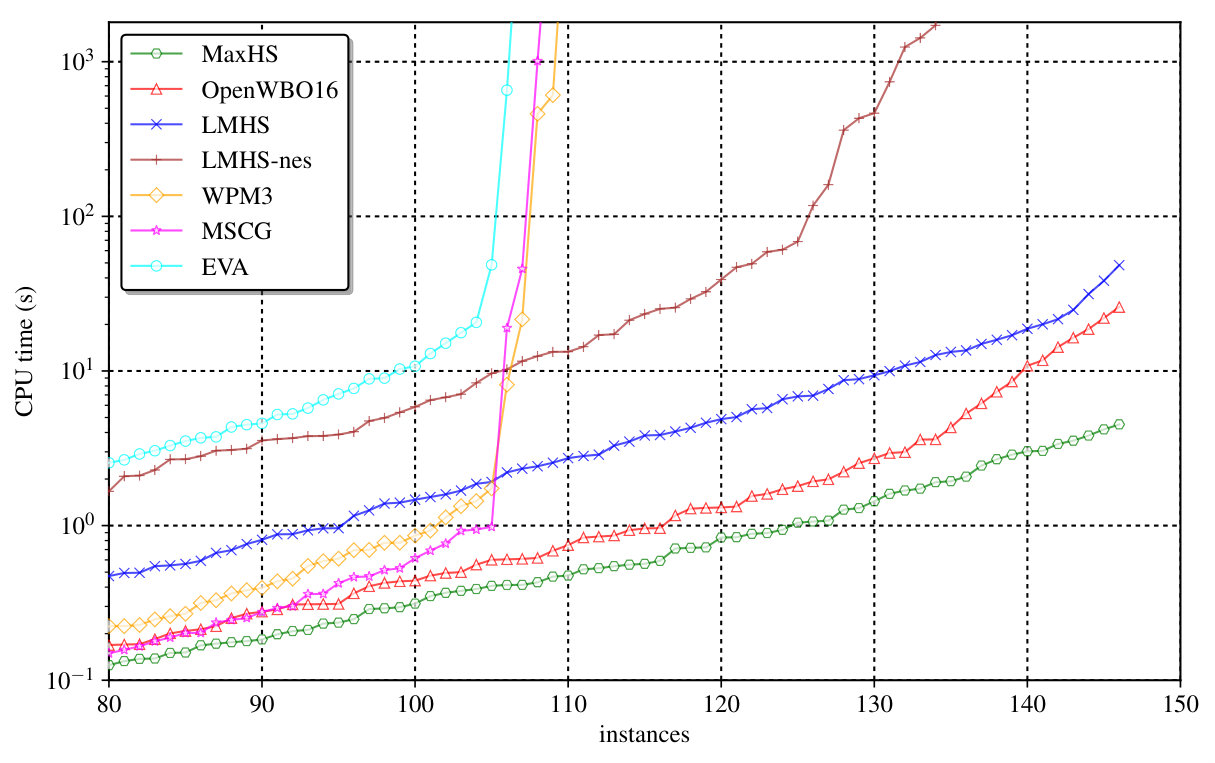 Figure 1
| 10 | 20 | 30 | 40 | 50 | 60 | 70 | 80 | 90 | ||||||||||
| 100 | 200 | 200 | 400 | 300 | 600 | 400 | 800 | 500 | 1000 | 600 | 1200 | 700 | 1400 | 800 | 1600 | 900 | 1800 | |
| UB | 65 | 65 | 230 | 230 | 495 | 495 | 860 | 860 | 1325 | 1325 | 1890 | 1890 | 2555 | 2555 | 3320 | 3320 | 4185 | 4185 |
| #DC | 9 | 7 | 13 | 13 | 27 | 26 | 25 | 25 | 50 | 50 | 49 | 36 | 70 | 70 | 48 | 49 | 63 | 63 |
| #I | 19 | 35 | 71 | 132 | 53 | 72 | 211 | 356 | 50 | 50 | 225 | 693 | 70 | 70 | 2140 | 768 | 747 | 812 |
Peer Reviews
No public reviews on file for this paper yet. If you reviewed it on a platform where reviews are public (OpenReview, ICLR, NeurIPS, ICML), you can paste yours below so the community can read it here.
Videos
No videos yet. Explain this paper in a talk, walkthrough, or lecture? Add one.
Taxonomy
TopicsConstraint Satisfaction and Optimization
11institutetext: LASIGE, Faculty of Science, University of Lisbon, Portugal
11email: {jpms,aignatiev,ajmorgado}@ciencias.ulisboa.pt
Horn Maximum Satisfiability:
Reductions, Algorithms & Applications
Joao Marques-Silva 11
Alexey Ignatiev 11
Antonio Morgado 11
Abstract
Recent years have witness remarkable performance improvements in maximum satisfiability (MaxSAT) solvers. In practice, MaxSAT algorithms often target the most generic MaxSAT formulation, whereas dedicated solvers, which address specific subclasses of MaxSAT, have not been investigated. This paper shows that a wide range of optimization and decision problems are either naturally formulated as MaxSAT over Horn formulas, or permit simple encodings using Horn MaxSAT. Furthermore, the paper also shows how linear time decision procedures for Horn formulas can be used for developing novel algorithms for the Horn MaxSAT problem.
1 Introduction
Recent years have seen very significant improvements in MaxSAT solving technology [13, 28, 2, 33]. Currently, the most effective MaxSAT algorithms propose different ways for iteratively finding and blocking unsatisfiable cores (or subformulas). However, and despite the promising results of MaxSAT in practical settings, past work has not investigated dedicated approaches for solving subclasses of the MaxSAT problem, with one concrete example being the MaxSAT problem over Horn formulas, i.e. HornMaxSAT 111In contrast, for predicate logic and many of its specializations, Horn clauses are used ubiquitously. This includes logic programming, among many others applications.. The HornMaxSAT optimization problem is well-known to be NP-hard [22]. In contrast to HornMaxSAT, the decision problem for Horn formulas is well-known to be in P, with linear time algorithms proposed in the 80s [15, 27]. This paper investigates practical uses of MaxSAT subject to Horn formulas, and shows that a vast number of decision and optimization problems are naturally formulated as HornMaxSAT. More importantly, as this paper also shows, a vast number of other decision and optimization problems admit simple HornMaxSAT encodings. One should observe that HornMaxSAT is NP-hard and so, by definition, any decision problem in NP admits a polynomial time reduction to HornMaxSAT. However, for many problems in NP, such reductions are not known, and may result in large (even if polynomial) encodings.
With the purpose of exploiting the observation that many optimization and decision problems have natural (and simple) reductions to HornMaxSAT, this paper also proposes a novel algorithm for HornMaxSAT. The new algorithm mimics recent Implicit Hitting Set algorithms222Throughout the paper, these are referred to as MaxHS-family of MaxSAT algorithms. proposed for MaxSAT [13, 33], thus exploiting the fact that Horn formulas can be decided in polynomial (linear) time [27], and for which minimal unsatisfiable cores (or MUSes) can be computed in polynomial time [26].
The paper is organized as follows. Section 2 introduces the definitions and notation used in the remainder of the paper. Section 3 shows that a large number of well-known optimization, but also decision, problems already have simple HornMaxSAT formulations which, to the best of our knowledge, have not been exploited before. Section 4 proposes a variant of recent general-purpose MaxSAT algorithms, that is dedicated to the HornMaxSAT problem. This section also shows that the new algorithm can elicit automatic abstraction mechanisms when solving large scale optimization problems. The potential of the work proposed in this paper is assessed in Section 6, and Section 7 concludes the paper.
2 Preliminaries
The paper assumes definitions and notation standard in propositional satisfiability (SAT) and MaxSAT [8]. Propositional variables are taken from a set . A Conjunctive Normal Form (CNF) formula is defined as a conjunction of disjunctions of literals, where a literal is a variable or its complement. CNF formulas can also be viewed as sets of sets of literals, and are represented with calligraphic letters, , , , etc. Given a formula , the set of variables is . A clause is a goal clause if all of its literals are negative. A clause is a definite clause if it has exactly one positive literal and all the other literals are negative; the number of negative literals may be 0. A clause is Horn if it is either a goal or a definite clause. A truth assignment is a map from variables to . Given a truth assignment, a clause is satisfied if at least one of its literals is assigned value 1; otherwise it is falsified. A formula is satisfied if all of its clauses are satisfied; otherwise it is falsified. If there exists no assignment that satisfies a CNF formula , then is referred to as unsatisfiable. (Boolean) Satisfiability (SAT) is the decision problem for propositional formulas, i.e. to decide whether a given propositional formula is satisfiable. Since the paper only considers propositional formulas in CNF, throughout the paper SAT refers to the decision problem for propositional formulas in CNF. Modern SAT solvers instantiate the Conflict-Driven Clause Learning paradigm [8]. For unsatisfiable (or inconsistent) formulas, MUSes (minimal unsatisfiable subsets) represent subset-minimal subformulas that are unsatisfiable (or inconsistent), and MCSes (minimal correction subsets) represent subset-minimal subformulas such that the complement is satisfiable [8].
To simplify modeling with propositional logic, one often represents more expressive constraints. Concrete examples are cardinality constraints and pseudo-Boolean constraints [8]. A cardinality constraint of the form is referred to as an constraint, whereas a cardinality constraint of the form is referred to as an constraint. Propositional encodings of cardinality and pseudo-Boolean constraints is an area of active research [37, 6, 35, 16, 8, 4, 10, 7, 5, 1, 29].
The (plain) MaxSAT problem is to find a truth assignment that maximizes the number of satisfied clauses. For the plain MaxSAT problem, all clauses are soft, meaning that these may not be satisfied. Variants of the MaxSAT can consider the existence of hard clauses, meaning that these must be satisfied, and also assign weights to the soft clauses, denoting the cost of falsifying the clause; this is referred as the weighted MaxSAT problem, WMaxSAT. When addressing MaxSAT problems with weights, hard clauses are assigned a large weight . The HornMaxSAT problem corresponds to the MaxSAT problem when all clauses are Horn. If clauses have weights, then HornWMaxSAT denotes the Horn MaxSAT problem when the soft clauses have weights.
Throughout the paper, standard graph and set notations will be used. An undirected graph is defined by a set of vertices and a set . The notation is used in this paper to represent the edges of , where the order of the vertices is irrelevant. Given , the complement graph is the graph with the edges in that are not in . Moreover, it is assumed some familiarity with optimization problems defined on graphs, including minimum vertex cover, maximum independent set, maximum clique, among others. Finally, the notation is used to represent polynomial time reducibility between problems [12, Section 34.3].
3 Basic Reductions
This section shows that a number of well-known problems can be reduced in polynomial time to the HornMaxSAT problem. Some of the reductions are well-known; we simply highlight that the resulting propositional formulas are Horn.
3.1 Optimization Problems on Graphs
Definition 1** (Minimum Vertex Cover, MinVC).**
Given an undirected graph , a vertex cover is such that for each , . A minimum (or cardinality minimal) vertex cover is a vertex cover of minimum size333This corresponds to requiring to be such that . Throughout the paper, we will skip the mathematical representation of minimum (but also maximum) size sets..
Reduction 1** ().**
For , let iff is not included in a vertex cover. For any , add a hard clause . For each , add a soft clause . (Any non-excluded vertex (i.e. ) is in the vertex cover.)
Remark 1*.*
The proposed reduction differs substantially from the one originally used for proving HornMaxSAT to be NP-hard [22], but our working assumptions are also distinct, in that we consider hard and soft clauses.
Definition 2** (Maximum Independent Set, MaxIS).**
Given an undirected graph , an independent set is such that for each either or . A maximum independent set is an independent set of maximum size.
Reduction 2** ().**
One can simply use the previous encoding, by noting the relationship between vertex covers and independent sets. For any , add a hard clause . For each , add a soft clause .
Definition 3** (Maximum Clique, MaxClique).**
Given an undirected graph , a clique (or complete subgraph) is such that for every pair , . A maximum clique is a clique of maximum size.
Reduction 3** ().**
A MaxSAT encoding for MaxClique is the following. For any , add a hard clause . For each , add a soft clause .
Definition 4** (Minimum Dominating Set, MinDS).**
Let be an undirected graph. is a dominating set if any is adjacent to at least one vertex in . A minimum dominating set is a dominating set of minimum size.
Reduction 4** ().**
Let iff is excluded from a dominating set . For each vertex add a hard Horn clause . The soft clauses are , for .
3.2 Optimization Problems on Sets
Definition 5** (Minimum Hitting Set, MinHS).**
Let be a collection of sets of some set . A hitting set is such that for any , . A minimum hitting set is a hitting set of minimum size.
Reduction 5** ().**
For each let iff is excluded from . For each , create a hard Horn clause . The soft clauses are , for .
Remark 2*.*
The minimum set cover (MinSC) is well-known to be equivalent to the minimum hitting set problem. Thus, the same reduction to HornMaxSAT can be applied.
Definition 6** (Maximum Set Packing, MaxSP).**
Let be a family of sets. is a set packing if . A maximum set packing is a set packing of maxim size.
Reduction 6** ().**
Let iff is included in the set packing. For each pair , such that , create a hard Horn clause . The soft clauses are , for .
Remark 3*.*
It is well-known that the maximum set packing problem can be reduced to the maximum clique problem. The reduction above exploits this result.
It also immediate to conclude that the weighted version of any of the optimization problems described in this and the previous sections can be reduced to HornWMaxSAT.
3.3 Handling Linear Constraints
This section argues that the propositional encodings of a number of linear constraints are Horn. In turn, this enables solving a number of optimization problems with HornMaxSAT.
The first observation is that any of the most widely used CNF encodings of AtMost constraints are composed exclusively of Horn clauses444To our best knowledge, this property of propositional encodings has not been investigated before.:
Proposition 1** (CNF Encodings of AtMost constraints).**
The following CNF encodings of AtMost constraints are composed solely of Horn clauses: pairwise and bitwise encodings [8, Chapter 2], totalizers [6], sequential counters [35], sorting networks [16], cardinality networks [4, 5], pairwise cardinality networks [10], and modulo totalizers [29].
- Proof.
Immediate by inspection of each encoding [8, 6, 35, 16, 4, 10, 5, 29]. ∎
For the case of the more general pseudo-Boolean constraints, , with non-negative, there also exist Horn encodings:
Proposition 2** (CNF Encodings of Pseudo-Boolean Constraints).**
The Local Polynomial Watchdog [7] encoding for PB constraints is composed solely of Horn clauses.
- Proof.
Immediate by inspection of the encoding in [7]. ∎
These observations have immediate impact on the range of problems that can be solved with HornMaxSAT and HornWMaxSAT. One concrete example is the Knapsack problem [12].
Definition 7** (Knapsack problem).**
Let denote a set of objects, each with value and weight , , and a maximum weight value . The knapsack problem is to pick a subset of objects of maximum value that is consistent with the weight constraint. By letting iff object is picked, we get the well-known 0-1 ILP formulation .
Reduction 7** ().**
*From Proposition 2, there exist Horn encodings for Pseudo-Boolean constraints. Thus, the hard constraint can be encoded with Horn clauses. The soft clauses are for each object , each with cost . Both the soft and the hard clauses in the reduction are Horn. *
4 HornMaxSAT Algorithm with Hitting Sets
This section develops a MaxHS-like [13, 33] algorithm for HornMaxSAT. In addition, the section shows that this MaxHS-like algorithm elicits the possibility of solving large scale problems with abstraction.
4.1 A MaxHS-Like HornMaxSAT Algorithm
With the goal of exploiting the special structure of HornMaxSAT, a MaxHS-like algorithm is envisioned [13, 33].
Algorithm 1 summarizes the proposed approach. The key observation is that each call to LTUR [27] runs in linear time. (Unit propagation as implemented in modern SAT solvers, will also run in polynomial time, but it will be less efficient in practice.) The original motivation for MaxHS is that finding a minimum hitting set of is expected to be much easier than solving the MaxSAT problem. This is also the motivation for HMaxHS. As observed in recent work [3, 26], MUSes (minimal unsatisfiable subsets) can be computed in polynomial time in the case of Horn formulas. MUS extraction, but also MCS (minimal correction subset) extraction [26], are based on the original LTUR algorithm [27]. It should be noted that some implementations of MaxHS use an ILP (Integer Linear Programming) package (e.g. CPLEX or SCIP) [13, 33]555SCIP and CPLEX and available, respectively, from http://scip.zib.de/ and https://www-01.ibm.com/software/commerce/optimization/cplex-optimizer/., whereas others exploit SAT solvers for computing minimum hitting sets [20, 19].
4.2 Automatic Abstraction-Based Problem Solving
For some of the problems described in Section 3 a possible criticism of Algorithm 1 is that it will iteratively find sets consisting of a single clause, and it will essentially add to all the clauses in . Although this is in fact a possibility for some problems (but not all, as investigated in Section 5), this section shows that even for these problems, Algorithm 1 can provide an effective problem solving approach.
Consider the example graph in Figure 1, where the goal is to compute a maximum independent set (or alternatively a minimum vertex cover).
From the figure, we can conclude that the number of vertices is , the number of edges is , the size of the maximum independent set is and the size of the minimum vertex cover is . From the inspection of the reduction from MaxIS (or MinVC) to HornMaxSAT, and the operation of Algorithm 1, one might anticipate that Algorithm 1 would iteratively declare each hard clause as an unsatisfiable core, and replicate the clause in the list of sets to hit, thus requiring a number of iterations no smaller than the number of edges. (More importantly, for a MaxHS-like algorithm, the number of iterations is worst-case exponential [13].) However, and as shown below, the operation of the HMaxHS actually ensures this is not the case.
Without loss of generality, consider any of the vertices in the clique, i.e. , say . For this vertex, no more than edges will be replicated, i.e. added to . Observe that, as soon as two edges and are replicated, a minimum hitting set will necessarily pick . As a result, after at most iterations, the algorithm will terminate with the answer . Essentially, the algorithm is capable of abstracting away clauses when computing the maximum independent set. Observe that can be made arbitrarily large. Abstraction is a well-known topic in AI, with important applications [17]. The example in this section suggests that HornMaxSAT and the HMaxHS algorithm can effectively enable automatic abstraction for solving large scale (graph) optimization problems. This remark is further investigated in Section 6.
It should be noted that the result above highlights what seems to be a fundamental property of the original MaxHS algorithm [13]. Although in the worst case, the algorithm can require an exponential number of steps to find the required set of clauses to remove to achieve consistency, the result above illustrates how the MaxHS can be effective at discarding irrelevant clauses, and focusing on the key parts of the formula, thus being able to compute solutions in a number of iterations not much larger than the minimum number of falsified clauses in the MaxHS solution. Practical results from recent MaxSAT Evaluations666http://www.maxsat.udl.cat/. confirm the practical effectiveness of MaxHS-like algorithms.
5 HornMaxSAT in Practice
Besides the reference optimization problems analyzed in Section 3, a number of practical applications can also be shown to correspond to solving HornMaxSAT or can be reduced to HornMaxSAT. This section investigates some of these problems, but also proposes generic encodings from either SAT and CSP into HornMaxSAT.
5.1 Sample Problems
Different optimization problems in practical settings are encoded as HornMaxSAT.
The winner determination problem (WDP) finds important applications in combinatorial auctions. An immediate observation is that the encoding proposed in [18] corresponds to HornMaxSAT. The problem of coalition structure generation (CSG) also finds important applications in multi-agent systems. An immediate observation is that some of the encodings proposed in [23] correspond to HornMaxSAT. HornMaxSAT also finds application in the area of axiom pinpointing for description logic, but also for other lightweight description logics. For the concrete case of , the problem encoding is well-known to be Horn [34], with the soft clauses being unit positive. The use of LTUR-like algorithms has been investigated in [3].
As shown in the sections below, it is actually simple to map different decision (and optimization777 In the case of optimization problems, it is simple to apply the same technique in the setting of Boolean Lexicographic Optimization (BLO) [25]. Due to lack of space, details are mitted.) problems into HornMaxSAT.
5.2 Reducing SAT to HornMaxSAT
Let be a CNF formula, with variables and clauses . Given , the reduction creates a Horn MaxSAT problem with hard clauses and soft clauses , . For each variable , create new variables and , where iff , and iff . Thus, we need a hard clause , to ensure that we do not simultaneously assign and . (Observe that the added clause is Horn.) For each clause we require to be satisfied, by requiring that one of its literals not to be falsified. For each literal use and for each literal use . Thus, is encoded with a new (hard) clause with the same number of literals as , but with only negative literals on the and variables, and so the resulting clause is also Horn. The set of soft clauses is given by and for each of the original variables . If the resulting Horn formula has a HornMaxSAT solution with at least variables assigned value 1, then the original formula is satisfiable; otherwise the original formula is unsatisfiable. (Observe that, by construction, the HornMaxSAT solution cannot assign value 1 to more than variables.) Clearly, the encoding outlined in this section can be the subject of different improvements, e.g. not all clauses need to be goal clauses.
The transformation proposed can be related with the well-known dual-rail encoding, used in different settings [9, 24, 31, 21, 30]. To our best knowledge, the use of a dual-rail encoding for deriving a pure Horn formula has not been proposed in earlier work.
5.3 Reducing CSP to HornMaxSAT
This section investigates reductions of Constraint Satisfaction Problems (CSP) into HornMaxSAT. Standard definitions are assumed [32]. A CSP is a triple , where is an -tuple of variables, is a corresponding -tuple of domains , such that , and is a tuple of constraints . is a pair , where is a relation on the variables in , and represents a subset of the cartesian product of the domains of the variables in .
One approach to encode CSPs as HornMaxSAT is to translate the CSP to SAT (e.g.[36]), and then apply the Horn encoder outlined in Section 5.2. There are however, alternative approaches, one of which we now detail. We show how to adapt the well-known direct encoding of CSP into SAT [36]. The set of variables is , such that iff is assigned value . Moreover, we consider the disallowed combinations of values of each constraint . For example, if the combination of values is disallowed, i.e. no tuple of the relation associated with contains these values, then add a (Horn) clause . For each , require that no more than one value can be used: ; this AtMost1 constraint can be encoded with Horn clauses as shown in Proposition 1. Finally, the goal is to assign as many variables as possible, and so add a soft clause for each and each . It is immediate that the CSP is satisfiable iff the HornMaxSAT formulation has a solution with at least satisfied soft clauses (and by construction it cannot assign value 1 to more than variables).
5.4 Reducing PHP to HornMaxSAT
The previous sections show that the optimization and decision problems with simple reductions to HornMaxSAT are essentially endless, as any decision problem that can be reduced to SAT or CSP can also be reduced to HornMaxSAT. However, it is also possible to develop specific reductions, that exploit the original problem formulation. This section investigates how to encode the representation of the pigeonhole principle (PHP) as HornMaxSAT, for which propositional encodings are well-known and extensively investigated [11].
Definition 8** (Pigeonhole Principle, PHP [11]).**
The pigeonhole principle states that if pigeons are distributed by holes, then at least one hole contains more than one pigeon. A more formal formulation is that there exists no injective function mapping to , for .
Propositional formulations of PHP encode the negation of the principle, and ask for an assignment such that the pigeons are plansed into holes [11]. Given a propositional encoding and the reduction proposed in Section 5.2, we can encode PHP formulas into HornMaxSAT. We describe below an alternative reduction.
Reduction 8** ().**
Let iff pigeon , with , is placed in hole , with . For each hole , , at most 1 pigeon can be placed in hole :
[TABLE]
*which can be encoded with Horn clauses, by Proposition 1.
For each pigeon , , the pigeon is placed in at most 1 hole:*
[TABLE]
*which can also be encoded with Horn clauses, by Proposition 1.
The soft clauses are , with . The PHP problem is satisfiable iff the HornMaxSAT problem has a solution satisfying at least soft clauses, i.e. are placed.*
6 Experimental Results
This section provides a preliminary investigation into exploiting reductions to HornMaxSAT in practice. All the experiments were run in Ubuntu Linux on an Intel Xeon E5-2630 2.60GHz processor with 64GByte of memory. The time limit was set to 1800s and the memory limit to 10GByte for each process to run. Two classes of problem instances were considered. The first being a set of 46 PHP instances that were generated ranging the number of holes from 10 up to 100. The second set of benchmarks corresponds to 100 instances generated according to the example in Figure 1, with ranging from 10 to 100 and ranging from to . In the experiments six different MaxSAT solvers were considered. Some solvers are core-guide [28] (namely, OpenWBO16, WPM3, MSCG and Eva), whereas others are based on implicit hitting sets (namely, MaxHS and LMHS) [28]. Additionally, a variant of LMHS was considered for which the option ”–no-equiv-seed” was set (LMHS-nes). The results are summarized in the cactus plot shown in Figure 2. As can be observed, solvers based on implicit hitting sets (i.e. the MaxHS family of MaxSAT algorithms), but also OpenWBO16, perform very well one the instances considered888Any implementation of the MaxHS-family of MaxSAT algorithms, by using a CDCL SAT solver, implements a basic version of the algorithm proposed in Section 4. . The differences to the other solvers are solely due to the PHP instances. While propositional encodings of PHP are well-known to be extremely hard for SAT solvers, the proposed MaxSAT encoding scales well for MaxHS-like algorithms, but also for the core-guided MaxSAT solver OpenWBO16.
Analysis of the number of iterations.
In order to validate the abstraction mechanism described in Section 4.2, we considered the LMHS-nes variant, and the benchmarks generated according to the example in Figure 1. The reason to consider LMHS-nes is that soft clauses are all unit and the set of soft clauses includes the complete set of variables of the formula. If the option is not set, then the complete CNF formula is replicated inside the MIP solver (CPLEX), as a preprocessing step, which results in exactly one call to CPLEX [14].
Table 1 presents the results obtained, where first and second row show the and the parameters of the instance. The third row (UB) shows the upper bound on the number of iterations presented in Section 4.2. The fourth and fifth rows show the number of disjoint cores (#DC) and the number of iterations (#I) reported by LMHS-nes. As can be concluded from the table, the number of iterations is always smaller than the upper bound, suggesting that the algorithm is able to abstract clauses more effectively than in the worst case scenario. The ability of HMaxHS algorithms to find good abstractions is expected to represent a significant step into deploying HornMaxSAT problem solvers.
7 Conclusions & Research Directions
The practical success of recent MaxSAT solvers not only motivates investigating novel applications, but it also justifies considering subclasses of the general MaxSAT problem. This paper investigates the subclass of MaxSAT restricted to Horn clauses, i.e. HornMaxSAT. The paper shows that a comprehensive set of optimization and decision problems are either formulated as HornMaxSAT or admit simple reductions to HornMaxSAT. The paper also shows that fundamental decision problems, including SAT and CSP, can be reduced to HornMaxSAT. Although NP-hardness of HornMaxSAT guarantees that such reductions must exist, the paper develops simple reductions, some of which were unknown to our best knowledge. The paper also proposes a HornMaxSAT algorithm, based on a well-known family of MaxSAT algorithms [13, 33], but which exploits the fact that the formulas to be analyzed are Horn. The experimental results show the promise of reductions of HornMaxSAT and motivate investigating further the use of HornMaxSAT as a generic problem solving approach. This also motivates the development of more efficient implementations of HMaxHS and of alternative approaches to HMaxHS.
The reference list from the paper itself. Each links out to its DOI / PubMed record.
- 1[1] I. Abío, R. Nieuwenhuis, A. Oliveras, and E. Rodríguez-Carbonell. BD Ds for pseudo-Boolean constraints - revisited. In SAT , pages 61–75, 2011.
- 2[2] C. Ansótegui, M. L. Bonet, and J. Levy. SAT-based Max SAT algorithms. Artif. Intell. , 196:77–105, 2013.
- 3[3] M. F. Arif, C. Mencía, and J. Marques-Silva. Efficient MUS enumeration of Horn formulae with applications to axiom pinpointing. In SAT , pages 324–342, 2015.
- 4[4] R. Asín, R. Nieuwenhuis, A. Oliveras, and E. Rodríguez-Carbonell. Cardinality networks and their applications. In SAT , pages 167–180, 2009.
- 5[5] R. Asín, R. Nieuwenhuis, A. Oliveras, and E. Rodríguez-Carbonell. Cardinality networks: a theoretical and empirical study. Constraints , 16(2):195–221, 2011.
- 6[6] O. Bailleux and Y. Boufkhad. Efficient CNF encoding of Boolean cardinality constraints. In CP , pages 108–122, 2003.
- 7[7] O. Bailleux, Y. Boufkhad, and O. Roussel. New encodings of pseudo-Boolean constraints into CNF. In SAT , pages 181–194, 2009.
- 8[8] A. Biere, M. Heule, H. van Maaren, and T. Walsh, editors. Handbook of Satisfiability , volume 185 of Frontiers in Artificial Intelligence and Applications . IOS Press, 2009.