Signatures of a gearwheel quantum spin liquid in a spin-$\frac{1}{2}$ pyrochlore molybdate Heisenberg antiferromagnet
Yasir Iqbal, Tobias M\"uller, Kira Riedl, Johannes Reuther, Stephan, Rachel, Roser Valent\'i, Michel J. P. Gingras, Ronny Thomale, Harald O., Jeschke

TL;DR
This paper theoretically investigates the quantum spin liquid behavior in a three-dimensional pyrochlore molybdate, revealing a gearwheel pattern in susceptibility and suggesting a molten chiral spiral order, consistent with experimental observations.
Contribution
It introduces a detailed theoretical model of Lu$_2$Mo$_2$O$_5$N$_2$, predicting a quantum spin liquid state with distinctive susceptibility features, supported by advanced computational methods.
Findings
No magnetic order down to 0.5 K despite strong antiferromagnetic interactions
Identification of a gearwheel pattern in reciprocal space susceptibility
Proposal of a molten chiral noncoplanar spiral as a quantum fluctuation effect
Abstract
We theoretically investigate the low-temperature phase of the recently synthesized LuMoON material, an extraordinarily rare realization of a three-dimensional pyrochlore Heisenberg antiferromagnet in which Mo are the magnetic species. Despite a Curie-Weiss temperature () of K, experiments have found no signature of magnetic ordering spin freezing down to K. Using density functional theory, we find that the compound is well described by a Heisenberg model with exchange parameters up to third nearest neighbors. The analysis of this model via the pseudofermion functional renormalization group method reveals paramagnetic behavior down to a temperature of at least , in agreement with the experimental findings hinting at a possible three-dimensional quantum spin liquid. The spin…
Click any figure to enlarge with its caption.
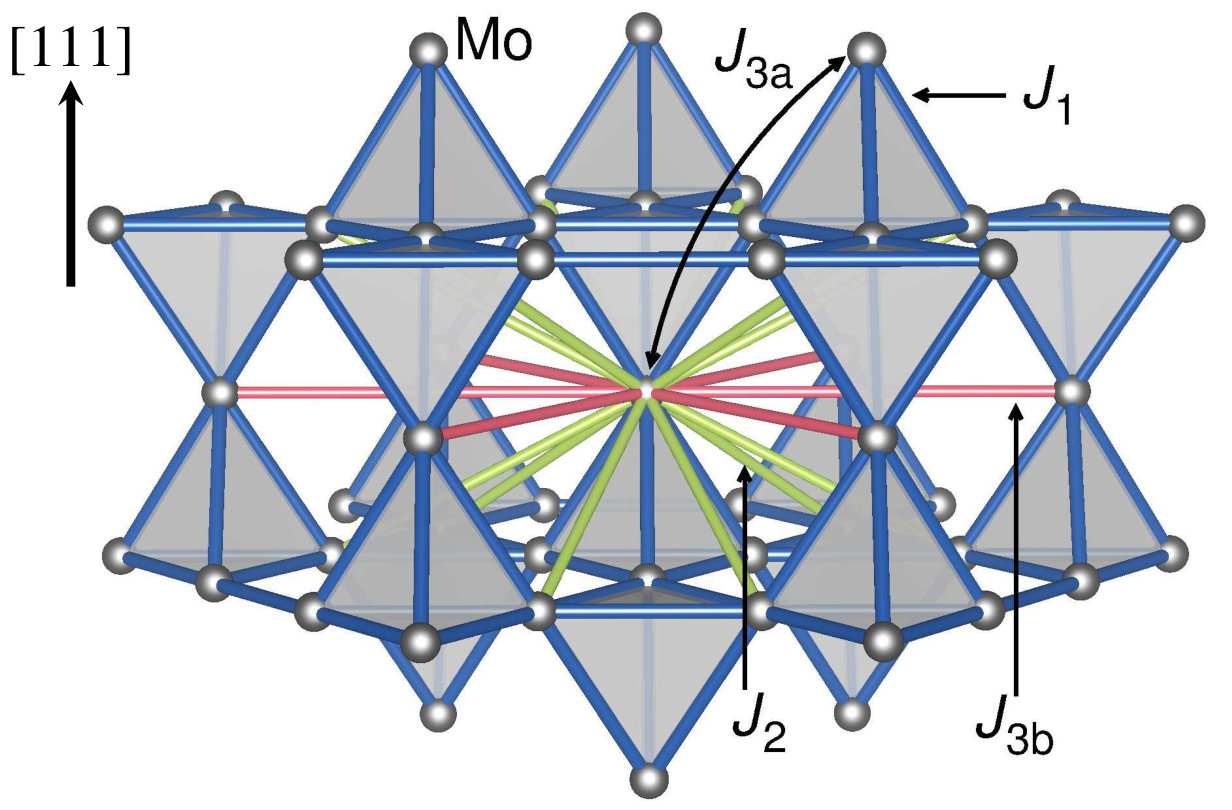 Figure 1
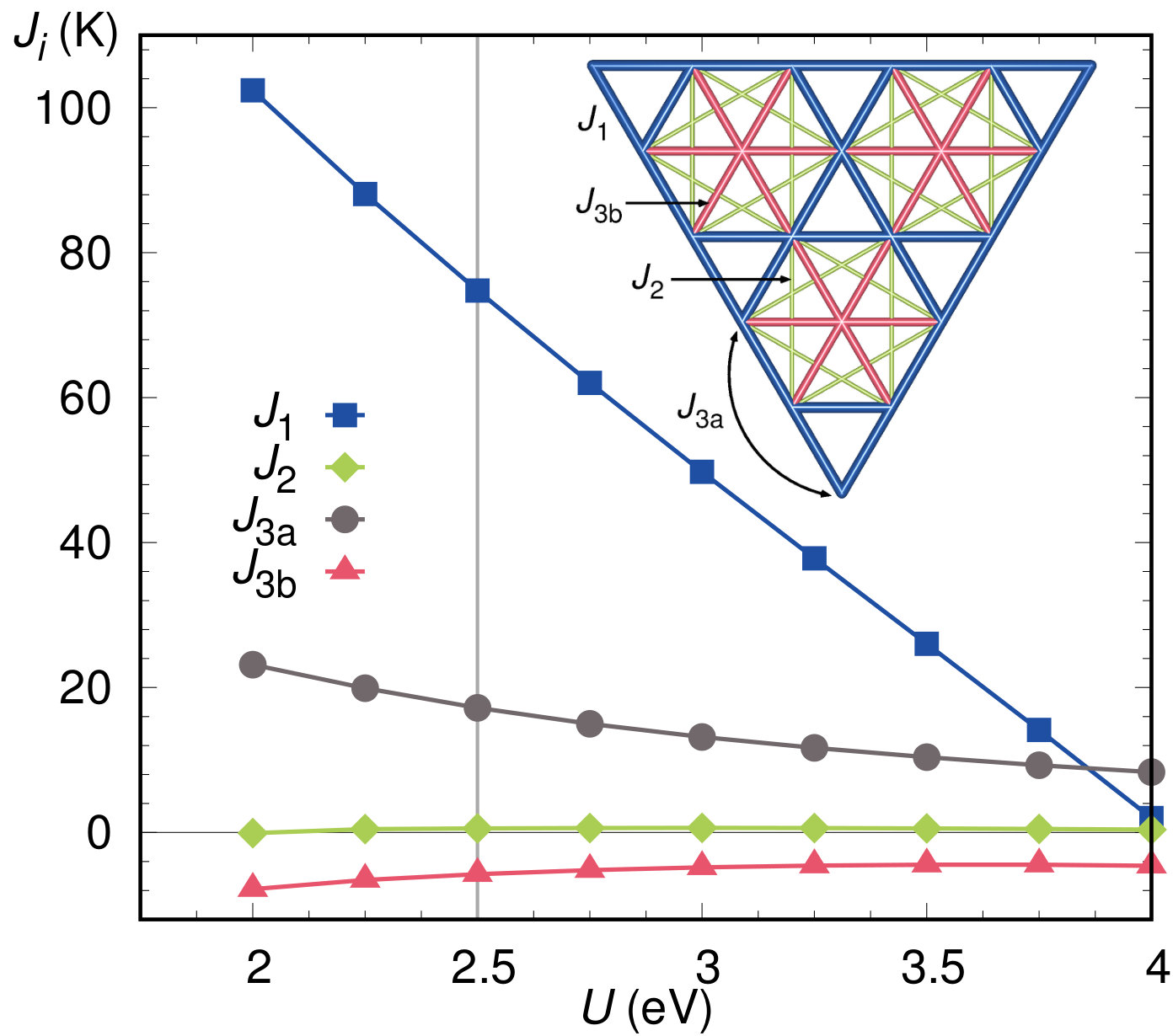 Figure 2
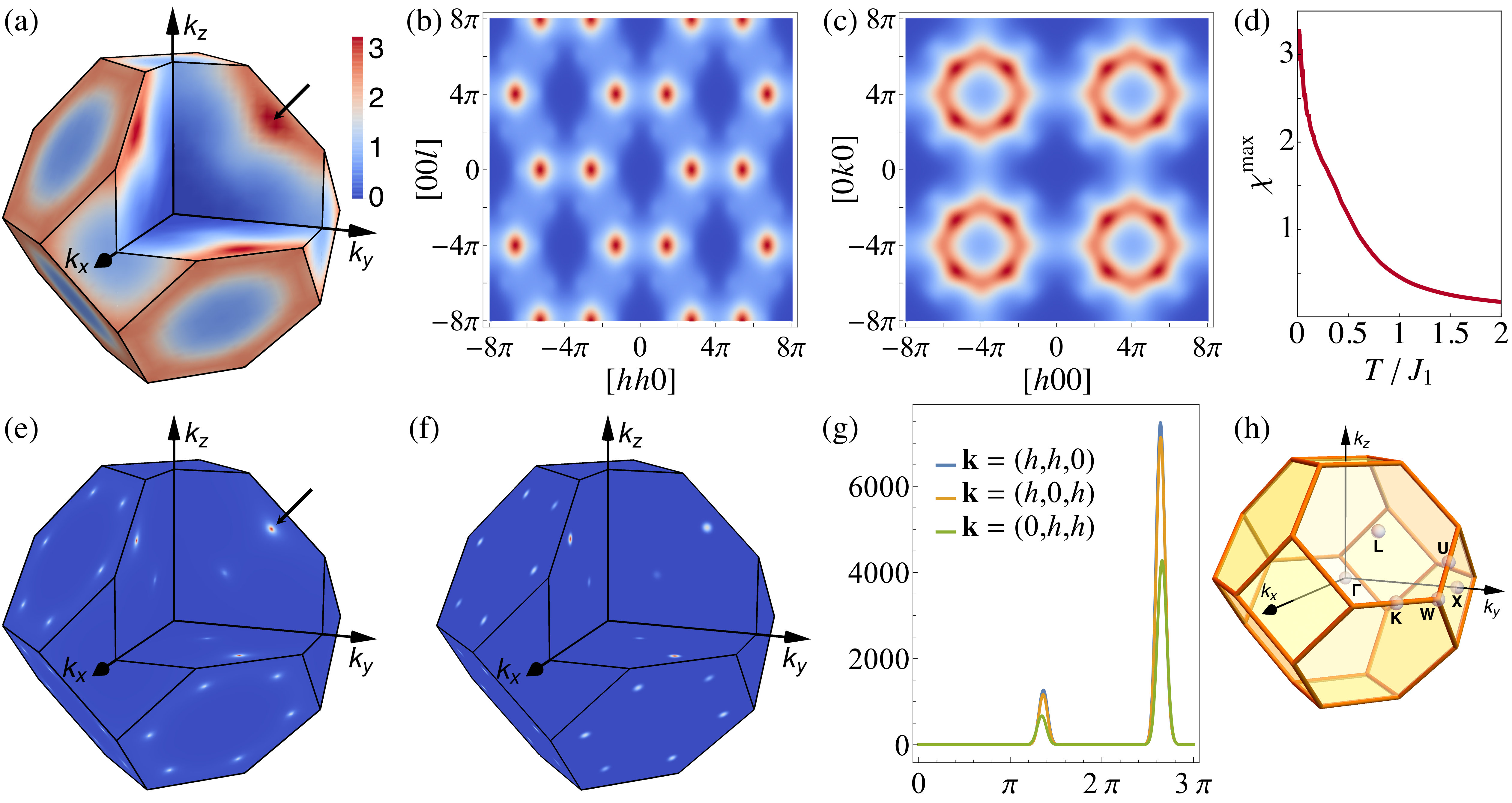 Figure 3
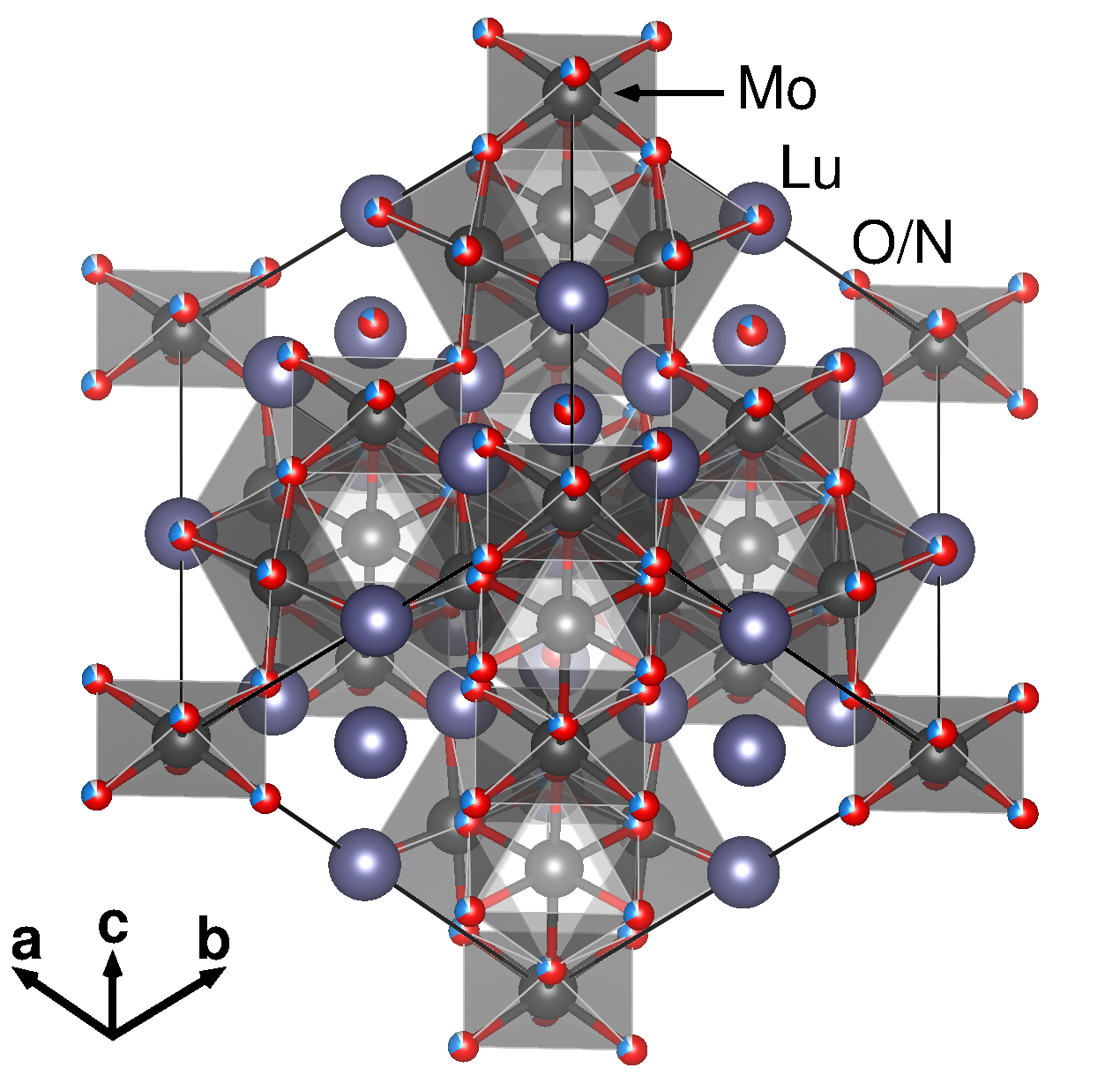 Figure 4
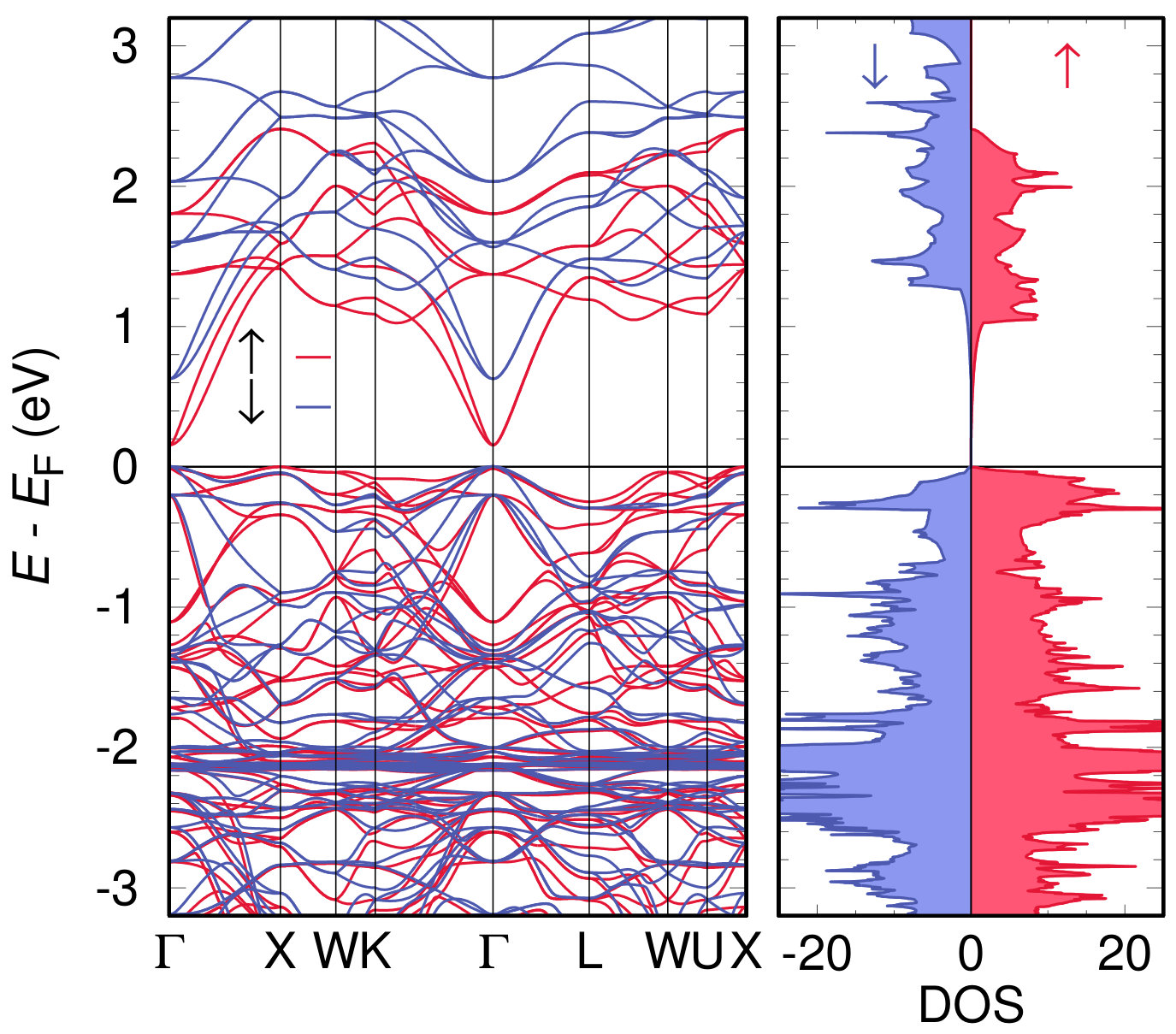 Figure 5
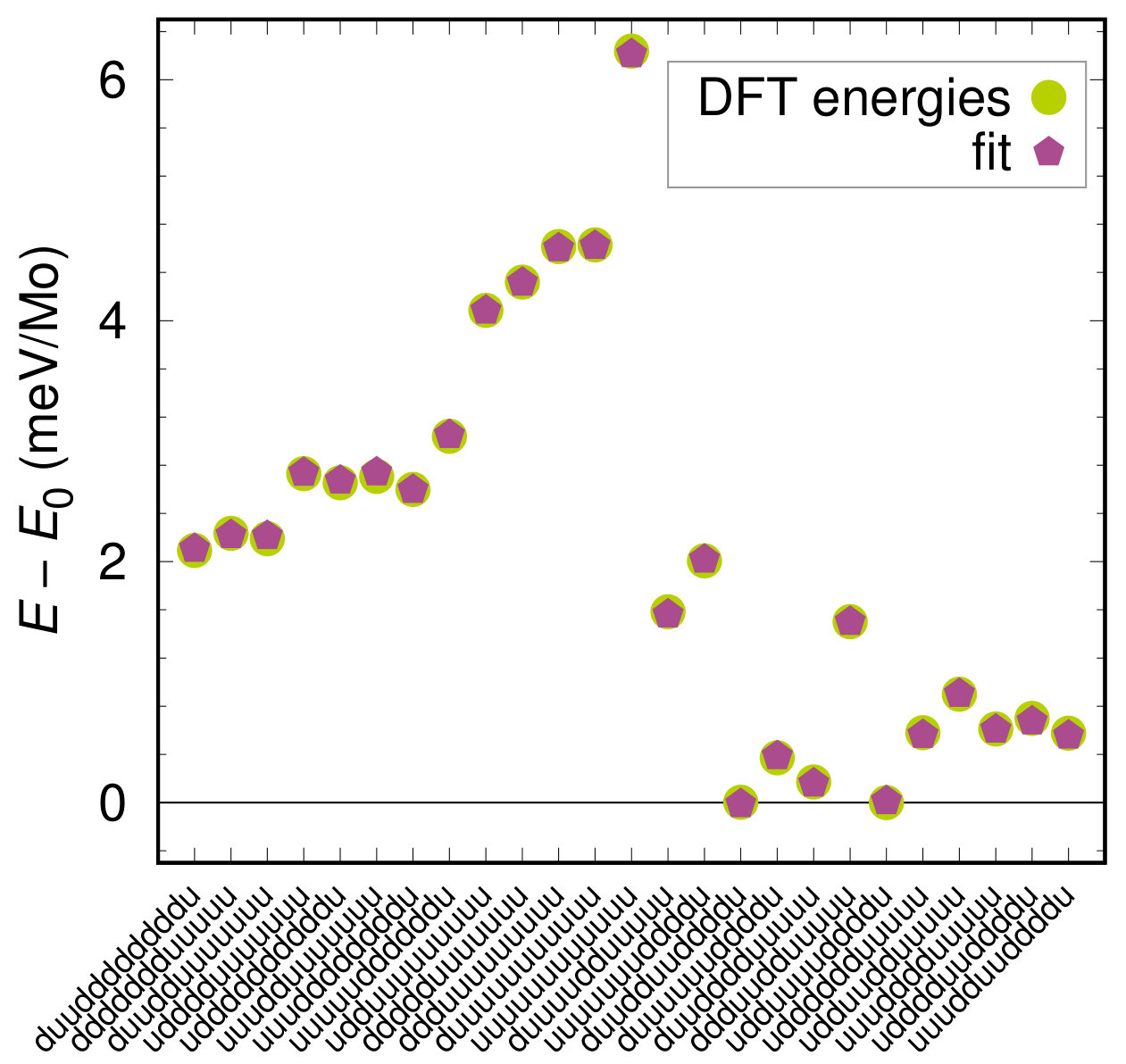 Figure 6
| (eV) | (K) | (K) | (K) | (K) | (K) | (K) |
|---|---|---|---|---|---|---|
| 2 | 102.4(6) | 23.2(5) | ||||
| 2.25 | 88.1(6) | 0.5(4) | 19.9(4) | |||
| 2.75 | 62.0(5) | 0.6(3) | 15.0(4) | |||
| 3 | 49.8(5) | 0.6(4) | 13.2(4) | |||
| 3.25 | 37.8(5) | 0.6(4) | 11.7(4) | |||
| 3.5 | 26.0(6) | 0.6(4) | 10.4(4) | |||
| 3.75 | 14.2(6) | 0.5(5) | 9.3(5) |
Peer Reviews
No public reviews on file for this paper yet. If you reviewed it on a platform where reviews are public (OpenReview, ICLR, NeurIPS, ICML), you can paste yours below so the community can read it here.
Videos
No videos yet. Explain this paper in a talk, walkthrough, or lecture? Add one.
Signatures of a gearwheel quantum spin liquid in a spin- pyrochlore molybdate Heisenberg antiferromagnet
Yasir Iqbal
Department of Physics, Indian Institute of Technology Madras, Chennai, 600036, India
Tobias Müller
Institute for Theoretical Physics and Astrophysics, Julius-Maximilian’s University of Würzburg, Am Hubland, D-97074 Würzburg, Germany
Kira Riedl
Institut für Theoretische Physik, Goethe-Universität Frankfurt, Max-von-Laue-Straße 1, D-60438 Frankfurt am Main, Germany
Johannes Reuther
Dahlem Center for Complex Quantum Systems and Fachbereich Physik, Freie Universität Berlin, D-14195 Berlin, Germany
Helmholtz-Zentrum Berlin für Materialien und Energie, D-14109 Berlin, Germany
Stephan Rachel
School of Physics, The University of Melbourne, Parkville, VIC 3010, Australia
Institut für Theoretische Physik, Technische Universität Dresden, D-01062 Dresden, Germany
Roser Valentí
Institut für Theoretische Physik, Goethe-Universität Frankfurt, Max-von-Laue-Straße 1, D-60438 Frankfurt am Main, Germany
Michel J. P. Gingras
Perimeter Institute for Theoretical Physics, Waterloo, Ontario, Canada N2L 5G7
Department of Physics and Astronomy, University of Waterloo, Waterloo, Ontario, Canada N2L 3G1
Canadian Institute for Advanced Research, 180 Dundas Street West, Toronto, Ontario, Canada M5G 1Z8
Ronny Thomale
Institute for Theoretical Physics and Astrophysics, Julius-Maximilian’s University of Würzburg, Am Hubland, D-97074 Würzburg, Germany
Harald O. Jeschke
Research Institute for Interdisciplinary Science, Okayama University, 3-1-1 Tsushima-naka, Kita-ku, Okayama 700-8530, Japan
Abstract
We theoretically investigate the low-temperature phase of the recently synthesized Lu2Mo2O5N2 material, an extraordinarily rare realization of a three-dimensional pyrochlore Heisenberg antiferromagnet in which Mo5+ are the magnetic species. Despite a Curie-Weiss temperature () of K, experiments have found no signature of magnetic ordering or spin freezing down to K. Using density functional theory, we find that the compound is well described by a Heisenberg model with exchange parameters up to third nearest neighbors. The analysis of this model via the pseudofermion functional renormalization group method reveals paramagnetic behavior down to a temperature of at least , in agreement with the experimental findings hinting at a possible three-dimensional quantum spin liquid. The spin susceptibility profile in reciprocal space shows momentum-dependent features forming a “gearwheel” pattern, characterizing what may be viewed as a molten version of a chiral noncoplanar incommensurate spiral order under the action of quantum fluctuations. Our calculated reciprocal space susceptibility maps provide benchmarks for future neutron scattering experiments on single crystals of Lu2Mo2O5N2.
Introduction. A quantum spin liquid (QSL) is an exotic strongly correlated paramagnetic quantum state of matter Pomeranchuk (1941); Anderson (1973); Fazekas and Anderson (1974) that lacks conventional long-range magnetic order down to absolute zero temperature and is characterized by nontrivial spin entanglement and low-energy fractionalized spin excitations Balents (2010); Savary and Balents (2017); Zhou et al. (2017). One of the ideal settings to explore QSL physics is provided by systems in which the magnetic moments reside on either a two- or three-dimensional network of corner-shared (CS) triangles or tetrahedra and interact with an isotropic nearest-neighbor antiferromagnetic Heisenberg exchange Hamiltonian. The promise of such systems stems, in part, from their low propensity to order even at the classical level Villain (1979); Chalker et al. (1992); Moessner and Chalker (1998). Materials with magnetic species described by an (effective) operator are expected to display the most extreme quantum behaviors, as suggested by numerous theoretical and numerical works spanning over years Harris et al. (1991); Canals and Lacroix (1998); Berg et al. (2003); Huang et al. (2016); Yan et al. (2011); Iqbal et al. (2013); Norman (2016); He et al. (2017); Liao et al. (2017), and are manifestly of significant interest.
While one might legitimately expect that single-ion anisotropy and exchange anisotropy would much undermine the likeliness of a QSL, the proposals that QSL states may be realized in systems described by effective degrees of freedom, but with strongly anisotropic bilinear spin-spin couplings originating from large spin-orbit interactions, are exciting developments in the field. These include “Kitaev” materials Jackeli and Khaliullin (2009); Reuther et al. (2011a); Winter et al. (2016); Hermanns et al. (2018); Trebst (2017); Winter et al. (2017) based on Ir4+ or Ru3+, and “quantum spin ice” (QSI) Molavian et al. (2007); Onoda and Tanaka (2010); Ross et al. (2011); Gingras and McClarty (2014) pyrochlore oxide materials with trivalent rare-earth ions.
In the above Heisenberg antiferromagnets, Kitaev and QSI systems, one has at hand a reference (idealized) Hamiltonian as the model presumed to host a QSL state. The general mindset in the field has been to consider materials whose true Hamiltonian, , may not be “too far” from in terms of all material-relevant perturbations . From a material perspective, the search and discovery of QSL phases thus require some luck so that is sufficiently weak that long-range order is evaded. The experimental investigation of such potential QSL materials requires the synthesis of single crystals which, albeit being at times a daunting challenge, is a necessary one as it allows to expose the nontrivial momentum dispersion of low-energy excitations characterizing QSL states Han et al. (2012); Hao and Tchernyshyov (2013); Punk et al. (2014).
A prime candidate for a QSL phase in two dimensions is the herbertsmithite kagome material where long-range exchange beyond nearest neighbor as well as the Dzyaloshinsky-Moriya (DM) interaction might be subcritical to drive this compound to a magnetic long-range ordered state Mendels et al. (2007); Han et al. (2012); Zorko et al. (2017). Illustrating further the subcritical role of further interactions, one may note the kapellasite kagome compound Fåk et al. (2012); Kermarrec et al. (2014), which is altogether described at “zeroth order” by a complex spin Hamiltonian with numerous competing interactions beyond nearest neighbor, landing it in a parameter space island where a QSL may be realized Bernu et al. (2013); Jeschke et al. (2013); Iqbal et al. (2015). Nevertheless, the number of candidates for QSL behavior in two dimensions is small and the situation for three-dimensional materials is even more disconcerting. The pyrochlore lattice of CS tetrahedra, occurring in pyrochlore oxides and spinel magnetic materials, is an attractive architecture to search for QSLs Harris et al. (1991); Canals and Lacroix (1998); Berg et al. (2003); Nussinov et al. (2007); Banerjee et al. (2008); Shannon et al. (2010); Normand and Nussinov (2014, 2016); Huang et al. (2016). Unfortunately, most materials in these two families either develop long-range magnetic order or display a spin-glass-like freezing at low temperature, hence averting a QSL state. Similarly, Na4Ir3O8 Okamoto et al. (2007), an antiferromagnetic spin- material with a three-dimensional hyperkagome lattice of CS triangles, also exhibits a spin freezing below about 7 K Shockley et al. (2015). The MgTi2O4 spinel has Ti3+ moments, but structurally distorts at low temperature Isobe and Ueda (2002). Finally, most Kitaev materials so far identified display long-range order and the behaviors of the best QSI candidates remain far from being well rationalized Trebst (2017).
One may thus offer an executive summary of the experimental situation, especially for three-dimensional materials: In all cases, the perturbations are above a critical value and preempt the formation of a QSL. At this juncture, a convergence of opportunities, from the point of view of (i) potential QSL material candidates and (ii) an ability to model its and expose its QSL nature with state-of-the-art numerical methods, is required to encourage the significant efforts in the synthesis of pertinent single crystals of three-dimensional QSL candidates. In this context, we propose in this Rapid Communication that Lu2Mo2O5N2 is a candidate much deserving such effort and subsequent investigation.
Lu2Mo2O5N2 is a pyrochlore Heisenberg antiferromagnet with Mo5+ moments that fail to develop long-range order or spin freezing down to K, despite a Curie-Weiss temperature of K Clark et al. (2014). Notwithstanding the appeal of its Heisenberg antiferromagnetic nature, we characterize in this work the leading perturbation of Lu2Mo2O5N2 in the hope of identifying a material with an innocuous such that it does not induce long-range magnetic order.
While the nonmagnetic random site O/N disorder might certainly be worth considering at a later stage, in this Rapid Communication, as a first step in fleshing out the leading physics at play in Lu2Mo2O5N2, we model this material as an effective homogeneous pyrochlore magnet. We apply a combination of (i) density functional theory (DFT) determination of the Hamiltonian parameters where the random O/N occupation is modelled using the virtual crystal approximation Singh et al. (2007), (ii) a pseudofermion functional renormalization group (PFFRG) study of the resulting Heisenberg Hamiltonian, and (iii) an analysis of the multiple- spiral order that is realized for a classical version of the spin model derived from DFT. We establish the nature of the perturbation and find it to be meek at inducing long-range order—likely the one key factor for the failure of this material to freeze or order down to . It is shown that the long-range (third-nearest-neighbor) exchange coupling, in particular, [see Fig. 1 and Eq. (1)], is crucial for defining a minimal material-relevant model Hamiltonian for Lu2Mo2O5N2, as found for chromium spinels Yaresko (2008); Tymoshenko et al. (2017). For the model of Eq. (1) below, the PFFRG shows an absence of magnetic order down to temperatures , in agreement with experiment. A classical analysis Nakamura and Hirashima (2007); Tsuneishi et al. (2007); Conlon and Chalker (2010); Okubo et al. (2011); Lapa and Henley (2012) of this model identifies a noncoplanar triple- incommensurate spiral order as the parent classical state, whose melting by quantum fluctuations, would give a suitable phenomenological frame to describe the observed quantum spin liquid, possibly of chiral nature, and its -dependent spin susceptibility fingerprint.
Results. The minimal model for Lu2Mo2O5N2 extracted from our DFT calculations Jeschke et al. (2011, 2013) is given by a four-parameter isotropic Heisenberg model,
[TABLE]
where is a quantum spin- operator at pyrochlore lattice site . The indices denote sums over nearest-neighbor (second-nearest-neighbor) pairs of sites. There are two inequivalent third-nearest-neighbor sites, the (connecting two Mo5+ sites with a nearest-neighbor Mo5+ ion in between) and (across an empty hexagon in one of the three interpenetrating kagome lattices of the pyrochlore structure) (see Fig. 1). We find that are antiferromagnetic while is ferromagnetic (see Fig. 1). The set of exchange couplings corresponding to eV (see Table S1 sup and Fig. 2) give an estimate of the Curie-Weiss temperature K corresponding to the experimentally determined value of K. The couplings are found to be in units of , with .
The PFFRG Reuther and Wölfle (2010); Reuther and Thomale (2011); Reuther et al. (2011b, a); Metzner et al. (2012); Iqbal et al. (2016a); Buessen and Trebst (2016); Hering and Reuther (2017); Baez and Reuther (2017) calculations (see Ref. sup ) for the model Hamiltonian [Eq. (1)] for Lu2Mo2O5N2 were performed on a cluster of 2315 correlated sites with the longest spin-spin correlator being \sim$$11.5 nearest-neighbor lattice spacings, which ensures an adequate -space resolution. The -space resolved spin susceptibility profile evaluated at the lowest temperature ( K) is shown in Fig. 3(a). At a temperature which is two orders of magnitude smaller compared to , the diffused spectral weight along the edges of the Brillouin zone (with a slight enhancement at the W points) reflects the high degree of frustration in Lu2Mo2O5N2. Interestingly, analogous features in the spectral weight distribution around the boundary are also shared by the highly frustrated spin- kagome Heisenberg antiferromagnet Depenbrock et al. (2012); Iqbal et al. (2013); Suttner et al. (2014). Away from the boundaries, one observes soft maxima [marked by an arrow in Fig. 3(a)] at an incommensurate wave vector (and symmetry-related points). The -dependent features of the susceptibility are best visualized in the plane, i.e., plane [Fig. 3(b)]. Therein, we observe that the spectral weight at the pinch points [ in Fig. 3(b)] is both substantially suppressed and smeared and, instead, redistributes to form hexagonal clusters Yavors’kii et al. (2008), similar to what is observed in ZnCr2O4 Lee et al. (2002). This behavior is a consequence of the nonzero third-nearest-neighbor couplings and in Eq. (1), as has been argued in Ref. Conlon and Chalker (2010) on the basis of a classical analysis. In the plane, i.e., plane [Fig. 3(c)], the characteristic spin susceptibility profile resembles a pattern of “gearwheels” and, following Ref. Okumura et al. (2010), we dub the spin liquid accordingly. The RG flow of the susceptibility tracked at the dominant wave vector is shown in Fig. 3(d) 111The value of changes only minimally with temperature. The RG flows tracked at these different vectors all show paramagnetic behavior., wherein the observed oscillations at small temperature arise due to frequency discretization. Its monotonic increase as without any indication of a divergence points to the absence of a magnetic phase transition, in agreement with experiment Clark et al. (2014). We reach similar conclusions for exchange couplings corresponding to different values of in the range given in Table S1 sup .
In order to identify the classical long-range magnetic order associated with Eq. (1), we use both the PFFRG method, and an iterative energy minimization of the classical Hamiltonian Lapa and Henley (2012). In the limit, the PFFRG flow equations permit an exact analytic solution in the thermodynamic limit and the approach is equivalent to the Luttinger-Tisza method Baez and Reuther (2017). The resulting ground states on non-Bravais lattices are approximate, since only the global constraint , where is the total number of lattice sites, is enforced Nussinov (2001); Kimchi and Vishwanath (2014). We find that under the RG flow, the two-particle vertex for the magnetic ordering (MO) wave vector, [marked by an arrow in Fig. 3(e)] (and symmetry-related points), diverges at a Néel temperature of , denoting the onset of an incommensurate magnetic order. The susceptibility profile evaluated at this ordering temperature is shown in Fig. 3(e). One observes that the susceptibility profile of the model [Fig. 3(a)] may be viewed as a diffuse version of the one for the classical model [Fig. 3(e)]. Under the action of quantum fluctuations, the subdominant Bragg peaks on the hexagonal faces in Fig. 3(e) become diffuse to form a uniform ring in Fig. 3(a), while the dominant Bragg peaks at smear out to form a gearwheel pattern, albeit leaving behind fingerprints [marked by an arrow in Fig. 3(a)]. The whitish “teeth” of the gearwheels seen in Fig. 3(c) can, likewise, be accounted for.
To obtain the exact classical ground state and, in addition, allow for possible lattice symmetry breaking, we perform an iterative classical energy minimization enforcing the constraint at each site Kimchi and Vishwanath (2014). This yields a magnetic state that is a noncoplanar triple- structure composed of a superposition of three different spirals, each governed by an incommensurate wave vector . Moreover, we find that although the total spin per tetrahedron is not zero, the deviation is not energetically significant, being only a few percent of . This implies an approximate equivalence between the antiferromagnetic and ferromagnetic couplings Chern et al. (2008); Lapa and Henley (2012), and accounts for the similarities of the orders found here with those of the - Heisenberg model Nakamura and Hirashima (2007); Tsuneishi et al. (2007); Okubo et al. (2011). The corresponding susceptibility profile is shown in Fig. 3(f), with the dominant Bragg peaks located at (in good agreement with ) (and symmetry-related points). The finite-size effects due to periodic boundary conditions cause Bragg peak splitting, and the results in Figs. 3(f) and 3(g) are shown after performing a Gaussian smoothing over the split peaks. It is important to note that the height of the Bragg peaks in the - and - planes are slightly different, but are roughly twice the height of the peak in the - plane [see Fig. 3(g)]. One may wonder whether the breaking of the cubic symmetry in the classical order could carry over to the case and give rise to a nematic QSL Iqbal et al. (2016b, c).
Interestingly, the spin configuration of our classical magnetic order is chiral, namely, that the effect of a time-reversal operation cannot be undone by a global SO(3) spin rotation. This is precisely the defining characteristic of a chiral spin state Messio et al. (2011) which, accordingly, exhibits a nonvanishing scalar spin chirality ). Indeed, we find that on every tetrahedron, any set of three spins gives a nonzero scalar spin chirality. The prospect of this chiral symmetry breaking carrying over to the QSL phase in the model Kim and Han (2008); Burnell et al. (2009); Hickey et al. (2017) sets the stage for a first realization in an insulator of a chiral spin liquid in three dimensions (see Refs. Machida et al. (2010); Lee et al. (2013) for a metallic context). While we are unable to address this issue within the current implementation of PFFRG sup , an alternative route might be to proceed through a projective symmetry group classification of chiral spin liquids along with a variational Monte Carlo analysis Bieri et al. (2015, 2016).
While our DFT calculations show that Lu2Mo2O5N2 is well approximated by a Heisenberg Hamiltonian, it merely serves as an effective minimal model. Indeed, a DM interaction term Dzyaloshinsky (1958) is also symmetry allowed. The Moriya rules Moriya (1960) constrain this interaction to be one of two types, called “direct” or “indirect” Elhajal et al. (2005); Kotov et al. (2005). Our DFT calculations of the DM term Riedl et al. (2016) find it to be “indirect” and estimate its magnitude to be (for a certain range of values). Within PFFRG, a treatment of the DM interaction for the pyrochlore lattice would be computationally expensive Hering and Reuther (2017). However, a classical optimization calculation at shows that a DM interaction does not significantly alter the nature of the classical state of the pure Heisenberg model (1). Indeed, we are unable to detect any shift in the Bragg peak positions within the available -space resolution, while only a minor redistribution of the spectral weight is observed.
Conclusion. We have shown that Lu2Mo2O5N2 is well described by an “extended” Heisenberg model. Our PFFRG analysis shows that the system remains paramagnetic down to a temperature that is at least two orders of magnitude smaller compared to the Curie-Weiss temperature . The spin susceptibility profile displays momentum-dependent features forming a pattern of gearwheels. These signatures lend support to the view that the supposed quantum spin liquid could be viewed as a molten version of a parent classical magnetic order, which is found to be a noncoplanar incommensurate spiral. Our work provides a theoretical prediction for the characteristic spin susceptibility profile which should ultimately be compared with future neutron scattering experiments on single crystals. We hope that our work motivates further experimental investigations of the potentially very interesting Lu2Mo2O5N2 which may prove to be the first realization of a quantum spin liquid based on a spin- pyrochlore Heisenberg antiferromagnet, as our work here suggests by building on the report of Ref. Clark et al. (2014).
We thank F. Becca, S. Bieri, L. Clark, I. I. Mazin, and J. Rau for useful discussions. The work was supported by the European Research Council through ERC-StG-TOPOLECTRICS-Thomale-336012. Y.I., T.M., and R.T. thank the DFG (Deutsche Forschungsgemeinschaft) for financial support through SFB 1170 (project B04). K.R. and R.V. thank the DFG for financial support through SFB/TR 49. J.R. is supported by the Freie Universität Berlin within the Excellence Initiative of the German Research Foundation. S.R. is supported by the DFG through SFB 1143. The work at the University of Waterloo was supported by the Canada Research Chair program (M.G., Tier 1) and by the Perimeter Institute (PI) for Theoretical Physics. Research at the Perimeter Institute is supported by the Government of Canada through Innovation, Science and Economic Development Canada and by the Province of Ontario through the Ministry of Research, Innovation and Science. We gratefully acknowledge the Gauss Centre for Supercomputing e.V. for funding this project by providing computing time on the GCS Supercomputer SuperMUC at Leibniz Supercomputing Centre (LRZ).
References
- Clark et al. (2014) L. Clark, G. J. Nilsen, E. Kermarrec, G. Ehlers, K. S. Knight, A. Harrison, J. P. Attfield, and B. D. Gaulin, Phys. Rev. Lett. 113, 117201 (2014).
- Bellaiche and Vanderbilt (2000) L. Bellaiche and D. Vanderbilt, Phys. Rev. B 61, 7877 (2000).
- Khomskii (2010) D. I. Khomskii, Basic Aspects of the Quantum Theory of Solids. Order and Elementary Excitations (Cambridge University Press, Cambridge, 2010).
- Koepernik and Eschrig (1999) K. Koepernik and H. Eschrig, Phys. Rev. B 59, 1743 (1999).
- Perdew et al. (1996) J. P. Perdew, K. Burke, and M. Ernzerhof, Phys. Rev. Lett. 77, 3865 (1996).
- Liechtenstein et al. (1995) A. I. Liechtenstein, V. I. Anisimov, and J. Zaanen, Phys. Rev. B 52, R5467 (1995).
- Riedl et al. (2016) K. Riedl, D. Guterding, H. O. Jeschke, M. J. P. Gingras, and R. Valentí, Phys. Rev. B 94, 014410 (2016).
- Reuther and Wölfle (2010) J. Reuther and P. Wölfle, Phys. Rev. B 81, 144410 (2010).
- Reuther and Thomale (2011) J. Reuther and R. Thomale, Phys. Rev. B 83, 024402 (2011).
- Reuther et al. (2011a) J. Reuther, D. A. Abanin, and R. Thomale, Phys. Rev. B 84, 014417 (2011a).
- Reuther et al. (2011b) J. Reuther, P. Wölfle, R. Darradi, W. Brenig, M. Arlego, and J. Richter, Phys. Rev. B 83, 064416 (2011b).
- Reuther et al. (2011c) J. Reuther, R. Thomale, and S. Trebst, Phys. Rev. B 84, 100406 (2011c).
- Reuther et al. (2014) J. Reuther, R. Thomale, and S. Rachel, Phys. Rev. B 90, 100405 (2014).
- Iqbal et al. (2016a) Y. Iqbal, P. Ghosh, R. Narayanan, B. Kumar, J. Reuther, and R. Thomale, Phys. Rev. B 94, 224403 (2016a).
- Hering and Reuther (2017) M. Hering and J. Reuther, Phys. Rev. B 95, 054418 (2017).
- Baez and Reuther (2017) M. L. Baez and J. Reuther, Phys. Rev. B 96, 045144 (2017).
- Metzner et al. (2012) W. Metzner, M. Salmhofer, C. Honerkamp, V. Meden, and K. Schönhammer, Rev. Mod. Phys. 84, 299 (2012).
- Iqbal et al. (2016b) Y. Iqbal, R. Thomale, F. Parisen Toldin, S. Rachel, and J. Reuther, Phys. Rev. B 94, 140408 (2016b).
- Lapa and Henley (2012) M. F. Lapa and C. L. Henley, ArXiv e-prints (2012), arXiv:1210.6810 [cond-mat.str-el] .
- Kimchi and Vishwanath (2014) I. Kimchi and A. Vishwanath, Phys. Rev. B 89, 014414 (2014).
The reference list from the paper itself. Each links out to its DOI / PubMed record.
- 1Pomeranchuk (1941) I. Pomeranchuk, Zh. Eksp. Teor. Fiz. 11 , 226 (1941).
- 2Anderson (1973) P. Anderson, Mater. Res. Bull. 8 , 153 (1973) . · doi ↗
- 3Fazekas and Anderson (1974) P. Fazekas and P. W. Anderson, Philos. Mag. 30 , 423 (1974) . · doi ↗
- 4Balents (2010) L. Balents, Nature (London) 464 , 199 (2010) . · doi ↗
- 5Savary and Balents (2017) L. Savary and L. Balents, Rep. Prog. Phys. 80 , 016502 (2017) . · doi ↗
- 6Zhou et al. (2017) Y. Zhou, K. Kanoda, and T.-K. Ng, Rev. Mod. Phys. 89 , 025003 (2017) . · doi ↗
- 7Villain (1979) J. Villain, Z. Phys. B 33 , 31 (1979) . · doi ↗
- 8Chalker et al. (1992) J. T. Chalker, P. C. W. Holdsworth, and E. F. Shender, Phys. Rev. Lett. 68 , 855 (1992) . · doi ↗