Distinct signals of the gauge-Higgs unification in $e^+e^-$ collider experiments
Shuichiro Funatsu, Hisaki Hatanaka, Yutaka Hosotani, Yuta Orikasa

TL;DR
This paper predicts distinctive signals of gauge-Higgs unification models in future electron-positron collider experiments, focusing on deviations in cross sections and asymmetries caused by Kaluza-Klein $Z'$ bosons.
Contribution
It demonstrates how Kaluza-Klein excitations in gauge-Higgs unification lead to observable deviations in collider cross sections and asymmetries, providing potential experimental signatures.
Findings
Significant deviations in muon pair production cross sections.
Altered forward-backward asymmetry in leptons.
Changes in $R_b$ ratio and left-right asymmetry from SM predictions.
Abstract
Effects of Kaluza-Klein excited neutral vector bosons ( bosons) in the gauge-Higgs unification on cross sections are studied, particularly in future collider experiments with polarized beams. Significant deviations in the energy and polarization dependence in , the lepton forward-backward asymmetry, and the left-right asymmetry from the standard model are predicted.
Click any figure to enlarge with its caption.
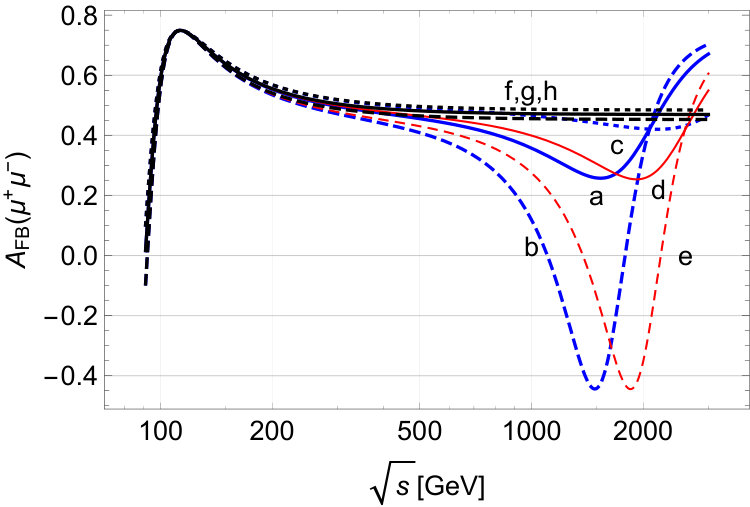 Figure 1
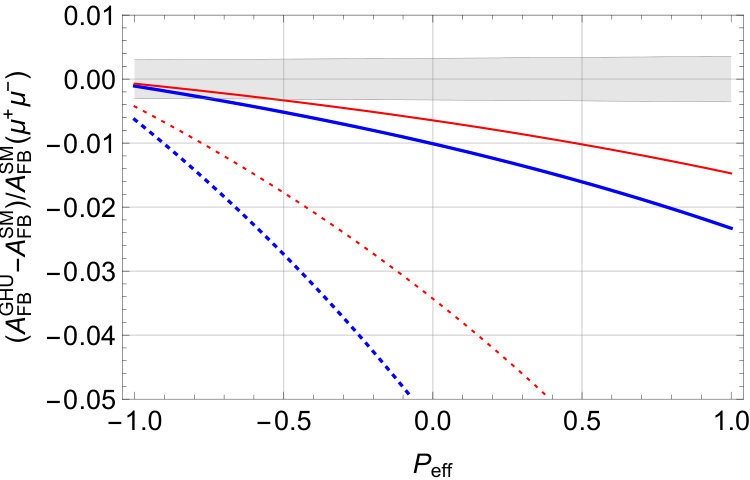 Figure 2
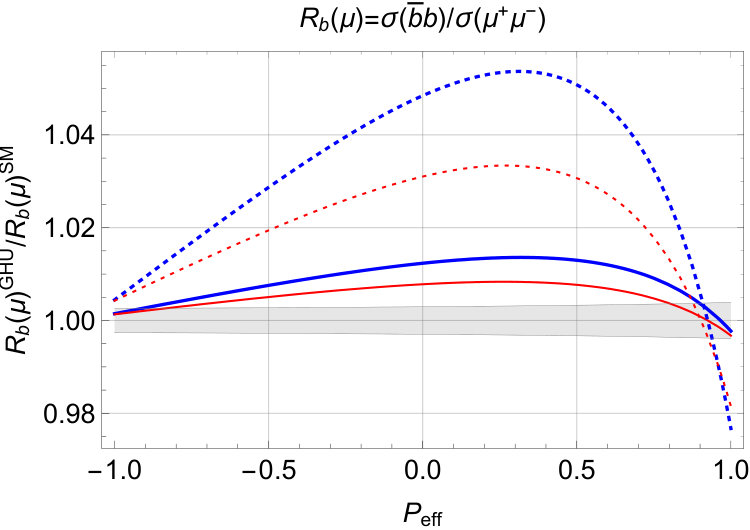 Figure 3
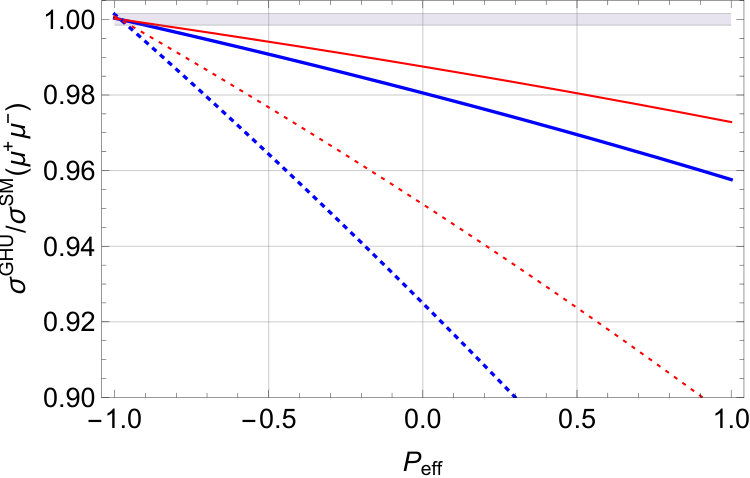 Figure 4
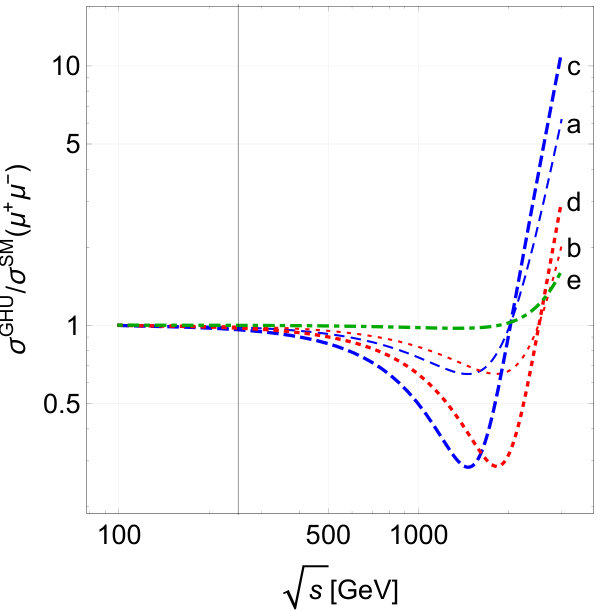 Figure 5
| [rad.] | [TeV] | [TeV] | [GeV] | [TeV] | [GeV] | [TeV] | [GeV] | |
|---|---|---|---|---|---|---|---|---|
| 0 | 0 | 0 | 0 | 0 | 0 | |||
| 0 | 0 | 0 | 0 | 0 | 0 | |||
| 0 | 0 | 0 | 0 | 0 | 0 | |||
| 0 | ||||||||
| 0 | ||||||||
| 0 | ||||||||
| 0 | 0 | 0 | 0 | 0 | 0 | |||
| 0 | 0 | 0 | 0 | 0 | 0 | |||
| 0 | 0 | 0 | 0 | 0 | 0 | |||
| 0 | ||||||||
| 0 | ||||||||
| 0 | ||||||||
| , | SM | GHU | ||
|---|---|---|---|---|
| (uncertainty) | ||||
| () | ||||
| () | ||||
| () | ||||
| () | ||||
| () |
Peer Reviews
No public reviews on file for this paper yet. If you reviewed it on a platform where reviews are public (OpenReview, ICLR, NeurIPS, ICML), you can paste yours below so the community can read it here.
Videos
No videos yet. Explain this paper in a talk, walkthrough, or lecture? Add one.
October 5, 2017 KEK-TH-1978, OU-HET 934
(revised.)
Distinct signals of the gauge-Higgs unification in collider experiments
Shuichiro Funatsu1, Hisaki Hatanaka2, Yutaka Hosotani2 and Yuta Orikasa3
1*KEK Theory Center, KEK, Tsukuba, Ibaraki 305-0801, Japan
2Department of Physics, Osaka University, Toyonaka, Osaka 560-0043, Japan
3Czech Technical University, Prague 12800, Czech Republic
Abstract
Effects of Kaluza-Klein excited neutral vector bosons ( bosons) in the gauge-Higgs unification on cross sections are studied, particularly in future collider experiments with polarized beams. Significant deviations in the energy and polarization dependence in , the lepton forward-backward asymmetry, and the left-right asymmetry from the standard model are predicted.
With the establishment of the standard model (SM) by the discovery of the Higgs boson, searching for physics beyond the SM and understanding the electroweak phase transition have become a few of the main topics in particle physics. Not only large hadron colliders, but also colliders play an important role for this purpose. In this letter we study distinct signals of the gauge-Higgs unification (GHU) [1]-[10] in the future collider experiments.
In GHU the Higgs boson is a part of the extra-dimensional component of the gauge potentials, appearing as a fluctuation mode of an Aharonov-Bohm (AB) phase in the fifth dimension. As a consequence the Higgs couplings , and Yukawa couplings deviate from those in the SM in a universal manner.[11] They are suppressed by a common factor ;
[TABLE]
For , probable values in the model, the deviation of the couplings amounts to , and is small. At the ILC at , the coupling can be measured in the accuracy with data [12]. Another prominent feature of the model is that the first Kaluza-Klein (KK) excited states of the neutral gauge bosons, , have large couplings to right-handed components of quarks and leptons, viable signals of which can be seen in hadron collider experiments [8, 10].
The main purpose of this letter is to check the effect of such bosons using lepton collider experiments in the past and future. We first examine the GHU model with precision measurements in LEP1 experiment at , and LEP2 experiments for . Then we predict several signals of bosons in GHU in collider experiments designed for future with collision energy with polarized electron and positron beams.
The GHU model we consider is the gauge theory in the Randall-Sundrum warped space with metric () where is the curvature. The warp factor is large (). symmetry is broken to by the orbifold boundary conditions at and . The part of the gauge fields, (), plays the role of the Higgs field in the SM. symmetry is spontaneously broken to by a brane-localized scalar field at . Finally the symmetry is dynamically broken to by the Hosotani mechanism.
5D fields are expanded in KK series. In particular, there are four KK towers of the neutral vector bosons, , , and (, ) where and correspond to the photon and boson, respectively. These fields except for couple to the SM fields and can be observed as neutral vector bosons.
In addition to the quark-lepton multiplets in the vector representation of , dark fermions in the spinor representation are introduced. As a consequence the electroweak symmetry breaking is achieved at the one loop level. The Higgs boson, which is massless at the tree level, acquires a finite mass , independent of the cutoff scale. The gauge hierarchy problem is thus solved.[2]
There remain two free parameters, and . Given and , the effective potential is fixed. From the location of the minimum of , the value is determined. There is the property called the universality such that many of the physical quantities are determined by , but do not depend on and independently. In the following we take and parameterize the model by .
We note that some of the composite Higgs models (CHM) have similar features to those in the GHU. In particular, CHM based on gauge group has almost the same gauge structure as the GHU [4, 13]. The gauge invariance is reduced to by orbifold boundary conditions in both cases. However, there are many differences between the two. The 4D Higgs boson in GHU is a fluctuation mode of the AB phase in the fifth dimension, but is not a pseudo-Nambu-Goldstone boson supposed in CHM. Secondly, in most of the CHM, -breaking boundary conditions are imposed on fermion fields by hand to obtain the quark-lepton spectrum. In the GHU theory based on the action principle the gauge invariance in the bulk and the gauge invariance on the UV and IR branes are strictly preserved. GHU is more restrictive than CHM, and is powerful to make predictions.
In GHU the relevant parameter for physics of SM particles is . With given, the KK spectra of various fields, the couplings of quarks and leptons to KK gauge bosons, and the Higgs couplings are all determined. The Higgs boson mass GeV and TeV are naturally realized for without fine-tuning of the parameters. It has been shown that corrections to due to an infinite number of KK states of , et al. running in the loop are finite and tiny for . It has been recognized that the GHU in the RS space gives nearly the same phenomenology at low energies as the SM for .
The phase in GHU corresponds to the vacuum misalignment angle in CHM. A bound has been derived in CHM from the parameter constraint.[13, 14] In GHU much stronger constraint is obtained from the current non-observation of signals at LHC. It should be stressed in this connection that in GHU in the RS space right-handed quarks and leptons and KK gauge bosons are localized near the IR brane whereas left-handed quarks and leptons are localized near the UV brane so that right-handed quarks and leptons have larger couplings to KK gauge bosons than left-handed quarks and leptons.
Masses and widths of bosons are tabulated in Table 1. Fermion couplings to for , and are given in Tables 2, 3 and 4, respectively. In the evaluation and are adopted. The couplings of quarks and leptons except for top quark are almost the same as in the SM within the accuracy of one part in . The deviation of the couplings are less than 1%, whereas the deviation of the couplings are very tiny in GHU.
We evaluate cross sections where is a lepton or quark. In addition to leptonic and hadronic cross sections, forward-backward asymmetry defined by
[TABLE]
the ratio of hadronic and leptonic cross sections , and the asymmetry of with right- and left-handed polarized electron beams are investigated.111In the numerical evaluation in this letter we have used the values of the various couplings obtained for GeV. With GeV the value of , for instance, decreases by 1.3 %.
Cross sections are evaluated to the leading order, which may receive quantum corrections. Such corrections are parametrised as where and are factorizable QCD and QED corrections, whereas denotes non-factorizable corrections. In this paper we assume that and for both GHU and SM are small. We have taken only the first KK states into account. The second KK states are approximately twice as heavy as the first KK states. The magnitudes of couplings of the second KK states are at most a half of the couplings of the first KK states. Thus the contributions of the second KK states are expected to be small.
In the LEP1 experiment [15] at the -pole () the measured and fitted values of cross sections, forward-backward asymmetries of charged leptons , (, ) and are given by
[TABLE]
where , , , and . In GHU, we obtain
[TABLE]
for , and , respectively. For , cross section is dominated by the boson resonance and effects of are very small. -boson couplings are very close to the SM value so that the deviation of the cross sections from the SM is very tiny. No significant deviations are seen. In LEP1, the measured value deviates from the fit value at nearly level. In GHU, is close to the SM value.
In the LEP2 experiment, cross sections of , and for twelve different collision energies () were measured. For the energy , is much larger than the cross sections for lepton final states. The average of is [16]. In GHU, we obtain , and at , and , and at for , and , respectively. Using the ratios we perform the -test for the . When , the -value is . In GHU (), (-value is ) [ (-value is )], [ (26%)] and [ (37%)] for with 12-bin [7-bin] fit for , and , respectively. Here in the 7-bin fit we have chosen seven largest energies (). In the fit, correlations among the data are taken into account. GHU is within the allowed range of the experimental uncertainty.
Recently at LHC with fb*-1* -collision data invariant mass distribution has been obtained[17]. The number of observed events and the expected number of the Drell-Yang process in the SM are and for , respectively. In GHU with , and the expected numbers of events are , and for [10], respectively.222In the ratio the K-factors in numerators and denominators are cancelled. For the GHU prediction deviates from the SM value (the observed number of events) at 1.8-sigma (2.4-sigma) level. In [10], we have evaluated the expected number of events of Drell-Yang process with . For LHC data, we predict for the excess of Drell-Yang events as = , , and for bins [2000, 3000], [3000, 4000], [4000,5000] and [5000, 6000], respectively.
At LEP2, experimental values of , and have rather large statistical errors and no significant deviations of the ratios and from the experimental data for these modes are seen.
The LHC results put the limit on GHU. To explore GHU one has to go to future colliders at higher energies, with [14, 18, 19, 20, 21]. Although with such energy s cannot be directory produced, the effects of interference among , and s can be seen. Furthermore, polarized electron and/or positron beams can be produced at future colliders. Since right-handed fermions have larger couplings to s in GHU, right-handed polarized electron beam will be sensitive to the s effects.
Following Ref. [22] we define the longitudinal polarization () so that the electron [positron] is purely right-handed when []. When the vector bosons dominate in the mediators, the cross section at the center-of-mass frame is given by
[TABLE]
where () is scattering cross section. Hereafter we consider , and . Although these quantities depend on both and , the dependence is parameterized by one effective polarization . When is given by (13), is satisfied so that one finds that where , , . As typical values one finds for . In the following study we parameterize the polarization in terms of instead of .
At with unpolarized beam (with polarized beam with ), (). In Figure 1, the relative cross section is plotted as a function of at and . At GeV, in GHU is smaller than the SM value by [] for [] when . At GeV with polarization , [] decrease of due to the interference will be observed. At with unpolarized beam, we expect events in the SM. In GHU the expected number of events and statistical significance are estimated to be [] and [] for [].
Systematic errors in the normalization of the cross sections can be reduced by measuring
[TABLE]
where the electron beams are polarized with and . We note that the left-right asymmetry is related to by . In Table 5, the effects of GHU on the are tabulated. GHU predicts a significant deficit in in the early stage of the ILC experiment.
In Figure 2, up to is displayed. For large deficit is expected for right-handed electron (and/or left-handed positron) beams. We have also plotted the case (“e” in the figure) with , namely the case with left-handed electron (and/or right-handed positron) beams. In this case, the interference effect of s is hardly seen for . In all cases the ratios grow for up to the large resonances.
Forward-backward asymmetry (FBA) in the SM at is () for (). In Figure 3, deviations of from the SM values are plotted as functions of . At and for , deviates by () from the SM for (). At and , deviates by () for (). Signals of GHU will be seen at [] level at with unpolarized [polarized] beams.
In Figure 4, is displayed up to . At , the effect of the interference among , and becomes maximum. In particular for right-handed polarized electron beams very large deviation from the SM is expected.
One can also measure , . They are tabulated in Table. 6. We note that and become larger than those in the SM, in quite contrast with the case.
The effect of the differences in the couplings of to leptons and quarks can be seen in the ratio of the cross sections .333The scattering process contains not only the process mediated by neutral vector bosons, but also the -fusion process followed by . We have assumed that these processes are efficiently separated and we consider only the vector-boson mediated process. In the SM with unpolarized beams, , and for , and , respectively. In Figure 5, deviations of from the SM value are plotted as functions of . The excess in becomes maximum for . At , [] excess for unpolarized beams and [] excess for polarized beams for [] are expected. In GHU with , deviation is expected with data. At , [3.3%] excess is expected for polarized beams. In Table. 7, deviation of from is tabulated. The deviation becomes largest around .
In this letter we have studied the effects of the bosons in GHU in the collider experiments. At the pole (), the effects of the bosons are small and both cross sections and lepton forward-backward asymmetries are consistent with the experiments. At the energies , cross sections and forward-backward asymmetry in GHU are found to be consistent with the LEP2 results. Recent LHC results put the limit in GHU. Large deviations from the SM in , , and are predicted at higher energies. In the future collider experiments, measurements of , , and with polarized beams will well discriminate GHU from the SM. In particular, measurement, even with unpolarized beams, can discriminate the GHU with at 11 (8) times of the statistical uncertainty level at with data. In the left-right asymmetry , for which systematic uncertainty is reduced, signals of GHU can be observed at 8 (5) times of the statistical uncertainty level . The characteristic dependence of and on the electron-positron polarization can also be used to study the couplings of the bosons to quarks and leptons as well.
The gauge-Higgs unification is promising. It predicts many signals in collider experiments. The left-right asymmetry will exhibit a distinct deviation from the SM in the early stage of 250 GeV ILC with polarized beams. At 1 TeV ILC or CLIC, clear signals of GHU will be seen in the forward-backward asymmetry .
Acknowledgments
The authors would like to thank M. Tanaka and S. Kanemura for valuable comments. This work was supported in part by the Japan Society for the Promotion of Science, Grants-in-Aid for Scientific Research No 15K05052 (HH and YH).
References
The reference list from the paper itself. Each links out to its DOI / PubMed record.
- 1[1] Y. Hosotani, “Dynamical Mass Generation by Compact Extra Dimensions”, Phys. Lett. 126B , 309 (1983); “Dynamics of Nonintegrable Phases and Gauge Symmetry Breaking”, Ann. Phys. 190 , 233 (1989).
- 2[2] H. Hatanaka, T. Inami and C. S. Lim, “The Gauge hierarchy problem and higher dimensional gauge theories”, Mod. Phys. Lett. A 13 , 2601 (1998).
- 3[3] H. Hatanaka, “Matter representations and gauge symmetry breaking via compactified space”, Prog. Theor. Phys. 102 , 407 (1999).
- 4[4] K. Agashe, R. Contino and A. Pomarol, “The Minimal Composite Higgs Model”, Nucl. Phys. B 719 , 165 (2005).
- 5[5] Y. Hosotani, K. Oda, T. Ohnuma and Y. Sakamura, “Dynamical Electroweak Symmetry Breaking in S O ( 5 ) × U ( 1 ) 𝑆 𝑂 5 𝑈 1 SO(5)\times U(1) Gauge-Higgs Unification with Top and Bottom Quarks”, Phys. Rev. D 78 , 096002 (2008); Erratum ibid. D 79 , 079902 (2009).
- 6[6] Y. Hosotani, M. Tanaka, and N. Uekusa, “Collider signatures of the S O ( 5 ) × U ( 1 ) 𝑆 𝑂 5 𝑈 1 SO(5)\times U(1) gauge-Higgs unification”, Phys. Rev. D 84 , 075014 (2011).
- 7[7] S. Funatsu, H. Hatanaka, Y. Hosotani, Y. Orikasa and T. Shimotani, “Novel universality and Higgs decay H → γ γ → absent 𝛾 𝛾 \to\gamma\gamma , gg in the SO(5) × \times U(1) gauge-Higgs unification”, Phys. Lett. B 722 , 94 (2013).
- 8[8] S. Funatsu, H. Hatanaka, Y. Hosotani, Y. Orikasa and T. Shimotani, “LHC signals of the S O ( 5 ) × U ( 1 ) 𝑆 𝑂 5 𝑈 1 SO(5)\times U(1) gauge-Higgs unification”, Phys. Rev. D 89 , 095019 (2014).