Reflection positivity and spectral theory
Palle Jorgensen, Feng Tian

TL;DR
This paper explores the spectral theory of reflection positivity in quantum physics, analyzing geometric and probabilistic properties, and establishing new theorems relating the Markov property to reflection positivity.
Contribution
It provides a detailed comparison of spectral properties in reflection-positive Hilbert spaces and introduces two new theorems linking the Markov property to reflection positivity.
Findings
OS-positivity can be expressed via projections and reflection operators
The Markov property implies reflection positivity, but not vice versa
Operators associated with OS-positive systems have canonical factorizations
Abstract
We consider reflection-positivity (Osterwalder-Schrader positivity, O.S.-p.) as it is used in the study of renormalization questions in physics. In concrete cases, this refers to specific Hilbert spaces that arise before and after the reflection. Our focus is a comparative study of the associated spectral theory, now referring to the canonical operators in these two Hilbert spaces. Indeed, the inner product which produces the respective Hilbert spaces of quantum states changes, and comparisons are subtle. We analyze in detail a number of geometric and spectral theoretic properties connected with axiomatic reflection positivity, as well as their probabilistic counterparts; especially the role of the Markov property. This view also suggests two new theorems, which we prove. In rough outline: It is possible to express OS-positivity purely in terms of a triple of projections in a fixed…
Click any figure to enlarge with its caption.
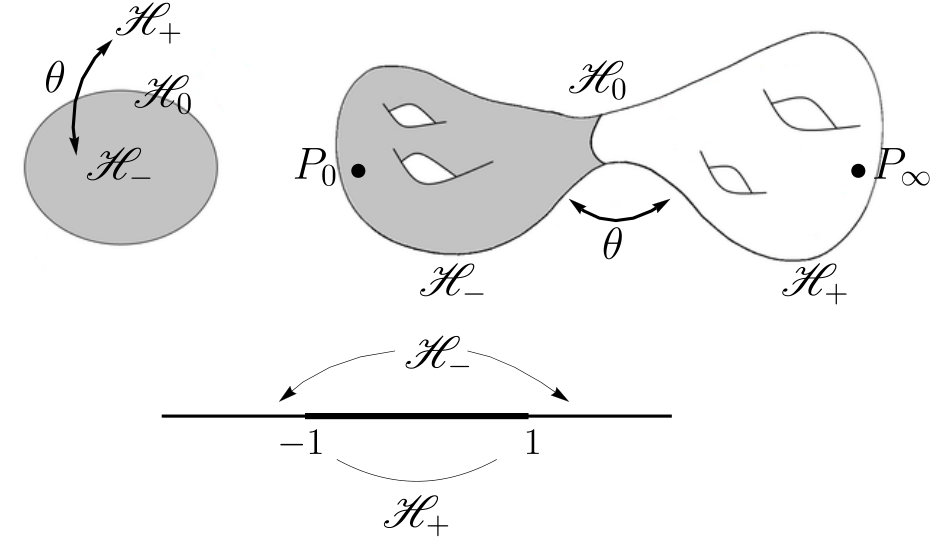 Figure 1
Peer Reviews
No public reviews on file for this paper yet. If you reviewed it on a platform where reviews are public (OpenReview, ICLR, NeurIPS, ICML), you can paste yours below so the community can read it here.
Videos
No videos yet. Explain this paper in a talk, walkthrough, or lecture? Add one.
Taxonomy
TopicsSpectral Theory in Mathematical Physics · Advanced Operator Algebra Research · Advanced Topics in Algebra
\RS@ifundefined
subsecref \newrefsubsecname = \RSsectxt
\RS@ifundefinedthmref \newrefthmname = theorem
\RS@ifundefinedlemref \newreflemname = lemma
\newreflemrefcmd=Lemma LABEL:#1 \newrefthmrefcmd=Theorem LABEL:#1 \newrefcorrefcmd=Corollary LABEL:#1 \newrefsecrefcmd=Section LABEL:#1 \newrefsubrefcmd=Section LABEL:#1 \newrefsubsecrefcmd=Section LABEL:#1 \newrefchaprefcmd=Chapter LABEL:#1 \newrefproprefcmd=Proposition LABEL:#1 \newrefexarefcmd=Example LABEL:#1 \newreftabrefcmd=Table LABEL:#1 \newrefremrefcmd=Remark LABEL:#1 \newrefdefrefcmd=Definition LABEL:#1 \newreffigrefcmd=Figure LABEL:#1
Reflection positivity and spectral theory
Palle Jorgensen and Feng Tian
(Palle E.T. Jorgensen) Department of Mathematics, The University of Iowa, Iowa City, IA 52242-1419, U.S.A.
[email protected] http://www.math.uiowa.edu/~jorgen/ (Feng Tian) Department of Mathematics, Hampton University, Hampton, VA 23668, U.S.A.
Abstract.
We consider reflection-positivity (Osterwalder-Schrader positivity, O.S.-p.) as it is used in the study of renormalization questions in physics. In concrete cases, this refers to specific Hilbert spaces that arise before and after the reflection. Our focus is a comparative study of the associated spectral theory, now referring to the canonical operators in these two Hilbert spaces. Indeed, the inner product which produces the respective Hilbert spaces of quantum states changes, and comparisons are subtle.
We analyze in detail a number of geometric and spectral theoretic properties connected with axiomatic reflection positivity, as well as their probabilistic counterparts; especially the role of the Markov property. This view also suggests two new theorems, which we prove. In rough outline: It is possible to express OS-positivity purely in terms of a triple of projections in a fixed Hilbert space, and a reflection operator. For such three projections, there is a related property, often referred to as the Markov property; and it is well known that the latter implies the former; i.e., when the reflection is given, then the Markov property implies O.S.-p., but not conversely. In this paper we shall prove two theorems which flesh out a much more precise relationship between the two. We show that for every OS-positive system , the operator has a canonical and universal factorization.
Our second focus is a structure theory for all admissible reflections. Our theorems here are motivated by Phillips’ theory of dissipative extensions of unbounded operators. The word “Markov” traditionally makes reference to a random walk process where the Markov property in turn refers to past and future: Expectation of the future, conditioned by the past. By contrast, our present initial definitions only make reference to three prescribed projection operators, and associated reflections. Initially, there is not even mention of an underlying probability space. This in fact only comes later.
Key words and phrases:
Osterwalder-Schrader positivity, renormalization, factorization, Hilbert space, reflection symmetry, quantum field theory, extensions of dissipative operators, Gaussian processes, random processes, random fields, Markov property.
2000 Mathematics Subject Classification:
Primary 47L60, 46N30, 81S25, 81R15, 81T05, 81T75; Secondary 60D05, 60G15, 60J25, 65R10, 58J65.
Contents
-
3 New Hilbert space from reflection positivity (renormalization)
-
5 A characterization of the Markov property: Markov vs O.-S. positivity
1. Introduction
The notion “reflection-positivity” came up first in a renormalization question in physics: “How to realize observables in relativistic quantum field theory (RQFT)?” This is part of the bigger picture of quantum field theory (QFT); and it is based on a certain analytic continuation (or reflection) of the Wightman distributions (from the Wightman axioms). In this analytic continuation, Osterwalder-Schrader (OS) axioms induce Euclidean random fields; and Euclidean covariance. (See, e.g., [OS73, OS75, GJ79, GJ87, Jor02, JP13, JJ17, JL17].) For the unitary representations of the respective symmetry groups, we therefore change these groups as well: OS-reflection applied to the Poincaré group of relativistic fields yields the Euclidean group as its reflection. The starting point of the OS-approach to QFT is a certain positivity condition called “reflection positivity.”
Now, when it is carried out in concrete cases, the initial function spaces change; but, more importantly, the inner product which produces the respective Hilbert spaces of quantum states changes as well. What is especially intriguing is that, before reflection we may have a Hilbert space of functions, but after the time-reflection is turned on, then, in the new inner product, the corresponding completion, magically becomes a Hilbert space of distributions.
The motivating example here is derived from a certain version of the Segal–Bargmann transform (see 4.2). For more detail on the background and the applications, we refer to two previous joint papers [JO98] and [JO00], as well as [Kle77, Kle78, KLS82, Jor86, Jor87, Nee94, Hal00, AJP07, JT17].
Our present purpose is to analyze in detail a number of geometric properties connected with the axioms of reflection positivity, as well as their probabilistic counterparts; especially the role of the Markov property. This view also suggests two new theorems, to follow in the rest of the paper.
In rough outline: It is possible to express Osterwalder-Schrader positivity (O.S.-p.) purely in terms of a triple of projections in a fixed Hilbert space, and a reflection operator. For such three projections, there is a related property, often referred to as the Markov property. It is well known that the latter implies the former; i.e., when the reflection is given, then the Markov property implies O.S.-p., but not conversely.
In this paper we shall prove two theorems which flesh out a much more precise relationship between the two. The word “Markov” traditionally makes reference to a random walk process where the Markov property in turn refers to past and future: Expectation of the future, conditioned by the past (details below). By contrast, our present initial definitions only make reference to three prescribed projection operators. Initially, there is not even mention of an underlying probability space. All this comes later. Now if we are in the context of a random walk process, then such a process may or may not have the Markov property; which is now instead defined relative to notions of past, present, and future, and the associated conditional expectations.
While our discussion of the Markov property is couched here in an axiomatic framework; and is motivated by our particular aims, we stress that Markov properties, Markov processes, and Markov fields form an active and very diverse area. While there are links from those directions to our present results, the connections are not always direct. For the readers benefit we have included the following citations [Nel58, Nel73a, Nel73b, Nel75, BDS16, KA17, LR17] on Markov/random fields.
In order to make our paper accessible to non-specialists, we have chosen to begin by recalling the fundamentals in the subject. This choice in turn helps us outline the general framework in the form we need it for what is to follow.
2. The geometry of reflections and positivity
Let be a given Hilbert space, and let be two unitary operators, such that:
[TABLE]
Note that (2.1) states that has spectrum equal to the two point set . We think of (2.2) as a reflection symmetry for the given operator . In this case, (2.2) states that is unitarily equivalent to its adjoint , and so and its adjoint have the same spectrum, but, except for trivial cases, is not selfadjoint.
We further assume that there exists a closed subspace s.t.
[TABLE]
[TABLE]
If is the projection onto , then (2.4) is equivalent to
[TABLE]
with respect to the usual ordering of operators (see 2.5).
Remark 2.1*.*
In our discussion of (2.2)-(2.3), we state things in the simple case of just a single unitary operator , but our conclusions will apply mutatis mutandis also to the case when U is instead a strongly continuous unitary representation of a suitable non-commutative Lie group (see 7 and the papers cited there). In the Lie group case, there is a distinguished one-parameter subgroup of corresponding to a choice of time-direction. Hence the corresponding restriction will be a unitary one-parameter group, and the forward direction will be the positive half-line , viewed as a sub-semigroup. If is a Lie group, we shall also be concerned with sub-semigroups. Condition (2.3) will refer to invariance of under this sub-semigroup. In all these cases, we shall simply refer to with regards to (2.2)-(2.3), even if it is not a single unitary operator. In case of a single unitary operator , of course by iteration we will automatically have a representation of the group of integers, and in this case the sub-semigroup will be understood to be .
Note on terminology. Given a fixed Hilbert space , we shall make use of the following identification between projections in , on the one hand, and the corresponding closed subspaces on the other. By projection , we mean an operator in satisfying . Conversely, if is a fixed closed subspace, then by general theory, we know that there is then a unique projection, say , such that .
In some of our discussions below, there will be more than one Hilbert space, say and ; and they may arise inside calculations. In those cases, it will be convenient to mark the inner products and norms with subscripts, , etc.
In the discussion of reflection positivity, there will typically be three projections , at the outset, and the corresponding closed subspaces will be denoted, , .
We shall denote such a system of projections by . If a reflection (see (2.1)) maps to (plus minus parity), we say that . If also (2.2) and (2.3) hold, we shall say that . (See 5 and 5.4.)
2.1. Definitions and Lemmas
In our study of reflections, and reflection positivity, we shall need a number of fundamental concepts from the theory of operators in Hilbert space. While they are in the literature, they are not collected in a single reference. For readers not in operator theory, we include below those basic facts in the form they will be needed inside the paper. A new feature is the notion of signed quadratic forms and subspaces which are positive with respect to such a given signed quadratic form; see 2.7.
Definition 2.2**.**
When , , and satisfy these conditions, i.e., (2.1)-(2.5), we then say that Osterwalder-Schrader reflection positivity holds, abbreviated O.S.P.
Below we discuss the standard ordering of projections. What will be important is that this ordering may be stated in terms of anyone of six equivalent properties. Each one will be relevant for the applications to follow; to geometry, to spectral theory, and to analysis of conditional expectations. For the latter, see e.g., 5.10, and 7.1.
Definition 2.3** (Order on projections).**
- (i)
A projection in a Hilbert space is an operator satisfying . 2. (ii)
If and are two projections, we say that iff (Def.) one of the following equivalent conditions holds:
- (a)
; 2. (b)
, ; 3. (c)
, ; 4. (d)
; 5. (e)
; 6. (f)
for vectors , the following implication holds: .
Proof.
This is standard operator theory, and can be found in books. See e.g. [JT17]. ∎
We shall need this ordering in an analysis of system (2.1)-(2.5). From the conditions , (reflection) we conclude that where is the projection onto .
Lemma 2.4**.**
Let be a reflection, and let be the projection such that , and let be a projection; then TFAE:
- (i)
; 2. (ii)
, i.e., .
Proof.
We have the following equivalences:
[TABLE]
and the result now follows from the equivalent statements in 2.3. ∎
Definition 2.5**.**
Fix a Hilbert space , and let and be two selfadjoint operators in . We say that iff (Def.) , for .
Note that in case and are projections, this order relation agrees with that in 2.3. Also , i.e., , , states that the spectrum of is a closed subset of .
Definition 2.6**.**
Let be a Hilbert space and let be two subspaces. Equip with the following signed quadratic form,
[TABLE]
for all , in .
A subspace is said to be positive iff for all , we have
[TABLE]
Lemma 2.7**.**
Let , , and be as in 2.6. Then a subspace is positive if and only if there is a contractive linear operator (w.r.t. the original norm from ) such that is the graph of , and so ,
[TABLE]
Proof.
It is clear that the graph of a contraction is a positive subspace in .
Conversely, suppose is a given positive subspace; then
[TABLE]
Using (2.9), we see that if and are both in , then ; and so defines a unique contractive operator . As a result, we get that is then the graph of this contraction . ∎
2.2. Reflections with given spaces and
The material in the previous subsection will serve to give a characterization of families of reflections; they will be computed from positive subspaces relative to certain signed quadratic forms; see especially 2.11. Signed quadratic forms in an infinite dimensional setting were first studied systematically by M. G. Krein et al [GKn62, KnvS66], and R. S. Phillips [Phi61].
Lemma 2.8**.**
Let , , , and be as in 2.4. Let be the projection onto . Then
[TABLE]
The decomposition is orthogonal and therefore unique,
[TABLE]
i.e., the eigenspaces for .
Fix a closed subspace . The O.S.-positivity , , holds iff is contained in the graph of a contractive operator
[TABLE]
i.e., .
Proof.
Decompose vectors as in (2.10)-(2.11), and assume O.S.-positivity, then
[TABLE]
But then the assignment will define a contractive operator as stated in the lemma. Indeed, suppose is as in (2.13). Since ; if , it follows that ; and so is well defined as a contractive operator (see 2.7).
When a contraction is given, then the corresponding closed subspace is ; and the reflection is determined by , and follows. (See also 2.15 below.)
Since the converse implication is clear, the lemma is proved. ∎
Corollary 2.9**.**
Given , , and , as stated in 2.8. Then there is a bijection between the admissible reflections , on the one hand, and partially defined contractions defined as in (2.12), on the other where
[TABLE]
Corollary 2.10**.**
Let be a reflection, and let so that . Let be the corresponding contraction.
Given a projection such that , then TFAE:
- (i)
; and 2. (ii)
.
Proof.
We shall identify closed subspaces in with the corresponding projections; see 2.3. By 2.9, has the form
[TABLE]
where , is a uniquely determined contraction.
Let ; then iff such that . So
[TABLE]
and both terms are zero; i.e., , and . The equivalence (i) (ii) now follows. ∎
Corollary 2.11**.**
Let be a reflection in a Hilbert space , and let . Let be the corresponding contraction. Assume the subspaces satisfy , and . We now have:
[TABLE]
where we identify subspaces with the corresponding projections.
Proof.
The implication “” is immediate from 2.10. Now, let . Hence, there are vectors such that . Hence,
[TABLE]
so both sides of (2.15) must be zero. We get , and ; so which is the desired conclusion (2.14). ∎
Remark 2.12*.*
In 2.11, we assumed ; but this is not necessarily satisfied in the general formulation (see (2.3)-(2.4)).
For example, let with the standard orthonormal basis . Set
[TABLE]
So is 1-dimensional. The contraction is given by
[TABLE]
yields . Then we have , where
[TABLE]
denotes the projection onto . It is clear that
[TABLE]
since .
Now, extend the contraction to via
[TABLE]
then . Thus, we get , but
[TABLE]
Remark 2.13*.*
In the general configuration the two projections from 2.11 can be more complicated. If it is only assumed that the system satisfies the O.S.-condition in (2.5), , then the best that can be said about is the following:
Let the projection onto ; then the following limit holds (in the strong operator topology):
[TABLE]
This conclusion follows from a general fact in operator theory, see e.g. [Aro50, sect.12], and also [JT17]. Moreover, the limit in (2.16) is known to be monotone (decreasing.)
2.3. Maximal Reflections
As we saw that the specification of reflections may be stated in terms of certain positive subspaces (2.8), it is natural to ask for the corresponding notion of maximal subspaces. We address this in the theorem to follow. The significance of maximality will be further addressed in the subsequent section.
Definition 2.14**.**
Let be a Hilbert space and a reflection on , see (2.1). Let , so that . Set
[TABLE]
As usual properties for projections have equivalent formulation for closed subspaces: In this case, we may identify elements in with closed subspaces such that
[TABLE]
Set .
Now, combining the results above, we arrive at the following conclusions:
Theorem 2.15**.**
Let , , and be as stated, and consider the corresponding as in (2.17), or equivalently (2.18).
Then is an ordered lattice of projections, and it has the following family of maximal elements: Let be a contractive operator, and set
[TABLE]
Then is maximal in , and every maximal element in has this form for some contraction .
Proof.
(i) If , and are in , it is clear that then so is .
(ii) Fix , . We have
[TABLE]
and by the argument in the proof of 2.8, we conclude that there is a contractive operator , and we get the representation
[TABLE]
Let , , be in ; and suppose . Let , , be the corresponding contractions, i.e., , then it follows from (2.21) that the contraction is an extension of .
(iii) By general theory, see e.g., [Phi61], any contraction as in (2.21) has contractive extensions . Setting as in (2.19), we conclude that . Also see [JT17].
(iv) Converse, fix a contraction , and consider , as in (2.19), the argument from the proofs of 2.8 and 2.9, shows that is maximal in ; and, conversely, every maximal element in has this form for some contraction . ∎
Example 2.16** (1-dimensional case of ; see (2.21)).**
Fix ; and consider with as spanned by , , , ; and . Then
[TABLE]
so that
Remark 2.17*.*
Our analysis of reflections and associated subspaces is based on our 2.8 and 2.9 where we show that the admissible pairs are determined by a certain family of partially defined contractive operators. This idea in turn is motivated by a parallel analysis of dissipative operators with dense domain, as pioneered by R.S. Phillips, see e.g., [Phi61]. In general, given , there are many subspaces which satisfy the O.S. positivity (2.5). In Corollaries 2.10-2.11 we concentrate on a particular case for which is maximal; see the statement of 2.11.
Our present discussion is parallel to the theory of Phillips [Phi61] regarding dissipative extensions. Phillips’ theory is also formulated in the language of contractions. Since Phillips’ theory deals with unbounded operators with dense domain, the interesting statements are for infinite-dimensional Hilbert spaces. Our results in 5 below also deal with extensions, and there are many parallels between the arguments we use there, and those of Phillips in the case of Cayley transforms of dissipative operators.
3. New Hilbert space from reflection positivity (renormalization)
Given a Hilbert space and three closed subspaces (equivalently, systems of projections, ). In this very general setting, it is possible to give answers to the following questions: What are the conditions on a given system which admits reflections ? Suppose reflections exist, then fix : What then is the variety of all compatible reflections ? Characterize the maximal reflections.
Given , and an admissible reflection , what are the unitary operators in which define reflection symmetries with respect to ? Given , what is the relationship between operator theory in , and that of the induced Hilbert space ? Explore dichotomies at the two levels.
Let , , , and be as above. In particular, we assume that . Set
[TABLE]
where “~” in (3.2) means Hilbert completion with respect to the sesquilinear form: , given by
[TABLE]
a renormalized inner product; see (2.4)-(2.5).
Set , consider as a contractive operator,
[TABLE]
Remark*.*
Constructing physical Hilbert spaces entail completions, often a completion of a suitable space of functions. What can happen is that the completion may fail to be a Hilbert space of functions, but rather a suitable Hilbert space of distributions. Recall that a completion, say , is defined axiomatically, and the “real” secret is revealed only when the elements in are identified; see 4.2 below.
3.1. Factorizations of
Given the basic framework of OS reflection positivity, the operator plays a crucial role since OS positivity is defined directly from this operator. We show that the operator from (3.4) offers a canonical factorization of . But we further show that this factorization is universal; see 3.4.
Theorem 3.1**.**
Let , , be as above, . Then TFAE:
- (i)
, O.S.-positivity; and 2. (ii)
there is a Hilbert space , and a bounded operator such that
[TABLE]
see 3.1.
Remark 3.2*.*
We show below that is a *universal *solution to the factorization problem (3.5) (see 3.4).
Proof of 3.1.
The implication (i)(ii) is contained in 3.3 below. Indeed, if (i) holds, then we may take , and ; see (3.4).
Conversely; suppose (ii) holds (see 3.1), then it is immediate that , by general theory; see 2.5 above. ∎
Lemma 3.3**.**
Let , , be as above. We assume further that , i.e., O.S.-positivity holds. Set . Let be the induced Hilbert space
[TABLE]
as in (3.4), and let be the canonical contraction. Then the adjoint operator is given by
[TABLE]
In particular, the formula (3.7) defines unambiguously.
Proof.
(i) We first show that the formula (3.7) defines an operator: We must show that if
[TABLE]
then . But by Schwarz, for all , we have
[TABLE]
and so as required in (3.7).
(ii) Since is contractive, it is determined uniquely by its values on a dense subspace of vectors in ; in this case .
(iii) It remains to verify that
[TABLE]
. Details:
[TABLE]
where we used the assumptions (2.1) and (2.5). In the computation, we omitted the subscript in the inner products. ∎
Corollary 3.4**.**
The solution to the factorization problem (see (3.5)), in the O.S.-p. case, is universal in the sense that if is any solution to (3.5) in 3.1, then there is a unique isomorphism such that , see 3.2; and , so is isometric.
Proof.
Let be a solution to (3.5) in 3.1; we then define the isomorphism (so as to complete the diagram in 3.2) as follow:
For , set
[TABLE]
Now this defines an operator , since if , then , so , and so as required.
Now it is immediate from (3.10), that this operator has the desired properties, in particular that the universality holds; see 3.2. ∎
Lemma 3.5**.**
Let be a Hilbert space, and a reflection in (see (2.1)). Let , so . Let be the new Hilbert space in (3.4). Let be the contraction, such that
[TABLE]
and ; then for , we have
[TABLE]
Proof.
By we refer here to the completion (3.4); see also 3.3. For the LHS in (3.12), we have
[TABLE]
where we have dropped the subscript in the computation. ∎
Remark 3.6*.*
The conclusion in 3.5 states that the range Ran\big{(}\left(I-C^{*}C\right)^{\frac{1}{2}}\big{)} is a realization of the induced Hilbert space in (3.4), so
[TABLE]
where , .
Lemma 3.7**.**
Let the setting be as above, see (2.1)-(2.3). Then , given by
[TABLE]
where class refers to the quotient in (3.1), is selfadjoint and contractive (see 3.3).
Proof.
(See [Kle77, Jor86, Jor87, JO98, Jor02].) Despite the fact that proof details in one form or the other are in the literature, we feel that the spectral theoretic features of the argument have not been stressed; at least not in a form which we shall need below.
Denote the “new” inner product in by , and the initial inner product in by .
is symmetric: Let , then
[TABLE]
which is the desired conclusion.* *
is contractive: Let , then
[TABLE]
By the spectral-radius formula, ; and we get , which is the desired contractivity. ∎
Remark 3.8*.*
In the proof of 3.7, we have made an identification:
[TABLE]
see (3.4). So the precise vectors are as follows: , ; see 3.3. The proof is in two steps:
Step 1. We verify the two conclusions for (symmetry and contractivity) but only initially for the dense space of vectors in : .
Step 2. Having the two properties verified on a dense subspace in , it follows that the same conclusions will hold also on completion of . The reason is that the two properties are preserved by passing to limits; now limit in the -norm.
Lemma 3.9**.**
Let , , and be as above. Set
[TABLE]
then , and , where is determined by
[TABLE]
Proof.
Immediate from 3.7. ∎
Lemma 3.10**.**
Let be a fixed Hilbert space with subspaces and . Let and denote the respective projections. Let be a reflection, i.e., , . Assume
[TABLE]
- (i)
Suppose is onto. Then we have the following equivalence
[TABLE] 2. (ii)
Suppose (i) holds, then we get two completions
[TABLE]
see (3.4) above. Then induces two isometries , , 3. (iii)
In general, the isometries from (ii) are not onto. Indeed, is onto iff ; and is onto iff .
Proof.
The key step in the proof of the lemma is (3.15). Indeed we have the following:
[TABLE]
where we used assumption (3.14) above.
Moreover, for all , we have:
[TABLE]
The remaining part of the proof is left to the reader. ∎
We now turn to a closer examination of the unitary reflection operator from (2.1)-(2.3). Given as in (2.1), i.e., , ; we assume that are two closed subspaces in such that ; or, equivalently, , where denote the respective projection for the corresponding subspaces ; i.e.,
[TABLE]
Finally, we shall assume that the O.S.-positivity condition holds; and so we are in a position to apply 2.8 and 2.9 above.
A given unitary operator in is said to be a reflection-symmetry iff (Def.)
[TABLE]
Theorem 3.11**.**
Let , , , and be as above, i.e., we are assuming O.S.-positivity; and further that satisfies (3.18)-(3.19). Let be the projection onto , i.e., we have .
- (i)
Then
[TABLE] 2. (ii)
If denotes the contraction from 2.8 and 2.9, then there is a unique operator such that ; and, if , , then
[TABLE] 3. (iii)
In particular, since is contractive by 3.7, we have
[TABLE]
Proof.
Note that (i) is immediate from (2.2) and 2.9.
The first half is immediate from definition of the contraction from 2.8. For , , we have
[TABLE]
and
[TABLE]
and eq. (3.21) in (ii) follows.
Now (iii) is immediate from (i)-(ii) combined with the fact that is contractive in ; see 3.7. ∎
Corollary 3.12**.**
Let , , , , , , be as in the statement of 3.10. Let be the corresponding induced Hilbert spaces, see (3.16). Now set
[TABLE]
and let denote the corresponding projections, i.e., . Then the following analogies of (3.14) hold:
[TABLE]
Moreover, we have the implication
[TABLE]
if and only if
[TABLE]
Proof.
By 3.10, it is easy to prove one of the two formula (3.23)-(3.24).
In detail, we must show that if , , then ; see (3.22). But this is clear since
[TABLE]
and by (3.14). We also used which is (ii) in 2.4.
The second conclusion follows from this, since if , ; then
[TABLE]
Now use , and the result follows. ∎
Remark 3.13*.*
In the statement of 3.12, we impose the technical assumption (3.26). The following example shows that this restricting condition (3.26) does not always hold; i.e., that 3.12 cannot be strengthened.
Example 3.14** (Also see 2.12).**
Let with standard orthonormal basis . Consider the reflection
[TABLE]
and set
[TABLE]
For , and , we get , but
[TABLE]
Hence condition (3.26) does not hold.
Note that , and
[TABLE]
i.e., the positivity condition in (3.25) is not satisfied.
Corollary 3.15**.**
Let , , and , be as in 3.12, assume (3.26), and let be the corresponding induced Hilbert spaces; see (3.22) applied to . Then the two quotient mappings are isometric.
Proof.
Immediate. ∎
3.2. Contractive Inclusions
As sketched in 4.2 below, there are three subspaces naturally associated with the geometry of a given reflection, , , and . The last two of these are determined naturally and directly from the given reflection . The role of the subspace is more subtle, and its role is more crucial in connection with the Markov property (see 5.4 below). Below we specify the possibilities for ; see especially the corollary to follow.
Corollary 3.16**.**
Let , , and be as in 3.12, and assume (i.e., O.S.-positivity). Then TFAE:
- (i)
, , (see (3.26)); 2. (ii)
* which is linear bounded and contractive, i.e.,*
[TABLE]
(we say that is contractively contained in ), and (3.29) holds.
Proof.
(i)(ii). Assume (i), then for fixed, the map is a bounded linear functional, so by Riesz and (i) (the Hilbert space is selfdual) s.t.
[TABLE]
The inner product in is denoted without subscript, but the -inner product is denoted , so , , .
By (i) and (3.29), we get , , which is the assertion in (ii).
(ii)(i). Assume (ii), and compute in (i). We have
[TABLE]
∎
Corollary 3.17**.**
Let , , , and be as described above, and let , be the corresponding projections. Introduce as in 3.12. Then the following implication holds:
[TABLE]
Proof.
We have
[TABLE]
which proves the corollary. We used , so . ∎
Remark 3.18*.*
The purpose of 3.17 is a version (see (3.30)) of the Markov property which is closer to the one used for Markov processes; see 7.
4. Unitary operators, symmetries, and reflections
In this section we introduce certain unitary representations which are given to act on the fixed Hilbert space. So we consider a given Hilbert space which carries a reflection symmetry (in the sense of Osterwalder-Schrader) as defined in 2. If the unitary representation under consideration, say , is a representation of a group , then reflection-symmetry will refer to a suitable semigroup in , so a sub-semigroup. The setting is of interest even in the three cases when is , , or some Lie group from quantum physics. In the cases , or , the semigroups are obvious, and, in each case, they define a causality. (The case is simply the study of a single unitary operator.) Nonetheless, the choice of semigroup in the case when is a Lie group is more subtle; see 7 below. However, many of the important spectral theoretic properties may be developed initially in the cases , or , where the essential structures are more transparent.
Lemma 4.1**.**
Let be a unitary one-parameter group in , such that , , and , ; then
[TABLE]
is a selfadjoint contraction semigroup, , i.e., there is a selfadjoint generator in (see 4.1),
[TABLE]
where
[TABLE]
[TABLE]
Proof.
See [GJ79, GJ87, Jor87, JO00].
∎
4.1. Two Examples
We include details below (4.2) to stress the distinction between an abstract Hilbert-norm completion on the one hand, and a concretely realized Hilbert space on the other.
Example 4.2** ([JO98, JO00]).**
Let be given, and let be the Hilbert space whose norm is given by
[TABLE]
Let be given, and set
[TABLE]
It is clear that then is a unitary representation of the multiplicative group acting on the Hilbert space . It can be checked that in (4.4) is finite for all ( the space of compactly supported functions on the line). Now let be the closure of in relative to the norm of (4.4). It is then immediate that , for , leaves invariant, i.e., it restricts to a semigroup of isometries acting on . Setting
[TABLE]
we check that is then a period- unitary in , and that
[TABLE]
and
[TABLE]
where is the inner product
[TABLE]
In fact, if , the expression in (4.8) works out as the following reproducing kernel integral:
[TABLE]
and we refer to [Jor86, JO98, JO00, Jor02] for more details on this example.
Hence up to a constant, the norm of (4.9) may be rewritten as
[TABLE]
and the inner product as
[TABLE]
where
[TABLE]
is the usual Fourier transform suitably extended to , using Stein’s singular integrals. Intuitively, consists of functions on which arise as for some in . This also introduces a degree of “non-locality” into the theory, and the functions in cannot be viewed as locally integrable, although for each , , contains as a dense subspace. In fact, formula (4.11), for the norm in , makes precise in which sense elements of are “fractional” derivatives of locally integrable functions on , and that there are elements of (and of ) which are not locally integrable.
A main conclusion in [Jor02] for this example is that, when and are as in (4.10), then the natural contractive operator from (3.2)-(3.4) is automatically 1-1, i.e., its kernel is 0.
Remark 4.3*.*
Note that, in general, the spectral type changes in passing from to in 3.7; see also 3.3. For example, from (4.5) above has absolutely continuous spectrum, while has purely discrete (atomic) spectrum: When , one checks that the spectrum of is the set .
Example 4.4** (See [JKL89]: Reflection Positivity on a Schottky Double).**
Let denote a compact Riemann surface which arises as a Schottky double of a bordered Riemann surface with boundary . A Schottky double of is defined as a mirror image , and is the union of , with glued on . Thus, the double of has an antiholomorphic involution , such that is the set of fixed points of . Let and define . The points and then provide reference points on the Riemann surface, which are interchanged by , see 4.2.
The standard case of a real, space-time can be understood as follows. For , , let denote a space-time point. The map
[TABLE]
defines a Riemann sphere , with the half-space mapping into the unit disc around the origin. Time reflection in space-time then maps into a reflection on the Riemann sphere. In local coordinates,
[TABLE]
We identify as the unit disc about infinity, and consider the Riemann sphere as a Schottky double of the unit disc, with given by (4.15). A convenient choice for is , so , and this comes from Euclidean space-time points at . In particular, the operator on the Riemann sphere can be thought of as a reflection through the unit circle .
The corresponding “infinite volume” space-time can also be studied. A compactification is given by the map
[TABLE]
5. A characterization of the Markov property: Markov
vs O.-S. positivity
In the classical case of Gaussian processes (see [AD92, AD93, ABDdS93, AJSV13, AJV14]), the question of reflection symmetry and reflection positivity is of great interest; see, e.g., [JP11a, JP11b, JP13, AJL13, JPT14, JP14, AJV14, Jaf15, JNO16, JJ17], and also [Kle77, Kle78, KLS82, AJP07].
Let be a given (fixed) Hilbert space; e.g., , square integrable random variables, where is a set (sample space) with a -algebra of subsets (information), and a given probability measure on . But the question may in fact be formulated for an arbitrary Hilbert space , and possible inseparable generally.
Recall that is a reflection if it satisfies , and .
Definition 5.1**.**
Given a Hilbert space , let
[TABLE]
i.e., all reflections in ; see (2.1).
Lemma 5.2**.**
Let be linear, and let be a pair of closed subspaces of with respective projections ; then TFAE:
- (i)
, i.e., maps into ; 2. (ii)
.
Proof.
Follows from the basic fact that . ∎
We saw in 2.9 that reflection satisfying are in 1-1 correspondence with contraction operators , where . We now fix , and therefore the subspace .
Let , be a pair of reflections (see 2 and 5.2 above), and assume they share the same pair , i.e.,
[TABLE]
Lemma 5.3**.**
Let and be the projections onto , and , i.e., we have , and . Let and be the corresponding contractions: , and . Then
[TABLE]
and
[TABLE]
Moreover, \left(I_{\mathscr{H}}+C^{\prime}\right)\big{|}_{P^{\prime}\mathscr{H}} has a one-sided inverse, and there is an operator
[TABLE]
such that
[TABLE]
Proof.
This is essentially a consequence of the characterization in 2.8 and 2.9. Indeed, from this, we get the existence of the operator as specified in (5.4), and satisfying
[TABLE]
for all . But (5.6) may be rewritten as:
[TABLE]
and the desired conclusion (5.5) now follows. ∎
Definition 5.4**.**
If , are projections in , let , and set
[TABLE]
Fix , so that , , set:
[TABLE]
Remark*.*
Recall that is a projection in iff (Def.) ; see 2.3.
In (5.8) and (5.9), the conditions on and the triple of projections are as follows: , and ; see 5.2.
Question**.**
(1) Given , what is ? (2) Given , what is ?
Definition 5.5**.**
Suppose is given, and .
- (i)
We say that reflection positivity holds iff (Def.)
[TABLE]
also called Osterwalder-Schrader positivity (O.S.-p). 2. (ii)
Given , we say that it satisfies the Markov property iff (Def.)
[TABLE] 3. (iii)
We set
[TABLE]
Lemma 5.6**.**
Suppose (5.11) holds (the Markov property), and , then
[TABLE]
i.e., the O.S.-positivity condition (5.10) follows.
Proof.
Using the properties in (5.8), we have
[TABLE]
where “” is in the sense of ordering of selfadjoint operators.
Note for any pair of projections, we have: , since
[TABLE]
where by definition. ∎
Recall the definition of and . 5.6 can be reformulated as:
Lemma 5.7**.**
For all , we have
[TABLE]
(See Definitions 5.1, 5.4, and eq. (5.13).)
Question**.**
Let be given, and suppose , for all , then does it follow that holds? (See 5.8 below for an affirmative answer.)
Theorem 5.8**.**
Given an infinite-dimensional complex Hilbert space , let the setting be as above, i.e., reflections, Markov property, and O.S.-positivity defined as stated. Then
[TABLE]
Remark 5.9*.*
If , and are given as in 2, and if is Markov, then (5.15) also holds with , satisfying (2.2)-(2.3). The idea in (5.15) is that when a system of projections is fixed as specified on the RHS in the formula, then on the LHS, we intersect only over the subset of reflections subordinated to this -system. And similarly when both and are specified, we intersect over the smaller set of jointly , subordinated reflections .
Proof.
We must show that if is given to satisfy the Markov property, i.e., , then for all ; see 3.10. Then by 5.6, the O.S. property will be automatic. Now given , a reflection may be constructed via an application of Zorn’s lemma to all reflections from to , see (5.20) below. Note we can assume that both of the subspaces are infinite-dimensional. Hence, to show existence of as asserted, we must show that, if is initially only defined on closed subspaces , then vectors may be chosen such that offers a non-trivial extension. This is a contradiction since the two subspaces may be chosen maximal by Zorn’s lemma. (See also [Phi61, Jor79].)
In detail: By 5.7, we already have “” in (5.15), and we now turn to the other inclusion:
Given , and suppose , . We shall show that , i.e.,
[TABLE]
Indirect proof of (5.16):
We must prove that if then s.t. .
Suppose , then , , where , s.t.
[TABLE]
and we may choose these vectors s.t.
[TABLE]
See also 2.15.
Define on (on 1-dimensional subspaces), ; and then extend it
[TABLE]
to a reflection with initial space and final space , (using again 2.15) s.t. the extension satisfies
[TABLE]
i.e., , see (5.20).
[TABLE]
Then by construction, see (5.19)-(5.20); and so, for this , , and (5.16) is proved. ∎
Example 5.10** (Markov property).**
Let , where
: sample space;
: total information;
: information from the past (or inside);
: information from the future (predictions), or from the outside;
: information at the present.
Let , be the corresponding conditional expectations, and the Markov property (5.11) then takes the form , .
The Markov process is a probability system:
[TABLE]
for (random variables conditioned by = the future); or, if , it simplifies to:
[TABLE]
For more details on this point, see 7 below.
Question**.**
Do we have analogies of O.S.-positivity (see (5.10)) in the free probability setting? That is, in the setting of free probability and non-commuting random variables.
6. A model for reflection symmetry
This is a following up on a result in [Jor02], and we offer the following analysis as reflection operators : Let , , be a pair of Hilbert spaces; we shall assume that they are both separable and infinite dimensional. Set , i.e., column vectors. The Hilbert norm in is the usual one:
[TABLE]
Set
[TABLE]
more precisely, .
Theorem 6.1**.**
Let , , and be as above. A system , with subspaces , in , satisfies the O.S.-condition , , if and only if there is a contractive linear operator such that , , and
[TABLE]
Proof.
We refer to [Jor02] for details, but the easy implication is as follows: Given , and be as in (6.2), then
[TABLE]
iff is contractive. One checks that the converse implication holds as well. ∎
Theorem 6.2**.**
Let be as above, and let be a contraction. Set
[TABLE]
Then the Markov property
[TABLE]
holds if and only if .
Proof.
Let be the projections corresponding to the two subspaces in (6.4). One checks that
[TABLE]
and
[TABLE]
In abbreviated form we have
[TABLE]
with the operator entries as specified in (6.7), and so
[TABLE]
A further computation yields
[TABLE]
and
[TABLE]
Hence the Markov property (6.6) holds iff . Note that . Using the operator entries from (6.7)-(6.8), we conclude that (6.6) holds iff , in which case , where is as in (6.5). ∎
Remark 6.3*.*
The matrix (i.e., the characteristic matrix of ) from (6.7) is obtained as follows:
Let , then
[TABLE]
On the other hand, is the projection from onto , where . It follows that,
[TABLE]
Solving (6.9)-(6.10), we get as in (6.7).
7. Markov processes and Markov reflection positivity
In the above, we considered systems , , , , and , where is a fixed Hilbert space; , are then three given projections in , is a reflection, and is a unitary representation of a Lie group .
The axioms for the system are as follows:
- (i)
; 2. (ii)
; 3. (iii)
; 4. (iv)
the O.S.-positivity holds, i.e.,
[TABLE] 5. (v)
, or .
It is further assumed that, for some sub-semigroup , we have , ; or equivalently,
[TABLE]
From 6, it is clear that the additional Markov-restriction
[TABLE]
is “very” strong. Moreover, if is fixed, we saw that (7.3) (7.1) (see 5.6).
Here we note that (7.3) holds in a natural setting of path space analysis:
7.1. Probability Spaces
By a probability space we mean a triple , where is a set (the sample space), is a -algebra of subsets (information), and is a probability measure defined on . Measurable functions on are called random variables. If is a random variable in , we say that it has finite second moment. An indexed family of random variables is called a stochastic process, or a random field.
Let be a fixed probability space. The expectation will be denoted
[TABLE]
if is a given random variable on .
We shall be primarily interested in the setting.
If is a random variable (or a random field) then
[TABLE]
where is the Borel -algebra of subsets of .
For every sub--algebra , there is a unique conditional expectation
[TABLE]
In fact defines a closed subspace in , the closed span of the indicator functions , and in (7.6) will then be the projection onto this subspace.
If is as in (7.5) then, for random variables , and , we have
[TABLE]
If is also in , then
[TABLE]
The following property is immediate from this: If , , are two sub--algebras with , then for all we have
[TABLE]
Indeed, this is immediate from the equivalences in 2.3.
Let be a random process in the given probability space . For , set the -algebra generated by the random variables . When is fixed, we set the -algebra generated by the random variable . We say that is a Markov-process iff (Def.), for every , and every measurable function , we have
[TABLE]
where , and , refer to the corresponding conditional expectations. It is well known that the Markov property is equivalent to the following semigroup property:
Set
[TABLE]
then, for all , we have
[TABLE]
So the semigroup law (7.12) holds if and only if the Markov property (7.10) holds.
In order to make a direct comparison with the present Markov property from 3.17, it is convenient to restrict attention to stationary processes; and we now turn to the details of that below.
7.2. The covariance operator
Now let be a real vector space; and assume that it is also a LCTVS, locally convex topological vector space. Let be a Lie group, a unitary representation of ; and let be a real valued stochastic process s.t. , and
[TABLE]
We further assume that a reflection is given, and that
[TABLE]
Let , , be given, and set
[TABLE]
where is a fixed positive definite Hermitian inner product on . Hence (7.15) determines a function on ; it is operator valued, taking values in operators in . This function is called the covariance operator.
To sketch the setting for the Markov property (7.3), we shall make two specializations (these may be removed!):
- (i)
, , and 2. (ii)
the process is stationary; i.e., referring to (7.15) we assume that the covariance operator is as follows:
[TABLE]
, .
In this case, the O.S.-condition (7.1) is considered for the following three sub--algebras , in :
- the -algebra generated by ,
- the -algebra generated by , and
- the -algebra generated by .
The corresponding conditional expectations will be denoted as follows:
[TABLE]
The corresponding closed subspaces in will be denoted , , respectively, and we shall consider the positivity conditions (7.1) O.S.-p, and (7.3) Markov, in this context.
Translating a theorem in [Kle77], we arrive at the following:
Theorem 7.1** (A. Klein [Kle77]).**
Let the stationary stochastic process , , be as specified above, and let be the covariance operator. Set , . Assume , , then for , , , we have
[TABLE]
which is the O.S.-positivity condition.
Moreover, the Markov property holds iff is a semigroup, i.e.,
[TABLE]
for .
In particular, in the case of stationary processes, when O.S.-positivity is assumed, then two conditions hold:
- (i)
the covariance function is positive definite:
[TABLE] 2. (ii)
condition (7.18) holds as well.
Remark 7.2*.*
In the scalar case, a list of stationary positive definite, and Gaussian O.S.-positive, covariance functions includes:
, , fixed;
, , fixed;
;
, .
But of these, only the first one is also the generator of a Markov system; it is the Ornstein-Uhlenbeck process. The corresponding semigroup is called the Ornstein-Uhlenbeck semigroup and it is of independent interest in applications to stochastic analysis (Lévy processes) and to mathematical physics; see e.g., [Nel73a, Nel73b, Nel75, Kle78, GJ87, App15, Che15, Jaf15, Teu16], and also [Kle77, Kle78, GJ79, Arv86, GJ87, JO98].
Remark 7.3*.*
As outlined in recent papers by the first named author with Neeb and Olafsson ([JO98, JO00, JNO16]), the extension of the results also holds in the context of Lie groups , with semigroups . The above deals with the case , .
Corollary 7.4**.**
Let be as specified above, , and assume Osterwalder-Schrader positivity holds. Let denote the Hilbert completion of with respect to the induced inner product from (7.18). Then a selfadjoint and contractive semigroup is well defined by ; i.e., is a selfadjoint contractive semigroup of operators in , .
Proof.
Immediate. Note that
[TABLE]
∎
Acknowledgement*.*
The co-authors thank the following colleagues for helpful and enlightening discussions: Professors Daniel Alpay, Sergii Bezuglyi, Ilwoo Cho, A. Jaffe, Paul Muhly, K.-H. Neeb, G. Olafsson, Wayne Polyzou, Myung-Sin Song, and members in the Math Physics seminar at The University of Iowa.
The reference list from the paper itself. Each links out to its DOI / PubMed record.
- 1[AB Dd S 93] Daniel Alpay, Vladimir Bolotnikov, Aad Dijksma, and Henk de Snoo, On some operator colligations and associated reproducing kernel Hilbert spaces , Operator extensions, interpolation of functions and related topics, Oper. Theory Adv. Appl., vol. 61, Birkhäuser, Basel, 1993, pp. 1–27. MR 1246577 (94i:47018)
- 2[AD 92] Daniel Alpay and Harry Dym, On reproducing kernel spaces, the Schur algorithm, and interpolation in a general class of domains , Operator theory and complex analysis (Sapporo, 1991), Oper. Theory Adv. Appl., vol. 59, Birkhäuser, Basel, 1992, pp. 30–77. MR 1246809 (94j:46034)
- 3[AD 93] by same author, On a new class of structured reproducing kernel spaces , J. Funct. Anal. 111 (1993), no. 1, 1–28. MR 1200633 (94g:46035)
- 4[AJL 13] Daniel Alpay, Palle Jorgensen, and Izchak Lewkowicz, Parametrizations of all wavelet filters: input-output and state-space , Sampl. Theory Signal Image Process. 12 (2013), no. 2-3, 159–188. MR 3285409
- 5[AJP 07] S. Albeverio, P. E. T. Jorgensen, and A. M. Paolucci, Multiresolution wavelet analysis of integer scale Bessel functions , J. Math. Phys. 48 (2007), no. 7, 073516, 24. MR 2337697
- 6[AJSV 13] Daniel Alpay, Palle Jorgensen, Ron Seager, and Dan Volok, On discrete analytic functions: products, rational functions and reproducing kernels , J. Appl. Math. Comput. 41 (2013), no. 1-2, 393–426. MR 3017129
- 7[AJV 14] Daniel Alpay, Palle Jorgensen, and Dan Volok, Relative reproducing kernel Hilbert spaces , Proc. Amer. Math. Soc. 142 (2014), no. 11, 3889–3895. MR 3251728
- 8[App 15] David Applebaum, Infinite dimensional Ornstein-Uhlenbeck processes driven by Lévy processes , Probab. Surv. 12 (2015), 33–54. MR 3385977