A highly predictive $A_{4}$ flavour 3-3-1 model with radiative inverse seesaw mechanism
A. E. C\'arcamo Hern\'andez, H. N. Long

TL;DR
This paper presents a highly predictive 3-3-1 model with an extended scalar sector and discrete symmetries, successfully explaining fermion masses, mixing, neutrino oscillations, and dark matter within a unified framework.
Contribution
It introduces a novel 3-3-1 model with discrete symmetries that accurately describes fermion flavor data and implements a radiative inverse seesaw mechanism for neutrino masses.
Findings
Model fits quark and lepton data for inverted neutrino hierarchy.
Predicts neutrinoless double beta decay effective mass of 46.9 meV.
Identifies a stable scalar dark matter candidate.
Abstract
We build a highly predictive 3-3-1 model, where the field content is extended by including several scalar singlets and six right handed Majorana neutrinos. In our model the gauge symmetry is supplemented by the discrete group, which allows to get a very good description of the low energy fermion flavor data. In the model under consideration, the discrete group is broken at very high energy scale down to the preserved discrete symmetry, thus generating the observed pattern of SM fermion masses and mixing angles and allowing the implementation of the loop level inverse seesaw mechanism for the generation of the light active neutrino masses, respectively. The obtained…
Click any figure to enlarge with its caption.
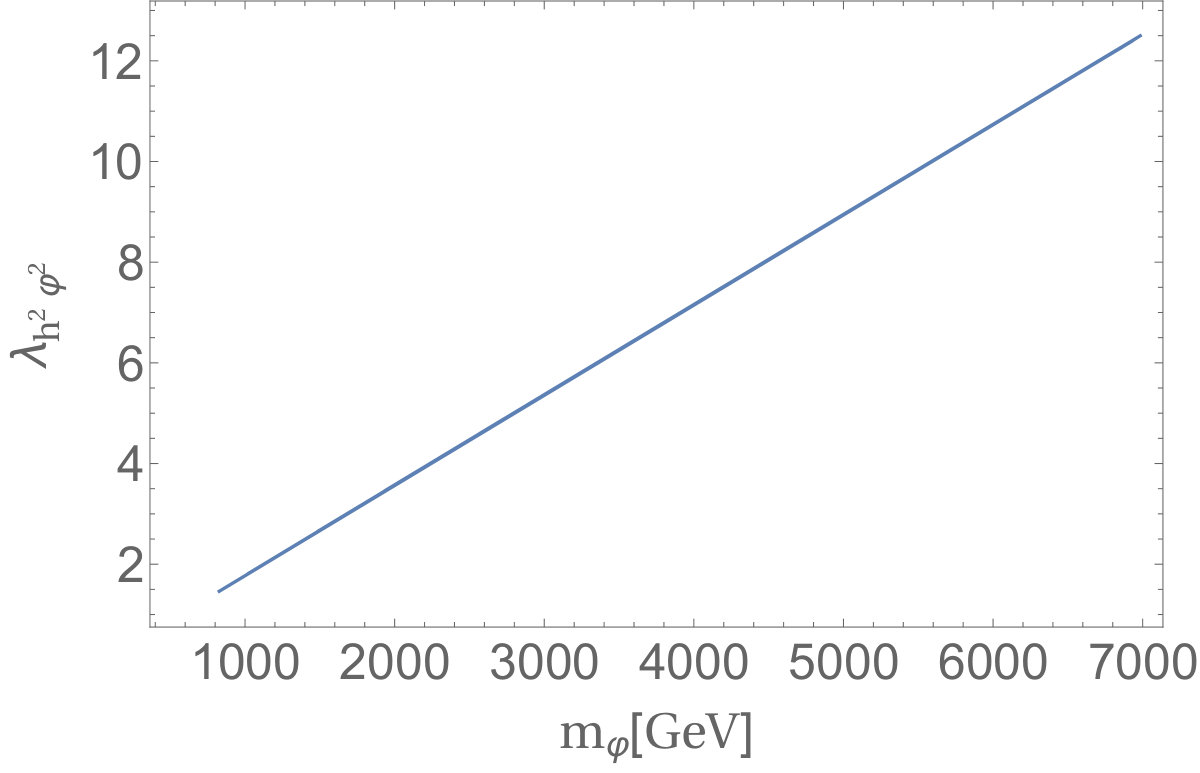 Figure 1
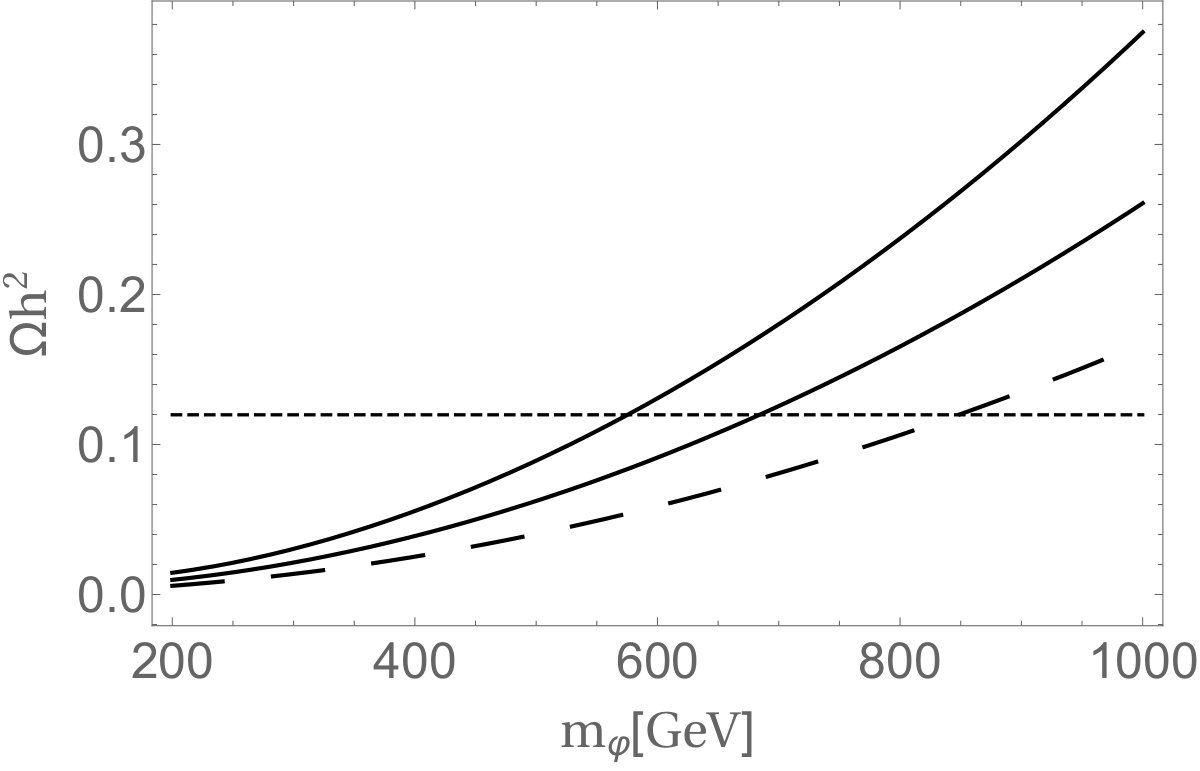 Figure 2
| Observable | Model value | Experimental value |
|---|---|---|
| Parameter | (eV2) | (eV2) | |||
|---|---|---|---|---|---|
| Best fit | |||||
| range | and | ||||
| range |
Peer Reviews
No public reviews on file for this paper yet. If you reviewed it on a platform where reviews are public (OpenReview, ICLR, NeurIPS, ICML), you can paste yours below so the community can read it here.
Videos
No videos yet. Explain this paper in a talk, walkthrough, or lecture? Add one.
A highly predictive flavour 3-3-1 model with radiative
inverse seesaw mechanism
A. E. Cárcamo Hernándeza
H. N. Longb,c
Corresponding.author: [email protected]
aUniversidad Técnica Federico Santa María and Centro Científico-Tecnológico de Valparaíso,
Casilla 110-V, Valparaíso, Chile,
bTheoretical Particle Physics and Cosmology Research Group, Advanced Institute of Materials Science, Ton Duc Thang University, Ho Chi Minh City, Vietnam
cFaculty of Applied Sciences, Ton Duc Thang University, Ho Chi Minh City, Vietnam
(March 11, 2024)
Abstract
We build a highly predictive 3-3-1 model, where the field content is extended by including several scalar singlets and six right handed Majorana neutrinos. In our model the gauge symmetry is supplemented by the discrete group, which allows to get a very good description of the low energy fermion flavor data. In the model under consideration, the discrete group is broken at very high energy scale down to the preserved discrete symmetry, thus generating the observed pattern of SM fermion masses and mixing angles and allowing the implementation of the loop level inverse seesaw mechanism for the generation of the light active neutrino masses, respectively. The obtained values for the physical observables in the quark sector agree with the experimental data, whereas those ones for the lepton sector also do, only for the case of inverted neutrino mass spectrum. The normal neutrino mass hierarchy scenario of the model is ruled out by the neutrino oscillation experimental data. We find an effective Majorana neutrino mass parameter of neutrinoless double beta decay of meV, a leptonic Dirac CP violating phase of and a Jarlskog invariant of about for the inverted neutrino mass hierarchy. The preserved symmetry allows for a stable scalar dark matter candidate.
pacs:
12.60.Cn,12.60.Fr,12.15.Lk,14.60.Pq
Keywords: Extensions of electroweak gauge sector, Extensions of electroweak Higgs sector, Electroweak radiative corrections, Neutrino mass and mixing
I Introduction
Despite its great consistency with the experimental data, the Standard Model (SM) is unable to explain several issues such as, for example, the number of fermion generations, the large hierarchy of fermion masses, the small quark mixing angles and the sizeable leptonic mixing ones. Whereas in the quark sector, the mixing angles are small, in the lepton sector two of the mixing angles are large, and one mixing angle is small. Neutrino experiments have brought clear evidence of neutrino oscillations from the measured neutrino mass squared splittings. The three neutrino flavors mix and at least two of the neutrinos have non vanishing masses, which according to neutrino oscillation experimental data must be smaller than the SM charged fermion masses by many orders of magnitude.
Models with an extended gauge symmetry are frequently used to tackle the limitations of the SM. In particular, the models based on the gauge symmetry , also called 3-3-1 models, can explain the origin of fermion generations thanks to the introduction of a family non-universal symmetry Georgi:1978bv ; Valle:1983dk ; Pisano:1991ee ; Foot:1992rh ; Frampton:1992wt ; Hoang:1996gi ; Hoang:1995vq ; Foot:1994ym ; Boucenna:2015pav ; Hernandez:2015ywg , can provide an explanation for the origin of the family structure of the fermions. These models have the following nice interesting features: 1) The three family structure in the fermion sector naturally arises in the 3-3-1 models from the cancellation of chiral anomalies and asymptotic freedom in QCD. 2) The fact that the third family is treated under a different representation, can explain the large mass difference between the heaviest quark family and the two lighter ones. 3) The 3-3-1 models allow the quantization of electric charge deSousaPires:1998jc ; VanDong:2005ux . 4) These models have several sources of CP violation Montero:1998yw ; Montero:2005yb . 5) The above models explain why the Weinberg mixing angle satisfies . 6) These models contain a natural Peccei-Quinn symmetry, necessary to solve the strong-CP problem Pal:1994ba ; Dias:2002gg ; Dias:2003zt ; Dias:2003iq . 7) The 3-3-1 models with heavy sterile neutrinos include cold dark matter candidates as weakly interacting massive particles (WIMPs) Mizukoshi:2010ky ; Dias:2010vt ; Alvares:2012qv ; Cogollo:2014jia . A concise review of WIMPs in 3-3-1 Electroweak Gauge Models is provided in Ref. daSilva:2014qba .
In the 3-3-1 models, one heavy triplet field with a Vacuum Expectation Value (VEV) at high energy scale , breaks the symmetry into the SM electroweak group , thus generating the masses of non SM fermions and non SM gauge bosons, while the other two lighter triplets with VEVs at the electroweak scale and , trigger the Electroweak Symmetry Breaking Hernandez:2013mcf and provide the masses for the SM particles.
On the other hand, the implementation of discrete flavor symmetries in several extensions of the SM has provided a nice description of the observed pattern of fermion masses and mixings (recent reviews on discrete flavor groups can be found in Refs. Ishimori:2010au ; Altarelli:2010gt ; King:2013eh ; King:2014nza ). Several discrete groups have been employed in extensions of the SM, such as Ma:2001dn ; He:2006dk ; Chen:2009um ; Ahn:2012tv ; Memenga:2013vc ; Felipe:2013vwa ; Varzielas:2012ai ; Ishimori:2012fg ; King:2013hj ; Hernandez:2013dta ; Babu:2002dz ; Altarelli:2005yx ; Morisi:2013eca ; Altarelli:2005yp ; Kadosh:2010rm ; Kadosh:2013nra ; delAguila:2010vg ; Campos:2014lla ; Vien:2014pta ; Hernandez:2015tna ; CarcamoHernandez:2017cwi , Kubo:2003pd ; Kobayashi:2003fh ; Chen:2004rr ; Mondragon:2007af ; Mondragon:2008gm ; Bhattacharyya:2010hp ; Dong:2011vb ; Dias:2012bh ; Meloni:2012ci ; Canales:2012dr ; Canales:2013cga ; Ma:2013zca ; Kajiyama:2013sza ; Hernandez:2013hea ; Ma:2014qra ; Hernandez:2014vta ; Hernandez:2014lpa ; Gupta:2014nba ; Hernandez:2015dga ; Hernandez:2015zeh ; Hernandez:2015hrt ; Hernandez:2016rbi ; CarcamoHernandez:2016pdu ; Arbelaez:2016mhg , Mohapatra:2012tb ; BhupalDev:2012nm ; Varzielas:2012pa ; Ding:2013hpa ; Ishimori:2010fs ; Ding:2013eca ; Hagedorn:2011un ; Campos:2014zaa ; Dong:2010zu ; VanVien:2015xha ; Arbelaez:2016mhg , Frampton:1994rk ; Grimus:2003kq ; Grimus:2004rj ; Frigerio:2004jg ; Babu:2004tn ; Adulpravitchai:2008yp ; Ishimori:2008gp ; Hagedorn:2010mq ; Meloni:2011cc ; Vien:2013zra , Kawashima:2009jv ; Kaburaki:2010xc ; Babu:2011mv ; Gomez-Izquierdo:2013uaa ; Gomez-Izquierdo:2017med , Luhn:2007sy ; Hagedorn:2008bc ; Cao:2010mp ; Luhn:2012bc ; Kajiyama:2013lja ; Bonilla:2014xla ; Vien:2014gza ; Vien:2015koa ; Hernandez:2015cra ; Arbelaez:2015toa , Ding:2011qt ; Hartmann:2011dn ; Hartmann:2011pq ; Kajiyama:2010sb , Aranda:2000tm ; Sen:2007vx ; Aranda:2007dp ; Chen:2007afa ; Frampton:2008bz ; Eby:2011ph ; Frampton:2013lva ; Chen:2013wba , Ma:2007wu ; Varzielas:2012nn ; Bhattacharyya:2012pi ; Ma:2013xqa ; Nishi:2013jqa ; Varzielas:2013sla ; Aranda:2013gga ; Ma:2014eka ; Abbas:2014ewa ; Abbas:2015zna ; Varzielas:2015aua ; Bjorkeroth:2015uou ; Chen:2015jta ; Vien:2016tmh ; Hernandez:2016eod ; CarcamoHernandez:2017owh ; Bernal:2017xat , Carballo-Perez:2016ooy and Everett:2008et ; Feruglio:2011qq ; Cooper:2012bd ; Varzielas:2013hga ; Gehrlein:2014wda ; Gehrlein:2015dxa ; DiIura:2015kfa ; Ballett:2015wia ; Gehrlein:2015dza ; Turner:2015uta ; Li:2015jxa have been considered to explain the observed pattern of fermion masses and mixings.
Among several discrete symmetry groups, the group has attracted a lot of attention since it is the smallest one which admits one three-dimensional representation as well as three inequivalent one-dimensional representations. Then, the choice of the symmetry is natural since there are three families of fermions, i.e, the left handed leptons can be unified in triplet representation of while the right handed leptons can be assigned to singlets. This setup has been proposed for first time in Ref. Ma:2001dn to study the lepton masses and mixings obtaining nearly degenerate neutrino masses and allowing realistic charged leptons masses after the symmetry is spontaneously broken. The scalar sector of the minimal setup of Ref. Ma:2001dn includes one triplet whose components are doublets and one doublet which transforms as an trivial singlet. As it has been extensively discussed in the literature (for a recent reviews see Refs. King:2013eh ; Altarelli:2010gt ; Ishimori:2010au ) the group, which is the group of even permutations of four elements has been shown to generate the tribimaximal mixing pattern which predicts solar mixing and atmospheric mixing angles consistent with the experimental data but yields a vanishing reactor mixing angle contradicting the recent experimental results from the Daya Bay An:2012eh , T2K Abe:2011sj , MINOS Adamson:2011qu , Double CHOOZ Abe:2011fz and RENO Ahn:2012nd experiments. In view of this the tribimaximal mixing pattern has to be modified.
In this work we build a highly predictive flavor 3-3-1 model, where the discrete symmetry is supplemented by the discrete group, providing a framework consistent with the current low energy fermion flavor data. In the model under consideration the different discrete group factors are broken completely, excepting the discrete group, which is broken down to the preserved symmetry, thus allowing the implementation of the one loop level inverse seesaw mechanism for the generation of the light active neutrino masses. The SM charged fermion masses and quark mixing angles arise from the breaking of the discrete group.
The content of this paper goes as follows. In section II we describe our model. The low energy scalar potential of our model is discussed in Section III. Section IV is devoted to the implications of our model in quark masses and mixings. Section V deals with lepton masses and mixings. We conclude in section VII. Appendix A provides a concise description of the discrete group. Appendix B shows a discussion of the scalar potential for a scalar triplet and its minimization equations.
II The model.
As is well known, the model (3-3-1 model) with and right-handed Majorana neutrinos in the lepton triplet is unsatisfactory in describing the observed SM fermion mass and mixing pattern, due to the unexplained hierarchy among its large number of Yukawa couplings. To address that problem, we propose an extension of the 3-3-1 model with , where the scalar sector is extended to include several EW scalar singlets, the fermion sector is extended by introducing six right handed Majorana neutrinos, and the gauge symmetry is supplemented by the discrete group, so that the full symmetry exhibits the following three-step spontaneous breaking:
[TABLE]
where the different symmetry breaking scales satisfy the following hierarchy Let us note that all discrete group are broken completely at the very high energy scale , excepting the discrete group which is broken down to the preserved symmetry. That preserved symmetry will allows us to implement a one loop level inverse seesaw mechanism for the generation of the light active neutrino masses.
In the 3-3-1 model under consideration, the electric charge is defined in terms of the generators and the identity by:
[TABLE]
with , and for triplet. Let us note that we have chosen , because in that choice the third component of the weak lepton triplet is a neutral field which allows to build the Dirac matrix with the usual field of the weak doublet. The introduction of a sterile neutrino in the model allows the implementation of a low scale seesaw mechanism (which could be inverse or linear) for the generation of the light neutrino masses. The 3-3-1 models with have the advantage over other 3-3-1 models with different values , of providing an alternative framework to generate neutrino masses, where the neutrino spectrum includes the light active sub-eV scale neutrinos as well as sterile neutrinos which could be dark matter candidates if they are light enough or candidates for detection at the LHC, if they have TeV scale masses. Let us note that if the TeV scale sterile neutrinos are found at the LHC, the 3-3-1 models with can be very strong candidates for unraveling the mechanism responsible for electroweak symmetry breaking.
The cancellation of chiral anomalies implies that quarks are unified in the following left- and right-handed representations Valle:1983dk ; Hoang:1995vq ; Diaz:2004fs ; CarcamoHernandez:2005ka :
[TABLE]
where and () are the left handed up and down type quarks fields in the flavor basis, respectively. The right handed SM quarks, i.e., and () and right handed exotic quarks, i.e., and () are assigned as singlets with quantum numbers equal to their electric charges.
Furthermore, the requirement of chiral anomaly cancellation constrains the leptons to the following left- and right-handed representations Valle:1983dk ; Hoang:1995vq ; Diaz:2004fs :
[TABLE]
In the present model the fermion sector is extended by introducing six right handed Majorana neutrinos, singlets under the 3-3-1 group, so that they have the following assignments:
[TABLE]
Regarding the scalar sector of the 3-3-1 model with right handed Majorana neutrinos, we assign the scalar fields in the following representations:
[TABLE]
The scalar sector of the 3-3-1 model with right handed Majorana neutrinos includes: three ’s irreps of , where one triplet gets a TeV scale vacuum expectation value (VEV) , that breaks the symmetry down to , thus generating the masses of non SM fermions and non SM gauge bosons; and two light triplets and acquiring electroweak scale VEVs and , respectively, thus triggering Electroweak Symmetry Breaking and then providing masses for the fermions and gauge bosons of the SM Hernandez:2013mcf .
On the other hand, the lepton number has a gauge component as well as a complementary global one, according to the following relation:
[TABLE]
where the upper and lower signs correspond to triplet and antitriplet of , respectively. The operator that does not commute with the gauge symmetry. However, is a conserved charge corresponding to the global symmetry, commuting with the gauge symmetry and corresponds to the ordinary lepton number. In addition, the hypercharge operator is defined as:
[TABLE]
From Eq. (7) it follows that the masses of the right handed Majorana neutrinos , which will be generated at one loop level (as we will shown later, in section V) will break the lepton number by two units, thus allowing the implementation of the one loop level inverse seesaw mechanism for the generation of the light active neutrino masses and giving rise to the neutrinoless double beta decay. Consequently, the light active neutrinos are also Majorana particles, as follows from the Valle-Schechter Theorem Schechter:1981bd , which states that any mechanism generating neutrinoless double beta decay implies that neutrinos are Majorana particles.
We extend the scalar sector of the 3-3-1 model with right handed Majorana neutrinos by adding the following scalar singlets, with the following assignments:
[TABLE]
The scalar fields of our model have the following assignments:
[TABLE]
Here the dimensions of the irreducible representations are specified by the numbers in boldface and the different charges are written in additive notation. Let us note that all scalar fields acquire nonvanishing vacuum expectation values, excepting the scalar singlet , whose charge corresponds to a nontrivial charge under the preserved symmetry. The scalar assignments under the discrete group are summarized in Table 1.
The quark assignments under the group are:
[TABLE]
Lets us note that we assign the quarks fields into singlet representations, excepting the SM right handed down type quarks fields which are grouped in a triplet.
The lepton fields of our model have the following assignments:
[TABLE]
As regards the lepton sector, we recall that the left and right-handed leptons are grouped into triplet and singlet irreducible representations, respectively, whereas the right-handed Majorana neutrinos, i.e., and are unified () into the triplets, i.e., and . The fermion assignments under the discrete group are summarized in Table 2.
With the above particle content, the relevant Yukawa terms for the quark and lepton sector invariant under the group , respectively, are:
[TABLE]
[TABLE]
where the dimensionless couplings in Eq. (13) and (14) are parameters. Furthermore, as it will shown in Sect. IV, the quark assignments under the different group factors of our model will give rise to SM quark mass textures where the CKM quark mixing angles only arise from the up type quark sector. As indicated by the current low energy quark flavor data encoded in the Standard parametrization of the quark mixing matrix, the complex phase responsible for CP violation in the quark sector is associated with the quark mixing angle in the - plane. Consequently, in order to reproduce the experimental values of quark mixing angles and CP violating phase, is required to be complex. Besides that, as it will shown in Sect. V, the light active neutrino sector will generate the tribimaximal mixing matrix, whereas the charged lepton sector will give rise to the reactor mixing angle. In order to account for CP violation in neutrino oscillations, we will also assume that the parameter is complex.
Although the flavor discrete groups in Eq. (1) look rather sophisticated, each discrete group factor is crucial for generating highly predictive SM fermion mass matrices consistent with low energy fermion flavor data. As it will shown in Sect. V, the predictive textures for the lepton sectors will give rise to the experimentally observed deviation of the tribimaximal mixing pattern. Besides that, the resulting SM quark mass matrices will give rise to quark mixing only emerging from the up type quark sector. This is a consequence of the flavor symmetry, which needs to be supplemented by the discrete group. As we will see in the next sections, this predictive setup can successfully account for SM fermion masses and mixings. The inclusion of the discrete group reduces the number of parameters in the Yukawa and scalar sector of the model making it more predictive. We choose since it is the smallest discrete group with a three-dimensional irreducible representation and 3 distinct one-dimensional irreducible representations, which allows to naturally accommodate the three fermion families. In what follows we provide an explanation of the role of each discrete cyclic group factor introduced in our model. The symmetry is the smallest cyclic symmetry that guarantees that the renormalizable Yukawa terms for the right handed Majorana neutrinos () only involve the scalar fields and () assumed to be real, whose VEVs are taken to satisfy TeV. In addition, the symmetry avoids 5 dimensional Yukawa interactions of the right handed Majorana neutrinos () with the scalar fields () (which acquire VEVs at very high energy scale), that could push the masses for these right handed Majorana neutrinos at very high scale. Consequently, the symmetry is crucial to have TeV scale inverse seesaw mediators (), which allows the implementation of a one loop level inverse seesaw mechanism to generate light active neutrino masses, thus giving rise to exotic pseudo-Dirac neutrinos within the LHC reach. The symmetry has the following roles: 1) To separate the scalar triplet participating in the Dirac neutrino Yukawa interactions from the remaining scalar triplets. 2) To forbid mixings between SM quarks and exotic quarks, thus resulting in a reduction of quark sector model parameters. 3) To allow the implementation of the one loop level inverse seesaw mechanism for the generation of the light active neutrino masses, due to to the fact that the discrete group is broken down to the preserved symmetry. Let us note that we use the discrete group since it is the smallest cyclic group that contains both the and symmetries. The symmetry contained in allows to decouple the exotic quarks from the SM quarks, whereas the preserved symmetry is crucial for the implementation of the one loop level inverse seesaw mechanism for the generation of the light active neutrino masses. In what concerns, the symmetry, it is worth mentioning that it is crucial to generate the observed charged fermion mass and quark mixing pattern. Let us note, that the properties of the groups imply that the symmetry is the smallest cyclic symmetry from which the Yukawa term of dimension twelve can be built, from a insertion on the operator, crucial to get the required suppression (where is one of the Wolfenstein parameters) needed to naturally explain the smallness of the up quark mass, which is ( is one of the Wolfenstein parameters) times a parameter. Furthermore, the discrete symmetry separates the scalar triplet participating in the SM down type quark Yukawa interactions from the remaining scalar triplets. The symmetry has the functions: 1) To select the allowed entries of the SM quark mass matrices, thus yielding a very predictive quark sector. It is worth mentioning that the is the smallest cyclic symmetry that allows us to get vanishing , and entries in the SM up type quark mass matrix. 2) To distinguish the scalar triplet participating in the quark Yukawa interactions, from the ones, i.e., and that appear in the neutrino Yukawa terms and from the scalar triplets, i.e., , and , contributing to the charged lepton masses, thus allowing to treat, the SM down type quark, the charged lepton and neutrino sectors independently. 3) To separate the scalar triplets and contributing to the electron and tau lepton masses as well as to the reactor mixing angle from the scalar triplet that give rises to the muon lepton mass. This is crucial to generate the experimentally observed deviation from the tribimaximal mixing pattern, which in our model arises from the charged lepton sector.
Furthermore, since the breaking of the discrete group gives rise to the charged fermion mass and quark mixing pattern, we set the VEVs of the singlet scalar fields (excepting which has a vanishing vacuum expectation value) with respect to the Wolfenstein parameter and the model cutoff , as follows:
[TABLE]
Let us note that we have assumed a hierarchy between the vacuum expectation values of the scalar triplets, in order to simplify our analysis of the scalar potential for the scalar triplets. That hierarchy in their VEVs will allow us to neglect the mixings between these fields as follows from the method of recursive expansion of Ref. Grimus:2000vj and to treat their scalar potentials independently. Furthermore, let us note that we have assumed the relation for the vacuum expectation values of the scalar triplets and contributing to the electron and tau lepton masses as well as to the reactor mixing angle . That assumption is made in order to connect the reactor mixing parameter with the Wolfenstein parameter , through the relation , which is suggested by the neutrino oscillation experimental data.
In the following we comment on the possible VEV patterns for the scalar triplets , , , , , . Since the VEVs of the scalar triplets satisfy the following hierarchy: the mixing angles between , , , , and are very small since they are suppressed by the ratios of their VEVs, which is a consequence of the method of recursive expansion proposed in Ref. Grimus:2000vj . Thus, the scalar potentials for the scalar triplets , , , , , can be treated independently. As shown in detail in Appendix B, the following VEV patterns for the scalar triplets are consistent with the scalar potential minimization equations for a large region of parameter space:
[TABLE]
III Low energy scalar potential
The renormalizable low energy scalar potential of the model under consideration is given by:
[TABLE]
where is the only real scalar. From the scalar potential given above, one obtains that the scalar mass eigenstates are connected with the weak scalar states by the following approximate relations
[TABLE]
with
[TABLE]
The low energy physical scalar spectrum of our model is composed of the following fields: 4 massive charged Higgs (, ), two CP-odd Higgses (), 5 neutral CP-even Higgs () and 2 neutral Higgs () bosons. The scalar is identified with the SM-like GeV Higgs boson found at the LHC. It it noteworthy that the neutral Goldstone bosons , , , are associated to the longitudinal components of the , , and gauge bosons, respectively. Furthermore, the charged Goldstone bosons and are associated to the longitudinal components of the and gauge bosons, respectively.
IV Quark masses and mixings.
From the quark Yukawa interactions given by Eq. (13) we find that the SM mass matrices for quarks take the form:
[TABLE]
where , (),, () are dimensionless parameters. Here is one of the Wolfenstein parameters and GeV the scale of electroweak symmetry breaking. From the SM quark mass textures given above, it follows that the quark mixing angles only arise from the up type quark sector. Besides that, the low energy quark flavor data indicates that the CP violating phase in the quark sector is associated with the quark mixing angle in the 1-3 plane, as follows from the Standard parametrization of the quark mixing matrix. Consequently, in order to get quark mixing angles and a CP violating phase consistent with the experimental data, we assume that all dimensionless parameters given in Eqs. (38) are real, except for , taken to be complex.
Furthermore, as follows from the different charge assignments for the quark fields, the exotic quarks do not mix with the SM quarks. We find that the exotic quark masses are given by:
[TABLE]
The obtained values for the physical quark mass spectrum Bora:2012tx ; Xing:2007fb , mixing angles and Jarlskog invariant Olive:2016xmw are consistent with their experimental data, as shown in Table 3, starting from the following benchmark point:
[TABLE]
In Table 3 we show the model and experimental values for the physical observables of the quark sector. We use the -scale experimental values of the quark masses given by Ref. Bora:2012tx (which are similar to those in Xing:2007fb ). The experimental values of the CKM parameters are taken from Ref. Olive:2016xmw . As indicated by Table 3, the obtained quark masses, quark mixing angles, and CP violating phase are consistent with the low energy quark flavor data.
In order to study the sensitivity of the obtained values for the SM quark masses, and CKM parameters under small variations around the best-fit values (maximum variation of , minimum of ), we show in Figures 1 and 2 the predicted SM quark masses and CKM parameters, respectively, as functions of the iteration. We find that a slight deviation from the best-fit values, keeps all the obtained SM quark masses, with the exception of the top and bottom quark masses, inside the experimentally allowed range. In what regards the top and bottom quark masses, a large amount of points are inside the experimentally allowed range. The points outside the experimentally allowed range, correspond to values close to the lower and upper experimental bounds of the bottom quark mass. In what concerns the quark mixing angles and Jarlskog invariant we find that a slight deviation from the best-fit values keeps the these CKM parameters within the same order of magnitude. Consequently, our model is very predictive for the quark sector.
On the other hand, from the SM quark textures, it follows that in order to obtain realistic SM quark masses and mixing angles without requiring a strong hierarchy among the Yukawa couplings, one should have , which implies that . Furthermore, as the coupling is proportional to , in order to get a coupling close to the SM expectation, we have . In what follows we briefly comment about the phenomenological implications of our model in the concerning to the flavor changing processes involving quarks. As previously mentioned, the different charge assignments for SM and exotic right handed quark fields imply the absence of mixing between them. The absence of mixings between the SM and exotic quarks will imply that the exotic fermions will not exhibit flavor changing decays into SM quarks and gauge (or Higgs) bosons. After being pair produced they will decay into the SM quarks and the intermediate states of heavy gauge bosons, which in turn decay into the pairs of the SM fermions, see e.g. Cabarcas:2008ys . The precise signature of the decays of the exotic quarks depends on details of the spectrum and other parameters of the model. The present lower limits on the gauge boson mass in models arising from LHC searches, reach around TeV Salazar:2015gxa . These bounds can be translated into limits of about 6.3 TeV on the gauge symmetry breaking scale . Furthermore, electroweak data from the decays and set lower bounds on the gauge boson mass ranging from TeV up to TeV CarcamoHernandez:2005ka ; Martinez:2008jj ; Buras:2013dea ; Buras:2014yna ; Buras:2012dp . The exotic quarks can be pair produced at the LHC via Drell-Yan and gluon fusion processes mediated by charged gauge bosons and gluons, respectively. A detailed study of the exotic quark production at the LHC and the exotic quark decay modes is beyond the scope of this work and is deferred for a future publication.
V Lepton masses and mixings.
From Eqs. (14), (15), (16) and using the product rules of the group given in Appendix A, we find that the charged lepton mass matrix is given by:
[TABLE]
where , , () are dimensionless parameters, assumed to be real, excepting , taken to be complex, in order to generate a nonvanishing leptonic Dirac CP violating phase. Specifically, for the sake of simplicity we take as .
The matrix is diagonalized by a rotation matrix according to:
[TABLE]
where the charged lepton masses are approximately given by:
[TABLE]
It is worth mentioning that the charged lepton masses are connected with the electroweak symmetry breaking scale GeV by their scalings with powers of the Wolfenstein parameter , with coefficients. This is consistent with our previous assumption made in Eq. (15) regarding the size of the VEVs for the singlet scalars appearing in the charged fermion Yukawa terms. Furthermore, it is noteworthy that the mixing angle in the charged lepton sector is large, which gives rise to an important contribution to the leptonic mixing matrix, coming from the mixing of charged leptons.
Regarding the neutrino sector, from the Eq. (14), we find the following neutrino mass terms:
[TABLE]
where the family symmetry constrains the neutrino mass matrix to be of the form:
[TABLE]
where the submatrices and are generated at tree level from the nonrenormalizable and renormalizable Yukawa terms, respectively, whereas the submatrix arises from a one loop level radiative seesaw mechanism mediated by the massive right handed Majorana neutrinos () and the real and imaginary parts of the charged scalar field . As previously mentioned, the facts that the discrete group is broken down to the preserved symmetry and the singlet scalar field (which appears in the neutrino Yukawa interaction ) has a charge corresponding to a nontrivial charge, implies that this scalar does not acquire a vacuum expectation value, thus generating the submatrix only at one loop level. The one loop Feynman diagrams contributing to the entries of the Majorana neutrino mass submatrix are shown in Figure 3. The submatrices , and are given by:
[TABLE]
where:
[TABLE]
and the following function has been introduced Ma:2006km :
[TABLE]
In order to connect the neutrino mass squared splittings with the quark mixing parameters and motivated by the relation , we set . In addition, for the sake of simplicity we assume that the charged singlet scalar field is heavier than the right handed Majorana neutrinos (), in such a way that we can restrict to the scenario:
[TABLE]
for which the submatrix takes the form:
[TABLE]
where and are dimensionless parameters, assumed to be real for simplicity. Furthermore, is the mass scale for the Majorana neutrinos (), which sets the scale of breaking of lepton number.
As shown in detail in Ref. Catano:2012kw , the full rotation matrix that diagonalizes the neutrino mass matrix is approximately given by:
[TABLE]
where
[TABLE]
and the physical neutrino mass matrices are:
[TABLE]
where is the light active neutrino mass matrix whereas and are the exotic Dirac neutrino mass matrices. It is worth mentioning that physical neutrino spectrum consists of three light active neutrinos and six exotic neutrinos. The exotic neutrinos are pseudo-Dirac, with masses TeV and a small splitting . This scenario is much more interesting than the one proposed in Ref. Hernandez:2016eod where the sterile neutrinos are very much outside the LHC reach since their masses are extremelly large, thus giving rise a double seesaw mechanism for the light active neutrino masses instead of the radiative inverse seesaw mechanism proposed in this work. Furthermore, , and are the rotation matrices which diagonalize , and , respectively. It is worth mentioning that the heavy quasi Dirac neutrinos can be produced in pairs at the LHC, via a Drell-Yan mechanism mediated by a heavy non Standard Model neutral gauge boson . The heavy quasi Dirac neutrinos can decay into a Standard Model charged lepton and a gauge boson, due to their mixings with the light active neutrinos. Thus, the observation of an excess of events in the dilepton final states with respect to the SM background, would be a signal supporting this model at the LHC and can be used to distiguish this model from the one proposed in Ref. Hernandez:2016eod . A detailed study of the collider phenomenology of this model is beyond the scope of the present paper and is left for future studies.
From Eq. (78) it follows that the light active neutrino mass matrix is given by:
[TABLE]
Let us note that the smallness of the active neutrino masses arises from their scaling with inverse powers of the high energy cutoff as well as from their linear dependence on the loop induced mass scale for the Majorana neutrinos ().
The light active neutrino mass matrix is diagonalized by a unitary rotation matrix , according to:
[TABLE]
Consequently, the light active neutrino spectrum is composed of one massless neutrino and two active neutrinos, whose masses are determined from the experimental values of the neutrino mass squared splittings.
From Eqs. (46) and Eqs. (80), it follows that the normal hierarchy scenario leads to a too value for the large reactor mixing angle, which is disfavored by the neutrino oscillation experimental data. Thus, the normal neutrino mass hierarchy scenario of our model is ruled out by the current data on neutrino oscillation experiments. In what regards inverted neutrino mass hierarchy, we find from Eqs. (46) and Eqs. (80), that the corresponding PMNS leptonic mixing matrix takes the form:
[TABLE]
From the standard parametrization of the leptonic mixing matrix, we predict that the lepton mixing parameters for the case of inverted neutrino mass hierarchy are given by:
[TABLE]
Let us note that for the sake of simplicity, we have taken reals the parameters and of the light active neutrino mass matrix. It is worth mentioning that the introduction of complex phases in the and parameters will not modify our predictions for the leptonic mixing parameters since they do not depend on the Majorana phases.
The obtained values for the charged lepton masses and leptonic mixing parameters are obtained starting from the following benchmark point:
[TABLE]
From the comparison of Eq. (82) with Table 4, it follows that the solar and reactor mixing parameter are in excellent agreement with the experimental data, whereas the atmospheric leptonic mixing parameter is deviated away, respectively from its best fit value. Let us note that with only two free effective parameters, i.e., and , our model predict leptonic mixing parameters in very good agreement with their experimental values, for the case of inverted neutrino mass spectrum. Furthermore, the obtained Jarlskog invariant and leptonic Dirac CP violating phase are given by:
[TABLE]
Furthermore, from the experimental values of the neutrino mass squared splittings for the case of inverted neutrino mass hierarchy, we found that the and parameters are given by:
[TABLE]
Thus, we obtain the following values for the neutrino mass squared splittings for the case of inverted neutrino mass hierarchy:
[TABLE]
Consequently, the predicted values for the neutrino mass squared splittings are inside their experimentally allowed range, thus exhibiting an excellent agreement with the experimental data on neutrino oscillations experiments, as follows from the comparison of Eq. (85) with Table 4.
Fig. 4 shows the correlations of the atmospheric and solar mixing parameters with the reactor mixing parameter . For our analysis, we randomly generated parameter configurations for and corresponding to values for the leptonic mixing parameters. To this end, we varied the parameters and in the ranges and (larger ranges will yields leptonic mixing parameters outside the experimentally allowed range). The correlation of the with mass parameters and and mixing parameters that sucessfully reproduce the values of the leptonic mixing parameters and neutrino mass squared splittings inside the experimentally allowed range are shown in Fig. 5. Correlations between the neutrino mass squared splittings and are displayed in Fig. 6.
Furthermore, in order to study the sensitivity of the obtained values for the Jarlskog invariant and leptonic Dirac CP violating phase under small variations around the best-fit values, subjected to the restriction that the resulting leptonic mixing parameters be inside the experimentally allowed range, we randomly generated parameter configurations for and in the ranges and , respectively. The resulting values for the Jarlskog invariant and leptonic Dirac CP violating phase as functions of the iteration are shown in Fig. 7. As indicated by Fig. 7, our model predicts Jarlskog invariant and leptonic Dirac CP violating phase in the ranges and , respectively.
In the following we proceed to determine the effective Majorana neutrino mass parameter, whose value is proportional to the amplitude of neutrinoless double beta () decay. The effective Majorana neutrino mass parameter is given by:
[TABLE]
where and are the squared of the PMNS leptonic mixing matrix elements and the masses of the Majorana neutrinos, respectively.
Thus, we obtain the following value for the effective Majorana neutrino mass parameter in the case of inverted neutrino mass hierarchy:
[TABLE]
In order to determine the predicted ranges for the effective Majorana neutrino mass parameter in our model, we have randomly generated the parameters , , and in a range of values where the neutrino mass squared splittings and the leptonic are consistent with the neutrino oscillation experimental data, in the scenario of vanishing Majorana phases. The effective Majorana neutrino mass parameter randomly generated as function of the iteration for the scenario of vanishing Majorana phases is shown in Fig. 8, which implies that this parameter has to be in the range eV eV. In what regards, the scenario of nonvanishing Majorana phases, i.e., and , complex, we have numerically checked that the obtained effective Majorana neutrino mass parameter has to be in the range eV eV.
Our obtained range of values for the effective Majorana neutrino mass parameter in the case of inverted neutrino mass hierarchy, is within the declared reach of the next-generation bolometric CUORE experiment Alessandria:2011rc or, more realistically, of the next-to-next-generation ton-scale -decay experiments. It is worth mentioning that the effective Majorana neutrino mass parameter has the upper bound of meV, which corresponds to yr at 90% C.L, which follows from the experimental data of the KamLAND-Zen experiment KamLAND-Zen:2016pfg . That limit is expected to be updated in a not too distant future. The GERDA “phase-II”experiment Abt:2004yk ; Ackermann:2012xja is expected to reach yr, which corresponds to meV. A bolometric CUORE experiment, using Alessandria:2011rc , is currently under construction and its estimated sensitivity is about yr, corresponding to meV. In addition, there are plans for ton-scale next-to-next generation experiments with 136Xe KamLANDZen:2012aa ; Albert:2014fya and 76Ge Abt:2004yk ; Guiseppe:2011me , asserting sensitivities over yr, which corresponds to meV. Some reviews on the theory and phenomenology of neutrinoless double-beta decay are provided in Refs. Bilenky:2014uka ; DellOro:2016tmg . Our results indicate that the derived model predicts at the level of sensitivities of the next generation or next-to-next generation experiments.
VI Dark matter relic density.
In this section we will discuss the implications of our model in Dark matter. We will assume that the Dark matter candidate in the model under consideration is a scalar. As a result of this assumption and considering that the scalar singlet is the only scalar field having a charge corresponding to a nontrivial charge under the preserved symmetry, we have that either or can be a Dark matter candidate in our model. Furthermore, we assume that the trilinear scalar coupling appearing in the scalar interaction satisfies , which implies that the imaginary part of the scalar field is lighter than its real part , as follows from Eq. (61). Consequently is the only stable scalar field and thus the scalar Dark matter candidate in our model.
Relic density of the dark matter in the present Universe is estimated as follows (c.f. Ref. Olive:2016xmw )
[TABLE]
where is the thermally averaged annihilation cross-section, is the total annihilation rate per unit volume at temperature and is the equilibrium value of the particle density, which are given by Edsjo:1997bg
[TABLE]
with and being the modified Bessel functions of the second kind order 1 and 2, respectively Edsjo:1997bg and . For the relic density calculation, we take as in Ref. Edsjo:1997bg , which corresponds to a typical freeze-out temperature. We assume that our DM candidate annihilates mainly into , , , and , with annihilation cross sections given by: Bhattacharya:2016ysw :
[TABLE]
where is the centre-of-mass energy, is the color factor, GeV and MeV are the SM Higgs boson mass and its total decay width, respectively.
In writting the above formulae we have considered that the scalar interactions between the SM Higgs field and the scalar dark matter candidate are described by the following scalar potential:
[TABLE]
Here we have worked on the decoupling limit where the couplings of the GeV Higgs boson to SM particles and its selfcouplings correspond to the SM expectation.
Let us note that the tree level vacuum stability constraints resulting from the requirement that the scalar potential be bounded from below, imply the following relations EliasMiro:2012ay ; Kannike:2016fmd :
[TABLE]
Furthermore, the tree level unitarity constraints yields the following relations Cynolter:2004cq :
[TABLE]
Fig. 9 displays the Relic density as a function of the mass of the scalar field , for several values of the quartic scalar coupling . The curves from top to bottom correspond to =0.7, 0.8 and 0.9, respectively. The horizontal line corresponds to the experimental value for the relic density. The Figure 9 shows that the Relic density is an increasing function of the mass and a decreasing function of the quartic scalar coupling . Consequently, an increase in the the mass of the scalar field will require a larger quartic scalar coupling , in order to account for the measured value of the Dark matter relic density, as indicated by Fig. 10. It is worth mentioning that the Dark matter relic density constraint yields a linear correlation between the quartic scalar coupling and the mass of the scalar Dark matter candidate , as shown in Fig. 10. We have numerically checked that in order to reproduce the experimental value Ade:2015xua of the relic density, the mass of the scalar field has to be in the range GeV GeV, for a quartic scalar coupling in the range , which is consistent with the vacuum stability and unitarity constraints shown in Eqs. 92 and 93. Furthermore, our range of values chosen for the quartic scalar coupling also allow the extrapolation of our model at high energy scales as well as the preservation of perturbativity at one loop level.
VII Conclusions
We constructed a highly predictive 3-3-1 model with right-handed neutrinos, where the symmetry is extended by and the field content is enlarged by extra singlet scalar fields and six right handed Majorana neutrinos. Our model is consistent with the low energy fermion flavor data. The , , , and symmetries are crucial for reducing the number of fermion sector model parameters, whereas the symmetry causes the charged fermion mass and quark mixing pattern. In the model under consideration, the light active neutrino masses are generated from a one loop level inverse seesaw mechanism and the observed pattern of charged fermion masses and quark mixing angles is caused by the breaking of the discrete group at very high energy. In our model the different discrete group factors are broken completely, excepting the discrete group, which is broken down to the preserved symmetry, thus allowing the implementation of the one loop level inverse seesaw mechanism for the generation of the light active neutrino masses. The resulting the neutrino spectrum of our model is composed of light active neutrinos and TeV scale exotic pseudo-Dirac neutrinos. The smallness of the active neutrino masses is a natural consequence of their scaling with inverse powers of the large model cutoff and of their linear dependence on the loop induced mass scale for the Majorana neutrinos (). The obtained values of the physical observables for the quark sector are consistent with the experimental data, whereas the ones for the lepton sector also do but only for the inverted neutrino mass spectrum. The normal neutrino mass hierarchy scenario of our model is disfavored by the neutrino oscillation experimental data, since the resulting reactor mixing parameter is much larger than its experimental upper limit. The obtained model predicts an effective Majorana neutrino mass parameter of neutrinoless double beta decay of meV, a leptonic Dirac CP violating phase of and a Jarlskog invariant of about for the inverted neutrino mass spectrum. Our obtained value of meV for the effective Majorana neutrino mass is within the declared reach of the next generation bolometric CUORE experiment Alessandria:2011rc or, more realistically, of the next-to-next generation ton-scale -decay experiments. Due to the fact that the discrete group, which is broken down to the preserved symmetry our model possesses a scalar DM particle candidate. The constraints arising from the DM relic density, set its mass in the range GeV GeV, for a quartic scalar coupling in the window .
Acknowledgments
This research has received funding from Fondecyt (Chile), Grants No. 1170803, CONICYT PIA/Basal FB0821, the Vietnam National Foundation for Science and Technology Development (NAFOSTED) under grant number 103.01-2017.356. A.E.C.H is very grateful to the Institute of Physics, Vietnam Academy of Science and Technology for the warm hospitality and for fully financing his visit.
Appendix A The product rules for
The group has one three-dimensional and three distinct one-dimensional , and irreducible representations, satisfying the following product rules:
[TABLE]
Considering and as the basis vectors for two -triplets , the following relations are fullfilled**:**
[TABLE]
where . The representation is trivial, while the non-trivial and are complex conjugate to each other. Some reviews of discrete symmetries in particle physics are found in Refs. Ishimori:2010au ; Altarelli:2010gt ; King:2013eh ; King:2014nza .
Appendix B Scalar potential for one scalar triplet
The scalar potential for any scalar triplet takes the form:
[TABLE]
where , , , , , .
That scalar potential given above has 8 free parameters: 1 bilinear and 7 quartic couplings. The scalar potential minimization conditions read:
[TABLE]
where \left\langle\Sigma\right\rangle=\left(\text{v_{\Sigma_{1}}e^{i\theta_{\Sigma_{1}}},v_{\Sigma_{2}}e^{i\theta_{\Sigma_{2}}},v_{\Sigma_{3}}e^{i\theta_{\Sigma_{3}}}}\right). Here for the sake of simplicity we consider vanishing phases in the VEV patterns of the triplet scalars, i.e., . Then, the scalar potential minimization equations given by Eq. (97) yields the following relations:
[TABLE]
From the relations given by Eq. (98) and setting , with , , , , , we obtain that the following VEV pattern:
[TABLE]
is a solution of the scalar potential minimization equations for a large region of parameter space.
From the expressions given above, and using the vacuum configuration for the scalar triplets given in Eq. (16), we find the following relation:
[TABLE]
These results indicate that the VEV patterns of the triplets, i.e., , , , , and in Eq. (99), are consistent with a global minimum of the scalar potential (96) of our model for a large region of parameter space.
The reference list from the paper itself. Each links out to its DOI / PubMed record.
- 1(1) H. Georgi and A. Pais, Phys. Rev. D 19 , 2746 (1979). doi:10.1103/Phys Rev D.19.2746
- 2(2) J. W. F. Valle and M. Singer, Phys. Rev. D 28 , 540 (1983). doi:10.1103/Phys Rev D.28.540
- 3(3) F. Pisano and V. Pleitez, Phys. Rev. D 46 , 410 (1992) doi:10.1103/Phys Rev D.46.410 [hep-ph/9206242].
- 4(4) R. Foot, O. F. Hernandez, F. Pisano and V. Pleitez, Phys. Rev. D 47 , 4158 (1993) doi:10.1103/Phys Rev D.47.4158 [hep-ph/9207264].
- 5(5) P. H. Frampton, Phys. Rev. Lett. 69 , 2889 (1992). doi:10.1103/Phys Rev Lett.69.2889
- 6(6) H. N. Long, Phys. Rev. D 54 , 4691 (1996) doi:10.1103/Phys Rev D.54.4691 [hep-ph/9607439].
- 7(7) H. N. Long, Phys. Rev. D 53 , 437 (1996) doi:10.1103/Phys Rev D.53.437 [hep-ph/9504274].
- 8(8) R. Foot, H. N. Long and T. A. Tran, Phys. Rev. D 50 , no. 1, R 34 (1994) doi:10.1103/Phys Rev D.50.R 34 [hep-ph/9402243].