QCD Results from HERA
Daniel Britzger (for the H1, ZEUS Collaborations)

TL;DR
This paper presents new QCD measurements from HERA, including heavy quark masses, prompt photon production, and jet cross sections, with comparisons to advanced theoretical predictions and a precise determination of the strong coupling constant.
Contribution
It provides the first NNLO predictions for jet cross sections and a new precise measurement of the strong coupling constant from HERA data.
Findings
Heavy quark masses: m_c=1290 MeV, m_b=4049 MeV
First NNLO comparison for jet production
Alpha_s(m_Z)=0.1157 with uncertainties
Abstract
New results on the measurements of the hadronic final state in neutral-current deep-inelastic scattering at HERA are presented. A combination of reduced charm and beauty cross sections is presented and the masses of the heavy quarks are determined to and . The measurement of the production of prompt photons accompanied by a jet provides a precise test of QCD predictions. Measurements of jet production cross sections are presented and compared for the first time to next-to-next-to-leading order predictions (NNLO). The strong coupling constant is determined from inclusive jet and dijet production cross sections using NNLO predictions to .
Click any figure to enlarge with its caption.
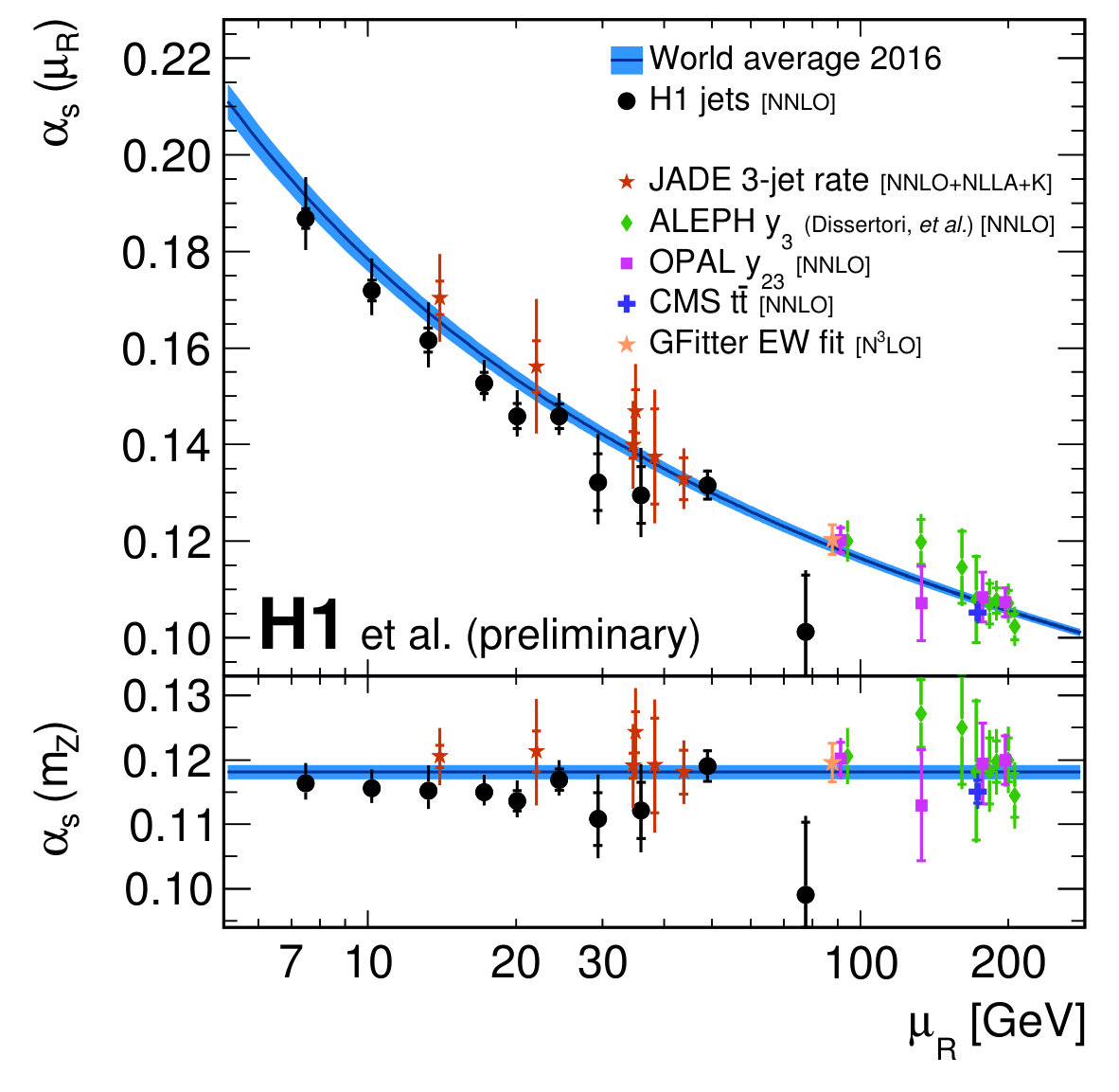 Figure 11
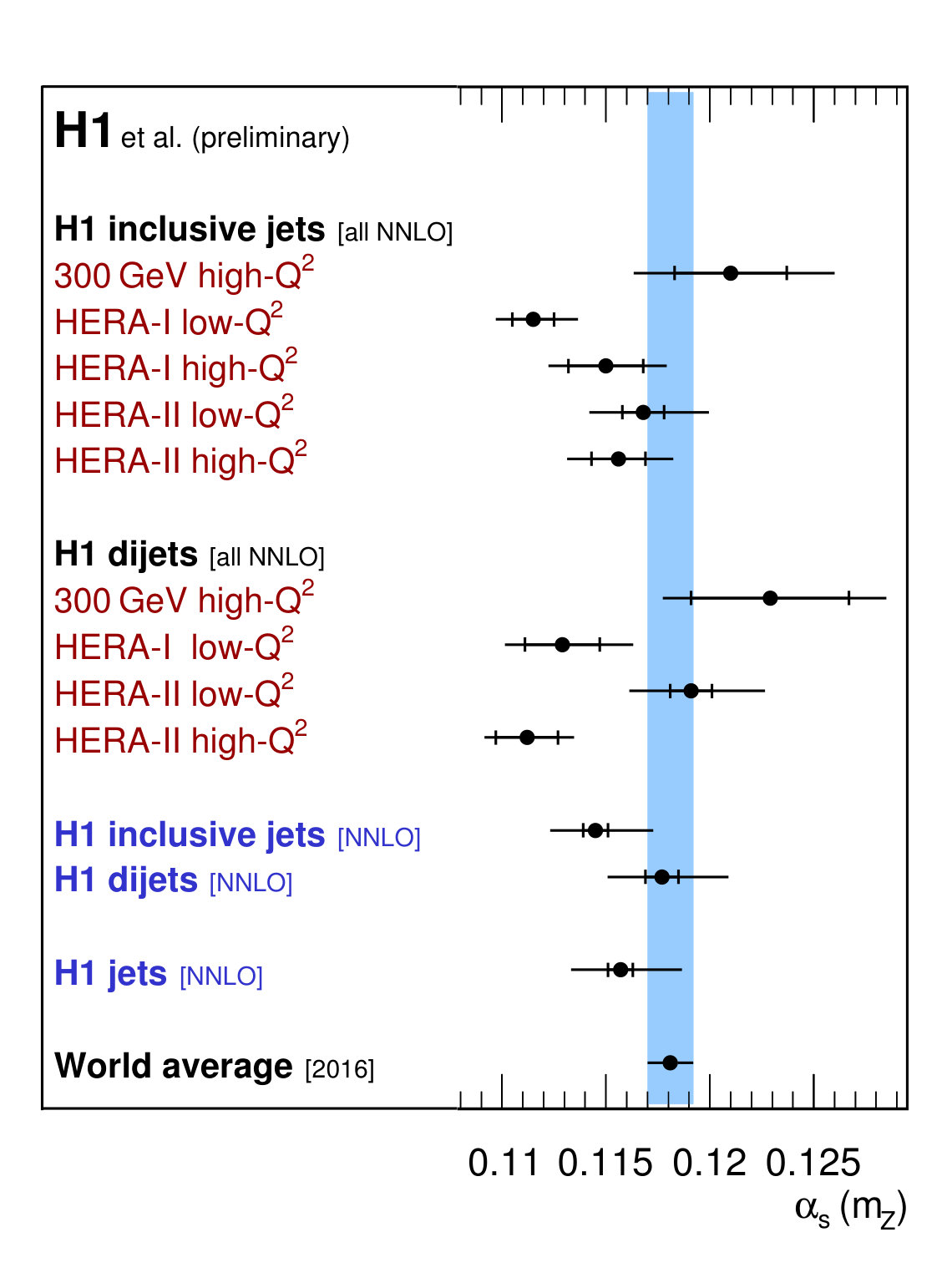 Figure 13
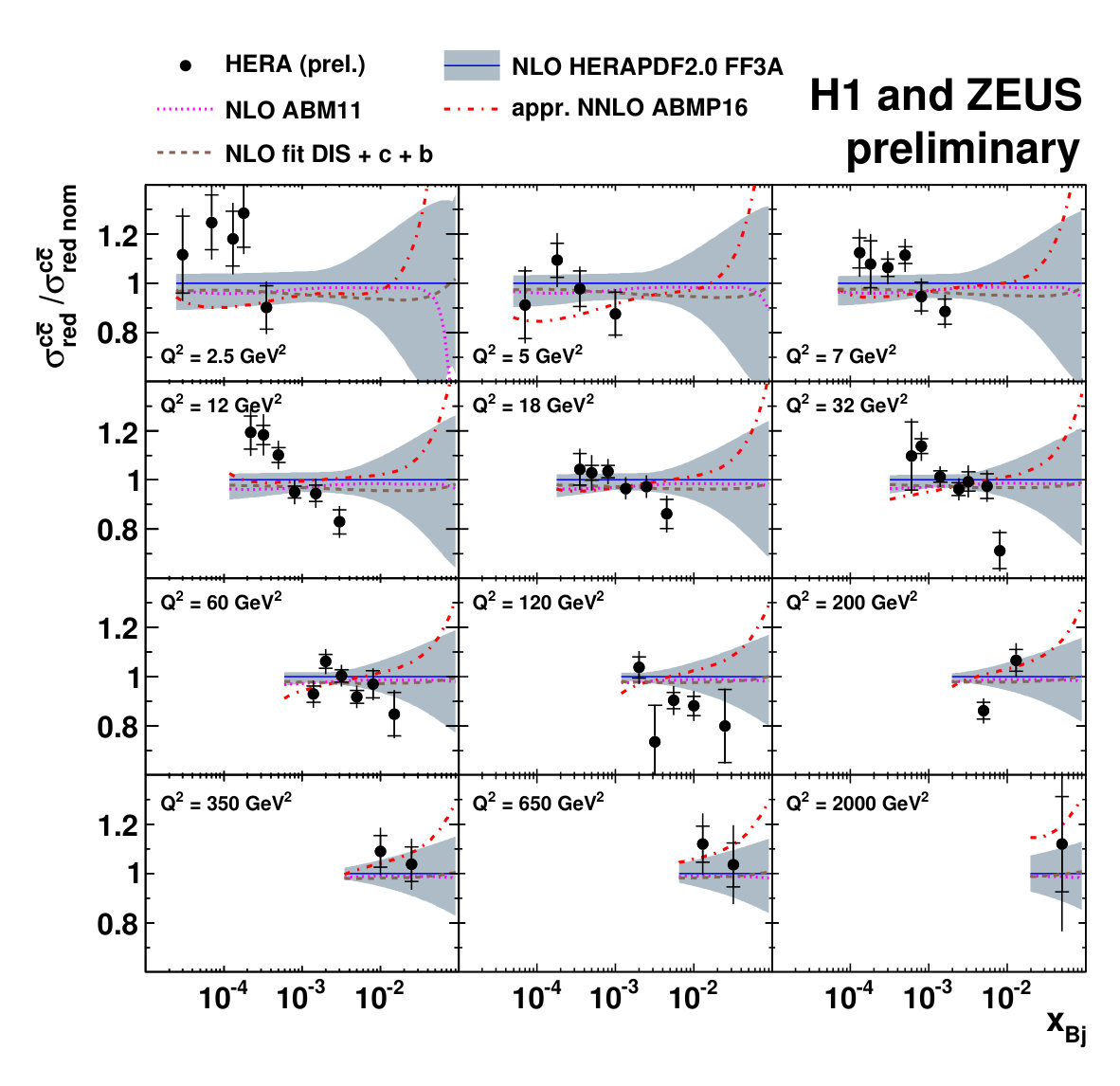 Figure 11
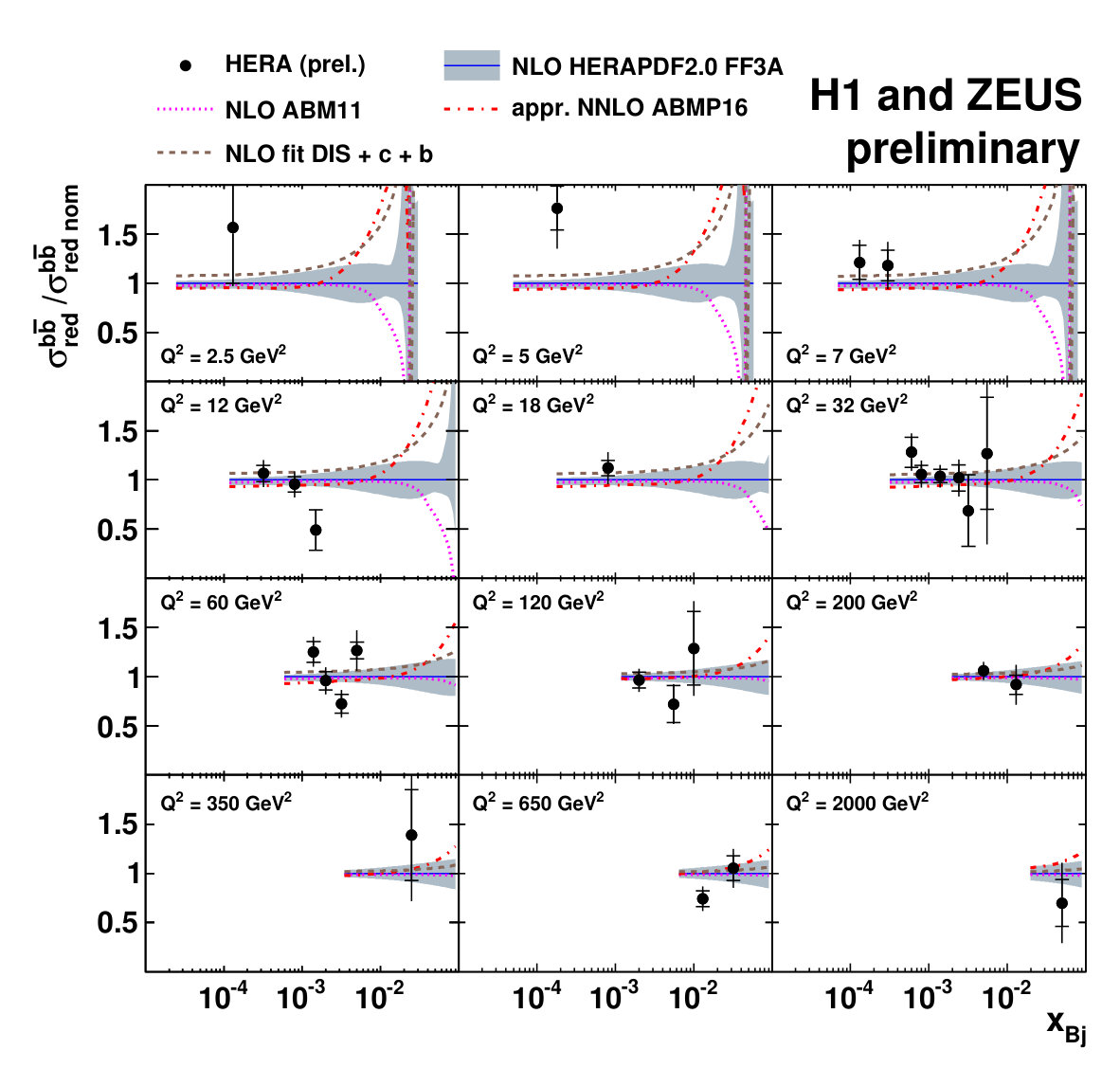 Figure 12
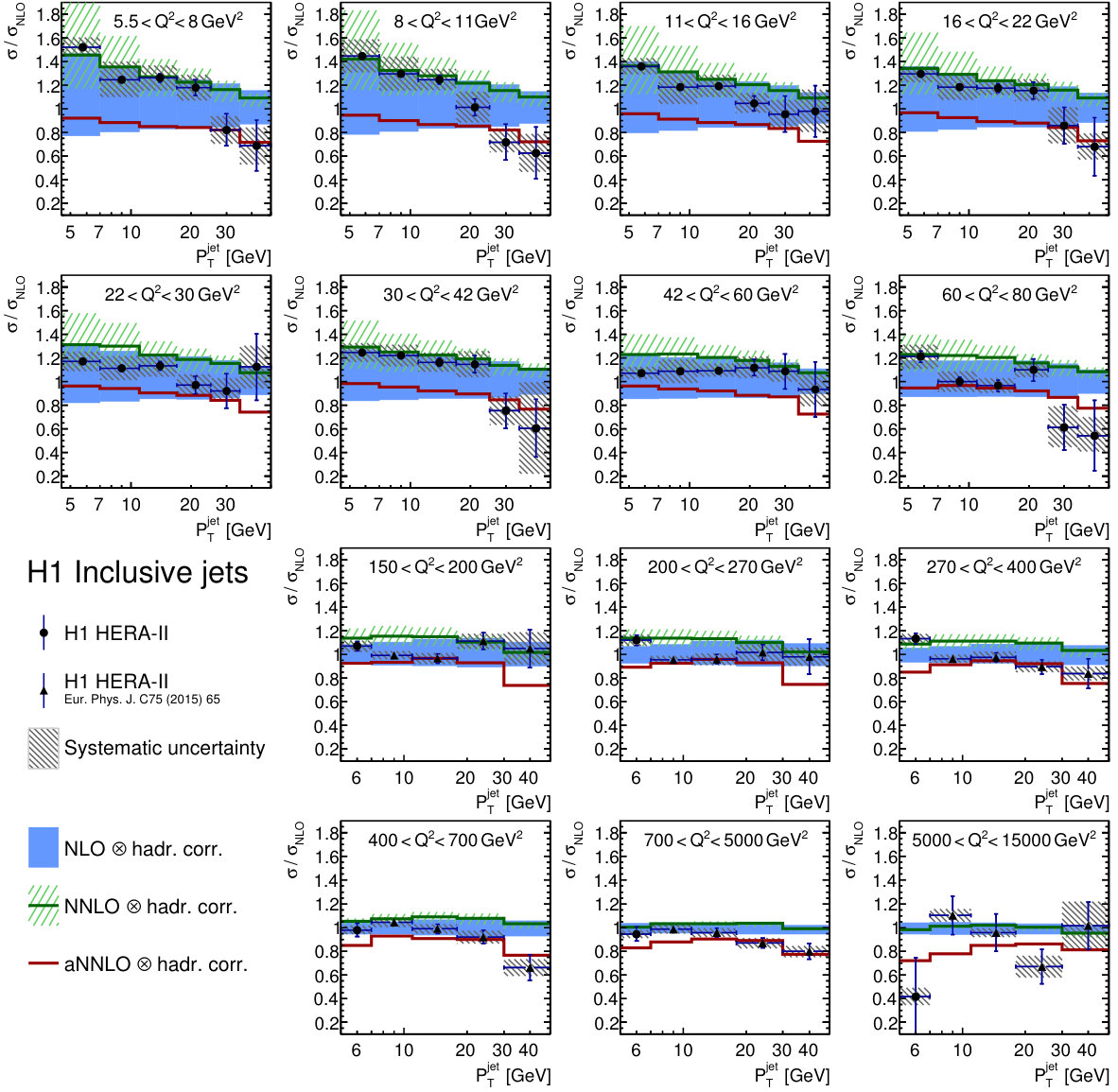 Figure 5
 Figure 6
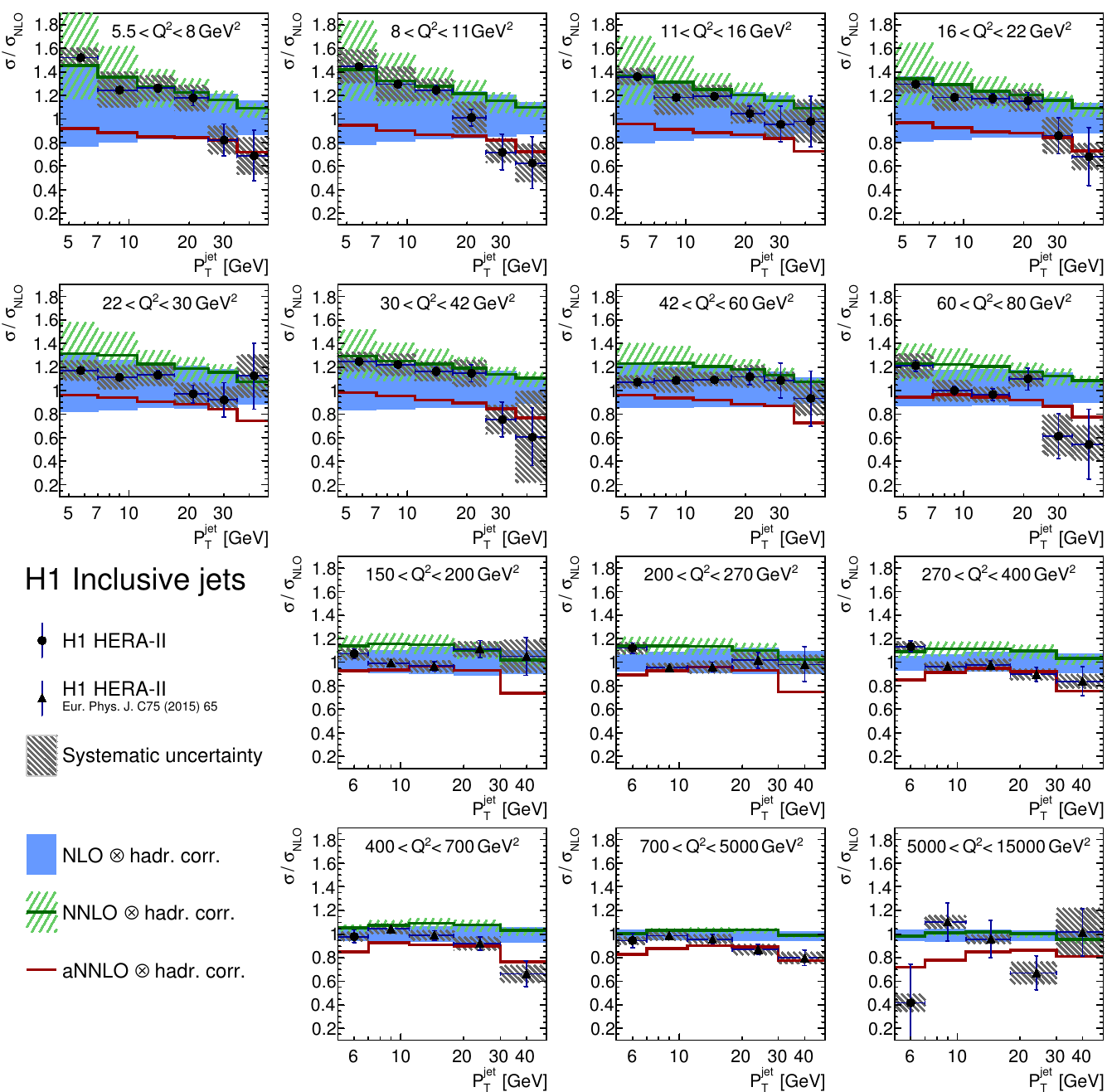 Figure 7
 Figure 8
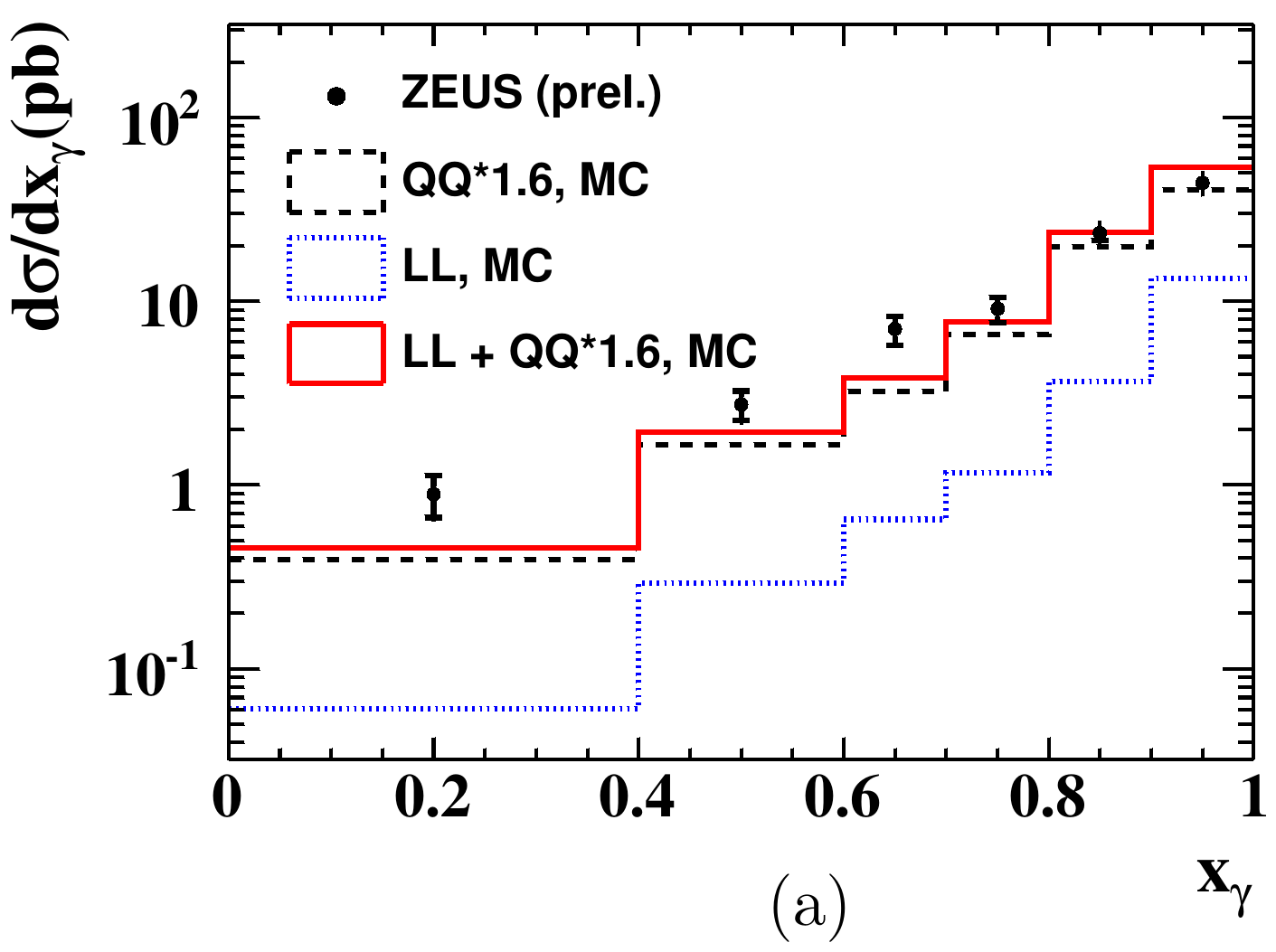 Figure 9
Peer Reviews
No public reviews on file for this paper yet. If you reviewed it on a platform where reviews are public (OpenReview, ICLR, NeurIPS, ICML), you can paste yours below so the community can read it here.
Videos
No videos yet. Explain this paper in a talk, walkthrough, or lecture? Add one.
QCD Results from HERA
D. BRITZGER for the H1 and ZEUS Collaborations
DESY, Notkestr. 85, 22607 Hamburg, Germany
Abstract
New results on the measurements of the hadronic final state in neutral-current deep-inelastic scattering at HERA are presented. A combination of reduced charm and beauty cross sections is presented and the masses of the heavy quarks are determined to and . The measurement of the production of prompt photons accompanied by a jet provides a precise test of QCD predictions. Measurements of jet production cross sections are presented and compared for the first time to next-to-next-to-leading order predictions (NNLO). The strong coupling constant is determined from inclusive jet and dijet production cross sections using NNLO predictions to .
1 Introduction
At the HERA collider electrons or positrons were collided with protons at a centre-of-mass energy of . The two multi-purpose experiments H1 and ZEUS collected data until 2007 with an integrated luminosity of about per experiment. The exploration of the hadronic final state in neutral-current (NC) DIS events, such as the study of jets, heavy quarks or photons produced in these events, provides precise constraints on QCD parameters.
2 Charm and Beauty Cross Sections
Multiple measurements of open charm and beauty production cross sections have been performed by the H1 and ZEUS experiments during different data-taking periods and using different tagging techniques. A previous combination [1] of charm cross sections is extended, taking new data into account, and also beauty cross sections are combined for the first time [2]. This provides a consistent data set of reduced charm and beauty cross sections, and , in the kinematic range of photon virtuality and Bjoerken- of .
The reduced cross sections which are input to the combination are obtained by extrapolating the visible cross sections to the nearest point of a (,) grid using NLO predictions by the HVQDIS program. The combination algorithm accounts for all correlations of the uncertainties and in total 209 charm and 57 beauty measurements are combined simultaneously to 52 reduced charm and 27 reduced beauty cross sections. The combination yields a value of for 187 degrees of freedom, thus indicating good consistency of the individual data. The combined data have significantly reduced uncertainties. The data are compared to NLO predictions using the HERAPDF2.0FF3A or the ABM11 PDF sets, as well as to approximate NNLO predictions using the ABMP16 PDF set in figure 1. All predictions are found to give a reasonable description of the data, with only small differences between the studied predictions.
A QCD analysis of the combined charm and beauty reduced cross sections together with the combined HERA inclusive DIS data [3] is performed, where the predictions are calculated by the QCDNUM and OPENQCDRAD programs in NLO accuracy. The methodology follows closely the approach of HERAPDF2.0FF3A [3], employing the fixed-flavour scheme with three active flavours at all scales, but in addition the masses of the charm and beauty quarks are free parameters to the fit. In this fit the running charm and beauty quark masses are determined to
[TABLE]
where the uncertainties indicate experimental uncertainties, model uncertainties (mod), mainly dominated by scale variations by factors of 2, and parameterisation uncertainties (par), which are determined using fits with extended parameterisations of the PDFs. The inclusive DIS data alone cannot reliably constrain the quark masses. The results are consistent with other determinations.
3 Isolated photons accompanied by jets in DIS
The production of isolated photons in events with at least one jet is measured in NC DIS in the kinematic region of . Photons were measured with transverse energy and pseudorapidity , and jets with and . The analysis complements earlier measurements of isolated photon production in NC DIS [4], and now differential cross sections as functions , , , , and are provided, where the observables denote the fraction of the incoming photon energy that is given to the photon and the jet, the fraction of proton energy taken by the interacting parton, and the azimuthal angles or rapidity differences between the photon and the jet or the scattered lepton, respectively. The cross sections are compared to Monte Carlo predictions by Djangoh+Pythia, where the photons radiated off a quark line are scaled by a factor of 1.6. These predictions provide a good description of the studied distributions [5], as exemplarily displayed in figure 3. The cross sections are further compared to predictions based on the factorisation method, which appear to have some problems in describing all measured distributions equally well.
4 Jet cross sections in DIS
Cross sections for jet production are measured in NC DIS in the Breit frame and exhibit a direct sensitivity to the strong coupling constant and to the gluon content of the proton. New measurements of jet production cross sections in NC DIS have been performed in the kinematic region and inelasticity . These are inclusive jet cross sections measured as a function of and jet transverse momentum, , as well as dijet and trijet cross sections measured as functions of and the average of the two or three leading jets [6]. Furthermore, the kinematic range of an earlier measurement of inclusive jet cross sections [7] at higher values of is extended to lower values of . The data are compared to NLO, to approximate NNLO and to next-to-next-to-leading order (NNLO) predictions [8], whenever available. The ratio of inclusive jet cross sections to NLO calculations together with other predictions is displayed in figure 3. The predictions are in general found in good agreement with the data within the experimental and theoretical uncertainties. The NNLO predictions improve significantly the description of inclusive jet and dijet cross sections as compared to NLO predictions in particular at lower scales and they also exhibit reduced scale uncertainties. Measurements of jet cross sections normalised to the inclusive NC DIS cross section in the respective interval further improve the experimental precision, since experimental uncertainties cancel partially.
5 Strong coupling constant at NNLO from jet cross sections
The strong coupling constant is determined in a fit of NNLO predictions [8] to inclusive jet and dijet cross sections measured by the H1 experiment during different data taking periods and different center-of-mass energies [9]. Altogether five data sets of inclusive jet cross sections and four data sets of dijet cross sections are considered and the data covers a range of momentum transfer of and jet transverse momenta of . Jets are defined by the jet-algorithm with a parameter and are contained within the pseudorapidity range . The -extraction methodology accounts for the -dependence of the hard coefficients, as well as the -dependence of the PDFs [9]. The latter is predicted by the factorisation theorem and it is taken as such into account in the fit. This provides an increased sensitivity to at lower scales, but a decreased sensitivity at higher scales.
Values of are determined in fits to the individual data sets, and in fits to all inclusive jet and dijet measurements as displayed in figure 5. These values are found to be consistent.
The value of determined in a fit to inclusive jet and dijet cross sections is found to be
[TABLE]
where uncertainties on the PDF, the choice of the PDF set (PDFset), the value of as input to the PDF extraction (PDF), the uncertainty on the hadronisation correction, and uncertainties due to scale variations by factors of 2, are considered. The value of is consistent with the world average value of . The dominating uncertainty arises from scale variations of the NNLO predictions.
The running of the strong coupling constant is determined by repeating the fits to groups of data points at similar scales. The results are displayed in figure 5 and compared to other extractions in at least NNLO accuracy. Good agreement with the QCD expectation and other determinations is found.
6 Summary and conclusions
Several years after ending of data taking at the HERA accelerator the H1 and ZEUS experiments have transformed their analysis frameworks into a long-term usable computational environment and provide new measurements and also combinations of previously published results. New theoretical developments, such as full next-to-next-to-leading order calculations for jet production, can thus be explored together with new data and precision QCD results are obtained, such as precision determinations of the strong coupling constant, , or the masses of heavy quarks.
References
- [1] H. Abramowicz et al. [H1 and ZEUS Collaborations], Eur.Phys.J. C73 (2013) 2, 2311, [arXiv:1211.1182].
- [2] H1 and ZEUS Collaborations, H1 and ZEUS preliminary report, H1prelim-17-071, ZEUS-prel-17-01 (2017).
- [3] H. Abramowicz et al. [H1 and ZEUS Collaborations], Eur.Phys.J. C75 (2015) 12, 580, [arXiv:1506.06042].
- [4]
S. Chekanov et al. [ZEUS Collaboration], Phys. Lett. B687 (2010) 16;
H. Abramowicz et al. [ZEUS Collaboration], Phys.Lett. B715 (2012) 88, [arXiv:1206.2270].
- [5] ZEUS Collaboration, ZEUS preliminary report, ZEUS-prel-16-001 (2016).
- [6] V. Andreev et al. [H1 Collaboration], Eur.Phys.J. C77 (2017) 4, 215, [arxiv:1611.03421].
- [7] V. Andreev et al. [H1 Collaboration], Eur.Phys.J. C75 (2015) 2, 65, [arxiv:1406.4709].
- [8]
J. Currie et al., Phys.Rev.Lett. 117 (2016) 4, 042001, [arXiv:1606.03991];
J. Currie et al., [arXiv:1703.05977]; J. Niehues et al., these proceedings.
- [9] H1 Collaboration and V. Bertone et al., H1 preliminary report, H1prelim-17-031 (2017).
The reference list from the paper itself. Each links out to its DOI / PubMed record.
- 1[1] H. Abramowicz et al. [H 1 and ZEUS Collaborations], Eur.Phys.J. C 73 (2013) 2, 2311, [ar Xiv:1211.1182].
- 2[2] H 1 and ZEUS Collaborations, H 1 and ZEUS preliminary report, H 1prelim-17-071, ZEUS-prel-17-01 (2017).
- 3[3] H. Abramowicz et al. [H 1 and ZEUS Collaborations], Eur.Phys.J. C 75 (2015) 12, 580, [ar Xiv:1506.06042].
- 4[4] S. Chekanov et al. [ZEUS Collaboration], Phys. Lett. B 687 (2010) 16; H. Abramowicz et al. [ZEUS Collaboration], Phys.Lett. B 715 (2012) 88, [ar Xiv:1206.2270].
- 5[5] ZEUS Collaboration, ZEUS preliminary report, ZEUS-prel-16-001 (2016).
- 6[6] V. Andreev e t al. [H 1 Collaboration], Eur.Phys.J. C 77 (2017) 4, 215, [arxiv:1611.03421].
- 7[7] V. Andreev e t al. [H 1 Collaboration], Eur.Phys.J. C 75 (2015) 2, 65, [arxiv:1406.4709].
- 8[8] J. Currie e t al., Phys.Rev.Lett. 117 (2016) 4, 042001, [ar Xiv:1606.03991]; J. Currie e t al., [ar Xiv:1703.05977]; J. Niehues e t al., these proceedings.