Diffusion in time-dependent random media and the Kardar-Parisi-Zhang equation
Pierre Le Doussal, Thimoth\'ee Thiery

TL;DR
This paper explores how diffusion in time-dependent random media relates to the KPZ universality class, predicting universal fluctuation distributions across dimensions and verifying these predictions numerically.
Contribution
It provides a continuum and lattice model framework linking diffusion in random media to KPZ universality, including predictions of universal distributions in various dimensions.
Findings
GOE Tracy-Widom distribution for 1D transition probability fluctuations
Phase transition from Gaussian to KPZ fluctuations in 3D with increasing bias
KPZ universal distributions for first particle arrival times
Abstract
Although time-dependent random media with short range correlations lead to (possibly biased) normal tracer diffusion, anomalous fluctuations occur away from the most probable direction. This was pointed out recently in 1D lattice random walks, where statistics related to the 1D Kardar- Parisi-Zhang (KPZ) universality class, i.e. the GUE Tracy Widom distribution, were shown to arise. Here we provide a simple picture for this correspondence, directly in the continuum as well as for lattice models, which allows to study arbitrary space dimension and to predict a variety of universal distributions. In we predict and verify numerically the emergence of the GOE Tracy-Widom distribution for the fluctuations of the transition probability. In we predict a phase transition from Gaussian fluctuations to 3D-KPZ type fluctuations as the bias is increased. We predict KPZ universal…
Click any figure to enlarge with its caption.
 Figure 1
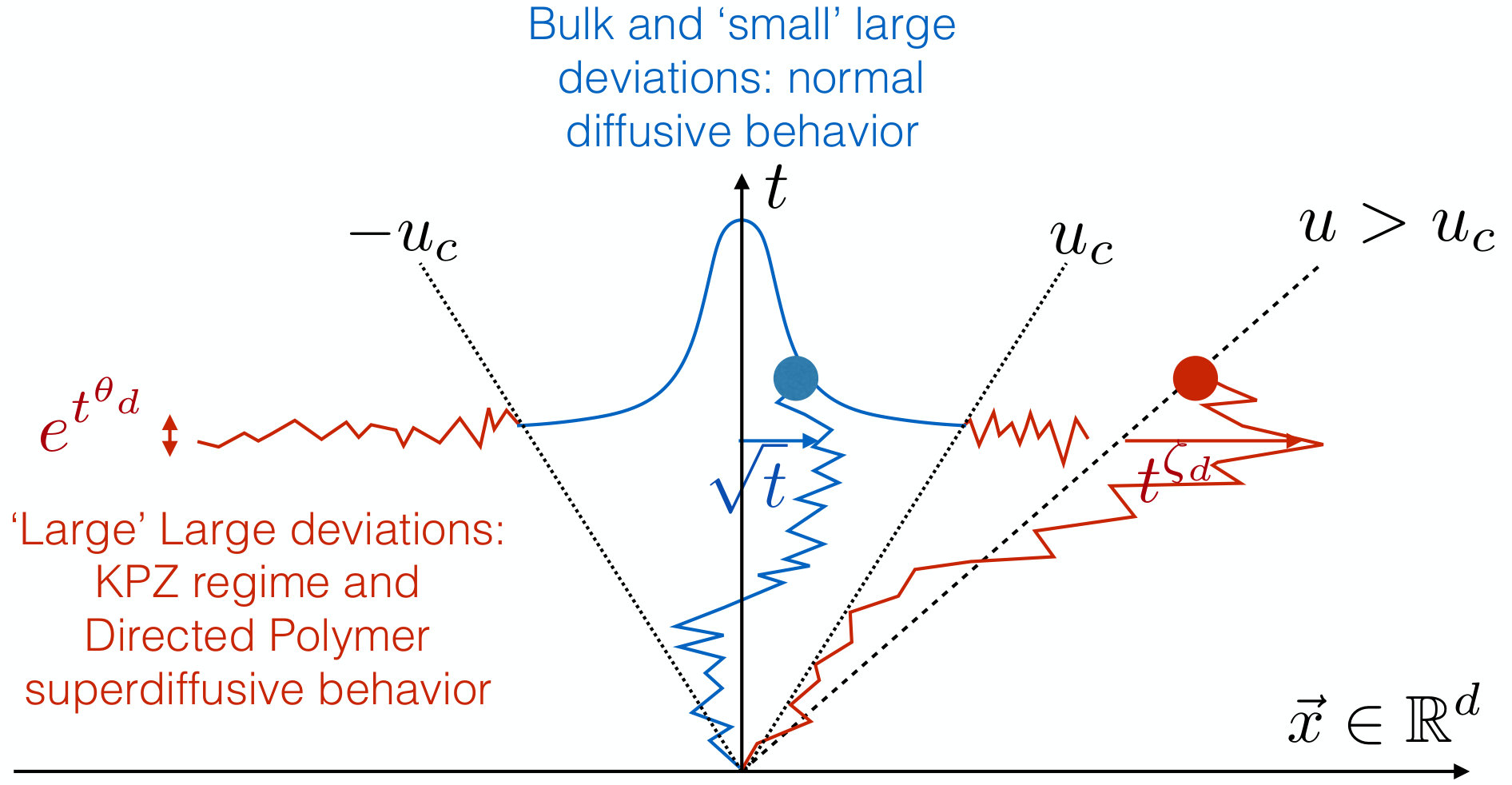 Figure 2
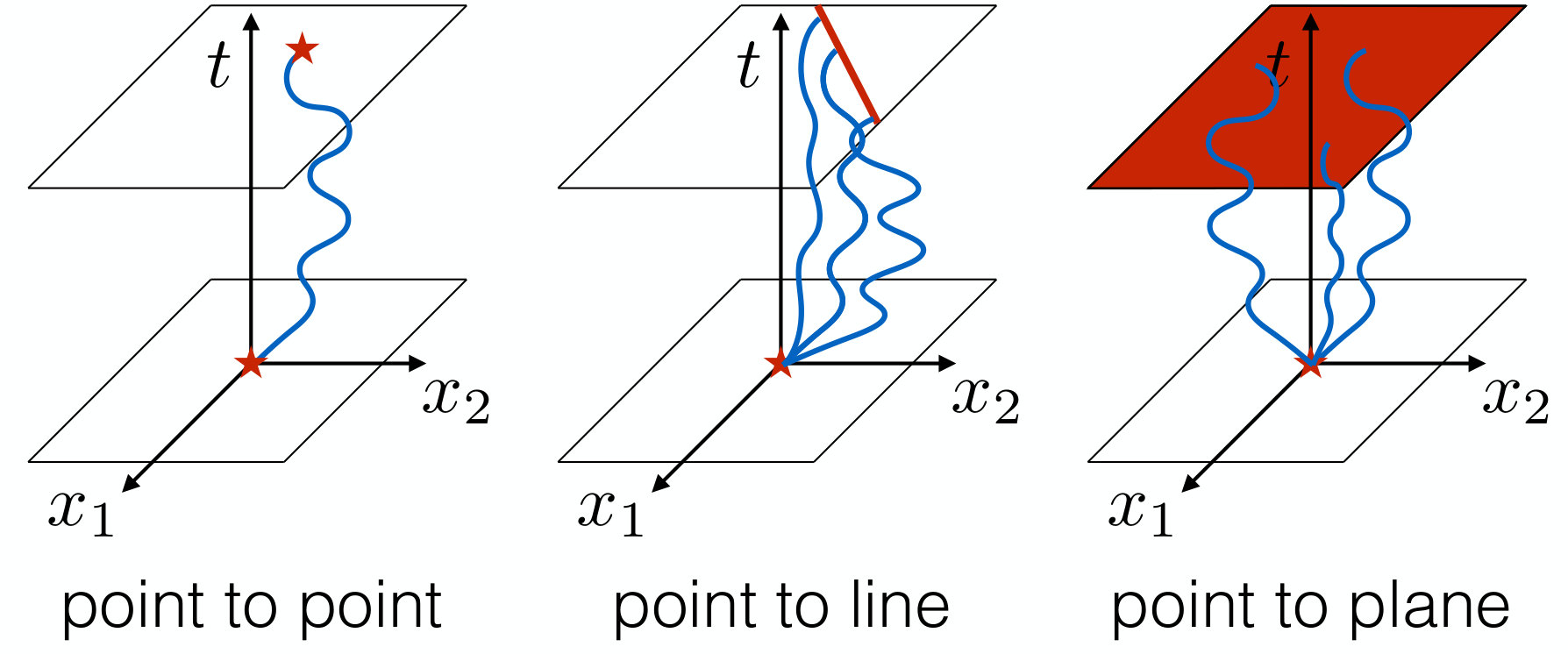 Figure 3
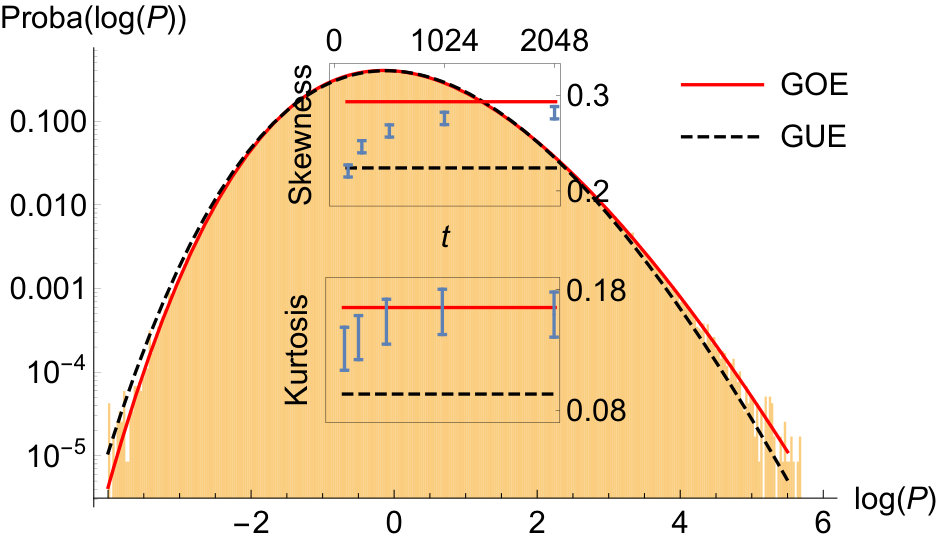 Figure 4
Peer Reviews
No public reviews on file for this paper yet. If you reviewed it on a platform where reviews are public (OpenReview, ICLR, NeurIPS, ICML), you can paste yours below so the community can read it here.
Videos
No videos yet. Explain this paper in a talk, walkthrough, or lecture? Add one.
Diffusion in time-dependent random media and the Kardar-Parisi-Zhang equation
Pierre Le Doussal
CNRS-Laboratoire de Physique Théorique de l’Ecole Normale Supérieure, 24 rue Lhomond,75231 Cedex 05, Paris, France
Thimothée Thiery
Instituut voor Theoretische Fysica, KU Leuven
Abstract
Although time-dependent random media with short range correlations lead to (possibly biased) normal tracer diffusion, anomalous fluctuations occur away from the most probable direction. This was pointed out recently in 1D lattice random walks, where statistics related to the 1D Kardar-Parisi-Zhang (KPZ) universality class, i.e. the GUE Tracy Widom distribution, were shown to arise. Here we provide a simple picture for this correspondence, directly in the continuum as well as for lattice models, which allows to study arbitrary space dimension and to predict a variety of universal distributions. In we predict and verify numerically the emergence of the GOE Tracy-Widom distribution for the fluctuations of the transition probability. In we predict a phase transition from Gaussian fluctuations to 3D-KPZ type fluctuations as the bias is increased. We predict KPZ universal distributions for the arrival time of a first particle from a cloud diffusing in such media.
Introduction Diffusion in random media arises in numerous fields, e.g. oil exploration in porous rocks porous , spreading of pollutants in inhomogeneous flows ParticlesFlows , diffusion of charge carriers in conductors bernasconi , relaxation properties of glasses trap , defect motions in solids, econophysics, population dynamics BMG2000 ; Wealth . Many works have studied time independent, i.e. static, random environments Review1 , in Static1D or in higher dimensions, with short-range (SR) StaticD-SR ; Lawler of long-range (LR) spatial correlations StaticD-LR . It was found that static disorder with SR correlations is generically irrrelevant above the upper-critical dimension , leading to normal diffusion in , while LR disorder can lead to anomalous diffusion in any .
Another important class of random media are time-dependent. These have been studied e.g. in the context of wave propagation BouchaudTimeDep , dispersion of particles in turbulent flows ParticlesFlows (the famous Richardson’s law Richardson ), and in the problem of the passive scalar PassiveScalar . The latter cases involve long range correlations in the flow, and lead to anomalous transport or multiscaling. The, a priori more benign, case of SR space-time correlations has received much attention recently in probability theory, within random walks in time-dependent random environments (TD-RWRE). Although then , and the diffusion is proved to be normal (in a given sample math1 ), interesting effects were demonstrated, such as a tendency for walkers in the same sample to coalesce Nwalkers , anomalous fluctuations RAP and large deviations LargeDev . Note that TD-RWRE can be generated in a purely static environment by considering directed random walks.
An a priori unrelated topic is stochastic growth and the celebrated Kardar-Parisi-Zhang (KPZ) equation KPZ
[TABLE]
where is the interface height at time and point , is the diffusivity, is the driving noise which, for most of our applications, will be SR space-time correlated. The non-linearity leads to a a non-trivial fixed point and exponents for the scaling of the fluctuations at large time, i.e. , with and from Galilean symmetry kardar1987scaling . The continuum KPZ equation (1) is at the center of a vast universality class including discrete growth models PrahoferSpohn2000 , particle transport models KrugReview , dimer covering, directed polymers kardar1987scaling ; Johansson2000 and more, subject in of much recent progress, due to discovery of integrable and determinantal properties CorwinReviews . Beyond exponents , the statistics of was shown to be related to the universal Tracy-Widom (TW) distributions of random matrix theory TW1994 , with e.g. the GUE (resp. GOE) TW distribution for growth starting from a droplet droplet (resp. a flat interface). For general little is known exactly, but scaling exponents and universal distributions were obtained numerically in halpin2012-2D ; halpin2012-1D ; Parisi2016 and, in some cases, compared with experiments halpin-kaz-review .
Recently, Barraquand and Corwin obtained an exact solution of a discrete TD-RWRE on with SR correlated jump probabilities, the so-called Beta polymer. The sample to sample fluctuations of the logarithm of the cumulative BarraquandCorwinBeta and transition usBeta probability distribution function (PDF) in the large deviations regime of the RW, ie. looking away from the most probable direction, were found to be distributed with the characteristic KPZ exponent and GUE TW distribution111Note also the upcoming work SeppalainenInprep on the roughness of random walk paths in the Beta polymer model.. This was followed by a proof of the universality of the 1D KPZ equation for the diffusive scaling limit of TD-RWRE on with weak disorder CorwinRWREWeakU .
These recent results hint at a general connection between TD-RWRE and KPZ growth. The aim of this Letter is to unveil a simple and general mechanism that explains the appearance of KPZ-type fluctuations in the TD-RWRE problem, beyond exactly solvable models, and for general . Our main result is that we conjecture the emergence of KPZ fluctuations everywhere in the large deviations regime of TD-RWRE in dimension , and a a phase transition in between a low-fluctuations phase for small large deviations and a phase with KPZ class high-fluctuations for large large deviations (see Fig. 1). We first consider the problem in the continuum setting, and then on the lattice . Using the emerging picture, we identify in a natural setting where GOE TW type distribution for the fluctuations of the logarithm of the PDF are expected. This is explicitly checked using simulations of a discrete model. We finally discuss the emergence of KPZ-related universality in the extreme value statistics of random walker diffusing in the same time-dependent random environment: universality of the PDF of the largest distance travelled by a particle in a cloud of pollutant diffusing in a non-homogeneous atmosphere and of the PDF of the first arrival time of the cloud in a given domain.
Main analysis We consider the Langevin equation for the diffusion of a particle in a dimensional time-dependent random force field , with and the uniform applied force,
[TABLE]
with a thermal Gaussian white noise, , and is the bare diffusion coefficient. Here and below refers to the average over thermal fluctuations , and over the disorder .
In a given random environment (i.e. sample) one defines the transition probability for a particle which starts at at time to end up to position at time . It is convenient for now to consider the (backward) transition probability that a particle starting at position at time , ends up at the origin at time [math] (the forward is considered later). The latter obeys the following random backward Kolmogorov equation
[TABLE]
with final condition . For simplicity we focus on being a space-time Gaussian white noise (interpreting (3) in the Îto sense) with variance
[TABLE]
where the parameter has dimension of a length. Our results on the large scale properties should hold for more general distribution of the disorder, as long as correlations of are short-ranged in space and time. Eq.(4) can be thought of as an approximation of more realistic models. One is a continuum model with disorder of (dimensionless) magnitude , a finite correlation length , and a finite correlation time . In that case with and two dimensionless rapidly decaying functions, and one relates to the space-time correlation volume of the noise as . Another is to see the continuum model as a limit of a discrete model, and to interpret as the lattice spacing.
In the following we analyze this RW locally around a given space-time direction (moving frame velocity) , i.e. for with . This is equivalent to looking around the origin in the model with an effective bias : using the equality in law between white noises one gets . We drop the subscript in unless needed, but should thus be thought of as a control parameter analogous to the velocity of the frame of observation compared to the mean velocity of the particles. We first note that the averaged value of the transition probability is equal to the transition probability of a RW in the averaged environment222This is due to the delta correlations in time in (4) and to the Îto prescription. As a consequence the bare values of and (or ) are not renormalized. A small but finite leads to small corrections to these values., hence it is Gaussian and given by . The regime is thus characterized by an exponential decay of the averaged probability: , hence corresponds to a large deviation regime, far away from the bulk of the probability, i.e. the optimal direction of the RW . To study the local fluctuations around this average profile of the probability, we introduce the partition-sum and height as
[TABLE]
Inserting (5) in (3) we obtain
[TABLE]
with the ‘droplet’ initial condition . In (6), (7) we have introduced the ‘directed polymer (DP) noise term’
[TABLE]
It is a Gaussian white noise with and, noting the norm of the bias,
[TABLE]
The equations (6)-(7), contain two (mutually correlated) noises. While the second source of noise (last term) is a signature of the RW nature of the problem (it is already present in the original backward Kolmogorov equation (3)), the first was generated by our rescaling of the transition probability (5) and is a signature of the fact that we are looking at the large deviation regime: it is the only term in (6)-(7) that depends on . A crucial observation is that if, in a first stage (justified below), one neglects the second source of noise, the equations (6) and (7) become respectively the multiplicative stochastic-heat-equation (MSHE) and the KPZ equation (1). The solution of the MSHE is known to be the partition sum of the continuum directed polymer problem, i.e. the equilibrium statistical mechanics at temperature of directed paths of length , with fixed endpoints and in a quenched random potential . It can formally be written as a path-integral
[TABLE]
while the solution of the KPZ equation with the so-called droplet initial condition is given by , the two problems hence being, as is well known, equivalent.
The emergence of the MSHE and KPZ equations in this problem is at the core of the connection between TD-RWRE and the KPZ universality-class (KPZUC). The rescaling (5) takes into account the deterministic influence of the bias and (6) sheds light on the peculiar nature of the bias-induced fluctuations of the transition probability. In the following we argue that these fluctuations dominate the statistical properties of at large scale, hence those of , and that is the mechanism that is responsible for the emergence of KPZ type-fluctuations.
Let us now explore some consequences of this connection in the DP language, which is more adapted to the physics of the RW problem in terms of space-time paths. It is well known kardar1987scaling ; Monthus that the DP exhibits a phase transition as a function of the noise strength between: (i) a diffusive phase at small where polymer paths are diffusive and do not feel the influence of the disorder; (ii) a pinned phase at large where directed polymer paths are superdiffusive with the universal (dimension-dependent) roughness exponent. While in the diffusive phase the fluctuations of the DP free-energy are small, , in the pinned phase the DP optimizes its energy: the partition sum is concentrated on a few optimal paths and the fluctuations of the DP free-energy scale with the length as with . While for there is a transition at a non-trivial value 333The existence of an upper-crical dimension where has not yet been settled, in and the system is always in the pinned phase.
We now argue, using the interface language, that the second source of noise in (6)-(7) is always irrelevant in the pinned phase at large time. In this phase the KPZ field displays scale invariant fluctuations and we can rescale with large and and the dynamic and roughness exponent of the KPZUC, with . From the scale invariance of the Gaussian white noise, under rescaling the second source of noise in (7) receives an additional factor as compared to the first one. This heuristic suggests that the second source of noise is irrelevant as long as . This condition is always satisfied in the rough phase, with in and decreases with .
This leads us to the following conjecture. In the RW problem, looking locally444Note that in a sense the conservation of probability of the random walk problem seems to be lost in the KPZ regime. This is only because the mapping to KPZ only holds locally in the large deviation region . Everywhere in that region the probability mass escapes towards the most probable direction, where the equivalence to KPZ breaks down. in the large deviation region , the system undergoes a phase transition as a function of the bias from: (i) a diffusive phase for where the local fluctuations of are and the random walk paths are diffusive with the same law as the RW in an averaged environment (for this was shown rigorously in math1 ); (ii) a pinned phase for where has larger fluctuations scaling as and random walk paths are superdiffusive with the DP roughness exponent . In addition the full multi-point distribution of at large are expected to be universal and identical to those of the free-energy of the DP problem in the pinned phase. Furthermore in and in we can give an estimate of the transition point. For the KPZ equation (1), renormalization group (RG) calculations indicate that the transition for occurs for the dimensionless coupling555 where is the -dimensional unit sphere area. of order : , with a short distance cutoff KPZ ; FreyTauber . Translating into the RW with we find , which provides an estimate for . As we mentionned the bias also incorporates the effect of looking at the problem in a moving frame of velocity . The phase transtion can thus be driven by and occurs when : the pinned phase occurs everywhere in space outside a ‘light-cone’ around the optimal direction of the RW (see Fig. 1). This picture agrees with known results. It was indeed shown in yilmaz1 ; yilmaz2 ; yilmaz3 that the annealed and quenched large deviations rate functions of an unbiased lattice RW, respectively defined as , and satisfy the following properties: (i) (optimal direction); (ii) in and for large enough in ; (iii) for small enough in . This confirms our scenario of a transition in , and our arguments show that the strong bias phase is in the KPZ class.
Scales and crossovers Let us now discuss the scale at which KPZUC emerges, first in the simpler one-dimensional case. To that aim, note that rescaling time, space and height in (7) as , and with the characteristic scales , and , leads to a rescaled KPZ-like equation for identical to (1) with , , up to the second source of noise of (7) which now involves a unit white noise multiplied by the dimensionless ratio . Hence for (weak-bias/weak-noise or large diffusivity limit) the ‘deformed’ KPZ-equation (7) becomes equivalent to the standard KPZ equation (this is reminiscent of the ‘weak-universality’ of the KPZ equation). Hence in this weak bias regime, we can apply the known results for the continuum KPZ equation, see SM . Thus, for , we predict that the KPZUC appears in the RW problem. At short scale , the behavior of the height in the KPZ equation becomes similar to the Edward-Wilkinson (EW) behavior gueudre2012short . In the RW problem we expect by inspection of (7) that the first source of noise (bias) dominates for while the second (diffusion) dominates for (with an associated time-scale ). We conclude that for there is a regime and where one can already neglect the second source of noise but KPZUC type fluctuations have not yet been build up: this should be an EW regime666We note that links between the Edward-Wilkinson universality class and the TD-RWRE have already been studied, see RAP ; RAP2 . This however seems very different from what we discuss here., see Fig. 2.
In general the scale at which the bias starts to dominate remains and , but the scales and where KPZ fluctuations emerge change. For example in disorder is marginally relevant and from RG KPZ ; FreyTauber ; NelsonPLD one has with here (see above) , and for the RW we take . For the scales are well-separated and we similarly expect an intermediate EW regime of fluctuations.
Discrete models To show the versatility of our argument, we now consider discrete models of TD-RWRE on . We note777Here and in the following the index emphasizes the discrete nature of the coordinate. the position of the random walker at time . At , the particle jumps, , with probability . Here is the set of unit translation vectors on the lattice and gives the jump direction. The are independent (except if they leave from the same site, where ) and identically distributed (iid). We suppose that these are biased: with at least some of the different from [math], and introduce the centered random variables . As in the continuum we consider , the probability that a particle starting at at time hits the origin at time [math]. Introducing a lattice spacing , we now estimate the KPZ noise that appears in this discrete RW model when rescaled diffusively around the diagonal of the lattice with and ( is a diagonal matrix), rescaling also the discrete noise as . In SM we show along the same line than in the continuum that the partition sum variable
[TABLE]
with , and satisfies the MSHE with a Gaussian white noise of strength given by
[TABLE]
with . Note that the lattice spacing still appears in this expression. In the result reads and one can obtain a finite limit as by taking : this is a weak-noise limit and there the convergence to the MSHE is an exact result (similar but different from CorwinRWREWeakU ) that we check in SM using the Beta polymer. To compare with the continuum one should also rescale the discrete bias with the lattice spacing by taking (see SM ) and keeping . In that case one obtains a small noise , in complete analogy with the continuum in (8) if one takes . In general (12) should be considered as an estimate of the DP noise felt in this discrete setting that, in the scaling , coincides with the continuum result (8), but also generalizes it in the large bias regime where the continuum model does not apply anymore.
Universal distributions It is useful to extend our analysis to the forward transition probability . It satisfies the Fokker-Planck equation . Considering again the ‘partition sum variable’ generates additional noise terms in this equation and our arguments can be repeated (see SM ): the statistical properties of at large scale are identical to those of the DP partition sum. In fact note that in law we must have .
We can also consider different initial/final conditions in the forward/backward setting. This is of great interest since the KPZUC is splitted in sub-universality classes CorwinReviews that depend on the boundary conditions, and we thus predict universal distributions for the fluctuations of or according to the chosen boundary conditions. These were determined numerically in halpin2012-2D and are known analytically in , on which we now focus. Using our argument and KPZ universality, we conjecture that the appropriately rescaled fluctuations of and are universal in the large-deviation region and distributed as a TW GUE random variable CorwinReviews . This has already been observed analytically and numerically for the exactly solvable Beta polymer, see BarraquandCorwinBeta ; usBeta . For the continuum model (2)-(4) in the absence of bias, , but in a moving frame, we obtain (using droplet , see SM ) a sharp prediction for
[TABLE]
where and , estimates valid in the weak bias limit , i.e. . These arguments extend SM using the KPZ equation at finite . They indicate an intermediate regime between typical Gaussian diffusion and the large deviation regime. Defining the dimensionless variable through , a crossover from EW to KPZ fluctuations in (13) occurs as increases. The crossover to diffusion occurs for and we predict on that scale fluctuations : fluctuations decay with time and we retrieve that converges (almost surely) to in this regime.
We now make a prediction related to the flat KPZ sub-universality class, which as yet has never been observed in the TD-RWRE context. It is known that the large time fluctuations of the logarithm of the solution of the MSHE with flat initial condition , properly scaled, are distributed according to a GOE Tracy-Widom random variable . Here it means that we must start the RW with the initial888Here we adopt the forward setting. Indeed, observing GOE fluctuations in the backward case requires imposing the final probability which does not seem possible. probability distribution given by . While non-normalizable in the infinite space, it is a natural initial condition on an interval of length with reflecting boundary conditions, : it is the stationary measure of the RW in the absence of disorder. Turning on the disorder at we predict that at large time (in the regime to avoid the influence of the boundaries), fluctuates as , where we-flat when . This scenario, and its universality, is checked explicitly through simulations of a dimensional discrete TD-RWRE, see Fig.4.
Extreme value statistics An important application of the large deviation regime of the RW where the KPZUC emerges, is to extreme value statistics. Consider independent walkers starting at the origin at with no bias, . We define the position of the rightmost walker in the direction of the unit vector . We show SM that the KPZ-universality in the fluctuations of the logarithm of the transition probability, , implies that as with
[TABLE]
then grows ballistically, with equality in law
[TABLE]
Here is the KPZ exponent, is a universal distribution SM characteristic of the point to hyperplane (of dimension ) subuniversality KPZUC (see e.g. halpin2012-2D ). Here and are non-universal, given in the continuum in SM . This is valid if the front velocity , so that KPZUC appears (with in ). A formula such as (15) was rigorously shown in an exactly solvable 1D model in BarraquandCorwinBeta with and a GUE TW random variable. Similarly, the first arrival time at , , of a particle from a cloud of independent particles, behaves, for fixed as
[TABLE]
with the same universal random variable SM . Arrival times in compact domains, i.e. a ball, leads instead to point to point KPZ distribution in any .
Conclusion In this Letter we investigated the origin and consequences of the emergence of universal statistics of the KPZUC in the large deviations regime of TD-RWRE in arbitrary dimension. We focused on short range correlated random media but our method readily extends to long range (LR) spatial correlations SM , leading to the distinct LR space correlated KPZ universality classes KardarLR . Important questions for the future are how LR correlations in time in the medium, and interactions within a cloud of particles, will affect the results, since those are present in many natural examples, such as the atmosphere or the ocean. We hope that this motivates further connections between the fields of growth and diffusion.
Acknowledgments We thank G. Barraquand, I. Corwin and F. Rassoul-Agha for discussions. T.T. has been supported by the InterUniversity Attraction Pole phase VII/18 dynamics, geometry and statistical physics of the Belgian Science Policy. This research was supported in part by the National Science Foundation under Grant No. NSF PHY11-25915 and we acknowledge hospitality from the KITP in Santa Barbara.
The reference list from the paper itself. Each links out to its DOI / PubMed record.
- 1(1) P. P. Mitra, P. N. Sen, L. M. Schwartz, and P. Le Doussal, Diffusion Propagator as a Probe of the Structure of Porous Media , Phys. Rev. Lett. 68 24 3555 (1992).
- 2(2) E. Balkovsky, G. Falkovich, A. Fouxon, Intermittent Distribution of Inertial Particles in Turbulent Flows , Phys. Rev. Lett. 86 , 13, 2790 (2001).
- 3(3) J. Bernasconi, H.U. Beyeler, S. Strassler, S. Alexander, Anomalous Frequency-Dependent Conductivity in Disordered One-Dimensional Systems , Phys. Rev. Lett. 42 (1979) 819.
- 4(4) J.-P. Bouchaud, Weak ergodicity breaking and aging in disordered systems , J. Phys. I (France) 2 (1992), 1705.
- 5(5) I. Giardina, J.P. Bouchaud, M. Mezard, Population dynamics in a random environment , Journal of Physics A: Mathematical and Theoretical, 34 (2001). ar Xiv:cond-mat/0005187.
- 6(6) J.P. Bouchaud, M. Mezard, Wealth condensation in a simple model of economy , Physica A, 282 3–4 (2000). ar Xiv:cond-mat/0002374.
- 7(7) J.P. Bouchaud, A. Georges, Anomalous diffusion in disordered media: Statistical mechanisms, models and physical applications , Phys. Rep. 195 127 (1990).
- 8(8) H. Kesten, M. Koslov, and F. Spitzer, A limit law for random walk in a random environment Compos. Math. 30:145 (1975). Y. Sinai, The Limiting Behavior of a One-Dimensional Random Walk in a Random Medium , Theor. Prob. Appl. 27:256 (1982). J. P. Bouchaud, A. Comtet, A. Georges, and P. Le Doussal, The Relaxation-Time Spectrum of Diffusion in a One-Dimensional Random Medium: an Exactly Solvable Case , Europhys. Lett. 3:653 (1987); Transient relaxation of a charged polymer chain subj