Uniformization and Steinness
Stefan Nemirovski, Rasul Shafikov

TL;DR
This paper proves that the unit ball in complex n-space uniquely covers both Stein and non-Stein strictly pseudoconvex domains, highlighting its special role in complex geometry.
Contribution
It establishes the uniqueness of the unit ball as the universal cover for certain classes of complex domains, linking uniformization and Steinness.
Findings
The unit ball is the only universal cover for both Stein and non-Stein strictly pseudoconvex domains.
This result characterizes the special status of the unit ball in complex manifold theory.
The paper connects uniformization properties with Steinness in complex analysis.
Abstract
It is shown that the unit ball in is the only complex manifold that can universally cover both Stein and non-Stein strictly pseudoconvex domains.
Click any figure to enlarge with its caption.
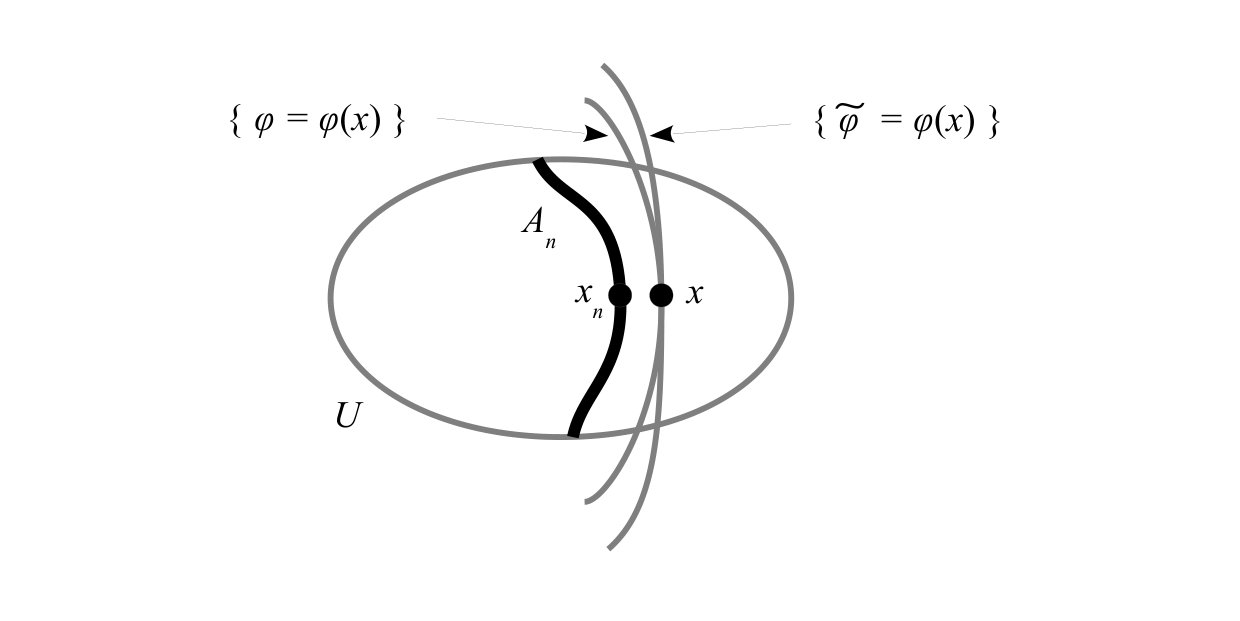 Figure 1
Peer Reviews
No public reviews on file for this paper yet. If you reviewed it on a platform where reviews are public (OpenReview, ICLR, NeurIPS, ICML), you can paste yours below so the community can read it here.
Videos
No videos yet. Explain this paper in a talk, walkthrough, or lecture? Add one.
Uniformization and Steinness
Stefan Nemirovski
Steklov Mathematical Institute, Moscow, Russia; Fakultät für Mathematik, Ruhr-Universität Bochum, Germany
and
Rasul Shafikov
University of Western Ontario, London, Canada
Abstract.
It is shown that the unit ball in is the only complex manifold that can universally cover both Stein and non-Stein strictly pseudoconvex domains.
1991 Mathematics Subject Classification:
Primary 32T15, Secondary 32Q30
The first author was partly supported by SFB/TR 191 of the DFG and RFBR grant №17-01-00592-a. The second author was supported by a grant from the Natural Sciences and Engineering Research Council of Canada.
In this note we use methods from [5] to show that the unit ball in is the only simply connected complex manifold that can cover both Stein and non-Stein strictly pseudoconvex domains.
Here a strictly pseudoconvex domain is a relatively compact domain in a complex manifold such that its boundary admits a -smooth strictly plurisubharmonic defining function.
Theorem**.**
Let be the universal cover of a Stein strictly pseudoconvex domain. Suppose that is not biholomorphic to the ball. Then any manifold covered by does not contain compact complex analytic subsets of positive dimension. In particular, any other strictly pseudoconvex domain covered by is Stein.
Examples of strictly pseudoconvex domains covered by the ball in which contain compact complex curves (and hence are not Stein) may be found in [2]. It is well-known that the ball covers compact complex manifolds as well.
Recall also from [4, 5] that a Stein strictly pseudoconvex domain is covered by the unit ball if and only if its boundary is everywhere locally CR-diffeomorphic to the unit sphere.
The theorem will follow immediately from the two lemmas below.
Lemma 1**.**
Let be a covering of a complex manifold admitting a strictly plurisubharmonic function . If is an analytic subset of positive dimension, then its projection cannot lie in a compact subset in .
Remark 2**.**
The assumptions of the lemma are satisfied if is (an unramified domain over) a Stein manifold. However, there exist examples of complex manifolds with strictly plurisubharmonic functions but no non-constant holomorphic functions [3].
Proof.
Suppose that is contained in a compact subset of . Then there exists a sequence of points such that , , and
[TABLE]
Choose a convex coordinate neighbourhood and a strictly plurisubharmonic function on such that and
[TABLE]
for some , see Fig. 1.
For each , there is a local inverse to defined on so that . Set . This is a complex analytic subset of with boundary in and by the choice of . Thus, for all by construction, whereas as . This contradicts the maximum principle for plurisubharmonic functions on complex analytic sets (see e.g. [1, §6.3]), which proves the lemma. ∎
Lemma 3**.**
Let be the universal covering of a strictly pseudoconvex domain by a complex manifold that is not biholomorphic to the ball. Suppose that is a covering of a complex manifold containing a connected compact complex analytic subset of positive dimension. Then is contained in a compact subset of .
Remark 4**.**
In this lemma, does not need to be Stein.
Proof.
Let be a plurisubharmonic defining function for . Following [5, §2.3], consider the function on defined by
[TABLE]
where denotes the upper semicontinuous regularisation. As shown in [5, §2.3], it follows from [5, Corollary 2.3] that is plurisubharmonic and strictly negative on . (It is explained in [5, §3.2] how to modify the proof of [5, Corollary 2.3] for non-Stein domains.) By the maximum principle,
[TABLE]
Hence,
[TABLE]
and therefore is relatively compact in . ∎
Remark 5**.**
The key point in the proof of Lemma 3 is the application of [5, Corollary 2.3]. That result is a consequence of [5, Proposition 2.2], which is an extension of the well-known Wong–Rosay theorem [6, 7] to universal coverings of strictly pseudoconvex domains in complex manifolds.
The reference list from the paper itself. Each links out to its DOI / PubMed record.
- 1[1] E.M. Chirka, Complex Analytic Sets , Kluwer Academic Publ., Dordrecht (1989).
- 2[2] W. M. Goldman, M. Kapovich, B. Leeb, Complex hyperbolic manifolds homotopy equivalent to a Riemann surface , Comm. Anal. Geom. 9 (2001), 61–95.
- 3[3] F. Forstnerič, A complex surface admitting a strongly plurisubharmonic function but no holomorphic functions , J. Geom. Anal. 25 (2015), 329–335
- 4[4] S. Nemirovski, R. Shafikov, Uniformization of strictly pseudoconvex domains , I, Izv. Math. 69 :6 (2005), 1189–1202.
- 5[5] S. Nemirovski, R. Shafikov, Uniformization of strictly pseudoconvex domains , II, Izv. Math. 69 :6 (2005), 1203–1210.
- 6[6] J.-P. Rosay, Sur une caractérisation de la boule parmi les domaines de ℂ n superscript ℂ 𝑛 \mathbb{C}^{n} par son groupe d’automorphismes , Ann. Inst. Fourier (Grenoble) 29 (1979), ix, 91–97.
- 7[7] B. Wong, Characterization of the unit ball in ℂ n superscript ℂ 𝑛 \mathbb{C}^{n} by its automorphism group , Invent. Math. 41 (1977), 253–257.