Testing Microfluidic Fully Programmable Valve Arrays (FPVAs)
Chunfeng Liu, Bing Li, Bhargab B. Bhattacharya, Krishnendu, Chakrabarty, Tsung-Yi Ho, Ulf Schlichtmann

TL;DR
This paper introduces an ILP-based testing strategy for microfluidic Fully Programmable Valve Arrays, effectively detecting manufacturing faults with minimal test vectors, thus improving reliability of next-generation microfluidic biochips.
Contribution
It presents a novel flow path and cut-set based formulation with a hierarchical ILP approach for efficient fault detection in FPVAs.
Findings
Effective fault detection with few test vectors
Hierarchical ILP strategy improves testing efficiency
Simulation confirms high fault coverage
Abstract
Fully Programmable Valve Array (FPVA) has emerged as a new architecture for the next-generation flow-based microfluidic biochips. This 2D-array consists of regularly-arranged valves, which can be dynamically configured by users to realize microfluidic devices of different shapes and sizes as well as interconnections. Additionally, the regularity of the underlying structure renders FPVAs easier to integrate on a tiny chip. However, these arrays may suffer from various manufacturing defects such as blockage and leakage in control and flow channels. Unfortunately, no efficient method is yet known for testing such a general-purpose architecture. In this paper, we present a novel formulation using the concept of flow paths and cut-sets, and describe an ILP-based hierarchical strategy for generating compact test sets that can detect multiple faults in FPVAs. Simulation results demonstrate the…
Click any figure to enlarge with its caption.
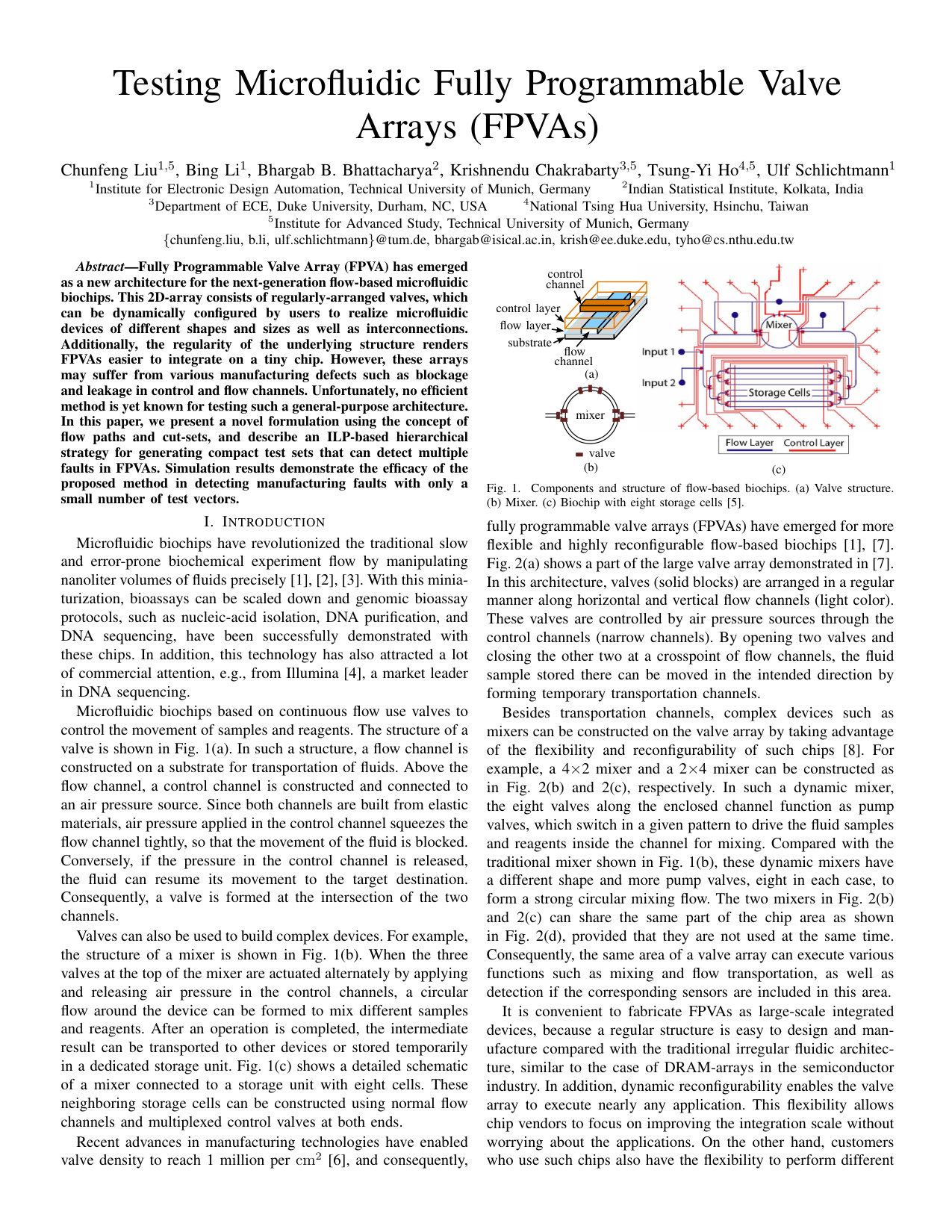 Figure 1
Peer Reviews
No public reviews on file for this paper yet. If you reviewed it on a platform where reviews are public (OpenReview, ICLR, NeurIPS, ICML), you can paste yours below so the community can read it here.
Videos
No videos yet. Explain this paper in a talk, walkthrough, or lecture? Add one.
Taxonomy
TopicsElectrowetting and Microfluidic Technologies · Microfluidic and Capillary Electrophoresis Applications · Innovative Microfluidic and Catalytic Techniques Innovation
See pages 1-last of FPVA_test_DATE17.pdf