Sampling-based Buffer Insertion for Post-Silicon Yield Improvement under Process Variability
Grace Li Zhang, Bing Li, Ulf Schlichtmann

TL;DR
This paper presents a sampling-based approach for post-silicon buffer insertion to improve chip yield under process variability, balancing buffer count and range for effective yield enhancement.
Contribution
It introduces a novel sampling-based method for optimal buffer placement that reduces buffer count while maximizing yield improvement.
Findings
Achieves up to 35% yield improvement
Uses fewer buffers with smaller ranges
Effective under process variability conditions
Abstract
At submicron manufacturing technology nodes process variations affect circuit performance significantly. This trend leads to a large timing margin and thus overdesign to maintain yield. To combat this pessimism, post-silicon clock tuning buffers can be inserted into circuits to balance timing budgets of critical paths with their neighbors. After manufacturing, these clock buffers can be configured for each chip individually so that chips with timing failures may be rescued to improve yield. In this paper, we propose a sampling-based method to determine the proper locations of these buffers. The goal of this buffer insertion is to reduce the number of buffers and their ranges, while still maintaining a good yield improvement. Experimental results demonstrate that our algorithm can achieve a significant yield improvement (up to 35%) with only a small number of buffers.
Click any figure to enlarge with its caption.
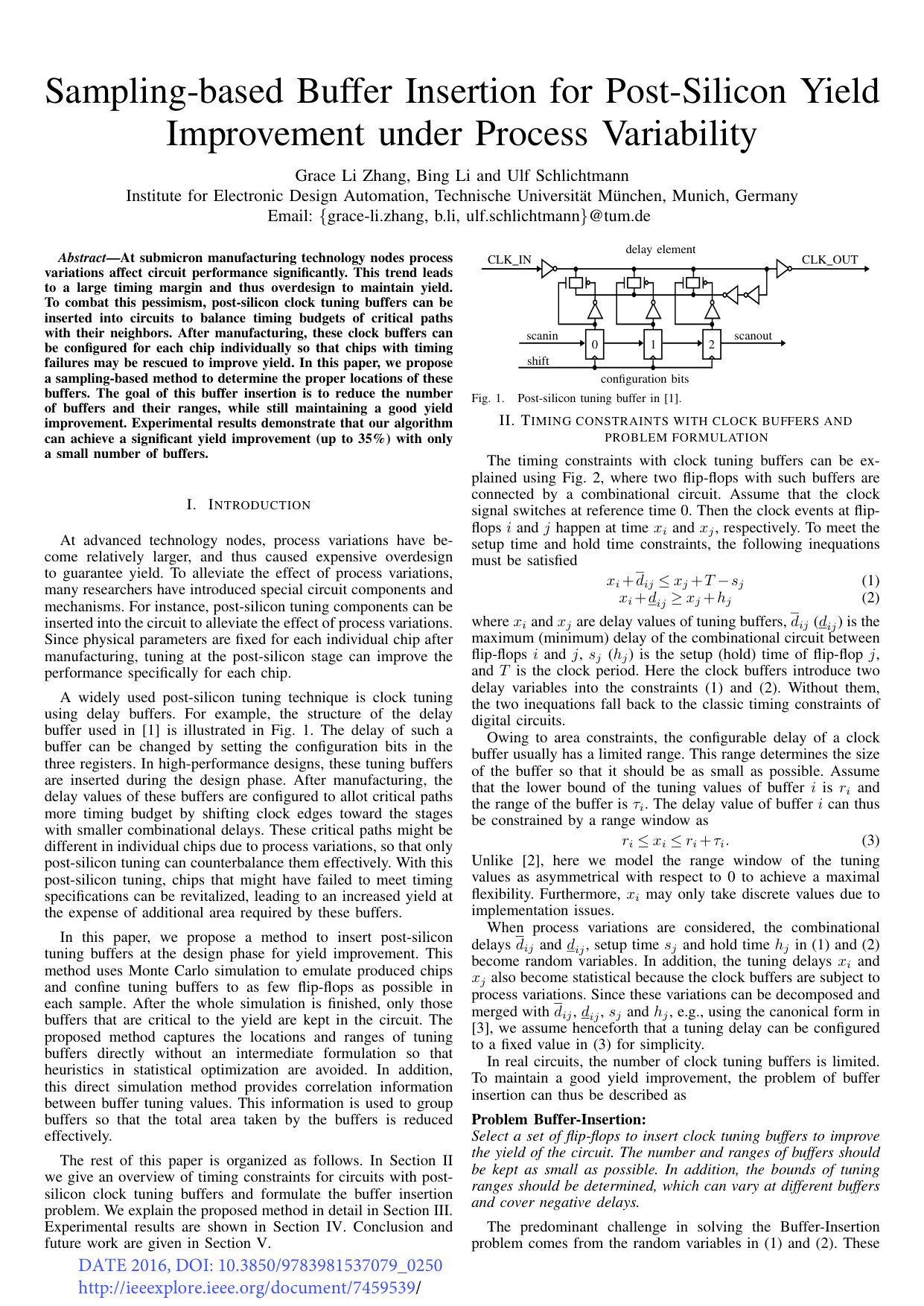 Figure 1
Peer Reviews
No public reviews on file for this paper yet. If you reviewed it on a platform where reviews are public (OpenReview, ICLR, NeurIPS, ICML), you can paste yours below so the community can read it here.
Videos
No videos yet. Explain this paper in a talk, walkthrough, or lecture? Add one.
See pages 1-last of Sampling_Buffer_Insertion_DATE2016.pdf