ILP-based Alleviation of Dense Meander Segments with Prioritized Shifting and Progressive Fixing in PCB Routing
Tsun-Ming Tseng, Bing Li, Tsung-Yi Ho, Ulf Schlichtmann

TL;DR
This paper introduces an ILP-based post-processing method to enlarge and distribute dense meander segments in PCB routing, reducing crosstalk and improving signal delay matching in high-performance designs.
Contribution
It proposes a novel ILP model with prioritized shifting and progressive fixing techniques to effectively alleviate dense meander segments in PCB routing.
Findings
Significantly enlarges meander segments under tight area constraints.
Reduces crosstalk effects in high-performance PCB signals.
Improves delay matching accuracy in PCB routing.
Abstract
Length-matching is an important technique to bal- ance delays of bus signals in high-performance PCB routing. Existing routers, however, may generate very dense meander segments. Signals propagating along these meander segments exhibit a speedup effect due to crosstalk between the segments of the same wire, thus leading to mismatch of arrival times even under the same physical wire length. In this paper, we present a post-processing method to enlarge the width and the distance of meander segments and hence distribute them more evenly on the board so that crosstalk can be reduced. In the proposed framework, we model the sharing of available routing areas after removing dense meander segments from the initial routing, as well as the generation of relaxed meander segments and their groups for wire length compensation. This model is transformed into an ILP problem and solved for a balanced…
Click any figure to enlarge with its caption.
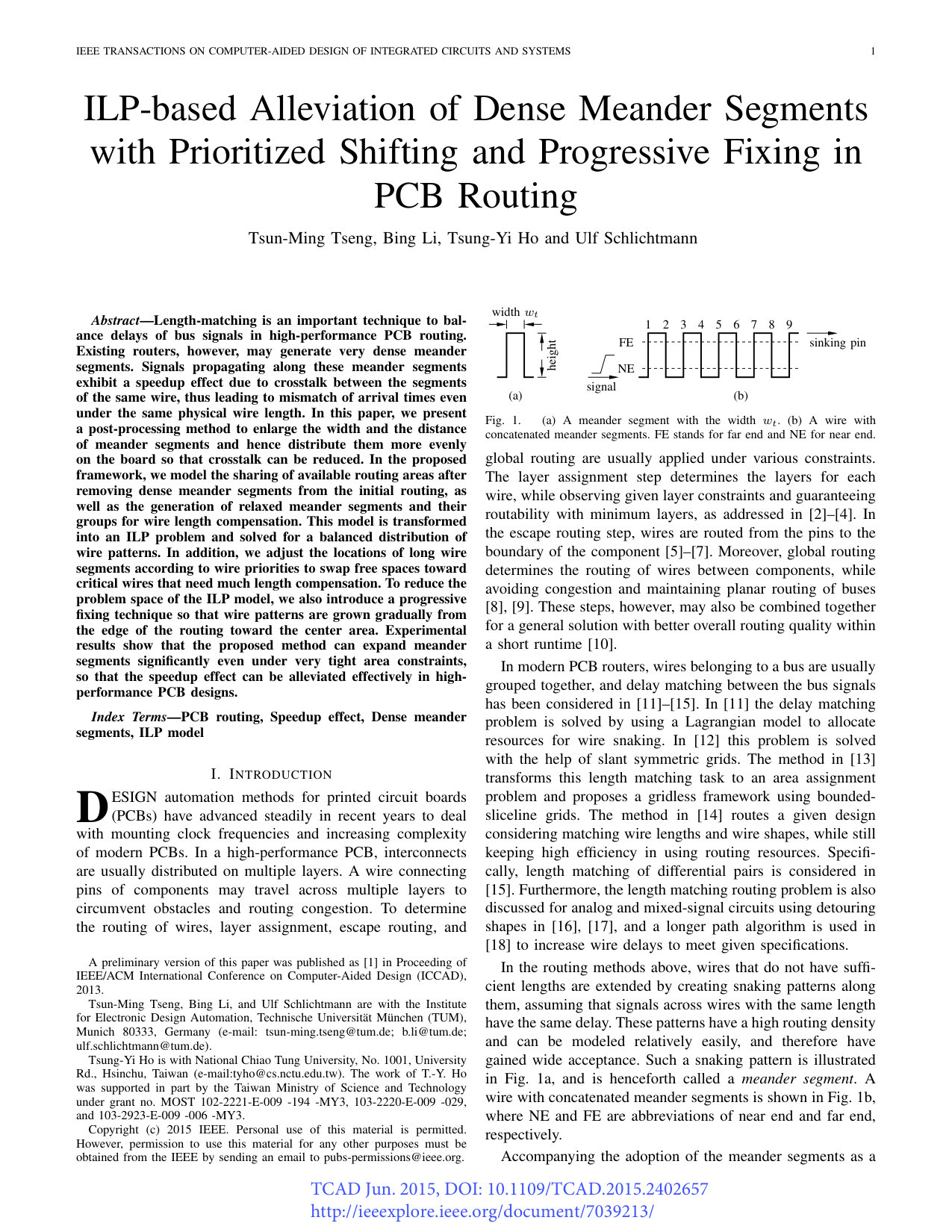 Figure 1
Peer Reviews
No public reviews on file for this paper yet. If you reviewed it on a platform where reviews are public (OpenReview, ICLR, NeurIPS, ICML), you can paste yours below so the community can read it here.
Videos
No videos yet. Explain this paper in a talk, walkthrough, or lecture? Add one.
See pages 1-last of Meander_Routing_TCAD_2015_06.pdf