Pseudo-Goldstone magnons in the frustrated S=3/2 Heisenberg helimagnet ZnCr2Se4 with a pyrochlore magnetic sublattice
Y. V. Tymoshenko, Y. A. Onykiienko, T. Mueller, R. Thomale, S. Rachel,, A. S. Cameron, P. Y. Portnichenko, D. V. Efremov, V. Tsurkan, D. L., Abernathy, J. Ollivier, A. Schneidewind, A. Piovano, V. Felea, A. Loidl, D., S. Inosov

TL;DR
This study investigates low-energy magnetic excitations in the frustrated S=3/2 Heisenberg helimagnet ZnCr2Se4, revealing pseudo-Goldstone magnons with small energy gaps, supported by neutron spectroscopy and theoretical calculations.
Contribution
It uncovers the existence of pseudo-Goldstone magnons with finite gaps in a cubic spinel helimagnet, highlighting their universal presence and implications for studying magnon interactions.
Findings
Identification of soft helimagnon modes with ~0.17 meV gap
Observation of pseudo-Goldstone magnons emerging from orthogonal wave vectors
Support for the universality of these excitations in symmetric helimagnets
Abstract
Low-energy spin excitations in any long-range ordered magnetic system in the absence of magnetocrystalline anisotropy are gapless Goldstone modes emanating from the ordering wave vectors. In helimagnets, these modes hybridize into the so-called helimagnon excitations. Here we employ neutron spectroscopy supported by theoretical calculations to investigate the magnetic excitation spectrum of the isotropic Heisenberg helimagnet ZnCr2Se4 with a cubic spinel structure, in which spin-3/2 magnetic Cr3+ ions are arranged in a geometrically frustrated pyrochlore sublattice. Apart from the conventional Goldstone mode emanating from the (0 0 q) ordering vector, low-energy magnetic excitations in the single-domain proper-screw spiral phase show soft helimagnon modes with a small energy gap of ~0.17 meV, emerging from two orthogonal wave vectors (q 0 0) and (0 q 0) where no magnetic Bragg peaks are…
Click any figure to enlarge with its caption.
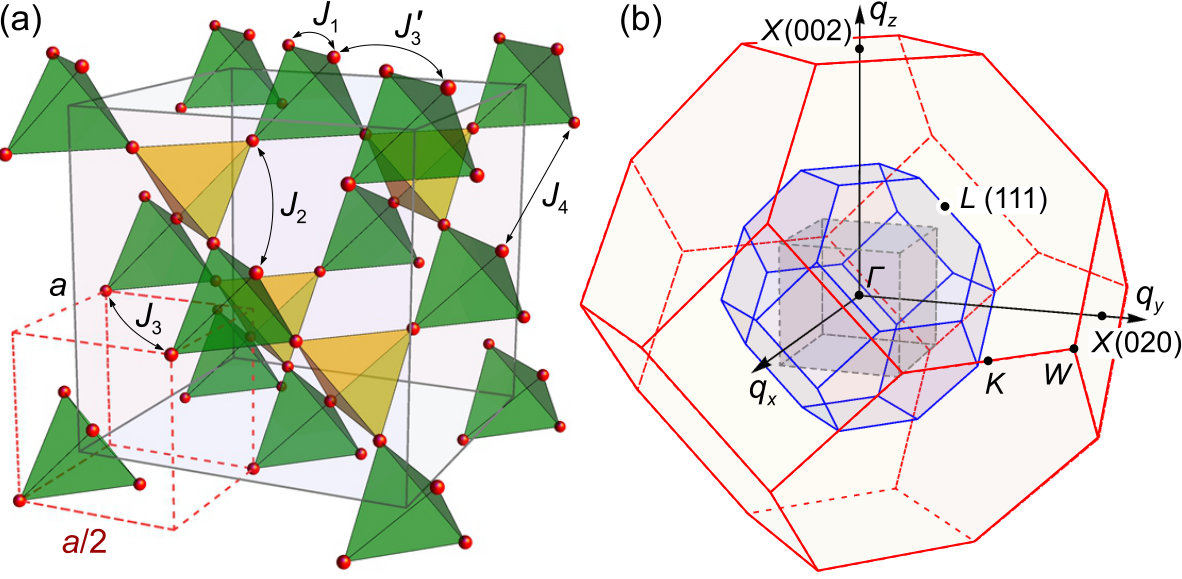 Figure 1
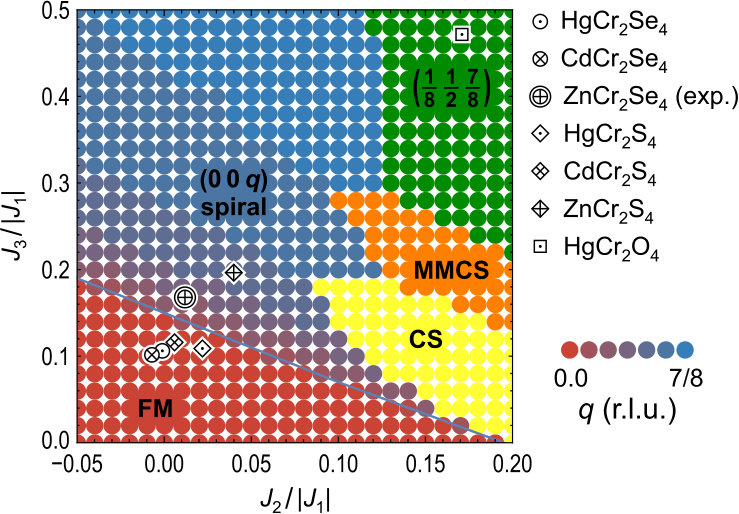 Figure 2
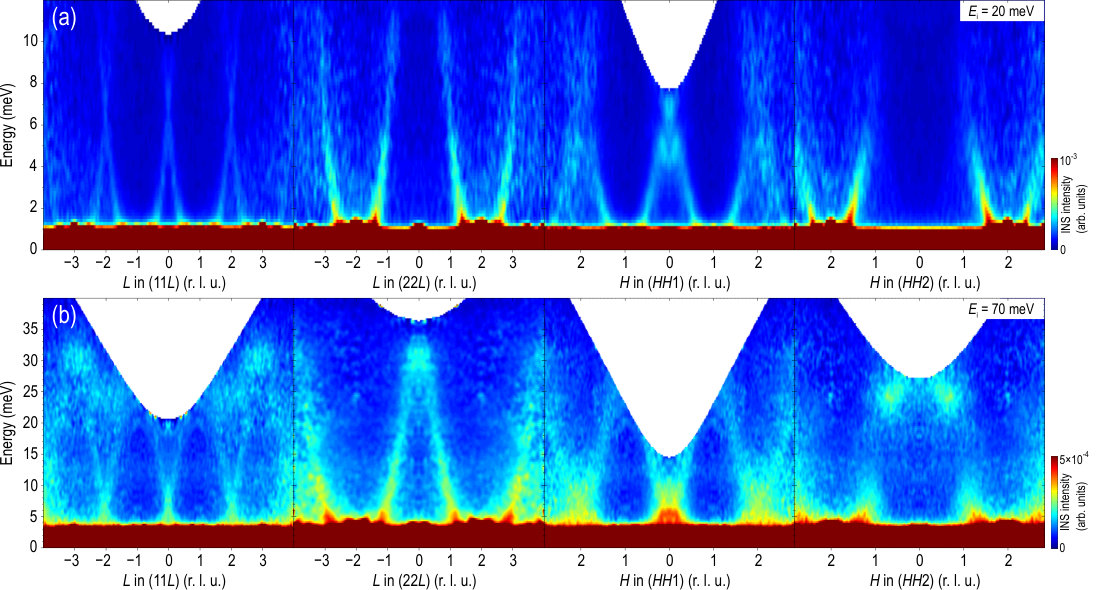 Figure 3
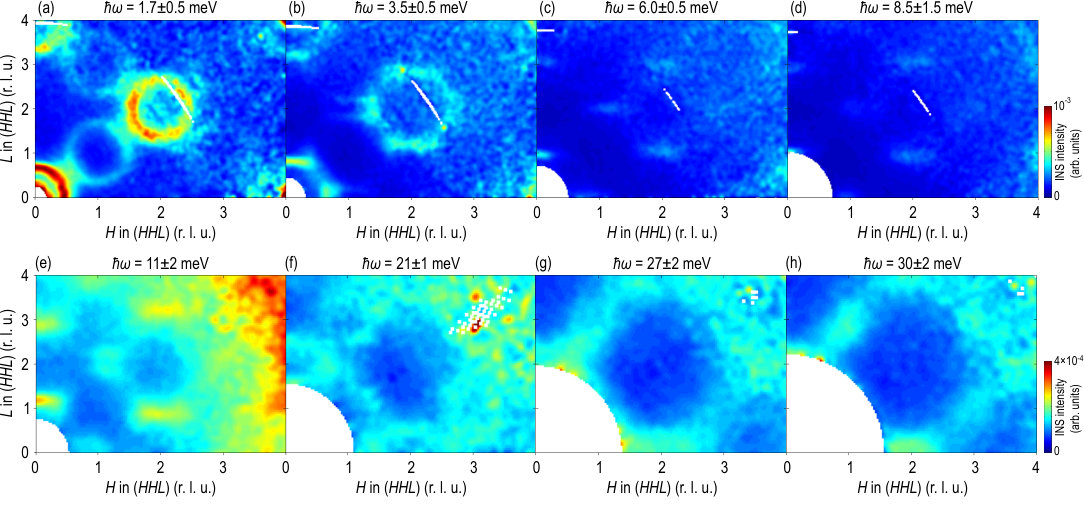 Figure 4
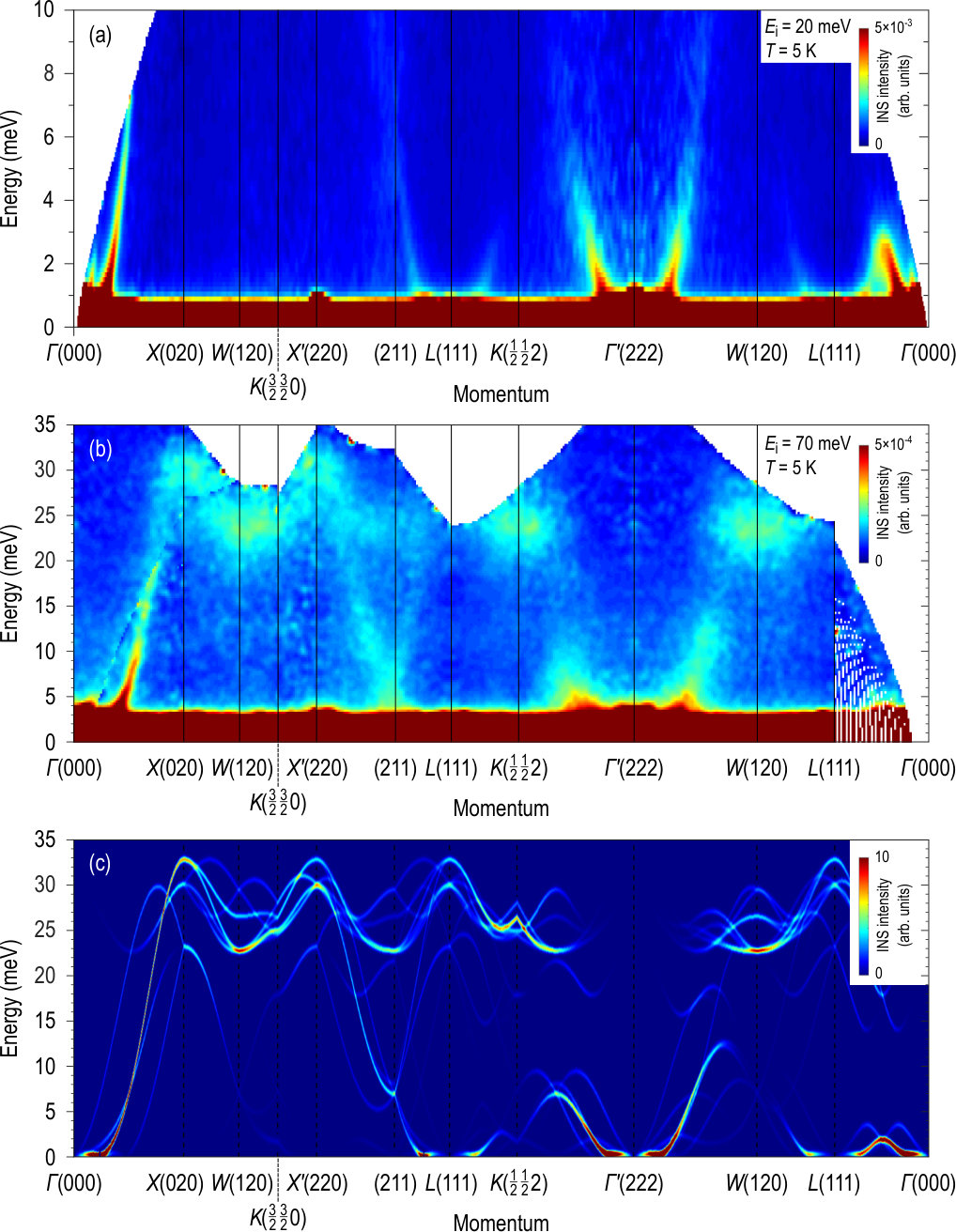 Figure 5
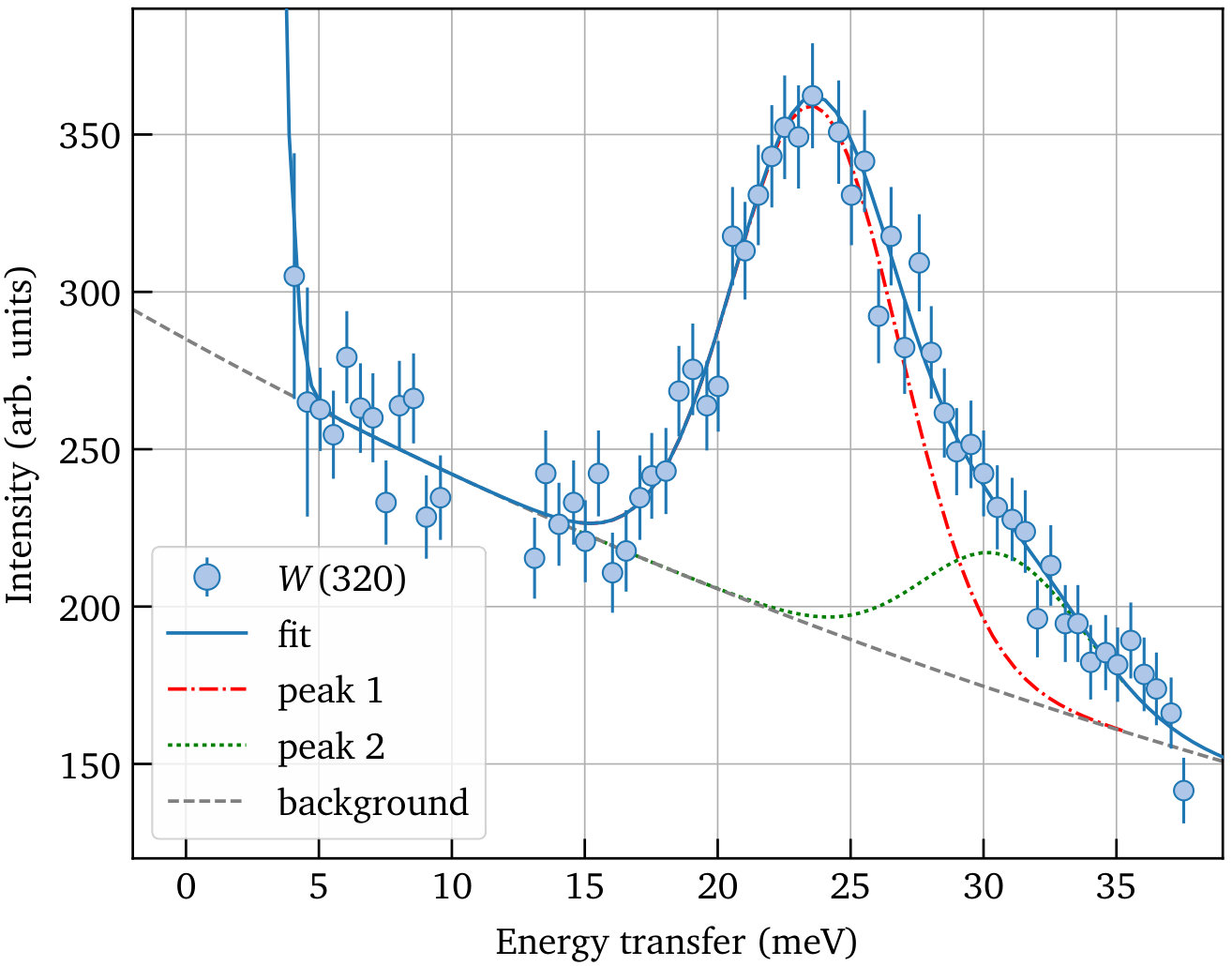 Figure 6
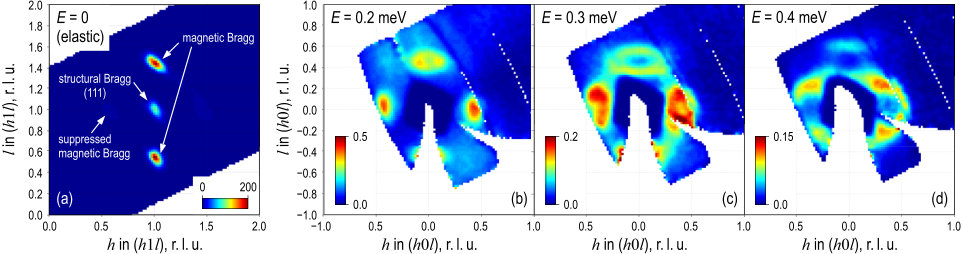 Figure 7
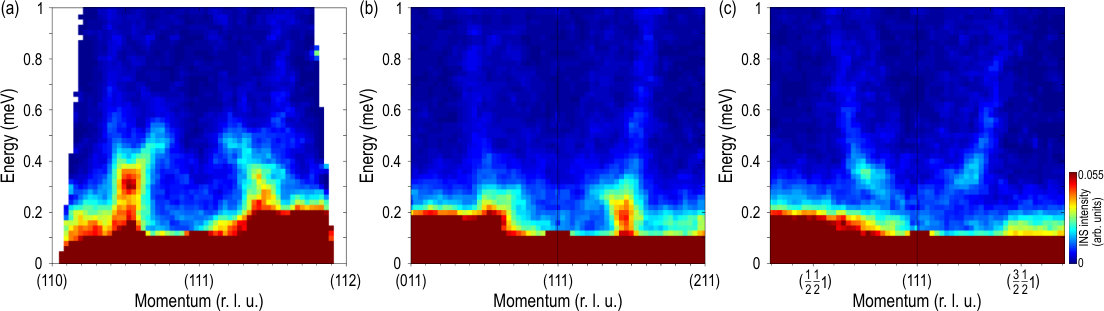 Figure 8
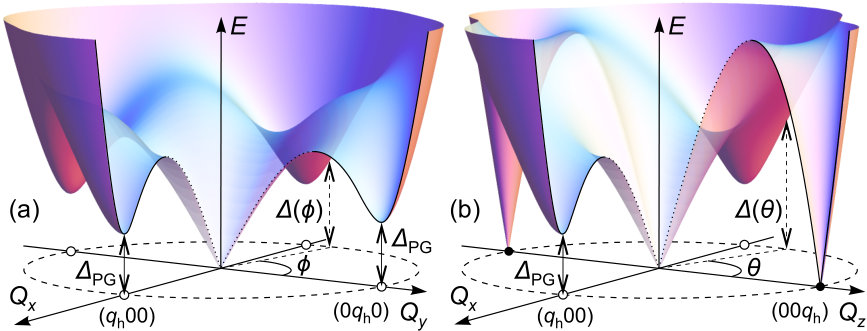 Figure 9
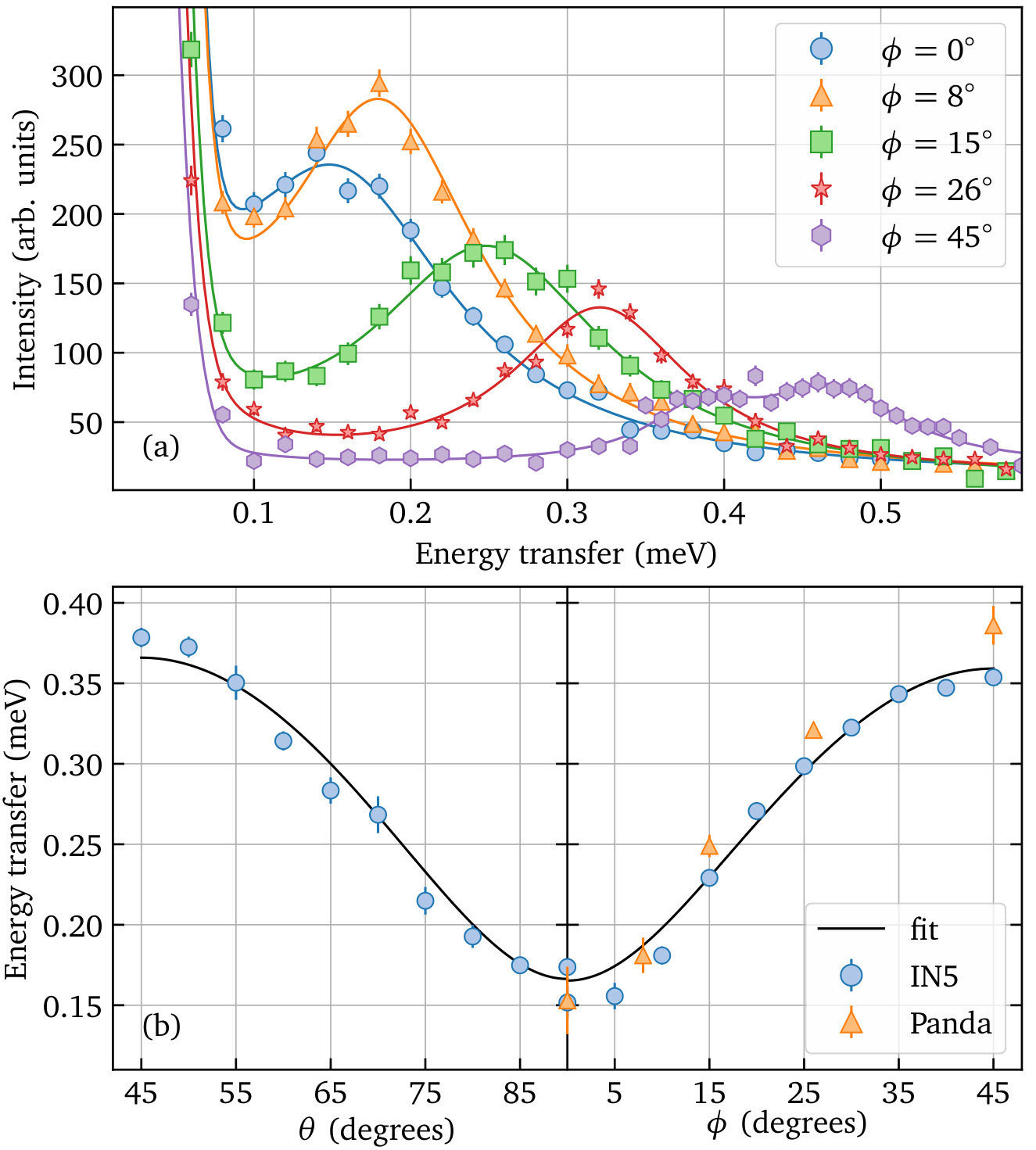 Figure 10
 Figure 11
 Figure 12
| Compound | ground state | Refs. | |||
| HgCr2O4 | 0.1714 | 0.471 | 0 | AFM | Matsuda et al. (2007) |
| ZnCr2S4 | 0.0395 | 0.198 | –0.014 | spiral | Yokaichiya et al. (2009) |
| CdCr2S4 | 0.0065 | 0.116 | –0.015 | FM | Menyuk et al. (1966) |
| HgCr2S4 | 0.0222 | 0.111 | –0.013 | spiral | Hastings and Corliss (1968); Tsurkan et al. (2006) |
| ZnCr2Se4 | 0.0102 | 0.169 | –0.018 | spiral | Plumier (1966); Cameron et al. (2016) |
| CdCr2Se4 | –0.0071 | 0.101 | –0.013 | FM | Menyuk et al. (1966) |
| HgCr2Se4 | –0.0014 | 0.109 | –0.013 | FM | Wojtowicz (1969) |
| Experimental values: | |||||
| ZnCr2Se4 | 0.0118 | 0.170 | –0.014 | [this work] | |
Peer Reviews
No public reviews on file for this paper yet. If you reviewed it on a platform where reviews are public (OpenReview, ICLR, NeurIPS, ICML), you can paste yours below so the community can read it here.
Videos
No videos yet. Explain this paper in a talk, walkthrough, or lecture? Add one.
Pseudo-Goldstone magnons in the frustrated S = 3/2 Heisenberg
helimagnet ZnCrSe with a pyrochlore magnetic sublattice
Y. V. Tymoshenko
Institut für Festkörper- und Materialphysik, Technische Universität Dresden, D-01069 Dresden, Germany
Y. A. Onykiienko
Institut für Festkörper- und Materialphysik, Technische Universität Dresden, D-01069 Dresden, Germany
T. Müller
Institut für Theoretische Physik, Universität Würzburg, 97074 Würzburg, Germany
R. Thomale
Institut für Theoretische Physik, Universität Würzburg, 97074 Würzburg, Germany
S. Rachel
Institut für Theoretische Physik, Technische Universität Dresden, D-01062 Dresden, Germany
Department of Physics, Princeton University, Princeton, New Jersey 08544, USA
School of Physics, University of Melbourne, Parkville, VIC 3010, Australia
A. S. Cameron
Institut für Festkörper- und Materialphysik, Technische Universität Dresden, D-01069 Dresden, Germany
P. Y. Portnichenko
Institut für Festkörper- und Materialphysik, Technische Universität Dresden, D-01069 Dresden, Germany
D. V. Efremov
Institute for Theoretical Solid State Physics, IFW Dresden, Helmholtzstraße 20, D-01069 Dresden, Germany
V. Tsurkan
Experimental Physics V, Center for Electronic Correlations and Magnetism, Institute of Physics, University of Augsburg, D-86135 Augsburg, Germany
Institute of Applied Physics, Academy of Sciences of Moldova, Chisinau MD-2028, Republic of Moldova
D. L. Abernathy
Quantum Condensed Matter Division, Oak Ridge National Laboratory, Oak Ridge, Tennessee 37831, USA
J. Ollivier
Institut Laue-Langevin, 71 avenue des Martyrs, CS 20156, F-38042 Grenoble cedex 9, France
A. Schneidewind
Jülich Center for Neutron Science (JCNS), Forschungszentrum Jülich GmbH, Outstation at Heinz Maier – Leibnitz Zentrum (MLZ), Lichtenbergaße 1, D-85747 Garching, Germany
A. Piovano
Institut Laue-Langevin, 71 avenue des Martyrs, CS 20156, F-38042 Grenoble cedex 9, France
V. Felea
Institute of Applied Physics, Academy of Sciences of Moldova, Chisinau MD-2028, Republic of Moldova
A. Loidl
Experimental Physics V, Center for Electronic Correlations and Magnetism, Institute of Physics, University of Augsburg, D-86135 Augsburg, Germany
D. S. Inosov
Institut für Festkörper- und Materialphysik, Technische Universität Dresden, D-01069 Dresden, Germany
Abstract
Low-energy spin excitations in any long-range ordered magnetic system in the absence of magnetocrystalline anisotropy are gapless Goldstone modes emanating from the ordering wave vectors. In helimagnets, these modes hybridize into the so-called helimagnon excitations. Here we employ neutron spectroscopy supported by theoretical calculations to investigate the magnetic excitation spectrum of the isotropic Heisenberg helimagnet ZnCr2Se4 with a cubic spinel structure, in which spin-3/2 magnetic Cr ions are arranged in a geometrically frustrated pyrochlore sublattice. Apart from the conventional Goldstone mode emanating from the ordering vector, low-energy magnetic excitations in the single-domain proper-screw spiral phase show soft helimagnon modes with a small energy gap of 0.17 meV, emerging from two orthogonal wave vectors and where no magnetic Bragg peaks are present. We term them pseudo-Goldstone magnons, as they appear gapless within linear spin-wave theory and only acquire a finite gap due to higher-order quantum-fluctuation corrections. Our results are likely universal for a broad class of symmetric helimagnets, opening up a new way of studying weak magnon-magnon interactions with accessible spectroscopic methods.
magnetic frustration, spin waves, helimagnets, spinels, pyrochlore lattice, Heisenberg model, neutron scattering
pacs:
75.30.Ds 75.10.Hk 78.70.Nx
I Introduction
I.1 Classical Heisenberg model on the pyrochlore lattice
The Heisenberg model on the pyrochlore lattice attracts a lot of interest as various spin models on this lattice give rise to the simplest three-dimensional frustrated spin systems. Even for classical spins, this model hosts a wide range of different ground states. Considering only the antiferromagnetic nearest-neighbor (NN) interactions results in a classical spin liquid Moessner and Chalker (1998), exhibiting no long-range magnetic order down to zero temperature. This is explained by strong geometric frustration that leads to a highly degenerate classical ground state. However, inclusion of further-neighbor interactions relieves this frustration and stabilizes various ordered ground states, among them ferromagnetism, single- or multi- spin spirals, nematic order, and other exotic phases Reimers et al. (1991); Lapa and Henley ; Takata et al. ; Okubo et al. (2011); Conlon and Chalker (2010).
Chromium spinels provide great opportunities to investigate magnetic interactions between classical spins on the structurally ideal pyrochlore lattice. These compounds have the general formula Cr, where and are non-magnetic ions and Cr is the magnetic cation in the configuration Yaresko (2008). Its magnetic sublattice has the pyrochlore structure with spins at the Cr sites. Using the classical Heisenberg model,
[TABLE]
is justified by the negligibly small magneto-crystalline anisotropy Siratori (1971); Zhang et al. (2016); Aoyama and Kawamura (2016). Thus we consider throughout the paper if sites and are neighbors [see Fig. I.1 (a)]. Depending on the chemical composition, chromium spinels exhibit different mechanisms of frustration, such as geometric frustration that occurs if dominant NN interactions are antiferromagnetic, or bond frustration which originates from competition between ferromagnetic NN and antiferromagnetic further-neighbor exchange.
To estimate the range and relative strengths of coupling constants in chromium spinels, Yaresko Yaresko (2008) performed ab initio calculations to extract exchange parameters up to the fourth nearest neighbor for various compounds of this family. Calculations showed that the NN interaction changes gradually from antiferromagnetic in some oxides to ferromagnetic in sulfides and selenides, while the next-nearest-neighbor (NNN) interaction is noticeably weaker than the antiferromagnetic exchange parameter (see Table I.2). For the HgCr2O4 system, can be even weaker than (or comparable, depending on the effective Coulomb repulsion ), so that the third-nearest-neighbor interaction may become dominant. Therefore, the existing theoretical phase diagram restricted to only NN and NNN interactions Lapa and Henley appears insufficient for a realistic description of these materials. The importance of the two -nearest-neighbor exchange paths on the pyrochlore lattice has been also emphasized for the spin- molybdate Heisenberg antiferromagnet Lu2Mo2O5N2 Clark et al. (2014), where and have opposite signs and dominate over . It was recently conjectured that this may lead to an unusual “gearwheel” type of a quantum spin liquid Iqbal et al. .
The reference list from the paper itself. Each links out to its DOI / PubMed record.
- 1Moessner and Chalker (1998) R. Moessner and J. T. Chalker, “ Properties of a classical spin liquid: The Heisenberg pyrochlore antiferromagnet ,” Phys. Rev. Lett. 80 , 2929–2932 (1998) . · doi ↗
- 2Reimers et al. (1991) J. N. Reimers, A. J. Berlinsky, and A.-C. Shi, “ Mean-field approach to magnetic ordering in highly frustrated pyrochlores ,” Phys. Rev. B 43 , 865–878 (1991) . · doi ↗
- 3(3) M. F. Lapa and C. L. Henley, “ Ground states of the classical antiferromagnet on the pyrochlore lattice ,” ar Xiv:1210.6810 (unpublished).
- 4(4) E. Takata, T. Momoi, and M. Oshikawa, “ Nematic ordering in pyrochlore antiferromagnets: high-field phase of chromium spinel oxides ,” ar Xiv:1510.02373 (unpublished).
- 5Okubo et al. (2011) T. Okubo, T. H. Nguyen, and H. Kawamura, “ Cubic and noncubic multiple- q 𝑞 q states in the Heisenberg antiferromagnet on the pyrochlore lattice ,” Phys. Rev. B 84 , 144432 (2011) . · doi ↗
- 6Conlon and Chalker (2010) P. H. Conlon and J. T. Chalker, “ Absent pinch points and emergent clusters: Further neighbor interactions in the pyrochlore Heisenberg antiferromagnet ,” Phys. Rev. B 81 , 224413 (2010) . · doi ↗
- 7Yaresko (2008) A. N. Yaresko, “ Electronic band structure and exchange coupling constants in A Cr 2 X 4 𝐴 subscript Cr 2 subscript 𝑋 4 A{\kern 0.5pt}\text{Cr}_{\text{\!2}}X_{\text{4}} spinels ( A 𝐴 A = Zn, Cd, Hg; X 𝑋 X = O, S, Se) ,” Phys. Rev. B 77 , 115106 (2008) . · doi ↗
- 8Siratori (1971) K. Siratori, “ Magnetic resonance of Zn Cr 2 2 {}_{\text{\!2}} Se 4 4 {}_{\text{4}} with screw spin structure ,” J. Phys. Soc. Jpn. 30 , 709–719 (1971) . · doi ↗