Characterization of minimal sequences associated with self-similar interval exchange maps
Milton Cobo, Rodolfo Guti\'errez-Romo, Alejandro Maass

TL;DR
This paper characterizes minimal sequences linked to self-similar interval exchange maps, providing conditions for wandering intervals and exploring the role of eigenvalues in their structure.
Contribution
It introduces a characterization of minimal sequences under the unique representation property for potentials from non-real eigenvalues, and analyzes conditions for wandering intervals.
Findings
Characterization of minimal sequences for non-real eigenvalues
Conditions determining the existence of wandering intervals
Relation between eigenvalues and affine extensions
Abstract
The construction of affine interval exchange maps with wandering intervals that are semi-conjugate with a given self-similar interval exchange map is strongly related with the existence of the so called minimal sequences associated with local potentials, which are certain elements of the substitution subshift arising from the given interval exchange map. In this article, under the condition called unique representation property, we characterize such minimal sequences for potentials coming from non-real eigenvalues of the substitution matrix. We also give conditions on the slopes of the affine extensions of a self-similar interval exchange map that determine whether it exhibits a wandering interval or not.
Click any figure to enlarge with its caption.
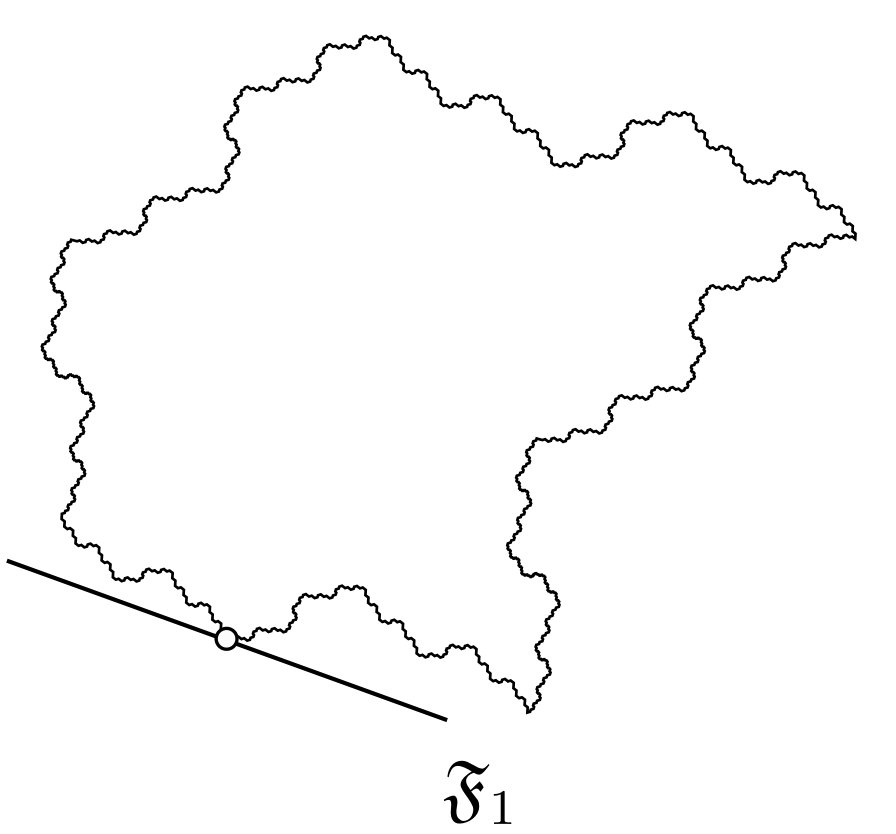 Figure 1
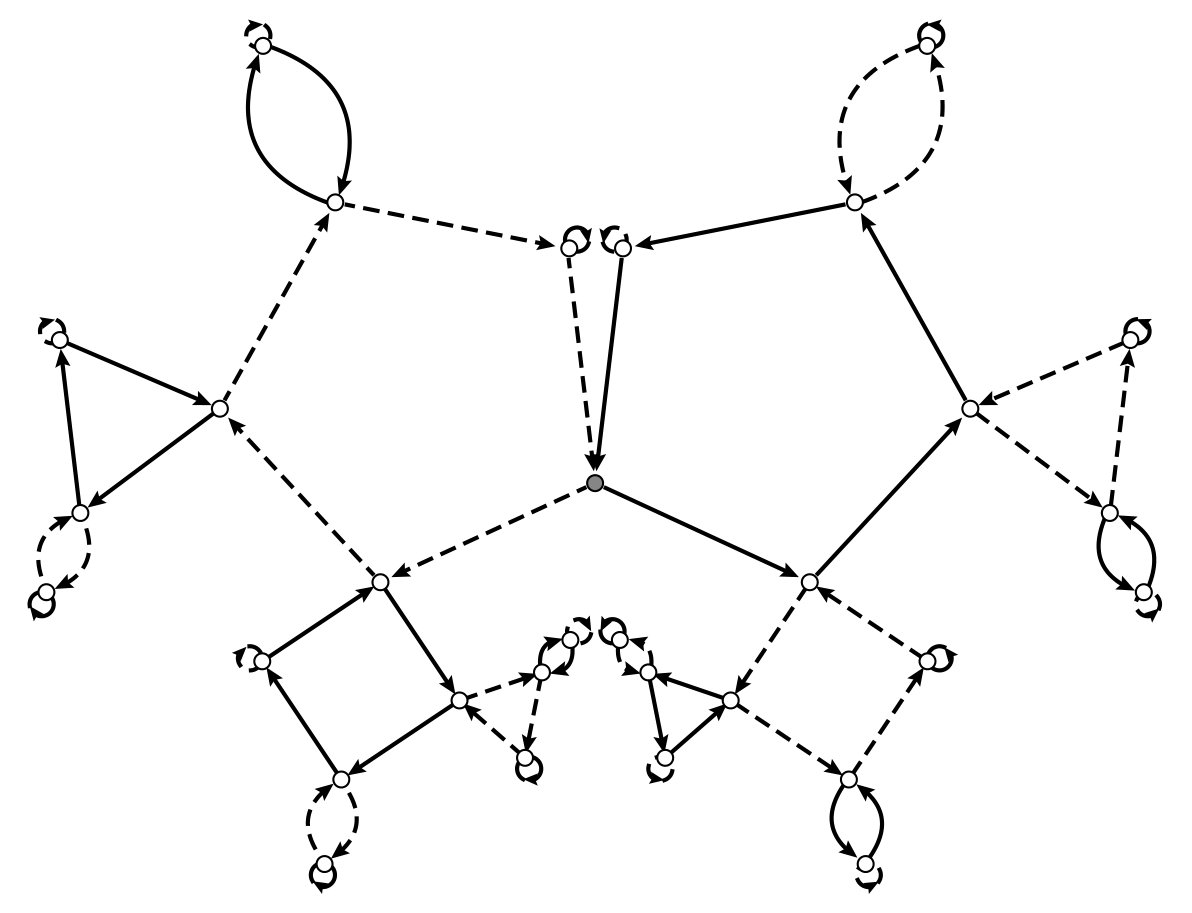 Figure 2
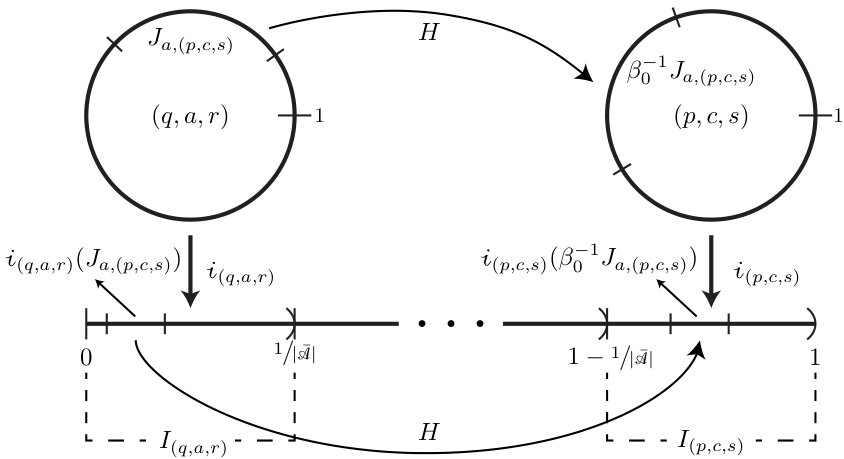 Figure 3
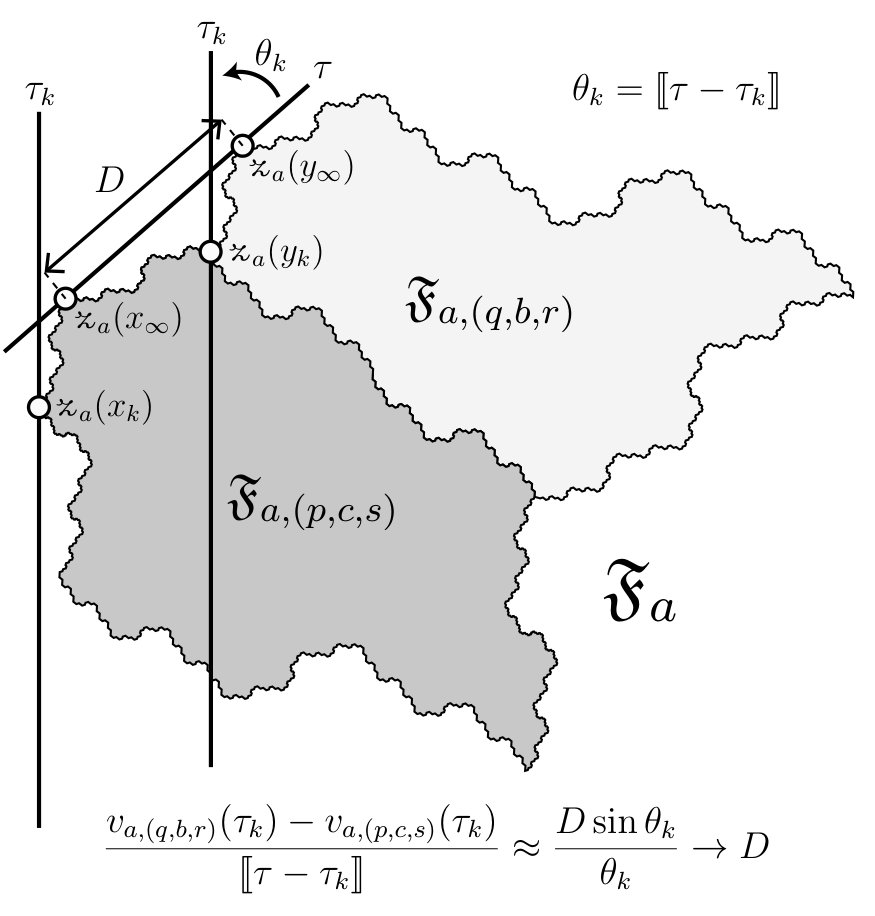 Figure 4
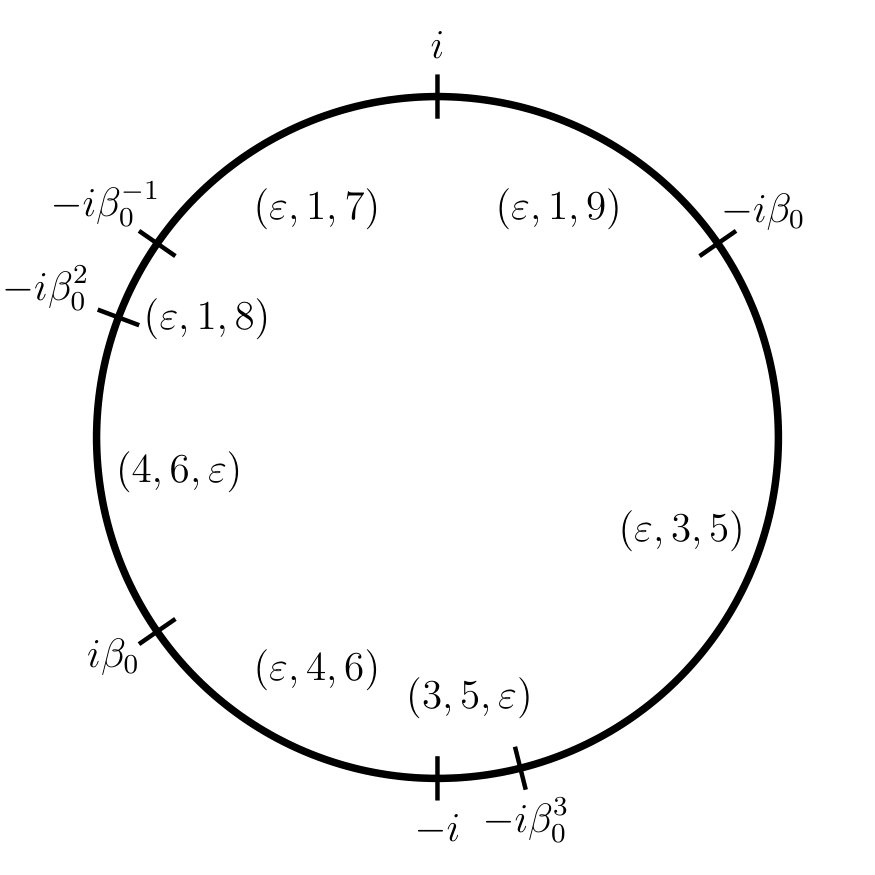 Figure 5
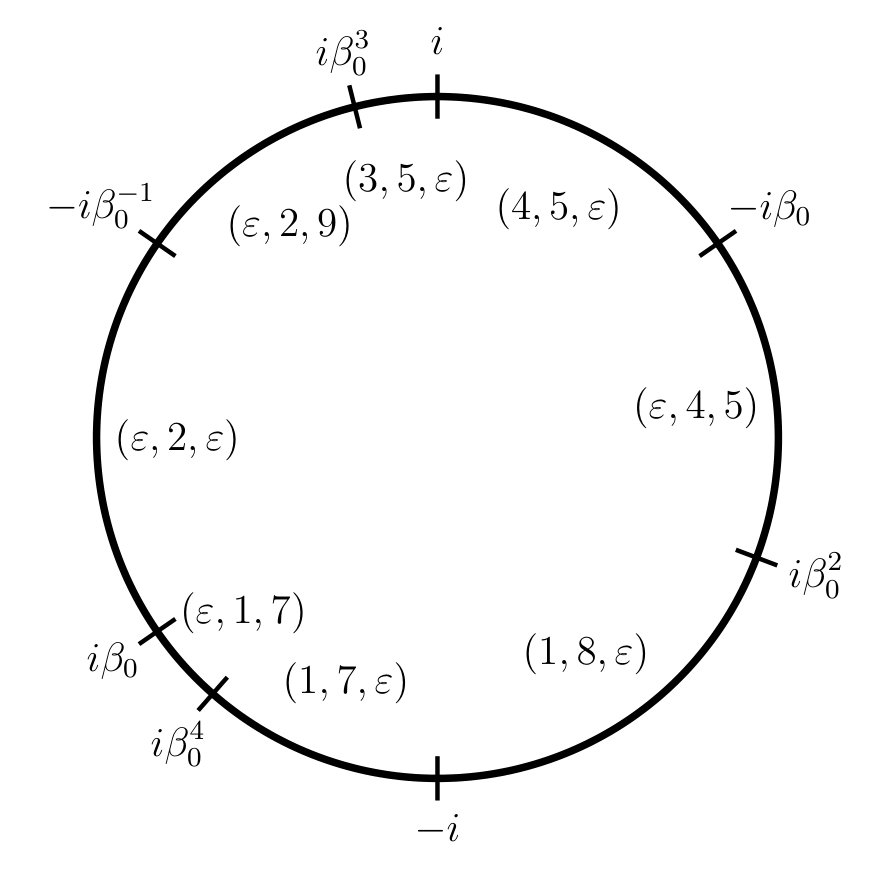 Figure 6
Peer Reviews
No public reviews on file for this paper yet. If you reviewed it on a platform where reviews are public (OpenReview, ICLR, NeurIPS, ICML), you can paste yours below so the community can read it here.
Videos
No videos yet. Explain this paper in a talk, walkthrough, or lecture? Add one.
Characterization of minimal sequences associated with self-similar interval exchange maps
Milton Cobo
Departamento de Matemática, Universidade Federal do Espírito Santo, Av. Fernando Ferrari 514, Goiabeiras, Vitória, Brasil.
,
Rodolfo Gutiérrez-Romo
Departamento de Ingeniería Matemática and Centro de Modelamiento Matemático, CNRS-UMI 2807, Universidad de Chile, Beauchef 851, Santiago, Chile.
and
Alejandro Maass
Departamento de Ingeniería Matemática and Centro de Modelamiento Matemático, CNRS-UMI 2807, Universidad de Chile, Beauchef 851, Santiago, Chile.
Abstract.
The construction of affine interval exchange maps with wandering intervals that are semi-conjugate to a given self-similar interval exchange map is strongly related to the existence of the so called minimal sequences associated with local potentials, which are certain elements of the substitution subshift arising from the given interval exchange map. In this article, under the condition called unique representation property, we characterize such minimal sequences for potentials coming from non-real eigenvalues of the substitution matrix. We also give conditions on the slopes of the affine extensions of a self-similar interval exchange map that determine whether it exhibits a wandering interval or not.
1. Introduction
Let and be a finite alphabet. An interval exchange map (i.e.m.) is a bijective map such that for a partition of by intervals of length and a vector we have if . In a similar way, an affine interval exchange map (affine i.e.m.) is a bijective map such that for a vector with positive entries and a vector we have if . The vector is called the slope vector of . An i.e.m. is self-similar if the first return map of to a proper interval is, up to rescaling, equal to .
An affine i.e.m. is semi-conjugate to an i.e.m. if there exists a continuous, surjective and non-decreasing map such that . We refer to as an affine extension of . It can be visualized as an “affine perturbation” of in the sense that it can be obtained from the graph of by perturbing the slopes.
Given an i.e.m. , the existence of an affine i.e.m. semi-conjugate to and having wandering intervals has been studied in several works during the last twenty years. As was established in [MMY10], this situation is generic in the space of parameters describing interval exchange maps, although there are some restrictions on the possible slope vectors ( should expand at a rate given by the second largest Lyapunov exponent of the associated Rauzy–Veech–Zorich cocycle).
Aside from [MMY10], most results concern self-similar i.e.m.’s. In this context, the pioneering work [CG97] established that there exists an affine i.e.m. with slope vector that is semi-conjugate to the i.e.m. if and only if the length vector of is orthogonal to . This condition is also equivalent to the fact that is generated by eigenvectors different from the Perron–Frobenius eigenvector of the matrix associated with . In subsequent works [CG97], [Cob02], [BHM10], [BBH14] and [CGM17], the existence of such an affine i.e.m. having wandering intervals is shown to be related to the spectral properties of .
More precisely, it was proved in [BHM10] that, if admits a real eigenvalue different from the Perron–Frobenius eigenvalue, but Galois conjugate to it, and an associated eigenvector , then there exists an affine i.e.m. with slope vector which is semi-conjugate to and has wandering intervals. Then, in [CGM17] this result was extended to the case of a non-real eigenvalue with such that is not a root of unity and under the so called unique representation property for and some associated eigenvector (see Definition 2.5). More precisely, it was proved that for almost all complex eigenvectors in the complex vector space generated by there exists an affine i.e.m. with slope vector that is semi-conjugate to and has a wandering interval. When is an eigenvector of associated with and , then any affine i.e.m. which is semi-conjugate to is indeed conjugate and, therefore, does not have wandering intervals (see [CG97], [Cob02] and [BBH14]).
The construction of affine perturbations of the i.e.m. with wandering intervals is somehow difficult. The strategy followed in [BHM10] and [CGM17], when is self-similar, is the one proposed by Camelier and Gutiérrez in [CG97]. It consists of “blowing up”, à la Denjoy, the orbits of specific points of the interval called distinguished points of a complex vector . The set of orbits of distinguished points is finite for each (see [Cob99] and [MMY10]). These points are intimately related to the so called minimal sequences of the substitutive subshift associated with the self-similar i.e.m. . More precisely, given and a complex vector , define and for . The sequence is said to be minimal for if for all . Then, the main technical step in the strategy devised in [CG97] requires a sequence for a complex vector such that the series is convergent. A necessary condition is that is minimal (up to a shift) for . Conversely, the main result [CGM17] states conditions under which minimal sequences always correspond to itineraries of distinguished points with respect to . In the aforementioned works, even if minimal sequences are constructed from eigenvectors associated with particular choices of eigenvalues as described before, very little is known about their nature, besides their existence.
We think that minimal sequences are interesting in their own. In particular, they are related to the extreme points in the boundary of some “fractal” sets associated with the expansive eigenspaces of integer matrices arising from substitutions. These fractals sets were first introduced by Dumont and Thomas in [DT89] to study numeration systems associated with substitutions. They are, in some sense, “dual” to the classical Rauzy fractals, which are associated with the contractive eigenspaces substitution matrices. They are also studied in [ABB11] in the particular case of the cubic Arnoux–Yoccoz map. Besides these two works, very little is known about them and understanding minimal sequences can shed light on such fractal sets.
In this article we characterize the set of minimal sequences and provide a method to compute them assuming the same hypotheses as in [CGM17]. That is, is a non-real eigenvalue of the matrix associated with the self-similar i.e.m. with such that is not a root of unity and under the unique representation property for and some associated eigenvector . In Theorems 3.3 and 3.4, we state that minimal sequences can be obtained iterating another map that turns out to be conjugate to an i.e.m. in its minimal components. This map is in fact the main novelty of this article that we think can play an interesting role in studying minimal sequences associated with general substitutive subshifts or can be extended to study minimal sequences associated with more general minimal subshifts, such as linearly recurrent systems. Corollary 3.5 states that for almost every eigenvector in the complex vector space generated by the set of minimal sequences is finite. Finally, in Theorems 3.7 and 3.6, we give conditions on the eigenvector in the complex space generated by that determine whether the affine extensions of with slope vector have a wandering interval or not.
We illustrate our results in the cubic Arnoux–Yoccoz map. We prove that for almost every complex eigenvector as before there are exactly two orbits of minimal sequences (and therefore exactly two orbits of distinguished points). Interestingly, the construction along the different minimal sequences produce different affine i.e.m.’s with different wandering intervals but the same slope vector. This shows that more than one affine i.e.m. with the same slope vector can be semi-conjugate to the cubic Arnoux–Yoccoz map. Since it was remarked at the end of Section 3.7.2 of [MMY10] that almost all i.e.m.’s are expected to have only one orbit of distinguished points, to our knowledge such examples are new.
In the next section we introduce the necessary background. We state our main results in Section 3. Section 4 is devoted to presenting the main technical consequences of our hypotheses. The map allowing to characterize minimal sequences is defined in Section 5 together with its main properties. Finally, our main results are proved in Section 6. To illustrate our main results, the cubic Arnoux–Yoccoz map is studied in Section 7 and an associated Appendix.
2. Background and Preliminaries
2.1. Self-similar i.e.m.’s
Let be a finite alphabet and be an i.e.m. exchanging the intervals of the partition of , i.e., if , where is the translation vector. We suppose that is self-similar on the interval with . That is, up to rescaling, the induced map on is equal to . Then is uniquely ergodic and minimal (every orbit of is dense in ). For more details on uniquely ergodic i.e.m.’s see [Vee78].
For each , define the interval and denote by the renormalization matrix given by , where is the first return time of to . By the minimality of , some power of is a positive matrix. We have that is its Perron–Frobenius eigenvalue and it is easy to see that the vector of lengths is an eigenvector of associated with . Also, the translation vector is an eigenvector of the transpose matrix associated with .
2.2. Substitution subshifts and minimal sequences
Let be a finite set or alphabet and let be the set of all words in . For , denotes its length, i.e., the number of letters in . The empty word is denoted by .
A substitution is a map . It naturally extends to the set of two-sided sequences by concatenation. That is, for the extension is given by
[TABLE]
where the central dot separates negative and nonnegative coordinates. A further natural convention is that .
We define the matrix associated with by: the entry is the number of times the letter appears in for any . The substitution is said to be primitive if a power of is strictly positive. This means that for some any letter in appears in the -th iterate of the substitution of any other letter in .
Let be the subshift defined from . That is, if and only if any subword of is a subword of for some integer and . We denote by the left shift in . We call the substitution subshift associated with . This subshift is minimal whenever is primitive.
If is primitive, by the recognizability property (see [Mos92]), given a point there exists a unique sequence such that for each integer we have and
[TABLE]
is the central part of , where the dot separates negative and nonnegative coordinates. This sequence is called the prefix-suffix decomposition of .
We refer to [Que87] and [Fog02] and references therein for the general theory of substitutions.
To a self-similar i.e.m. we associate a substitution subshift in the following way. Given we construct a symbolic sequence by the rule if and only if . The sequence is called the itinerary of . Let be the closure of the set of sequences constructed in this way for every . Clearly the sequence associated with corresponds to , where is the left shift map. Moreover, it is classical that there exists a continuous and surjective map such that . The map is invertible up to a countable set of points corresponding to the orbits of discontinuities of . Since is self-similar, the restriction of to is minimal and is a subshift associated with a substitution. The substitution is constructed in the following way: if and only if for every integer and . We then have that the matrix of the substitution is the transpose of the renormalization matrix associated with , i.e., . Furthermore, and is primitive. For details see [CG97].
2.3. Minimal sequences for a vector
Let be a primitive substitution in the alphabet . Given a vector and a word we define . For a sequence we define , and for . It is easy to see that if is an eigenvector of associated with , then for any integer ,
[TABLE]
Definition 2.1**.**
A sequence is a minimal sequence for the vector if
[TABLE]
Assume is the substitution associated with a self-similar i.e.m. . We adopt all notations of Section 2.1 and we assume is a non-real eigenvalue of with . In Lemma 4.4 in [CGM17] it is proved that:
Lemma 2.2**.**
For any eigenvector of associated with there exist minimal sequences.
2.4. Fractals associated with a self-similar i.e.m. and the unique representation property
Let be a self-similar i.e.m. which is self-similar on the interval , and be an eigenvalue of with such that is not a root of unity. Consider an eigenvector of for . Recall is the substitution associated with .
Denote by the set of possible triples in such that . Set , which we call the set of labels. We define
[TABLE]
and, for ,
[TABLE]
For write . We also consider the partition of by the subsets
[TABLE]
for .
The next concepts depend on the choice of , nevertheless, to simplify notations we omit this dependence.
For each and we define maps and by
[TABLE]
Given and we consider the sets (referred hereafter as “the fractals”)
[TABLE]
We easily notice the decomposition: . We say that a sequence is a representation of if . We also consider and for each .
Definition 2.3**.**
For each we define the maps
[TABLE]
where . Analogously, for ,
[TABLE]
Notice that and .
In Lemmas 5.3 and 7.2 in [CGM17] it is proved that:
Lemma 2.4**.**
For every , is continuous and has lateral derivatives at each .
A point is called an extreme point for the direction if . The set of extreme points for the direction is written as . We also set .
The results of this article depend on the following hypothesis:
Definition 2.5**.**
We say that satisfies the unique representation property (u.r.p.) for and the eigenvector if every extreme point of the associated fractals has a unique representation. That is, for any and any extreme point there exists a unique with .
The unique representation property implies in particular that extreme points of do not belong to intersections for distinct . In [CGM17] it is proved that this property holds for the cubic Arnoux–Yoccoz map.
3. The main results
Throughout the article we will assume the conditions of Section 2. Namely, is a self-similar i.e.m. on the interval , where . Recall that this implies that the associated symbolic system is generated by a substitution . We denote its matrix by . We fix a non-real eigenvalue of satisfying that and that is not a root of unity, and an eigenvector for . We assume that satisfies the u.r.p. for and .
For , we denote by the set of directions such that, for different labels and in , we have . This definition is slightly different from the one given in [CGM17], but the two definitions coincide under the u.r.p. It will be proved in Lemma 4.2 that the u.r.p. implies that is finite for all . We set .
Our main results depend on the following map. Set and let be defined as if . Clearly, the definition of is ambiguous if , however, under the u.r.p., is well-defined and continuous except at finitely many points. The map will be extensively discussed in Section 5. In particular, we will show that is conjugate to an interval translation map, i.e., a piecewise isometry of an interval. These maps are different from interval exchange maps because they need not be bijective.
Our first result will be proved at the end of Section 5:
Theorem 3.1**.**
Let be a self-similar i.e.m. Assume that has an eigenvalue with such that is not a root of unity, and that there exists an eigenvector for such that has the u.r.p. for and . Then has finitely many minimal components and its restriction to each minimal component is an i.e.m.
We need the following definitions to state our results. In what follows is the natural distance between and in .
Definition 3.2**.**
- (i)
A direction is good if for some constant and every we have that . 2. (ii)
Conversely, a direction is very bad if for every we have . 3. (iii)
An eigenvector of for is said to be good (resp. very bad) if , where is a good (resp. very bad) direction.
Notice that if is a good direction then necessarily for all .
The definition of good direction is different from that of [CGM17], but each good direction as in Definition 3.2 is also a good direction in the sense of that article. Lemma 7.4 in [CGM17] can be then applied to show that the set of good directions has total Lebesgue measure, which implies that the set of very bad directions has measure zero.
We will show in Lemma 6.11 that the main result of [CGM17], Theorem 7.1, still holds for good directions in the sense of Definition 3.2.
Our next two results characterize minimal sequences for good eigenvectors. Roughly speaking, the prefix-suffix decompositions of minimal sequences for these eigenvectors are given, up to a finite number of coordinates, by the pre-orbits of in its minimal components.
Theorem 3.3**.**
Assume the same hypotheses of Theorem 3.1. If is a good eigenvector, and is a minimal sequence for , then the prefix-suffix decomposition of satisfies that:
- •
* belongs to a minimal component of for some ,*
- •
, for all .
Conversely, we have a way to construct minimal sequences for good eigenvectors.
Theorem 3.4**.**
Assume the same hypotheses of Theorem 3.1. If is a good eigenvector, and belongs to a minimal component of the map , then, setting for , we have that is the prefix-suffix decomposition of some shift of a minimal sequence for the vector .
The fact that has finitely many minimal components allows us to deduce:
Corollary 3.5**.**
Assume the same hypotheses of Theorem 3.1. If is a good eigenvector, then the set of minimal sequences for is finite.
Depending on the logarithm of the slope vector of an affine extension of , the existence or absence of wandering intervals is ensured:
Theorem 3.6**.**
Assume the same hypotheses of Theorem 3.1. If is a good eigenvector, then no affine extension of with slope vector is conjugate to .
Theorem 3.7**.**
Assume the same hypotheses of Theorem 3.1. If is a very bad eigenvector, then every affine extension of with slope vector is conjugate to .
In other words, affine extensions constructed from good eigenvectors exhibit wandering intervals, whereas those constructed from very bad eigenvectors do not.
An important consequence of the previous results is that one can explicitly describe minimal sequences producing affine extensions with wandering intervals of a given self-similar i.e.m. and, thus, construct good approximations of such extensions.
In particular, we apply our results to the cubic Arnoux–Yoccoz map. For this example there exists an eigenvalue of the associated matrix with and multiplicity one. It was proved in [CGM17] that the u.r.p. holds. We prove that that map has exactly two minimal components and, thus:
Theorem 3.8**.**
In the cubic Arnoux–Yoccoz map, for each good eigenvector associated with , there are exactly two orbits of minimal sequences.
By the construction shown at the beginning of Section 2 of [CGM17], to each of these two orbits of minimal sequences corresponds an affine i.e.m. with slope vector which is semi-conjugate to . These two affine i.e.m. have distinct wandering intervals and are, therefore, not conjugate to each other.
4. Main consequences of the unique representation property
In this section we state the main technical lemmas implied by the u.r.p. that we will use to prove our main results. Consider a self-similar i.e.m. satisfying the hypotheses of Theorem 3.1. That is, has an eigenvalue with such that is not a root of unity, and that there exists an eigenvector for such that has the u.r.p. for and . This eigenvector will be fixed for the rest of the article and all concepts defined in Section 2.4 will be associated with it.
Our next lemma is a slightly more general version of Lemma 7.7 in [CGM17]. We omit the proof because it is essentially the same.
Lemma 4.1**.**
Let and such that , with and different elements of . Then there exist finite constants such that if is a sequence in converging to when , then
[TABLE]
The constants and are given by:
[TABLE]
The u.r.p. implies that and are disjoint. Since both sets are compact, we obtain that .
As a consequence of Lemma 4.1 we get:
Lemma 4.2**.**
The set is finite for each .
Proof.
Suppose by contradiction that for some the set is infinite and let be a sequence in that converges to such that for every .
Without loss of generality we may assume that there exist in such that and for every . By continuity of , and , we have that . Indeed, this set is closed.
Consider sequences and attaining the minimum for the direction , that is, . We may assume that and when . Then clearly and . Thus the hypotheses of Lemma 4.1 are satisfied. Since for all , this lemma ensures that . Therefore, the intersection is nonempty, since these sets are closed, contradicting the u.r.p. ∎
5. The skew product
In this section we thoroughly study the map . We always assume the u.r.p. for and . We will see that is conjugate to a piecewise translation on the interval, that it has finitely many minimal components and that, when restricted to each minimal component, it is an interval exchange map.
Recall that is the set of possible triples in such that and that .
Lemma 5.1**.**
For each and the set
[TABLE]
is a finite union of closed intervals. Moreover, if and are different elements in , then the interiors of and are disjoint.
Proof.
We prove that each is closed and has a finite number of connected components. Let be a sequence in that converges to . Let be a sequence in such that . Since is compact, we can assume that converges to . Therefore, by continuity of we have that . By definition, we conclude that and thus is closed.
Now, since each of the sets is closed, then the boundary of a connected component in is contained in . By the u.r.p., is finite (see Lemma 4.2). Then each has finitely many connected components and thus is a finite union of closed intervals.
Finally, is contained in . So again by finiteness of their interiors are disjoint. ∎
Notice that, for each , the union of the closed intervals composing the sets covers . Therefore, if each of such closed intervals is redefined to be left-closed and right-open we get a partition of by intervals.
Recall that and that is given by
[TABLE]
if . Equivalently, if . The definition is ambiguous if (there is more than one choice for ). Nevertheless, by Lemma 4.2, is finite when the u.r.p. holds, so is well defined and continuous except at finitely many points. Therefore, we can fix the ambiguity by setting to be right-continuous. This is possible since the ambiguities are determined by the boundaries of the closed intervals defining each . Observe that the definition of is independent of and .
5.1. Orbits of and extreme points
Let be the set of all possible maps defined as by omitting the right-continuous hypothesis, including . As discussed in previous paragraph, this set is clearly finite. Also, any element in is aperiodic because is not a root of unity. First we notice that:
Remark 5.2**.**
The existence of satisfying is equivalent to the fact that , i.e., it is equivalent to the existence of such that .
Let and be the projections to the first and second coordinates of respectively.
Lemma 5.4 below establishes a relation between the orbits of maps in with the representations in of extreme points in for any direction. Indeed, it tell us that such representations are the same as forward orbits of maps in . We remark that such orbits are by definition in .
To prove it we recall Lemma 5.6 in [CGM17]:
Lemma 5.3**.**
If is a representation of an extreme point in for the direction , then the shift is a representation of an extreme point in for the direction .
This is called the continuation property.
Lemma 5.4**.**
Let and . A sequence is the representation of an extreme point in if and only if there exists such that
[TABLE]
for any .
Proof.
Let be the representation of an extreme point for the direction . That is, . Fix some and put , and , where and are chosen such that . By the continuation property (Lemma 5.3), the shifted sequence belongs to and is a representation of an extreme point for the direction . From Remark 5.2, there exists such that
[TABLE]
Since the ambiguity points to define are finite, for some the sequence does not contain any such point. Thus, can be taken to be for all . Since is not a root of unity, the finite sequence cannot repeat any ambiguity point. Thus the map in that is equal to in for and equal to elsewhere is well defined. We conclude that
[TABLE]
Conversely, suppose that is obtained from the trajectory by some of with . Set , and .
From Remark 5.2, if for , then there exists a representation of an extreme point of the fractal in the direction : .
Then, using recursively the properties of each and the continuation property we get:
[TABLE]
Taking the limit when we conclude that . ∎
5.2. Minimal components of maps in
Any map in can be visualized as an interval translation map (i.t.m.) We recall that a map defined in an interval is an i.t.m. if it is a piecewise translation with finitely many discontinuities. Contrary to i.e.m.’s these maps need not be injective or surjective. Basic properties of i.t.m. can be found in [BK95].
To simplify notations we only illustrate this construction with the right-continuous map . For other maps in it is analogous. Partition the interval into consecutive intervals of the same length, each one associated with an element . Call such interval and assume it is left-closed and right-open. Observe that the substitution associated with the i.e.m. is injective (indeed, the associated matrices are invertible), so for each there exists a unique such that .
The map naturally induces a map on that we also call in the following way. For each let be an orientation preserving linear identification of both sets such that is the left extreme point of the interval . If on then on (see Figure 2). Since on has finitely many discontinuities, the map seen on is an i.t.m. Moreover, since is not a root of unity, is an aperiodic i.t.m.
We need to define the notion of minimal component for seen in . Since is not continuous we need to adapt the classical definition from topological dynamics. This is done by using a standard procedure in i.e.m. theory that can be adapted to the context of an i.t.m. and which we sketch here. It follows the discussion in Section 2 of [BK95].
First we call the left continuous version of , that is, . Now we define a new space . Let be the set of discontinuities of together with its preimages and images by . Then we build the ordered set , where is a disjoint copy of putting every point immediately to the left of . That is, we introduce little holes in at positions calling the left side of the hole and the right side . The order of naturally extends to this new set. The set endowed with the order topology is a compact metric space. Finally, let be the map defined as in , for and is defined by continuity (notice that is increasing in a neighbourhood of ).
One proves that is a continuous map on the compact metric space . Moreover, leaves invariant and (the restriction of to ) coincides with as a map.
Definition 5.5** ([ST00]).**
We say that is a minimal component for the i.t.m. if , where is a minimal component of . That is, and every point in has a dense orbit by (for the corresponding topology).
By definition of , if is a minimal component for then its restrictions to and are invariant by . Moreover, if then . Then, is strongly invariant by , that is, . We also have that for any , and that two different minimal components are disjoint.
Using the fact that is an aperiodic i.t.m. and Theorem 2.4 in [ST00] we get:
Lemma 5.6**.**
* has a finite number of minimal components.*
Recall that we have mapped each to a unique point . This map can be extended to by sending each to the same as for every . We call this map .
Lemma 5.7**.**
The minimal components of and are finite unions of intervals of positive length.
Proof.
Let be a minimal component of . Then, by definition for a minimal component of .
For each define as the projection on of , where . We will prove that .
Let and let . For any integer we have that the first coordinate of is . Since the rotation by is irrational, we get that . Moreover, we can find subsequences converging to every point in from above and below. Since is compact, we obtain that . Notice that we have used the convergence in the topology of . A similar argument shows that each is closed. Then, there exists such that contains an open interval .
Let be the set of the such that the first coordinate of belongs to . Since is an open interval, there exist such that for every either or belongs to . Since is closed, we deduce that both and belong to for every , so is an open interval in .
By minimality, there exists such that . Since and are invariant for , we obtain that . To conclude, we have that and are finite unions of intervals of positive length, since the image of an interval by either or is a finite union of intervals (recall that it is an i.t.m.) ∎
Given there always exists a minimal component contained in the closure of its orbit by . Indeed, let such that . The closure of its orbit by contains a minimal component . Then, satisfies (notice that the topology of is stronger than the one of ). We conclude by mapping back these objects to .
Lemma 5.8**.**
There exists such that for any we have that belongs to a minimal component contained in the closure of its orbit by . In particular, there exists a unique minimal component contained in the closed orbit of any point in .
Proof.
We prove the lemma using the map as seen on . Consider the element such that . Let be a minimal component contained in . By definition , where is a minimal component for with as discussed just before the lemma.
By Lemma 5.7, we have that has nonempty interior. Since is contained in , there exists such that attains the interior of . This implies in particular that contains a unique minimal component. Thus, . But has nonempty interior and is continuous, so by compactness there exists such that and then . Using a similar argument as the one developed in the proof of the previous lemma to pass from to , one deduces that .
To conclude that can be chosen uniformly, we observe from Lemma 5.6 that and have finitely many minimal components. ∎
5.3. Proof of Theorem 3.1
Let be the limit set of : . As a consequence of the previous lemma and the fact that minimal components for are strongly invariant (see the comment after the definition of minimal components), there exists such that if . In the nomenclature of [BK95], this property means that is of finite type. By Lemma 5.8, every point attains the minimal component in the closure of its orbit in steps. Moreover, is surjective when restricted to a minimal component. Therefore, is equal to the disjoint union of the minimal components of . We collect all this observations in the following Corollary for future reference.
Corollary 5.9**.**
There exists such that . Moreover, is equal to the disjoint union of the minimal components of and thus is a finite union of intervals of positive length.
Proof of Theorem 3.1.
It was already proved in Lemmas 5.6 and 5.7 that has finitely many minimal components each of which is a union of intervals. We need to prove that the restriction of to a minimal component is a minimal i.e.m. At each minimal component is surjective, but since it is an i.t.m. it is also injective, so it is an i.e.m. ∎
6. Construction of minimal points
We continue under the same assumptions of the previous sections. In particular, we fix the eigenvector used to define fractals and related concepts in Section 2.4.
The following result is implied by Lemma 7.4 in [CGM17], since Definition 3.2 is weaker than the one in that article.
Lemma 6.1**.**
Almost every is a good direction.
A direct consequence of the lemma is that almost every eigenvector in the complex space generated by is good.
6.1. Technical lemmas
Our first lemma is a slight modification of Lemma 5.7 in [CGM17]. We omit the proof since it is almost identical.
Lemma 6.2**.**
There exists a constant such that for all , , and ,
[TABLE]
We will also need a stronger result.
Lemma 6.3**.**
There exists a constant such that for all , , and , we have that if for and , then
[TABLE]
Moreover, if then
[TABLE]
Proof.
By Lemma 5.4, . Then,
[TABLE]
We conclude using that the series is uniformly bounded with respect to , and . The second statement of the lemma is analogous. ∎
The next lemma is the crucial step in the proofs of our main results. It will allow to characterize the prefix-suffix decompositions of minimal sequences.
Lemma 6.4**.**
Let be a good direction and . Assume is an increasing sequence of positive integers such that for all with . There exists such that if, for some , satisfies , then .
Proof.
We proceed by contradiction. Without loss of generality, suppose that there exists in and a sequence such that for all .
Consider also the sequence given by
[TABLE]
By Lemma 4.2 the set is finite. Then, since is not a root of unity, after extracting a subsequence we can assume that . Then, by hypothesis and definition of , it follows that each and
[TABLE]
Without loss of generality we assume that . By continuity of and , . On the other hand, by Lemma 6.2 used in the sequence we have that and thus .
Therefore, the hypotheses of Lemma 4.1 hold and there exists such that for every :
[TABLE]
where is strictly positive.
Since, by hypothesis, , we get:
[TABLE]
On the other hand, by Lemma 6.3, we obtain that:
[TABLE]
[TABLE]
Finally, since is a good direction, then as . Therefore, if is sufficiently large, , which contradicts the hypothesis that for all . ∎
Definition 6.5**.**
Let and an integer . By changing the indices of the letters we can decompose the word as a pointed word , where . We use the notation to refer to this kind of decomposition.
We say that is minimal for and the vector if for all .
Observe that this is equivalent to for every (see Lemma 4.3 in [CGM17]), so is a proper prefix of satisfying for any proper prefix of .
The next lemma provides a finite prefix-suffix decomposition for .
Lemma 6.6**.**
Let , and with . That is, . Then, there exists a finite prefix-suffix decomposition such that for every and satisfying . In other words, finite words that are shifts of iterates of letters have an analogue of a prefix-suffix decomposition.
Proof.
If , then with satisfying , so the result holds in this case.
We now assume that and proceed by induction. That is, we assume that any shift of has a finite prefix-suffix decomposition. Let , where is chosen so with the minimum possible . Let be the finite prefix-suffix decomposition of . We have that . By minimality of , we conclude that . We write the word as and then define the finite prefix-suffix decomposition of as . By definition of and , this sequence satisfies the desired properties. ∎
The following lemma allows to relate the finite prefix-suffix decompositions of minimal words with extreme points of finite order.
Lemma 6.7**.**
Let , and with . Assume is minimal for and and let be its finite prefix-suffix decomposition. If for and the first coordinates of coincide with , then .
Proof.
Put with . By definition of the finite prefix-suffix decomposition, we have that . Applying , using (1) and taking real parts, we obtain:
[TABLE]
for every prefix of . On the other hand, for any there exists a prefix of such that . Indeed, we can take . Thus for all . ∎
The following corollary of previous lemma was implicit in the proof of Lemma 5.13 in [CGM17].
Corollary 6.8**.**
Let be the prefix-suffix decomposition of a minimal sequence for the vector for some . Let and be such that its first coordinates coincide with . Then .
Finally, using the following lemma we only have to consider minimal sequences with infinitely many non-empty prefixes and suffixes. This argument was given in the proof of Proposition 7.8 in [CGM17], but we state it here for convenience.
Lemma 6.9**.**
Let be the prefix-suffix decomposition of a minimal sequence for the vector for some . Then, there exist infinitely many such that . Analogously, there exist infinitely many such that .
Proof.
Assume by contradiction that for some integer and every . We will show that is eventually periodic, which contradicts Lemma 5.8 in [CGM17]. We have that for every . Then, for every , the value of determines a unique possible value for and . By induction, it is easy to see that is periodic. Proving that infinitely many ’s are nonempty is completely analogous. ∎
6.2. Proof of Theorem 3.3
We have already proved in Theorem 3.1 that the restriction of to each minimal component corresponds to a minimal i.e.m. In this way we can refer to the inverse of on each minimal component.
Under the hypothesis of Theorem 3.3 we need to prove that: for every good direction and every minimal sequence for , its prefix-suffix decomposition satisfies:
- (a)
for some , belongs to a minimal component of ;
- (b)
for all .
Proof of Theorem 3.3.
Let be a good direction. We claim there exists such that for every we have
[TABLE]
If this holds, from Theorem 3.1 we have that of any point of is contained in a minimal component of , where is a universal constant. Therefore, by taking we get (a) and (b).
We prove the claim by contradiction. Assume there exists an increasing sequence of integers such that
[TABLE]
Without loss of generality we may assume that for all : and there exists in such that
- •
and
- •
.
By Remark 5.2 we have that for all .
On the other hand, let be a point such that its first coordinates coincide with . Since is the prefix-suffix decomposition of a minimal sequence, by Corollary 6.8 we have that for all . This contradicts Lemma 6.4 since . ∎
6.3. Proof of Theorem 3.4
Under the hypotheses of Theorem 3.4 we need to prove that, for every good direction , if belongs to a minimal component of and for every , then is the prefix-suffix decomposition of some shift of a minimal sequence for the vector . Let be the set of sequences in that are the prefix-suffix decomposition of a point in . It is not difficult to prove that:
[TABLE]
Proof of Theorem 3.4.
Let be good direction. Consider a sequence such that its prefix-suffix decomposition is the one given in the statement of the theorem, i.e., .
We will start by proving that is not empty for infinitely many . An analogous proof shows that is not empty for infinitely many .
Assume by contradiction that the suffixes are eventually empty. Then, we have that is eventually periodic as in the proof of Lemma 6.9. Thus, there exists and such that for every and .
Let and such that its first coordinates are
[TABLE]
By Lemma 6.3, we have that . Let be the limit of , which is periodic. By taking appropriate subsequences we get that is an extreme point in for some direction in . This contradicts Lemma 5.8 in [CGM17] which states that eventually periodic elements cannot represent extreme points.
The sequence induces a partition of the non-zero integers in the following way: the set is defined by the coordinates covered by or in , where the dot separates negative and non-negative coordinates. Since infinitely many ’s and ’s are nonempty, we have that . We define , and .
Suppose now by contradiction that is not in the trajectory by the shift of a minimal sequence for the vector . Then, there exists an increasing sequence of integers such that is strictly decreasing and equal to . Let such that . Without loss of generality, we assume that for every .
Let be the prefix-suffix decomposition of . We have that and that, by definition, , where is such that its first coordinates are . Since by definition , we have that:
[TABLE]
We may assume that for every : and .
By definition of , is chosen so that for all . This fact contradicts Lemma 6.4 since .
∎
6.4. Proof of Corollary 3.5
We start by showing that the orbits of minimal sequences are finite:
Lemma 6.10**.**
Given a good direction , there are finitely many orbits of minimal sequences for the eigenvector .
Proof.
Let be the set of sequences in whose prefix-suffix decomposition is the projection on of for some belonging to a minimal component of . Since is finite, we obtain that is finite.
Let be the prefix-suffix decomposition of a minimal sequence for the vector . By Theorem 3.3 there exists such that
- •
belongs to a minimal component of and
- •
for every .
Let be the sequence whose prefix-suffix decomposition is the projection on of . We have that the prefix-suffix decomposition of and coincide for every . But, by Lemma 6.9, infinitely many ’s and ’s are nonempty. Therefore belongs to the orbit of by the shift action on . This concludes the proof. ∎
Fix a slope vector and for , denote and for . Let
[TABLE]
which might be equal to (observe that every term of the series is positive). If is a finite (pointed) word, we similarly define and for . Letting and , we set .
The main result of [CGM17], Theorem 7.1, states that if is a minimal sequence for a good eigenvector and , then . In the next lemma we will prove a similar result for a sequence of finite words which are minimal in the sense of Definition 6.5 and eigenvectors which are good in the sense of Definition 3.2.
Lemma 6.11**.**
Let be a good eigenvector and let . Fix and for every let be minimal for and . Then, there exists a constant such that for all .
Let us remark that the proof of this lemma uses the same techniques as those of Theorem 7.1 in [CGRM17], but the present result seems stronger. Indeed, observe that if is a minimal sequence for the vector and is its prefix-suffix decomposition, then for all the pointed word whose prefix-suffix decomposition is is minimal for and . Therefore, this lemma easily implies Theorem 7.1 of [CGRM17], namely, that We tried hard to prove the converse, unsuccessfully. For this reason, a new proof, although with very similar arguments to that of Theorem 7.1 in [CGRM17], seemed to us unavoidable. Moreover, we need to account for the different definition of good eigenvector.
Proof.
We will prove the lemma only for the series associated with the positive coordinates of , i.e., we will prove that are uniformly bounded. The proof for the negative part is similar.
Let such that for every , which exists by definition of good direction. Let , which satisfies . Let . It is sufficient to prove that there exist constants such that for every and for every sufficiently large . This is the same as saying that for . To prove this, it is enough to show that
[TABLE]
We proceed by contradiction and suppose that there exists subsequences of natural numbers and such that and
[TABLE]
Let for every . Denote by and be the finite prefix-suffix decompositions of and respectively.
By taking subsequences if necessary, we can assume that there exist distinct elements such that, for :
- (i)
; 2. (ii)
; 3. (iii)
.
Now, since with , we have that
[TABLE]
for every .
We will now reverse the indexes of the finite prefix-suffix decompositions of and in order to obtain sequences in . Let and be the sequences in obtained by reversing the coordinates of and and such that for each .
Without loss of generality we will assume that converges to . By Lemma 5.12 in [CGM17], is the representation of an extreme point in . We will show that any limit point of in is the representation of an extreme point in and therefore belongs to .
Applying to (5), using the definitions of and , and multiplying by , we get that for every :
[TABLE]
Let us write for . By taking real parts and rearranging the previous expression we obtain:
[TABLE]
Furthermore, since is minimal. Then we get
[TABLE]
On the other hand, since is a subword of and grows as (recall that is the Perron–Frobenius eigenvalue of ), we have that for sufficiently large . Therefore, by definition of ,
[TABLE]
From assumption (4), we obtain that
[TABLE]
In particular, from equation (6) we obtain that any limit point of in is such that is an extreme point for the direction , that is, . Therefore, belongs to .
Recall that is the constant in the definition of good direction. Amplifying equation (6) by , we find that
[TABLE]
for all sufficiently large . Hence,
[TABLE]
Since is minimal,
[TABLE]
We also know that and therefore that
[TABLE]
On the other hand, since and are representations of extreme points for the same direction , the unique representation property we are assuming implies that .
Using Lemma 6.2 we conclude that for each :
[TABLE]
for a constant which does not depend on .
Finally, by (8), (9) and Lemma 4.1 we conclude that
[TABLE]
for infinitely many . Since is a good eigenvector and , by definition, . This contradicts (7). ∎
Proof of Corollary 3.5.
Let be a minimal sequence for the vector . We have that is also a minimal sequence for some if and only if . By Lemma 6.11, we have that there exists such that for every with . This concludes the proof. ∎
6.5. Proof of Theorem 3.6
Proof of Theorem 3.6.
For , let be its itinerary by with respect to the partition . Let be an affine i.e.m. with slope which is semi-conjugate to . Then there exists a continuous surjective map such that . Let be the pushforward by of the Lebesgue measure on , that is, for any Borel set of . It is easy to see that
[TABLE]
for every , where . More generally, if and , then if :
[TABLE]
For each and , denote and let . We have that is the union of the sets with and . Therefore,
[TABLE]
We obtain that there exist , and a subsequence of the natural numbers such that, for every ,
[TABLE]
Now assume by contradiction that there exists an affine i.e.m. with slope vector which is conjugate to . That is, we assume that is injective. We will show that this contradicts inequality (11).
Let be a sequence of locally minimal words for and the vector , i.e., there exists such that
[TABLE]
with for every . By Lemma 6.11, there exists a constant such that for every . Note that and . Thus, by equation (10),
[TABLE]
Therefore,
[TABLE]
for all . Finally, let be a limit point of . We have that . Since is invertible and is injective, we have that , so
[TABLE]
contradicting (11).
∎
6.6. Proof of Theorem 3.7
We start by showing that minimal components of contain directions in .
Lemma 6.12**.**
If is a minimal component of , then there exists such that .
Proof.
Assume that for each there exists a unique with . Let and let be the maximal interval containing . That is, , where is the maximal interval containing such that . We will prove that .
By hypothesis, for some and each . By minimality, there exists such that , which implies that . We obtain that:
[TABLE]
If was a proper subset of , then it would also be a proper subset of . This contradicts the maximality of . Therefore, .
Now, by minimality, there exists such that . Assume that is minimal with this property. By hypothesis, we deduce that:
[TABLE]
and that for every and . We conclude that the projection of any pre-orbit by is periodic. Fixing a good eigenvector , by Theorem 3.4 we obtain that there exist ultimately periodic minimal sequences for . This contradicts Lemma 5.8 in [CGM17]. ∎
Lemma 6.13**.**
Under the hypotheses of Theorem 3.3, if is a very bad eigenvector, is a minimal sequence for and , then .
Proof.
Let be the prefix-suffix decomposition of . We claim that there exist a subsequence and distinct labels and in such that, for every ,
- (i)
; 2. (ii)
when ; 3. (iii)
; 4. (iv)
.
From these conditions we can prove that . Indeed, let be an element of whose first coordinates coincide with . Clearly, .
By definition of and the fact that is minimal, we obtain from Lemma 6.7 that .
Let be such that for every . Clearly, and from Lemma 6.2 and Lemma 4.1, there exists such that, for every sufficiently large ,
[TABLE]
and therefore, from the fact that is a very bad direction, we conclude that, for some constant and every sufficiently large ,
[TABLE]
If is a prefix of , then
[TABLE]
for some increasing sequence . Therefore,
[TABLE]
and, since is a minimal sequence, we obtain that for every . We conclude that , so .
If is a prefix of , then
[TABLE]
for some increasing sequence . Therefore,
[TABLE]
By (12), we obtain that
[TABLE]
for all sufficiently large . We conclude that , so .
We will now prove that we can find a sequence such that (i)-(iv) hold. We consider two complementary cases:
Case 1. Assume that there exists such that, for all ,
[TABLE]
That is, up to finitely many terms, the prefix-suffix decomposition of is obtained by the projection of a pre-orbit by . By Lemma 5.8 we have that belongs to a minimal component of and, therefore, that belongs to for all .
By the previous lemma, there exists such that . Since is minimal, we can find a sequence such that converges to . We can also assume that is constant. We then obtain claims (i)-(iii).
By definition of , we have that and, by continuity, we obtain that . Since , there exists such that . In this way, we obtain (iv), and the claim holds in this case.
Case 2. Assume that there exists a subsequence such that
[TABLE]
for every . Without loss of generality, we may assume that there exists and distinct labels such that, for all ,
- (i)
; 2. (ii)
when ; 3. (iii)
;
and .
We therefore have conditions (i)-(iii) of our claim, and we must prove that (iv) holds.
Notice that, by continuity of and definition of , . To obtain (iv), it is enough to show that .
Let such that its first coordinates are . Clearly, . By definition of and the fact that is minimal, we obtain from Corollary 6.8 that . Therefore, if is any limit point of in of , then . Thus, . We conclude that our claim also holds in the second case.
∎
Proof of Theorem 3.7.
Consider an affine extension of with slope vector . Let be a continuous, surjective and non-decreasing map such that . We claim that if is not injective, then there exists a minimal sequence for which the series is finite.
Indeed, let be such that is an interval of positive length (that is, is a wandering interval for ). Let be the itinerary of by . Observe that, since is non-decreasing, for any :
[TABLE]
so for every . Since, for every , the slope of on the interval is , we obtain that, for every ,
[TABLE]
where is the Lebesgue measure on . The intervals are pairwise disjoint, so
[TABLE]
which shows that . The sequence must then be minimal up to a shift. The proof follows by the previous lemma. ∎
7. The cubic Arnoux–Yoccoz map
In the cubic Arnoux–Yoccoz i.e.m. (A-Y i.e.m.) we illustrate the main theorems of the article. In particular, we construct the map together with its minimal components. We have to mention that this example is not really self-similar in the sense of this article, but the natural symbolic coding is substitutive and the substitution satisfies the conditions of this article. In any case, it can be transformed in such a way that the resulting i.e.m. fully satisfies our conditions, but the extra notation is unnecessary to understand the phenomenon. Details on this transformation can be found in [LPV07].
Let be the unique real number such that and let be the map exchanging both halves of the interval while preserving orientation. That is,
[TABLE]
Then, the A-Y i.e.m. is given by . Properties of were extensively discussed in [ABB11]. In particular, it is proved that the map is equal, up to rescaling and rotation, to the map induced on the interval and, by considering an appropriate refinement of continuity intervals of into nine intervals, one may encode the relation of orbits by for this partition and the orbits of the induced system for the induced partition by the following substitution on the alphabet :
[TABLE]
One then has that . It is easy to check that is primitive. The characteristic polynomial of is , where the last two factors are irreducible. The roots of are , and , whereas the roots of are , and , where is the Perron–Frobenius eigenvalue. We assume that is the eigenvalue with positive imaginary part. Numerically, . It is proved in [Mes00] that is never real for any . Furthermore, we have that the eigenspace associated with has dimension 1. In fact, it is generated by
[TABLE]
In what follows and are the corresponding eigenvalue and eigenvector of used in previous sections. By Lemma 8.8 in [CGM17] we have that this example satisfies the u.r.p. for the selected and . Also, the boundaries of the associated fractals are Jordan curves (see Lemma 8.5 and Corollary 8.7 in [CGM17]).
First we compute the sets where we can find extreme points in different sub-fractals. Since , and (proved in [ABB11]), we focus on the subalphabet .
Lemma 7.1**.**
One has
[TABLE]
where and , .
Proof.
The bounds on and were found computationally and then proved analytically. The proof is tedious but elementary, so we omit it here. See the Appendix for computations. ∎
Using the previous lemma it is possible to compute the right-continuous map somewhat explicitly (it will depend on the bounds for and ). The bounds on and are sufficiently good so that restricted to its minimal components does not depend on their exact values.
Lemma 7.2**.**
The map has exactly two minimal components shown in Figure 3.
Proof.
By iterating , we see that , so the limit set . In addition, the restriction of to coincides with the map in Figure 3. ∎
Lemma 7.3**.**
Let be a real number and let be algebraic. Then, .
Proof.
We will use Baker’s theorem, which relies on the following definition: given an algebraic number whose minimal primitive polynomial is , we define its height as .
Let . First observe that and that is algebraic. Let such that and . We have that and are linearly independent over the rational numbers, since is not a root of unity. Moreover,
[TABLE]
and, since , the number attaining the minimum in the previous equation has absolute value at most . Therefore,
[TABLE]
We consider several cases:
If is neither a root of unity nor a rational power of , then , and are linearly independent over the rational numbers. The height of is . By Baker’s theorem, we obtain that for every , where is a constant independent of . Therefore, .
If is a root of unity, then with a rational number. Therefore,
[TABLE]
If is larger than both the numerator and denominator of , then the height of most for every . Baker’s theorem then shows that for every with , where is a constant independent of . Observe that the minimum cannot be attained at except for finitely many . Therefore, for sufficiently large .
If is a rational power of , then for some rational number . Therefore,
[TABLE]
If is larger than the numerator and denominator of , then the height of is at most . By Baker’s theorem, we obtain that for every and , where is a constant independent of . Therefore, for sufficiently large .
In any case, for sufficiently large, is bounded from below by , where is a polynomial and is a constant independent of . This fact rules out the exponential rate of convergence.
∎
8. Possible additional examples
In this section we present a class of i.e.m.’s for which we think it is possible to find new examples verifying the hypotheses of our main results. These hypotheses are: the existence of a suitable eigenvalue, that is, a non-real expanding eigenvalue such that is not a root of unity, and the unique representation property. The family of examples satisfies the first hypothesis. Nevertheless, to determine if the unique representation property holds for a specific example in this class one needs to understand the topology of the associated fractals. We expect that algebraic conditions similar to the ones in [BHM10] are sufficient. Indeed, conditions of this nature should imply that the fractals are “well-behaved” in a broad sense since this is true for classical Rauzy fractals.
We will make use of the notion of Rauzy–Veech algorithm and related concepts such as Rauzy classes. For more details on these notions we suggest [Via06] and [Yoc10].
8.1. Suitable eigenvalue hypothesis
We will restrict the discussion to i.e.m.’s which are periodic for the Rauzy–Veech algorithm. This is a natural class of self-similar i.e.m.’s as explained in [CGM17, Section 7.2].
First observe that i.e.m.’s exchanging five intervals or less cannot satisfy this hypothesis. Indeed, any reciprocal quintic polynomial of a primitive matrix has at least three real roots. If the remaining roots , are non-real, then as they are complex conjugates.
However, it is possible to construct an infinite family of self-similar i.e.m.’s exchanging six intervals whose induction matrices have suitable eigenvalues by finding appropriate cycles in a Rauzy class as done in [BHM10, Section 6]. Indeed, consider the hyperelliptic permutation
[TABLE]
We consider three cycles on the Rauzy class of (see Figure 4):
- (1)
alternating top and bottom operations until coming back to ; 2. (2)
alternating bottom and top operations until coming back to ; 3. (3)
three bottom operations, followed by top operations and two more bottom operations, for an integer .
The induction matrices , and obtained from these three cycles are, respectively, the following:
[TABLE]
[TABLE]
Let . We will show that has a non-real expanding eigenvalue.
A straightforward computation shows that its characteristic polynomial is given by
[TABLE]
Let be the Perron–Frobenius root of and . Let , , , be the other four roots of and , . By expanding the equality , we obtain that:
- •
;
- •
;
- •
.
This can be reduced to
- •
;
- •
;
- •
.
Therefore, we have that
[TABLE]
The discriminant of the cubic polynomial is negative for all , which implies that it has one real root and two non-real conjugate roots. Since is real, we obtain that and are non-real and satisfy . Therefore, is non-real. Moreover, if , then and would be real. We obtain (without loss of generality) that . Finally, is an irreducible polynomial if . Indeed, its modulus-three reduction is in such case, which is readily seen to be irreducible over . We obtain that and are Galois-conjugates. By [CGM17, Lemma 7.9], we conclude that is not a root of unity.
Appendix
In this section we detail the computation of the set for the Arnoux–Yoccoz fractals. These fractals are extensively studied in Section 8 of [CGM17].
For any , and it is possible to compute numerically by using a dynamic programming approach. This fact and the next lemma allow to compute the first coordinates of the representation of an extreme point.
Lemma A.1**.**
Let , and . There exists such that for any one has that
[TABLE]
Therefore, if , then .
Proof.
We have that . Moreover, by Lemma 6.2, we have that for some . By adding both inequalities we obtain the desired result. ∎
The optimal constant of the previous lemma is . Any larger constant is valid as well, so we may choose any such that for every and . A simple choice is , where is chosen so that for every .
For the case of the Arnoux–Yoccoz fractals, the prefix satisfies the previous condition, so and we choose .
The strategy to compute is the following: first notice that, since , one has that . We will then assume that . Lemma A.1 allows us to know in which subfractal is the minimum attained. By using a binary search approach, we can obtain sufficiently good bounds for exactly two distinct directions in . The next lemma shows that these are the only elements of .
Lemma A.2**.**
Assume that . One has that for every .
Proof.
By the previous discussion, . We will show that .
By Corollary 8.7 and Lemma 8.8 in [CGM17], we know that has the u.r.p. for and that each is the closure of the Jordan interior of a Jordan curve .
Since , we have that . By Lemma 8.6 in [CGM17], we have that the interiors of and are disjoint. Assume by contradiction that are distinct elements of . Let and be extreme points for the directions and , respectively. By the u.r.p., , and .
Since is the closure of the Jordan interior of a Jordan curve, it is homeomorphic to a closed disc, so there exists a curve such that , , and lies in the interior of for every . We have that for every .
Let be the unique 2-simplex with . Note that it is not possible that or , so is indeed a non-degenerate 2-simplex. By definition, one has that if . Therefore, has at least two arc-connected components, one of which contains . Each connected component intersects at most two of the three line segments in , which is a contradiction since intersects the three lines. ∎
Lemma A.1 then allows to compute the first coordinates of the extreme points for the upper and lower bound for the directions in . We observe that, in most cases, these coordinates are equal after a few steps, even if they start in different subfractals. This fact produces an equation for some elements of .
For the other cases, the coordinates do not appear to become equal after any numbers of steps. For these directions we can only obtain bounds and we are not able to compute the exact values. Nevertheless, the bounds are good enough to compute the exact minimal components of .
Acknowledgement: The first author is grateful to the MathAmsud grant DCS-2017. The second and third authors are grateful to CMM-Basal grant PFB-03.
The reference list from the paper itself. Each links out to its DOI / PubMed record.
- 1[ABB 11] P. Arnoux, J. Bernat and X. Bressaud “Geometrical models for substitutions” In Exp. Math. 20.1 , 2011, pp. 97–127
- 2[BBH 14] X. Bressaud, A.. Bufetov and P. Hubert “Deviation of ergodic averages for substitution dynamical systems with eigenvalues of modulus 1” In Proc. Lond. Math. Soc. (3) 109.2 , 2014, pp. 483–522
- 3[BHM 10] X. Bressaud, P. Hubert and A. Maass “Persistence of wandering intervals in self-similar affine interval exchange transformations” In Ergodic Theory Dynam. Systems 30.3 , 2010, pp. 665–686
- 4[BK 95] M. Boshernitzan and I. Kornfeld “Interval translation mappings” In Ergodic Theory Dynam. Systems 15.5 , 1995, pp. 821–832
- 5[CG 97] R. Camelier and C. Gutiérrez “Affine interval exchange transformations with wandering intervals” In Ergodic Theory Dynam. Systems 17.6 , 1997, pp. 1315–1338
- 6[CGM 17] M. Cobo, R. Gutiérrez-Romo and A. Maass “Wandering intervals in affine extensions of self-similar interval exchange maps: the cubic Arnoux–Yoccoz map” In Ergodic Theory Dynam. Systems , 2017
- 7[Cob 02] M. Cobo “Piece-wise affine maps conjugate to interval exchanges” In Ergodic Theory Dynam. Systems 22.2 , 2002, pp. 375–407
- 8[Cob 99] M. Cobo “Affine transformations semi-conjugate to interval exchanges”, 1999