Information Retrieval and Criticality in Parity-Time-Symmetric Systems
Kohei Kawabata, Yuto Ashida, and Masahito Ueda

TL;DR
This paper explores how information flow in parity-time-symmetric systems exhibits a phase transition, with complete information retrieval in the unbroken phase and irreversibility in the broken phase, revealing critical behavior and hidden entanglement.
Contribution
It uncovers the critical behavior of information flow at the PT transition and links it to entanglement and reversible-irreversible dynamics in PT-symmetric systems.
Findings
Complete information retrieval in PT-unbroken phase
Power-law behavior near the PT transition point
Hidden entanglement behind information retrieval
Abstract
By investigating information flow between a general parity-time (PT) -symmetric non-Hermitian system and an environment, we find that the complete information retrieval from the environment can be achieved in the PT-unbroken phase, whereas no information can be retrieved in the PT-broken phase. The PT-transition point thus marks the reversible-irreversible criticality of information flow, around which many physical quantities such as the recurrence time and the distinguishability between quantum states exhibit power-law behavior. Moreover, by embedding a PT-symmetric system into a larger Hilbert space so that the entire system obeys unitary dynamics, we reveal that behind the information retrieval lies a hidden entangled partner protected by PT symmetry. Possible experimental situations are also discussed.
Click any figure to enlarge with its caption.
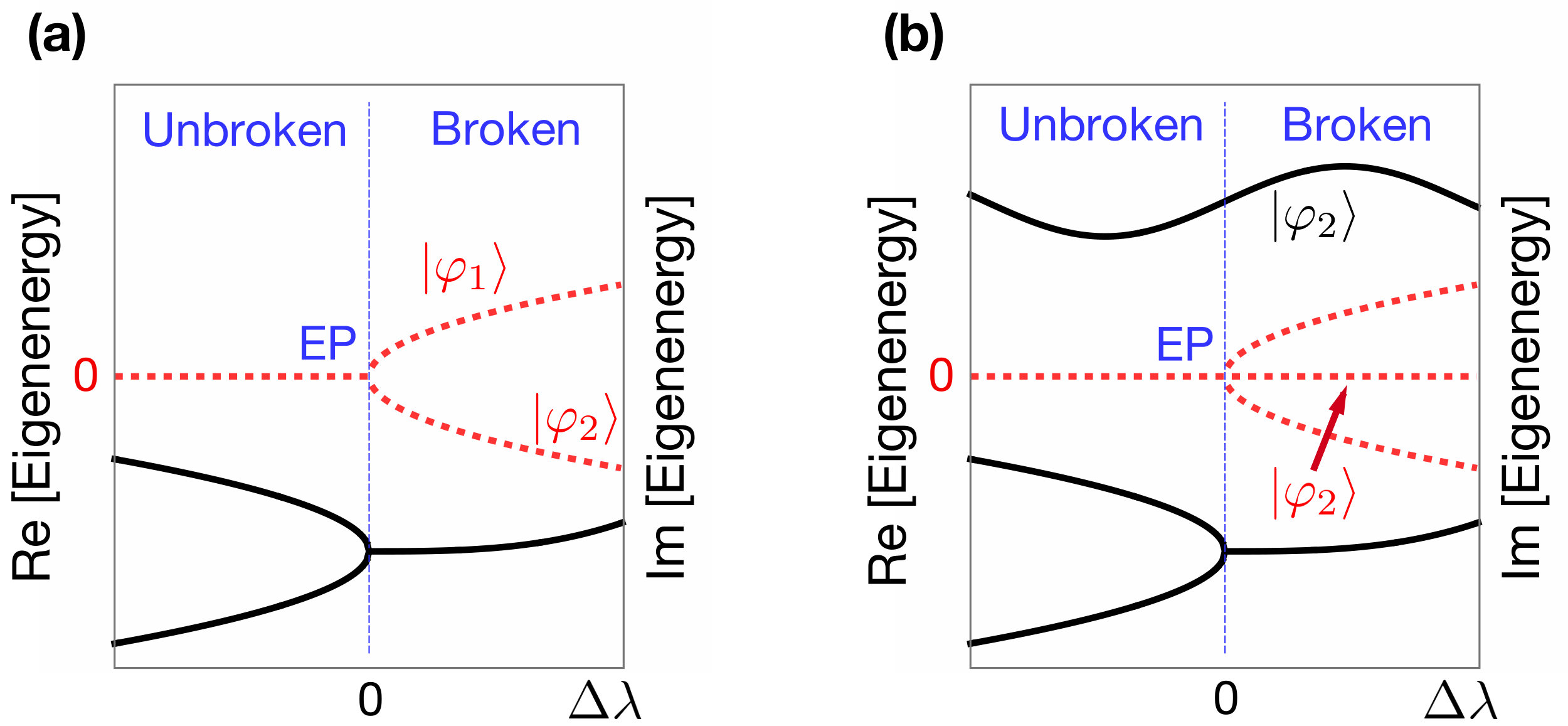 Figure 1
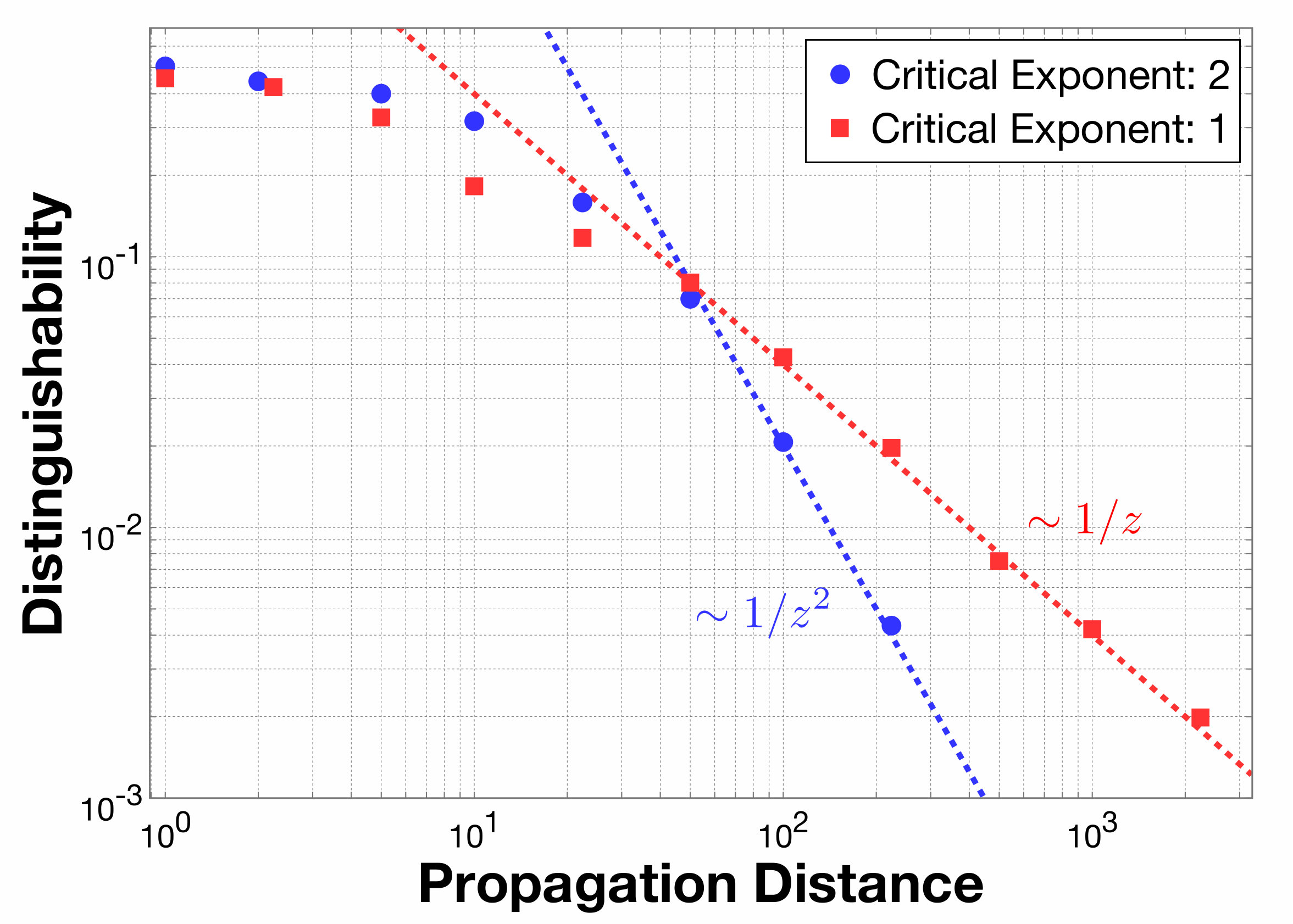 Figure 2
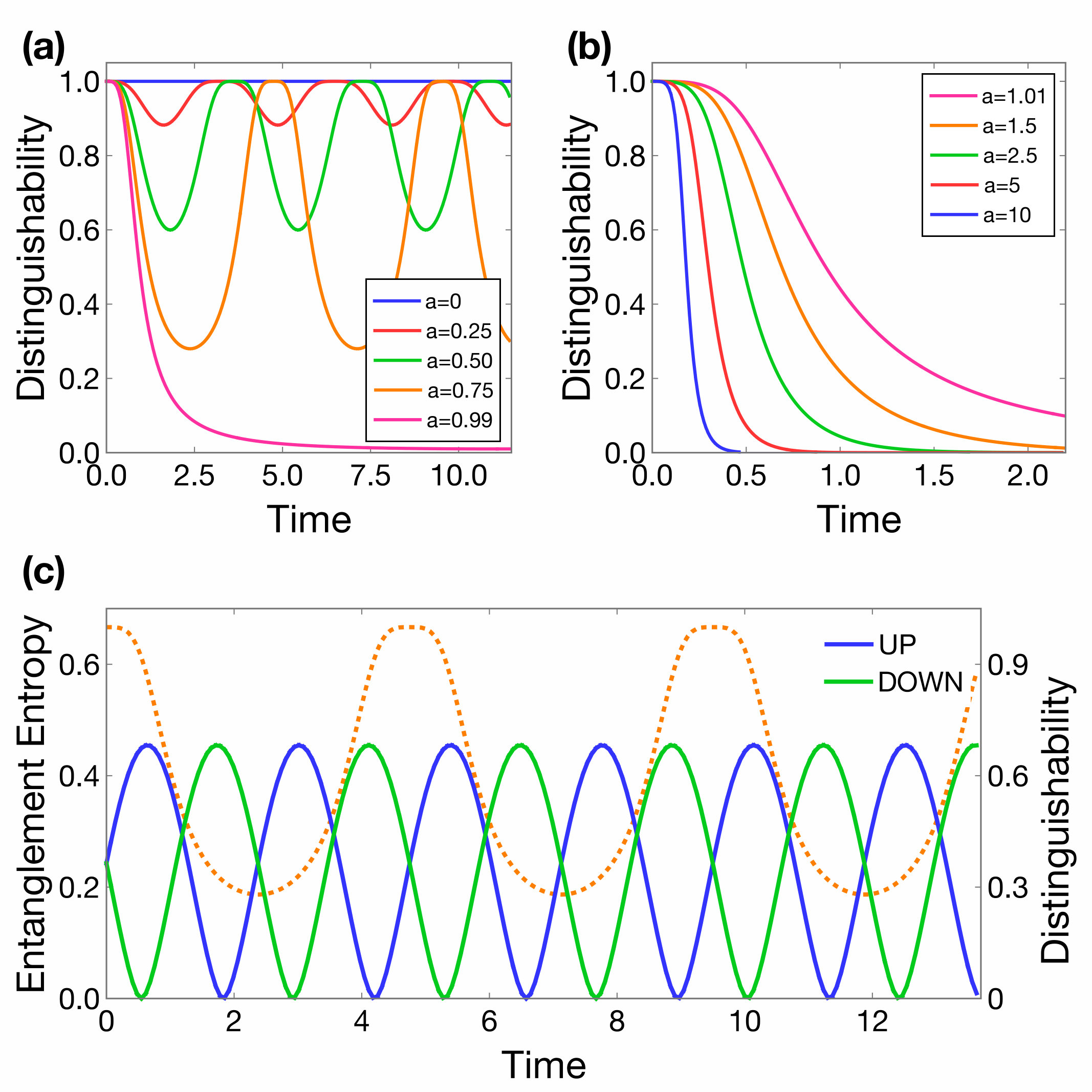 Figure 3
Peer Reviews
No public reviews on file for this paper yet. If you reviewed it on a platform where reviews are public (OpenReview, ICLR, NeurIPS, ICML), you can paste yours below so the community can read it here.
Videos
No videos yet. Explain this paper in a talk, walkthrough, or lecture? Add one.
Information Retrieval and Criticality in Parity-Time-Symmetric Systems
Kohei Kawabata
Department of Physics, University of Tokyo, 7-3-1 Hongo, Bunkyo-ku, Tokyo 113-0033, Japan
Yuto Ashida
Department of Physics, University of Tokyo, 7-3-1 Hongo, Bunkyo-ku, Tokyo 113-0033, Japan
Masahito Ueda
Department of Physics, University of Tokyo, 7-3-1 Hongo, Bunkyo-ku, Tokyo 113-0033, Japan
RIKEN Center for Emergent Matter Science (CEMS), Wako, Saitama 351-0198, Japan
Abstract
By investigating information flow between a general parity-time (PT) -symmetric non-Hermitian system and an environment, we find that the complete information retrieval from the environment can be achieved in the PT-unbroken phase, whereas no information can be retrieved in the PT-broken phase. The PT-transition point thus marks the reversible-irreversible criticality of information flow, around which many physical quantities such as the recurrence time and the distinguishability between quantum states exhibit power-law behavior. Moreover, by embedding a PT-symmetric system into a larger Hilbert space so that the entire system obeys unitary dynamics, we reveal that behind the information retrieval lies a hidden entangled partner protected by PT symmetry. Possible experimental situations are also discussed.
Non-Hermitian systems with parity-time (PT) symmetry have attracted growing interest over the past two decades Bender-98 ; Bender-review . PT-symmetric systems have two phases: the unbroken phase where the entire eigenspectrum is real, and the broken phase where some eigenvalues form complex conjugate pairs. Between the two phases lies an exceptional point where an unconventional phase transition occurs Heiss-12 . Several unique properties of PT-symmetric systems have been predicted and observed in classical systems where gain and loss are balanced El-Ganainy-07 ; Makris-08 ; Guo-09 ; Ruter-10 ; Longhi-09 ; Wimmer-15 ; Bender-13 ; Lin-11 ; Feng-13 ; Regensburger-12 ; Peng-14 ; Gao-15 ; Liu-16 ; Schindler-11 ; Ramezani-12 ; Assawaworrarit-17 ; Bender-13 ; Konotop-review . Since the first observations of PT-symmetry breaking and power oscillations in optics El-Ganainy-07 ; Makris-08 ; Guo-09 ; Ruter-10 , researchers have reported rich wave phenomena unique to non-conservative systems such as unidirectionality Lin-11 ; Feng-13 and light transport in multifunctional devices Regensburger-12 . Related phenomena have been studied in other subfields of physics, including electrical circuits Schindler-11 ; Ramezani-12 ; Assawaworrarit-17 and mechanical oscillators Bender-13 . In the quantum regime, various aspects of PT-symmetric systems have been studied Bender-07 ; Graefe-08 ; Dast-16 ; Chtchelkatchev-12 ; YCLee-14 ; Chen-14 ; TonyLee-14 ; Saleur-16 ; Tripathi-16 ; Brody-16 ; Yin-17 ; Obuse-16 ; Obuse-17 ; Ashida-16 ; Li-16 ; Ashida-17 , such as Bose-Hubbard dimers Graefe-08 , entanglement Chen-14 ; TonyLee-14 ; Saleur-16 , and critical phenomena Ashida-16 . In particular, the first observation of the PT transition in quantum systems has recently been reported in ultracold atoms Li-16 .
While loss is usually considered to be detrimental to the coherence of a system Zurek-03 ; deVega-17 ; Breuer-textbook , the unique phenomena and useful applications in PT-symmetric classical systems illustrate the utility of balanced gain and loss. From this wisdom in the classical regime, PT-symmetric quantum systems are expected to show robustness against decoherence, potentially leading to a long coherence time in quantum information processing and engineering. However, information-theoretic characterization of PT-symmetric systems has hitherto been unexplored. In addition to the practical importance, such characterization is needed for deeper understanding of PT-symmetric systems as open quantum systems.
The dynamics governed by a PT-symmetric non-Hermitian Hamiltonian is described by Brody-12
[TABLE]
Here we employ the usual Hilbert-Schmidt inner product and consider the effective non-unitary dynamics of an open quantum system described by Remark-InnerProduct . Recalling that the non-unitary state reduction enables an observer to acquire information about the system, one might well wonder if the non-unitarity of the PT dynamics given by Eq. (1) could lead to information flow between the system and the environment. In this Letter, we show that this is indeed the case, where the environment plays a role of an observer that continuously monitors the system. In particular, we demonstrate that the system in the PT-unbroken phase can completely retrieve the information that has flowed into the environment. We also find unique criticality of the information flow around the PT-transition point, across which the reversible information flow turns irreversible and vice versa. Moreover, by embedding a PT-symmetric system into a larger closed system, we identify the physical origin behind the information retrieval as an entangled partner hidden in the environment.
The information retrieval in PT-symmetric systems suggests novel possibilities for better controlling the behavior of quantum systems, in a way different from the quantum Zeno effect Zeno-1 ; Zeno-2 ; Zeno-3 or the dynamical decoupling DynamicalDecoupling-1 ; DynamicalDecoupling-2 ; DynamicalDecoupling-3 . While the dynamical decoupling relies on the time reversal by pulse injections, the information retrieval discussed in this Letter is induced by a hidden entangled partner protected by PT symmetry. The underlying physics is essentially distinct from that of decoherence-free subspaces in which the unitary state evolution is guaranteed by certain symmetry DFS-1 ; DFS-2 ; DFS-3 ; DFS-4 ; DFS-5 ; DFS-6 ; DFS-7 ; by contrast, the PT dynamics is intrinsically non-unitary both in the unbroken and broken phases.
Information flow. —
We consider a general -level quantum system and characterize information flow to and from it in terms of the trace distance between two quantum states of the same system Nielsen-Chuang :
[TABLE]
where . The trace distance measures the distinguishability of two quantum states since is the maximal probability of the two states and being successfully distinguished distinguishability ; Nielsen-05 . The trace distance is invariant under unitary transformations, i.e., no information leaks out from the system under unitary evolution. In addition, the trace distance does not increase under completely positive and trace-preserving (CPTP) maps, i.e., if is a CPTP map CPTP . Thus, a monotonic decrease in the distinguishability () signifies unidirectional information flow from the system to the environment. In contrast, an increase in the distinguishability () signifies information backflow from the environment to the system, implying the presence of memory effects in the open quantum dynamics. In other words, the dynamics involving a time interval with is considered to be non-Markovian Erez-08 ; Wolf-08 ; BLP-09 ; BLP-10 ; RHP-10 ; Luo-12 ; CM-14 ; CMM-17 ; BLP-16 .
We note that the P-divisibility of linear quantum dynamical maps is equivalent to Markovianity of quantum processes RHP-10 ; CM-14 . Although the PT dynamics given by Eq. (1) is indeed P-divisible Brody-12 , the divisibility cannot detect the non-Markovianity of the PT dynamics due to non-linearity. Moreover, the PT dynamics in the PT-unbroken phase is not contractive. However, the time evolution of can still serve as a measure to characterize the non-Markovianity in the PT dynamics, since this measure directly quantifies information flow between a system and its environment, and hence detects the presence of memory effects even if the dynamics is neither linear nor contractive, as demonstrated below. While other measures are also possible Remark-RelativeEntropy , the trace distance is suitable as a measure of information flow because it distinguishes all different quantum states and depends only on the system’s dynamics.
Information retrieval. —
We consider generic behavior of information flow between a PT-symmetric system and an environment. First of all, the distinguishability oscillates and eventually returns to the initial value in the PT-unbroken phase:
[TABLE]
The proof of this result is given later. The recurrence of the distinguishability implies the presence of a time interval with . Therefore, the system retrieves the information that has flowed into the environment, and thus the system in the PT-unbroken phase exhibits unique non-Markovian behavior.
This non-Markovianity arises from the non-orthogonality of eigenstates. To show this, we conduct the spectral decomposition of the PT dynamics given by Eq. (1):
[TABLE]
where is a right eigenstate of with a real eigenenergy Brody-12 ; Brody-14 . When the dynamics is unitary, eigenstates are orthogonal to each other, and the normalization factor, which is given by the denominator of Eq. (4), is constant. In the PT dynamics, by contrast, the normalization factor oscillates due to the non-orthogonality of eigenstates, indicating the presence of continuous information exchange between the system and the environment. In this respect, power oscillations observed in various systems Makris-08 ; Ruter-10 ; Schindler-11 ; Regensburger-12 ; Bender-13 ; Li-16 may be interpreted as evidence of information backflow from the environment and a signature of non-Markovianity in the PT-unbroken phase.
Universal criticality of information flow at the PT transition. —
Unconventional criticality of information flow emerges around the PT-transition point, above which information flow ceases to be reversible. The criticality of information flow derives from the power-law behavior of an eigenenergy of an eigenstate coalescing at the exceptional point Heiss-08 :
[TABLE]
where ’s () are system-specific coefficients, is a real control parameter with () corresponding to the PT-unbroken (PT-broken) phase, and is the order of the exceptional point (i.e., the number of coalescing states at the exceptional point). Note that is usually equal to , but is also possible Heiss-12 ; Heiss-08 ; Graefe-11J ; Ding-16 .
As a consequence of Eq. (5), the recurrence time of the distinguishability given by Eq. (3) exhibits the following power-law behavior near the exceptional point SuppMat :
[TABLE]
It is remarkable that different PT-symmetric systems having the same order can exhibit the same critical behavior given by Eq. (6). In this sense, the power-law behavior of the recurrence time is a universal property inherent in PT-symmetry breaking, where the order of the exceptional point characterizes the universality class.
In the PT-broken phase, the eigenstate with the largest imaginary part dominates the dynamics for a sufficiently long time. Thus, the distinguishability exponentially decreases and never returns to the initial value Remark-Broken-ShortTime ; SuppMat :
[TABLE]
where is a relaxation time. Thus, information flows unidirectionally from the system to the environment, and the dynamics is asymptotically Markovian. Here, the relaxation time also shows power-law behavior near the exceptional point:
[TABLE]
The critical exponent is the same as that of the recurrence time in the PT-unbroken phase.
At the exceptional point, both the recurrence time in the PT-unbroken phase and the relaxation time in the PT-broken phase diverge, indicating the disappearance of a characteristic time scale of the system. As a result, the distinguishability itself exhibits power-law behavior:
[TABLE]
Here the critical exponent is if the eigenstate with the second largest imaginary part in the PT-broken phase coalesces with some other states at the exceptional point; otherwise, SuppMat .
The above criticality is universal in the sense that it depends only on the order of the exceptional point. The obtained universal behavior accompanying diverging characteristic scales of the system is reminiscent of the critical phenomena in many-body systems Goldenfeld ; Sachdev . It is a unique feature of non-Hermitian systems that such critical behavior can appear even in finite systems, in sharp contrast to Hermitian systems where critical behavior emerges only in the thermodynamic limit.
Embedding a PT-symmetric system into a larger Hermitian system. —
To establish clear physical understanding of the information retrieval, we consider embedding a PT-symmetric system of interest into a larger Hermitian system. Here, our idea is motivated by the Naimark extension for quantum measurement Naimark ; Ozawa ; Hayashi : by adding an ancilla (a measuring apparatus) and extending the Hilbert space, any non-unitary dynamics can be understood as a unitary dynamics of the entire system followed by quantum measurement acting on the ancilla. Moreover, the extension provides a rigorous proof of the information retrieval given by Eq. (3).
To begin with, we consider a case of the PT-unbroken phase. We examine pure states for the sake of simplicity, but the discussion can straightforwardly be generalized to mixed states. We introduce a Hermitian invertible operator that characterizes the pseudo-Hermiticity, satisfying Most-02-a ; Most-02-b . Note that the unbrokenness of PT symmetry is equivalent to the existence of an invertible linear operator such that Most-02-b . We define a parameter and an operator , where ’s () are eigenvalues of . If PT symmetry is unbroken, is positive, so is . An important property that allows for the following extension is that is invariant under the PT dynamics Most-02-a .
With the operator defined above, we construct a PT-symmetric counterpart , add a two-level ancilla, and consider an entangled state in an extended Hilbert space :
[TABLE]
The norm of such a state in the extended space is and is conserved for an arbitrary PT dynamics. Therefore, the entire extended system is Hermitian and closed. When a measurement is performed on the ancilla and is postselected, we obtain ; when is postselected, we obtain the PT-symmetric counterpart . While obeys , its counterpart obeys . Our extension is minimal since the ancilla as an environment has only two levels. In particular, if is a two-level system, reduces to and GS-08 . An experiment using such an extension for a two-level system has recently been realized with two entangled photons Tang-16 . We emphasize that our idea of the extension is different from that of Ref. GS-08 , which essentially relies on the property unique to a two-level system. Moreover, we consider the extension in the PT-broken phase as shown below, while Ref. GS-08 is restricted to the PT-unbroken phase.
The conservation of the norm of the extended state implies the unitarity of its evolution . We can explicitly construct the Hermitian Hamiltonian in the extended closed system that satisfies : where acts locally on the Hilbert space of the system , and acts globally on as an interaction between the system and the ancilla SuppMat . A crucial property of the extended Hamiltonian is that the original system is non-Hermitian if and only if the characteristic interaction in the extended Hilbert space is non-zero. Since the interaction is global, the entanglement (or quantum mutual information) between the system and the ancilla oscillates in time. The presence of an entangled partner hidden in the environment is the physical origin of the memory effect of PT-symmetric systems: the information that has flowed into the environment is actually stored in the entanglement with the ancilla.
PT-symmetry breaking viewed from a larger closed system. —
The information retrieval can now be proven. The extended Hermitian system with finite energy levels returns back to the original state by the quantum recurrence theorem Recurrence-1 ; Recurrence-2 , and the PT-symmetric system obtained by the projection of an extended Hermitian system also returns to the initial state. Here, we emphasize that it is a priori not obvious whether such an extension with a finite-level ancilla is possible, and this underlying finite dimensionality is a nontrivial universal feature of the PT-unbroken open quantum systems. When PT symmetry is broken, in contrast, is no longer Hermitian and the above extension breaks down. In fact, the irreversibility of information flow in the PT-broken phase leads to the impossibility of the extension with a finite-dimensional ancilla, and an infinite-dimensional ancilla is needed for embedding a PT-broken system into a larger closed system. The recurrence theorem cannot be applied to an infinite system, where the irreversible dynamics should emerge Remark-Weisskopf-Wigner .
The above extension of a PT-symmetric system gives an insight into PT-symmetry breaking. PT-symmetry breaking can occur in finite systems Bender-review , although the conventional theory of phase transitions tells us that spontaneous symmetry breaking occurs only in the thermodynamic (infinite-dimensional) limit Goldenfeld ; Sachdev . The above observation implies a close relationship of PT-symmetry breaking to this conventional wisdom: in view of an extended Hermitian system, an infinite-dimensional ancilla is required for the PT transition to occur. The exceptional point is characterized as a singular point at which the dimension of the companion ancilla suddenly changes from finite to infinite.
It is also intriguing to revisit the criticality of information flow at the exceptional point in an extended Hermitian system. At the exceptional point, the norm of the PT-symmetric counterpart diverges and the probability of successful postselection of the system of interest vanishes. Peculiar as it may appear, the vanishing probability at the exceptional point is reminiscent of the conventional critical phenomena. Around the critical point, the system undergoes larger fluctuations and hence the number of measurements required for obtaining the true value increases critically according to a power law.
Two-level system. —
As the simplest example, we consider a two-level system , where is an energy scale and represents the degree of non-Hermiticity. This model has been realized in both classical Ruter-10 ; Gao-15 ; Liu-16 and quantum Tang-16 ; Li-16 experiments. The eigenenergies are , and thus the exceptional point is located at with the order . Let () be the time-evolved state starting from the initial state (). Then the distinguishability between them is calculated to be SuppMat
[TABLE]
We thus confirm that the obtained behavior is consistent with the general theory discussed above (Fig. 1 (a) (b)).
The presence of a hidden entangled partner behind the information retrieval is understood through examination of the entanglement entropy between the system and the ancilla. Figure 1 (c) represents the calculated entanglement entropy, which clearly shows the oscillation of the entanglement synchronous with that of .
PT-symmetric optics. —
The above discussion on information flow can be applied to classical optical systems El-Ganainy-07 ; Makris-08 . Let us consider the propagation of beams through a complex PT-symmetric potential , where their electric-field envelopes obey the paraxial equation of diffraction . Then the distinguishability between two electric-field envelopes of the same system corresponds to where the inner product is defined by .
The earlier discussions cannot directly be applied to optical settings in a strict sense, since the discussions are confined to finite-dimensional systems. However, we expect that the universal behavior of information flow continues to hold, and actually confirm it for a specific PT-symmetric periodic potential , where measures the degree of non-Hermiticity Makris-08 . In the PT-unbroken phase (), the distinguishability oscillates in accordance with power oscillations Makris-08 ; Ruter-10 ; Schindler-11 ; Regensburger-12 ; Bender-13 ; in the PT-broken phase (), it exponentially decays because of attenuation and amplification. A remarkable feature shows up at the exceptional point () Longhi-10 ; Graefe-11 , where the distinguishability asymptotically decays according to a power law whose critical exponent is or for appropriately chosen initial states SuppMat .
Conclusion and outlook. —
We have found that information that has flowed into an environment can be retrieved in a PT-symmetric system. This information retrieval originates from a universal feature of an environment that couples to a PT-symmetric system: it can be modeled by a finite-dimensional (infinite-dimensional) ancilla in the PT-unbroken (PT-broken) phase. Here the exceptional point plays a role of the critical point around which many physical quantities such as the recurrence time and the distinguishability show power-law behavior. These findings may find novel applications to quantum control.
It is also worthwhile to remark that the information retrieval in a PT-symmetric system might be distinct from the conventional non-Markovian behavior that has been found in typical open quantum systems coupled to an infinite bath Zurek-03 ; deVega-17 ; Breuer-textbook ; Erez-08 ; Wolf-08 ; BLP-09 ; BLP-10 ; RHP-10 ; Luo-12 ; CM-14 ; CMM-17 ; BLP-16 . While we expect that a broad class of information measures can be used as a witness of the non-Markovianity discussed in this Letter, it merits further study to clarify their applicability in detail and explore possible relevance to the known non-Markovian behavior mentioned above.
Acknowledgements. —
We thank Yûto Murashita and Sho Higashikawa for valuable discussions. This work was supported by KAKENHI Grant No. JP26287088 from the Japan Society for the Promotion of Science, a Grant-in-Aid for Scientific Research on Innovative Areas “Topological Materials Science” (KAKENHI Grant No. JP15H05855), and the Photon Frontier Network Program from MEXT of Japan. K. K. and Y. A. were supported by the JSPS through Program for Leading Graduate Schools (ALPS). Y. A. acknowledges support from JSPS (Grant No. JP16J03613).
The reference list from the paper itself. Each links out to its DOI / PubMed record.
- 1(1) C. M. Bender and S. Boettcher, Phys. Rev. Lett. 80 , 5243 (1998).
- 2(2) C. M. Bender, Rep. Prog. Phys. 70 , 947 (2007).
- 3(3) W. D. Heiss, J. Phys. A 45 , 444016 (2012).
- 4(4) R. El-Ganainy, K. G. Makris, D. N. Christodoulides, and Z. H. Musslimani, Opt. Lett. 32 , 2632 (2007).
- 5(5) K. G. Makris, R. El-Ganainy, D. N. Christodoulides, and Z. H. Musslimani, Phys. Rev. Lett. 100 , 103904 (2008).
- 6(6) A. Guo, G. J. Salamo, D. Duchesne, R. Morandotti, M. Volatier-Ravat, V. Aimez, G. A. Siviloglou, and D. N. Christodoulides, Phys. Rev. Lett. 103 , 093902 (2009).
- 7(7) C. E. Rüter, K. G. Makris, R. El-Ganainy, D. N. Christodoulides, M. Segev, and D. Kip, Nat. Phys. 6 , 192 (2010).
- 8(8) S. Longhi, Phys. Rev. Lett. 103 , 123601 (2009).