Manipulation of Quenching in Nanoantenna-Emitter Systems Enabled by External Detuned Cavities: A Path to Enhance Strong-Coupling
Burak Gurlek, Vahid Sandoghdar, and Diego Mart\'in-Cano

TL;DR
This paper demonstrates how external detuned cavities can manipulate quenching in nanoantenna-emitter systems, enabling enhanced strong coupling and improved emitter efficiency through interference effects.
Contribution
It introduces a novel method using broadband Fabry-Perot microcavities to control quenching and achieve strong coupling in nanoantenna-emitter systems.
Findings
Cavity-assisted suppression of nonradiative quenching channels
Enhanced coupling and bandwidth narrowing of hybrid resonances
Potential for improved solid-state emitter efficiency
Abstract
We show that a broadband Fabry-Perot microcavity can assist an emitter coupled to an off-resonant plasmonic nanoantenna to inhibit the nonradiative channels that affect the quenching of fluorescence. We identify the interference mechanism that creates the necessary enhanced couplings and bandwidth narrowing of the hybrid resonance and show that it can assist entering into the strong coupling regime. Our results provide new possibilities for improving the efficiency of solid-state emitters and accessing diverse realms of photophysics with hybrid structures that can be fabricated using existing technologies.
Click any figure to enlarge with its caption.
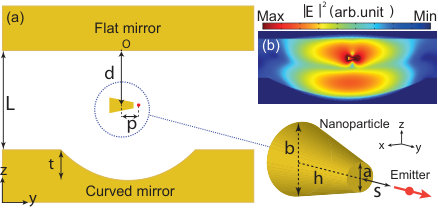 Figure 1
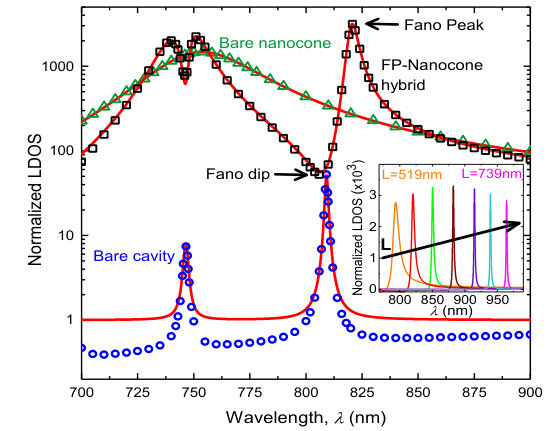 Figure 2
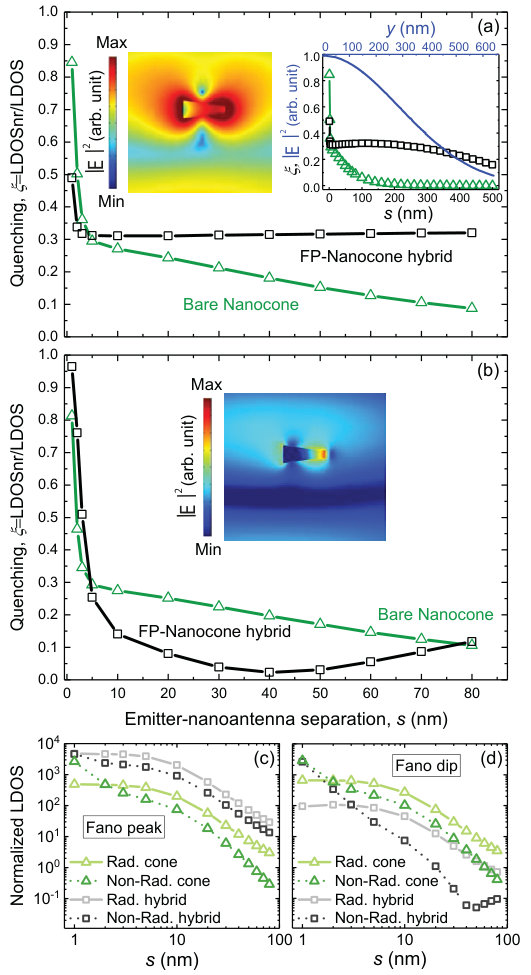 Figure 3
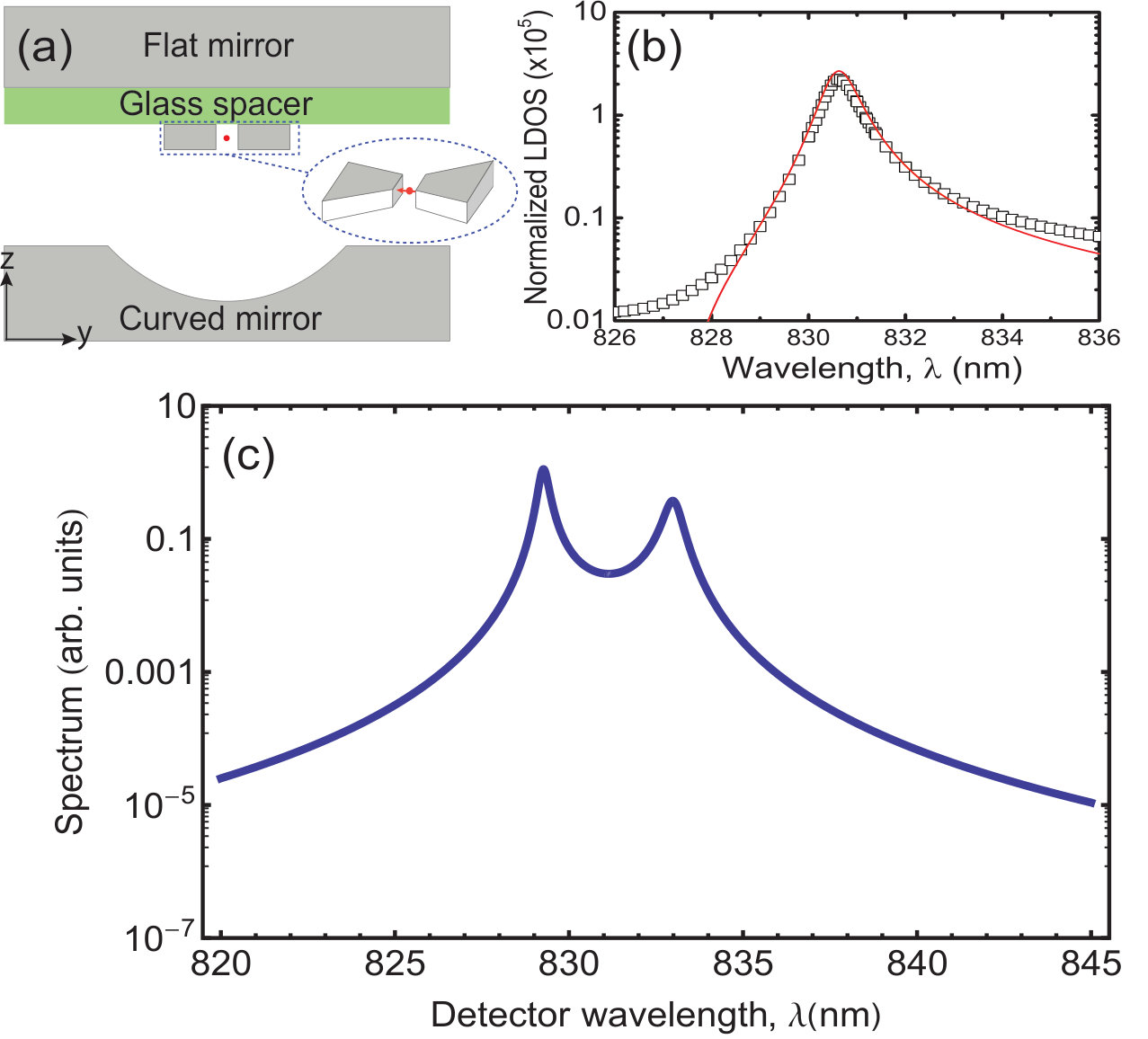 Figure 4
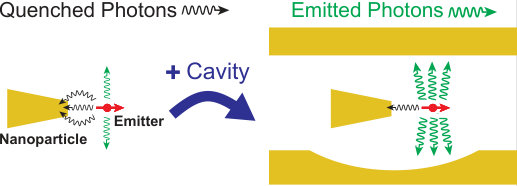 Figure 5
Peer Reviews
No public reviews on file for this paper yet. If you reviewed it on a platform where reviews are public (OpenReview, ICLR, NeurIPS, ICML), you can paste yours below so the community can read it here.
Videos
No videos yet. Explain this paper in a talk, walkthrough, or lecture? Add one.
\alsoaffiliation
Friedrich Alexander University Erlangen-Nuremberg, D-91058 Erlangen, Germany
\alsoaffiliationFriedrich Alexander University Erlangen-Nuremberg, D-91058 Erlangen, Germany
{tocentry}
Manipulation of quenching in nanoantenna-emitter systems enabled by external detuned cavities: a path to enhance strong-coupling
Burak Gurlek
Max Planck Institute for the Science of Light, Staudtstraße 2, D-91058 Erlangen, Germany
Vahid Sandoghdar
Max Planck Institute for the Science of Light, Staudtstraße 2, D-91058 Erlangen, Germany
Diego Martín-Cano
Max Planck Institute for the Science of Light, Staudtstraße 2, D-91058 Erlangen, Germany
Abstract
We show that a broadband Fabry-Perot microcavity can assist an emitter coupled to an off-resonant plasmonic nanoantenna to inhibit the nonradiative channels that affect the quenching of fluorescence. We identify the interference mechanism that creates the necessary enhanced couplings and bandwidth narrowing of the hybrid resonance and show that it can assist entering into the strong coupling regime. Our results provide new possibilities for improving the efficiency of solid-state emitters and accessing diverse realms of photophysics with hybrid structures that can be fabricated using existing technologies.
keywords:
Quenching, nanoantennas, plasmonics, microcavities, strong-coupling, single-photon emitters.
The excited state of a quantum emitter can decay radiatively via spontaneous emission of photons or nonradiatively in a process called quenching. The interplay between these two decay channels crucially determines the application potentials of solid-state emitters such as organic molecules, semiconductor nanocrystals or color centers 1. While spontaneous emission is known to be enhanced or inhibited by photonic environments 2, the nonradiative decay channel is usually thought to be an intrinsic property of the emitter and its immediate surrounding.
The best-known modification of radiative rates is the so-called Purcell effect, where a quantum emitter is coupled to a conventional resonator of quality factor and mode volume 3. When the atom-photon interaction rate becomes larger than both the cavity loss rate () and the atomic coupling rate to other competing modes, one also can reach the strong-coupling regime (SCR) 2, where photonic and atomic excitations are coherently exchanged and hybridized.
A more recent alternative approach for accessing the Purcell effect or the SCR places the emitter in the near field of plasmonic nanoantennas 4, 5, 6, 7, 8, 9. However, the close vicinity of the emitter to metals results in dissipation and substantial coupling to higher-order multipolar antenna modes 10, 11, which in turn, causes an increase in the nonradiative rate that is faster than those in the radiative decay 6, 10. So far, few nanoantenna configurations 6, 7, 8, 9 have succeeded in accessing interesting radiative effects in competition with the nonradiative channels.
In this Letter, we study the coupling of a quantum emitter to a hybrid structure consisting of a Fabry-Perot (FP) resonator and a plasmonic nanoantenna. Figure 1 sketches an example of the proposed device using a gold nanocone antenna 12. Hybrid arrangements have recently considered the combination of cavities with plasmonic nanoantennas for achieving Purcell enhancement 13, 14, 15 and strong coupling 16. In what follows, we explore regimes where both radiative and nonradiative properties of an emitter are improved if a cavity is hybridized with a strongly detuned nanoantenna. Importantly, we demonstrate that one can generally counteract and control nonradiative channels from afar using a FP resonator. In contrast to previous works, we also show that an emitter coupled to the hybrid compound resonance can enter the SCR in configurations, where neither the isolated nanoantenna nor the cavity alone would access this regime. Aside from a fundamental interest, these results hold promise for practical applications, where the emitter quantum efficiency plays an important role.
To investigate the influence of the hybrid cavity-antenna structure on an emitter, we examine the local density of states (LDOS). This electromagnetic quantity is connected to the imaginary part of the Green’s tensor and thus to the power dissipated by a dipole, which we calculate by means of full-wave computations with COMSOL Multiphysics 17. Figure 2 displays the normalized LDOS for a broadband FP-nanocone system (black squares) as a function of the emission wavelength for an emitter that lies at ten nanometers from the nanocone close to the antinode of the FP microcavity [see Fig. 1(b)]. Highly enhancing nanoantennas, such as nanocones, facilitate reaching the SCR with moderately low-Q cavities as shown below. We identify two main regions of enhanced LDOS in Fig. 2: a double-peaked feature with a very broad linewidth at nm and a narrower resonance around 820 nm.
It is instructive to compare the normalized LDOS to the same configurations of a bare microcavity (blue circles) and an isolated nanocone (green triangles) in Fig. 2. The outcome indicates that the broadband plasmon modes of the nanoantenna and two transverse cavity modes with narrower linewidths interfere constructively to yield to two general scenarios: a double-peaked structure for resonant modes coupling and a shifted cavity resonance for off-resonant interaction. The latter frequency change at longer wavelengths is attributed to the common cavity red shifts reported for small plasmonic nanoparticles 18. Notice that the maximum LDOS values () for the off-resonant mode has been enhanced by one order of magnitude with respect to the bare cavity mode and by a factor of three with respect to the isolated nanocone over a fairly narrow bandwidth. This enhancement comes as a result of the intermediate values of both the quality factor (, ) and the mode volume of the hybrid resonance (). These features make the detuned hybrid mode very attractive for strong coupling as shown below. Furthermore, the combination of the nanoantenna and cavity modes also leads to dips in the LDOS values. Both the peak and dip result respectively from constructive and destructive interference events known from Fano phenomena 19 for two resonant systems with antithetic bandwidths (, ).
An important and attractive aspect of the broadband hybrid cavity is that the enhancement effect can be tuned to different frequencies over a very large spectral range by simply adjusting the cavity length (see inset in Fig. 2). In fact, it is remarkable that the LDOS is enhanced to such a degree at over hundred nanometers wavelength detuning from the antenna plasmon resonance, which in this case was set close to 750 nm. Intuitively, the circulation of the optical energy in the microcavity compensates for the lower plasmonic enhancement of the LDOS at a large detuning. We note that this phenomenon provides a unique and novel means for external and selective manipulation of the emitter coupling to plasmonic antennas.
To obtain a deeper insight into the different participating resonant modes and to evaluate semianalytical expressions of the Green’s tensor, we also used the quasinormal mode (QNM) approach that is based on a modal expansion and the Lorentz-reciprocity theorem 20. This enables to determine the Purcell factor for single QNMs 20 that is valid for any lossy resonator (see implementation in ref 17) and it is derived from the Green’s tensor with component 21, where denotes the normalized field parallel to the orientation of the dipole at its position 17, is the QNM resonance real frequency, and denotes its fullwidth at half-maximum. The red lines in Fig. 2 represent the contribution from several QNMs, showing an excellent agreement for the hybrid full-wave response, whereas additional non-resonant modes would be necessary for describing the suppressed LDOS values with respect to free space (cf. values below 1 for the blue circles). The double-peaked LDOS arises as a result of the interference of two nearly resonant QNMs, consisting of a plasmonic-like mode and an FP-like one with positive and negative values, respectively. Negative contributions are common features of nearly resonant QNMs 20, with the total sum remaining positive and thus physical (cf. red line). On the other hand, the detuned peak is mainly described by a single FP-nanoantenna QNM [cf. its intensity distribution in Fig. 1(b)], whereas the broader off-resonant QNMs contribute to the destructive interference dip.
A severe general limitation of plasmonic nanoantennas concerns quenching of emission at very small distances caused by nonradiative channels 11, 22. To study the quenching behavior of the detuned hybrid mode, we calculated the fraction of the LDOS that is dissipated () in the metallic nanostructure given by as a direct measure for quenching, where LDOS, and is the imaginary part of the permittivity of the metal. Figure 3(a)-(b) displays versus the antenna-emitter distance at the Fano peak (a) and dip (b) of the far-detuned hybrid mode shown in Fig. 2, while Fig. 3(c)-(d) presents both the radiative and nonradiative components of the LDOS, together with the bare nanocone results for comparison.
At the Fano peak [cf Fig. 3(a)], we find that is stronger than the case of a bare nanocone for nm and has a nearly constant value. This anomalous trend is in marked contrast to the quenching behavior for a bare nanoantenna (green triangles), which commonly increases in a monotonous fashion for smaller 11. We attribute these findings to the concentration of the field in the metallic structure [see left inset of Fig. 3(a)] caused by the constructive interference of the nanoantenna and cavity modes, thus, resulting in an enhanced absorption. The right inset in Fig. 3(a) shows that the circulation of the optical energy in the microcavity can extend this effect even to separations comparable to a FWHM of the cavity mode profile (blue curve), where quenching by a bare nanocone becomes negligible. We note that, nevertheless, the structure keeps an overall good radiation efficiency of over a large spatial range while the LDOS is enhanced by ten times with respect to the bare cone [see Fig. 3(c)]. This radiative emission can be mostly collected by a FP mode with an overlap of about 81% [see Fig. 1(b)].
Another impressive phenomenon occurs at the Fano dip, as presented in Fig. 3(b). Here, acquires lower values than that of the bare nanocone case, exhibiting suppression of quenching. The inset in Fig. 3(b) illustrates that in this case, the destructive interference of the plasmonic and cavity modes lead to an intensity minimum inside the nanocone. This effect makes the emitter highly efficient over a large distance range, e.g. at nm. Figure 3(d) shows in more detail the involved competition between the radiative and nonradiative rates of the hybrid structure at different emitter-antenna separations compared to the bare nanoantenna case. The balance between emission enhancements and quenching can be adjusted smoothly between the Fano dip and peak by varying the FP cavity length or by changing the emitter-antenna separation. For example, the general quenching behaviors are reversed for nm due to the cavity radiative competition against quasistatic contributions 23, 22. These above-described cavity modifications are general and thus observable for different nanoparticles (see more examples in Supporting Information).
We now present an example of an antenna-FP geometry that shows an amelioration of the nonradiative channels and brings a single quantum emitter to the SCR. Here, we consider a bowtie antenna 24, 7 compatible with fabrication on a flat cavity mirror [see Fig. 4(a)] and an organic molecule with a typical natural linewidth of MHz at cryogenic temperatures. We chose the antenna parameters (see caption of Fig. 4) to place its resonance at nm and tune a moderately low-Q cavity resonance (=3400) at nm in order to obtain an enhancing hybrid mode as discussed in Fig. 2. Figure 4(b) displays the LDOS enhancement on the Fano peak of the resulting hybrid mode at nm, whereas the red line shows the excellent single QNM approximation near resonance that relates directly to the Purcell factor 20, reaching .
Applying the macroscopic quantum electrodynamics and the Green’s tensor formalism 26, 22, we evaluate the resonance fluorescence spectrum for the composite structure within the single QNM approximation and a two-level emitter (see derivation in ref 22). Figure 4(c) shows the spectrum outcome, which reveals a large peak splitting characteristic of strong coupling. Using a single Lorentzian model 26, provided within the single QNM approximation, we can estimate and understand the coupling rate and the condition for entering in SCRs in terms of , and the splitting 2 in the spectrum. In the case of the bare cavity, , and lead to and , i.e. outside the SCR. Similarly, in the case of a bare nanoantenna, the very small mode volume of , and lead to while remains well below unity (see their respective single-peak spectra in Supp. Information). It is the cooperative-enhanced ratio of large and fairly low of the detuned FP hybrid mode (, , ) that allows surpassing the strong coupling threshold to , while achieving a high radiative efficiency enabled by the cavity. This suppression of nonradiative channels occurs precisely at the extreme close distances favorable for the SCR with bare nanoantennas (see details in Supp. Information), showing a potential route to ameliorate the significant nonradiative emission in plasmonic systems that hinders its photonic detection. In addition, we note that reported by previous hybrid cavity-nanoantenna structures 16, 14, 15 are about two orders of magnitude lower.
The features of detuned FP-antenna hybrids studied in this work are general and potentially observable in previously proposed hybrid systems 27, 28, 29, 30, 31, 32 by including single emitters 13, 16, 14, 15, with different cavity geometries 29, 13, 16, 25, 14, 15, 18, 33 and nanoantenna structures 7, 8. These open new avenues in diverse research areas such as sensing, surface-enhanced Raman scattering, solid-state spectroscopy 29, 34, and quantum optics 35. The resulting Fano resonances at tunable frequencies can be used to improve the emission efficiency of solid-state emitters such as organic molecules or color centers by selective enhancement of their zero-phonon transitions 36, 33. Important limits to the coupling in these hybrid systems are set by the antenna scatterings and cavity losses 15 that have no general analytical solutions. This calls for an extensive research for optimizing the suppression of quenching on metallic nanoantennas with ultimate radiative enhancements, e.g. in atomic enhanced nanoparticles 37. The strong radiative enhancement also ushers in new studies of single-emitter coherent interactions at ambient temperatures, where . Here, accounts for the pure dephasing rate 38 caused by phononic excitations, which typically ranges from to for solid-state emitters 36. In contrast to inefficient high-Q cavity approaches, where the emitter linewidths exceed by several orders of magnitude 36, the high coupling rates ( THz) and large bandwidths ( THz) of the hybrid structure could then potentially bring diverse solid-state emitters at room temperatures into the SCR (e.g. for a SiV 36, MHz and THz, or for a molecule, MHz and THz). This order of magnitude estimation points to the accessibility of interesting phenomena with strong coupling as reflected in diverse reports, e.g. strong single-photon nonlinearities 39, nonclassical processing 40, 41, Bose-Einstein condensation 42, unobserved optomechanical effects 43, and rare chemical reactions 44, 45. Another prominent possibility is to tune the near-field quenching and enhancement caused by plasmonic and to extend these interactions to longer length scales. This opens important doors for coupling many emitters to the same hybrid mode, facilitating investigations of collective effects such as nonclassical correlations 46 with enhanced dipole-dipole interactions 47 and in collective strong coupling phenomena 48 that take place on femtosecond scales at room temperature 7, 8. Here, the tunability of cavity-antenna systems can be particularly useful for modifying in-situ these collective interactions 44, 48, 22, 49, 45. {acknowledgement} This work was supported by the Max Planck Society and the European Research Council (Advanced Grant SINGLEION). V. acknowledges the support from the Alexander von Humboldt Professorship. The authors thank Claudiu Genes for reading and providing constructive comments of the manuscript.
{suppinfo} Cavity modification of quenching and LDOS for a nanosphere. Quenching suppresion in state-of-the art nanoantennas at small separations. Spectra for bowtie, bare cavity and bowtie-cavity hybrid.
The reference list from the paper itself. Each links out to its DOI / PubMed record.
- 1Lounis and Orrit 2005 Lounis, B.; Orrit, M. Single-photon sources. Rep. Prog. Phys. 2005 , 68 , 1129
- 2Haroche and Raimond 2006 Haroche, S.; Raimond, J. M. Exploring the Quantum ; Oxford University Press: Oxford, 2006
- 3Purcell 1946 Purcell, E. Spontaneous emission probabilities at radio frequencies. Phys. Rev. 1946 , 69 , 681
- 4Trügler and Hohenester 2008 Trügler, A.; Hohenester, U. Strong coupling between a metallic nanoparticle and a single molecule. Phys. Rev. B: Condens. Matter Mater. Phys. 2008 , 77 , 115403
- 5Savasta \latin et al. 2010 Savasta, S.; Saija, R.; Ridolfo, A.; Di Stefano, O.; Denti, P.; Borghese, F. Nanopolaritons: Vacuum Rabi splitting with a single quantum dot in the center of a dimer nanoantenna. ACS Nano 2010 , 4 , 6369–6376
- 6Agio and Alú 2012 Agio, M., Alú, A., Eds. Optical Antennas ; Cambridge University Press: Cambridge, UK, 2012
- 7Santhosh \latin et al. 2016 Santhosh, K.; Bitton, O.; Chuntonov, L.; Haran, G. Vacuum Rabi splitting in a plasmonic cavity at the single quantum emitter limit. Nat. Commun. 2016 , 7
- 8Chikkaraddy \latin et al. 2016 Chikkaraddy, R.; de Nijs, B.; Benz, F.; Barrow, S. J.; Scherman, O. A.; Rosta, E.; Demetriadou, A.; Fox, P.; Hess, O.; Baumberg, J. J. Single-molecule strong coupling at room temperature in plasmonic nanocavities. Nature 2016 , 535 , 127–130