Gravitino/Axino as Decaying Dark Matter and Cosmological Tensions
Koichi Hamaguchi, Kazunori Nakayama, Yong Tang

TL;DR
This paper explores supersymmetric axion models where gravitino or axino serve as decaying dark matter, potentially addressing cosmological tensions by extending the standard ΛCDM model.
Contribution
It demonstrates that in these models, the next-to-lightest supersymmetric particle naturally has a lifetime comparable to the universe's age, providing a viable decaying dark matter scenario.
Findings
NLSP lifetime is comparable to the universe's age in certain parameter regions
Decaying dark matter can help alleviate cosmological tensions
Supersymmetric axion models offer a well-motivated framework for such scenarios
Abstract
In supersymmetric axion models, if the gravitino or axino is the lightest SUSY particle (LSP), the other is often the next-to-LSP (NLSP). We investigate the cosmology of such a scenario and point out that the lifetime of the NLSP naturally becomes comparable to the present age of the universe in a viable parameter region. This is a well-motivated example of the so-called decaying dark matter model, which is recently considered as an extension of the CDM model to relax some cosmological tensions.
Click any figure to enlarge with its caption.
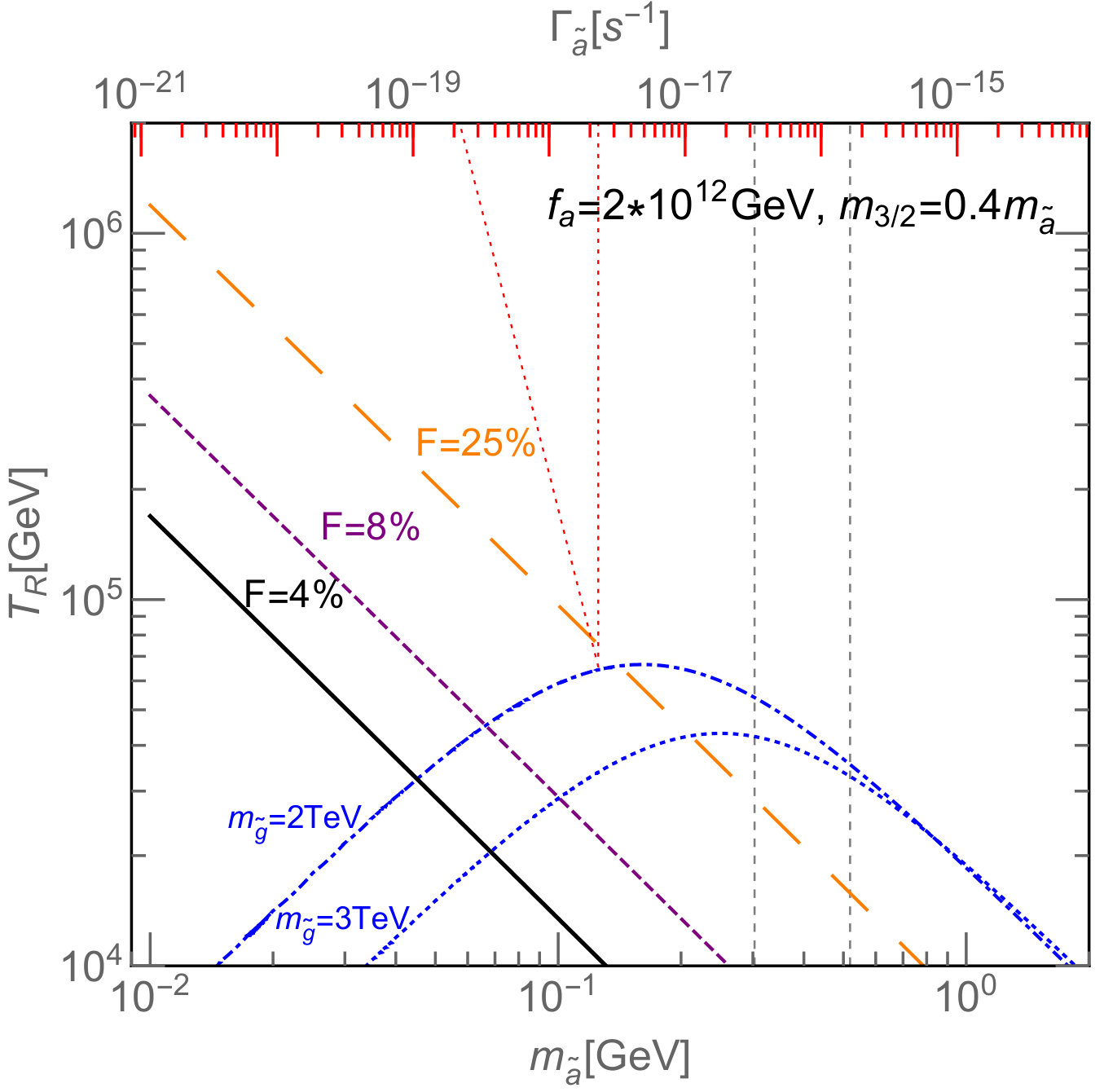 Figure 1
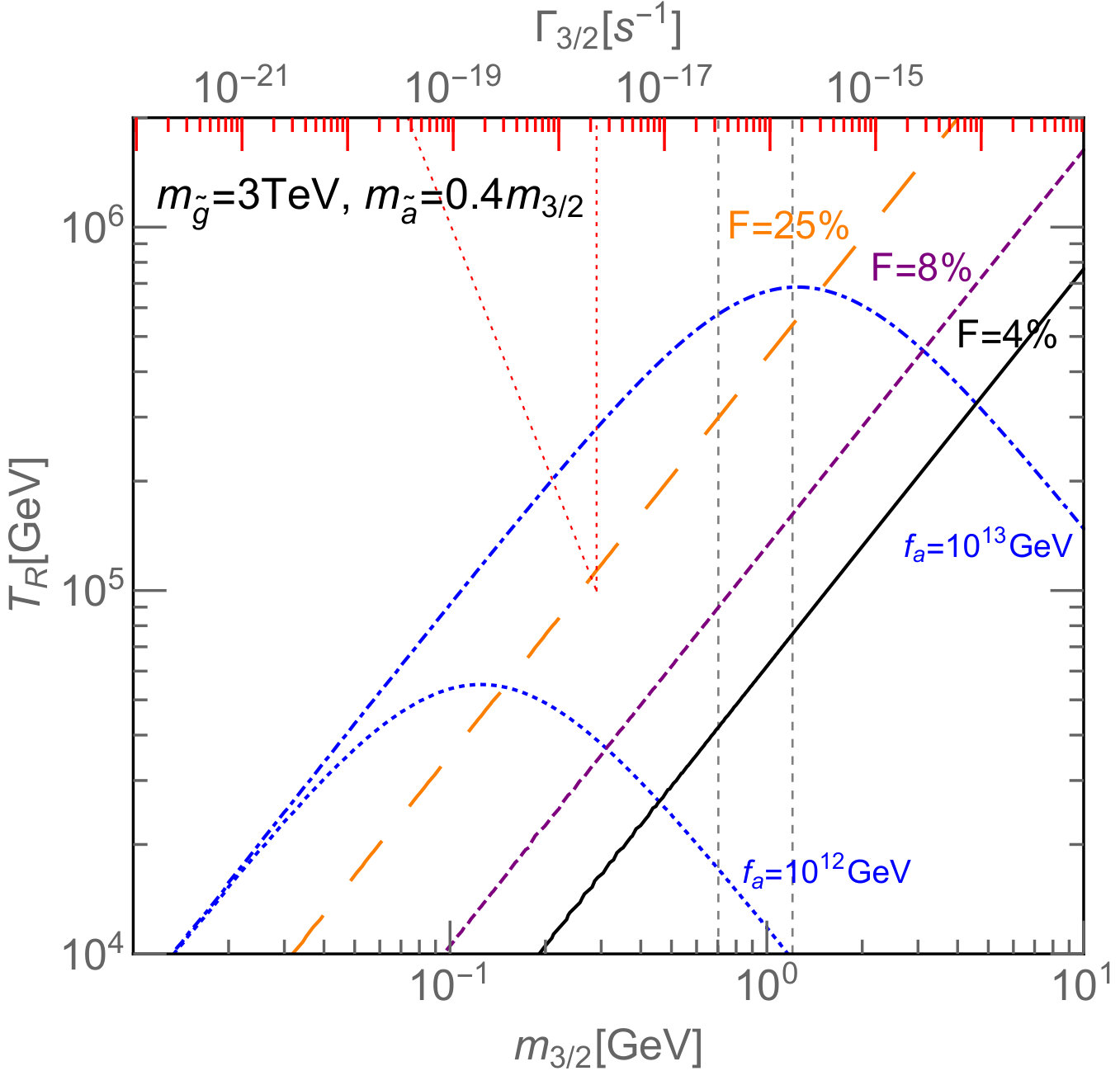 Figure 2
Peer Reviews
No public reviews on file for this paper yet. If you reviewed it on a platform where reviews are public (OpenReview, ICLR, NeurIPS, ICML), you can paste yours below so the community can read it here.
Videos
No videos yet. Explain this paper in a talk, walkthrough, or lecture? Add one.
UT-17-19, IPMU-17-0079
Gravitino/Axino as Decaying Dark Matter and
Cosmological Tensions
Koichi Hamaguchi1,2, Kazunori Nakayama1,2, Yong Tang1
1Department of Physics, Faculty of Science, University of Tokyo, Bunkyo-ku, Tokyo 113-0033, Japan
2Kavli Institute for the Physics and Mathematics of the Universe (Kavli IPMU), University of Tokyo, Kashiwa 277–8583, Japan
Abstract
In supersymmetric axion models, if the gravitino or axino is the lightest SUSY particle (LSP), the other is often the next-to-LSP (NLSP). We investigate the cosmology of such a scenario and point out that the lifetime of the NLSP naturally becomes comparable to the present age of the universe in a viable parameter region. This is a well-motivated example of the so-called decaying dark matter model, which is recently considered as an extension of the CDM model to relax some cosmological tensions.
I Introduction
Supersymmetric (SUSY) version of the axion models have many good features: it solves the gauge hierarchy problem, strong CP problem Peccei:1977hh and provides dark matter (DM) candidates (see Ref. Kawasaki:2013ae for a review of SUSY axion model). In particular, the existence of the axino, fermionic superpartner of the axion, makes the cosmological scenarios rich depending on its mass scale. Although model-dependent, the axino mass tends to be the same order of the gravitino mass in many realistic setups Goto:1991gq ; Chun:1992zk ; Chun:1995hc ; Kim:2012bb ; Kawasaki:2013ae . Then it happens that if the gravitino or axino is the lightest SUSY particle (LSP), the other naturally becomes the next-to-LSP (NLSP). In such a situation, the NLSP decays into the LSP plus axion, with a very long lifetime. Although this decay channel is an “invisible” process in a sense that all the gravitino, axino and axion hardly interact with other particles, such an invisible decay can leave distinct features in cosmological observations. We point out that the abundance of NLSP can be sizable and the lifetime of NLSP in this setup is naturally predicted to be close to the present age of the universe for a reasonable scale of the Peccei-Quinn (PQ) symmetry breaking and the reheating temperature. This is a well-motivated example of the decaying DM scenario, which is recently studied in the context of solving/relaxing cosmological tensions, explained below.111The gravitino (axino) decay into the axino (gravitino) and axion has been considered in some different motivations Olive:1984bi ; Chun:1993vz ; Kim:1994ub ; Asaka:2000ew ; Ichikawa:2007jv ; Hasenkamp:2011em ; Graf:2013xpe .
Since the discovery of our Universe’s accelerated expansion, CDM (cosmological constant/dark energy + cold dark matter) has been becoming the standard paradigm for cosmology. Various experiments have confirmed this simple picture by measuring key observables precisely in cosmic microwave background (CMB), large scale structure (LSS), expansion rate and so on. In spite of those successes, there are still some persistent tensions between different measurements. One of the most notable tensions is the Hubble constant measured by Hubble Space Telescope Riess:2016jrr and Planck Planck:2015xua . The latest analysis Riess:2016jrr of HST data gives km s*-1Mpc-1*, which is about 3.4 higher than the value given by Planck Planck:2015xua within the CDM model. Also, on the structure growth rate (the amplitude of matter perturbation at scale around 8 Mpc), Planck data gives , which is relatively larger than other low redshift measurements, for example, from weak lensing survey CFHTLenS Heymans:2012gg , and also about 2.3 deviation with the recent result from the KiDS-450 survey Hildebrandt:2016iqg . Those tensions deserve further investigations or improvements on the systematic uncertainties. On the other hand, they could also indicate extensions of the standard CDM model and guide to new physics Pourtsidou:2016ico ; DiValentino:2016hlg ; Qing-Guo:2016ykt ; Archidiacono:2016kkh ; Lesgourgues:2015wza ; Murgia:2016ccp ; Ko:2016uft ; Ko:2016fcd ; DiValentino:2016ucb ; Barenboim:2016lxv ; Chacko:2016kgg ; Zhao:2017urm ; Berezhiani:2015yta ; Chudaykin:2016yfk ; Enqvist:2015ara ; Anchordoqui:2015lqa ; Poulin:2016nat . In Refs. Berezhiani:2015yta ; Chudaykin:2016yfk , a solution with decaying DM was proposed to resolve the above two tensions simultaneously by modifying the late-time cosmological evolution, where a sub-dominant component of DM () decays with lifetime s, shorter than the age of Universe. On the other hand, Ref. Poulin:2016nat claimed that the decaying DM does not drastically improve the situation, but still alleviates the tension in a right way especially for longer than the present age of the universe. These observations may be regarded as a hint for decaying DM, or in the conservative viewpoint they just give constraint on the decaying DM scenario. In any case, the SUSY axion model is subject to these observations and it is worth studying its implications.
In Sec. II we show that SUSY axion model naturally fits into the decaying DM scenario for reasonable range of parameters. In Sec. III we construct an explicit model of SUSY axion which is suitable for the present purpose. Several cosmological constraints will also be discussed.
II Gravitino/Axino as decaying dark matter
In SUSY theories to address the strong CP problem, axino, the fermionic superpartner of axion, is predicted Rajagopal:1990yx . Although the exact mass spectrum of axino depends on the details of model which we shall come back later, some models could have of the order of gravitino mass Goto:1991gq ; Chun:1992zk ; Chun:1995hc ; Kim:2012bb . Thus, if the gravitino or axino is the LSP, the other is often the NLSP, and the NLSP naturally becomes a long lived particle (decaying DM).
The interaction among the gravitino, axion and axino is
[TABLE]
where , is axino, is the axion, and is the gravitino. We consider two scenarios; (i) the gravitino NLSP the axino LSP, and (ii) the axino NLSP the gravitino LSP.
- (i)
In the models with the gravitino NLSP and the axino LSP, we obtain222 Actually there may be a relative phase between the gravitino mass and axino mass in the model basis. This phase affects the decay rate through the term which is linear in .
[TABLE]
where and denote the gravitino and axino mass respectively and we have neglected the axion mass. When the decay width or lifetime of gravitino goes as
[TABLE]
- (ii)
In the models with the axino NLSP and the gravitino LSP, we obtain
[TABLE]
The above decay widths agree with Chun:1993vz ; Kim:1994ub ; Asaka:2000ew in the limit of massless final states.
Now let us discuss the abundances of the gravitino and the axino. The production rate of gravitino depends on the temperature of thermal bath. The relic abundance of gravitino is given by Refs. Bolz:2000fu ; Pradler:2006qh ; Rychkov:2007uq
[TABLE]
where is the reheating temperature after the inflation, is the running gluino mass, and the last factor parametrizes the effective gravitino production rate whose value changes as –0.35 for – Rychkov:2007uq . Thermal gravitino production occurs mostly by the scattering processes of particles with strong interaction. Since the production is UV-dominant, higher reheating temperature gives larger relic abundance. Here we neglect the possible non-thermal contribution from, for example, other SUSY particle’s decay, which are highly model dependent. In the numerical calculation, we use an approximation , where is the gluino mass and is the running SU(3) coupling.
The axino production may be dominated by the scatterings of gluons and gluinos. In such a case, the axino relic density depends on the axino mass , the reheating temperature and the PQ symmetry breaking scale Brandenburg:2004du ; Strumia:2010aa ,
[TABLE]
where the function changes as –21.5 for – Strumia:2010aa . Here we assumed the KSVZ axion model Kim:1979if ; Shifman:1979if . In the DFSZ model Dine:1981rt ; Zhitnitsky:1980tq , the axino production would be dominated by the axino-Higgs-higgsino and/or axino-quark-squark interactions and becomes independent of the reheating temperature Chun:2011zd ; Bae:2011jb .
To be complete, we also show the axion contribution to DM from the misalignment production Turner:1985si ,
[TABLE]
where is the initial value of the misaligned axion field. Since we are interested in relatively low reheating temperature , we naturally expect that the PQ symmetry is not restored during/after inflation. Thus we do not need to take care of the axion production from topological defects.
For convenience, we define the following useful quantity :
[TABLE]
where and parametrizes the fraction of cold dark matter that is transferred into radiation. This definition also contains the case where is close to and the LSP remains non-relativistic.
In Fig. 1, we show the results for the gravitino NLSP scenario in the plane of , with gluino mass and . The blue dotted and dot-dashed curves give with and , respectively. For fixed , regions below the blue curves are allowed since the axion contribution to DM can compensate with proper initial in Eq. (7). We also show the contours of the decaying DM fraction , and in solid black, dashed purple and long-dashed orange lines, respectively, which illustrates how the gravitino contribution shifts in the plane. Notably, within the allowed parameter ranges the gravitino lifetime is rather close to the present age of the universe , and also its energy fraction to the total DM is sizable. Therefore, the NLSP gravitino naturally becomes a good candidate of the decaying DM. The parameter region between the two vertical gray dashed lines may be interesting from the viewpoint of cosmological tensions Berezhiani:2015yta ; Chudaykin:2016yfk , s*-1* and a few percent. In addition, we also show the constraint on the decaying DM from Refs. Poulin:2016nat for with red dotted lines in the upper part of the figure. The region inside this dotted triangle is excluded by combination of various cosmological data. Conversely, the region near this red dotted line may be favored since the cosmological tensions are relaxed. For the case of , Ref. Poulin:2016nat obtained an upper bound on , which coincides with our solid black line and, if robust, would exclude the region above.
Fig. 2 shows the case of the axino NLSP scenario, with and . In this case, a relatively lower reheating temperature is necessary to give a viable DM relic density, which can be understood by comparing the mass scales in Eqs. (5) and (6). For fixed , regions below the blue curves are allowed. As can be seen in the figure, there is a parameter space between the two vertical gray dashed lines that might be interesting for cosmological tensions. Again, the constraint from Ref. Poulin:2016nat is shown by the red dotted triangle.
We emphasize that the allowed parameter regions are not so large in both cases and hence it is the prediction of the gravitino/axino LSP scenario that the NLSP has a lifetime comparable to the present age of the universe, as often considered in the context of decaying DM model to relax the cosmological tensions.
III A model of SUSY axion
Now we provide one of the concrete setups of a SUSY axion model and its cosmological implications. Let us consider a SUSY axion model with superpotential
[TABLE]
where and are PQ scalars with global U(1) charges of and while is neutral under the U(1), is a constant term and involves the coupling of with some other sector to make the global U(1) anomalous under the QCD. In the KSVZ model we have with and denoting the additional vector-like quarks and in the DFSZ model we have with and denoting the up- and down-type Higgs doublets, which may also solve the so-called problem Kim:1983dt , although we focus on the KSVZ model in this letter. We also assume gauge-mediated SUSY breaking model Giudice:1998bp to make the gravitino mass much smaller than the soft SUSY breaking scale.
Without loss of generality, all the parameters in Eq. (9) are taken to be real and positive by field redefinition. Including the SUSY breaking effects, the scalar potential is given by
[TABLE]
The soft masses are naively from gravity mediation effects. In the KSVZ model, couples to and and hence it also receives soft masses from gauge mediation effect. This gives negative contribution to the soft masses as Asaka:1998ns ; ArkaniHamed:1998kj ; Choi:2011rs ; Nakayama:2012zc . If this is dominant, we need some extra potential to stabilize the PQ field at appropriate field value. In the present analysis, we neglect it by assuming that is small enough. The potential minimum is
[TABLE]
The PQ scale which appeared in the previous section is given by where denotes the domain wall number which is equal to unity in the simplest KSVZ axion model. Note that the phase of the product , or , is determined by minimizing the potential to be zero, but remains undetermined, corresponding to the axion. This freedom allows us to redefine the phases so that . The mass matrix of the fermionic components are given by
[TABLE]
Since , the two heavy mass eigenvalues are both found to be . Noting that , the light mass eigenvalue is given by
[TABLE]
This light state is identified with axino. Neglecting corrections of , the axino mass eigenstate is
[TABLE]
In general, and hence . Thus the gravitino mass is comparable to the axino mass in this model. It is possible to make a slight hierarchy between the gravitino and axino mass if either or so that or .333 In the KSVZ model, the axino may radiatively obtain a mass from the gauge mediation effect as with being the soft SUSY breaking -term related to the superpotential . This contribution is small enough once we assume that the gauge-mediation contribution to the saxion mass is small enough.
Let us briefly consider the saxion cosmology. Because of the holomorphic property of the superpotential, the global U(1) indicates the existence of the flat direction in the scalar potential, which is only lifted up by the SUSY breaking effect and it is identified with the saxion. In the model presented above, there is a moduli space along and the mass of this direction is of the order of . The saxion begins a coherent oscillation when the Hubble expansion rate becomes comparable to the saxion mass, , with amplitude of . Thus, its the abundance is444 For the KSVZ model, thermal effects may be marginally important for interesting parameter regions Kawasaki:2010gv ; Kawasaki:2011ym ; Moroi:2012vu .
[TABLE]
where represents the uncertainly of the initial amplitude. Saxions are also produced thermally by the scatterings of particles in thermal bath, but it is subdominant or at most comparable to the coherent oscillation for the parameters of our interest. The lifetime of the saxion (assuming that it mainly decays into the axion pair) is given by Chun:1995hc ; Graf:2012hb
[TABLE]
where is in general an numerical coefficient. Therefore it may decay after the Big-Bang Nucleosynthesis (BBN) begins and hence we must take care of the BBN constraint. Although the saxion dominantly decays into the axion pair, a small fraction goes into the visible sector. For the saxion mass of GeV, it may decay into two photons and two mesons. First, the branching fraction of two-photon decay is about with being electro-magnetic fine structure constant. It is harmless for this mass range since the constraint reads GeV for sec, for example Kawasaki:2004qu . (See also Ref. Kawasaki:2007mk for more detailed constraints in a similar setup.) Second, the branching fraction of two-meson decay is expected to be with being the QCD fine structure constant. According to Ref. Pospelov:2010cw , the constraint roughly reads for sec. This is also not a strong constraint in the parameter ranges of our interest. Let us also comment on the constraint from the axion dark radiation abundance. It requires that the extra effective number of neutrino species should be smaller than Planck:2015xua , which roughly means that the saxion must decay before it dominates the universe Kawasaki:2007mk ; Graf:2013xpe . From Eq.(17) and Eq.(18), it is well satisfied in the parameter ranges of our interest.
Finally, the lightest SUSY particle except for the gravitino/axino (stau, for example) can decay into the gravitino/axino that may be able to affect BBN. For the stau mass larger than and , the BBN bound is safely evaded Kawasaki:2008qe .
IV Conclusions
We have shown that SUSY axion models naturally predict the gravitino/axino LSP-NLSP system, and the lifetime of the NLSP becomes of the order of the present age of the universe for natural parameter ranges of the PQ breaking scale and the reheating temperature. This is a good example of the so-called decaying DM scenario, which is recently introduced in the context of tensions between cosmological parameters deduced from the CMB observation and low-redshift astronomical observations. Taking the tension seriously, the decaying DM scenario is one of the options as an extension of the CDM model and hence it is worth studying whether such a model is natural or not from the particle physics point of view.
If the cosmological tension is really explained by the gravitino/axino decaying DM scenario, there are several observable predictions. First, the PQ scale is close to GeV and the axion coherent oscillation is expected to constitute sizable fraction of DM. It is within the reach of the cavity search experiment Sikivie:1983ip ; Bradley:2003kg ; Asztalos:2009yp . The future of proposed experiment to measure the effect of long-range force mediated by the axion may also be sensitive to this axion mass scale Arvanitaki:2014dfa . Second, the lightest SUSY particle except for the gravitino/axino is long-lived at the collider scale. If it is the stau, charged tracks may be observed at the LHC. The current bound CMS:2016ybj is and the future data at LHC might probe up to Feng:2015wqa . Thus the discovery of both the axion and long-lived SUSY particle signatures would test or support our scenario.
Acknowledgments
This work was supported by the Grant-in-Aid for Scientific Research on Scientific Research A (No.26247038 [KH], No.26247042 [KN], No.16H02189 [KH]), Young Scientists B (No.26800121 [KN], No.26800123 [KH]) and Innovative Areas (No.26104001 [KH], No.26104009 [KH and KN], No.15H05888 [KN], No.16H06490 [YT]), and by World Premier International Research Center Initiative (WPI Initiative), MEXT, Japan.
The reference list from the paper itself. Each links out to its DOI / PubMed record.
- 1(1) R. D. Peccei and H. R. Quinn, CP Conservation in the Presence of Instantons , Phys. Rev. Lett. 38 (1977) 1440–1443 . · doi ↗
- 2(2) M. Kawasaki and K. Nakayama, Axions: Theory and Cosmological Role , Ann. Rev. Nucl. Part. Sci. 63 (2013) 69–95 [ ar Xiv:1301.1123 ]. · doi ↗
- 3(3) T. Goto and M. Yamaguchi, Is axino dark matter possible in supergravity? , Phys. Lett. B 276 (1992) 103–107 . · doi ↗
- 4(4) E. J. Chun, J. E. Kim, and H. P. Nilles, Axino mass , Phys. Lett. B 287 (1992) 123–127 [ hep-ph/9205229 ]. · doi ↗
- 5(5) E. J. Chun and A. Lukas, Axino mass in supergravity models , Phys. Lett. B 357 (1995) 43–50 [ hep-ph/9503233 ]. · doi ↗
- 6(6) J. E. Kim and M.-S. Seo, Mixing of axino and goldstino, and axino mass , Nucl. Phys. B 864 (2012) 296–316 [ ar Xiv:1204.5495 ]. · doi ↗
- 7(7) K. A. Olive, D. N. Schramm, and M. Srednicki, Gravitinos as the Cold Dark Matter in an omega = 1 Universe , Nucl. Phys. B 255 (1985) 495–504 . · doi ↗
- 8(8) E. J. Chun, H. B. Kim, and J. E. Kim, Dark matters in axino gravitino cosmology , Phys. Rev. Lett. 72 (1994) 1956–1959 [ hep-ph/9305208 ]. · doi ↗