Cellular Automaton-Like Model of Arising Physical-Like Properties
Marek Pietrow

TL;DR
This paper introduces a cellular automaton-like model based on a simple relation among abstract objects, which leads to stable quantities and a discrete spectrum, potentially resembling quantum system representations.
Contribution
It proposes a novel cellular automaton-like model for abstract objects that exhibits stable quantities and discrete spectra, suggesting parallels with quantum systems.
Findings
Quantities stabilize over time during evolution.
The model produces a discrete spectrum of values.
Potential connections to quantum system representations.
Abstract
A simple relation of the order of abstract objects generates an dimensional basis of three dimensional vectors. A cellular automaton-like model of evolution of this system is postulated. During this evolution, some quantities stabilize with time and form a discrete spectrum of values. The presented model may have some general aspects in common with a cellular automaton representation of a quantum system.
Click any figure to enlarge with its caption.
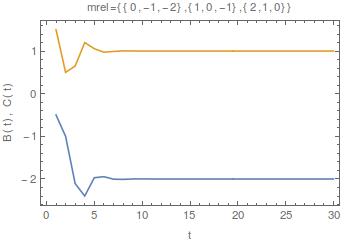 Figure 1
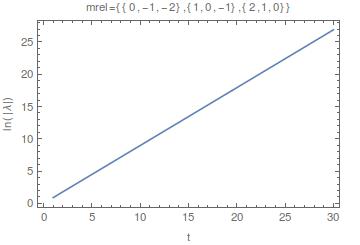 Figure 2
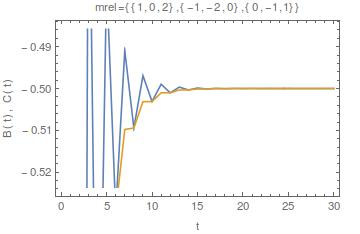 Figure 3
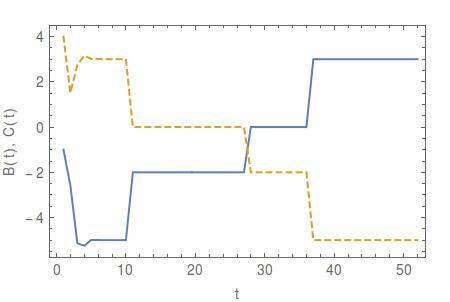 Figure 4
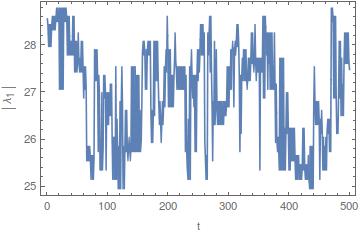 Figure 5
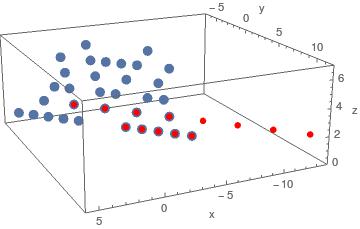 Figure 6
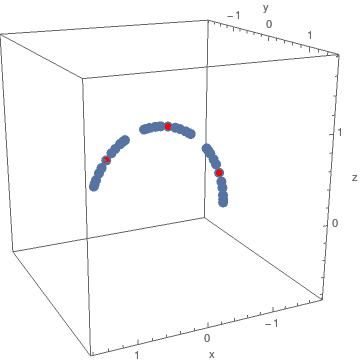 Figure 7
Peer Reviews
No public reviews on file for this paper yet. If you reviewed it on a platform where reviews are public (OpenReview, ICLR, NeurIPS, ICML), you can paste yours below so the community can read it here.
Videos
No videos yet. Explain this paper in a talk, walkthrough, or lecture? Add one.
Taxonomy
TopicsCellular Automata and Applications · Computability, Logic, AI Algorithms
\SetWatermarkScale
7 \SetWatermarkTextpaper draft \SetWatermarkLightness0.95
Cellular Automaton-Like Model of Arising Physical-Like Properties
M. Pietrow111e-mail: [email protected]
Abstract
A simple relation of the order of abstract objects generates an dimensional basis of three dimensional vectors. A cellular automaton-like model of evolution of this system is postulated. During this evolution, some quantities stabilise with time and form a discrete spectrum of values. The presented model may have some general aspects in common with a cellular automaton representation of a quantum system.
Introduction:
Cellular automata (CA) are used to describe the behaviour of systems with a wide range of complexity from physics to biology [1]. Mainly, the description is functional, but not a structural one (CA rules allow description of some aspects of a system at a high structural level without references to the rules from the deeper level of subsystems).
The aim of this presentation is opposite to some extent. One does not require here a compatibility of an introduced model with any special real system. Instead, it was assumed that there exists a set of some abstract objects and a general quantity, an order, characterising each member of this set. Based on this, a matrix was constructed which keeps relations between these objects. The properties of this matrix were examined and some arising similarities to physical properties were brought into focus. Furthermore, the presented model keeps the compatibility with CA ideas to some extent and tries to adhere to a description of a set of physical objects from the structural point of view.
Although most of the ideas here are postulated but not derived from something deeper, it would be promising to consider the Author’s idea of a simple relation between some elementary objects and an introductory model of how physical properties arise from it.
Relation matrix ():
A fundamental feature of a system of basic objects (thought here as abstract entities, not physical ones; called here elementary objects) is the relation between them. One of the simplest relations seems to be an ’order’ of these objects. For example, for three objects there are 3 of their possible arrangements.
Now, consider a set of identical elementary objects. Let us define an matrix (relation matrix), which describes the distance (in the meaning of this order) of the -th relative to the -th object. For example, =-1 because the object is one step before the one (it proceeds object ). The for three particles of the order is
[TABLE]
whereas for the order we have
[TABLE]
The Eigensystem of the :
s have interesting properties. Consider a for an arrangement as an example. Its eigenvalues are
[TABLE]
whereas the corresponding eigenvectors are
[TABLE]
where ∗ denotes a complex conjugation.
The following is an interesting general rule for (no matter what its dimension is). Its eigenvalues are equal to [math], whereas the respective eigenvectors always have the non-zero values in 3 dimensions only. These vectors span the space, .
The seems to be a promising representation of physical objects in a common physical space, i.e. these eigenvectors can describe the basic objects in a three-dimensional sub-spaces of a common space. Let us call these vectors with the zero eigenvalues the physical vectors.
Other properties of :
Some other interesting properties of are listed below.
Permutation of related elementary objects does not change the eigenvalues of , whereas the eigenvectors do change. 2. 2.
The physical vectors are independent of in the case of generalisation of the relation definition in as
[TABLE] 3. 3.
Any ’s sub-matrix of dimension has physical vectors. 4. 4.
s (for the arrangements and ) have no physical vectors. Normalised eigenvectors of these matrices resemble spin vectors for a spin- particle
[TABLE]
whereas these s are proportional to one of the Pauli matrices, : and .
For three elementary objects in the relation, there is one physical vector as an eigenvector222When rearrangement of the elementary objects takes place the components of this vector
(7)
interchange. . In this case, all sub-matrices of all three-dimensional s generated from permutations of the order give the eigenvalues from the set and these sub-matrices are a simple combination of the Pauli matrices. For (two or more physical vectors present) the expansion into the Pauli matrices becomes less trivial.
To generalise, the (sub)-s seem to be promising operators for spin description.
The time evolution of such a system is postulated below. 5. 5.
s are antihermitian (antisymmetric). Some sets of s form a linearly independent set (for example, a subset of three s generated by permutations of elementary objects). According to the general theory [2], they form a Lie algebra of generators related to some unitary matrices. This suggests a possibility of description of quantum-like evolution [3] by these matrices. 6. 6.
Another scheme of a time evolution (called a second kind) of a system described by could be suggested by the case of 2-dim s which have been linked with a spin. Each of the Pauli matrices can be derived from one of them by some elementary operations known from linear algebra (two lines333rows or columns, optionally switching, a line multiplication by a number). Thus, the evolution of in a general sense could be identified with elementary operations. In general, swapping lines is not equivalent to permutations of the elementary objects.
In the simplest case, one may consider a at each step where some two lines could be randomly swapped. However, a more complicated algorithm could be used as a current generator. A new could be considered as a product of up-to-now s that could change additionally at some steps by swaps of lines.
On the other hand, continuing the idea of relations, for a system of three elementary objects as an example, their states , , are influenced by each state from all these objects in the set. Thus, it could be written
[TABLE]
The matrix here could be identified with .
More generally, for a set of consecutive steps , eq. (8) gives
[TABLE]
The equation above is, in fact, a requirement to find a vector which is unchanged by a projection by the operator. Vectors which are the solution of (9) have interesting properties.
As an example, consider the for three elementary objects. Calculate and as a function of time (because the rank of any is 2, and are –dependent here). These functions are shown in fig. 1.
Additionally, the physical vectors do not change with steps, whereas the rest of the eigenvectors set oscillate within some set of values.
The non-zero eigenvalues of rise logarithmically with steps when the system evolves without swaps in between inside the matrix–fig. 2.
However, when the swaps of lines take place, the non-zero eigenvalue rises much faster that logarithmically.
One may consider the evolution complicated one step more. If one makes some swaps of lines and then solves eq. (9), the result for and will approximate asymptotically some value – fig. 3.
On the other hand, if one makes a swap of matrix lines between some steps of evolution and solves eq. (9) after each step then one observes switches to some other value for some time (fig. 4). The interesting feature of this evolution is that the spectrum of values is discrete (they form a multiplet).
Generally, the changes of values do not coincide with the moment of the swap of the matrix lines.
A discrete spectrum of and is also obtained when one calculates it for any sub-matrix of a larger under evolution.
The evolution of a second kind erases the anti-symmetricity of a and thus it is a considerably different scheme. However, the antisymmetricity returns after some swaps. 7. 7.
If the evolution consists in swapping lines, the number of physical vectors does not change. Also, if one considers the evolution (9) with , the number of the physical vectors remains constant.
It is interesting to consider physical vectors relating to s representing all permutations of elementary objects. These vectors form sets with non-zero values at different three of positions: , , , etc.. Each points the same network of points located at a plane (blue points in fig. 5; any length of vectors are possible). The number of points increases with (all points generated by smaller set of elementary objects are generated by a larger one, too). Furthermore, any swaps of ’s lines produce physical vectors which are a subset of the network given by permutations of elementary objects (e.g.: red points in fig. 5). Moreover, a multiplication of mentioned in the eq. (9) does not give an additional points but those generated by permutations. Permutations and powering (no matter what is done first) give the points from the regular structure whose an initial part was depicted in fig. 5.
In fact, any length of the eigenvectors of s are possible. If one limits to normalized vectors only the set of possible points form a part of a circle centred at with radius 1 and normal vector pointing in the direction of (blue points in fig. 6).
Let us follow the position of the points described by at each step of the evolution consisting on random swapping lines or powering the matrix. If then the position of the point could change randomly from step to step at a semi-circle of possible points. However, if (there is only one physical vector) only jumps between the points given in red in fig. 6 are possible.
To generalise, the physical vectors point a net of places in a three-dimensional sub-space for each of objects. The structure of the network (positions of allowed points) is the same for each of these physical vector. According to this, each has its own (’internal’) net of possible states. Although each physical vector is represented in its own subspace, from this model, the coordinates of each possible point obey the equation , where - and -coordinates can be regarded as common ones whereas the -coordinate is set individually for each vector.
The further Author’s work will be devoted to check if the jumps through the network (for the one particle case, in particular) could describe a space-time motion of elementary objects in some way.
The evolution described in point 6 above resembles rules obeyed by the CA [1] in general. Its algorithm is an application of a simple rule (9) at each step (however, when swaps of matrix lines take place, randomness of choice as a generalisation of CA rules is added). The equivalence of cells in CA would be matrix elements (or lines) here. Each matrix element changes by application of a rule that requires other elements (but not neighbouring ones only). Additionally, in both cases, the evolution and the CA, some values can form a complex pattern of changes in ’time’. Such behaviour is maintained by non-zero eigenvalues of s (fig. 7).
Conclusions:
This paper presents a collection of statements and hypotheses concerning a relation between basic physical properties, e.g. a number of dimensions of space containing physical objects or an evolution process, and relation matrix properties for which some characteristics have been investigated. From a point of view of the model presented above, the resembles operators in quantum mechanics. Possibly, a permutation group would help to find a link. An interesting consequence would be that the spin-like vector may originate from two-dimensional eigensystems which differ in dimensionality only from three dimensional physical vectors originating from larger s.
The statements do not form a consistent view of linked concepts but the Author’s hope is that the interesting properties of s do reveal a structure resembling CA with quantum-like properties and could be developed for a useful description of physical many-body systems.
The reference list from the paper itself. Each links out to its DOI / PubMed record.
- 1[1] S. Wolfram, A new kind of science . Wolfram Media, 2002.
- 2[2] http://mathworld.wolfram.com/Antihermitian Matrix.html.
- 3[3] W. Greiner and B. Müller, Quantum mechanics: Symmetries . Springer Science & Business Media, 1994.