The stochastic growth of metal whiskers
Biswas Subedi, Dipesh Niraula, Victor G. Karpov

TL;DR
This paper presents a probabilistic theory explaining the intermittent growth of metal whiskers caused by local energy barriers from surface imperfections, aiding in reliability prediction.
Contribution
It introduces a new stochastic model for metal whisker growth, linking local electric field variations to growth intermittency and providing distribution of stopping times.
Findings
Distribution of MW stopping times derived
Intermittent growth explained by energy barriers
Model improves reliability forecasting
Abstract
The phenomenon of spontaneously growing metal whiskers (MW) raises significant reliability concerns due to its related arcing and shorting in electric equipment. The growth kinetics of MW remains poorly predictable. Here we present a theory describing the earlier observed intermittent growth of MW as caused by local energy barriers related to variations in the random electric fields generated by surface imperfections. We find the probabilistic distribution of MW stopping times, during which MW growth halts, which is important for reliability projections.
Click any figure to enlarge with its caption.
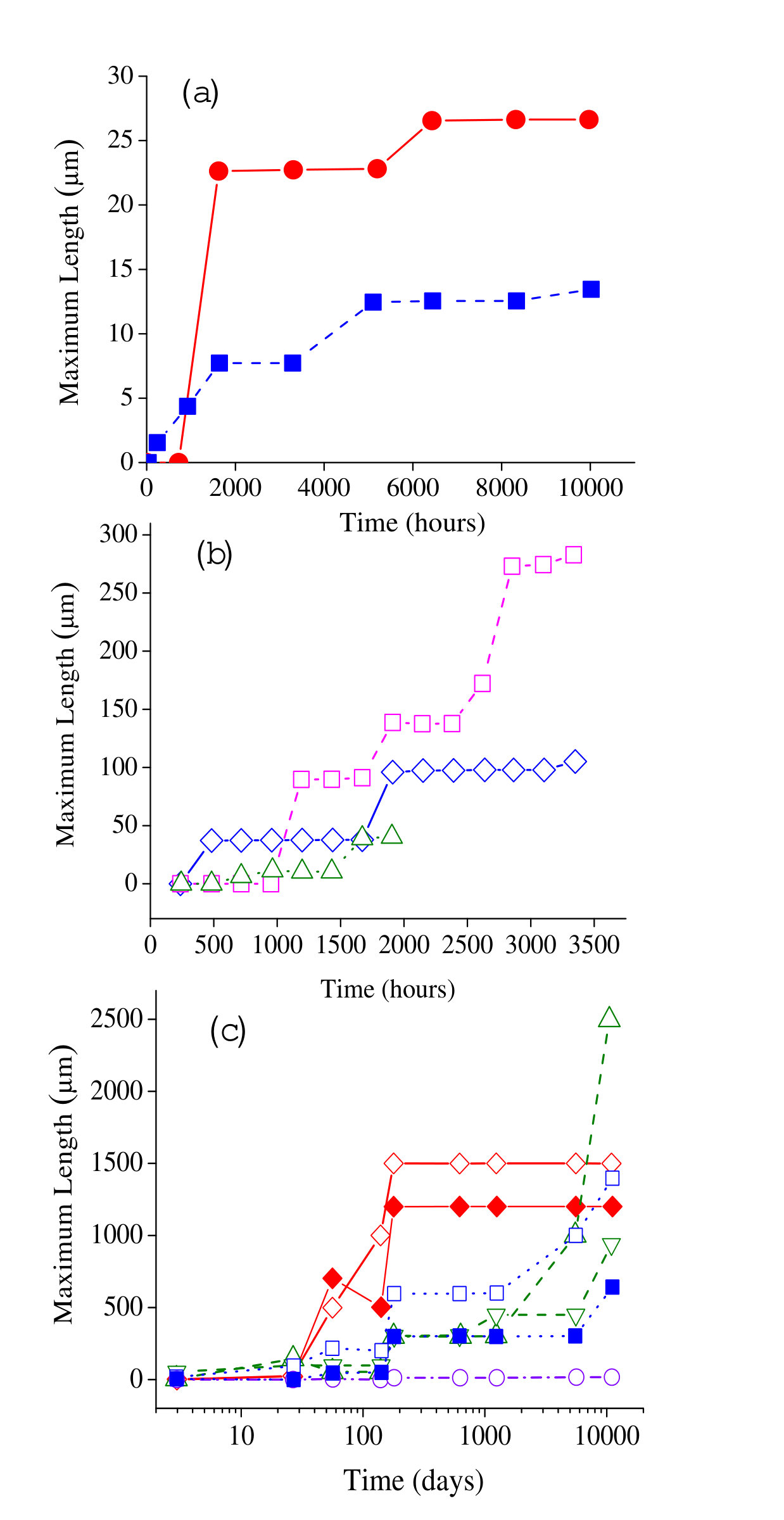 Figure 1
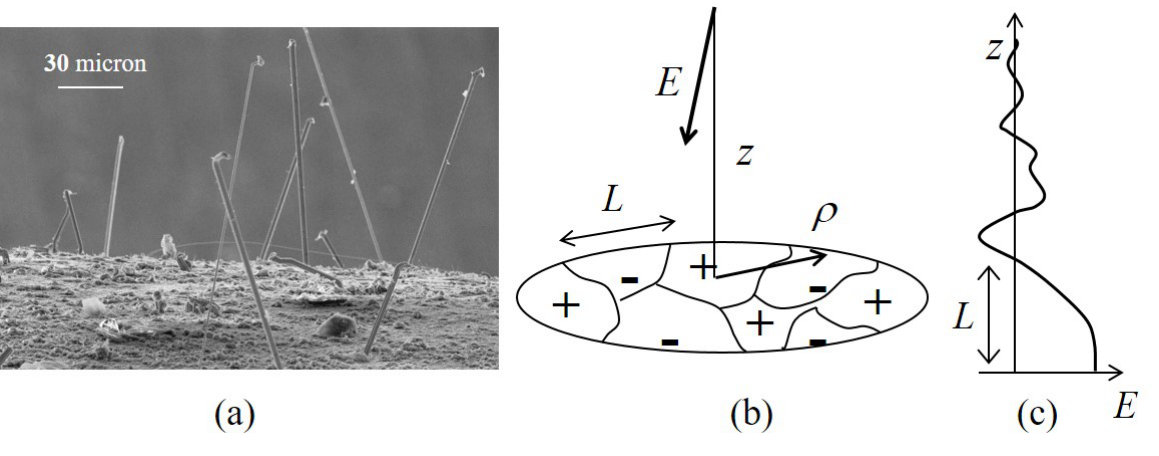 Figure 2
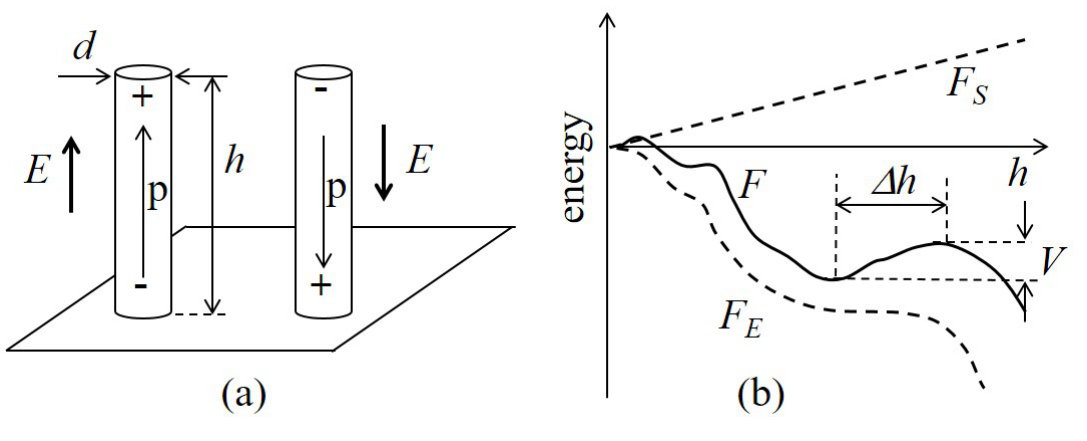 Figure 3
Peer Reviews
No public reviews on file for this paper yet. If you reviewed it on a platform where reviews are public (OpenReview, ICLR, NeurIPS, ICML), you can paste yours below so the community can read it here.
Videos
No videos yet. Explain this paper in a talk, walkthrough, or lecture? Add one.
The stochastic growth of metal whiskers
Biswas Subedi
Department of Physics and Astronomy, University of Toledo, Toledo,OH 43606, USA
Dipesh Niraula
Department of Physics and Astronomy, University of Toledo, Toledo,OH 43606, USA
Victor G. Karpov
Department of Physics and Astronomy, University of Toledo, Toledo,OH 43606, USA
Abstract
The phenomenon of spontaneously growing metal whiskers (MW) raises significant reliability concerns due to its related arcing and shorting in electric equipment. The growth kinetics of MW remains poorly predictable. Here we present a theory describing the earlier observed intermittent growth of MW as caused by local energy barriers related to variations in the random electric fields generated by surface imperfections. We find the probabilistic distribution of MW stopping times, during which MW growth halts, which is important for reliability projections.
Introduction – Metal whiskers [MW; illustrated in Fig. 2 (a)] are hair-like protrusions growing from the surfaces of many metals, such as Sn, Zn, Cd, and Ag. MW caused shorting in electronic packages raises significant reliability concerns and losses in different technologies ranging from aerospace and military to auto industry and medical devices. NASA1 ; barnes ; galyon2003 ; brusse2002 ; panashchenko2009 After about 70-year of observations, the understanding of MW growth remains insufficient.
Mechanical stresses, sarobol2013 ; pei2013 ; pei2014 ; chason2014 local recrystallization regions, vianco2015 ; qiang2014 intermetallic compounds, tu1994 ; so1996 and stress gradientsstein2014 ; yang2008 ; sobiech2008 ; sobiech2009 have been considered as MW driving forces. A recent electrostatic concept attributes MW growth to random electric fields generated by surfaces of imperfect metals. shvydka2016 ; karpov2014 ; karpov2015 ; niraula2015 ; vasko2015 ; vasko2015a ; borra2016 ; niraula2016
The predictability of MW effects is hindered by their stochastic nature: MW lengths () and diameters () are mutually uncorrelated and broadly distributed obeying log-normal statistics; the local concentration of MW varies exponentially between different regions. Many other observations summarized by G. Davy davy2014 indicate that stochasticity as well. In particular, MW “…growth rate is often not constant. A whisker may stop growing for a while, then start growing again.” davy2014 ; kostic2014 MW growth randomly interrupted for years ashworth2016 and days kim2008 ; meschter2015 was observed; Fig. 1 presents a compilation.
Here, we present a theory describing the stochastically intermittent longitudinal growth of MW. We establish the statistics of MW barriers () and stopping times,
[TABLE]
during which the longitudinal MW growth ceases; here and is the thermal energy. The practical side of our work is that the time dependent probabilities of MW lengths determine the likelihood of their related reliability failures.
Model –Our consideration is based on the electrostatic theory, karpov2014 ; niraula2015 ; shvydka2016 according to which the major factor behind MW growth is the random electric field generated by charged surface imperfections, such as grain boundaries, contaminations, chemical or structural nonuniformities. The random distribution of charges is presented by the uncorrelated charge patches of a certain dimension illustrated in Fig. 2.
As sketched in Fig. 3 (a), the field induced electric dipole will decrease MW energy by regardless of the field orientation. Because the polarizability of a needle shaped metal particle landau1984 can be rather high while its surface is small, MW nucleation and growth become possible. The free energy of MW can be written as,
[TABLE]
where the first and second terms represent respectively the electrostatic () and surface () contributions, is the surface tension, is MW diameter, is its length, is the normal (along -coordinate parallel to the whisker axis) component of the random electric field, and . Because the electric field is random, so are the functionals , , and . In particular, randomly located regions of low field strength give rise to the surface energy related barriers that can either temporarily or permanently inhibit whisker growth. The effect of such barriers was shown to predict the log-normal distribution of MW lengths. karpov2014 ; niraula2015 However, related to stopping times, the probabilistic distribution of that barrier heights remained unknown.
To analytically describe a stopping barrier, we use the Taylor expansion in the proximity of an arbitrary MW length
[TABLE]
which yields a barrier height and width,
[TABLE]
Statistical Analysis – The probabilistic properties of such stopping barriers are determined by the statistics of random coefficients, , , and , which can be expressed from Eq. (2),
[TABLE]
where , and we have neglected relatively small derivatives of the logarithmically weak function .
Using Coulomb’s law the random quantities and can be expressed through the random surface charge density where is the elemental charge,
[TABLE]
where is the 2D radius vector. Being integrals of large numbers of random contributions, and satisfy the conditions of central limit theorem and obey Gaussian distributions.
The latter distributions’ moments are readily effected for the case of delta-correlated surface charges,
[TABLE]
Here the angular brackets represent averaging, stands for the delta-function, and
[TABLE]
is a constant where is the characteristic rms fluctuation of surface charge density. The delta-function representation remains adequate when where m is the characteristic linear dimension of a charge patch. Using Eq. (7), the definitions in Eq. (6), and assuming long enough whiskers, , yields
[TABLE]
We are now in a position to describe the probabilistic distribution of stopping barriers. Substituting Eq. (5) into Eq. (4) yields,
[TABLE]
where we have introduced
[TABLE]
The random quantities and in Eq. (10) and (11) are approximated by their averages from Eq. (9): using the same technique as in Appendix B of Ref. karpov2014, , it is seen that their rms fluctuations are proportional to the small parameter . In that approximation, one gets, , and
[TABLE]
with
[TABLE]
and
[TABLE]
Using Eqs. (13) and (8) the characteristic barrier is estimated as,
[TABLE]
where we have used karpov2014 m, cm*-2*, and . In particular, short enough stopping times possible for observations correspond to , thus very close to . The condition of low barriers, defines simultaneously the range of applicability of approximation in Eq. (3). Indeed, replacing in the expression for in Eq. (4) with its average by virtue of Eq. (5) yields,
[TABLE]
Expressing from Eq. (12), the Gaussian distribution yields the normalized barrier distribution,
[TABLE]
at distance from the metal surface [recall that depends on as specified in Eq. (13)]. Because for all practical cases one has to assume , the distribution in Eq. (17) is not very different from uniform, , which is typical of many models of disordered systems [note that is length dependent in Eq. (13)].
The corresponding distribution of stopping times is,
[TABLE]
Neglecting again the exponent, the latter distribution can be closely approximated by the generic form known for many disordered systems.
There is a strong correlation between the random quantities corresponding to the same length scale,
[TABLE]
and similar for other correlation coefficients, where the latter equality represents the case of small and we have used Eqs. (6) and (7).
Conclusions –The following conclusions can be made based on the results in Eqs. (13), (17), (18) and (19).
-
The electrostatic theory naturally predicts the stochastic intermittent kinetics of MW growth.
-
For all practical purposes, the stopping barriers can be described in the cubic approximation.
-
Their probabilistic distribution is close to uniform.
-
The stopping time distribution is close to characteristic of many processes in disordered systems. It predicts that short time interruptions are more likely and can be overlooked unless intentionally tracked.
-
The barriers typically extend over the entire length ranges at which they appear; the next barrier for the same MW is expected when its length changes by an order of magnitude.
-
The characteristic barrier height increases with MW length [Eq. (13)], and the characteristic stopping time increases with exponentially.
Our theory relates the intermittent growth of MW to the physics of disordered systems where random barriers inhibit a system development. It neglects the details of the underlying material structure and diffusion emphasizing instead the general disorder effects. An alternative interpretation referring to material specific aspects can suggest that “…As the tin plating anneals and grain growth occurs there will be interruptions in the mechanism of whisker growth, particularly when grain annihilation or abnormal grain growth takes place during recrystallization. This could account for ‘stop-and-go’ growth.”dunn2017
Collecting sufficient data on the intermittency statistics, such as the stopping time distribution and correlations between and MW length could help to experimentally verify the above theory.
We would like to summarize our consideration by saying that the occasionally observed intermittent growth is explained by the electrostatic theory accounting for barriers in MW free energies. In our stochastic picture of MW development, short time growth interruptions happen more often, especially at the earlier stages, and can be overlooked. On the other hand, longer MW can show exponentially longer interruptions that can be misinterpreted as the end of MW growth.
Industry standards for MW propensity limited time tests, such as suggested by Joint Electron Devices Engineering Council, industry ; comments need to be approached statistically, predicting with a certain probability the long-term growth of MW, for example, the probability of a certain MW growth during the desired time interval. Industrial protocols for such statistical predictions can be attempted based on a theory such as the above quantifying possible losses in the spirit of actuarial analyses.
The authors acknowledge useful discussions with D. Shvydka, A. D. Kostic, G. Davy, J. Brusse, B. Dunn, S. Meschter, and P. Snugovsky.
The reference list from the paper itself. Each links out to its DOI / PubMed record.
- 1(1) NASA Goddard Space Flight Center Tin Whisker Homepage, website http://nepp.nasa.gov/whisker .
- 2(2) J. R. Barnes, Bibliography for Tin Whiskers, Zinc Whiskers, Cadmium Whiskers, Indium Whiskers, and Other Conductive Metal and Semiconductor Whiskers; http://www.dbicorporation.com/whiskbib.htm
- 3(3) G. T. Galyon, Annotated Tin Whisker Bibliography And Anthology, IEEE Transactions on electronics Packaging Manufacturing, 28 , 94 (2005); http://thor.inemi.org/webdownload/newsroom/TW_ , biblio-July 03.pdf
- 4(4) J. Brusse, G. Ewell, and J. Siplon, Tin Whiskers: Attributes and Mitigation, Capacitor and Resistor Technology Symposium (CARTS), March 25-29, pp. 68-80, (2000).
- 5(5) L. Panashchenko, Evaluation of environmental tests for tin whisker assessment, MS Thesis, University of Maryland (2009). http://hdl.handle.net/1903/10021
- 6(6) P. Sarobol, J.E. Blendell, C.A. Handwerker, Whisker and hillock growth via coupled localized Coble creep, grain boundary sliding, and shear induced grain boundary migration, Acta Materialia 61 , 1991, (2013).
- 7(7) F. Pei and E. Chason, J. Electron. Materials, In Situ Measurement of Stress and Whisker/Hillock Density During Thermal Cycling of Sn Layers, J. Electron. Materials, 43 , 80, (2014).
- 8(8) E. Chason, F. Pei, C.L. Briant, H. Kesari, and A.F. Bower, Significance of Nucleation Kinetics in Sn Whisker Formation, J. Electron. Materials, 43 , 4435, (2014).