Convex equipartitions of colored point sets
Pavle V. M. Blagojevi\'c, G\"unter Rote, Johanna K. Steinmeyer,, G\"unter M. Ziegler

TL;DR
This paper proves that any d-colored set of points in general position in olds can be partitioned into subsets with convex hulls, extending previous results and using measure equipartition theorems combined with network flow techniques.
Contribution
It extends equipartition results to colored point sets in olds, combining measure partition theorems with network flow methods to handle boundary ambiguities.
Findings
Partition of colored points with convex hulls is possible in olds.
Uses measure equipartition theorems to guide point set partitioning.
Network flow approach resolves boundary point ambiguities.
Abstract
We show that any -colored set of points in general position in can be partitioned into subsets with disjoint convex hulls such that the set of points and all color classes are partitioned as evenly as possible. This extends results by Holmsen, Kyn\v{c}l & Valculescu (2017) and establishes a special case of their general conjecture. Our proof utilizes a result obtained independently by Sober\'on and by Karasev in 2010, on simultaneous equipartitions of continuous measures in by convex regions. This gives a convex partition of with the desired properties, except that points may lie on the boundaries of the regions. In order to resolve the ambiguous assignment of these points, we set up a network flow problem. The equipartition of the continuous measures gives a fractional flow. The existence of an integer flow then yields the…
Click any figure to enlarge with its caption.
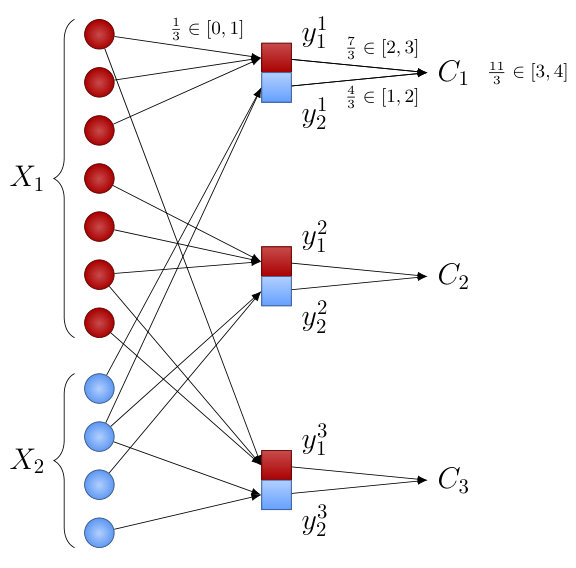 Figure 1
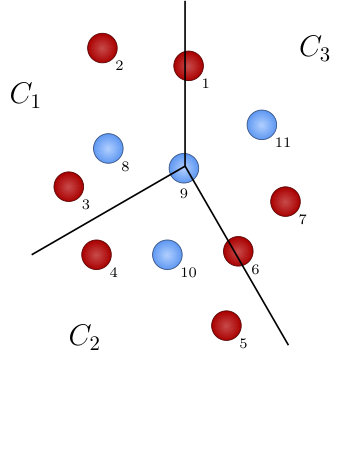 Figure 2
Peer Reviews
No public reviews on file for this paper yet. If you reviewed it on a platform where reviews are public (OpenReview, ICLR, NeurIPS, ICML), you can paste yours below so the community can read it here.
Videos
No videos yet. Explain this paper in a talk, walkthrough, or lecture? Add one.
Convex Equipartitions of Colored Point Sets
Pavle V. M. Blagojević111The authors are supported by DFG via the Collaborative Research Center TRR 109 “Discretization in Geometry and Dynamics.” PVMB is also supported by the grant ON 174008 of the Serbian Ministry of Education and Science. GMZ is also supported by DFG via the Berlin Mathematical School BMS.
Institut für Mathematik, FU Berlin
Arnimallee 2, 14195 Berlin, Germany
Günter Rote
Institut für Informatik, FU Berlin
Takustraße 9, 14195 Berlin, Germany
Johanna K. Steinmeyer
Institut für Mathematik, FU Berlin
Arnimallee 2, 14195 Berlin, Germany
Günter M. Ziegler
Institut für Mathematik, FU Berlin
Arnimallee 2, 14195 Berlin, Germany
(May 23, 2017; revised December 11, 2017)
Abstract
We show that any -colored set of points in general position in can be partitioned into subsets with disjoint convex hulls such that the set of points and all color classes are partitioned as evenly as possible. This extends results by Holmsen, Kynčl & Valculescu (2017) and establishes a special case of their general conjecture. Our proof utilizes a result obtained independently by Soberón and by Karasev in 2010, on simultaneous equipartitions of continuous measures in by convex regions. This gives a convex partition of with the desired properties, except that points may lie on the boundaries of the regions. In order to resolve the ambiguous assignment of these points, we set up a network flow problem. The equipartition of the continuous measures gives a fractional flow. The existence of an integer flow then yields the desired partition of the point set.
1 Introduction
A (finite) set of points in is in general position if every subset of size at most is affinely independent. A partition of into disjoint subsets is an -coloring of . The sets are called color classes and we say that the set is -colored. A subset containing points from at least distinct color classes is said to be -colorful.
In this language, the classical partition result of Akiyama and Alon reads as follows.
Theorem 1** (Akiyama–Alon [2]).**
Let be positive integers, and let be a -colored set of points in general position in , with each color class containing points. Then there is a partition of into -colorful sets of size whose convex hulls are pairwise disjoint.
Akiyama and Alon gave a beautifully simple proof using a discrete version of the ham-sandwich theorem, which is a well known consequence of the Borsuk–Ulam theorem. The use of such topological methods created a lot of progress in solving discrete partitioning problems. In fact, many related partition results have both a continuous mass partition as well as a discrete colored version—often equivalent.
In this paper, we consider the following conjecture of Holmsen, Kynčl and Valculescu [5, Conjecture 3].
Conjecture 2** (Holmsen–Kynčl–Valculescu, 2016).**
Let , and be positive integers, and let be an -colored set of points in general position in . Suppose there is a partition of into -colorful sets of size . Then there is also such a partition with the additional geometric property that the convex hulls of the sets are pairwise disjoint.
Here, the assumption of the existence of a partition depends only on the number of color classes and their sizes, and it involves no geometry. It is obviously a necessary condition. In particular, it implies that and .
Theorem 1 answers the case when . The case was settled by Aichholzer et al. [1] and by Kano, Suzuki and Uno [8]. Further developments on the planar case were made independently by Bespamyatnikh, Kirkpatrick and Snoeyink [3], Ito, Uehara and Yokoyama [6] as well as Sakai [11], who confirmed the conjecture for two colors () when the sizes of the color classes are divisible by . Holmsen, Kynčl and Valculescu resolved the conjecture for the remaining cases in the plane, as well as for the case when , the latter by giving a particular discretization of the ham-sandwich theorem [5]. Their method is similar to the one used previously by Kano and Kynčl [7] to establish the case , who for the proof developed a generalization of the ham-sandwich theorem for measures in , which they called the hamburger theorem.
Holmsen et al. emphasized the connection of the conjecture with a continuous analogue for the case , proved in the plane by Sakai [11] and extended to arbitrary dimension by Soberón [13] and independently by Karasev [9]. (A more general version, for functions that are not necessarily measures, was obtained soon after by Karasev, Hubard and Aronov [10] and by Blagojević and Ziegler [4].)
Theorem 3** (Soberón–Karasev, 2010).**
Let be positive integers, and let be absolutely continuous finite measures on with respect to the Lebesgue measure. Then there exists a partition of into convex regions that simultaneously equipartitions all measures, that is,
[TABLE]
for all and all .
Holmsen, Kynčl and Valculescu state:
“However, going from the continuous version to the discrete version seems to require, in many cases, a non-trivial approximation argument, and we do not see how the continuous results […] could be used to settle our Conjecture 3 for the case .”
Indeed, this is not straightforward. However, in this paper we show how it can be done: We confirm Conjecture 2 when , as a direct corollary of the following main result. For this we say that a partition of a finite set into parts is an equipartition if each of the parts contains or elements of .
Theorem 4**.**
Let be positive integers, and let be a -colored set of points in general position in . Then there exists an equipartition of into subsets which simultaneously equipartition each of the color classes and whose convex hulls are pairwise disjoint.
To see that Theorem 4 implies Conjecture 2 for the case , observe that in this case the condition on of admitting a partition into pairwise disjoint -colorful sets of size implies that each color class has at least elements. In an equipartition of a color class , each part contains at least points. Thus, each part of contains all colors. With and an equipartition of , we get sets of size that each contain at least one point of each of the colors.
2 Preliminaries
In order to discretize Theorem 3, we start by employing a classical idea (see Alon & Akiyama [2]): We replace the points in with small enough closed balls and then define measures on these. The problem with applying the continuous result is that the boundaries of the regions may cut through some balls, see Figure 1 (left). We will assign every such “ambiguous” point to one of the regions intersected by the ball centered at the point.
The following lemma shows that, if the radius of the balls is small enough, we will always get a partition of with disjoint convex hulls, no matter how we resolve the ambiguities. In Section 3 we will prove that we can resolve these ambiguities in such a way that we get an equipartion of the full point set as well as of each of the color classes . Note that this does not guarantee the existence of a partition of into convex regions such that each region would contain one of the disjoint convex hulls.
By general position, no points of with lie on a common -flat (affine subspace of dimension ). When we replace the points by balls, we make their radius small enough so that no of these balls are intersected by any -flat.
Lemma 5**.**
Let be a finite set of points in general position, and let be chosen such that no closed balls of radius centered at points from with can be intersected by a common -flat. Suppose we are given an affine hyperplane and a partition of satisfying
[TABLE]
where and are the open half-spaces determined by . Then
[TABLE]
Proof.
The proof is based on the perturbation argument from [2, Proof of Lemma 2], which we make more explicit.
We perform a reverse induction on the number of -balls intersected by , starting with the maximum possible value and proceeding downwards. For the induction basis, when , we choose points in the intersection of the balls with . We move them straight to the ball centers at constant speed, and we let the hyperplane through the points follow along. By our assumptions, is always uniquely defined throughout the motion, and it will not intersect any other ball at any time. When the points arrive, goes through points of . We now perturb each point perpendicular to in the appropriate direction, so that the corresponding point of will be on the desired side, or . The position of the remaining points with respect to is unchanged throughout this process, and it was correct from the beginning since did not intersect their balls. Thus, we have a hyperplane strictly separating the sets and . Consequently, .
Let us now consider the case that intersects balls. As above, we choose points from inside these balls, and we move them towards the ball centers. The motion of is no longer uniquely defined, but since the moving points are never in degenerate position, they span an -flat that moves continuously, and we can continuously move the hyperplane while containing . If, during this motion, intersects an additional ball, we have increased and we proceed by induction. Otherwise, we arrive at a position where goes through points of , and we perform the perturbation as above. ∎
In order to assign boundary points to regions we will set up a flow network with a fractional flow; from this we obtain an integer flow, which in turn will determine the assignment.
In a directed graph with a set of vertices and a set of arcs , a flow is a function that assigns a real number to each arc. The excess of the flow at the vertex of the graph is the difference between the inflow and the outflow:
[TABLE]
To obtain an integer flow from a fractional one, we will use the following statement.
Proposition 6**.**
Let be a directed graph, and let , and be integer-valued functions on the arcs and on the vertices, respectively. If there is some flow on such that
[TABLE]
then there is also an integer flow that satisfies the same bounds.
Proof.
This is a variation of the well-known integrality results on network flows. Classical flow networks involve only a single vertex with negative excess (source) and a single vertex with positive excess (sink), conserving the flow at all other vertices. The network we consider has several sources and sinks. Additionally, the excesses at these vertices are not fixed but allowed to vary within bounds, and we have lower as well as upper capacities on the arcs.
Such networks can be reduced to the classical situation by standard transformations; We sketch these transformations. (See [12, Corollary 11.2i] for an alternative approach via Hoffman’s circulation theorem.)
- •
First, any arc with a positive lower bound and upper bound is replaced by a conventional arc with nonnegative flow and upper bound . To compensate this offsetting of the flow, the excesses have to be adapted. We subtract from the excess bounds and at and add it to the excess bounds and at . In the network that we will use, there are no arcs with negative bounds. Such an arc could be treated by introducing the reverse arc .
- •
To deal with the variation of the excess, we create an additional “balancing sink” . We fix the excess of each vertex at its lower bound. Thus, a vertex with excess bounds and (as modified in the previous step) is declared to be a sink with demand if , or a source with supply if . The excessive inflow at is then absorbed by an arc of capacity . We fix the demand of to make the overall sum of demands equal to the overall supply.
- •
Finally, we add a new super-source with an arc to every source , of capacity equal to the supply at , and a new super-sink , with an arc from every sink to , of capacity equal to the demand at .
Flows in the original graph correspond, in the transformed network, to classical flows from to that saturate all edges out of . Integrality is preserved throughout the transformation. ∎
3 Proof of the main result
Proof of Theorem 4.
Let and be positive integers, and let be a -colored set of points in general position in . Using the tools presented in Section 2, we now prove our claim that we can partition into sets of size or that have pairwise disjoint convex hulls and simultaneously equipartition the color classes. The proof is done in several steps.
(1) From points to measures.
We replace each point by a ball centered at , with a real number small enough such that no -flat with intersects more than balls. With each ball centered at a point in , we associate a uniformly distributed measure of unit total mass. For each and for every measurable subset , let be the total measure of balls centered at points in that is captured by . Clearly, are absolutely continuous finite measures on with . According to Theorem 3, there exists a partition of into convex regions which equipartitions the measures, that is,
[TABLE]
for all and all .
(2) A directed graph of incidences.
In order to apply Lemma 5, we show the existence of an assignment of the points in to the regions such that for each point assigned to a region , intersects , while in total or points are assigned to each region, with or of color class for every . Such an assignment may be modeled as an integer flow from the points in to the regions in the partition, where each has an outflow of and each region has an inflow of or , the number of points assigned to it. To guarantee an equipartition of the color classes, we add a middle layer of vertices, one for each color and region, and set the constraints on these vertices and arcs accordingly.
We define the directed graph with , where
[TABLE]
contains a vertex for each color and each region , and the set contains a vertex for each region. We have arcs from a point to those vertices in corresponding to the color of and the regions incident to the ball centered at , as well as arcs from the vertices in to their respective region in . More precisely, the set of arcs is
[TABLE]
For the vertices of , we define lower bounds and upper bounds on the excess as follows:
[TABLE]
In all five cases, the the lower bounds don’t exceed the upper bounds.
(3) A fractional flow.
We now construct a fractional flow by setting
[TABLE]
The lower and upper constraints on the arcs are trivially satisfied,
[TABLE]
With for all , we get
[TABLE]
With for a vertex , the values yield
[TABLE]
Lastly, for a we get
[TABLE]
and consequently for all .
(4) Back to geometry.
From this fractional flow, Proposition 6 produces an integer flow on that satisfies the constraints given by functions and . This in turn gives an assignment of points into sets of size and , equipartitioning . The middle layer of ensures that each of the sets contains or points from the color class , resulting in a simultaneous equipartition of and all color classes.
We now want that, for any two regions and , the sets of points assigned to and assigned to have disjoint convex hulls. For each point assigned to a region, intersects that region, by the definition of the arc set . We may therefore apply Lemma 5 to the set and conclude that the convex hulls of and are disjoint. ∎
Acknowledgements
We are grateful to the four DCG referees for many useful comments and suggestions.
The reference list from the paper itself. Each links out to its DOI / PubMed record.
- 1[1] O. Aichholzer, S. Cabello, R. Fabila-Monroy, D. Flores-Peñaloza, T. Hackl, C. Huemer, F. Hurtado, and D. R. Wood. Edge-removal and non-crossing configurations in geometric graphs. Discrete Math. Theor. Comput. Sci. (DMTCS) , 12:75–86, 2010.
- 2[2] J. Akiyama and N. Alon. Disjoint simplices and geometric hypergraphs. In Combinatorial Mathematics: Proc. of the Third International Conference, New York 1985 , volume 555 of Annals of the New York Academy of Sciences , pages 1–3, 1989.
- 3[3] S. Bespamyatnikh, D. Kirkpatrick, and J. Snoeyink. Generalizing ham sandwich cuts to equitable subdivisions. Discrete Comput. Geom. , 24:605–622, 2000.
- 4[4] P. V. M. Blagojević and G. M. Ziegler. Convex equipartitions via Equivariant Obstruction Theory. Israel Journal of Mathematics , 200:49–77, 2014.
- 5[5] A. F. Holmsen, J. Kynčl, and C. Valculescu. Near equipartitions of colored point sets. Comput. Geom. Theory Appl. , 65:35–42, 2017.
- 6[6] H. Ito, H. Uehara, and M. Yokoyama. 2 2 2 -dimension ham sandwich theorem for partitioning into three convex pieces. In Discrete and Computational Geometry: Japanese Conference, JCDCG’98 Tokyo, Japan, December 9–12, 1998. Revised Papers , pages 129–157. Springer-Verlag, 2000.
- 7[7] M. Kano and J. Kynčl. The hamburger theorem. Comput. Geom. Theory Appl. , 68:167–173, 2018.
- 8[8] M. Kano, K. Suzuki, and M. Uno. Properly colored geometric matchings and 3 3 3 -trees without crossings on multicolored points in the plane. In Discrete and Computational Geometry and Graphs , volume 8845 of Lecture Notes in Comput. Sci. , pages 96–111. Springer-Verlag, 2014.