Sub-Nyquist Channel Estimation over IEEE 802.11ad Link
Kumar Vijay Mishra, Yonina C. Eldar

TL;DR
This paper explores sub-Nyquist sampling techniques for efficient channel estimation in IEEE 802.11ad 60 GHz links, leveraging channel sparsity and compressed sensing to reduce sampling rates significantly.
Contribution
It introduces a novel approach to low-rate channel estimation for IEEE 802.11ad using compressed sensing and sub-Nyquist sampling, demonstrating feasibility at one-seventh of Nyquist rates.
Findings
Feasibility of channel estimation at one-seventh of Nyquist rate
Minimal performance degradation with sub-Nyquist sampling
Effective exploitation of channel sparsity in 802.11ad
Abstract
Nowadays, millimeter-wave communication centered at the 60 GHz radio frequency band is increasingly the preferred technology for near-field communication since it provides transmission bandwidth that is several GHz wide. The IEEE 802.11ad standard has been developed for commercial wireless local area networks in the 60 GHz transmission environment. Receivers designed to process IEEE 802.11ad waveforms employ very high rate analog-to-digital converters, and therefore, reducing the receiver sampling rate can be useful. In this work, we study the problem of low-rate channel estimation over the IEEE 802.11ad 60 GHz communication link by harnessing sparsity in the channel impulse response. In particular, we focus on single carrier modulation and exploit the special structure of the 802.11ad waveform embedded in the channel estimation field of its single carrier physical layer frame. We…
Click any figure to enlarge with its caption.
 Figure 1
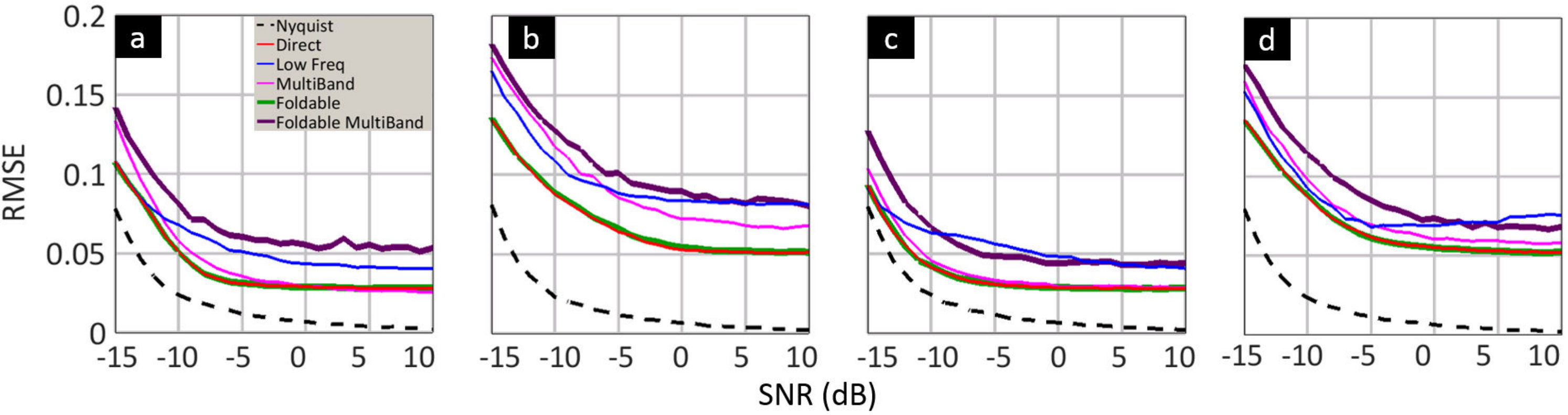 Figure 2
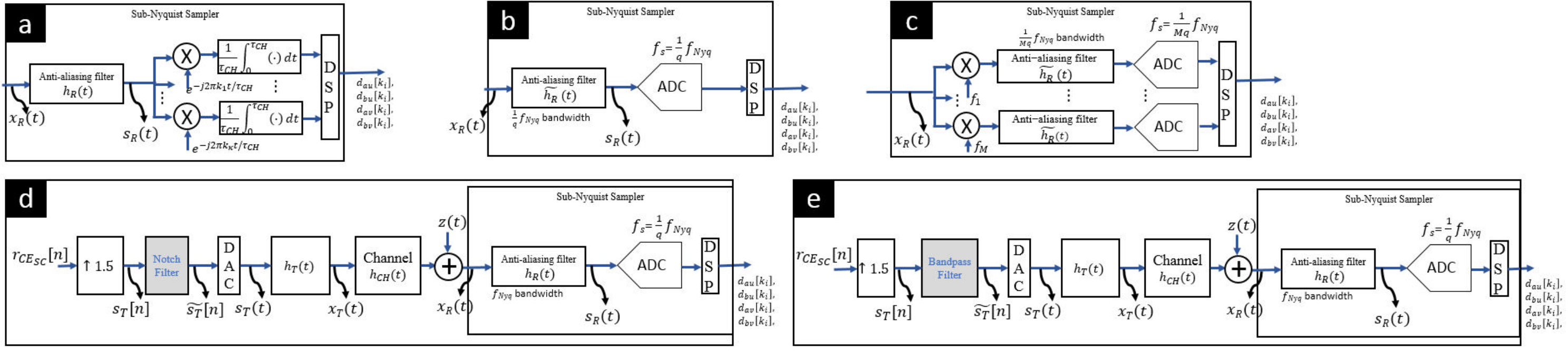 Figure 3
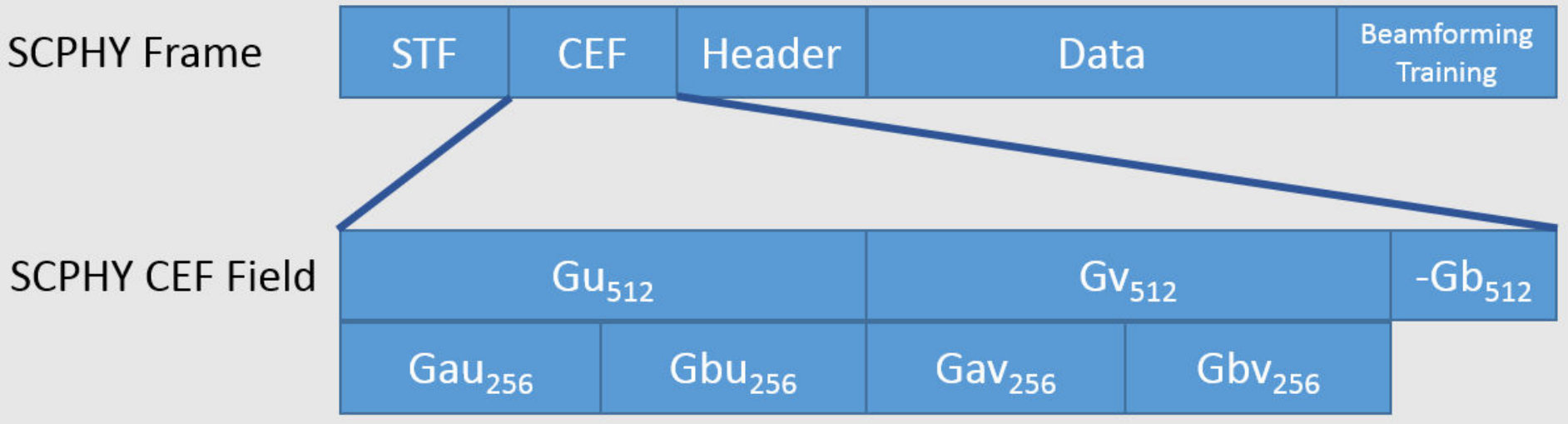 Figure 4
 Figure 5
Peer Reviews
No public reviews on file for this paper yet. If you reviewed it on a platform where reviews are public (OpenReview, ICLR, NeurIPS, ICML), you can paste yours below so the community can read it here.
Videos
No videos yet. Explain this paper in a talk, walkthrough, or lecture? Add one.
Sub-Nyquist Channel Estimation over IEEE 802.11ad Link
Kumar Vijay Mishra and Yonina C. Eldar The authors are with the Andrew and Erna Viterbi Faculty of Electrical Engineering, Technion - Israel Institute of Technology, Haifa, Israel. E-mail: {mishra, yonina}@ee.technion.ac.il. This project is funded by the European Union’s Horizon 2020 research and innovation programme under grant agreement ERC-BNYQ. K.V.M. acknowledges partial support via Andrew and Erna Finci Viterbi Fellowship and Lady Davis Fellowship.
Abstract
Nowadays, millimeter-wave communication centered at the 60 GHz radio frequency band is increasingly the preferred technology for near-field communication since it provides transmission bandwidth that is several GHz wide. The IEEE 802.11ad standard has been developed for commercial wireless local area networks in the 60 GHz transmission environment. Receivers designed to process IEEE 802.11ad waveforms employ very high rate analog-to-digital converters, and therefore, reducing the receiver sampling rate can be useful. In this work, we study the problem of low-rate channel estimation over the IEEE 802.11ad 60 GHz communication link by harnessing sparsity in the channel impulse response. In particular, we focus on single carrier modulation and exploit the special structure of the 802.11ad waveform embedded in the channel estimation field of its single carrier physical layer frame. We examine various sub-Nyquist sampling methods for this problem and recover the channel using compressed sensing techniques. Our numerical experiments show feasibility of our procedures up to one-seventh of the Nyquist rates with minimal performance deterioration.
Index Terms:
802.11ad, sub-Nyquist, sparse recovery, Golay sequences, channel estimation.
I Introduction
The pervasive presence of wireless networks in indoor data communication has led to the demand for very high data throughput links. In this context, recent advances in millimeter-wave technology provide multi-gigabit connectivity in the 60 GHz unlicensed radio-frequency (RF) band with 7-9 GHz of contiguous spectrum [1]. The IEEE 802.11ad standard has been recently developed to enable throughput of up to 7 Gbps at 60 GHz for short-range wireless communication [2]. The diminished range is due to heavy attenuation through physical barriers at 60 GHz. However, in an indoor wireless setting, such a high-speed link is ideal to enable applications which require huge data rates such as transmission of uncompressed high definition (HD) video [3], in-room gaming [4], intra-large-vehicle communications [5, 6] and indoor positioning systems [7].
The IEEE 802.11ad transmits both single carrier (SC) and orthogonal frequency-division multiplexing (OFDM) modulation schemes at operating frequencies of 1.76 GHz and 2.64 GHz, respectively. The SC physical layer (SCPHY) frame of 802.11ad protocol encapsulates Golay complementary sequences [8, 9]. These sequences have the property of perfect aperiodic autocorrelation (zero sidelobes) making them useful for communication channel estimation [10, 11] and radar remote sensing [12, 13]. In this paper, we focus on the channel estimation problem using 802.11ad SCPHY frames.
Environments such as indoor wireless networks and vehicular communications are highly variable with typical channel coherence times of nanoseconds. As a result, 802.11ad chip sequences are of extremely short duration requiring the receivers to use analog-to-digital converters (ADCs) that operate at very high (GHz) sampling rates. It is desirable to avoid these high-rate ADCs for the purposes of saving power, circuit area and cost. In this context, several methods have been proposed recently to address the problem of channel estimation for ultra wideband wireless systems using fewer samples than obtained at the Nyquist rate (see [14] and references therein). Most exploit the fact that the channel is sparse facilitating the use of compressed sensing (CS) techniques [15, 16].
However, sub-Nyquist channel estimation for IEEE 802.11ad remains relatively unexamined in prior studies. In this paper, we develop an 802.11ad-based channel estimation procedure that operates at up to one-seventh of the Nyquist rate without significant loss of performance. Although a comprehensive statistical characterization of the 802.11ad channel model is still ongoing, it has been found that it is similar to the well-documented IEEE 802.15.3c channel model [17, 18], and can be assumed to be sparse. Our recovery algorithm uses the Xampling framework where Fourier coefficients of the received signal are acquired from their low-rate samples [16].
Among prior studies, the closest to our work is [14] where analog sub-Nyquist sampling methods are developed for channel estimation. The transmit waveform in [14] is an Ipatov sequence that has the property of perfect periodic autocorrelation. For the IEEE 802.11ad link, [19, 20] explore channel estimation at Nyquist sampling rates. Recently, the special structure of 802.11ad SCPHY frame has also been exploited for parameter estimation in an automotive radar setup that operates at Nyquist rates and uses Wireless Local Area Network (WLAN) for vehicle-to-vehicle communications [21]. CS-based channel estimation for 802.11ad link is investigated in [18] where it is assumed that low rate measurements are already available. Compared to these studies, our method directly deals with the sub-Nyquist sampling of the IEEE 802.11ad waveform, leverages the special construction of the IEEE 802.11ad SCPHY frame, and suggests feasible modifications in 802.11ad hardware for possible implementations. As in [14], we observe that foldable sampling leads to the best performance over all hardware realizable sub-Nyquist methods examined.
In the next section, we describe the special structure of the IEEE 802.11ad SCPHY preamble including properties of Golay complementary sequence pairs. Then, we explain our system model and conventional Nyquist-based channel estimation. We present sub-Nyquist channel estimation in Section IV. Various sampling strategies to obtain few Fourier coefficients are discussed in Section V where we validate our model and methods via numerical experiments. We provide concluding remarks in Section VI.
II System Model and Nyquist Processing
The IEEE 802.11ad protocol frame has a complex structure. We rely only on its SCPHY preamble for channel estimation.
II-A Transmitter
The IEEE 802.11ad SCPHY frame consists of a short training field (STF), a channel estimation field (CEF), header, data and beamforming training field (Fig. 1). The STF and CEF together form the SCPHY preamble. Within the CEF lie two 512-point sequences and . Each of them contains a Golay complementary pair of length , and , respectively.
A Golay complementary pair consists of two sequences and each of the same length with entries , such that their aperiodic autocorrelation functions have sidelobes equal in magnitude but opposite in sign. The sum of the two autocorrelations, therefore, has a peak of and a sidelobe level of zero:
[TABLE]
where denotes linear convolution. To observe this property in the frequency domain, consider and as the Discrete Fourier Transforms (DFTs) of the sequences and , respectively. Then, the sum of the spectral densities of the two sequences is flat, i.e., for each DFT index ,
[TABLE]
The convolution in (1) is linear while the DFT has the circular convolution property. Therefore, for these relations to hold, we must choose a DFT of length . Other perfect autocorrelation sequences [22] and complementary pairs [23] also exist and have been used for radar and communication applications.
The 802.11ad CEF transmit signal is a concatenated sequence
[TABLE]
Here, the sequences and are defined for ; for other values of , they are set to zero. Typical 802.11ad transmitters employ DACs that operate at 2.64 GHz to also enable OFDM signals. Therefore, the discrete-time signal is upsampled by a factor of to obtain a sequence just before sending it to a digital-to-analog-converter (DAC) module (Fig. 2):
[TABLE]
The corresponding upsampled constituting sequences of are denoted as , , and so on. We represent the discrete-time sequence as a weighted sum of Dirac impulses
[TABLE]
where . This signal is passed through the transmit shaping filter (Fig. 2) to obtain:
[TABLE]
The 802.11ad protocol specifies a spectral mask for the transmit signal to limit inter-symbol interference [2, section 21.3.2]. We assume that includes a low-pass baseband filter with an equivalent amplitude characteristic of the spectral mask.
II-B Channel and receiver
For the entire duration of the SCPHY packet, the channel is treated as linear and time-invariant [17]. Assuming the received signal contains echoes from paths, the continuous channel response is
[TABLE]
where and are the path losses and delays, respectively. The received signal is then given by
[TABLE]
where is additive white Gaussian noise (AWGN). Prior to sampling at the receiver, an anti-aliasing continuous-time filter (usually a milled analog filter at 60 GHz) is used to remove high-frequency noise from the signal and also to attenuate adjacent channels. The signal processed by the filter is
[TABLE]
where represents the overall analog filter impulse response and is the filtered noise. The received signal is sampled at rate GHz to obtain the discrete-time signal .
II-C Channel estimation
In a Nyquist receiver, the received signal samples are downsampled by a factor of 1.5. Since the constant spectrum property (2) of Golay sequences is not affected due to upsampling, here we skip the downsampling stage. The samples are passed through four correlators, each corresponding to one of the Golay sequences of length . For example, if we assume that the overall analog filter has a flat unity frequency response over the band of interest, then the signal trail of one of the correlators is
[TABLE]
By correlating the received samples with , , and , we similarly obtain , , and .
Since we intend to exploit the property in (1), we delay the correlator outputs: ,, , . The outputs of the complementary pairs are then summed up. As shown in Fig. 2, this results in two estimates of the channel, and . For instance, the first estimate of the channel is
[TABLE]
We average to obtain the final estimate . In the absence of noise, recovers the true channel perfectly.
III Sub-Nyquist Channel Estimation
In order to reduce the GHz sampling rates of 802.11ad receivers, we propose sub-Nyquist channel estimation. It has been shown [24, 25, 26] that sparse channels as in (8) can be recovered from low-rate samples using only Fourier coefficients. We use the Xampling framework to obtain Fourier coefficients from low-rate samples.
III-A Fourier series representation
The sequence consists of two Golay complementary pairs and each pair is processed separately. Therefore, hereafter, it suffices to consider only one pair (say ) for our discussion. The continuous-time signals and are derived as weighted sums of Diracs from their discrete-time counterparts. The received signal corresponding to one of the transmit Golay sequences is
[TABLE]
The channel impulse response is of finite duration and we observe the signal for time . The Fourier series representation of the received signal in (13) is
[TABLE]
Here, are the Fourier series coefficients:
[TABLE]
where and are the Fourier series coefficients of the signal and noise trails. In particular,
[TABLE]
Suppose the continuous-time Fourier Transforms (CTFTs) of and are and , respectively. Then, the CTFT of is . Substituting into (16), we get
[TABLE]
If the low-pass filter has a cut-off frequency (say), then the Fourier series coefficients of the filtered signal above vanish:
[TABLE]
Following the aforementioned procedure, we similarly obtain , , and corresponding to continuous-time Golay sequence signals , , and , respectively.
III-B Sampling and matched filtering
Substituting (17) into (15) produces
[TABLE]
The time delays are aligned to a grid where and is an integer. In Nyquist processing, all complex Fourier coefficients are obtained. For sub-Nyquist processing, the received signal is sampled at low rates. Corresponding to these low-rate samples, let denote a subset of complex Fourier coefficients such that and . In Fig. 3, this process corresponds to the “Sub-Nyquist sampler” block and yields Fourier coefficients.
When the sampled signal is correlated with the Golay sequence , the Fourier coefficients of the resulting signal are
[TABLE]
for all . Similarly, for the other part of the complementary pair,
[TABLE]
The sum of the two complementary Fourier coefficients yields
[TABLE]
where (i.e. twice the Golay sequence length), and is the corresponding noise trail. We assume that only AWGN enters the receiver so that the filtered, sampled noise is white discrete noise. If the power density of white noise is and the bandwidth of the anti-aliasing filter is , then the power of discrete white noise is . For both Nyquist and sub-Nyquist processing, the response is typically known via prior calibration.
III-C Sparse recovery
We can express the coefficients in (22) in matrix form as
[TABLE]
where , is an -sparse vector of length whose non-zero values are the path losses , is a diagonal matrix, is the noise vector, and is a matrix with th element . Equation (23) models a sparse recovery problem
[TABLE]
where is some positive constant and is the number of non-zero elements of the vector. This problem can be solved using one of the several compressed sensing recovery algorithms such as orthogonal matching pursuit (OMP) and minimization [15]. Let the solution of (III-C) be . For the other Golay sequence pair, we similarly obtain and the corresponding sparse vector for a different set of sampled coefficients. Our final channel estimate is then .
Alternatively, if the sampling coefficients are the same for both Golay pairs, then we first average to obtain and then obtain the channel estimate by solving a single sparse recovery problem
[TABLE]
where is some positive constant.
IV Sub-Nyquist Sampling Methods
There are several ways to implement the sub-Nyquist sampler. For simplicity, consider such that is an integer defining the sampling reduction factor. The 802.11ad single carrier Nyquist rate is GHz. In direct sampling (Fig. 4a), the signal obtained after the anti-aliasing filter is passed through as many analog chains as the number of sub-Nyquist coefficients . Each branch is modulated by a complex exponential, followed by integration over . This technique gives most flexibility in choosing the Fourier coefficients, but is expensive in terms of hardware.
Another approach is to limit the bandwidth of such that only the lowest frequencies are free of aliasing (Fig. 4b). Then, we sample these lowest frequencies with a (Nyquist) low-rate ADC. This method requires modification in 60 GHz hardware so that the analog receive filter has reduced passband. In multiband sampling, disjoint randomly-chosen groups of consecutive Fourier coefficients are obtained such that the total sampled coefficients are still . This translates to splitting the signal across branches, passing the downconverted signal through reduced-bandwidth anti-aliasing filters , and then performing Nyquist sampling on each band with a low-rate ADC (Fig. 4c).
The previous three methods alter only the receiver. We now discuss two sampling procedures where both transmitter and receiver are modified. In foldable sampling [14], the received signal is sampled below the Nyquist rate resulting in folding over or aliasing of the signal spectrum that exceeds the Nyquist sampling rate of the ADC. Aliasing is avoided by notching out those coefficients from the transmit signal that will alias over the low-frequency part of the sampled signal. The entire signal consisting of DFT taps can be assumed to be divided into groups of coefficients. If we subsample this signal at the rate , then coefficients of each group will alias over each other in the sampled signal. But if coefficients at each tap are notched out in the transmit signal, then aliasing is circumvented. We randomly choose each of the coefficients from any of the groups and notch out the remaining coefficients in the transmit signal. The notch filter is a digital filter (Fig. 4d), and can be realized by zeroing out the undesired FFT coefficients of the signal . Let be a vector that is one only at coefficients in the set and zero everywhere. Then, the transmit signal is obtained by , where denotes entry-wise product. This has more flexibility in randomizing the selected coefficients over the full signal spectrum. Changes in the 60 GHz filter are also not necessary. This sampling may suffer from SNR loss due to aliasing of out-band noise; fortunately, the stopband attenuation of 60 GHz filters is sufficiently high to avert this. The foldable multiband sampling (Fig. 4e), is similar to foldable sampling except that instead of selecting each coefficient randomly from groups, we choose sets of consecutive coefficients from each group such that the total number of coefficients is still . The corresponding transmitter uses digital bandpass filters.
We verified our procedures through numerical experiments. We used channel impulse responses of length with a sparsity level and a flat response for the filter as is typical in 802.11ad scenarios. We used four bands for multiband and multiband foldable sampling. The effective SNR for foldable methods after sampling is kept the same as the Nyquist in these experiments showing an improvement in RMSE at low SNRs; here, the noise in unsampled frequencies is completely filtered out. We characterized the recovery performance through the root mean square error: RMSE . Fig. 5 shows the estimation performance for different algorithms, reduction factors (q = 2 and 7) and SNR levels. We observe that the foldable and direct sampling are closest to the Nyquist sampling in performance especially at low SNRs and high reduction factor . At high SNRs, Nyquist sampling shows superior performance over all other methods. The performance of average-first-OMP-next is slightly better than averaging the individual optimized solutions.
V Summary
We presented a sub-Nyquist channel estimation procedure for the IEEE 802.11ad link. Among various low-rate sampling options, the foldable sampling method offers minimum degradation in RMSE and can be realized using a digitally programmable transmitter. Other methods necessitate changing the analog receive filter which is technologically difficult at 60 GHz. With some tolerance in performance loss, sub-Nyquist sampling methods can complement the promise of very high throughput in IEEE 802.11ad links.
Acknowledgements
We would like to thank Alecsander Eitan of Qualcomm Israel, Tamir Bendory and Kfir Cohen for insightful conversations.
The reference list from the paper itself. Each links out to its DOI / PubMed record.
- 1[1] T. S. Rappaport, S. Sun, R. Mayzus, H. Zhao, Y. Azar, K. Wang, G. N. Wong, J. K. Schulz, M. Samimi, and F. Gutierrez, “Millimeter wave mobile communications for 5G cellular: It will work!” IEEE Access , vol. 1, pp. 335–349, 2013.
- 2[2] “Wireless LAN Medium Access Control (MAC) and Physical Layer (PHY) Specifications Amendment 3: Enhancements for Very High Throughput in the 60 G Hz Band,” IEEE Std. 802.11ad , 2012.
- 3[3] R. C. Daniels and R. W. Heath Jr., “60 G Hz wireless communications: Emerging requirements and design recommendations,” IEEE Veh. Technol. Mag , vol. 2, no. 3, 2007.
- 4[4] “Wireless LAN at 60 G Hz – IEEE 802.11ad explained,” Agilent Technologies Application Note , 2013.
- 5[5] J. Choi, V. Va, N. Gonzalez-Prelcic, R. Daniels, C. R. Bhat, and R. W. Heath, “Millimeter-wave vehicular communication to support massive automotive sensing,” IEEE Commun. Mag. , vol. 54, no. 12, pp. 160–167, 2016.
- 6[6] N. González-Prelcic, R. Méndez-Rial, and R. W. Heath Jr., “Radar aided beam alignment in mmwave V 2I communications supporting antenna diversity,” in IEEE Inf. Theory and Appl. Workshop , 2016.
- 7[7] C. Chen, Y. Han, Y. Chen, and K. R. Liu, “Indoor global positioning system with centimeter accuracy using Wi-Fi [Applications Corner],” IEEE Signal Process. Mag. , vol. 33, no. 6, pp. 128–134, 2016.
- 8[8] M. J. E. Golay, “Complementary series,” IRE Trans. on Inf. Theory , vol. 7, no. 2, pp. 82–87, 1961.