Spin-tensor--momentum-coupled Bose-Einstein condensates
Xi-Wang Luo, Kuei Sun, Chuanwei Zhang

TL;DR
This paper proposes a new scheme to realize spin-tensor--momentum coupling in spin-1 Bose-Einstein condensates, revealing novel phases and states that could advance quantum physics research and applications.
Contribution
It introduces a novel method to generate spin-tensor--momentum coupling in spin-1 ultracold gases, enabling exploration of new quantum phases and dynamical states.
Findings
Discovery of stripe superfluid phases with tunable periods
Identification of multicritical points in phase transitions
Potential for observing dynamical supersolid-like states
Abstract
The recent experimental realization of spin-orbit coupling for ultracold atomic gases provides a powerful platform for exploring many interesting quantum phenomena. In these studies, spin represents spin vector (spin-1/2 or spin-1) and orbit represents linear momentum. Here we propose a scheme to realize a new type of spin-tensor--momentum coupling (STMC) in spin-1 ultracold atomic gases. We study the ground state properties of interacting Bose-Einstein condensates (BECs) with STMC and find interesting new types of stripe superfluid phases and multicritical points for phase transitions. Furthermore, STMC makes it possible to study quantum states with dynamical stripe orders that display density modulation with a long tunable period and high visibility, paving the way for direct experimental observation of a new dynamical supersolid-like state.. Our scheme for generating STMC can be…
Click any figure to enlarge with its caption.
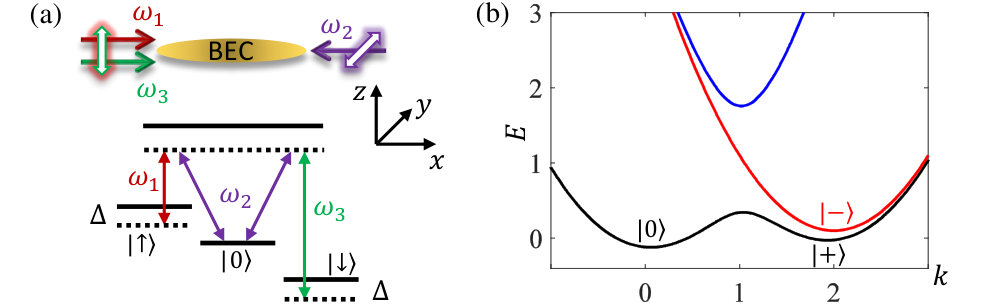 Figure 1
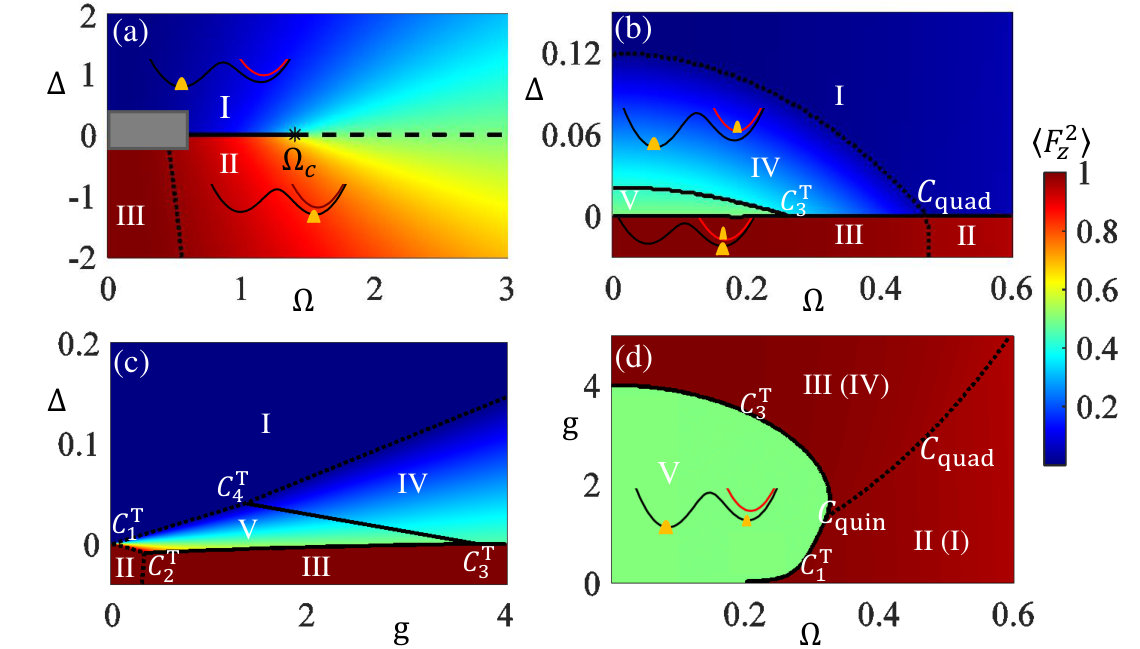 Figure 2
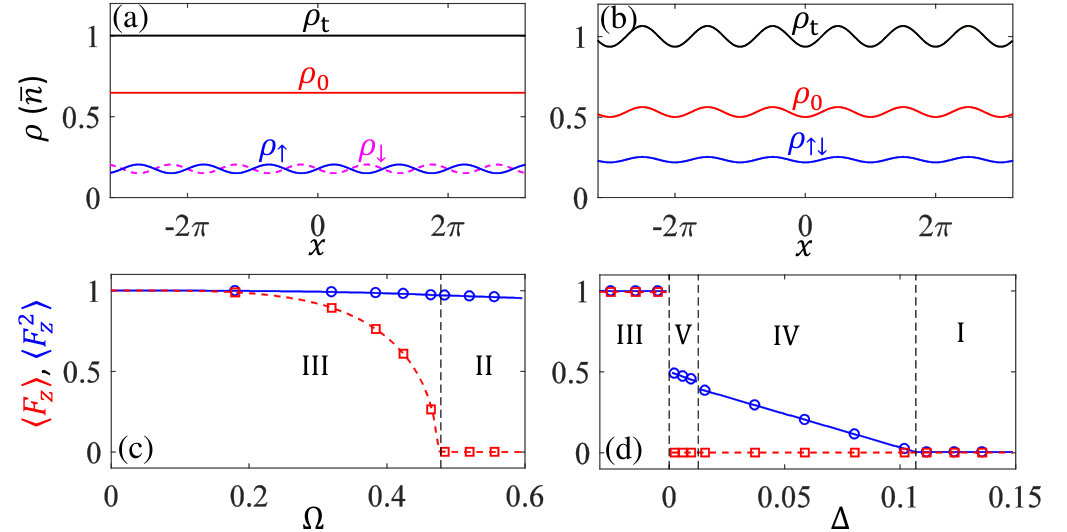 Figure 3
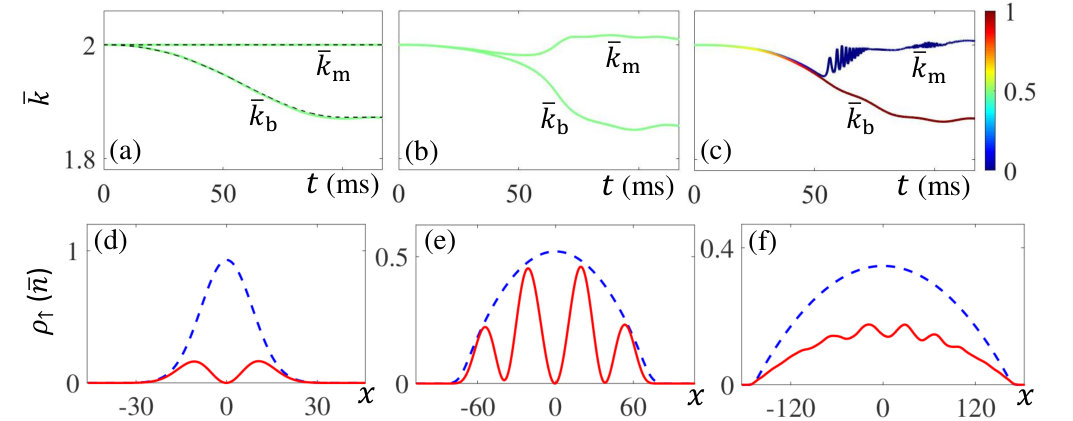 Figure 4
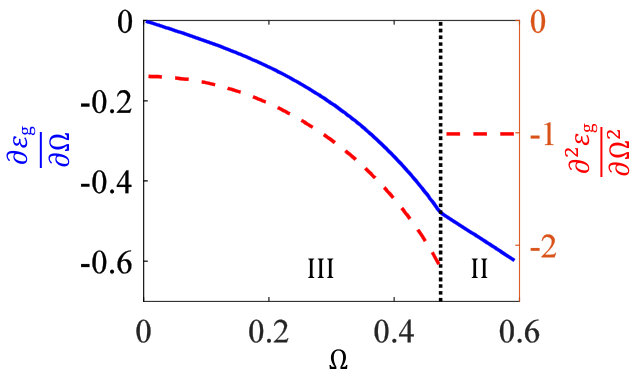 Figure 5
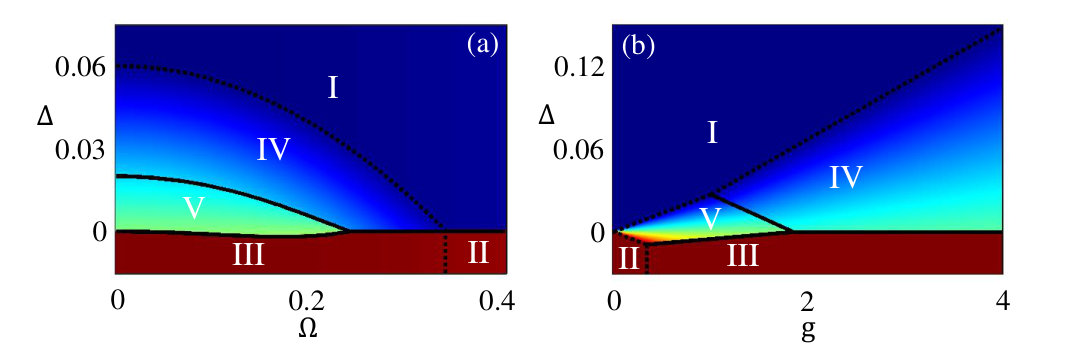 Figure 6
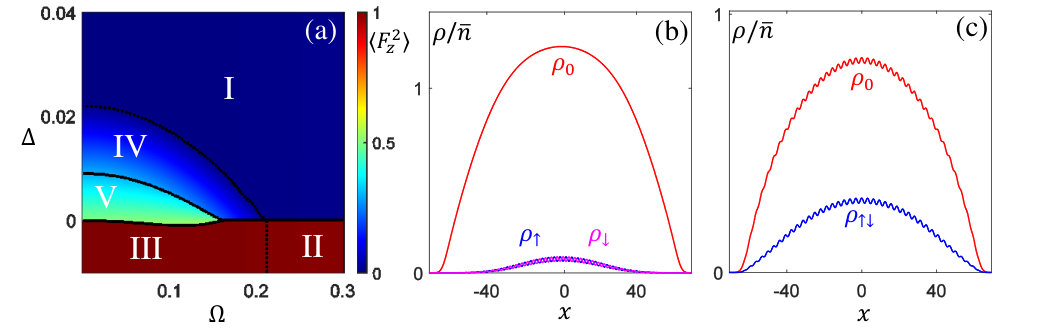 Figure 7
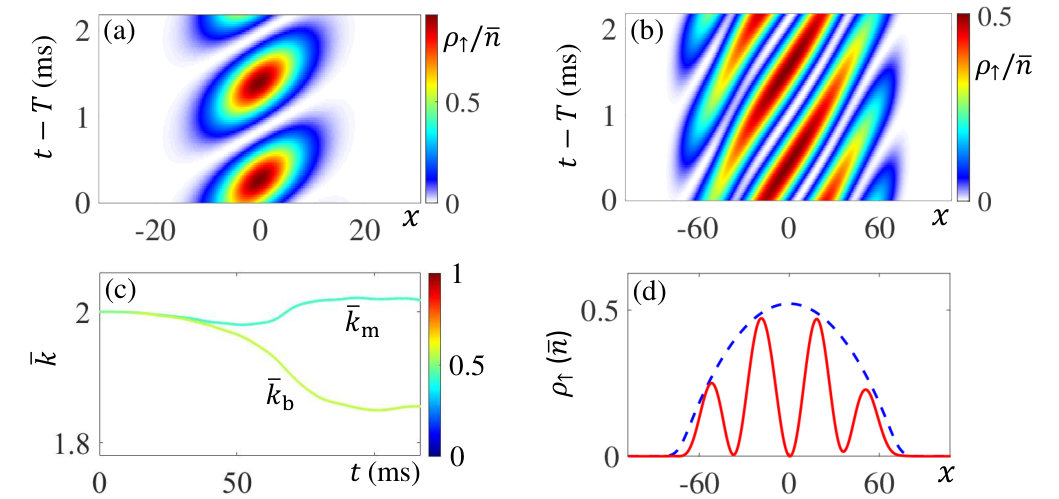 Figure 8
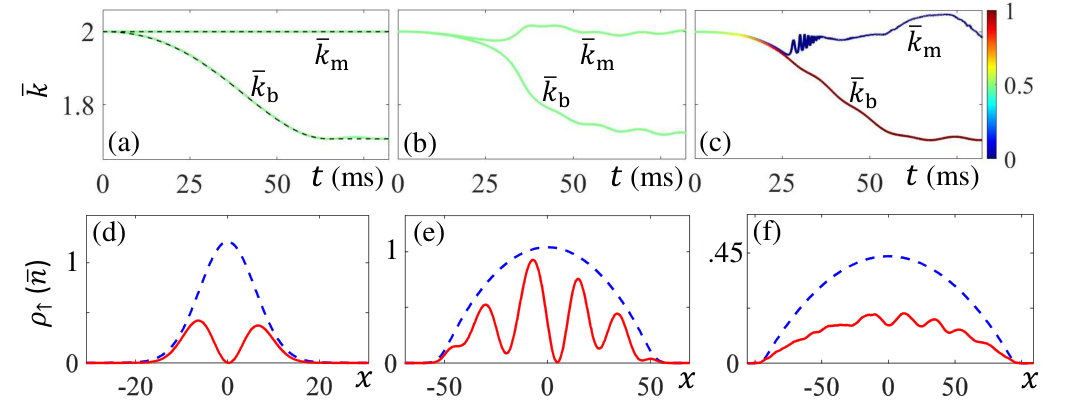 Figure 9
Peer Reviews
No public reviews on file for this paper yet. If you reviewed it on a platform where reviews are public (OpenReview, ICLR, NeurIPS, ICML), you can paste yours below so the community can read it here.
Videos
No videos yet. Explain this paper in a talk, walkthrough, or lecture? Add one.
Taxonomy
TopicsCold Atom Physics and Bose-Einstein Condensates
††thanks: Corresponding author.
Email: [email protected]
Spin-tensor–momentum-coupled Bose-Einstein condensates
Xi-Wang Luo
Kuei Sun
Chuanwei Zhang
Department of Physics, The University of Texas at Dallas, Richardson, Texas 75080-3021, USA
Abstract
The recent experimental realization of spin-orbit coupling for ultracold atomic gases provides a powerful platform for exploring many interesting quantum phenomena. In these studies, spin represents spin vector (spin-1/2 or spin-1) and orbit represents linear momentum. Here we propose a scheme to realize a new type of spin-tensor–momentum coupling (STMC) in spin-1 ultracold atomic gases. We study the ground state properties of interacting Bose-Einstein condensates (BECs) with STMC and find interesting new types of stripe superfluid phases and multicritical points for phase transitions. Furthermore, STMC makes it possible to study quantum states with dynamical stripe orders that display density modulation with a long tunable period and high visibility, paving the way for direct experimental observation of a new dynamical supersolid-like state.. Our scheme for generating STMC can be generalized to other systems and may open the door for exploring novel quantum physics and device applications.
Introduction.—The coupling between matter and gauge field plays a crucial role for many fundamental quantum phenomena and practical device applications in condensed matter xiao2010berry ; hasan2010colloquium ; qi2011topological and atomic physics dalibard2011colloquium . A prominent example is the spin-orbit coupling, the coupling between a particle’s spin and orbit (e.g., momentum) degrees of freedom, which is responsible for important physics such as topological insulators and superconductors hasan2010colloquium ; qi2011topological . In this context, recent experimental realization of spin-orbit coupling in ultracold atomic gases lin2011spin ; zhang2012collective ; qu2013observation ; olson2014tunable ; wang2012spin ; cheuk2012spin ; Williams2013 ; huang2016experimental ; wu2016realization opens a completely new avenue for investigating quantum many-body physics under gauge field Stanescu2008 ; zhang2008p ; Wu2011 ; wang2010spin ; ho2011bose ; li2012quantum ; zhang2012mean ; hu2012spin ; ozawa2012stability ; Gong2011 ; Hu2011 ; Yu2011 ; Qu2013b ; Zhang2013b ; galitski2013spin .
So far in most works on spin-orbit coupling in solid state and cold atomic systems, the spin degrees of freedom are taken as rank-1 spin vectors (), such as electron spin-1/2 or pseudospins formed by atomic hyperfine states that can be large (e.g., spin-1 or 3/2). Experimentally, spin-orbit coupling for spin-1 Bose-Einstein condensates (BECs) has been realized recently campbell2015itinerant ; luo2016tunable and interesting magnetism physics has been observed lan2014raman ; Natu2015 ; sun2016interacting ; yu2016phase ; martone2016tricriticalities . Mathematically, it is well known that there exist not only spin vectors, but also spin tensors [e.g., irreducible rank-2 spin-quadrupole tensor ] in a large spin () system. Therefore two natural questions are: i) Can the coupling between spin tensors of particles and their linear momenta be realized in experiments? ii) What new physics may emerge from such spin-tensor–momentum coupling (STMC)?
In this Letter, we address these two questions by proposing a simple experimental scheme for realizing STMC for spin-1 ultracold atomic gases. Our scheme is based on slight modification of previous experimental setup campbell2015itinerant and is experimentally feasible. The STMC changes the band structure dramatically, leading to interesting new physics in the presence of many-body interactions between atoms. Although both bosons and fermions can be studied, here we only consider spin-1 BECs to illustrate the effects of STMC. Our main results are:
i) The single particle band structure with STMC consists of two bright-state bands (top and bottom) and one dark-state middle band [Fig. 1(b)], where the dark-state band is not coupled with two bright-state bands through Raman coupling. However, the dark-state band plays an important role on both ground-state and dynamical properties of the interacting BECs.
ii) We study the ground-state phase diagrams with exotic plane-wave and stripe phases, where the dark-state middle band can be partially populated despite not the single particle ground state. The stripe phase is a coherent superposition of two or more plane-wave states. It possesses both superfluid property as a BEC and crystal-like density modulation that spontaneously breaks translational symmetry of the Hamiltonian, satisfying two major criteria for the supersolid order pomeau1994dynamics . Experimentally, the stripe order has recently been observed indirectly using Bragg reflection li2017stripe . We find the transitions between different phases possess interesting multicriticality phenomena with triple, quadruple and even quintuple points.
iii) The existence of dark middle band makes it possible to study quantum states with dynamical supersolid-like stripe orders. In particular, we show how to dynamically generate a stripe state with a long tunable period (m) and high visibility () of density modulation, which may be directly measured in experiments (such direct measurement is still challenging for the ground-state stripe patterns due to their short period and low visibility li2014superstripes ). The dynamical stripe state as a superfluid BEC, although not the ground state, does possess interesting stripe patterns that break the translational symmetry of the Hamiltonian, resembling a dynamical supersolid-like order.
The model.—We consider a setup similar as that in the recent experiment campbell2015itinerant but with a slightly different laser configuration, as shown in Fig. 1(a), where three Raman lasers with wavenumber are employed to generate STMC. The three lasers induce two Raman transitions between hyperfine spin states and , both of which have the same recoil momentum along the direction. The single-particle Hamiltonian in the spin-1 basis is (we set )
[TABLE]
where is equivalent to the spin tensor (up to a constant), , is the Raman coupling strength, and is the detuning for both and states. We see that another spin state is always an eigenstate and does not couple to nor through , and thus is a dark state.
Since the BEC wavefunction in the and directions is not affected by the Raman lasers, we can consider the physics only along the direction sun2016interacting ; yu2016phase ; martone2016tricriticalities . After a unitary transformation to quasi-momentum basis, we write the Hamiltonian in energy and momentum units and , respectively, as
[TABLE]
where and are dimensionless transverse-Zeeman and spin-tensor potential, respectively, and describes the coupling between spin tensor and the linear momentum, i.e., STMC.
The single-particle Hamiltonian has three energy bands [see a typical structure in Fig. 1(b)]. The dark-state middle band always has the spin state and spectrum , which are independent of . The top and bottom bright-state bands exhibit the same behavior as the known spin-orbit-coupled spin- system with spin states and . The decoupling of the middle band is protected by the spin-tensor symmetry , under which the middle band (top and bottom bands) corresponds to (1). Although the single-particle ground state always selects the bottom band, the atomic interactions can break the symmetry and drastically change the BEC’s ground state as well as dynamical properties by involving the middle band.
Under the Gross-Pitaevskii (GP) mean-field approximation, the energy density becomes
[TABLE]
with the system volume, and the three-component condensate wavefunction normalized by the average particle number density . The interaction strengths represent density and spin interactions in spinor condensates ho1998spinor ; Ohmi1998Bose , respectively. is the unitarily transformed spin operator, whose and components exhibit spatial modulation that cannot be eliminated through any local spin rotation (different from previous models sun2016interacting ; yu2016phase ; martone2016tricriticalities ). Such modulation is essential for stripe phases in the system.
We consider a variational ansatz SM
[TABLE]
to find the ground state, with , and spinors . The energy density now becomes a functional of eight variational parameters , , , , , , , and , and its minimization () leads to the ground state SM . The quantum phase diagram can be characterized by the variational wavefunction, experimental observables and , and the symmetry . The derivative of the ground-state energy () displays discontinuity as varies across a first-order (second-order) phase boundary SM . This argument also applies to () SM . We also numerically solve the GP equation using imaginary time evolution to obtain the ground states, which are in good agreement with the variational results.
Phase diagram.—For ferromagnetic interaction (e.g., 87Rb), the BEC has three plane-wave () and two stripe () phases (Fig. 2): (I) plane-wave phase in , having (spin unpolarized), , and (middle band unpopulated); (II) plane-wave phase in , having , , and ; (III) spin-polarized plane-wave phase in having and (middle band populated); (IV) mix-band stripe phase, having , , and ; (V) bottom-band stripe phase, same as (IV) except . The last three phases exhibit ferromagnetism: phases (III), (IV), and (V) all have twofold degenerate ground states with global ferromagnetic order , , and , respectively. Note that these orders are calculated in the laboratory frame (the basis of ) and reflect the energetic favor by the ferromagnetic interaction. For anti-ferromagnetic interaction (e.g., 23Na), the system has a relatively simple phase diagram containing only two plane-wave phases (I) and (II), separated by a first-order phase-boundary at . Hereafter we focus on the ferromagnetic case.
In Fig. 2(a) we plot the phase diagram in the - plane. At a sufficiently large , the middle band does not participate in the ground state, so the phase diagram is similar to the spin-orbit-coupled spin- system: the two plane-wave phases (I) and (II) are separated by a first-order-transition boundary (solid line along ) if or a crossover one (dashed line) if . As decreases, the middle band minimum gets closer to the right minimum of the bottom band [Fig. 1(b)]. If the BEC originally stays in the plane-wave phase (II) (), it starts to partially occupy the middle band [Fig. 2(b), bottom inset], undergoing a second-order transition (dotted curve) to the polarized phase (III). From the energetic point of view, the BEC populates to a slightly higher single particle energy state to get polarized to reduce ferromagnetic interaction energy. Note that phase (III) is still a plane-wave phase since the BEC occupies both bands at the same .
At a small and , the energy difference between the single-particle band minimum [plane wave (I)] and the other bottom-band minimum [plane wave (II)] or the middle-band minimum is comparable to the interaction energy, so the BEC may favor the co-occupation of (I) and a higher-energy local minimum as long as the total energy can be reduced more by the interaction. In Fig. 2(b), we zoom in the framed region of Fig. 2(a) and show the emergence of two stripe phases. The mix-band stripe phase (IV) is the superposition of plane wave (I) and the one around the middle-band minimum (top inset). Phase (IV) exhibits spin-density waves due to the superposition [Fig. 3(a)] and a global ferromagnetic order that reduces the interaction energy, compensating the higher middle-band energy. Note that phase (IV) has a uniform total density due to the orthogonality between the middle and bottom band spins, but the spin-density waves form a stripe pattern. The bottom-band stripe phase (V), which appears at even weaker and , is the superposition of two bottom-band plane waves (I) and (III) [Fig. 2(d) inset]. Phase (V) exhibits a total-density wave [Fig. 3(b)], which, compared with (IV), increases the interaction energy, but the total energy is favorable due to the pure bottom-band occupation and global ferromagnetic order . We remark that the superposition of three plane waves (with co-occupation of three band minima) is never energetically favorable because it cannot maximize the ferromagnetic order.
Returning to the phase diagram Fig. 2(b), the (I)–(IV) phase boundary corresponds to a second-order transition, which meets the (II)–(III) boundary at a quadruple point at . The (IV)–(V) boundary corresponds to a first-order transition, which encounters phase (III) at a triple point at . To study the dependence on interaction, we plot the phase diagram in the - plane in Fig. 2(c), with a fixed ratio . We see that the stripe region increases with (due to the increasing ), and phase (IV) is more favorable than (V) in the large- region (due to the large ). For the plane-wave phases (II) and (III), the latter has global ferromagnetic order and is hence favorable with strong interaction. The - diagram also shows first-order transitions between any two of (III), (IV), and (V) phases, second-order transitions between any other adjacent phases, and four triple points at the (I)-(II)-(V), (II)-(III)-(V), (III)-(IV)-(V), and (I)-(IV)-(V) encounters, respectively. In Fig. 2(d), we show how the encounters of phases along change with the interaction. We see that phases (III) and (IV) survive at large , while (I) and (II) survive at large , in agreement with the energetic argument. The boundaries represent three traces of triple points and quadruple point , respectively, which intercept at a quintuple point as the joint of all five phases.
In Figs. 3(a) and (b), we plot spatial profiles of each spin component’s density and total density for stripe phases (IV) and (V), respectively. Phase (IV) shows out-of-phase modulations between and , representing spin-vector () density wave, and uniform and , while (V) shows in-phase modulations of all components and hence , of which overlap each other, representing a spin-tensor () density wave. The modulation wavelength matches the laser’s recoil momentum (i.e., ). This can be understood in the quasi-momentum frame that the minimization of interaction energy requires equal modulations between the spin components and the spin operator in Eq. (3). Since the separation between two band minima is smaller than at finite , the two plane-wave components of the stripe phases do not exactly stay on the band minima. In Figs. 3(c) and (d), we plot (squares) and (circles) along (III)-(II) and (III)-(V)-(IV)-(I) transition paths in Fig. 2(b), respectively. The discontinuity in spin-tensor polarization (its first derivative) indicates the occurrence of first-order (second-order) phase transition.
Dynamical stripe state.—The middle-band minimum and the right bottom-band minimum are close to each other (both near ). Therefore a coherent superposition of plane waves on these two minima leads to a long-period stripe state, which can be directly measured in experiments. To generate such a stripe state, we consider Rb atoms in a harmonic trap Hz, initially prepared in spin state with the Raman lasers off and [the initial state belongs to phase (III) since the two minima coincide and are equally populated as ]. The 800-nm Raman lasers are gradually turned on such that increases from [math] to within a time and then remains constant. If we consider an adiabatic process, where the ramping rate of is much slower than the energy scale of the spin-interaction strength , the system will stay in the ground-state plane-wave phase (III) until exceeds the critical value where a transition to plane-wave phase (II) occurs. While for a dynamical process where the ramping rate of is much faster than the spin-interaction strength (but much slower than other energy scales such as the trapping frequency), the system no longer stays in the ground state, and the BEC on the two band minima are expected to split in the momentum space, leading to the stripe state.
Figs. 4(a) and (d) show the results of real-time GP simulation for non-interacting atoms. The averaged momenta and of atoms in the bottom and middle bands follow their band minima respectively, with displaying slight dipole oscillation chen2012collective at due to the collective excitations caused by the finite increasing rate of . The final state is a stripe state similar to phase (IV) but with a much higher visibility and a longer period, and the stripe pattern is moving rather than stationary due to the dynamical phases of the two bands SM .
For atoms with realistic interactions and consider a dynamical process much faster compared to , we can neglect the spin interaction and focus on the density-interaction effects. The density interaction preserves the symmetry and thus the atom populations of the two bands remain unchanged. However, shifts together with at the beginning then they separate and eventually return to their band minima respectively. At , the density interaction induces synchronous dipole oscillations of and with a frequency different from the single-particle case [see Fig. 4(b)]. Nevertheless, we obtain a stripe state as the final state [see Fig. 4(e)] with a long period (m for ) and high visibility (close to 100%). For Rb with , such dynamical stripe states can always be obtained in the region where SM . Also, the stripe period can be tuned by changing the value of (e.g. leads to a period of m) SM . Such periodic density modulations of dynamical stripe phases break the translational symmetry of the Hamiltonian, showing dynamical supersolid-like properties.
In the opposite region where the dynamical process is slow compared to the spin interaction, the system follows the plane-wave ground state. As increases, atoms are transferred from the middle to bottom band until a transition to phase (II) occurs. Thus the final state has no middle-band population and no stripe states would be obtained, as shown in Figs. 4(c) and (f) with tiny stripes caused by weak excitations.
Conclusions.—In summary, we propose a scheme to realize STMC in a spin-1 BEC, and study its ground-state and dynamical properties. The interplay between STMC and atomic interactions leads to many interesting quantum phases and multicritical points for phase transitions. The STMC offers a simple way to generate a new type dynamical stripe states with high visibility and long tunable periods, paving the way for direct experimental observation of long-sought stripe states. The proposed STMC for ultracold atoms open the door for exploring many other interesting physics, such as STMC fermionic superfluids, Bogoliubov excitations with interesting roton spectrum khamehchi2014measurement ; Ji2015 , non-Abelian STMC (similar as Rashba spin-orbit coupling), and STMC in optical lattices (where nontrivial topological bands may emerge).
Acknowledgements.
Acknowledgements: We thank P. Engels for helpful discussion. This work is supported by AFOSR (FA9550-16-1-0387), NSF (PHY-1505496), and ARO (W911NF-17-1-0128).
Supplementary Materials
Validation of the ansatz
The top and bottom bright-state bands exhibit the same physics as the known spin-orbit-coupled spin- system: the two spin branches and with relative energy difference are separated by at , and mixed to form top/bottom bands with a gap at a finite . At , the bottom band has degenerate double minima for , above which the band makes a transition to a single-minimum structure. The decoupling of the middle band is protected by the spin-tensor symmetry , under which the middle band (top and bottom bands) corresponds to (1). Therefore, even if the gap between the middle and bottom band minima is small [ at weak ], the single-particle ground state always selects one minimum on the the bottom band. However, the atomic interactions can break the symmetry and drastically change the BEC’s ground state by involving the middle band. The ground state is mainly determined by the two lower bands, with three minima in total. So we may consider a more general ansatz
[TABLE]
with , , and . The stripe phase is supposed to lower the spin interaction by generating ferromagnetic order. The ferromagnetic order is maximized when , that is when the modulation of the spin density is equal to the modulation of the spin operator . Then Eq. (S1) is reduced to the ansatz given in the main text. The above arguments are verified numerically by considering the ansatz Eq. (S1) and we always have for the ground state.
Variational energy density
In the following, we give a detailed derivation of the variational energy density, using the variational ansatz
[TABLE]
The single particle energy density is
[TABLE]
We have
[TABLE]
similarly we can obtain
[TABLE]
and
[TABLE]
The density-interaction energy is
[TABLE]
and the spin-interaction energy is
[TABLE]
with spatially modulated spin operator ,
[TABLE]
[TABLE]
and . Thus we have
[TABLE]
Then we obtain the total energy density as
[TABLE]
The stripe phase is supposed to lower the spin-interaction energy density , in which there exists a term proportional to . This gives the mathematic reason why we always have in the stripe phases.
The variational ansatz leads to an energy density which is a functional of eight parameters. Such an energy density plays the role of Ginsburg-Landau potential, and the ground state and the corresponding energy density are obtained by finding the minimum of the Ginsburg-Landau potential with respect to all eight parameters. The quantum phase diagram can be characterized with the variational wavefunction, experimental observables and , and the symmetry property . The phase transitions in our system are determined based on the Ehrenfest classification, with the order of the phase transition labeled by the lowest derivative of the ground-state energy density that is discontinuous at the transition. In particular, we examine the derivatives and (One can apply the Hellmann-Feynman theorem to obtain these relations), and () displays discontinuity as varies across a first-order (second-order) phase boundary [see Figs. 3(c) and (d) in the main text]. This argument also applies to the derivatives () as shown in Fig. S1, though they are less experimentally accessible. For a crossing over, all these derivatives should be continuous.
Perturbation analysis
We consider the regime where and are small, and the interactions are weak. For the ground state properties, we can omit the high-energy top band safely, and consider only the two lower bands. The middle band has a minimum at with spin state
[TABLE]
The bottom band has two minima, one at with spin state
[TABLE]
and the other at with spin state
[TABLE]
As we discussed above, the ground state may contain two plane waves at most, so we consider a perturbation ansatz
[TABLE]
with , the energy density now becomes
[TABLE]
According to the second partial derivative test, it can be proven that the minima of always satisfy , which means that the co-occupation of three band minima is never energetically favorable. So there are three cases:
(1) and , describes a plane-wave state in phase (II) or a polarized plane-wave state in phase (III), with its energy density
[TABLE]
(2) and , describes a plane-wave state in phase (I) or stripe state in phase (IV) with energy density
[TABLE]
(3) and , describes a plane-wave state in phase (I) or stripe state in phase (V) with energy density
[TABLE]
Generally, the Ginsburg-Landau potential can not be written as a functional of a single scalar order parameter for the interacting multi-component bosonic fields considered here. Nevertheless, by assuming an perturbative ansatz with fixed spin state and reduced parameter space, the effective Ginsburg-Landau potential can be written as a functional of a single scalar order parameter (either or ) for certain phase transitions, as can be seen from Eqs. (S30), (S31, (S32).
Therefore, the ground state is determined by minimizing , with ground-state energy density given by . Using Eqs. (S30), (S31, (S32), it is straight forward to calculate the ground state and the corresponding energy density . The phase boundaries can be obtained by examining the ground state or the derivation of over . As shown in Figs. S2 (a) (b), we find that the phase boundary between (I) and (II) [(III) and (IV)] is , the phase boundary between (I) and (IV) is , the boundary between (II) and (III) is , and the boundary between (V) and (I) [(II)] is . The phase diagrams by perturbation analysis, as well as the behavior of the multicriticalities, are qualitatively in good agreement with the full variational calculation, though the exact phase boundaries are slightly different. This is because the perturbation results are valid only to the order of , and generally the spin states of interacting BECs are slightly different from the spin states in the perturbation ansatz.
Effects of interaction ratio and harmonic trap
In the main text, we have fixed the interaction ratio as , a stronger (weaker) will enlarge (shrink) the regions of stripe and polarized plane-wave phases, but does not qualitatively change the phase diagram structure. To show this, in Fig. S3(a), we give the phase diagrams of interaction ratio for Rb atoms. Typically, the atomic density is about cm*-3*, for s-wave scattering length 100.48 ( is the Bohr radius) and Raman-laser wavelength nm, the corresponding interaction is . Moreover, for realistic experiments, the BECs are confined by a harmonic trap, we consider a trapping frequency kHz and calculate the ground state using imaginary time evolution of the GP equation. Figs. S3 (b) and (c) show the ground-state density modulations corresponding to stripe phases (IV) and (V).
Dynamical stripe states
Our dynamical process (where the ramping rate of is much faster than the spin-interaction strength) leads to a final state being a nearly equal superposition of two plane waves (with an overall Gaussian-packet form in the presence of a Harmonic trap),
[TABLE]
where “b” (“m”) labels the bottom (middle) band, with spin states , momentum and coefficients . Although the equal superposition remains over time, is different from the ordinary stripe state by a dynamical phase originating from the energy difference between middle and bottom bands.
Nevertheless, this state has a uniform total density and a striped sinusoidal spin density. Although the spin-density modulation propagates in space due to the dynamical phase , the visibility and period of the spin-density modulation do not change, as shown in Figs. S4 (a) and (b). Furthermore, the dynamical stripe state itself has the superfluid property and breaks the translational symmetry of the Hamiltonian, showing a supersolid-like property. Note that the density modulation period is tunable and long enough for direct experimental observation of such dynamical stripe state.
The long-period and high-visibility dynamical stripe states can always be obtained as long as the spin interaction is weak, as shown in Figs. S4 (c) and (d), where we consider the weakly interacting Rb atoms with and typical interaction ratio . The population percentage of the bottom band is slightly increased since some middle-band atoms are scattered to the bottom band by spin interaction, and the stripe pattern in Fig. S4 (d) moves similarly as in Fig. S4 (b). Moreover, the modulation period can be tuned by changing the value of , as shown in Fig. S5 with and a corresponding stripe period of m. In Fig. S5 (e), the stripe visibility is slightly reduced, because the spin component in the bottom band increases slightly with .
The reference list from the paper itself. Each links out to its DOI / PubMed record.
- 1(1) D. Xiao, M.-C. Chang, and Q. Niu, Berry phase effects on electronic properties, Rev. Mod. Phys. 82 , 1959 (2010) . · doi ↗
- 2(2) M. Hasan and C. Kane, Colloquium: topological insulators, Rev. Mod. Phys. 82 , 3045 (2010) . · doi ↗
- 3(3) X.-L. Qi and S.-C. Zhang, Topological insulators and superconductors, Rev. Mod. Phys. 83 , 1057 (2011) . · doi ↗
- 4(4) J. Dalibard, F. Gerbier, G. Juzeliūnas, and P. Öhberg, Colloquium: Artificial gauge potentials for neutral atoms, Rev. Mod. Phys. 83 , 1523 (2011) . · doi ↗
- 5(5) Y.-J. Lin, K. Jiménez-García, and I. B. Spielman, Spin-orbit-coupled Bose-Einstein condensates, Nature (London) 471 , 83 (2011) . · doi ↗
- 6(6) J.-Y. Zhang, et al., Collective dipole oscillations of a spin-orbit coupled Bose-Einstein condensate, Phys. Rev. Lett. 109 , 115301 (2012) . · doi ↗
- 7(7) C. Qu, C. Hamner, M. Gong, C. Zhang, and P. Engels, Observation of zitterbewegung in a spin-orbit-coupled Bose-Einstein condensate, Phys. Rev. A 88 , 021604 (2013) . · doi ↗
- 8(8) A. Olson, S. Wang, R. Niffenegger, C. Li, C. Greene, and Y. Chen, Tunable landau-zener transitions in a spin-orbit-coupled Bose-Einstein condensate, Phys. Rev. A 90 , 013616 (2014) . · doi ↗