Low-Error Operation of Spin Qubits with Superexchange Coupling
Marko J. Ran\v{c}i\'c, Guido Burkard

TL;DR
This theoretical study explores superexchange interactions between spin qubits in quantum dots, identifying conditions for noise-insensitive operations and controllable interaction signs, advancing quantum dot qubit control.
Contribution
It introduces the concept of super sweet spots for superexchange, enabling low-error qubit operations insensitive to charge noise and spin-orbit errors.
Findings
Existence of super sweet spots for superexchange
Superexchange sign can be controlled by energy detuning
Potential for high-fidelity spin qubit operations
Abstract
In this theoretical work we investigate superexchange, as a means of indirect exchange interaction between two single electron spin qubits, each embedded in a single semiconductor quantum dot (QD). The exchange interaction is mediated by an intermediate, empty QD. Our findings suggest the existence of first order "super sweet spots", in which the qubit operations implemented by superexchange interaction are simultaneously insensitive to charge noise and errors due to spin-orbit interaction. We also find that the sign of the superexchange can be changed by varying the energy detunings between the QDs.
Click any figure to enlarge with its caption.
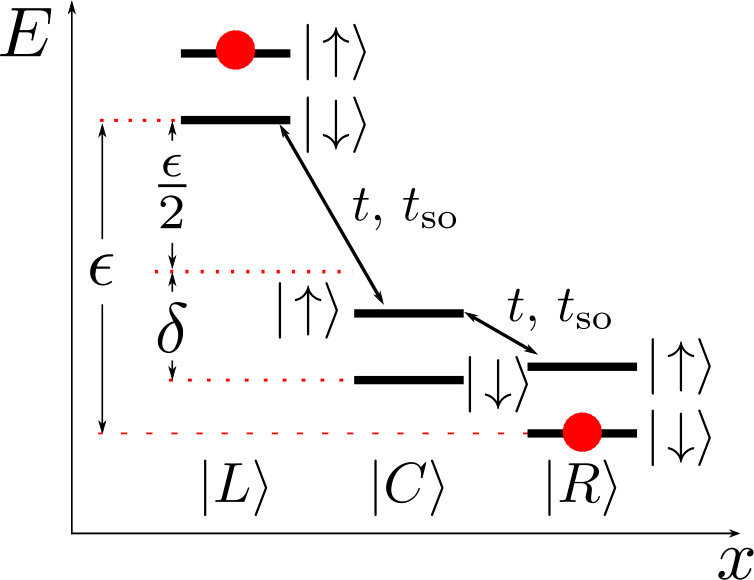 Figure 1
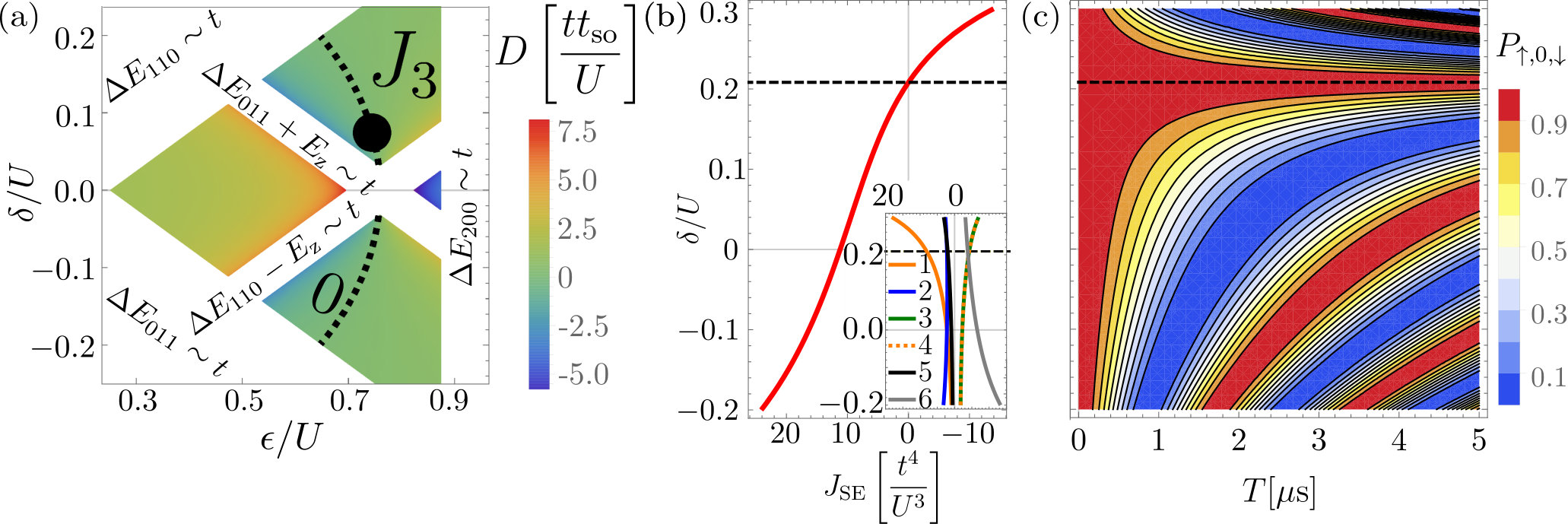 Figure 2
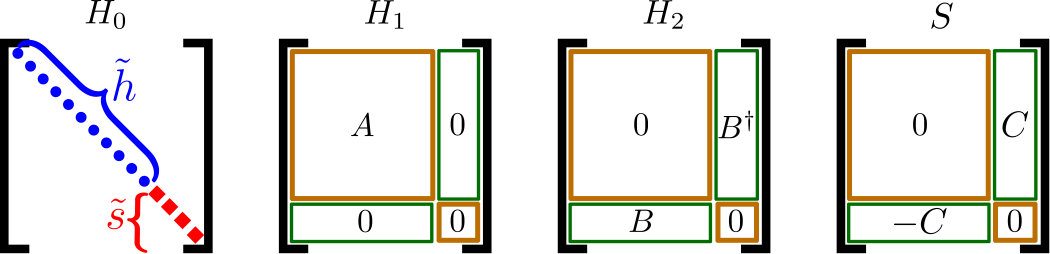 Figure 3
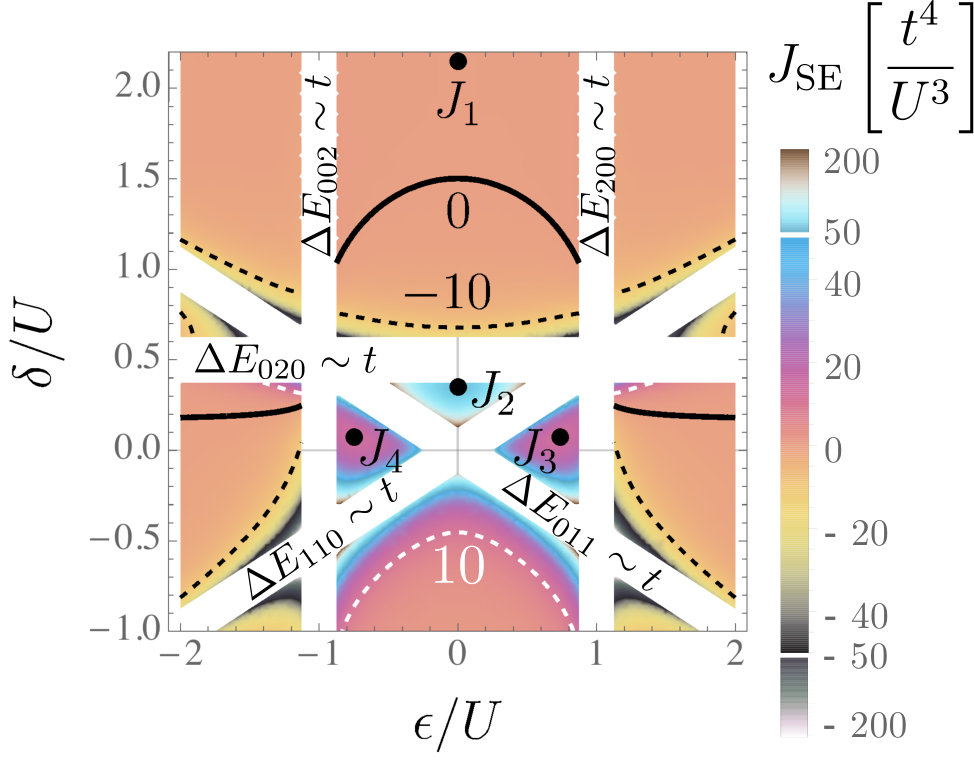 Figure 4
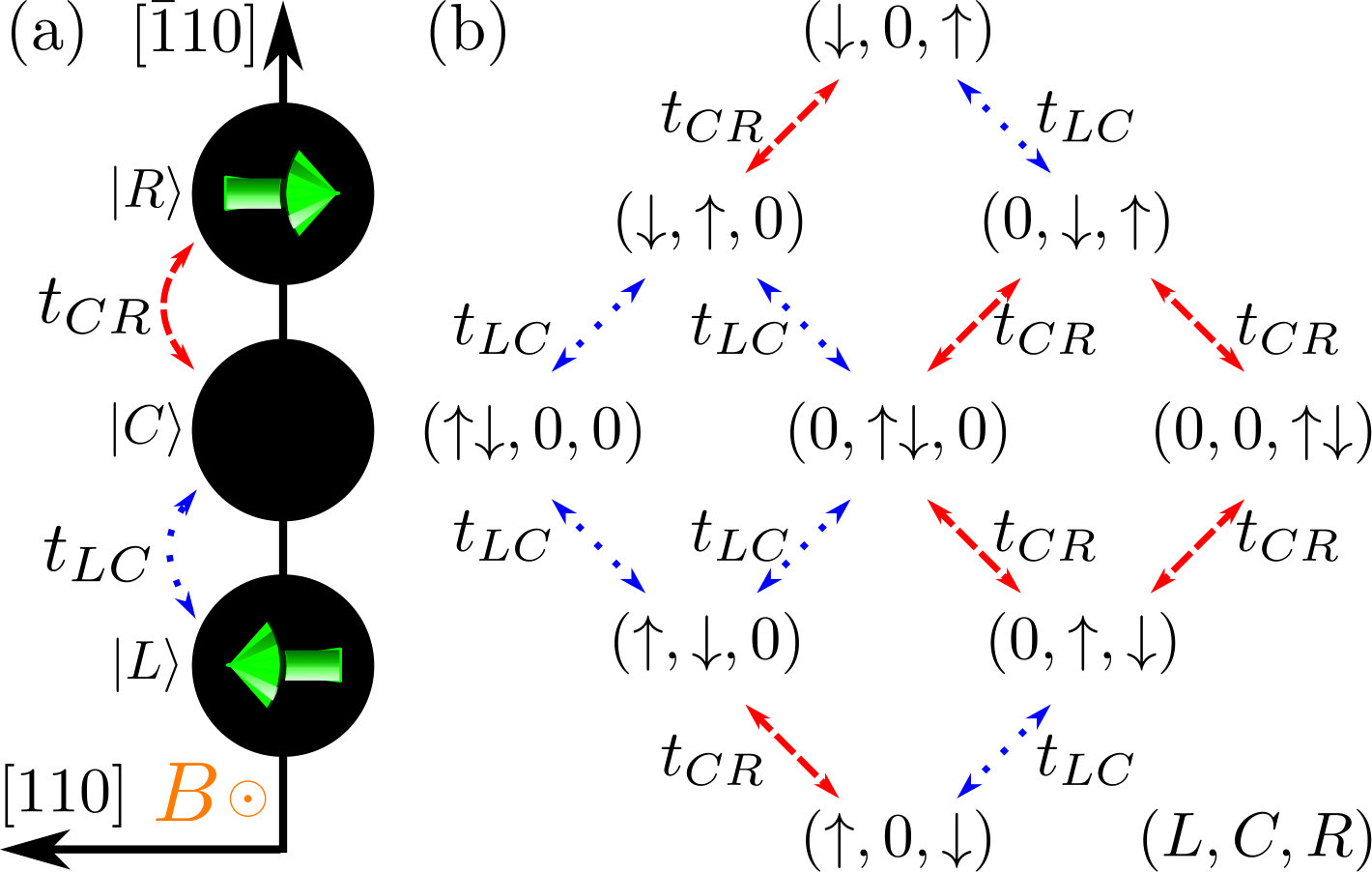 Figure 5
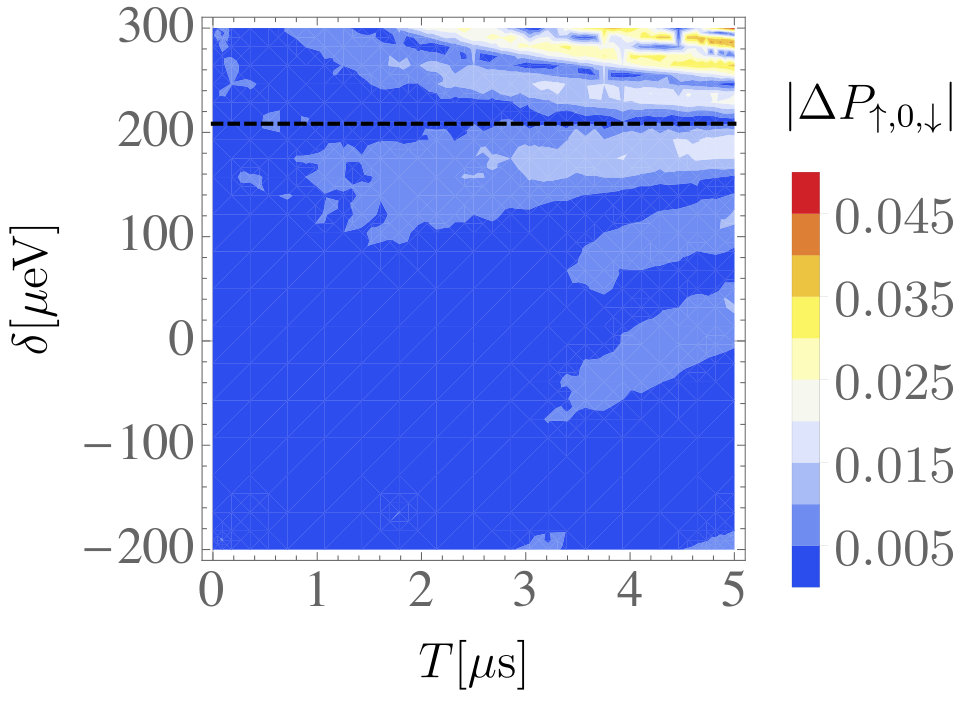 Figure 6
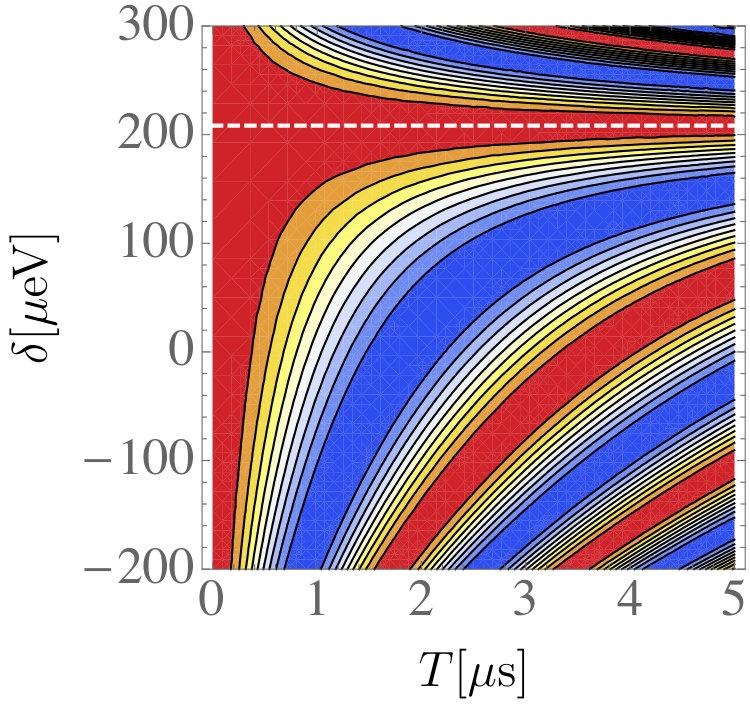 Figure 7
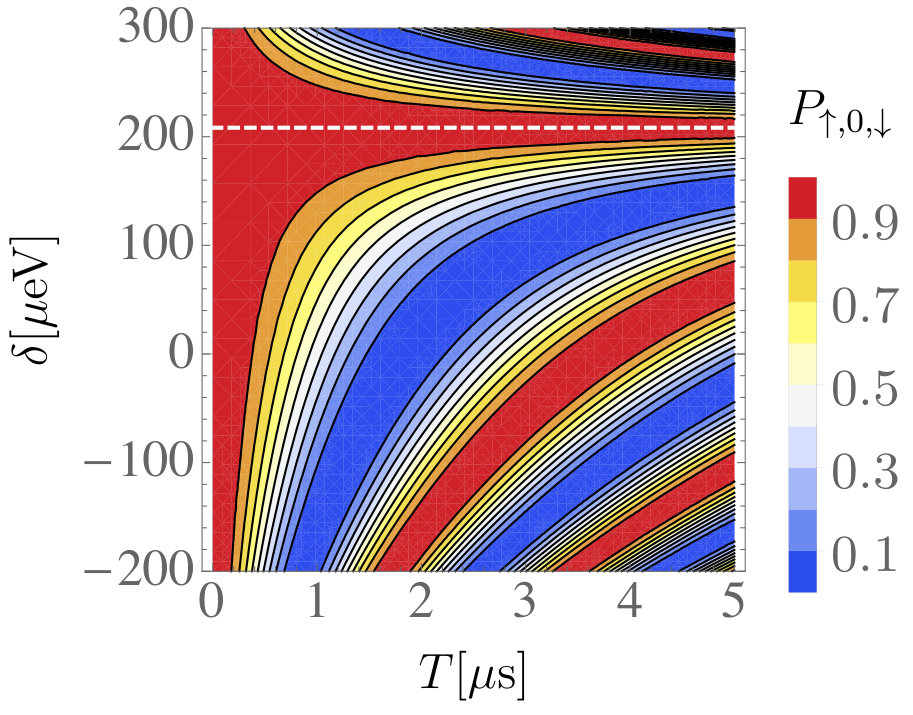 Figure 8
| i | Superexchange path | Superexchange expression | Sign of |
|---|---|---|---|
| 1 | |||
| 2 | |||
| 3 | |||
| 4 | |||
| 5 | |||
| 6 |
Peer Reviews
No public reviews on file for this paper yet. If you reviewed it on a platform where reviews are public (OpenReview, ICLR, NeurIPS, ICML), you can paste yours below so the community can read it here.
Videos
No videos yet. Explain this paper in a talk, walkthrough, or lecture? Add one.
\zexternaldocument
[B-]Supplementary
††thanks: Current address: Department of Physics, University of Basel, Klingelbergstrasse 82, CH-4056 Basel, Switzerland
Low-Error Operation of Spin Qubits with Superexchange Coupling
Marko J. Rančić
Guido Burkard
Department of Physics, University of Konstanz, D-78457 Konstanz, Germany
(March 10, 2024)
Abstract
In this theoretical work we investigate superexchange, as a means of indirect exchange interaction between two single electron spin qubits, each embedded in a single semiconductor quantum dot (QD). The exchange interaction is mediated by an intermediate, empty QD. Our findings suggest the existence of first order “super sweet spots”, in which the qubit operations implemented by superexchange interaction are simultaneously insensitive to charge noise and errors due to spin-orbit interaction. We also find that the sign of the superexchange can be changed by varying the energy detunings between the QDs.
Introduction.–Noise-insensitive control of qubits is an important task in quantum information science Loss and DiVincenzo (1998); Burkard et al. (1999); Hu and Das Sarma (2006); Hanson et al. (2007). In addition to its use for two-qubit operations of single electron spin qubits Petta et al. (2005), the exchange interaction has been utilized to control double Levy (2002); Reilly et al. (2008); Wu et al. (2014); Petta et al. (2005) and triple electron spin qubits DiVincenzo et al. (2000); Medford et al. (2013a, b, c) in semiconductor quantum dots (QDs). However, overcoming the sensitivity of exchange interaction to charge noise Burkard et al. (1999); Hu and Das Sarma (2006) and errors originating from spin-orbit interaction Bonesteel et al. (2001); Burkard and Loss (2002) has proved to be a challenging task.
Three electron spin qubits can be operated close to a “sweet spot”, where the sensitivity of exchange interaction to charge noise vanishes in first order Medford et al. (2013a, b, c); Russ and Burkard (2015). On the other hand, two-electron spin qubits embedded in double QDs, only have a trivial first order “sweet spot”, where the exchange interaction is smallest (. A possibility to reduce the sensitivity of the qubit to electric noise is to control the magnitude of the exchange interaction by controlling the tunnel coupling instead of controlling the detuning between the two dots (symmetric operation) Reed et al. (2016); Martins et al. (2016).
The spin-orbit interaction represents a powerful resource to control spin qubits Nadj-Perge et al. (2010, 2012). On the other hand, it can also reduce the coherence time of the electron spin qubit, hamper efforts to prolong the coherence time of the electron spin qubit Rančić and Burkard (2014); Nichol et al. (2015), and lead to errors in two-qubit operations Bonesteel et al. (2001); Burkard and Loss (2002).
Superexchange is the underlying mechanism responsible for the creation of antiferomagnetic order in CuO and MnO Kramers (1934); Anderson (1950), is a possible mechanism for -wave high superconductivity Kotliar and Liu (1988), and allows for switching between ferromagnetic and anti-ferromagnetic order in cold atomic gases Trotzky et al. (2008). Although the possibility to use mediated exchange (superexchange) was mentioned in the original Loss-DiVincenzo proposal Loss and DiVincenzo (1998), superexchange has not received significant attention from the spin qubit community (see, however, refs. Trif et al. (2008); Sánchez et al. (2014); Baart et al. (2016)). One of the reasons for this lies in the fact that compared to the direct exchange superexchange requires an additional quantum dot.
In this theoretical paper, we investigate superexchange, the exchange interaction between two single electron spin qubits, each embedded in a semiconductor QD on the left and right , mediated by an empty quantum dot in the center (see Fig. 1 (a)). We have discovered a parameter regime in which the superexchange is non-zero and is simultaneously insensitive to both charge noise and errors due to spin-orbit interaction in first order (a non-trivial first order “super sweet spot”). Our further findings suggest that the sign and the magnitude of superexchange can be controlled by varying the detunings between the QDs.
Model.–The superexchange is a fourth-order tunneling process, in which the charge state with antiparallel spins, virtually tunnels via the or state to the , or charge state, followed by a tunneling back to the or state and finally again to the charge state, but with the spin state of the and QD exchanged, as shown in Fig. 1.
We describe the system with a generalized Hubbard Hamiltonian for two electrons in a triple quantum dot,
[TABLE]
Here, is the Zeeman energy due to an external magnetic field, and are the magnitudes of spin-conserving and spin-orbit-induced spin-non-conserving tunnel hoppings respectively, between dots and . Furthermore, denotes the energy bias of the -th dot, is the Coulomb penalization of the doubly occupied quantum dot, is the Coulomb energy of two neighboring dots occupied with single electrons and the number operator, with being the spin creation (annihilation) operator of the charge state with spin , . The in the index of the sum denotes that the sum runs over nearest neighbor QDs and , and the index denotes a restricted double sum which runs over all possible states of different spin.
The Coulomb repulsion of doubly occupied quantum dots is characterized by an energy of , and the Coulomb repulsion of neighboring dots being occupied . Therefore, we neglect the Coulomb repulsion of neighboring dots for simplicity. We also assume a linear triple QD arrangement, allowing us to neglect direct hopping between the R and the L dot, . Furthermore, from now on we will assume that , , a 2DEG in the plane of a zincblende semiconductor and Rashba and Dresselhaus spin-orbit constants of same signs Giglberger et al. (2007). This means that the magnitude of the spin-orbit hopping is maximal when the linear triple quantum dot is structured along the crystallographic axis and minimal when the triple quantum dot is structured along (see Fig. 1 (a)). The relation between the spin-conserving and spin-non-conserving hopping is given by where, is the interdot separation, and is the spin-orbit length, where is the angle between the crystallographic axis and the interdot connection axis. Detunings in the Hamiltonian Eq. (1) can be expressed in terms of two parameters, the detuning between the outer dots and the detuning between the center dot and average detuning of the outer dots Fig. 2.
Results.–We transform the initial generalized Hubbard Hamiltonian (see Eq. (1) and Eq. (2)) by means of a fourth order Schrieffer-Wolff (SW) transformation, yielding an effective Hamiltonian in which the superexchange subspace is decoupled from the dimensional subspace of high energy states (for more details about the SW transformation see the Supplementary material). For a linear quantum dot structured along and an external magnetic field parallel to the direction, the effective Hamiltonian up to forth order in perturbation theory in and within the superexchange subspace is
[TABLE]
Here, and are spin operators belonging to the and QDs and is the magnitude of superexchange involving spin-conserving tunnel hoppings
[TABLE]
The second term in Eq. (3) is the lowest-order spin-orbit contribution to the exchange coupling, with and being the -components of the spin operator corresponding to the and QD respectively. The magnitude of the spin-orbit contribution is given by
[TABLE]
The third term in Eq. (3) is the Zeeman energy with being the -component of the spin operator corresponding to QD. In the process of deriving Eqs. (3-5) we have neglected all terms with a power higher than , and only kept the lowest order contribution involving spin-orbit interaction .
A non-trivial superexchange “sweet spot” is a point in which the superexchange is in first order insensitive to fluctuations of the detuning parameters and , and furthermore the superexchange is not zero. Solving the coupled systems of equations , and for and in the case of vanishing spin-orbit interaction we obtain four solutions for and in units of and “sweet spots” , , in units of where is the tunneling and is Coulomb repulsion Fig. 3.
In contrast to a double QD loaded with two electrons, a linear triple QD loaded with two electrons has four points in the parameter space of and in which the exchange interaction is simultaneously first order insensitive in fluctuation of this two parameters. It should be noted that “sweet spots” , and lie close to the areas in which no superexchange takes place due to leakage outside the superexchange subspace (white regions in Fig. 3). The width of the white areas in Fig. 3 is proportional to tunneling , and this imposes a limit beyond which the magnitude of superexchange cannot by increased by increasing the tunnel coupling, while simultaneously performing superexchange at the double “sweet spot”.
We want to find values of the Zeeman energy for which around the “sweet spots”. This would give rise to superexchange simultaneously insensitive to charge noise and spin-orbit effects in first order. By inserting and () into Eq. (5) we found that such non-zero values exist corresponding to and and therefore to “sweet spots” , while no non-zero for and exists. Two such values of the Zeeman energy exist for each of the “sweet spots” and . The Coulomb repulsion in InGaAs quantum dots. The Zeeman energy of corresponds to an external magnetic field of . However, due to a much higher -factor this field is for InAs, and thus easier to achieve. As shown in Fig. 4 (a) the point at is a “super sweet spot” in which the superexchange is simultaneously insensitive to charge noise and spin-orbit effects are vanishing. It should be noted that spin-orbit interaction is much stronger in InAs compared to GaAs.
Solving (Eq. (4)) we calculate for which the spin-conserving superexchange is zero for any value of and for which the superexchange is zero for any value of see Fig. 3.
[TABLE]
where, all given in units of Coulomb repulsion U. It should be noted that the result is symmetric with respect to the sign of . When , at large negative values of the bias the main contribution of the superexchange comes from the path 6 which gives rise to negative superexchange (see Tab. 1) as the bias is increased towards the positive values, the superexchange path 1 becomes more dominant yielding a positive sign of superexchange (see Fig. 4 (b) and Fig. 4 (b) inset).
Now we will investigate the dynamical evolution of spin states caused by superexchange interaction in the absence of spin-orbit interaction. We start by initializing a state. The time evolution of the system in the superexchange subspace is modeled in the following way , where is the initial wavefunction corresponding to the initialization of the state, the wavefunction at time , and where is given by Eq. (3). In Fig. 4 (d) we observe that superexchange oscillations are suppressed around the point . Areas above and below the black line correspond to different signs of superexchange.
Conclusion.–We have investigated coherent superexchange and found points in parameter space in which the superexchange is both insensitive to charge noise and the spin-orbit contribution is zero. Furthermore, we have shown that the sign of the superexchange can be changed by varying the detuning parameters. An experimental implementation of our findings would allow for charge noise-insensitive, error-free two-qubit operation of the spin qubit and charge-noise-insensitive, error-free control of the qubit around the exchange axis. The implications of our findings to the operation of the exchange only qubit in a charge-noise-insensitive manner are planned as a forthcoming investigation.
Acknowledgments.–We acknowledge funding from the EU within the Marie Curie ITN Spin-Nano and the German Research Foundation within the SFB 767.
I Supplementary Material for: Low-Error Operation of Spin Qubits with Superexchange Coupling
II The Schrieffer-Wolff Transformation
The full Hamiltonian comprises of the diagonal part and the off-diagonal part
[TABLE]
Here, is the Zeeman energy due to an external magnetic field, the magnitude of spin-non-conserving tunnel hopping caused by spin-orbit interaction, is the magnitude of spin-conserving tunnel hopping between dots and . Furthermore, the energy bias of the -th dot, is the Coulomb penalization of the doubly occupied quantum dot, is the Coulomb energy of two neighboring dots occupied with single electron, and the number operator, with being the spin creation (annihilation) operator of the charge state with spin , }. The in the index of the sum denotes that the runs over nearest neighbor QDs and , and the index denotes a double sum which runs over all possible possible configurations with opposite spin. We assume a linear arrangement, neglecting all direct couplings between the and QDs.
The Hamiltonian is dimensional and it comprises of the dimensional high energy subspace \tilde{h}=\{{\color[rgb]{0,0,1}\definecolor[named]{pgfstrokecolor}{rgb}{0,0,1}{S(2,0,0),}\,{S(0,2,0),}}\,{\color[rgb]{0,0,1}\definecolor[named]{pgfstrokecolor}{rgb}{0,0,1}{S(0,0,2),}\,{S(1,1,0),\,}{T_{0}(1,1,0),\,}{S(0,1,1),\,}{T_{0}(0,1,1),\,}{T_{+}(1,1,0),\,}{T_{-}(1,1,0),\,}{T_{+}(0,1,1),}\,{T_{-}(0,1,1)}}\} and the dimensional (low energy) superexchange subspace \tilde{s}={\{{\color[rgb]{1,0,0}\definecolor[named]{pgfstrokecolor}{rgb}{1,0,0}S(1,0,1),\,T_{0}(1,0,1),\,T_{+}(1,0,1),\,T_{-}(1,0,1)}\}}. Here, stands for the singlet and , , are the triplets, respectively. Numbers in the parentheses denote charge states. The diagonal part of the Hamiltonian comprises of superexchange states and high energy states (see Fig. 5)
[TABLE]
where the detunings from Eq. (8) were rewritten as , the detuning between the outer dots and the detuning between the average of the outer dots and the middle dot.
The interaction part of the Hamiltonian can be divided into terms containing interaction between different states and terms containing interactions between the and states (see Fig. 5)
[TABLE]
where is given by
[TABLE]
and
[TABLE]
where is given by
[TABLE]
Here, the magnitude of spin-non-conserving tunnel hopping caused by spin-orbit interaction, is the magnitude of spin-conserving tunnel hopping between dots and (left , center and right ).
We apply the following unitary transformation to the Hamiltonian , where must be anti-Hermitian to ensure the unitarity of the transformation. Expanding in a Taylor series the Hamiltonian equals
[TABLE]
where and . Assuming that has the same block structure as , the transformed Hamiltonian can be separated into a block-diagonal (BD) part (having the block structure of ) and off-diagonal (OD) part (having the same structure as )
[TABLE]
The goal of the Schrieffer-Wolff transformation is to derive the effective Hamiltonian in the (BD) form. Assuming the separation between the superexchange states and the high energy states is large compared to the tunnel couplings we can write , where each and .
Every order of is determined by requiring that the OD part of the effective Hamiltonian vanishes. This gives rise to a set of coupled equations which can be iteratively solved for
[TABLE]
By inserting Eq. (16) into Eqs. (15) we obtain the following expressions for the effective Hamiltonian in th order of perturbation
[TABLE]
This yields
[TABLE]
III Comparison between the evolution involving the superexchange subspace and full Hilbert space
Here, a comparison is presented between the time evolution governed by an effective Hamiltonian in the subspace, obtained by eliminating states with a Schrieffer-Wolff transformation and the time evolution governed by a Hamiltonian involving all states (Fig. 6). It should be noted that the results presented here and in the main part of the paper are in the basis. The and bases are connected with and bases by a unitary Hadamard basis transformation.
The two ways of modeling time evolution produce results which do not differ by more then , and therefore the result obtained by the Schrieffer-Wolff transformation are valid in the domain of applicability of the Schrieffer-Wolff transformation.
{textblock}
20(23,140) (a)
{textblock}20(75,140) (b)
{textblock}20(132,140) (c)
The reference list from the paper itself. Each links out to its DOI / PubMed record.
- 1Loss and Di Vincenzo (1998) D. Loss and D. P. Di Vincenzo, Phys. Rev. A 57 , 120 (1998), URL http://link.aps.org/doi/10.1103/Phys Rev A.57.120 .
- 2Burkard et al. (1999) G. Burkard, D. Loss, and D. P. Di Vincenzo, Phys. Rev. B 59 , 2070 (1999), URL http://link.aps.org/doi/10.1103/Phys Rev B.59.2070 .
- 3Hu and Das Sarma (2006) X. Hu and S. Das Sarma, Phys. Rev. Lett. 96 , 100501 (2006), URL http://link.aps.org/doi/10.1103/Phys Rev Lett.96.100501 .
- 4Hanson et al. (2007) R. Hanson, L. P. Kouwenhoven, J. R. Petta, S. Tarucha, and L. M. K. Vandersypen, Rev. Mod. Phys. 79 , 1217 (2007), URL http://link.aps.org/doi/10.1103/Rev Mod Phys.79.1217 .
- 5Petta et al. (2005) J. R. Petta, A. C. Johnson, J. M. Taylor, E. A. Laird, A. Yacoby, M. D. Lukin, C. M. Marcus, M. P. Hanson, and A. C. Gossard, Science 309 , 2180 (2005), URL http://science.sciencemag.org/content/309/5744/2180.short .
- 6Levy (2002) J. Levy, Phys. Rev. Lett. 89 , 147902 (2002), URL http://link.aps.org/doi/10.1103/Phys Rev Lett.89.147902 .
- 7Reilly et al. (2008) D. Reilly, J. Taylor, J. Petta, C. Marcus, M. Hanson, and A. Gossard, Science 321 , 817 (2008), URL http://science.sciencemag.org/content/321/5890/817 .
- 8Wu et al. (2014) X. Wu, D. R. Ward, J. Prance, D. Kim, J. K. Gamble, R. Mohr, Z. Shi, D. Savage, M. Lagally, M. Friesen, et al., Proceedings of the National Academy of Sciences 111 , 11938 (2014), URL http://www.ncbi.nlm.nih.gov/pmc/articles/PMC 4143001/ .