Limits on spin-dependent WIMP-nucleon cross section obtained from the complete LUX exposure
LUX Collaboration: D. S. Akerib, S. Alsum, H. M. Ara\'ujo, X. Bai, A., J. Bailey, J. Balajthy, P. Beltrame, E. P. Bernard, A. Bernstein, T. P., Biesiadzinski, E. M. Boulton, P. Br\'as, D. Byram, S. B. Cahn, M. C., Carmona-Benitez, C. Chan, A. A. Chiller, C. Chiller, A. Currie

TL;DR
This paper reports new experimental constraints on spin-dependent WIMP-nucleon interactions from the complete LUX exposure, significantly improving previous limits and providing the most sensitive WIMP-neutron constraint to date.
Contribution
The study provides the most sensitive constraints on spin-dependent WIMP-nucleon cross sections using the full LUX data set, employing a profile likelihood analysis.
Findings
90% CL upper limit on WIMP-neutron cross section: 1.6×10⁻⁴¹ cm²
90% CL upper limit on WIMP-proton cross section: 5×10⁻⁴⁰ cm²
Almost sixfold improvement over previous LUX results
Abstract
We present experimental constraints on the spin-dependent WIMP-nucleon elastic cross sections from the total 129.5 kg-year exposure acquired by the Large Underground Xenon experiment (LUX), operating at the Sanford Underground Research Facility in Lead, South Dakota (USA). A profile likelihood ratio analysis allows 90% CL upper limits to be set on the WIMP-neutron (WIMP-proton) cross section of = 1.6 cm ( = 5 cm) at 35 GeV, almost a sixfold improvement over the previous LUX spin-dependent results. The spin-dependent WIMP-neutron limit is the most sensitive constraint to date.
Click any figure to enlarge with its caption.
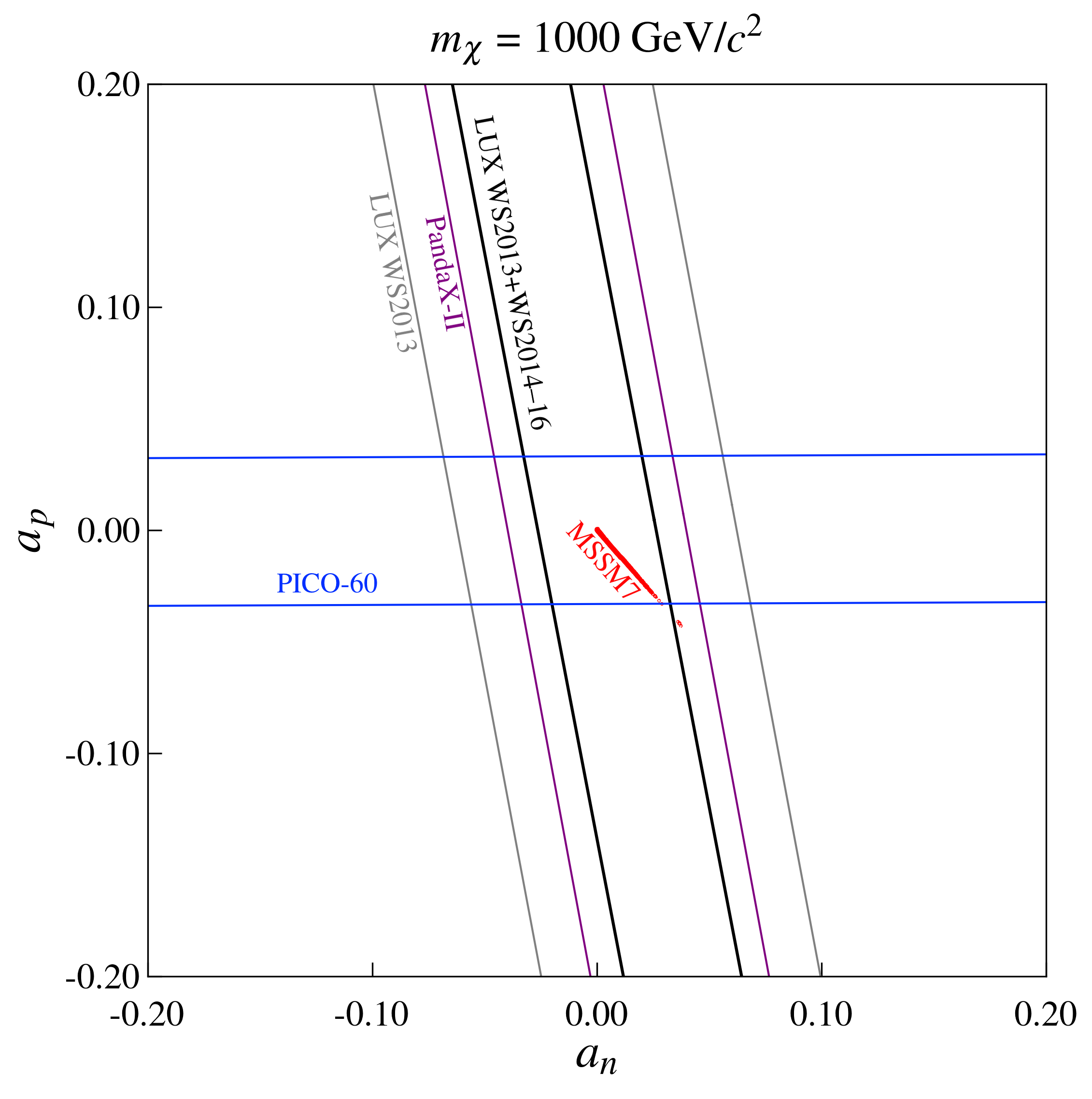 Figure 1
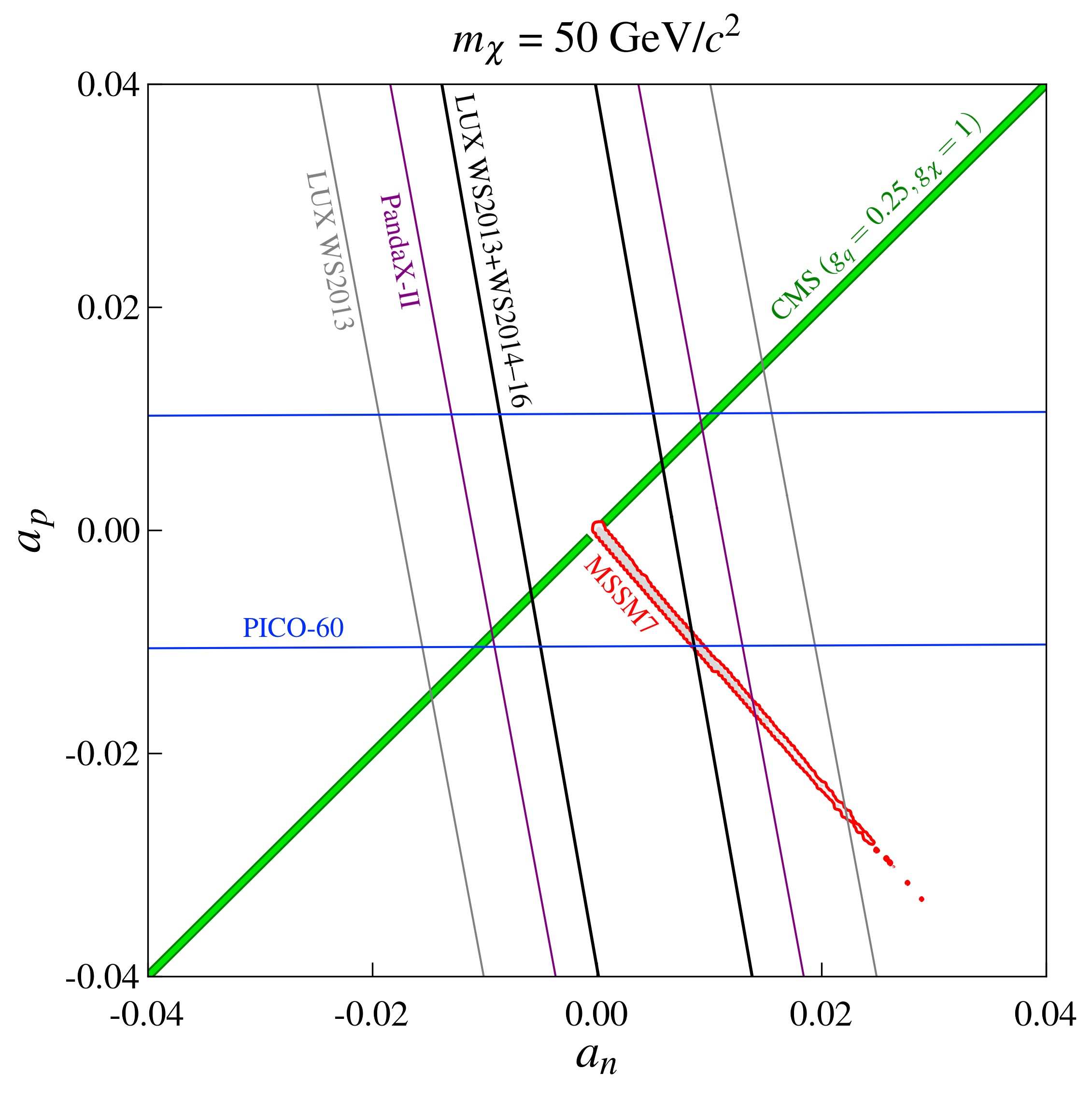 Figure 2
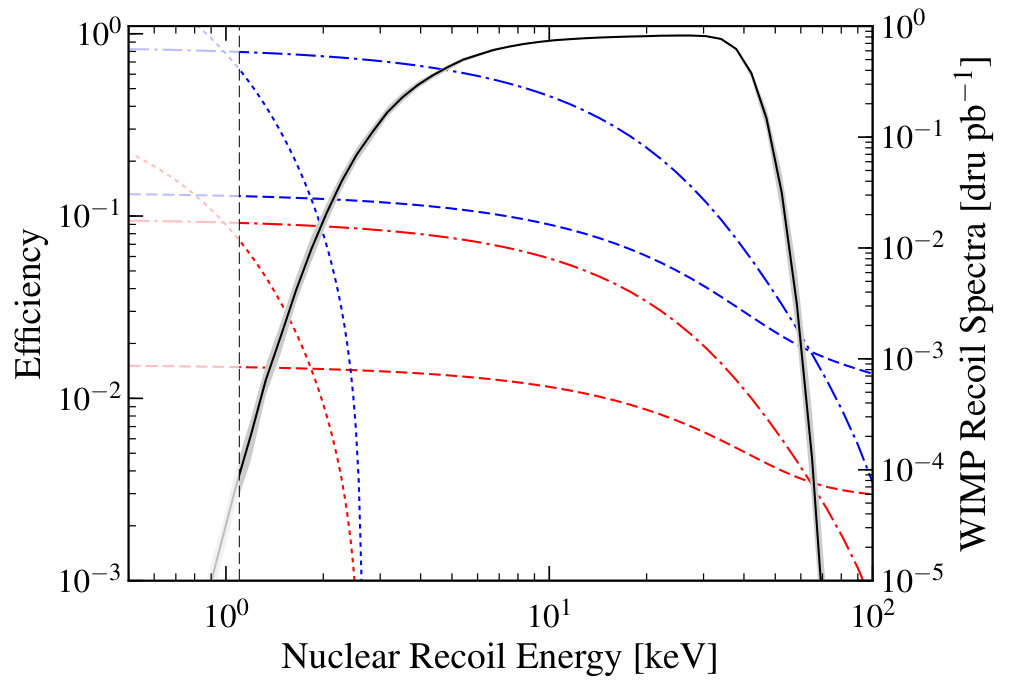 Figure 3
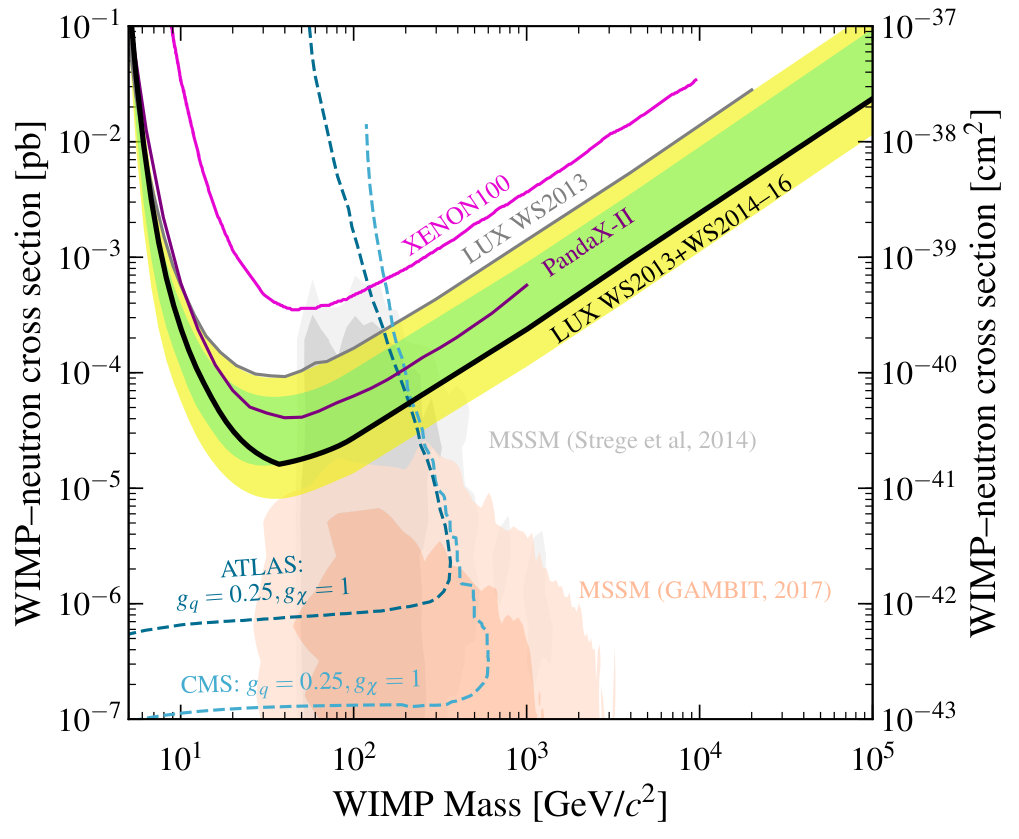 Figure 4
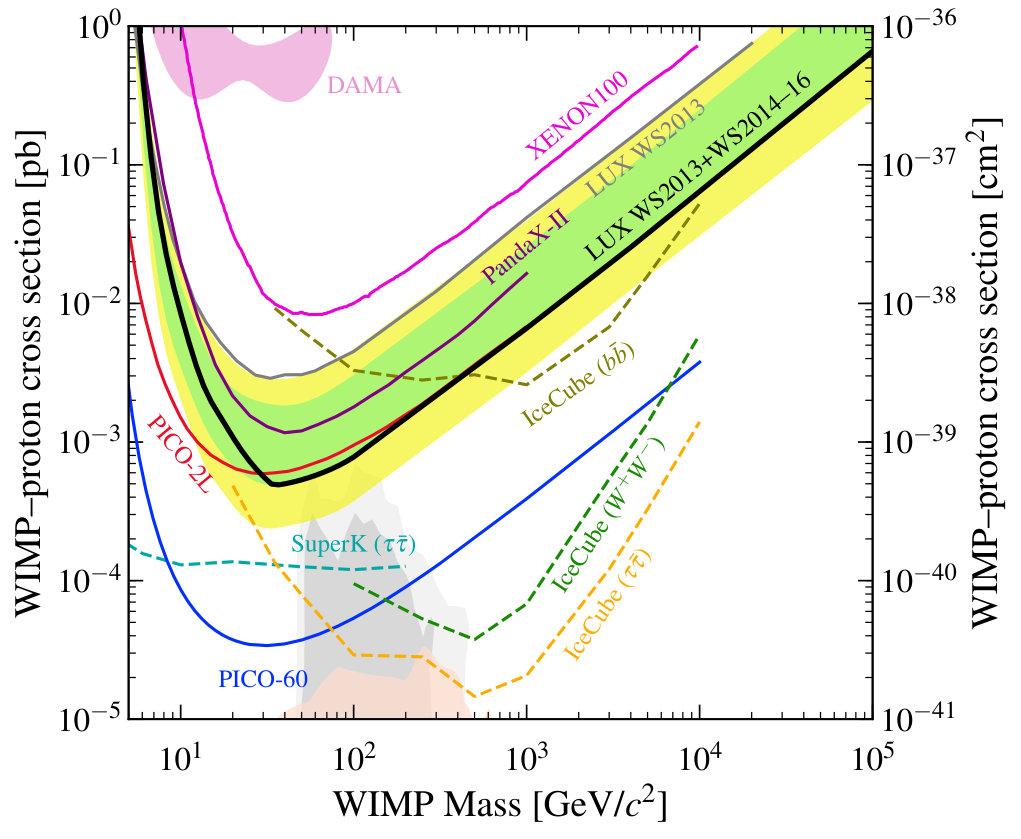 Figure 5
Peer Reviews
No public reviews on file for this paper yet. If you reviewed it on a platform where reviews are public (OpenReview, ICLR, NeurIPS, ICML), you can paste yours below so the community can read it here.
Videos
No videos yet. Explain this paper in a talk, walkthrough, or lecture? Add one.
LUX Collaboration
Limits on spin-dependent WIMP-nucleon cross section obtained from the complete LUX exposure
D.S. Akerib
Case Western Reserve University, Department of Physics, 10900 Euclid Ave, Cleveland, OH 44106, USA
SLAC National Accelerator Laboratory, 2575 Sand Hill Road, Menlo Park, CA 94205, USA
Kavli Institute for Particle Astrophysics and Cosmology, Stanford University, 452 Lomita Mall, Stanford, CA 94309, USA
S. Alsum
University of Wisconsin-Madison, Department of Physics, 1150 University Ave., Madison, WI 53706, USA
H.M. Araújo
Imperial College London, High Energy Physics, Blackett Laboratory, London SW7 2BZ, United Kingdom
X. Bai
South Dakota School of Mines and Technology, 501 East St Joseph St., Rapid City, SD 57701, USA
A.J. Bailey
Imperial College London, High Energy Physics, Blackett Laboratory, London SW7 2BZ, United Kingdom
J. Balajthy
University of Maryland, Department of Physics, College Park, MD 20742, USA
P. Beltrame
SUPA, School of Physics and Astronomy, University of Edinburgh, Edinburgh EH9 3FD, United Kingdom
E.P. Bernard
University of California Berkeley, Department of Physics, Berkeley, CA 94720, USA
Yale University, Department of Physics, 217 Prospect St., New Haven, CT 06511, USA
A. Bernstein
Lawrence Livermore National Laboratory, 7000 East Ave., Livermore, CA 94551, USA
T.P. Biesiadzinski
Case Western Reserve University, Department of Physics, 10900 Euclid Ave, Cleveland, OH 44106, USA
SLAC National Accelerator Laboratory, 2575 Sand Hill Road, Menlo Park, CA 94205, USA
Kavli Institute for Particle Astrophysics and Cosmology, Stanford University, 452 Lomita Mall, Stanford, CA 94309, USA
E.M. Boulton
University of California Berkeley, Department of Physics, Berkeley, CA 94720, USA
Lawrence Berkeley National Laboratory, 1 Cyclotron Rd., Berkeley, CA 94720, USA
Yale University, Department of Physics, 217 Prospect St., New Haven, CT 06511, USA
P. Brás
LIP-Coimbra, Department of Physics, University of Coimbra, Rua Larga, 3004-516 Coimbra, Portugal
D. Byram
University of South Dakota, Department of Physics, 414E Clark St., Vermillion, SD 57069, USA
South Dakota Science and Technology Authority, Sanford Underground Research Facility, Lead, SD 57754, USA
S.B. Cahn
Yale University, Department of Physics, 217 Prospect St., New Haven, CT 06511, USA
M.C. Carmona-Benitez
Pennsylvania State University, Department of Physics, 104 Davey Lab, University Park, PA 16802-6300, USA
University of California Santa Barbara, Department of Physics, Santa Barbara, CA 93106, USA
C. Chan
Brown University, Department of Physics, 182 Hope St., Providence, RI 02912, USA
A.A. Chiller
University of South Dakota, Department of Physics, 414E Clark St., Vermillion, SD 57069, USA
C. Chiller
University of South Dakota, Department of Physics, 414E Clark St., Vermillion, SD 57069, USA
A. Currie
Imperial College London, High Energy Physics, Blackett Laboratory, London SW7 2BZ, United Kingdom
J.E. Cutter
University of California Davis, Department of Physics, One Shields Ave., Davis, CA 95616, USA
T.J.R. Davison
SUPA, School of Physics and Astronomy, University of Edinburgh, Edinburgh EH9 3FD, United Kingdom
A. Dobi
Lawrence Berkeley National Laboratory, 1 Cyclotron Rd., Berkeley, CA 94720, USA
J.E.Y. Dobson
Department of Physics and Astronomy, University College London, Gower Street, London WC1E 6BT, United Kingdom
E. Druszkiewicz
University of Rochester, Department of Physics and Astronomy, Rochester, NY 14627, USA
B.N. Edwards
Yale University, Department of Physics, 217 Prospect St., New Haven, CT 06511, USA
C.H. Faham
Lawrence Berkeley National Laboratory, 1 Cyclotron Rd., Berkeley, CA 94720, USA
S.R. Fallon
University at Albany, State University of New York, Department of Physics, 1400 Washington Ave., Albany, NY 12222, USA
S. Fiorucci
Lawrence Berkeley National Laboratory, 1 Cyclotron Rd., Berkeley, CA 94720, USA
Brown University, Department of Physics, 182 Hope St., Providence, RI 02912, USA
R.J. Gaitskell
Brown University, Department of Physics, 182 Hope St., Providence, RI 02912, USA
V.M. Gehman
Lawrence Berkeley National Laboratory, 1 Cyclotron Rd., Berkeley, CA 94720, USA
C. Ghag
Department of Physics and Astronomy, University College London, Gower Street, London WC1E 6BT, United Kingdom
M.G.D. Gilchriese
Lawrence Berkeley National Laboratory, 1 Cyclotron Rd., Berkeley, CA 94720, USA
C.R. Hall
University of Maryland, Department of Physics, College Park, MD 20742, USA
M. Hanhardt
South Dakota School of Mines and Technology, 501 East St Joseph St., Rapid City, SD 57701, USA
South Dakota Science and Technology Authority, Sanford Underground Research Facility, Lead, SD 57754, USA
S.J. Haselschwardt
University of California Santa Barbara, Department of Physics, Santa Barbara, CA 93106, USA
S.A. Hertel
University of Massachusetts, Department of Physics, Amherst, MA 01003-9337 USA
Lawrence Berkeley National Laboratory, 1 Cyclotron Rd., Berkeley, CA 94720, USA
Yale University, Department of Physics, 217 Prospect St., New Haven, CT 06511, USA
D.P. Hogan
University of California Berkeley, Department of Physics, Berkeley, CA 94720, USA
M. Horn
South Dakota Science and Technology Authority, Sanford Underground Research Facility, Lead, SD 57754, USA
University of California Berkeley, Department of Physics, Berkeley, CA 94720, USA
Yale University, Department of Physics, 217 Prospect St., New Haven, CT 06511, USA
D.Q. Huang
Brown University, Department of Physics, 182 Hope St., Providence, RI 02912, USA
C.M. Ignarra
SLAC National Accelerator Laboratory, 2575 Sand Hill Road, Menlo Park, CA 94205, USA
Kavli Institute for Particle Astrophysics and Cosmology, Stanford University, 452 Lomita Mall, Stanford, CA 94309, USA
R.G. Jacobsen
University of California Berkeley, Department of Physics, Berkeley, CA 94720, USA
W. Ji
Case Western Reserve University, Department of Physics, 10900 Euclid Ave, Cleveland, OH 44106, USA
SLAC National Accelerator Laboratory, 2575 Sand Hill Road, Menlo Park, CA 94205, USA
Kavli Institute for Particle Astrophysics and Cosmology, Stanford University, 452 Lomita Mall, Stanford, CA 94309, USA
K. Kamdin
University of California Berkeley, Department of Physics, Berkeley, CA 94720, USA
K. Kazkaz
Lawrence Livermore National Laboratory, 7000 East Ave., Livermore, CA 94551, USA
D. Khaitan
University of Rochester, Department of Physics and Astronomy, Rochester, NY 14627, USA
R. Knoche
University of Maryland, Department of Physics, College Park, MD 20742, USA
N.A. Larsen
Yale University, Department of Physics, 217 Prospect St., New Haven, CT 06511, USA
C. Lee
Case Western Reserve University, Department of Physics, 10900 Euclid Ave, Cleveland, OH 44106, USA
SLAC National Accelerator Laboratory, 2575 Sand Hill Road, Menlo Park, CA 94205, USA
Kavli Institute for Particle Astrophysics and Cosmology, Stanford University, 452 Lomita Mall, Stanford, CA 94309, USA
B.G. Lenardo
University of California Davis, Department of Physics, One Shields Ave., Davis, CA 95616, USA
Lawrence Livermore National Laboratory, 7000 East Ave., Livermore, CA 94551, USA
K.T. Lesko
Lawrence Berkeley National Laboratory, 1 Cyclotron Rd., Berkeley, CA 94720, USA
A. Lindote
LIP-Coimbra, Department of Physics, University of Coimbra, Rua Larga, 3004-516 Coimbra, Portugal
M.I. Lopes
LIP-Coimbra, Department of Physics, University of Coimbra, Rua Larga, 3004-516 Coimbra, Portugal
A. Manalaysay
University of California Davis, Department of Physics, One Shields Ave., Davis, CA 95616, USA
R.L. Mannino
Texas A & M University, Department of Physics, College Station, TX 77843, USA
M.F. Marzioni
SUPA, School of Physics and Astronomy, University of Edinburgh, Edinburgh EH9 3FD, United Kingdom
D.N. McKinsey
University of California Berkeley, Department of Physics, Berkeley, CA 94720, USA
Lawrence Berkeley National Laboratory, 1 Cyclotron Rd., Berkeley, CA 94720, USA
Yale University, Department of Physics, 217 Prospect St., New Haven, CT 06511, USA
D.-M. Mei
University of South Dakota, Department of Physics, 414E Clark St., Vermillion, SD 57069, USA
J. Mock
University at Albany, State University of New York, Department of Physics, 1400 Washington Ave., Albany, NY 12222, USA
M. Moongweluwan
University of Rochester, Department of Physics and Astronomy, Rochester, NY 14627, USA
J.A. Morad
University of California Davis, Department of Physics, One Shields Ave., Davis, CA 95616, USA
A.St.J. Murphy
SUPA, School of Physics and Astronomy, University of Edinburgh, Edinburgh EH9 3FD, United Kingdom
C. Nehrkorn
University of California Santa Barbara, Department of Physics, Santa Barbara, CA 93106, USA
H.N. Nelson
University of California Santa Barbara, Department of Physics, Santa Barbara, CA 93106, USA
F. Neves
LIP-Coimbra, Department of Physics, University of Coimbra, Rua Larga, 3004-516 Coimbra, Portugal
K. O’Sullivan
University of California Berkeley, Department of Physics, Berkeley, CA 94720, USA
Lawrence Berkeley National Laboratory, 1 Cyclotron Rd., Berkeley, CA 94720, USA
Yale University, Department of Physics, 217 Prospect St., New Haven, CT 06511, USA
K.C. Oliver-Mallory
University of California Berkeley, Department of Physics, Berkeley, CA 94720, USA
K.J. Palladino
University of Wisconsin-Madison, Department of Physics, 1150 University Ave., Madison, WI 53706, USA
SLAC National Accelerator Laboratory, 2575 Sand Hill Road, Menlo Park, CA 94205, USA
Kavli Institute for Particle Astrophysics and Cosmology, Stanford University, 452 Lomita Mall, Stanford, CA 94309, USA
E.K. Pease
University of California Berkeley, Department of Physics, Berkeley, CA 94720, USA
Lawrence Berkeley National Laboratory, 1 Cyclotron Rd., Berkeley, CA 94720, USA
Yale University, Department of Physics, 217 Prospect St., New Haven, CT 06511, USA
L. Reichhart
Department of Physics and Astronomy, University College London, Gower Street, London WC1E 6BT, United Kingdom
C. Rhyne
Brown University, Department of Physics, 182 Hope St., Providence, RI 02912, USA
S. Shaw
University of California Santa Barbara, Department of Physics, Santa Barbara, CA 93106, USA
Department of Physics and Astronomy, University College London, Gower Street, London WC1E 6BT, United Kingdom
T.A. Shutt
Case Western Reserve University, Department of Physics, 10900 Euclid Ave, Cleveland, OH 44106, USA
Kavli Institute for Particle Astrophysics and Cosmology, Stanford University, 452 Lomita Mall, Stanford, CA 94309, USA
C. Silva
LIP-Coimbra, Department of Physics, University of Coimbra, Rua Larga, 3004-516 Coimbra, Portugal
M. Solmaz
University of California Santa Barbara, Department of Physics, Santa Barbara, CA 93106, USA
V.N. Solovov
LIP-Coimbra, Department of Physics, University of Coimbra, Rua Larga, 3004-516 Coimbra, Portugal
P. Sorensen
Lawrence Berkeley National Laboratory, 1 Cyclotron Rd., Berkeley, CA 94720, USA
S. Stephenson
University of California Davis, Department of Physics, One Shields Ave., Davis, CA 95616, USA
T.J. Sumner
Imperial College London, High Energy Physics, Blackett Laboratory, London SW7 2BZ, United Kingdom
M. Szydagis
University at Albany, State University of New York, Department of Physics, 1400 Washington Ave., Albany, NY 12222, USA
D.J. Taylor
South Dakota Science and Technology Authority, Sanford Underground Research Facility, Lead, SD 57754, USA
W.C. Taylor
Brown University, Department of Physics, 182 Hope St., Providence, RI 02912, USA
B.P. Tennyson
Yale University, Department of Physics, 217 Prospect St., New Haven, CT 06511, USA
P.A. Terman
Texas A & M University, Department of Physics, College Station, TX 77843, USA
D.R. Tiedt
South Dakota School of Mines and Technology, 501 East St Joseph St., Rapid City, SD 57701, USA
W.H. To
Case Western Reserve University, Department of Physics, 10900 Euclid Ave, Cleveland, OH 44106, USA
SLAC National Accelerator Laboratory, 2575 Sand Hill Road, Menlo Park, CA 94205, USA
Kavli Institute for Particle Astrophysics and Cosmology, Stanford University, 452 Lomita Mall, Stanford, CA 94309, USA
California State University Stanislaus, Department of Physics, 1 University Circle, Turlock, CA 95382, USA
M. Tripathi
University of California Davis, Department of Physics, One Shields Ave., Davis, CA 95616, USA
L. Tvrznikova
University of California Berkeley, Department of Physics, Berkeley, CA 94720, USA
Lawrence Berkeley National Laboratory, 1 Cyclotron Rd., Berkeley, CA 94720, USA
Yale University, Department of Physics, 217 Prospect St., New Haven, CT 06511, USA
S. Uvarov
University of California Davis, Department of Physics, One Shields Ave., Davis, CA 95616, USA
V. Velan
University of California Berkeley, Department of Physics, Berkeley, CA 94720, USA
J.R. Verbus
Brown University, Department of Physics, 182 Hope St., Providence, RI 02912, USA
R.C. Webb
Texas A & M University, Department of Physics, College Station, TX 77843, USA
J.T. White
Texas A & M University, Department of Physics, College Station, TX 77843, USA
T.J. Whitis
Case Western Reserve University, Department of Physics, 10900 Euclid Ave, Cleveland, OH 44106, USA
SLAC National Accelerator Laboratory, 2575 Sand Hill Road, Menlo Park, CA 94205, USA
Kavli Institute for Particle Astrophysics and Cosmology, Stanford University, 452 Lomita Mall, Stanford, CA 94309, USA
M.S. Witherell
Lawrence Berkeley National Laboratory, 1 Cyclotron Rd., Berkeley, CA 94720, USA
F.L.H. Wolfs
University of Rochester, Department of Physics and Astronomy, Rochester, NY 14627, USA
J. Xu
Lawrence Livermore National Laboratory, 7000 East Ave., Livermore, CA 94551, USA
K. Yazdani
Imperial College London, High Energy Physics, Blackett Laboratory, London SW7 2BZ, United Kingdom
S.K. Young
University at Albany, State University of New York, Department of Physics, 1400 Washington Ave., Albany, NY 12222, USA
C. Zhang
University of South Dakota, Department of Physics, 414E Clark St., Vermillion, SD 57069, USA
Abstract
We present experimental constraints on the spin-dependent WIMP-nucleon elastic cross sections from the total 129.5 kg-year exposure acquired by the Large Underground Xenon experiment (LUX), operating at the Sanford Underground Research Facility in Lead, South Dakota (USA). A profile likelihood ratio analysis allows 90% CL upper limits to be set on the WIMP-neutron (WIMP-proton) cross section of = 1.6 cm2 ( = 5 cm2) at 35 GeV, almost a sixfold improvement over the previous LUX spin-dependent results. The spin-dependent WIMP-neutron limit is the most sensitive constraint to date.
The existence of dark matter is now supported by a wide array of astrophysical evidence, though the nature of its composition remains a mystery. The hypothetical WIMP (Weakly Interacting Massive Particle) is a compelling candidate, addressing both the observed astronomical phenomena as well as shortcomings of the Standard Model of particle physics (SM). The WIMP appears in many extensions of the SM, including supersymmetry Jungman et al. (1996), extra dimensions Servant and Tait (2003), and little Higgs theories Birkedal et al. (2006). In these models, WIMPs may couple to SM particles mainly via scalar (spin-independent) and axial-vector (spin-dependent) interactions. The Large Underground Xenon (LUX) experiment, operating at the Sanford Underground Research Facility in Lead, South Dakota, is designed to detect such interactions through the scattering of galactic WIMPs with Xe nuclei. The LUX WIMP search program comprises two distinct exposures, termed WS2013 and WS2014–16. The combined dataset of both runs has been analyzed to produce world-leading limits on the spin-independent (SI) WIMP-nucleon cross section Akerib et al. (2017). Here, we present the results for the spin-dependent (SD) coupling of WIMPs to protons and neutrons.
LUX searches for WIMPs with a dual phase time projection chamber (TPC), detecting energy depositions through the resulting ionization and scintillation in the target material. The active detector volume, containing 250 kg of liquid xenon (LXe), is monitored by two horizontal arrays of 61 photomultiplier tubes (PMTs) each. The bottom array sits underneath a cathode grid in the LXe, while the top array looks on from above, in the gas phase. An energy deposition in the active region generates prompt scintillation photons as well as ionization electrons, which drift upwards under the influence of an applied electric field. The scintillation light is the first signal observed in the PMTs (S1). The second signal (S2) corresponds to the liberated charge: ionized electrons travel vertically to the liquid surface, where they are extracted into the gas phase and accelerated by a strong electric field. This produces additional vacuum ultraviolet (VUV) photons via electroluminescence. The S2 signal, originating close to the top PMT array, localizes the interaction in the plane. Additionally, the time delay between S1 and S2 gives the depth below the liquid surface, thereby allowing for full 3D position reconstruction. Position information is crucial for defining a fiducial volume, excluding background events that occur near the TPC walls. Further discrimination between WIMP signals (nuclear recoils, or NRs) and Compton or beta backgrounds (electron recoils, or ERs) is achieved using the S2 to S1 ratio.
As discussed in Akerib et al. (2017), the recent WS2014–16 dataset was collected under substantially different detector conditions than WS2013: the electric drift field in the active volume featured spatial non-uniformities that evolved slowly over the course of the exposure. In particular, a significant radial component of the field was observed, as well as a vertical gradient in field magnitude. As a consequence of this field symmetry deformation, electron drift trajectories were bent radially inward, complicating the position reconstruction process. Though a similar phenomenon was seen in WS2013, the effects in WS2014–16 were more severe in magnitude, azimuthal distortion, and time-dependence. For example, in WS2014–16, an ionized electron originating near the edge of the cathode at a radius of 24 cm would reach the liquid surface at a radius of 10 cm (as opposed to 20 cm in WS2013). In addition to affecting electron drift paths, the field asymmetry introduced spatially-varying charge and light yields in the LXe. This is a result of the recombination physics of electron-ion pairs—more electrons (and thus fewer photons) will escape an interaction taking place in a region of greater field strength. As such, the boundaries of the bands populated by ERs and NRs in S1–S2 space vary slightly as a function of event position (and, to a lesser extent, calendar date).
A rigorous calibration regimen was established to address the challenges presented by the unique field geometry in the WS2014–16 analysis. Weekly 83mKr injections Kastens et al. (2009, 2010); Manalaysay et al. (2010), in conjunction with periodic injections of tritiated methane Akerib et al. (2016a), enabled the separation of electric field effects from the usual geometric effects typical of TPC detectors (i.e. spatial light collection efficiency and electron lifetime). Furthermore, 83mKr data were used to tune a 3-D electrostatic model of the detector, built with the comsol Multiphysics package com . The electric field maps produced from this effort allowed for the time-dependent translation between true event position and the position inferred from the observed S2.
NR calibrations were performed with neutrons from a deuterium-deuterium (DD) fusion generator Akerib et al. (2016b); Verbus et al. (2017). This technique, pioneered by LUX following the WS2013 run, was employed throughout the WS2014–16 exposure to monitor the detector’s expected response to signal events. ER calibrations were obtained with tritiated methane, where the beta decays of tritium (endpoint 18.6 keV) give an excellent high statistics characterization of ER background events Akerib et al. (2016a).
This analysis combines the WS2013 and WS2014–16 datasets in search of spin-dependent scattering between WIMPs and Xe nuclei. The WS2013 exposure was taken between April and August of 2013, totaling 95 live-days with a fiducial mass of 145 kg Akerib et al. (2016c). A simple set of selection cuts were applied to the data, leaving 591 events in the region of interest. This dataset was previously analyzed to set SD WIMP-nucleon cross section limits Akerib et al. (2016d). The WS2014–16 dataset was subjected to similar cuts, and furthermore featured a blinding protocol wherein fake WIMP events (“salt”) were injected into the data-stream. A full discussion of these data quality and selection cuts as well as the salting scheme can be found in Ref. Akerib et al. (2017). In both runs, cuts were designed to select low-energy events with a single S1 followed by a single S2. The net effect on NR detection efficiency is illustrated in Fig.1, which shows the exposure-weighted efficiency of both WS2013 and WS2014–16 (black line, left axis scale). Efficiencies are calculated by applying analysis cuts to simulated NR events. Also plotted on the same energy scale are sample recoil spectra from SD WIMP-nucleon elastic scattering (right axis scale).
The spin-dependent coupling between WIMPs and sea quarks within target nucleons is evaluated using effective field theory (EFT) due to the non-perturbative nature of the strong force. As in Akerib et al. (2016d), we use the calculations made with 1-body (1b) and 2-body (2b) WIMP-quark scattering presented in Klos et al. (2013). The differential cross section derived is
[TABLE]
where is the Fermi constant, is the ground state angular momentum of the nucleus, is the WIMP velocity, and is the non-trivial momentum dependent axial-vector structure factor. In the zero momentum transfer limit it reduces to
[TABLE]
The are WIMP-proton(neutron) coupling constants for 1b currents and account for the effects of 2b currents (in the nomenclature of Klos et al. (2013), ). are the spin expectation values of the proton and neutron groups in the nucleus. The case of “proton-only” coupling () is so named because, in the 1b regime, only the protons contribute to (the same applies to “neutron-only” with ). However, with the introduction of 2b currents, neutrons may be involved in a “WIMP-proton” scattering event, changing this picture. Thus, for target nuclei with unpaired neutrons such as 129Xe and 131Xe, sensitivity is much greater in the neutron-only case (since ), though 2b currents allow for non-zero sensitivity to a proton coupling. 129Xe and 131Xe occur naturally in xenon with respective abundances of 29.5% and 23.7%.
The non-zero momentum transfer structure factors can be decomposed as
[TABLE]
where are the isovector/isoscalar components. Fit parameters for these functions are listed for 129Xe and 131Xe in Table IV of Klos et al. (2013). Using these, we can compute and generate various SD WIMP-nucleon recoil spectra (see Fig. 1). We assume a standard Maxwellian WIMP velocity distribution near Earth with km/s, = 544 km/s, and = 0.3 GeV/cm3. To calculate the average relative Earth velocity during the exposure, we follow Ref.Savage et al. (2006) to obtain km/s and km/s.
A two-sided profile likelihood ratio (PLR) statistic is used to test signal hypotheses Cowan et al. (2011a), whereby the complete LUX dataset is compared against a multi-channel, extended, unbinned likelihood function Cranmer (2015); CMS (2011). LUX data are categorized into five “channels”: one corresponds to the WS2013 exposure, and the remaining four represent discrete time periods of relatively constant detector conditions in the WS2014–2016 dataset, termed “date bins.” The simultaneous model is thus the product of each channel’s likelihood, along with the nuisance parameter constraints. Nuisance parameters, representing systematic uncertainties in the model, are described in Akerib et al. (2017), as are the components of the background model. Here, we review some details of the model construction.
The signal and background probability distribution functions (PDFs) for WS2013 are defined in four observables: corrected interaction radius and height, S1, and Akerib et al. (2016c). Uncorrected S2 position coordinates are used in WS2014–16, with the loss of axial symmetry necessitating the introduction of the third spatial dimension. ER backgrounds as well as the NR signal are modeled by further subdividing the data into segments of drift time.111A small NR background from 8B solar neutrinos is also modeled with this technique. Neutrons (muon-induced or from detector components) can also produce NR background events, though the estimated rate is negligible Akerib et al. (2017, 2015). For each date bin of WS2014–16, calibration data is used to tune response models in four horizontal slices of the detector (within which the field strength variation is acceptably low). From these date- and depth-specific models, implemented with the Noble Element Simulation Technique (NEST) Lenardo et al. (2015), Monte Carlo (MC) data are generated to produce 16 ER and NR PDFs. Spatial PDFs are built separately using MC from the Geant4-based Agostinelli et al. (2003) LUXSim Akerib et al. (2012) software: simulated event positions are transformed into the observed S2 coordinate space via the 83mKr-derived field maps, once for each date bin.
As in WS2013, the WS2014–16 data contains a background population that defies the ER and NR description. Interactions occurring very near the TPC walls suffer charge loss to the PTFE panels, suppressing the S2 signal. Since position reconstruction statistical uncertainty scales as S2*-1/2*, these low charge yield events are more likely to be mis-reconstructed as taking place within the fiducial volume (because of the long tail in their radial distribution). An empirical model is constructed to describe this population using control samples of the dataset outside the region of interest. More so than the other models, this “wall” model features strong correlations between position and pulse area observables. For example, the width of the radial distribution is dependent on uncorrected S2, which is itself a function of the corrected S2 and observables used in the PLR. Furthermore, in observed S2 position coordinates, the radial position of the wall varies with . The final PDF is implemented as a finely binned 5-dimensional histogram in each date bin, via an extension of the technique described in Ref. Lee (2015). Specifics of the model construction will be detailed in a forthcoming publication.
The full background model is found to be a good fit to the combined dataset. The data are consistent with the background-only hypothesis (PLR ) when testing a 50\text{\,}\,$$\mathrm{GeV}\,c^{-2} signal. As a further cross-check, the WS2013 and WS2014–16 PDFs are separately projected into 1-dimensional spectra for each observable. These are compared to data with a Kolmogorov-Smirnov test, demonstrating acceptable goodness of fit ( and in WS2013 and WS2014–16, respectively) Akerib et al. (2016c, 2017). Finding no evidence for WIMP signals in the data, we proceed in setting 90% confidence level (CL) limits on the WIMP-nucleon cross section, in the case of spin-dependent coupling.
For a given WIMP mass and choice of coupling type, the PLR test statistic distribution is constructed at a range of signal cross sections from MC pseudo-experiments generated with the RooStats package Moneta et al. (2010). The -value of the observed data is then calculated over this range, where by definition the 90% CL upper limit is given by the cross section at which . In using the raw PLR test statistic, however, an experiment may benefit unreasonably from background under-fluctuations. To safeguard against setting an upper limit at a cross section to which LUX is insensitive, a power constraint Cowan et al. (2011b) is imposed at of the expected sensitivity calculated from background-only trials (as in Akerib et al. (2017)). Since the WS2013 limits were reported with an overly conservative power constraint at the median expected sensitivity, this combined result exhibits a stronger improvement than suggested simply by the increase in exposure.
The advance in sensitivity can be seen in Fig. 2 , which shows cross section limits as a function of WIMP mass in the cases of neutron- and proton-only coupling. The limits from the combined LUX data are plotted as a thick black line, labeled “LUX WS2013+WS2014–16”. LUX is more sensitive to the neutron-only scenario, owing to the unpaired neutron in 129Xe and 131Xe nuclei, and sets a minimum upper limit of at 35\text{\,}\,$$\mathrm{GeV}\,c^{-2}, a nearly sixfold improvement over the previous WS2013 result. Indeed, among direct detection experiments, LUX is world-leading in sensitivity to WIMP-neutron interactions. Also shown are sample results from LHC searches, interpreted as exclusions in the WIMP mass vs. cross section plane by assuming mediator coupling parameters in a -like simplified modelBuchmueller et al. (2015); Busoni et al. (2016). Though strictly model-dependent, these limits present strong constraints below 500 GeV, whereas the sensitivity of LXe TPCs extends to much higher WIMP masses.
To contextualize these WIMP-neutron cross section limits, regions of favored parameter space derived from a 7-parameter Minimal Supersymmetric Standard Model (MSSM7 Bergstrom and Gondolo (1996)) are also indicated. These regions, newly calculated Athron et al. (2017a) by the GAMBIT collaboration Athron et al. (2017b, c); Workgroup et al. (2017a, b), are generated from scans of the MSSM7, where constraints from a suite of experimental results appear in the likelihood functions. In particular, recent results from LUX Akerib et al. (2017) and PandaX–II Tan et al. (2016) are included. As such, the favored parameter space is appropriately just beyond the sensitivity of this work (since the dataset used here is the same as in the SI analysis of Ref. Akerib et al. (2017), which is already taken into account by the GAMBIT profile likelihood scan). Another region of favored parameter space from a 2014 scan of MSSM-15 Strege et al. (2014) is shown for comparison, illustrating the rapid advance of the field and the contribution of direct detection searches such as LUX.
In the proton-only scenario, high mass limits from this result now coincide with those previously set by the PICO-2L experiment. The recent limit from PICO-60 sets the standard for proton-only sensitivity in direct detection, bolstering the constraints from indirect searches performed by the neutrino detectors IceCube and Super-Kamiokande. CMS and ATLAS take (i.e. the coupling of quark type to the axial-vector mediator) to be universal, and thus set equivalent limits on WIMP-neutron and -proton cross section (the curves are omitted in the bottom panel of Fig. 2 for clarity). However, we note that in a more careful treatment of the simplified model, renormalization group evolution of the couplings from the LHC to nuclear energy scale leads to significant isospin violation (see Ref. Crivellin et al. (2014); D’Eramo and Procura (2015); D’Eramo et al. (2016)).
The cases of neutron- and proton-only coupling fall on the axes of the more general parameter space spanned by and . By following the prescription laid out in Tovey et al. (2000), elliptical exclusions in this plane are made according to:
[TABLE]
where the sum is performed over target isotopes with mass numbers , and are the 90% CL upper limits on WIMP-proton(neutron) cross-section, calculated individually from these isotopes. For the PICO-60 results, where only the proton-only results are reported, limits are calculated according to Giuliani and Girard (2005). Exclusions are shown in Fig. 3 for two choices of WIMP mass, highlighting the complementary experimental reach of LXe and fluorine-rich detectors. The CMS results are also shown in this plane as exclusions along the line (since is assumed to be the same for all quarks) Sirunyan et al. (2017); McCabe . Results from the GAMBIT scans of the MSSM7 are also displayed.
In conclusion, the complete LUX dataset has been analyzed to set limits on SD WIMP-nucleon scattering. World-leading constraints are presented for neutron-only coupling, complementing searches for particle production at the LHC. Further complementarity with the PICO-60 result is achieved in the 2D – plane. Future work will investigate a more complete set of EFT interaction operators, beyond those that define the standard SI and SD paradigm.
The authors thank C. McCabe for useful discussions on the interpretation of LHC searches, and P. Scott and the GAMBIT collaboration for providing their results on the – plane. We also thank F. D’Eramo, B. J. Kavanagh, and P. Panci for pointing out subtleties that arise from the running of couplings in simplified dark matter models. This work was partially supported by the U.S. Department of Energy (DOE) under award numbers DE-AC02-05CH11231, DE-AC05-06OR23100, DE-AC52-07NA27344, DE-FG01-91ER40618, DE-FG02-08ER41549, DE-FG02-11ER41738, DE-FG02-91ER40674, DE-FG02-91ER40688, DE-FG02-95ER40917, DE-NA0000979, DE-SC0006605, DE-SC0010010, and DE-SC0015535; the U.S. National Science Foundation under award numbers PHY-0750671, PHY-0801536, PHY-1003660, PHY-1004661, PHY-1102470, PHY-1312561, PHY-1347449, PHY-1505868, and PHY-1636738; the Research Corporation grant RA0350; the Center for Ultra-low Background Experiments in the Dakotas (CUBED); and the South Dakota School of Mines and Technology (SDSMT). LIP-Coimbra acknowledges funding from Fundação para a Ciência e a Tecnologia (FCT) through the project-grant PTDC/FIS-NUC/1525/2014. Imperial College and Brown University thank the UK Royal Society for travel funds under the International Exchange Scheme (IE120804). The UK groups acknowledge institutional support from Imperial College London, University College London and Edinburgh University, and from the Science & Technology Facilities Council for PhD studentships ST/K502042/1 (AB), ST/K502406/1 (SS) and ST/M503538/1 (KY). The University of Edinburgh is a charitable body, registered in Scotland, with registration number SC005336.
This research was conducted using computational resources and services at the Center for Computation and Visualization, Brown University, and also the Yale Science Research Software Core. The 83Rb used in this research to produce 83mKr was supplied by the United States Department of Energy Office of Science by the Isotope Program in the Office of Nuclear Physics.
We gratefully acknowledge the logistical and technical support and the access to laboratory infrastructure provided to us by SURF and its personnel at Lead, South Dakota. SURF was developed by the South Dakota Science and Technology Authority, with an important philanthropic donation from T. Denny Sanford, and is operated by Lawrence Berkeley National Laboratory for the Department of Energy, Office of High Energy Physics.
The reference list from the paper itself. Each links out to its DOI / PubMed record.
- 1Jungman et al. (1996) G. Jungman, M. Kamionkowski, and K. Griest, Phys. Rep. 267 , 195 (1996) , ar Xiv:hep-ph/9506380 [hep-ph] . · doi ↗
- 2Servant and Tait (2003) G. Servant and T. M. P. Tait, Nucl. Phys. B 650 , 391 (2003) , ar Xiv:hep-ph/0206071 [hep-ph] . · doi ↗
- 3Birkedal et al. (2006) A. Birkedal, A. Noble, M. Perelstein, and A. Spray, Phys. Rev. D 74 , 035002 (2006) , ar Xiv:hep-ph/0603077 [hep-ph] . · doi ↗
- 4Akerib et al. (2017) D. S. Akerib et al. (LUX), Phys. Rev. Lett. 118 , 021303 (2017) , ar Xiv:1608.07648 [astro-ph.CO] . · doi ↗
- 5Kastens et al. (2009) L. Kastens et al. , Phys. Rev. C 80 , 045809 (2009) . · doi ↗
- 6Kastens et al. (2010) L. W. Kastens, S. Bedikian, S. B. Cahn, A. Manzur, and D. N. Mc Kinsey, JINST 5 , P 05006 (2010) .
- 7Manalaysay et al. (2010) A. Manalaysay, T. M. Undagoitia, A. Askin, L. Baudis, A. Behrens, et al. , Rev. Sci. Instrum. 81 , 073303 (2010) , ar Xiv:0908.0616 [astro-ph.IM] . · doi ↗
- 8Akerib et al. (2016 a) D. S. Akerib et al. (LUX), Phys. Rev. D 93 , 072009 (2016 a) , ar Xiv:1512.03133 [physics.ins-det] . · doi ↗