Electrical single spin read-out using an exchange-coupled quantum dot
Cl\'ement Godfrin, Stefan Thiele, Karim Ferhat, Svetlana Klyatskaya,, Mario Ruben, Wolfgang Wernsdorfer, Franck Balestro

TL;DR
This paper introduces a novel all-electrical, non-destructive method for continuous single spin detection using exchange interaction with a quantum dot, achieving high fidelity and significant conductance changes.
Contribution
It demonstrates a new exchange-coupled quantum dot technique for single spin read-out, offering an alternative to spin-charge conversion methods.
Findings
Conductance variations up to 4% observed.
Read-out fidelities exceed 99.5%.
Asymmetric exchange coupling model matches experimental data.
Abstract
We present a new way of continuously reading-out the state of a single electronic spin. Our detection scheme is based on an exchange interaction between the electronic spin and a nearby read-out quantum dot. The coupling between the two systems results in a spin-dependent conductance through the read-out dot and establishes an all electrical and non-destructive single spin detection. With conductance variations up to 4% and read-out fidelities greater than 99.5%, this method represents an alternative to systems where spin to charge conversion cannot be implemented. Using a semi-classical approach, we present an asymetric exchange coupling model in good agreement with our experimental results.
Click any figure to enlarge with its caption.
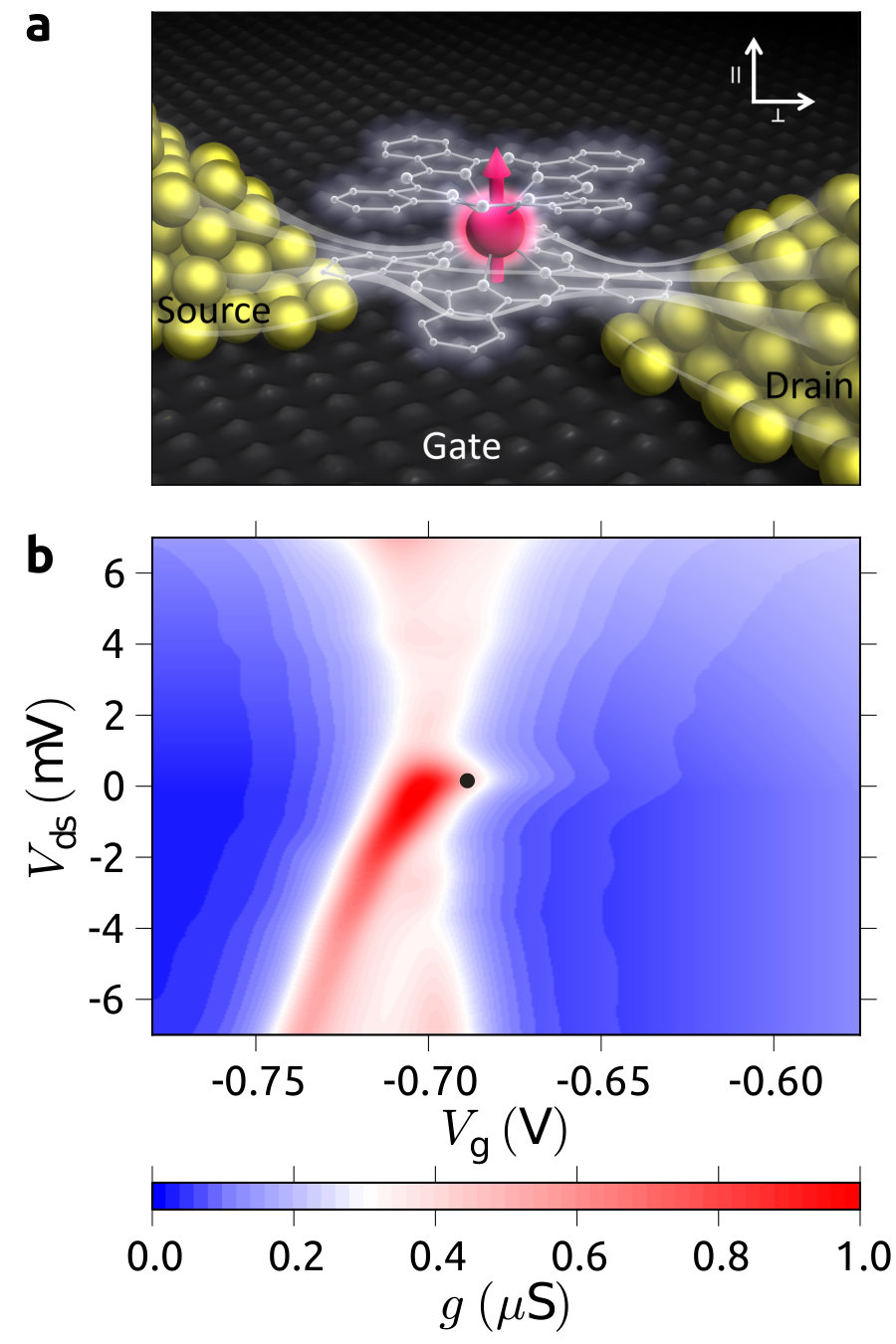 Figure 1
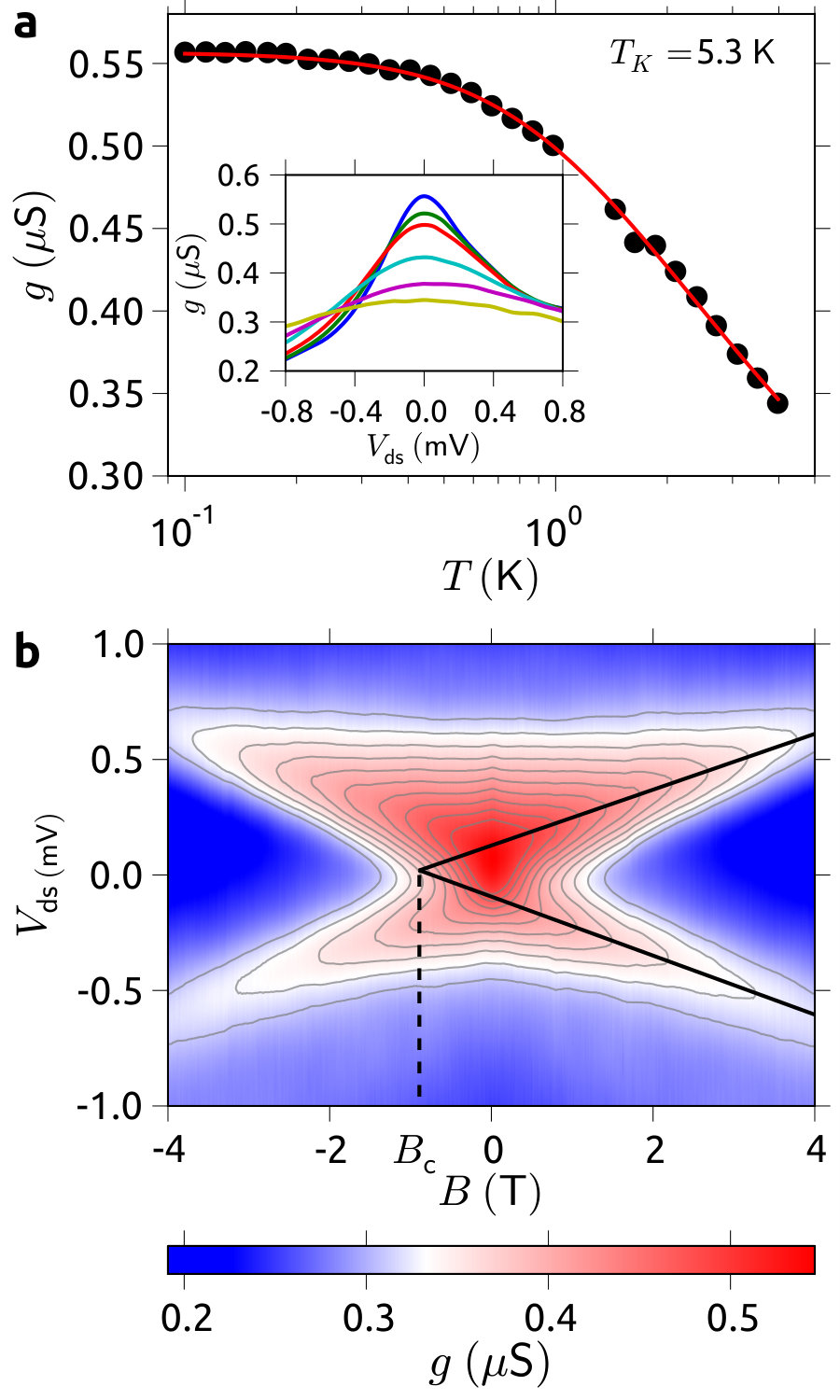 Figure 2
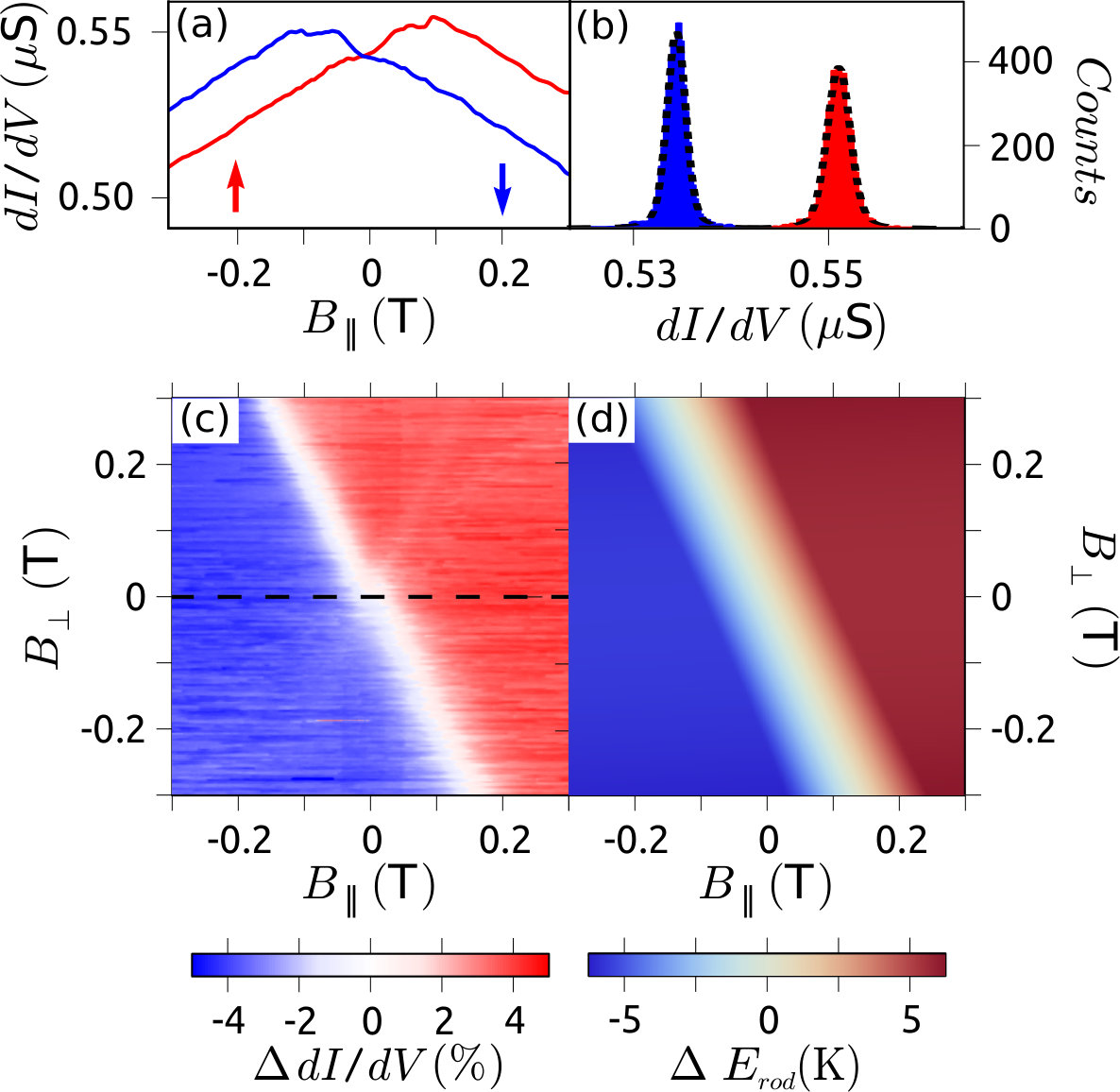 Figure 3
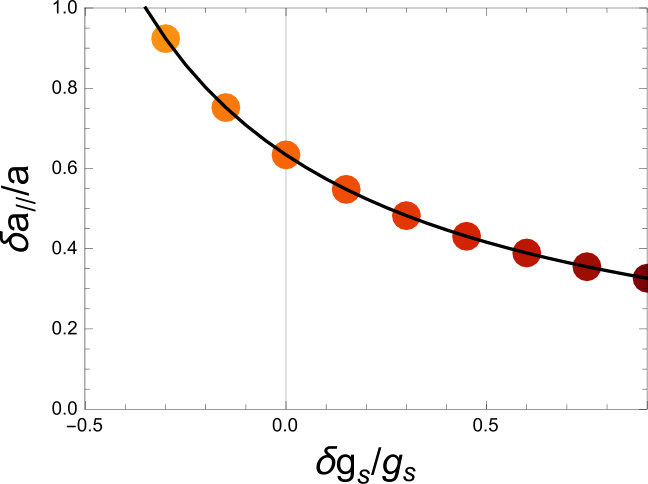 Figure 4
Peer Reviews
No public reviews on file for this paper yet. If you reviewed it on a platform where reviews are public (OpenReview, ICLR, NeurIPS, ICML), you can paste yours below so the community can read it here.
Videos
No videos yet. Explain this paper in a talk, walkthrough, or lecture? Add one.
Electrical single spin read-out using an exchange-coupled quantum dot
C. Godfrin
CNRS Inst. NEEL, F-38000, France.
S. Thiele
CNRS Inst. NEEL, F-38000, France.
K. Ferhat
CNRS Inst. NEEL, F-38000, France.
S. Klyatskaya
Institute of Nanotechnology (INT) Karlsruhe Institute of Technology (KIT) 76344 Eggenstein-Leopoldshafen, Germany
M. Ruben
Institute of Nanotechnology (INT) Karlsruhe Institute of Technology (KIT) 76344 Eggenstein-Leopoldshafen, Germany
W. Wernsdorfer
Institute of Nanotechnology (INT) Karlsruhe Institute of Technology (KIT) 76344 Eggenstein-Leopoldshafen, Germany
F. Balestro
CNRS Inst. NEEL, F-38000, France.
Abstract
We present a new way of continuously reading-out the state of a single electronic spin. Our detection scheme is based on an exchange interaction between the electronic spin and a nearby read-out quantum dot. The coupling between the two systems results in a spin-dependent conductance through the read-out dot and establishes an all electrical and non-destructive single spin detection. With conductance variations up to 4% and read-out fidelities greater than 99.5%, this method represents an alternative to systems where spin to charge conversion cannot be implemented. Using a semi-classical approach, we present an asymetric exchange coupling model in good agreement with our experimental results.
keywords:
quantum dot, single-molecule magnets, single-molecule transistor, single-spin detection, nanospintronics
\alsoaffiliation
Univ. Grenoble Alpes, Inst. NEEL, F-38000, France.
\alsoaffiliationUniv. Grenoble Alpes, Inst. NEEL, F-38000, France.
\alsoaffiliationUniv. Grenoble Alpes, Inst. NEEL, F-38000, France.
\alsoaffiliationInstitut de Physique et Chimie des Matériaux de Strasbourg (IPCMS), CNRS-Université de Strasbourg 67034 Strasbourg, France.
\alsoaffiliationCNRS Inst. NEEL, F-38000, France. \alsoaffiliationUniv. Grenoble Alpes, Inst. NEEL, F-38000, France.
\alsoaffiliationUniv. Grenoble Alpes, Inst. NEEL, F-38000, France. \alsoaffiliationInst. Univ. de France 103 Blvd Saint-Michel 75005 Paris, France.
\phone+33 (0)476887915
\abbreviationsIR,NMR,UV
Over the last 10 years, advances in nanofabrication and measurement technologies allowed for the read-out 1, 2, 3, 4 and manipulation 5, 6, 7, 8, 9, 10, 11 of single electronic and nuclear spins. Besides the opportunity of testing our understanding of quantum mechanics, these progresses are at the heart of recent developments towards potential applications in the field of nanospintronics 12, 13, molecular spintronics 14, 16, 15 and quantum information processing 17. Among different concepts, systems integrating an all electrical spin detection benefit most from achievements of the microelectronic industry, but so far, they relied on the spin to charge conversion 18, 2, 19 which required emptying the electron into a nearby reservoir. However, in devices where the energy of the spin system is much more negative than the Fermi energy of the leads, a different detection technique is mandatory. Here we present a general detection scheme based on a single electronic spin coupled to a read-out quantum dot. Because of the exchange coupling between the two systems, transport properties through the read-out quantum dot are spin dependent, enabling an electrical read-out which is non-destructive of the single electronic spin.
To implement this general detection scheme, we fabricated a single TbPc2 molecule spin-transistor (Figure 1a) using the electromigration technique20. This spin transistor can be split into two coupled quantum systems :
(i) The 4f electrons of the terbium Tb3+ ion possess an electronic spin. Its total spin S=3 and total orbital momentum L=3, originats from its [Xe]4f8 electronic configuration. Because of a strong spin-orbit coupling, the total angular magnetic moment of the electronic spin is J=6. In addition, the two phthalocyanines (Pc) generate a ligand field that leads to an electron-spin ground state doublet and which is well isolated and have a uniaxial anisotropy axis perpendicular to the Pc-plane 30 (Figure 1a). At finite magnetic fields, the degeneracy of the doublet is lifted, the electronic spin can reverse and emit a phonon via a direct relaxation process.
(ii) the Pc ligands create a read-out quantum dot. The TbPc2 has a spin S= delocalized over the two Pc ligands21 which is close in energy to the Tb-4f states. Thus, delocalized -electron system results in a quantum dot in the vicinity of the electronic spin carried by the Tb3+ ion. This read-out quantum dot is tunnel-coupled to source and drain terminals to perform transport measurements. Furthermore, an overlap of this -electron with the Tb3+ 4f electrons gives rise to a strong exchange coupling between the read-out quantum dot and the electronic spin, without affecting its magnetic properties, as demonstrated in the following.
1 Experimental Results
Now, we present the characterization of our single-molecule spin transistor measuring the differential conductance as a function of the source drain voltage and the gate voltage to obtain the stability diagram presented in Figure 1b at an electronic temperature around 80 mK. Regions colored in red and blue exhibited respectively high and low differential conductance values. Note that this sample is the same as previously studied4, the difference in conductance originating from a slight change of the molecules tunnel-coupling to the metallic leads due to aging of the device. From the general characteristics of the Coulomb diamond in Figure 1b, we obtained a conversion factor , resulting in a low estimation of the charging energy of the quantum dot under investigation. First, this large value agree with the idea that the single TbPc2 molecular magnet creates the quantum dot. Moreover, Zhu et al. 22 showed that electrons add to the TbPc2 only go to the Pc ligands up to the fifth reduction and second oxidation. As a results, as observed in our previous works on two different samples 4, 11, the charge state as well as the magnetic properties of the Tb3+ ion are conserved. On these accounts, the read-out quantum dot is most likely created by the Pc ligands as depicted in Figure 1a.
The stability diagram presented in Figure 1b exhibits a zero bias anomaly on the right side of the charge degeneracy point, which is associated with the usual spin S=1/2 Kondo effect observed in 2D electron gas quantum dots23, 24 and single molecule transistors26, 27. The Kondo temperature was determined by measuring the differential conductance at V as a function of the temperature for a fixed gate voltage (Figure 2a). By fitting the results to the empirical formula 23:
[TABLE]
where is the maximum conductance, =0.22 and is the fixed background conductance, we obtained a Kondo temperature K.
To determine the configuration and value of the exchange coupling between the electronic spin and the read-out quantum dot carried by the Tb3+ ion, we investigated the evolution of the Kondo peak depending on the applied bias voltage and the magnetic field . By increasing the Kondo peak splits linearely, with a 124 V/T rate, as presented in Figure 2b. The slope is a direct measurement of the -factor , which is consistent with the usual spin S=1/2 Kondo effect.
However, an extrapolation of this linear splitting from positive to negative magnetic fields display an intersection at a negative critical magnetic field mT, in contrast with the classical spin S=1/2 Kondo effect behavior. Indeed, classically is positive and directly related to the Kondo temperature via: . To understand this behavior, we use the analogy to the underscreened spin S=1 Kondo effect 25, 29, where electrons of leads and a screened spin S=1/2 are antiferromagnetically coupled. The remaining unscreened spin S=1/2 is weakened coupled by a ferromagnetic coupling to the electrons of the leads, creating an additional effective magnetic field. As a result, the critical field of finite values is decreased to almost zero Tesla 29.
In our single molecular magnet spin-transistor device, the negative value of originates from a ferromagnetic coupling between the read-out quantum dot and the terbium’s electronic spin carrying a magnetic moment equal to 9 . Taking into account this coupling, the relation between the critical field and the Kondo temperature can be modified to 4:
[TABLE]
where is the coupling constant, and the z component of the electronic Tb3+ and read-out quantum dot spins respectively. Using the Kondo temperature K obtained from Eq.1 and the critical field extracted from the magnetic field dependence (Figure 2b), a coupling constant T is obtained. We emphasize that such a high value cannot be explained by a purely dipolar interaction due to the terbium magnetic moment. Indeed, the relative distance between the phthalocyanine read-out quantum dot and the Tb3+ ion is about 0.5 nm, giving a dipolar interaction of the order of 0.1 T, which is more than one order of magnitude lower than the measured coupling constant. As an efficient exchange interaction requires an overlap of the wave functions between the electronic magnetic moment carried by the Tb3+ ion and the read-out quantum dot, this high coupling further validates the expected configuration for which the read-out quantum dot is the phthalocyanine. We present in the supplementary information two other TbPc2 based spin transistors for which the exchange coupling was measured.
We now present the measurements and the model to explain how the exchange coupling between the electronic spin state and the read-out quantum dot induces a spin dependence of the differential conductance. We first define and being the magnetic fields applied parallel and perpendicular to the easy axis of the molecule respectively (Figure 1a). For and , we recorded the differential conductance at the working point while sweeping (Figure 3a). By repeating this measurement, we obtained two distinct magneto-conductance signals, corresponding to the two electronic spin states (red) and (blue). The two measurements intersect at and have a constant differential conductance difference for mT. To quantify the read-out fidelity of our device, we recorded the conductance values at mT for 10000 measurements. Plotting the results into a histogram yielded two distinct Gaussian like distributions as presented in Figure 3b. The read-out fidelity was determined to 99.5% by relating the overlap of the best fits to this two distributions.
To further characterize the signal originating from the electronic spin, we determined the conductance difference between the two orientation of the electronic spin ( and ) as a function of and (Figure 3c). Two different areas are visible. The red one, in which the spin conductance was lower than the spin and the blue one in which the inverse scenario occur. At a particular combination of and the signal goes to zero, which is indicated by the white region. The configuration of Figure 3a is represented by the dotted line.
2 Theoretical discussion
To explain the magneto-conductance evolution as a function of and , we use a semi-classical approach to describe the influence of the electronic spin on the energy of the read-out quantum dot. The model considers the spin of the read-out quantum dot, the Ising spin of the 4f electrons both coupled to an external magnetic field . The spin is exchanged coupled to . The Hamiltonian of the system is given by:
[TABLE]
with and respectively the -factor of the read-out quantum dot and of the electronic spin, the exchange coupling and the Bohr magneton. In the experiment, the magnetic field is applied along two directions, such that we define it in the x-z plane : (. Furthermore, is considered as a classical vector confined on the easy axis of the TbPc2 molecular magnet 30. Due to the axial symmetry of the system, we consider it as invariant under a rotation in the x-y plan. The read-out dot Hamiltonian can be consequently defined in the () basis as:
[TABLE]
Because the spin of the read-out quantum dot can not be considered as a punctual electronic momentum aligned along the easy axis of terbium magnetization, the exchange interaction can not be described by a diagonal tensor. Indeed the delocalisation of the electron in the ligand involves a multi-polar correction expressed in terms of coupling between the various spacial components i.e off-diagonal terms in the exchange tensor . Moreover, the -tensor is sensitive to the shape of the QD31, and measurements32, 33 in quantum dot showed a significant anisotropy of the -factor which turned out to be tunable by electrical means33, 34. Therefore, due to the non-symetric coupling of the read-out quantum dot to the leads, and because no chemical environment argument can ensure an isotropic -factor, the more general way to express the exchange tensor and the -factor in the () basis is :
[TABLE]
Where the notation "" is used for the anisotropic contributions. Subsequently, taking and , the Hamiltonian in the read-out dot electronic spin basis is given by:
[TABLE]
The eigenenergies of the read-out dot are
[TABLE]
where is function of , meaning that the states are degenerated for . This result in a shift of the crossing point in as the function of observed in the measurement presented in Figure 3c, given by :
[TABLE]
In order to obtain an estimation of the off-diagonal term , as well as the anisotropy of , we use the experimental values determined from the measurements presented in Figure 2 ( T and ), and extract the slope of from the measurement presented in Figure 3c. We calculated and present in Figure 4 the different doublet in accordance with the experimental measurements. An infinite number of doublet gives a perfect agreement with the experiment. Minimizing the anisotropy of the -factor, we use , we obtain the energy difference of the read-out quantum dot : , depending on the state or of the electronic spin, as a function of and (Figure 3d). The zero sensitivity region (in white in Figure 3c) as well as the qualitative agreement comfort the model used to interpret the magneto-conductance signal.
3 Conclusions
In summary, we report on the proposition, theoretical explanation and experimental realization of an electrical read-out of a single electronic spin using an exchange coupled read-out quantum dot. This experimental realization has been demonstrated using the net magnetic moment of a single molecule, the read-out quantum dot being directly sensitive to the spin orientation resulting in signal amplitudes up to 4% and read-out fidelities of 99.5%. This detection scheme is fully consistent with any single molecule architecture for which the magnetic moment is carried by a single atom embedded by a ligand, as far as the charge state of the spin dot remains unchanged, as it is the case for all the Lanthanide Double-Decker family (Tb, Dy, Ho, etc … ), and could also allow the detection of a single magnetic impurity in semiconductor quantum dots, or single spin coupled to a nanotube or nanowire, leading to a potential progress in nano spintronic and quantum information processing.
4 Methods
The single-molecule spin based transistor was prepared by blow-drying a dilute dichloromethane solution of the TbPc2 molecule onto a gold nanowire on an Au/HfO2 gate fabricated through atomic-layer deposition. Before the solution was blow-dried, the electrodes were cleaned with acetone, ethanol, isopropanol solution and oxygen plasma. The connected sample was enclosed in a high-frequency, low-temperature filter, consisting of a Ecosorb microwave filter, anchored to the mixing chamber of a dilution refrigerator with a base temperature of about 50 mK. The molecule-coated nanowire was then broken by electromigration, using a voltage ramp at 50 mK. Transport measurements were taken using a lock-in amplifier in a dilution refrigerator equipped with a home-made three-dimensional vector magnet, allowing us to sweep the magnetic field in three dimensions at rates up to 0.2 T s*-1*.
{acknowledgement}
This work was partially supported by MoQuaS FP7-ICT-2013-10, the DFG Programs No. SPP 1459 and No. TRR 88 3Met, ANR-12-JS10-007 SINUSManip, ANR MolQuSpin. The samples were manufactured at the NANOFAB facilities of the Néel Institute. The authors thank E. Eyraud, Y. Deschanels, D. Lepoittevin, C. Hoarau, E. Bonet & C. Thirion, and are grateful to B. Canals for sharing his fruitful expertise about the nature of interactions in magnetic system
{suppinfo}
The following files are available free of charge.
- •
TbPc2 spin based transistors : All measurements presented in the article have been performed on the same sample. We present in the Supporting Information two other TbPc2 spin based transistors for which the exchange coupling was measured.
The reference list from the paper itself. Each links out to its DOI / PubMed record.
- 11 Elzerman, J. M., Hanson; R., Van Beveren, L. W.; Witkamp, B.; Vandersypen, L. M. K.; Kouwenhoven, L. P. Single-shot read-out of an individual electron spin in a quantum dot. Nature 2004 , 431-435.
- 22 Morello, A.; Pla, J. J.; Zwanenburg, F. A.; Chan, K. W.; Tan, K. Y.; Huebl, H.; Alves, A. D. Single-shot readout of an electron spin in silicon. Nature 2010 , 687-691.
- 33 Neumann, P.; Beck, J.; Steiner, M.; Rempp, F.; Fedder, H.; Hemmer, P. R.; Wrachtrup, J.; Jelezko, F. Single-shot readout of a single nuclear spin. Science 2010 , 542-544.
- 44 Vincent, R.; Klyatskaya, S.; Ruben, M.; Wernsdorfer, W.; Balestro, F. Electronic Read-Out of a Single Nuclear Spin Using a Molecular Spin Transistor. Nature 2012 , 357-360.
- 55 Jelezko, F.; Gaebel, T.; Popa, I.; Gruber, A.; Wrachtrup, J. Observation of coherent oscillations in a single electron spin. Phys. Rev. Lett. 2004 , 076401.
- 66 Koppens, F. H. L.; Buizert, C.; Tielrooij, K. J.; Vink, I. T.; Nowack, K. C.; Meunier, T.; Kouwenhoven L.P.; Vandersypen, L. M. K. Driven coherent oscillations of a single electron spin in a quantum dot. Nature 2006 , 766-771.
- 77 Pioro-Ladriere, M.; Obata, T.; Tokura, Y.; Shin, Y. S.; Kubo, T.; Yoshida, K.; Taniyama, T.; Tarucha, S. Electrically driven single-electron spin resonance in a slanting Zeeman field. Nat. Phys. 2008 , 776-779.
- 88 Koehl, W. F.; Buckley, B. B.; Heremans, F. J.; Calusine, G.; Awschalom, D. D. Room temperature coherent control of defect spin qubits in silicon carbide. Nature 2011 , 84-87.