Fine approximation of convex bodies by polytopes
M\'arton Nasz\'odi, Fedor Nazarov, and Dmitry Ryabogin

TL;DR
This paper proves that any convex body can be closely approximated by a polytope with a controlled number of vertices, providing bounds that depend exponentially on dimension and polynomially on the approximation parameter.
Contribution
It establishes a new bound on the number of vertices needed for polytope approximation of convex bodies in high dimensions.
Findings
Existence of polytopes with controlled vertices approximating convex bodies
Bounds depend exponentially on dimension and polynomially on approximation accuracy
Approximation preserves the convex body's shape within a factor of (1 - epsilon)
Abstract
We prove that for every convex body with the center of mass at the origin and every , there exists a convex polytope with at most vertices such that .
Click any figure to enlarge with its caption.
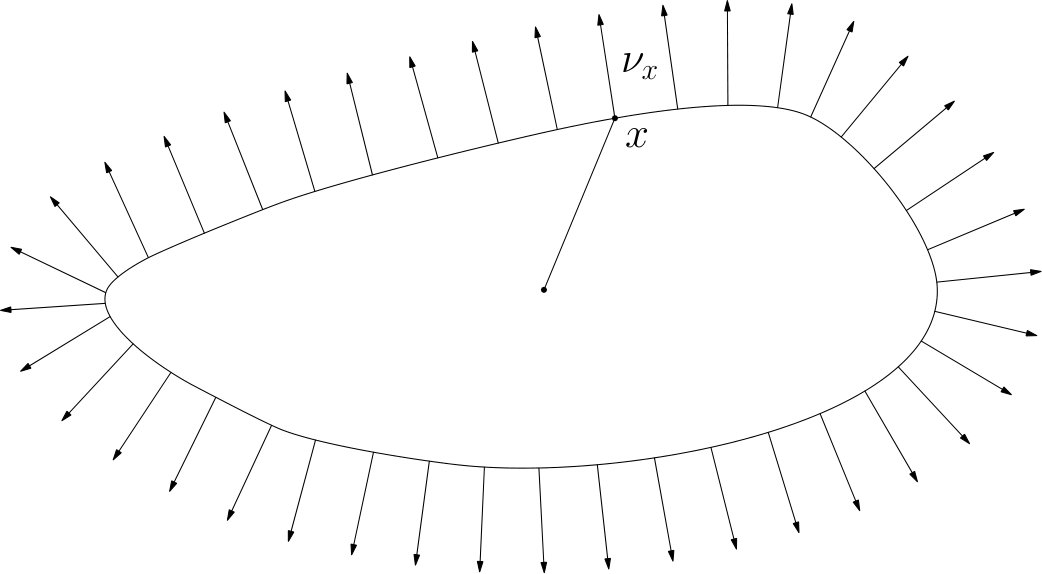 Figure 1
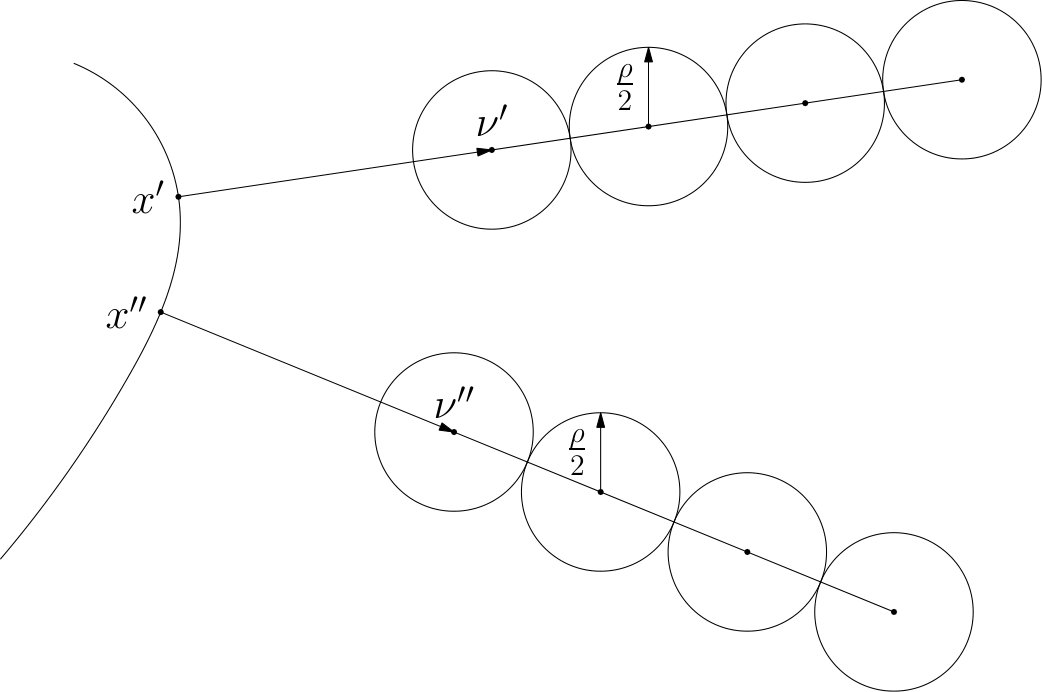 Figure 2
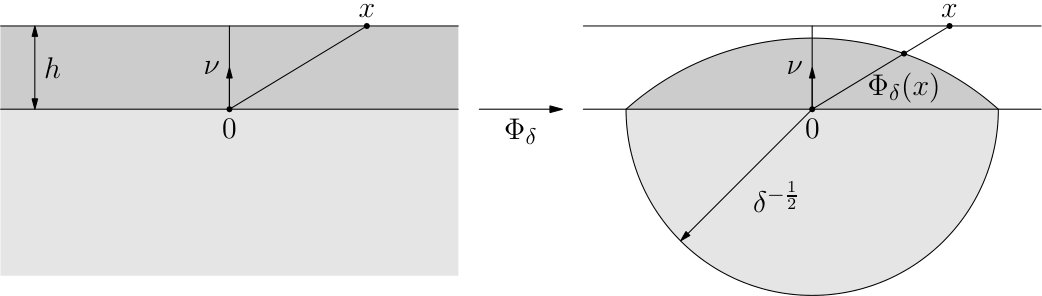 Figure 3
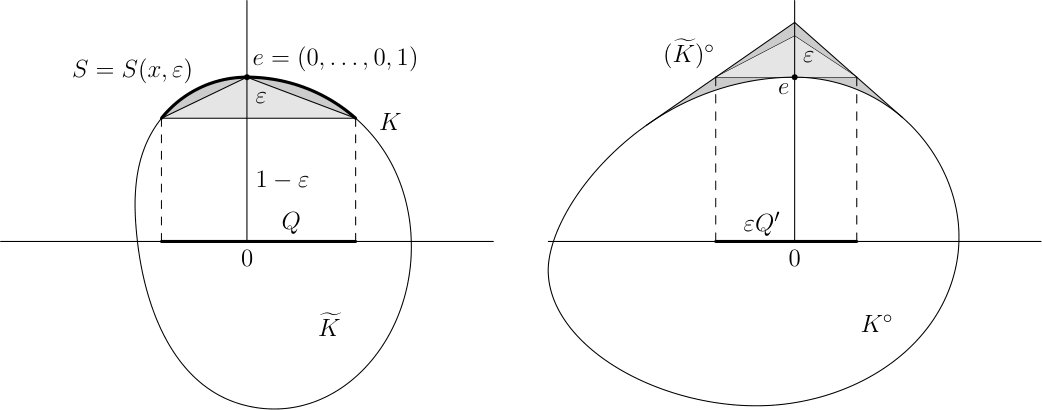 Figure 4
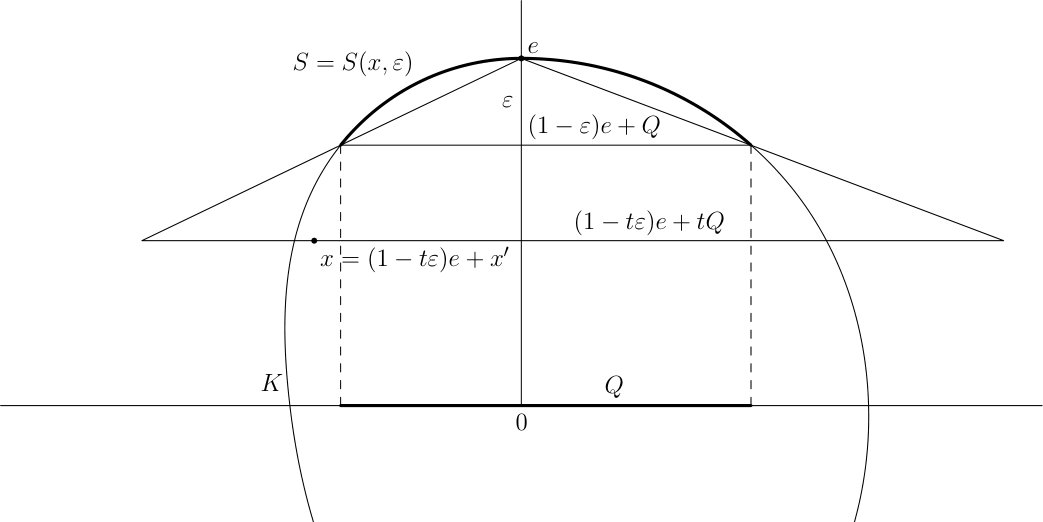 Figure 5
Peer Reviews
No public reviews on file for this paper yet. If you reviewed it on a platform where reviews are public (OpenReview, ICLR, NeurIPS, ICML), you can paste yours below so the community can read it here.
Videos
No videos yet. Explain this paper in a talk, walkthrough, or lecture? Add one.
Fine approximation of convex bodies by polytopes
Márton Naszódi
Dept. of Geometry, Lorand Eötvös University
Pazmany Peter Stny. 1/C, Budapest, Hungary 1117
,
Fedor Nazarov
Department of Mathematics, Kent State University, Kent, OH 44242, USA
and
Dmitry Ryabogin
Department of Mathematics, Kent State University, Kent, OH 44242, USA
Abstract.
We prove that for every convex body with the center of mass at the origin and every , there exists a convex polytope with at most vertices such that .
Key words and phrases:
Approximation by polytopes
The first named author is supported in part by the János Bolyai Research Scholarship of the Hungarian Academy of Sciences, and the National Research, Development, and Innovation Office, NKFIH Grant K119670.
The second and the third named authors are supported in part by U.S. National Science Foundation Grants DMS-0800243 and DMS-1600753
1. Introduction and main result
A convex body in is a compact convex set with non-empty interior. Our goal is to prove the following theorem.
Theorem**.**
Let be a convex body in with the center of mass at the origin, and let . Then there exists a convex polytope with at most vertices such that .
This result improves the 2012 theorem of Barvinok [B] by removing the symmetry assumption and the extraneous factor. Our approach uses a mixture of geometric and probabilistic tools.
We refer the reader to the surveys of Bronshtein [Br] and Gruber [Gr] for the discussion of the history of the problem. Unfortunately, we will have to rely upon two non-trivial classical results (Blaschke-Santaló inequality and its reverse), which makes this paper a bit less reader-friendly than we would like it to be despite our best efforts to provide well-written and easily accessible references for all statements that we use without a proof.
2. Outline of the proof
Without loss of generality, we may assume that has smooth boundary, in particular, has a unique supporting hyperplane at each boundary point. Our task is to find a finite set of points such that satisfies . By duality, this is equivalent to the requirement that every cap , where and is the outer unit normal to at , contains at least one point of .
The key idea is to construct a probability measure on such that for every , we have with some depending on only.
Since there are infinitely many caps, our next aim is to choose an appropriate finite net of cardinality such that the condition for all implies that for all . Given such a net, we will be able to apply a general combinatorial result essentially due to Rogers to construct the desired set of cardinality approximately , which will be still as long as is at most double exponential in .
A natural net to try is the Bronshtein–Ivanov net (see [BI]), which allows one to approximate a point and the corresponding outer unit normal by a point in the net and its outer unit normal simultaneously. Unfortunately, it works only for uniformly -convex bodies, i.e., the bodies that can be touched by an outer sphere of fixed controllable radius at every boundary point.
So, the last step will be to show that the task of approximating an arbitrary convex body can be reduced to that of approximating a certain uniformly -convex body associated with .
In the exposition, these steps are presented in reverse. We start with constructing the associated uniformly -convex body (Sections 3, 4, 5). Then we build the Bronshtein-Ivanov net of appropriate mesh and cardinality, and check that it is, indeed, enough to consider the caps (Sections 6, 7, 8). Finally, we construct the probability measure and finish the proof of the theorem (Sections 9, 10).
3. Standard position
Since the problem is invariant under linear transformations, we can always assume that our body is in some “standard position”. The exact notion of the standard position to use is not very important as long as it guarantees that , say, where is the unit ball in centered at the origin.
One possibility is to make a linear transformation such that John’s ellipsoid (see [Ba], Lecture 3) of the centrally-symmetric convex body is the unit ball, so and, since (see [BF], page 57), it follows that .
4. The function and the mapping
Fix . For , define as the positive root of the equation . Put , .
Lemma 1**.**
The function is a decreasing smooth function on ; is an increasing function mapping to ; is a diffeomorphism of onto the open ball ; if is a unit vector and , then the image of the half-space is the intersection of and the ball of radius centered at (see Figure 1).
Proof.
The first statement is obvious. To show the second one, just notice that is the positive root of and, as , this root increases to . The third claim follows from the observation that the derivative of the mapping is strictly positive and continuous on . To prove the last claim, observe that if , then
[TABLE]
by the definition of . ∎
It follows that for every convex body containing the origin, is also convex. Since for every interval , , we have , the image is contained in . Moreover, if , then is the intersection of balls of radii not exceeding . In particular, for every boundary point , we can find a ball of radius containing whose boundary sphere touches at .
5. From the approximation of to the approximation of
Lemma 2**.**
Let . Suppose that a convex body satisfies and . If is a finite set such that , then .
Proof.
Note that the conditions of the lemma imply that . Since for every , is a positive multiple of , we conclude that as well, so is convex. Suppose that there exists such that . Then,
[TABLE]
However,
[TABLE]
Denoting , , we have
[TABLE]
Since and , it follows that
[TABLE]
Since and , we get
[TABLE]
so cannot be contained in , which contradicts our assumption. ∎
This lemma implies that an -approximation of yields an -approximation of . Note also that is rather close to . More precisely, if , we have . The center of mass of may no longer be at the origin, of course, but the only non-trivial property of we shall really use is the Santaló bound , where
[TABLE]
is the polar body of the convex body . This bound holds for because [math], being the center of mass of , is, thereby, the Santaló point of (see Section 10 for details). For sufficiently small , it is inherited by just because and, thereby,
[TABLE]
Choosing , we see that the body also satisfies the Santaló bound with only marginally worse constant. At last, if , we have .
Thus, replacing by (and by ) if necessary, from now on we can restrict ourselves to the class of convex bodies with smooth boundary such that and for every boundary point , there exists a ball of fixed radius containing whose boundary sphere touches at . Moreover, we can also assume that .
6. The Bronshtein–Ivanov net
Let . Let be a convex body with smooth boundary containing the origin and contained in . Consider the set of points , where is the outer unit normal to at . Let be a maximal -separated set in , i.e., a set such that any two of its members are at distance at least (see Figure 2). We will call the corresponding set a Bronshtein-Ivanov net of mesh for the body .
Lemma 3**.**
We have , and for every , we can find such that .
Proof.
Let and let , . Note that, by the convexity of , we must have , . Hence, we always have
[TABLE]
and the second conclusion of the lemma follows immediately from the definition of .
Now assume that . Write
[TABLE]
Thus, if the balls of radius centered at and are disjoint, so are the balls of radius centered at and . From here we conclude that the balls of radius centered at the points , are all disjoint (see Figure 3) and contained in .
The total number of these balls is at least (for every point in the net, there is a chain of at least balls corresponding to different values of ), whence and the desired bound for follows. ∎
7. The distance bound
The following lemma shows that -caps of convex bodies have small diameters.
Lemma 4**.**
Let . Assume that , , and is the outer normal to at . If , i.e., and , then .
Proof.
Let be the ball of radius containing whose boundary sphere touches at . Then and is the outer unit normal to at , so is centered at . Note also that, since , we have . Now we have
[TABLE]
so
[TABLE]
as required. ∎
8. Discretization
Lemma 5**.**
Let . Let . Let and let and be the outer unit normals to at and respectively. Assume that and . Then
[TABLE]
Proof.
We have
[TABLE]
Here, when passing from the second line to the third one, we used the inequality .
Note now that
[TABLE]
and , so
[TABLE]
∎
Recall that our task is to find a finite set of points such that . This requirement is equivalent to the statement that for every , there exists such that , where is the outer unit normal to at .
Lemma 5 implies that it would suffice to show the existence of satisfying a slightly stronger inequality for every point in the Bronshtein–Ivanov net only, provided that we can ensure that .
To this end, we apply Lemma 4, which shows that the inequality automatically implies the distance bound . Thus, if we choose , we will be in good shape.
By Lemma 3, the size of the corresponding Bronshtein-Ivanov net is at most , which has the correct power of already. However, is superexponential in , which prevents us from just using the full Bronshtein–Ivanov net for and forces us to work a bit harder.
9. Rogers’ trick
We now remind the reader a simple abstract construction essentially due to Rogers [R].
Lemma 6**.**
Let be a family of measurable subsets of a probability space such that for some , we have for all . Then there exists a set of cardinality at most that intersects each .
Here stands for the least non-negative integer greater than or equal to .
Proof.
First we choose points randomly and independently according to and obtain a random set . For every fixed , we have
[TABLE]
Hence, the expected number of sets disjoint from is at most . Choosing one additional point in each such set, we shall get a set of cardinality intersecting all . Puting , we get the desired bound. ∎
Now, let . Suppose that we can construct a probability measure on such that for every and every , we have with some .
We take the Bronshtein–Ivanov net of constructed in Section 6. Its cardinality does not exceed , where is of order . Consider the caps . By Lemma 6, there exists a set of cardinality at most that intersects each of those caps. If , then the cardinality of is of order .
10. The construction of the measure
Let be a positive integer (we shall need both and ). Recall that for a convex body containing the origin in its interior, its polar body is defined by
[TABLE]
We shall need the following well-known (but, in part, highly non-trivial) facts about the polar bodies:
Fact 1. If has a smooth boundary and is strictly convex, that is, contains no line segment on its boundary, then the relation , , , defines a continuous one to one mapping from to . The vector is just , where is the outer unit normal to at (see [Sch], Corollary 1.7.3, page 40).
Fact 2. For any convex body containing the origin in its interior, we have (see [BM], [K], [NAZ]).
Fact 3. If is a convex body with the center of mass at the origin, then
[TABLE]
(see [MP]).
Lemma 7**.**
Let be a convex body containing the origin in its interior and satisfying the Santaló bound . For any Borel set , define . Consider the “cones” and and put
[TABLE]
Then is a probability measure on invariant under linear automorphisms of and for all and all .
Proof.
The invariance of under linear automorphisms of follows immediately from the general properties of the volume with respect to linear transformations and the relation .
Apply an appropriate linear transformation to put the body in such a position that . Then is given by . Let be the convex body such that is the cross-section of by the hyperplane . Let .
Our first goal will be to show that
[TABLE]
where is the polar body to in .
To this end, note that contains the interior of the pyramid of height with the base , so
[TABLE]
We claim now that the interior of the pyramid is contained in (see Figure 4). Since , and , it suffices to show that .
To this end, take , and let , , so , where .
Since , by the convexity of , (see Figure 5). Now, , hence, . Let with . Then . Thus, . It follows by the convexity of that , and, therefore,
[TABLE]
Multiplying these two estimates, we get the desired inequality.
On the other hand, we have , and . Hence,
[TABLE]
Combining it with the previous estimate and using Fact 2, we get
[TABLE]
Finally, since , we get
[TABLE]
as required. ∎
This lemma, together with the discussion in Section 9, completes the proof of the theorem.
The reference list from the paper itself. Each links out to its DOI / PubMed record.
- 1[Ba] K. Ball , An elementary introduction to modern convex geometry , in “Flavors of Geometry”, Edited by Silvio Levy, Mathematical Sciences Research Institute Publications, 31, Cambridge Univ. Press (1997). http://library.msri.org/books/Book 31/files/ball.pdf
- 2[B] A. Barvinok , Thrifty approximations of convex bodies by polytopes , Int. Math. Res. Not. IMRN 16 (2014), 4341-4356. https://arxiv.org/abs/1206.3993 v 2
- 3[BF] T. Bonnesen and W. Fenchel , Theory of convex bodies , BCS Associates, Moscow, Idaho, 1987.
- 4[BM] J. Bourgain, V. Milman , New volume ratio properties for convex symmetric bodies in ℝ n superscript ℝ 𝑛 {\mathbb{R}}^{n} , Invent. Math. 88 (1987), 319–340.
- 5[BI] E. Bronshtein and L. Ivanov , The approximation of convex sets by polyhedra (Russian) , Sibirsk. Mat. Zh. 16 (1975), 1110-1112; translation in Siberian Math. J. 16 (1975), no. 5, 852-853 (1976).
- 6[Br] E. Bronshteĭn , Approximation of convex sets by polyhedra (Russian) , Sovrem. Mat. Fundam. Napravl., 22 (2007), 5-37.
- 7[Gr] P. Gruber , Aspects of approximation of convex bodies , Handbook of convex geometry, North-Holland, Amsterdam, Vol. A, B, (1993), 319-345.
- 8[G] B. Grünbaum , Partitions of mass-distributions and of convex bodies by hyper- planes , Pacific J. Math. 10 (1960), 1257-1261.