Intersecting hexagons in 3-space
Jozsef Solymosi, Ching Wong

TL;DR
This paper investigates the combinatorial geometry of hexagons in three-dimensional space, establishing that the maximum number of 'fat' hexagons on n points without heavy intersections grows slower than quadratically with n.
Contribution
It introduces the concept of heavy intersection for hexagons in 3D and proves a bound on their maximum number under certain geometric conditions.
Findings
Number of heavy-intersection-free fat hexagons is o(n^2)
Heavy intersections are constrained in 3D configurations
Provides bounds for geometric arrangements of hexagons
Abstract
Two hexagons in the space are said to intersect heavily if their intersection consists of at least one common vertex as well as an interior point. We show that the number of hexagons on n points in 3-space without heavy intersections is o(n^2), under the assumption that the hexagons are "fat".
Click any figure to enlarge with its caption.
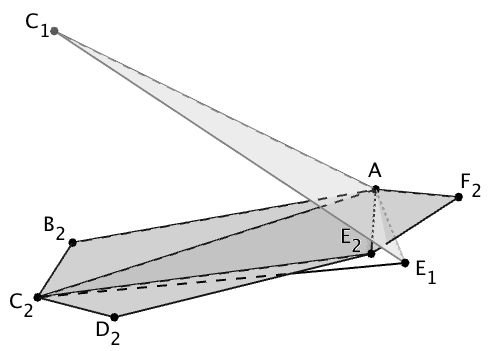 Figure 1
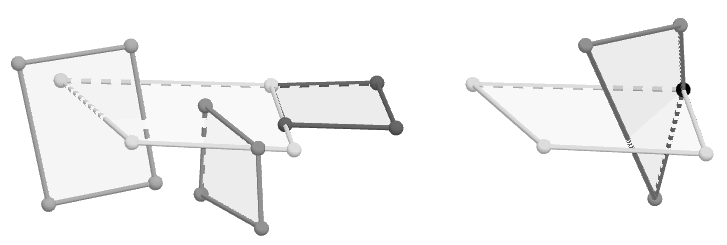 Figure 2
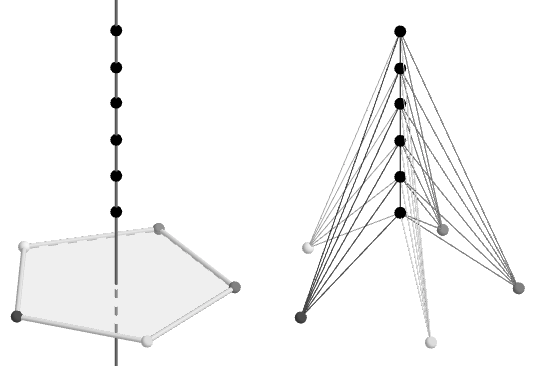 Figure 3
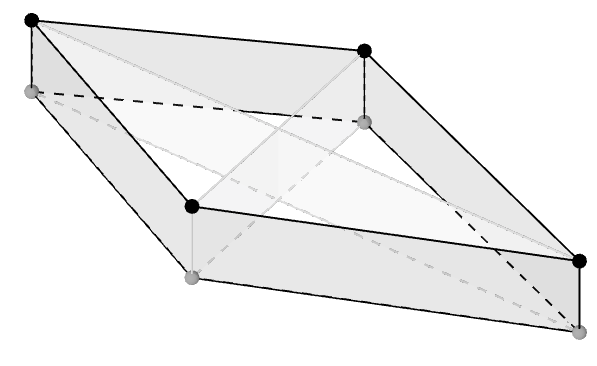 Figure 4
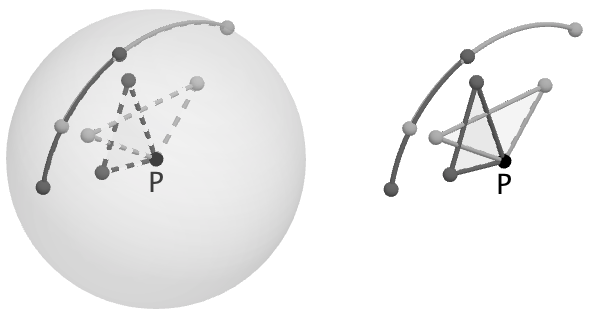 Figure 5
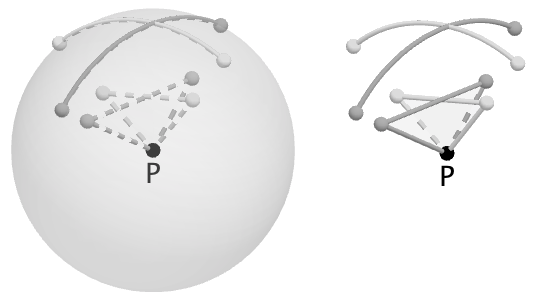 Figure 6
Peer Reviews
No public reviews on file for this paper yet. If you reviewed it on a platform where reviews are public (OpenReview, ICLR, NeurIPS, ICML), you can paste yours below so the community can read it here.
Videos
No videos yet. Explain this paper in a talk, walkthrough, or lecture? Add one.
Intersecting hexagons in 3-space
József Solymosi
Department of Mathematics, University of British Columbia, Vancouver, BC, Canada V6T 1Z2
and
Ching Wong
Department of Mathematics, University of British Columbia, Vancouver, BC, Canada V6T 1Z2
Abstract.
Two hexagons in the space are said to intersect heavily if their intersection consists of at least one common vertex as well as an interior point. We show that the number of hexagons on points in 3-space without heavy intersections is , under the assumption that the hexagons are ‘fat’.
The first author was supported by NSERC, NKFI KKP 133819, and OTKA NK 104183 grants
1. Introduction
The problem of finding the maximum number of hyperedges in a geometric hypergraph in -dimensional space with certain forbidden configurations (intersections) is a general problem in discrete geometry. Several such problems were considered by Dey and Pach in [1]. We are interested in finding the maximum number of (planar and convex) polygons on some vertex set of points in -space, where no two of them are allowed to intersect in certain ways. In this paper, we confine our attention to 3-space, and by polygons we mean planar polygons, i.e. the vertices are co-planar, which are convex. As usual, a - (where ) is a polygon with vertices.
1.1. Almost disjoint polygons
It was asked by Gil Kalai [2] and independently by Günter Ziegler (quoted from [3]) what the maximum possible number of triangles spanned by points is, such that any two are almost disjoint:
Definition 1** (Almost disjoint polygons).**
Two polygons in -space are said to be almost disjoint if they are either disjoint, or their intersection consists of one common vertex. See Figure 1.
Let be the maximum possible number of pairwise almost disjoint -gons on points in -space. It is easy to see that for all , by arbitrarily forming a -gon from each -gon.
We remark that a set of pairwise almost disjoint triangles on points gives a partial Steiner triple system of order . A simple counting reveals that such system has at most triples. It follows that
[TABLE]
for every .
Károlyi and Solymosi [3] constructed configurations showing that for some universal constant . Finding sharper lower bounds seems like a very hard problem. In fact, it is not even known if the genus of a polytope on vertices can have order . If so, the magnitude of would be . The best lower bound of the largest genus is , due to a construction of McMullen, Schulz and Wills [4]. For more details, we refer the interested reader to [6] where Ziegler gives a simplified construction providing the same bound.
When , a tight asymptotic bound can be obtained if we relax the assumption a little by allowing the triangles to intersect also in an (entire) edge. Let be the maximum possible number of -gons on points so that any two of them are either disjoint, or intersect in a vertex or an edge. Since we allow more intersections, we have for all and . It is again clear that decreases with , for all .
Proposition 2**.**
As ,
[TABLE]
The proof is given in Section 2.
1.2. Non-heavily intersecting polygons
In this chapter, we focus on an even more relaxed assumption on the intersections of the -gons.
Definition 3** (heavily intersecting polygons).**
Two polygons in -space are said to intersect heavily if their intersection consists of at least one common vertex as well as an interior point.
We say that a collection of -gons has no heavy intersections if no two of these polygons intersect heavily. See Figure 2.
Let be the maximum possible number of -gons without heavy intersections on points in -space. It is, once again, true that and , for all .
In such arrangements, two -gons cannot share a diagonal and so for . In fact, the proof of Proposition 2 (first part) works here as well, and so
[TABLE]
for every .
This upper bound is actually sharp, in magnitude, for triangles and quadrilaterals (). One can give a construction of quadrilaterals on points without heavy intersections as follows: Let be an even number and suppose we are given points in general position (no three points collinear) on a plane . Fix any vector not parallel to . Then the points are incident to desired quadrilaterals with vertices , where . Figure 3 shows an example when .
When , we show that the number of hexagons without heavy intersections is , under an extra assumption on the ‘fatness’ of the hexagons defined below.
Definition 4** (Fat hexagons).**
Let and . A hexagon is -fat if
- (1)
the ratio of any two sides is bounded between and , and 2. (2)
it has three non-neighbour vertices having interior angles between and .
Our main tool is the Triangle Removal Lemma of Ruzsa and Szemerédi, which states that for any , there exists such that any graph on vertices with at least pairwise edge-disjoint triangles, has at least triangles in total. See [5] for the original formulation of this result. The following is the precise statement of our main theorem, which is proved in Section 3.
Theorem 5**.**
For any and , there is a function
[TABLE]
such that any family of -fat hexagons in -space on points without heavy intersections has size at most .
2. Proof of Proposition 2
We first show that . Given such a set of triangles on points. Pick any of these points, say , and project the remaining points in -space onto a sphere centred at . We want to upper bound the number of triangles incident with the point . For each of such triangles, say , we project the line segment between and onto the sphere . These geodesic segments, together with the projected points, form a graph on having at most vertices. Here, we subdivide an edge (geodesic segment) if there are vertices lying on it. We note that if there were multiple edges on , then their corresponding triangles would lie on the same plane and intersect in an interior point, as shown in Figure 4. Hence, the number of edges in is at least the number of triangles incident to . As illustrated in Figure 5, the graph is planar, and so it has at most edges. Hence,
[TABLE]
Now, we show that whenever is odd. To see this, we are using the well-known Christmas tree arrangement. Let there be points on a circle centred at the origin on the -plane and points on -axis, as in Figure 6 (left). So we have a total of points in -space. We consider the triangles with one vertex on the circle, and the other two vertices being a consecutive pair of points chosen on the -axis. See Figure 6 (right). It is easy to see that if two triangles are not disjoint, they intersect in either a vertex or an edge.
3. Proof of Theorem 5
Let . Given many -fat hexagons on vertices in -space. We show that two of these hexagons intersect heavily, when is large enough. We may assume, in particular, that no two hexagons share a diagonal.
To reduce the dimension of the ambient space, we project these hexagons onto a random plane such that no two vertices share the same projection and that a positive fraction of the hexagons is -fat. Indeed, if we project a -fat hexagon onto a plane making an angle at most with the plane containing , it is straightforward to show that the projected hexagon is -fat, where
[TABLE]
The existence of heavily intersecting hexagons relies on a similar-slope property. This can be described quantitatively by the difference of two angles of inclination. To this end, let be the smallness of such differences which is to be determined later.
We choose from the -fat projected hexagons the most popular family consisting of hexagons, which have inscribed triangles of similar shapes and orientations.
More precisely, let us enumerate by any order the projected hexagons as and label their vertices as , oriented counter-clockwise, where are the three non-neighbour vertices having angles between and .
There exists a positive fraction of these hexagons so that for any , the inclined angles of the diagonals and differ by at most . Similarly the same property holds true for the diagonals and in yet a sub-collection of hexagons.
We define to be the graph whose vertices are the projected points and whose edges are from the triangles formed by the vertices chosen above. Then, as we assumed that no two hexagons share a diagonal, contains edge-disjoint triangles. An application of the Triangle Removal Lemma yields, when is large enough, a triangle whose edges come from three different hexagons, say , and . For each , let be the triangle .
We are ready to study the intersection properties of these three hexagons in the -space. In other words, we now ‘unproject’ the points.
Two of the triangles, say and , lie on the same side of and let be the triangle making a larger angle with . Then, as shown in Figure 7, the hexagon intersects heavily with the triangle , and hence with the hexagon , as long as the three non-neighbour vertices lie outside of the triangle on the plane of projection, which is guaranteed if we choose
[TABLE]
the right hand side being a lower bound of the six angles etc. under the -fatness assumption. This completes the proof.
4. Open problems
The original question of Kalai and Ziegler is still widely open even if we restrict the question to fat triangles. Let us say that a triangle is fat if all its angles are between 50 and 70 degrees. Let us state a special case of the Kalai-Ziegler problem
Conjecture 6**.**
In 3-space the number of almost disjoint fat triangles spanned by points is
One would expect a type upper bound with some but we can’t even show On the other hand we are not aware of any construction with a superlinear number of almost disjoint fat triangles.
Although Regularity Lemmas were used in discrete geometry, it is very likely that in the proof of Theorem 5 one could substitute it with some geometric arguments providing much better bounds.
The reference list from the paper itself. Each links out to its DOI / PubMed record.
- 1[1] T. K. Dey and J. Pach, Extremal problems for geometric hypergraphs. Discrete Comput. Geom. 19 (1998), no. 4, 473–484.
- 2[2] G. Kalai, communication with J. Solymosi at Euroconference in Mathematics on Crete, Anogia, Griechenland, 19-25 August 2000 (Organizers E. Welzl and G.M. Ziegler)
- 3[3] G. Károlyi and J. Solymosi, Almost disjoint triangles in 3-space. Discrete and computational geometry and graph drawing (Columbia, SC, 2001). Discrete Comput. Geom. 28 (2002), no. 4, 577–583.
- 4[4] P. Mc Mullen, Ch. Schulz and J. M. Wills, Polyhedral 2 2 2 -manifolds in E 3 superscript 𝐸 3 E^{3} with unusually large genus. Israel J. Math. 46 (1983), no. 1–2, 127–144.
- 5[5] I. Z. Ruzsa and E. Szemerédi, Triple systems with no six points carrying three triangles. In Combinatorics , (Proc. Fifth Hungarian Colloq., Keszthely, 1976), Vol. II, Colloq. Math. Soc. János Bolyai, 18, North-Holland, Amsterdam-New York, 1978, pp. 939–945.
- 6[6] G. M. Ziegler, Polyhedral surfaces of high genus. In Discrete differential geometry , Oberwolfach Semin., 38, Birkhauser, Basel, 2008, pp. 191–213.