Nearby Young, Active, Late-type Dwarfs in Gaia's First Data Release
Joel H. Kastner (Rochester Institute of Technology), Germano Sacco, (INAF Arcetri Observatory), David Rodriguez (American Museum of Natural, History), Kristina Punzi (RIT), B. Zuckerman (UCLA), Laura Vican Haney (UCLA)

TL;DR
This study uses Gaia DR1 data to confirm the youth and proximity of a subset of GALNYSS stars, revealing many are nearby, young late-type stars, including previously unrecognized objects, thus expanding the known population of young stellar objects.
Contribution
First validation of Gaia DR1 distances and ages for GALNYSS candidate young stars, identifying new nearby, young late-type stars and binaries.
Findings
19 GALNYSS stars within 120 pc are confirmed as young (10-100 Myr).
Several hundred nearby young stars are identified in the GALNYSS sample.
Most newly identified young stars are located north of +30° declination.
Abstract
The Galex Nearby Young Star Survey (GALNYSS) has yielded a sample of 2000 UV-selected objects that are candidate nearby (150 pc), young (age 10--100 Myr), late-type stars. Here, we evaluate the distances and ages of the subsample of (19) GALNYSS stars with Gaia Data Release 1 (DR1) parallax distances pc. The overall youth of these 19 mid-K to early-M stars is readily apparent from their positions relative to the loci of main sequence stars and giants in Gaia-based color-magnitude and color-color diagrams constructed for all Galex- and WISE-detected stars with parallax measurements included in DR1. The isochronal ages of all 19 stars lie in the range 10--100 Myr. Comparison with Li-based age estimates indicates a handful of these stars may be young main-sequence binaries rather than pre-main sequence stars. Nine of the 19 objects have…
Click any figure to enlarge with its caption.
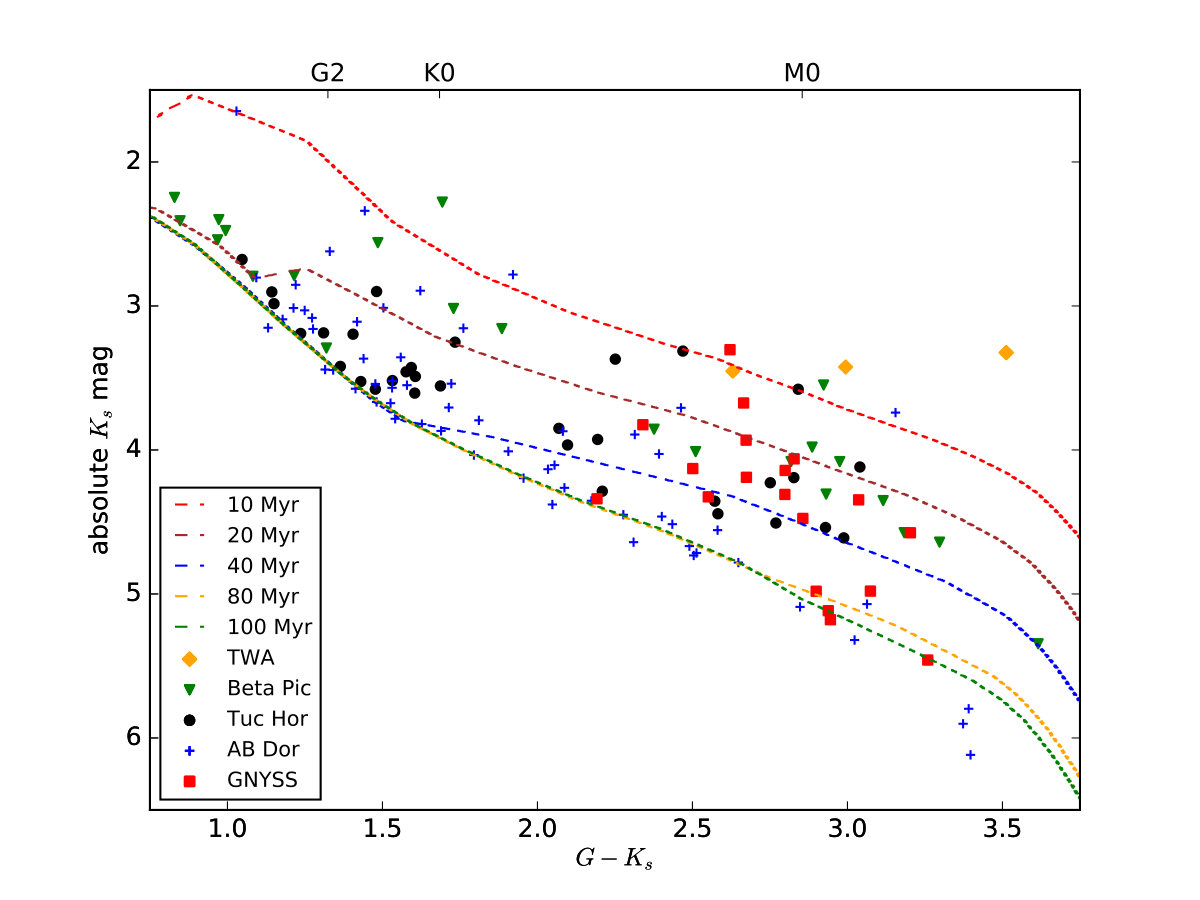 Figure 4
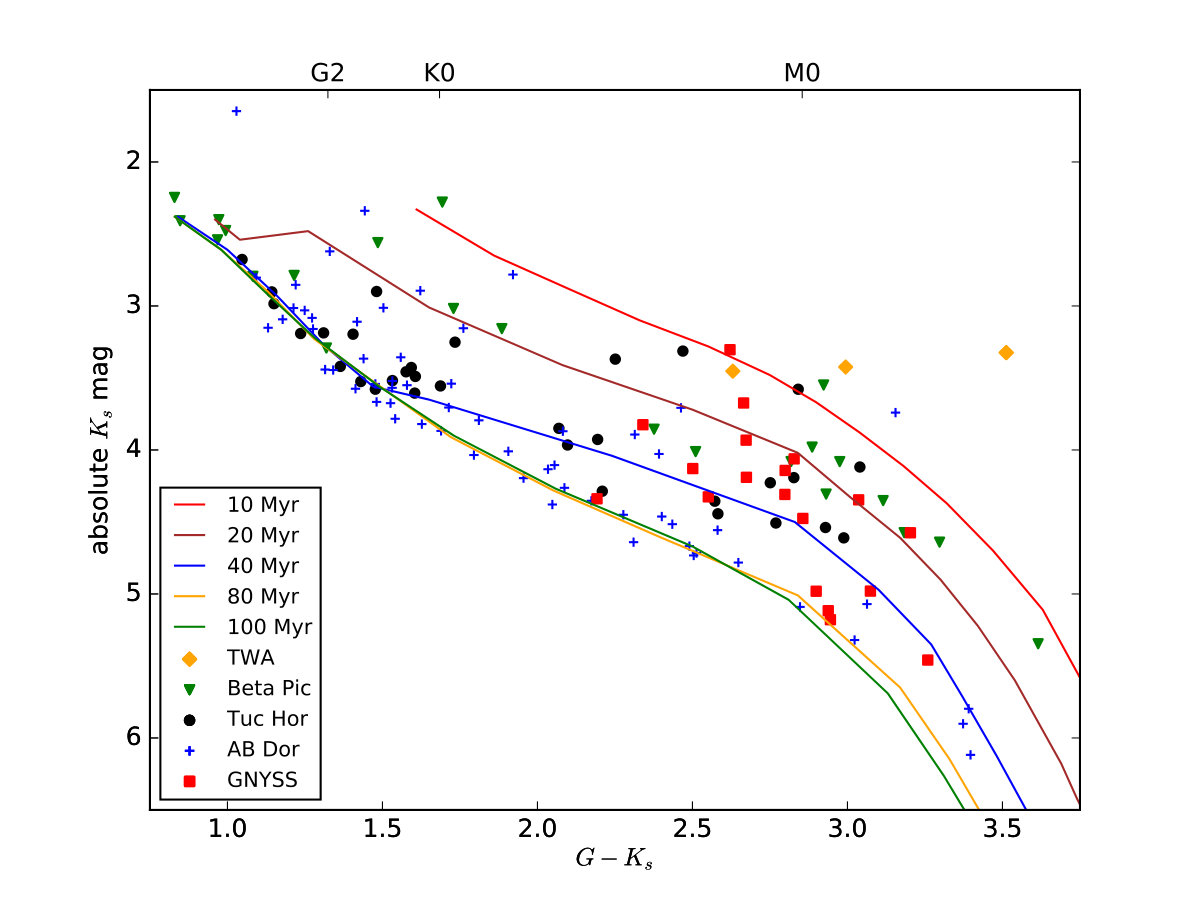 Figure 4
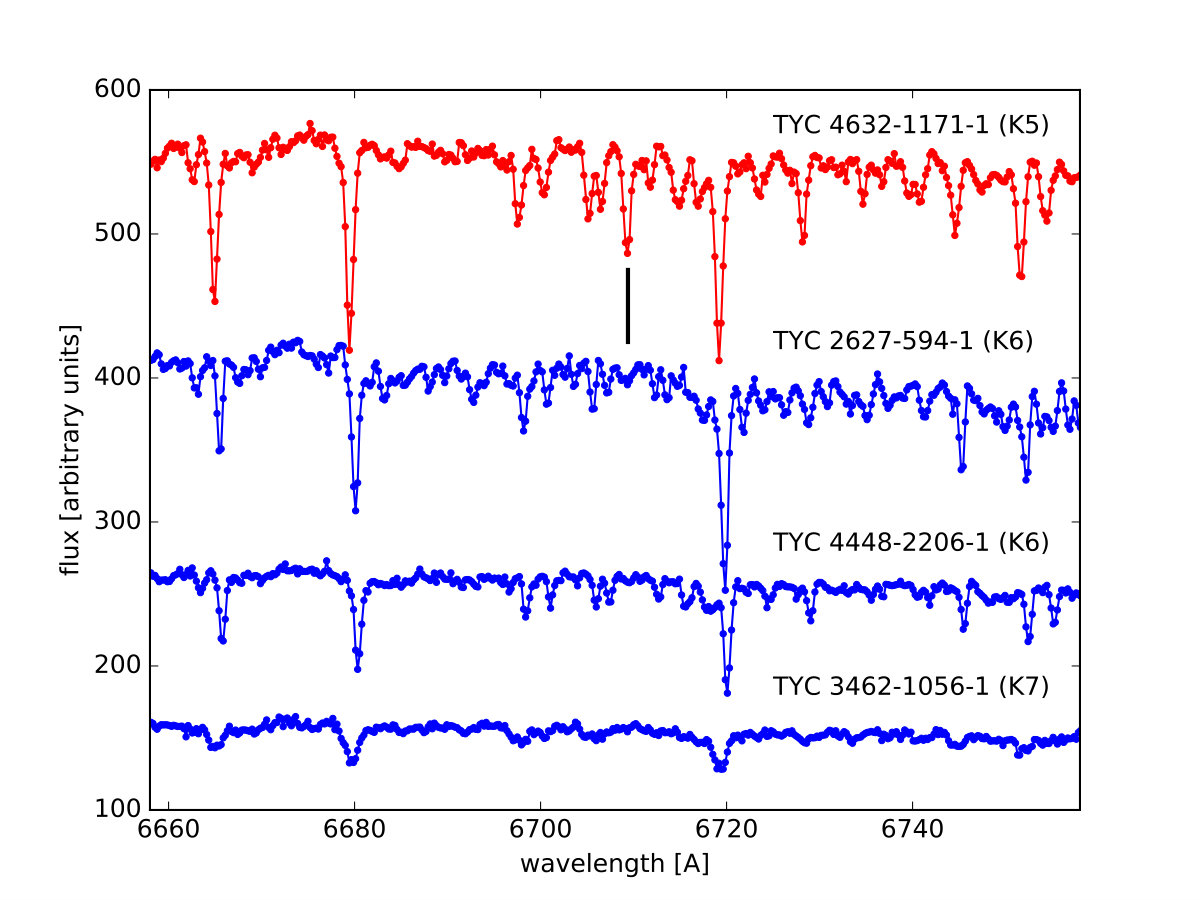 Figure 7
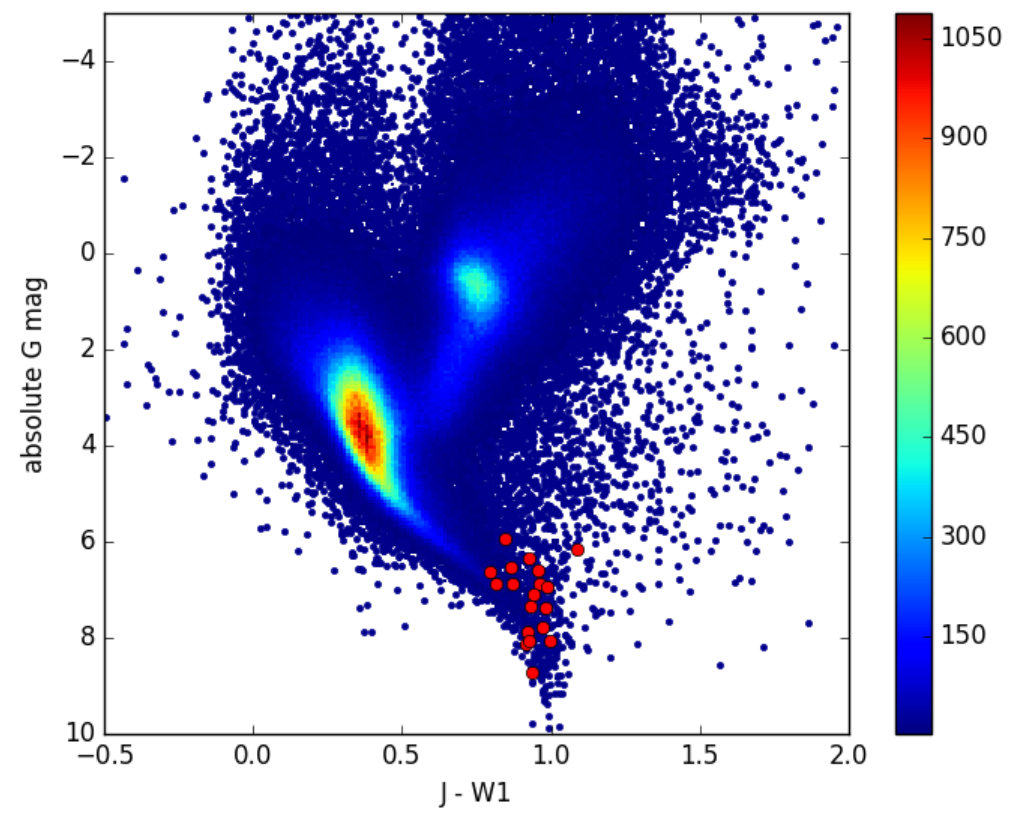 Figure 1
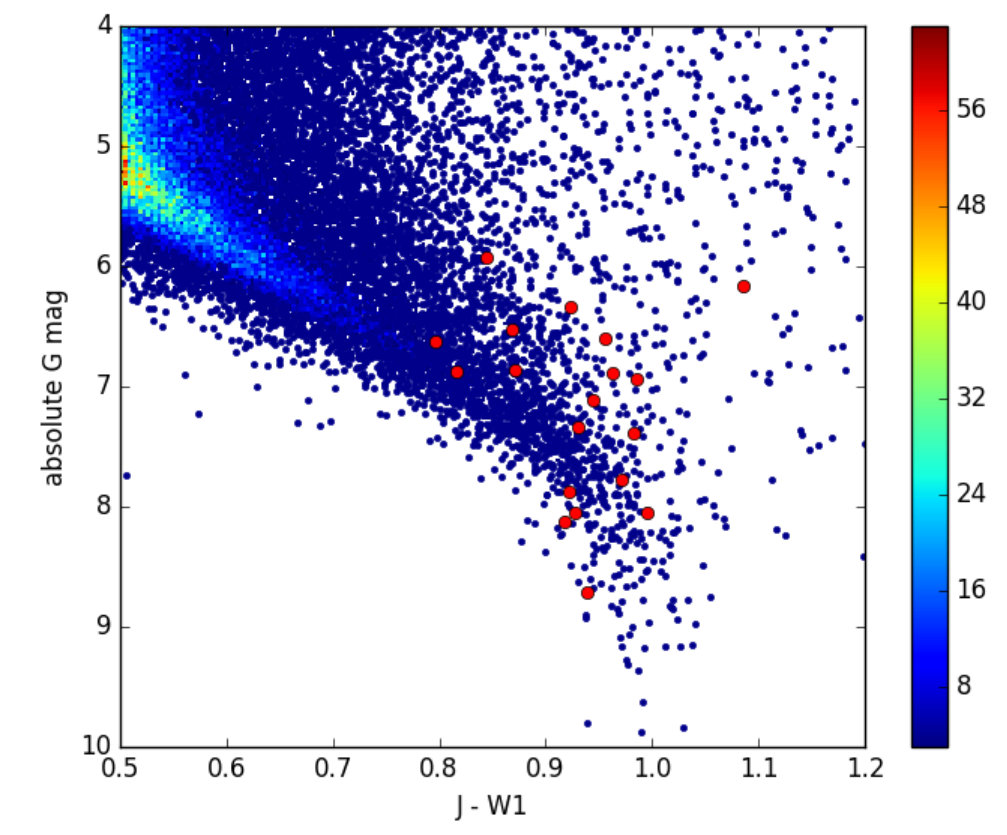 Figure 1
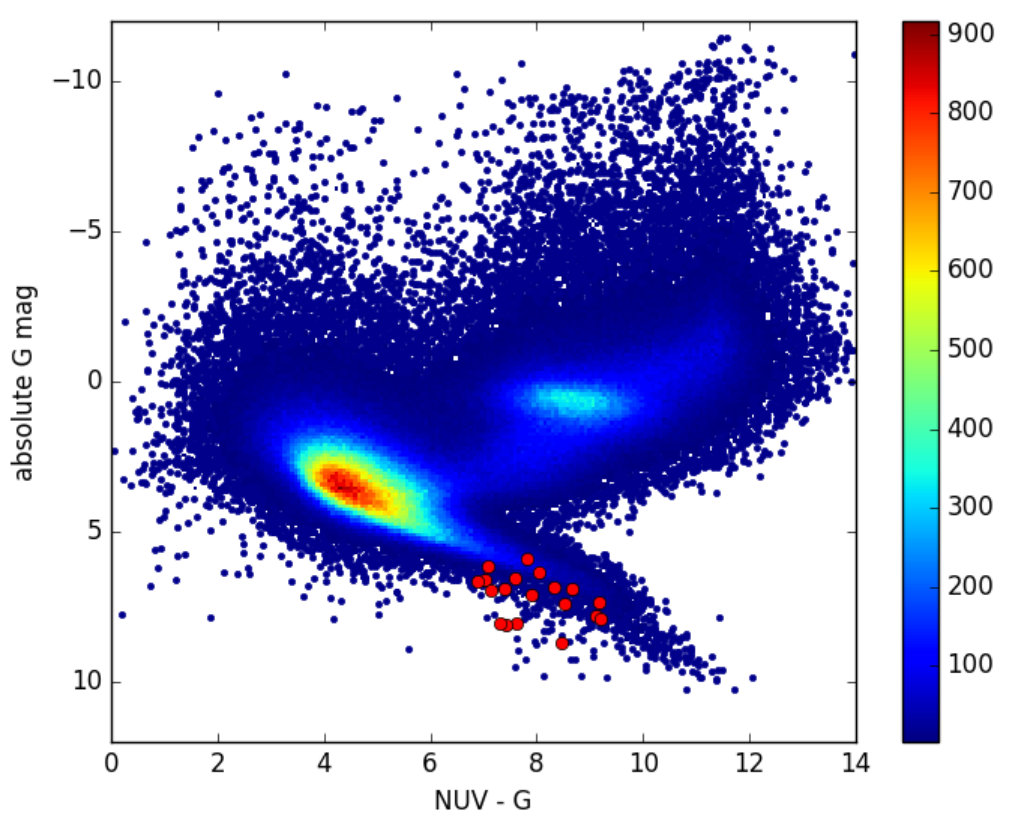 Figure 2
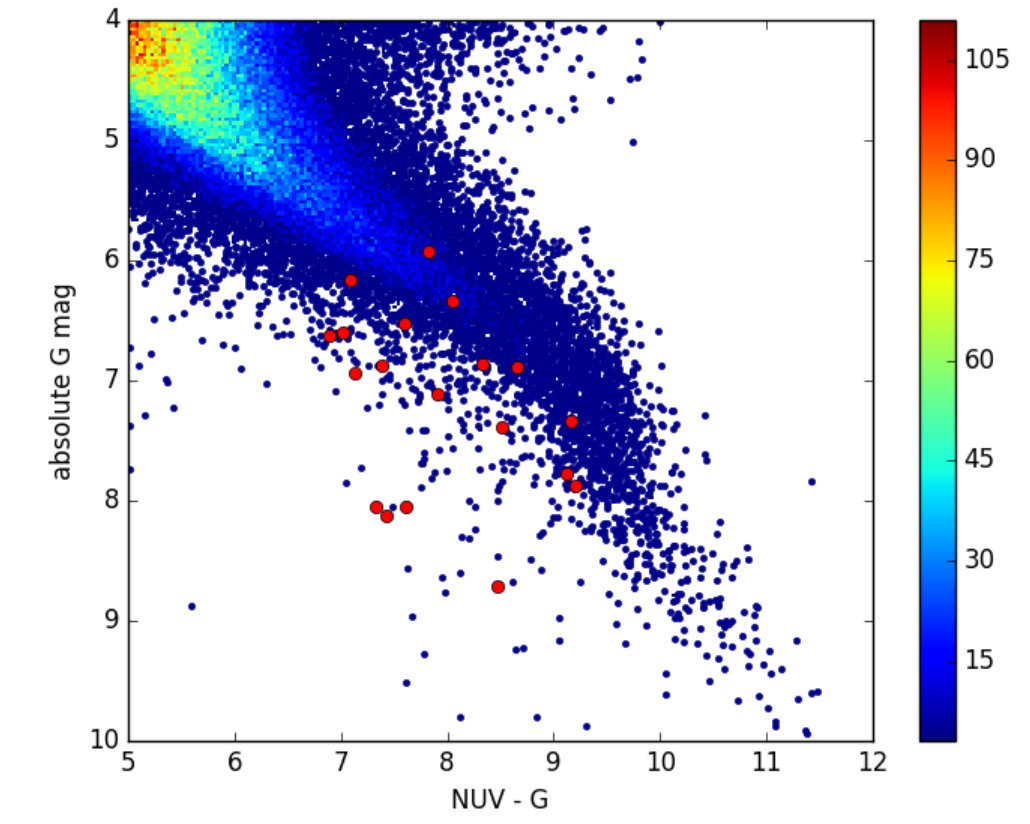 Figure 2
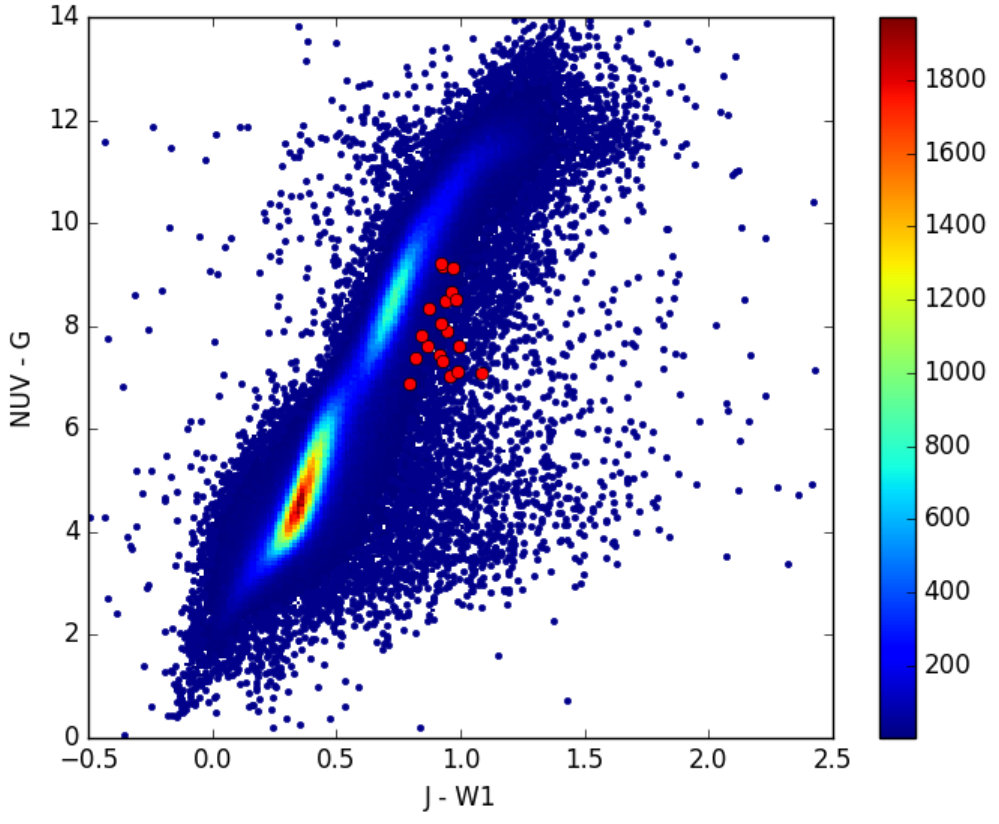 Figure 3
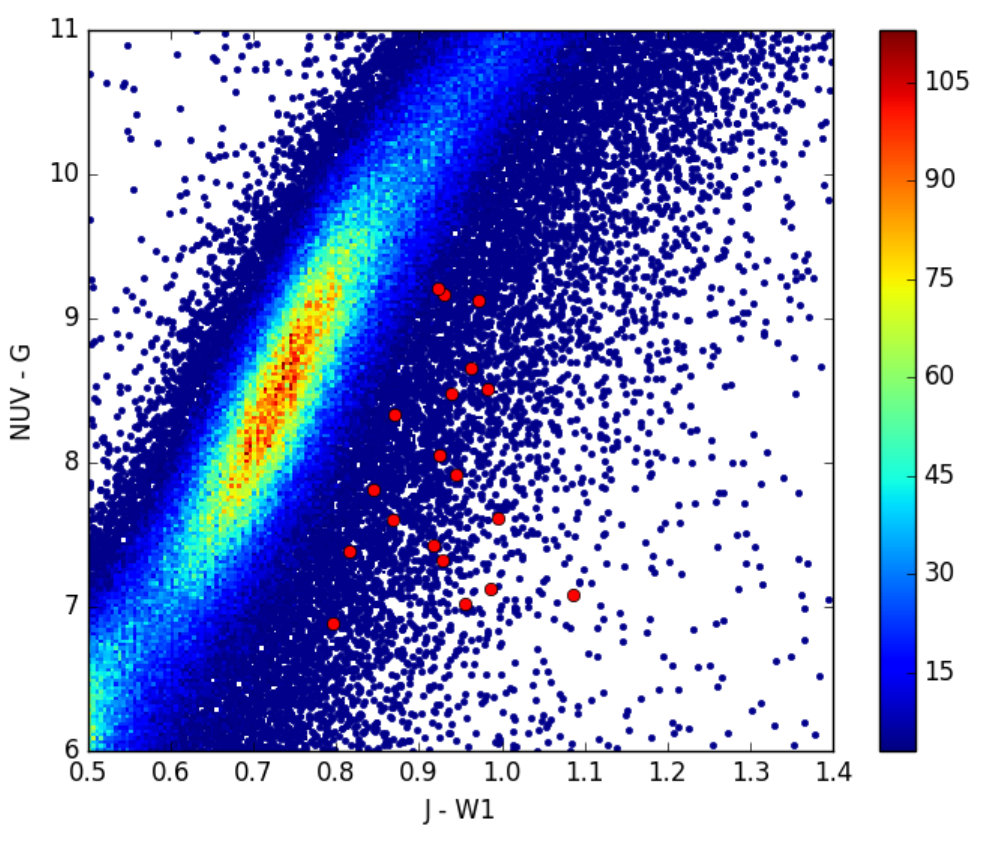 Figure 3
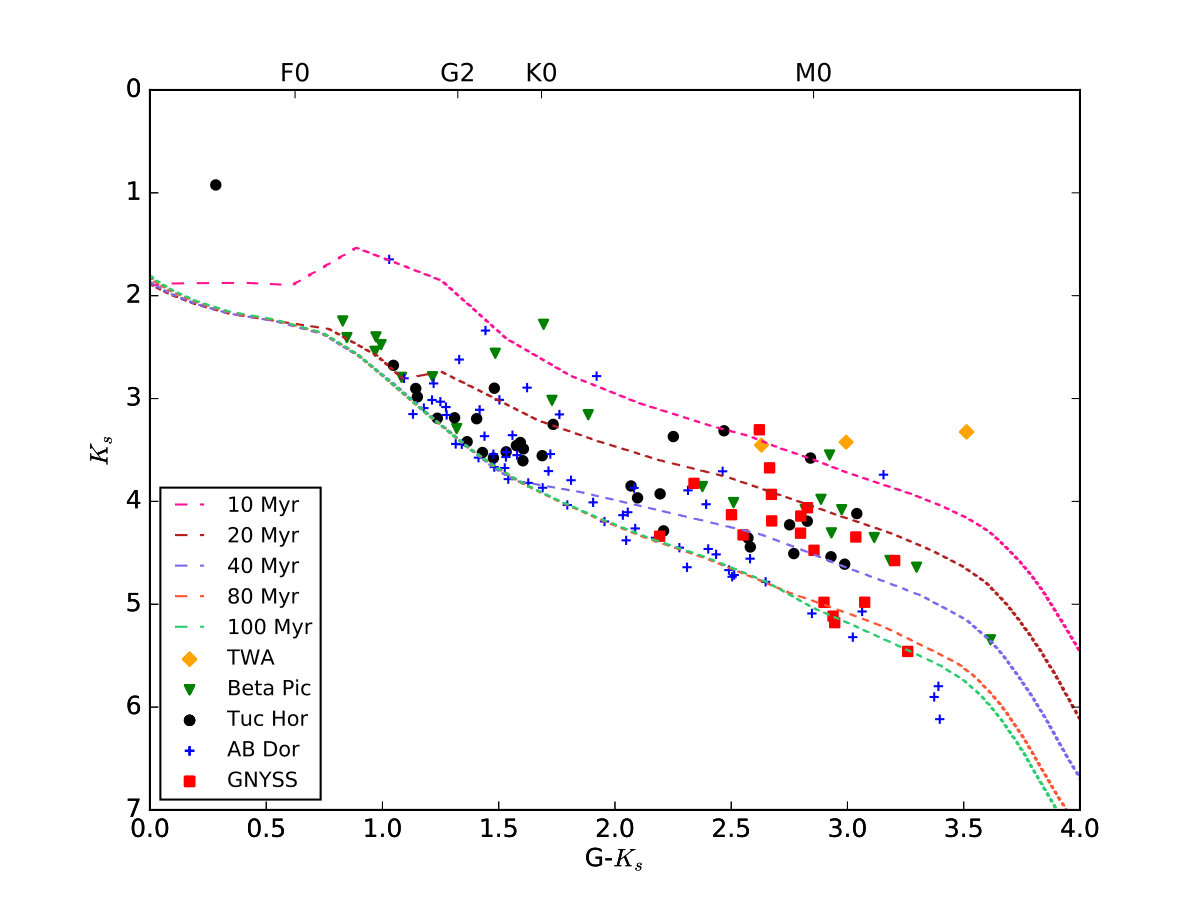 Figure 4
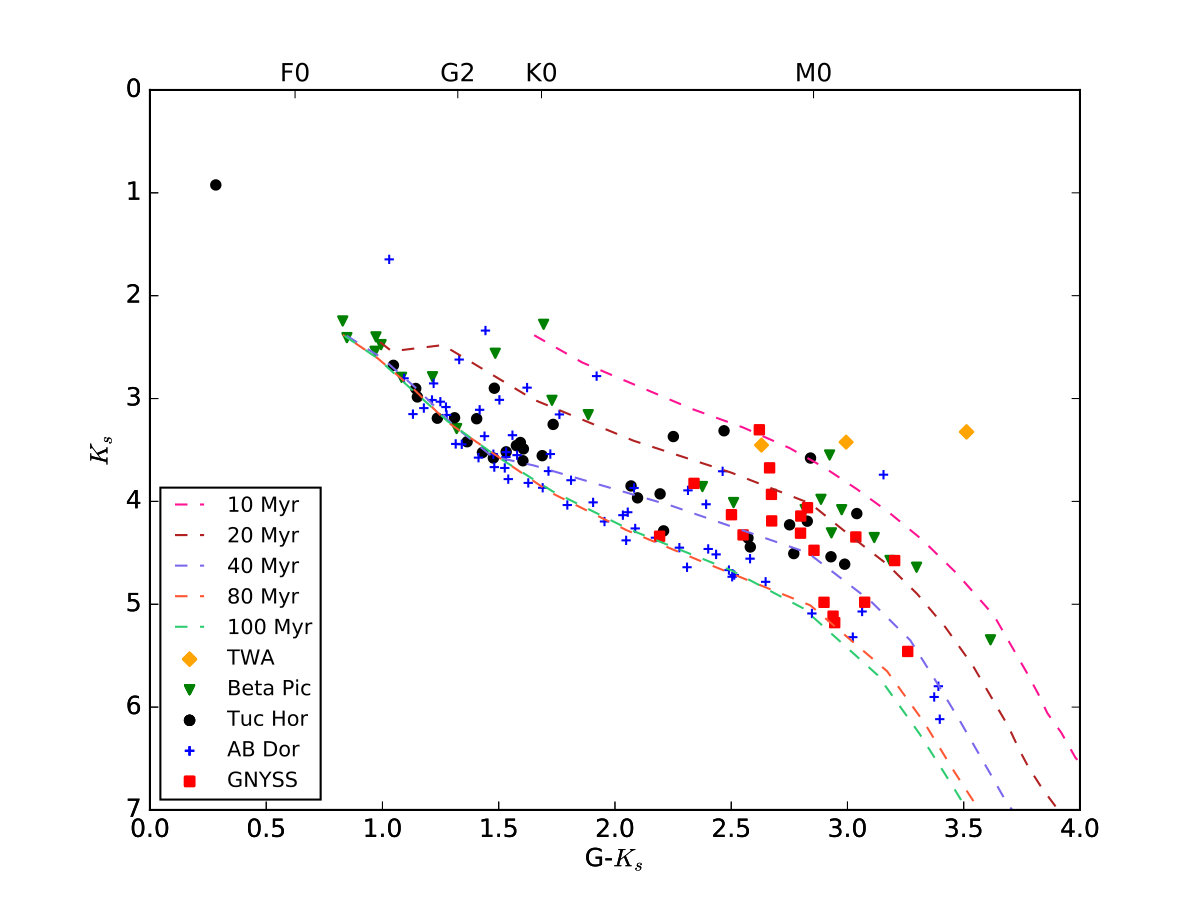 Figure 4
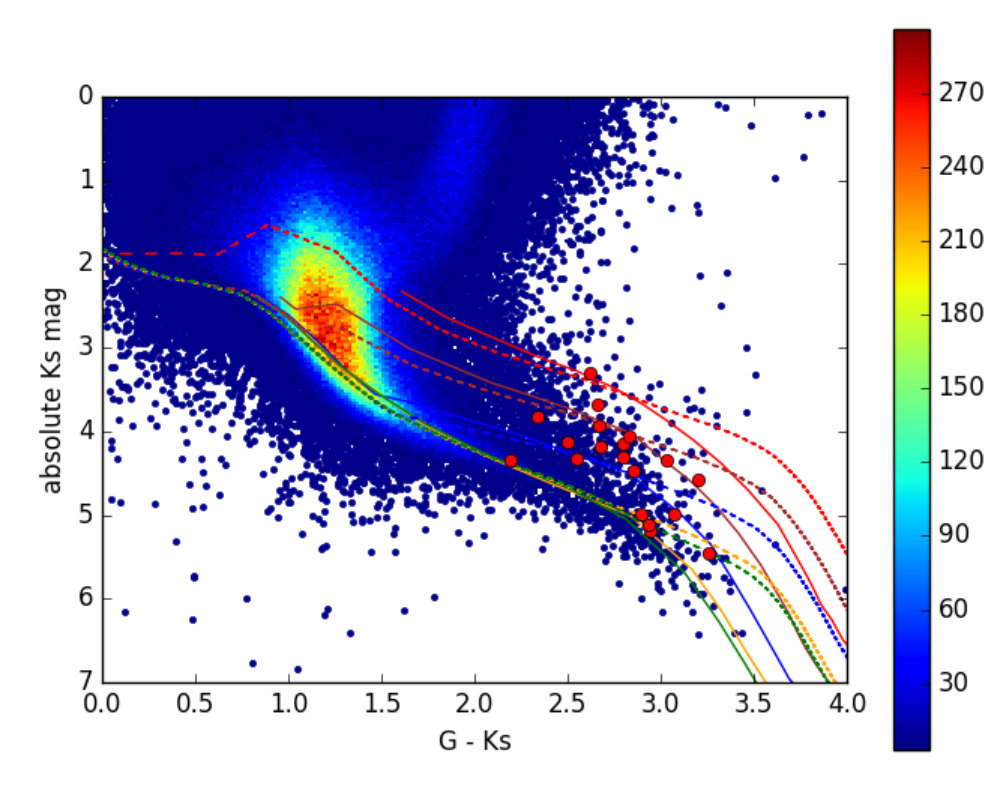 Figure 5
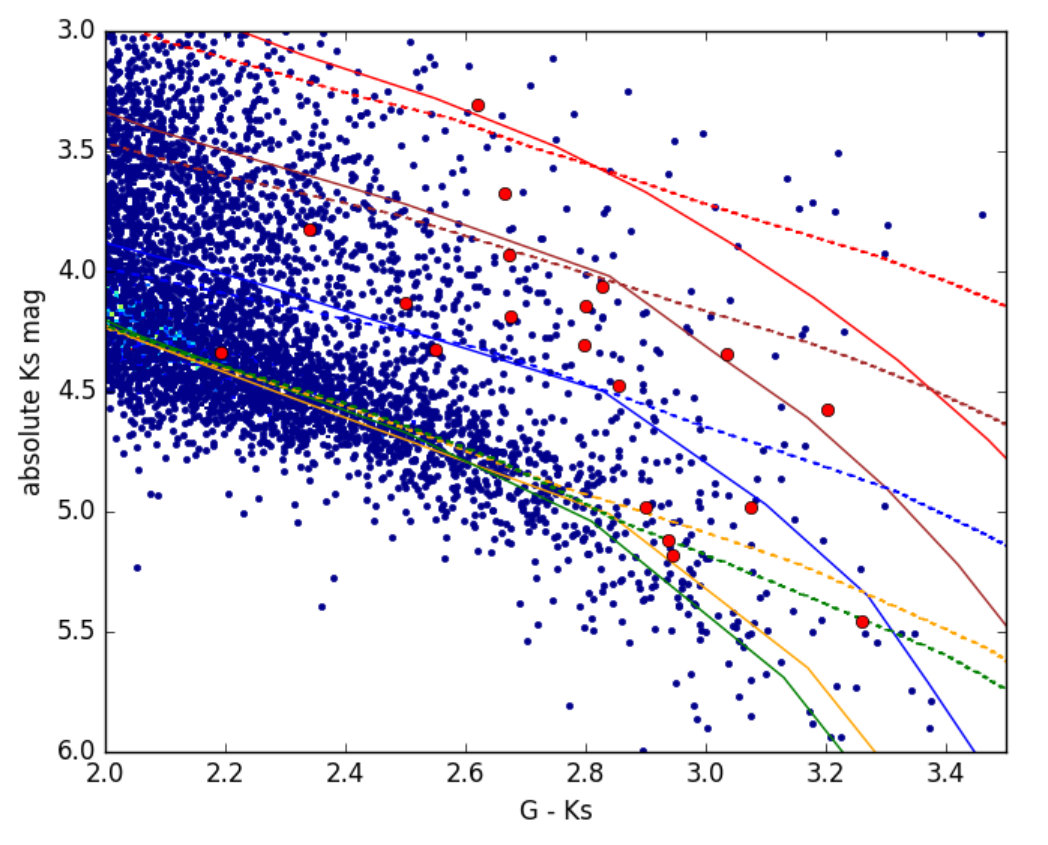 Figure 5
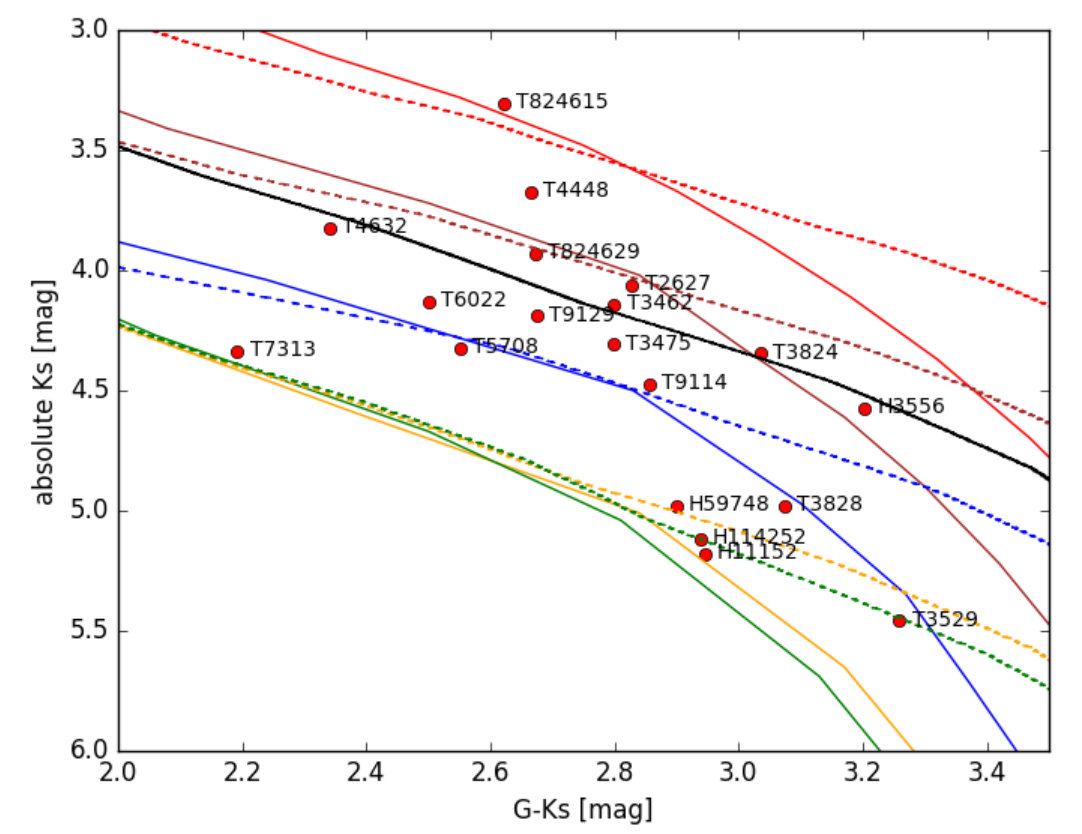 Figure 6
| Name | Sp. typea | |||||
|---|---|---|---|---|---|---|
| (J2000) | (mas) | mas yr-1 | mas yr-1 | |||
| HIP 3556 | 00h45m28.3143s | 51d37m34.816s | M1.5 (1) | 24.57 (0.34) | 99.05 (0.12) | -58.50 (0.13) |
| HIP 11152 | 02h23m26.7534s | +22d44m05.071s | M1 V (2) | 36.86 (0.34) | 98.51 (0.17) | -112.54 (0.1) |
| TYC 6022-1079-1 | 09h03m33.6062s | 20d35m59.067s | K3 Ve (3) | 21.96 (0.45) | -61.46 (1.49) | -3.30 (1.33) |
| TYC 3824-657-1 | 11h01m19.1896s | +52d52m23.325s | K7b | 15.69 (0.52) | -106.75 (0.39) | -21.53 (1.39) |
| TYC 3828-36-1c | 11h15m53.7148s | +55d19m49.266s | M0.5 V (4) | 35.03 (0.29) | -179.28 (0.37) | -91.51 (0.49) |
| TYC 4632-1171-1 | 11h35m34.1586s | +82d59m21.212s | K5b | 14.02 (0.34) | -59.99 (0.66) | -25.53 (0.90) |
| HIP 59748d | 12h15m08.4801s | +48d43m56.455s | M0.5 V (5) | 43.81 (0.85) | -239.41 (0.07) | -53.58 (0.08) |
| TYC 8246-2900-1 | 13h06m50.2206s | 46d09m56.365s | K3 Ve (3) | 10.50 (0.41) | -40.43 (1.87) | -18.86 (0.51) |
| TYC 8246-1527-1 | 13h06m54.3469s | 45d41m31.511s | K5 Ve (3) | 9.11 (0.32) | -33.24 (1.52) | -19.02 (0.39) |
| TYC 3462-1056-1 | 13h29m32.0979s | +51d42m11.155s | K7 (6) | 10.56 (0.32) | -8.87 (0.37) | -15.58 (0.72) |
| TYC 3475-768-1 | 14h18m42.3443s | +47d55m14.986s | K7 (7) | 12.71 (0.29) | -25.20 (0.44) | 6.02 (0.70) |
| TYC 7313-1015-1 | 15h18m20.4560s | 30d56m35.118s | K5 Ve (3) | 14.15 (0.32) | -40.46 (1.13) | -26.63 (0.47) |
| TYC 3529-1437-1 | 18h17m25.0569s | +48d22m03.058s | M2 (6) | 50.28 (0.88) | -46.53 (2.97) | 49.81 (3.28) |
| TYC 2627-594-1 | 18h21m50.4645s | +32d53m58.807s | K6b | 14.09 (0.38) | 15.68 (1.20) | -5.06 (1.14) |
| TYC 5708-357-1 | 19h15m34.8331s | 08d30m20.056s | K5b | 14.98 (0.29) | 9.79 (2.18) | -7.03 (1.91) |
| TYC 4448-2206-1 | 19h23m23.2302s | +70d07m38.848s | K6b | 8.94 (0.85) | 33.96 (3.32) | 46.06 (2.05) |
| TYC 9114-1267-1 | 21h21m28.9851s | 66d55m07.768s | K7 V (3) | 31.14 (0.80) | 116.27 (1.18) | -90.87 (1.60) |
| HIP 114252e | 23h08m19.6620s | 15d24m36.049s | M0 Ve (3) | 39.85 (0.25) | 106.94 (0.19) | -18.99 (0.13) |
| TYC 9129-1092-1 | 23h35m18.8758s | 64d33m42.884s | K6 V (3) | 18.43 (0.71) | 192.83 (1.94) | -31.07 (1.79) |
| Name | Sp. type | |||||||
|---|---|---|---|---|---|---|---|---|
| (mag) | (mag) | (mag) | (mag) | (pc) | () | |||
| HIP 3556 | M1.5 | 10.83 | 9.12 | 3.20 | 0.97 | 40.70 (0.56) | 0.85 | 3.55 |
| HIP 11152 | M1 | 10.29 | 7.43 | 2.95 | 0.92 | 27.13 (0.25) | 1.09 | 3.85 |
| TYC 6022-1079-1 | K3 | 9.92 | 6.89 | 2.50 | 0.80 | 45.54 (0.93) | 0.68 | 2.52 |
| TYC 3824-657-1 | K7 | 11.40 | 8.51 | 3.04 | 0.98 | 63.73 (2.11) | 0.79 | …a |
| TYC 3828-36-1 | M0.5 | 10.33 | 7.32 | 3.07 | 0.93 | 28.55 (0.24) | 1.06 | 3.37 |
| TYC 4632-1171-1 | K5 | 10.43 | 7.08 | 2.23 | 1.09 | 71.33 (1.73) | 0.18 | 3.47 |
| HIP 59748 | M0.5 | 9.67 | 9.21 | 2.90 | 0.92 | 22.83 (0.44) | 1.09 | 4.4 |
| TYC 8246-2900-1 | K3 | 11.50 | 7.02 | 2.67 | 0.96 | 95.24 (3.72) | 0.69 | …a |
| TYC 8246-1527-1 | K5 | 11.13 | 7.82 | 2.62 | 0.84 | 109.8 (3.9) | 0.46 | 3.36 |
| TYC 3462-1056-1 | K7 | 11.82 | 7.13 | 2.80 | 0.99 | 94.70 (2.87) | 0.64 | 3.31 |
| TYC 3475-768-1 | K7 | 11.59 | 7.91 | 2.80 | 0.94 | 78.68 (1.80) | 0.86 | …a |
| TYC 7313-1015-1 | K5 | 10.78 | 7.60 | 2.19 | 0.87 | 70.67 (1.60) | 0.52 | 3.60 |
| TYC 3529-1437-1 | M2 | 10.21 | 8.48 | 3.26 | 0.94 | 19.89 (0.35) | 1.32 | 2.98 |
| TYC 2627-594-1 | K6 | 11.15 | 8.66 | 2.83 | 0.96 | 70.97 (1.91) | 0.71 | 3.92 |
| TYC 5708-357-1 | K5 | 11.0 | 7.38 | 2.55 | 0.82 | 66.76 (1.29) | 0.89 | 3.86 |
| TYC 4448-2206-1 | K6 | 11.58 | 8.05 | 2.67 | 0.92 | 111.9 (10.6) | 0.40 | 3.88 |
| TYC 9114-1267-1 | K7 | 9.87 | 9.17 | 2.86 | 0.93 | 32.11 (0.82) | 0.86 | …b |
| HIP 114252 | M0 | 10.05 | 7.60 | 2.94 | 0.87 | 25.09 (0.16) | 1.10 | |
| TYC 9129-1092-1 | K6 | 10.54 | 8.34 | 2.67 | 0.87 | 54.26 (2.09) | 0.69 | 3.49c |
| Name | Telescope/Instrument | Date | RV | EW(H)a | EW(Li)b |
|---|---|---|---|---|---|
| (UT) | km s-1 | (Å) | (mÅ) | ||
| HIP 3556c | MPG/FEROS | 12 Dec. 2013 | 0.7 | … | 30 |
| MPG/FEROS | 20 Dec. 2013 | 1.3 | 0.06 | 30 | |
| HIP 11152 | IRTF/SpeX | 5 Nov. 2013 | … | … | … |
| TYC 3824-657-1 | Lick/Kast | 3 May 2013 | … | 0.3 | 60 |
| TYC 4632-1171-1 | Keck/ESI | 6 March 2017 | 17.91.5 | 90 | |
| HIP 59748 | Keck/ESI | 7 March 2017 | 19.41.5 | 40 | |
| TYC 8246-2900-1 | DuPont/BC832 | 21 June 2014 | … | 0.18 | 8020 |
| TYC 3462-1056-1 | Keck/ESI | 7 March 2017 | 13.72.2 | 40 | |
| TYC 3475-768-1 | Lick/Kast | 3 May 2013 | … | 0.3 | 90 |
| Keck/ESI | 7 March 2017 | 1.4 | 40 | ||
| TYC 3529-1437-1 | Lick/Hamilton | 25 Aug. 2012 | 1.8 | 0.35 | 65 |
| TYC 2627-594-1 | Keck/ESI | 6 March 2017 | 1.5 | 40 | |
| TYC 5708-357-1 | Lick/Hamilton | 27 Aug. 2012 | 2.9 | 0.05 | 12010 |
| TYC 4448-2206-1 | Lick/Hamilton | 26 Aug. 2012 | 10 | … | 50 |
| Keck/ESI | 6 March 2017 | 1.4 | 0.0 | 40 | |
| TYC 9114-1267-1 | DuPont/BC832 | 21 June 2014 | … | … | 60 |
| Name | sp. type | RVa | EW(Li)b | Age, Lic | Age, CMDd | NYMGe | |||
|---|---|---|---|---|---|---|---|---|---|
| (pc) | (km s-1) | (km s-1) | (pc) | (mÅ) | (Myr) | (Myr) | |||
| HIP 3556 | M1.5 | 40.7 | 30 | 30 | 40–80f | Tuc-Hor | |||
| HIP 11152 | M1 | 27.1 | +10.4 | … | … | 80–100 | |||
| TYC 6022-1079-1 | K3 | 45.5 | +20.4 | 120 | 30–100 | 35 | Columba?g | ||
| TYC 3824-657-1 | K7 | 63.7 | … | … | 60 | 30 | 20–30 | ||
| TYC 3828-36-1 | M0.5 | 28.6 | … | … | 40–60 | ||||
| TYC 4632-1171-1 | K5 | 71.3 | 17.9 | 90 | 50–100 | 25 | AB Dor?g | ||
| HIP 59748 | M0.5 | 22.8 | 19.4 | 40 | 30 | 80 | |||
| TYC 8246-2900-1 | K3 | 95.2 | +17.3 | 80 | 40 | 20 | PMG?g | ||
| TYC 8246-1527-1 | K5 | 110 | +9.4 | 470 | 10–20 | 10 | TWAg or Sco-Cen? | ||
| TYC 3462-1056-1 | K7 | 94.7 | 13.7 | 40 | 30 | 25 | |||
| TYC 3475-768-1 | K7 | 78.7 | +2.6 | 0.3, 35.5, 70.2 | 40 | 30 | 35 | ||
| TYC 7313-1015-1 | K5 | 70.7 | 230 | 30–50 | 80 | ||||
| TYC 3529-1437-1 | M2 | 19.9 | 65 | 20 | 40–100 | AB Dor?g | |||
| TYC 2627-594-1 | K6 | 71.0 | 32.8, 58.0, 24.4 | 40 | 30 | 20 | |||
| TYC 5708-357-1 | K5 | 66.8 | 120 | 30–100 | 40 | ||||
| TYC 4448-2206-1 | K6 | 112 | +20.3 | 50 | 30 | 15 | |||
| TYC 9114-1267-1 | K7 | 32.1 | +3.3 | 60 | 30 | 40 | Tuc-Horh | ||
| HIP 114252 | K6 | 25.1 | +2.7 | … | … | 80–100 | |||
| TYC 9129-1092-1 | K6 | 54.3 | +15.0 | … | … | 30 |
Peer Reviews
No public reviews on file for this paper yet. If you reviewed it on a platform where reviews are public (OpenReview, ICLR, NeurIPS, ICML), you can paste yours below so the community can read it here.
Videos
No videos yet. Explain this paper in a talk, walkthrough, or lecture? Add one.
Nearby, Young, Active, Late-type Dwarfs in Gaia’s First Data Release
Joel H. Kastner11affiliation: Chester F. Carlson Center for Imaging Science, School of Physics & Astronomy, and Laboratory for Multiwavelength Astrophysics, Rochester Institute of Technology, 54 Lomb Memorial Drive, Rochester NY 14623 USA ([email protected]) , Germano Sacco22affiliation: INAF-Osservatorio Astronomico di Arcetri, …, Italy , David Rodriguez33affiliation: AMNH, NY, NY, USA , Kristina Punzi11affiliation: Chester F. Carlson Center for Imaging Science, School of Physics & Astronomy, and Laboratory for Multiwavelength Astrophysics, Rochester Institute of Technology, 54 Lomb Memorial Drive, Rochester NY 14623 USA ([email protected]) , B. Zuckerman44affiliation: Dept. of Physics & Astronomy, UCLA, Los Angeles, CA , Laura Vican Haney44affiliation: Dept. of Physics & Astronomy, UCLA, Los Angeles, CA
Abstract
The Galex Nearby Young Star Survey (GALNYSS) has yielded a sample of 2000 UV-selected objects that are candidate nearby (150 pc), young (age 10–100 Myr), late-type stars. Here, we evaluate the distances and ages of the subsample of (19) GALNYSS stars with Gaia Data Release 1 (DR1) parallax distances pc. The overall youth of these 19 mid-K to early-M stars is readily apparent from their positions relative to the loci of main sequence stars and giants in Gaia-based color-magnitude and color-color diagrams constructed for all Galex- and WISE-detected stars with parallax measurements included in DR1. The isochronal ages of all 19 stars lie in the range 10–100 Myr. Comparison with Li-based age estimates indicates a handful of these stars may be young main-sequence binaries rather than pre-main sequence stars. Nine of the 19 objects have not previously been considered as nearby, young stars, and the majority of these are found at declinations north of 45∘. The Gaia DR1 results presented here indicate that the GALNYSS sample includes several hundred nearby, young stars, a substantial fraction of which have not been previously recognized as having ages 100 Myr.
1 Introduction
The past two decades have seen dramatic progress in our knowledge of the population of stars of age 200 Myr that lie within 100 pc of the Sun (Zuckerman & Song, 2004; Torres et al., 2008; Kastner et al., 2016b). Such nearby, young stars, most of which are found in loose kinematic groups (for a recent review, see Mamajek, 2016), provide unique tests of pre-main sequence stellar evolution and the late stages of evolution of protoplanetary disks (Kastner, 2016, and refs. therein), and represent the best targets for direct imaging searches for giant exoplanets (e.g., Chauvin, 2016).
The majority of stars of type F through early M that are members of these nearby young moving groups (NYMGs) have been identified, or their youth has been confirmed, via their anomalously large coronal X-ray fluxes relative to the late-type field star population (Zuckerman & Song, 2004; Torres et al., 2008, and refs. therein). This intense coronal emission is the external manifestation of the strong internal magnetic dynamos and, hence, large surface magnetic fields that are characteristic of young, late-type stars. If the mass functions of NYMGs resemble those of the field, however, then the presently known membership of these nearby groups is significantly lacking in stars of spectral type later than K (e.g., Gagné et al., 2017). This deficiency is due, in part, to a lack of sensitive X-ray measurements over sufficiently large regions of sky, such as would be necessary to detect nearby young stars with spectral types later than early M at distances beyond a few tens of pc (Rodriguez et al., 2013).
Fortunately, the same strong stellar surface magnetic activity that generates X-ray-luminous coronae around young stars also leads to UV-luminous chromospheres. Hence, young late-type stars also stand out against field dwarfs in terms of their UV emission. The Galex (UV) All-sky Imaging Survey (AIS; Bianchi et al., 2014), which covered 90% of the sky in its far-ultraviolet (FUV, 1344–1786 Å) and near-ultraviolet (NUV, 1771–2831 Å) bandpasses, thereby represents a powerful means to identify young K and M stars in the field (Shkolnik et al., 2011). The Galex AIS data are rendered particularly powerful when coupled with proper motion and/or radial velocity (RV) data that can constrain the space motions (i.e., Galactic velocity components) of candidate stars (Rodriguez et al., 2011).
To exploit this potential, we (Rodriguez et al., 2011, 2013) developed a method to select candidate nearby, young, late-type stars on the basis of their UV excesses and NYMG-like space motions. This method involves analysis of the results of the cross-correlation of the Galex AIS source catalog with proper motion catalogs and the all-sky infrared point source catalogs compiled from Two Micron All-sky Survey (2MASS) and Wide-field Infrared Space Explorer (WISE) data. The resulting Galex Nearby Young Star Survey (GALNYSS) sample consists of 2000 candidate young (age 10–100 Myr), nearby (D150 pc), late-type stars (Rodriguez et al., 2013).
As a consequence of the faintness of field K and M dwarfs at distances beyond a few tens of pc, the vast majority of the GALNYSS stars lack parallax measurements. Hence, Rodriguez et al. (2013) estimated the likely distance range of each star based on the assumption that its age lies in the range 10–100 Myr. Precise distance determinations are required to confirm (or refute) the young-star status of individual GALNYSS sample objects and, for those stars confirmed as young, to establish their likely ages. Furthermore, the available proper motion data is of relatively low quality for a significant fraction of these stars; in such cases, we calculated proper motions from 2MASS and WISE positions, yielding proper motions that are typically quite uncertain. Thus — while preliminary investigations suggest that a significant fraction of GALNYSS sample stars are indeed young and nearby (Rodriguez et al., 2011, 2013) — the precise distances and ages of most of the individual stars, and their status as members (or nonmembers) of known NYMGs, remain to be determined.
The forthcoming avalanche of high-precision parallaxes and proper motions for \sim$$10^{9} stars that will flow from the Gaia mission (Gaia Collaboration et al., 2016) will enable confirmation or refutation of nearby, young star status for the vast majority of the 2000 GALNYSS candidates identified thus far. Gaia Data Release (DR1), which includes the Tycho Gaia Astrometric Solution (TGAS) data — consisting of parallaxes and proper motions for 2.5 stars (Lindegren et al., 2016) — provides the first opportunity to use Gaia data to test the youth and proximity of GALNYSS stars. Here, we present a “proof of concept” study that makes use of the Gaia DR1 data to verify the young-star status, and infer ages and space motions, for the small fraction (2.5%) of the GALNYSS sample that is included in TGAS.
2 Sample: GALNYSS Stars with Gaia-based Parallax Distances 120 pc
We used the Vizier cross-match tool111http://cdsxmatch.u-strasbg.fr/xmatch to identify all stars in the GALNYSS sample of 2031 objects compiled by Rodriguez et al. (2013) with parallax () measurements in the Gaia TGAS catalog. This cross-match exercise, which used a matching radius of 3*′′*, generated a total of 50 objects. The small fraction of GALNYSS objects with parallax and proper motion data in TGAS (50 of 2000, i.e., 2.5%) most likely reflects the overall faintness of the GALNYSS sample, which has a mean mag 14 (compared with a mean mag of 10.8 for TGAS).
To further limit the initial sample studied here to those GALNYSS stars included in TGAS that are closest to Earth, we then selected only those objects for which mas, corresponding to distances pc — i.e., closer than the nearest known actively star-forming molecular cloud complexes (such as those in Taurus-Aurigae and Ophiuchus). This straightforward selection criterion ( mas) yielded the subsample of 19 GALNYSS objects whose Gaia TGAS catalog data (positions, parallaxes, proper motions, and magnitudes) are listed in Table 1. For the remaining 31 GALNYSS objects present in TGAS, the Gaia parallaxes are either unreliable (e.g., have high relative uncertainties) or are too small to be consistent with the hypothesis that these objects are stars (young or otherwise) within 120 pc.
2.1 Distances and bolometric luminosities
In Table 2, we list the stellar distances corresponding to the parallaxes in Table 1, as well as the magnitudes and Galex/Gaia/2MASS colors of the Table 1 stars. We used the distances and the listed spectral types to estimate bolometric luminosities from the stars’ magnitudes (as obtained from Gaia pre-launch, spectral type-dependent vs. relations in Jordi et al., 2010) and the spectral type-dependent bolometric corrections tabulated in Pecaut & Mamajek (2013). For the handful of stars for which no spectral type is available in the literature, the spectral types, and hence values, are based on consideration of colors (see § 3.2) as well as 2MASS and WISE colors (Pecaut & Mamajek, 2013).
2.2 Relative X-ray luminosities
To further investigate the pre-MS status of the Table 1 stars, we consulted the HEASARC archives222https://heasarc.gsfc.nasa.gov/db-perl/W3Browse/w3browse.pl for each star’s association (or lack thereof) with an X-ray source in the ROSAT All-Sky Survey (RASS). We assume a RASS source is associated with a given star if the source-star angular offset is 30*′′, i.e., smaller than the nominal PSF of ROSAT’s Position Sensitive Proportional Counter. We find the majority of the Table 1 stars have associated RASS X-ray sources. Only one star (HIP 59748) is a RASS nondetection, and there are five cases of ambiguous RASS source associations, i.e., wide binaries or low-significance RASS sources lying at offsets 30′′* from Table 1 stars (see Table 2 footnotes).
The count rates of RASS sources unambiguously associated with Table 1 stars were converted to fluxes assuming a conversion factor appropriate for young late-type stars, i.e., erg cm*-2* count*-1* (Kastner et al., 2016a). The resulting X-ray fluxes were used to determine the stars’ X-ray luminosities relative to bolometric, , at the epoch of the RASS observations. These values are listed in Table 2. For all but one of the Table 1 stars with unambiguous RASS detections or nondetections, lies in the range , as expected for late-K and early-M pre-MS stars (see, e.g., Kastner et al., 2016a, and refs. therein). The lone exception is HIP 59748, whose RASS upper limit suggests (see § 4.1.3).
2.3 Spectroscopy
The GALNYSS sample stars have been the subject of an ongoing optical/IR spectroscopic survey (Rodriguez et al., 2013; Vican et al., 2016). To date, spectra have been obtained for 13 of the 19 Table 1 stars. We list the telescopes, instruments, and observing dates for these observations, as well as results for radial velocities (RVs) and equivalent widths (EWs) of H emission and Li i 6708 absorption lines, in Table 3.We make use of these RV and EW measurements to calculate space () velocities and in assessing stellar age and NYMG membership, as summarized in Table 4 and described in §§ 2.4, 4. Details concerning spectrum acquisition, reduction, and analysis will be presented in a forthcoming paper (Vican Haney et al., 2017).
2.4 Galactic positions and space velocities
The availability of precise parallaxes in the Gaia TGAS catalog yields improved Galactic positions () for the Table 1 stars, while the availability of Gaia TGAS proper motions provides the opportunity to recalculate space velocities for the 18 Table 1 stars whose RVs have been measured. These RVs and the resulting calculations of and , as obtained from D. Rodriguez’s kinematics calculator333http://kinematics.bdnyc.org/, are listed in Table 4.
3 Results and Discussion
3.1 Colors of GALNYSS stars relative to all Galex-detected stars in TGAS
In Fig. 1 and Fig. 2, we display color-magnitude diagrams (CMDs) for all stars in the TGAS catalog that were detected by Galex, with a match radius used to establish associations between TGAS and Galex sources. Fig. 1 is restricted to those Galex-detected stars in TGAS for which WISE photometry is also available, where we used a match radius to establish associations between TGAS/Galex and WISE sources. The stellar main sequence (MS) is evident in both CMDs, as are the horizontal and giant branches (upper panels of Fig. 1, 2).
In both CMDs, the Table 1 stars are positioned, for the most part, on the tails of the lower MS distributions, somewhat offset from the expected positions of the latest-type stars (lower panels of Figs. 1, 2). However, the offsets from the MS lie in different directions in the two CMDs: in the vs. CMD, the Table 1 stars mostly lie above the lower MS, whereas in the vs. CMD (Fig. 2), the Table 1 stars mostly lie to the left of (below) the lower MS. This difference is readily understandable in terms of the specific combination of relatively large (pre-main sequence) luminosities and high levels of activity that characterize the stars selected via the criteria for inclusion in GALNYSS (Rodriguez et al., 2013). Specifically, in Fig. 1, we see that the absolute magnitudes of the Table 1 stars are generally smaller than MS stars of similar color. This offset reflects the fact that absolute is here serving as a proxy for luminosity (), while provides an effective proxy for photospheric temperature () for K and M stars (e.g., Pecaut & Mamajek, 2013). Hence, Fig. 1 confirms that the GALNYSS subsample in Table 1 is primarily composed of low-mass, pre-MS stars, i.e., stars that lie above MS stars of similarly low . Only four Table 1 stars appear to lie on or below the MS locus in Fig. 1, and two of these stars, HIP 11152 and TYC 3828-36-1, have previously been identified as young (§4.2).
In complementary fashion, Fig. 2 demonstrates that the Table 1 stars are chromospherically active. Most of these 19 stars lie to the left of the lower MS in Fig. 2 because their levels of chromospheric UV emission are elevated relative to those of late-type MS dwarfs (Rodriguez et al., 2013) and, as a consequence, the colors of GALNYSS stars are bluer than those of late-type MS stars of similar absolute mag. Similarly, the vs. color-color diagram displayed in Fig. 3 shows that the Table 1 stars are bluer—i.e., more chromospherically active—than stars of similar (as reflected in their colors). This is consistent with the expected active young (pre-MS or ZAMS) star status of the GALNYSS sample as a whole. Figs. 2 and 3 hence show that the Galex vs. Gaia () color, like (Rodriguez et al., 2013), serves as an activity indicator for late-type stars.
The preceding (color-based) analysis indicates that most, and perhaps all, of the late-type stars in Table 1 are magnetically active, pre-main-sequence (pre-MS) or young MS stars. This conclusion derives additional support from the H spectral region measurements summarized in Table 3: H appears in emission for most stars, with most stars displaying H emission EWs in the range 0.4 Å to 1.4 Å. This regime of H emission-line EWs is typical of nearby, young (hence chromospherically active) stars in the mid-K through early-M spectral type range spanned by the objects in Table 1 (see, e.g., Fig. 5 in Zuckerman & Song, 2004).
We note that none of the Table 1 stars show evidence for the presence of a primordial or debris disk in the form of warm circumstellar dust, in WISE photometric data. Specifically, late-type stars with dusty disks are expected to have “red” colors (i.e., ; e.g., Schneider et al., 2012), whereas all of the Table 1 stars display , with most in the range .
3.2 Comparison with NYMG members and pre-main sequence isochrones
In Fig. 4, we present an absolute vs. CMD, constructed from Gaia and 2MASS data, that serves to compare the optical/near-IR CMD positions of the Table 1 stars with those of members of four particularly well-studied NYMGs: the TW Hya Association (TWA), the Pic Moving Group (Beta Pic), the Tucana-Horologium Association (Tuc Hor) and the AB Dor Assocation (AB Dor). The Gaia data for these NYMGs were compiled from the photometric ( band) and parallax data available in TGAS for the TWA, Beta Pic, Tuc Hor, and AB Dor member stars listed in Torres et al. (2008). Specifically, based on the Torres et al. (2008) lists, we find (respectively) 3, 23, 33, and 61 members of the four groups for which TGAS data are available.
The resulting vs. CMD is overlaid with pre-MS isochrones obtained from the models presented in Tognelli et al. (2011, top panel of Fig. 4) and Baraffe et al. (2015, bottom panel of Fig. 4). The two sets of model isochrones diverge sharply for values of , a color corresponding roughly to spectral type M0 (Figs. 4 and 5). It is apparent from Fig. 4 that the TWA, Beta Pic, Tuc Hor, and AB Dor NYMGs present a sequence of generally increasing magnitude (corresponding to decreasing ) for a given color (corresponding to a given ). This sequence is consistent with the relative ages of these NYMGs, i.e., 8, 23, 45, and 100–150 Myr, respectively (Donaldson et al., 2016; Mamajek, 2016, and refs. therein). There is considerable scatter, however, some of which is due to the presence of unresolved binaries in the Torres et al. (2008) NYMG membership lists (see §3.3).
It is clear from Fig. 4 that the Table 1 stars for the most part span an age range similar to that of the four NYMGs, i.e., from 10 Myr (TWA) to 100 Myr (AB Dor). The pre-MS natures of the majority of the Table 1 stars, as well as the approximate age range just noted for these stars, derive further support from both sets of pre-MS isochrones that are overlaid on the data in Fig. 4.
To further explore this last point we plot, in Fig. 5, vs. CMDs in which the Tognelli et al. (2011) and Baraffe et al. (2015) isochrones and the positions of the Table 1 stars are overlaid on the full set of TGAS sources with Galex and WISE counterparts (i.e., the same TGAS sample as is illustrated in Figs. 1–3). The fact that this MS locus lies along the oldest (80 and 100 Myr) model isochrones (see bottom panel of Fig. 5) reflects the fact that stars of type K and earlier have nearly settled onto the MS by such ages, but also appears to reinforce the notion that *Galex-*selected late-type stars represent a population that is systematically younger than late-type field stars generally (Shkolnik et al., 2011). Comparing Fig. 4 and the top panel of Fig. 5, it is readily apparent that the vast majority of the NYMG members and all but four of the Table 1 stars lie above the lower MS locus, as defined by the TGAS sample.
3.3 Age estimates and NYMG membership assessments
In Fig. 6 we present a vs. CMD (as in Fig. 4) with the axes scaled so as to more easily ascertain the positions of the Table 1 stars relative to the pre-MS isochrones calculated from models in Tognelli et al. (2011) and Baraffe et al. (2015). In Table 4 (column “Age, CMD”), we list the isochronal ages of individual stars as inferred from these positions in Fig. 6. We caution that, for any stars that are unresolved binaries, their absolute magnitudes — and, therefore, their isochronal (CMD-based) ages — would be underestimates. In the worst case — an unresolved binary consisting of components of equal luminosity — the absolute magnitude could be underestimated by up to 0.75 mag (see below). This would potentially cast doubt on the pre-MS status of some of the Table 4 stars. Furthermore, the isochronal ages of most Table 1 stars of type M0 and later are uncertain, due to the significant discrepancies between the Tognelli et al. (2011) and Baraffe et al. (2015) model isochrones for values of (Fig. 6). For those stars with , the Baraffe et al. (2015) isochrones yield younger age estimates than those of Tognelli et al. (2011) for a star of given absolute magnitude and color.
For these reasons, we have also estimated ages via comparison of the available measurements of the EW of the Li i 6708 absorption line with the empirical trends of Li EW with spectral type illustrated in Murphy & Lawson (2015, their Fig. 8), for the (15) Table 1 stars for which such Li EW measurements are available. These Li EW-based ages are also listed in Table 4 (column “Age, Li”). For the majority of stars, the isochronal (color-magnitude diagram) and Li EW-based ages are in reasonable agreement. In those cases for which the age estimates are discrepant, the isochronal ages are generally younger than the Li-based ages. Such discrepancies may indicate that the radii of these (pre-MS) stars are larger than predicted by the models (such radial “inflation,” in turn, can likely be ascribed to the intense magnetic activity characteristic of pre-MS stars; Jeffries et al., 2017, and references therein). However, some of the discrepancies between isochronal and Li-based ages apparent in Table 4 may reveal cases in which the presence of a binary companion corrupts the isochronal age estimates.
To illustrate and diagnose the possible effects of binarity on the estimated isochronal ages, we include in Fig. 6 a (black) curve representing the 80 Myr isochrone from Tognelli et al. (2011) transformed upwards in luminosity by 0.75 mag. This transformed isochrone correponds to the “worst-case” scenario of equal-components binary systems whose CMD positions are asymptotically approaching the main sequence. High confidence can be placed in the pre-MS status of the half-dozen Table 1 stars that lie above the black curve in Fig. 6, as well as those stars that lie below the black curve for which isochronal ages 100 Myr are supported by Li absorption line EW measurements. Cases of suspected or confirmed binaries — some of which are indicated by the aforementioned discrepancies between isochronal and Li-based ages — are noted for individual systems in § 4. Cases in which a system’s possible binarity would likely rule out young star status (e.g., HIP 59748) are noted in § 4.1.3.
We have used the isochronal and Li-based age estimates in combination with comparisons of the and values for individual stars (§ 2.4; Table 4) with the loci of space velocities and positions of known NYMGs (e.g., Torres et al., 2008; Malo et al., 2014; Mamajek, 2016, and references therein) to evaluate the potential NYMG membership of individual Table 1 stars. We find that most Table 1 stars whose ages are commensurate with membership in a given NYMG(s) are found far from those NYMGs in and/or space. The few cases of stars that have potential NYMG associations are noted in the last column of Table 4 and are discussed in § 4. We note that the BANYAN II on-line NYMG membership probability calculator444http://www.astro.umontreal.ca/ gagne/banyanII.php (Gagné et al., 2014) appears to support these potential NYMG associations in only one case (i.e., HIP 3556; see § 4.2).
4 Individual Objects
4.1 Stars not previously considered as young
To the best of our knowledge, nine Table 1 stars have not previously been mentioned, listed, or otherwise included in published investigations concerned with NYMGs or individual nearby, young stars. The majority of these are found in the northern sky (§4.1.1). Two of the nine Table 1 objects not previously considered as young lie a mere 20 pc from Earth, but both may be unresolved binaries whose components are in fact young MS (as opposed to pre-MS) stars (§4.1.3).
4.1.1 Newly identified nearby, young stars in the northern sky
The isochronal ages of 40 Myr we infer for five Table 1 objects that are considered here for the first time as young — TYC 3824-657-1, TYC 4632-1171-1, TYC 3462-1056-1, TYC 2627-594-1, and TYC 4448-2206-1 — are surprising given their positions in the northern sky, far from the nuclei of known NYMGs. Two of these stars, TYC 4632-1171-1 and TYC 4448-2206-1, lie north of +70∘. The youth of these stars is reflected in their large values of (Table 2) and, in four of five cases (all but TYC 4448-2206-1), the detection of Balmer line emission (Table 3; Dragomir et al., 2007).
Among these stars, only TYC 4632-1171-1 displays Li absorption. Based on its Li absorption line depth, this star is likely significantly older than inferred from comparison with isochrones (Table 4). Its space velocity is not far from that of the AB Dor locus (Torres et al., 2008), and the upper end of the age range inferred from its Li EW would be consistent with AB Dor membership. However, it lies 40 pc from the nucleus of that group.
The ages estimated from nondetections of Li absorption in the other four stars are also discrepant with (older than) their isochronal ages. This suggests all five stars are binary systems that are unresolved by Gaia. Of the four, only TYC 3462-1056-1 is a known binary, although its M2 companion, at a separation of 1.8*′′* (170 AU), does not affect the inferred isochronal age of the primary (Janson et al., 2012). Even if TYC 3824-657-1, TYC 4448-2206-1, TYC 2627-594-1 and the primary of TYC 3462-1056-1 were equal-components binaries, however, their isochronal ages would still be 80 Myr (Fig. 6).
On the other hand, the space velocities of TYC 2627-594-1 and TYC 4448-2206-1 are highly anomalous among known nearby young stars (Torres et al., 2008; Mamajek, 2016). It is possible these stars are runaways from southern NYMGs. If not, there is reason to doubt their pre-MS status, despite the young ages inferred from comparison with isochrones.
4.1.2 TYC 5708-357-1: young star without a home?
The star TYC 5708-357-1 displays moderate H emission and Li absorption lines in our Lick/Hamilton spectroscopy. The isochronal age of TYC 5708-357-1, 40 Myr (Fig. 6), is consistent with its Li i 6708 line EW (120 mÅ; Table 4) assuming our ( color-based) classification of mid-K is accurate. However, while it is not found as far from known NYMGs as the northern-sky stars just discussed, the of TYC 5708-357-1 are inconsistent with membership in known NYMGs with ages 40 Myr (Mamajek, 2016).
4.1.3 Stars with isochronal ages 80 Myr that may be unresolved, main-sequence binaries
HIP 59748 and TYC 3529-1437-1. Due to their proximity ( pc), these two stars have been included in numerous catalogs and papers devoted to nearby, bright, late-type dwarfs (e.g., Frith et al., 2013). However, neither star had previously been flagged as particularly young. Although both stars have isochronal ages of 100 Myr (Fig. 6; Table 4), it appears likely that these isochronal ages are underestimates, due to binarity.
The isochronal age of TYC 3529-1437-1 is uncertain even if the star is single, mainly due to the discrepancy between model isochrones for its regime of . Our nondetection of Li absorption would not be inconsistent with the younger end of the isochronal age range we infer from Fig. 6 (40–100 Myr). The star’s space velocity is similar to the mean of the 45 Myr-old Carina group, and not far from the of 100 Myr-old AB Dor (Mamajek, 2016). Its distance and Galactic () position is a better match to the latter NYMG and, hence, TYC 3529-1437-1 would appear to be more viable as a AB Dor candidate. However, while BANYAN II yields a 64% probability that TYC 3529-1437-1 is a “young” (age 1 Gyr) field star given the star’s Gaia data (Table 1) and RV (Table 4) as input, the BANYAN II membership probability for AB Dor is only 3%.
The young-star status of the early-M star HIP 59748 is also uncertain. While its isochronal age is only 80 Myr (Fig. 6), comparison with models of late-type stars yields an age of a few Gyr (Mann et al., 2015). As is the case for the early-M TYC 3529-1437-1, our Li absorption line upper limit is not particularly constraining. The velocities of HIP 59748 do not match those of any known NYMG and, while the isochronal age we determine is compatible with membership in AB Dor, it lies 20 pc from this NYMG in . While HIP 59748 was not found to be a binary in the high-resolution imaging survey of Jódar et al. (2013), the star was flagged as a potential proper motion binary by Frankowski et al. (2007), and we find a significant discrepancy between its catalogued RV (13.240.24 km s*-1*) and the RV we measure from our Keck/ESI spectrum (19.41.5 km s*-1*). We further note that an age as young as 80 Myr is difficult to reconcile with the star’s nondetection in the RASS (Table 2). Based on the resulting inferred upper limit of , this star is far weaker in X-rays than typical of early-M stars in young clusters (e.g., Kastner et al., 1997, 2016a) — an observation consistent with the fact that HIP 59748 is among the weaker UV excess sources among the Table 1 stars and displays relatively weak, variable H emission (literature values of H EW range from 0.36 to +0.39 Å; Lépine et al., 2013; Gaidos et al., 2014).
TYC 3475-768-1. The strength of TiO bands in our Lick/Kast spectrum and its color are consistent with the K7 spectral type originally determined for TYC 3475-768-1 by Stephenson (1986). The Li absorption line upper limit we infer from our Lick/Kast spectroscopy (EW 90 mÅ; Table 3) implies this star is older than its isochronal age of 35 Myr. As in the cases of HIP 59748 and TYC 3529-1437-1, if TYC 3475-768-1 is an equal-components binary, its isochronal age would be 80 Myr (Fig. 6). Its space velocity is inconsistent with known NYMGs and nearby young stars generally.
4.2 Stars Previously Considered as Young
Ten Table 1 stars are either confirmed or candidate members of NYMGs, or have been considered and rejected as members of specific NYMGs. Seven of these (i.e., all except HIP 3556, HIP 11152, and TYC 3828-36-1) were included in the catalog of candidate nearby young stars compiled by Torres et al. (2006), but were not among the candidate PMG members identified as part of that study. Three of these ten stars are components or potential components of wide binaries (§4.2.1).
4.2.1 Components (and potential components) of wide binaries
TYC 8246-2900-1. The combination of velocities and 20 Myr isochronal age we infer for the early-K star TYC 8246-2900-1 suggests that this star could be a member of the PMG. However, the weak Li absorption measured for TYC 8246-2900-1, which is indicative of an age Myr, argues against this inference. This discrepancy between Li-based and isochronal ages is indicative of a binary nature for TYC 8246-2900-1. It is furthermore intriguing that TYC 8246-2900-1 is found 8.3*′* from the well-studied, dusty, young F-type binary system HD 113766, (Lisse et al., 2017, and refs. therein), given that the proper motions of the two are consistent within the errors (TYC 8246-2900-1: 33.21.5 mas yr*-1*, 19.00.4 mas yr*-1*, Table 1; HD 113766: 34.090.82 mas yr*-1*, 17.900.59 mas yr*-1*, van Leeuwen, 2007). This raises the possibility that the two stars constitute a comoving pair with projected separation 47 kAU. If so, the HD 113766 plus TYC 8246-2900-1 system would join the ranks of hierachical binaries consisting of dusty, intermediate-mass primaries and wide-separation, late-type secondaries (Kastner et al., 2012; Zuckerman, 2015, and refs. therein).
However, the RV of TYC 8246-2900-1 (+17.3 km s*-1* Torres et al., 2006) differs significantly from that of HD 113766 (listed in Simbad as 1.03.0), and the Hipparcos parallax of the latter (8.161.01 mas; van Leeuwen, 2007) differs by 2.5 from the Gaia parallax of the former (10.560.32 mas; Table 1). The potential close binary nature of TYC 8246-2900-1 might explain the discrepancy in RVs. Radial velocity monitoring of TYC 8246-2900-1 as well as the forthcoming Gaia parallax distance to HD 113766 should provide tests of the hypothesis that HD 113766 and TYC 8246-2900-1 represent a wide binary. If TYC 8246-2900-1 and HD 113766 are indeed physically associated, this would imply that the age of the latter is also at least 20 Myr and likely 40 Myr, which is considerably older than previously determined (Lisse et al., 2017, and refs. therein).
TYC 9114-1267-1. This star is the secondary component of the 26*′′* (834 AU) projected separation binary WDS 212146655, whose primary, V390 Pav (= HD 202746), is a candidate Tuc-Hor member (Zuckerman et al., 2001) of spectral type G9 (Elliott et al., 2016). Our DuPont/BC832 spectroscopy supports the classification of TYC 9114-1267-1 as K7 (Torres et al., 2006). The (40 Myr) age we estimate for TYC 9114-1267-1 and our Li absorption line upper limit (60 mÅ) are consistent with Tuc-Hor membership for the V390 Pav plus TYC 9114-1267-1 system (WDS 212146655) and appears to rule out PMG membership for this system (see also Schlieder et al., 2010; Alonso-Floriano et al., 2015). On the other hand, while the TGAS parallaxes of V390 Pav (31.240.26 mas) and TYC 9114-1267-1 (31.10.8 mas) agree to within the errors, their TGAS proper motions differ significantly (V390 Pav: 95.660.06, 101.200.09 mas yr*-1*; TYC 9114-1267-1: 116.31.2, 90.91.6 mas yr*-1*), as do their RVs (Torres et al., 2006, V390 Pav: 24.1 km s*-1*; TYC 9114-1267-1: +3.3 km s*-1*;). This discrepancy in space motions is especially surprising given the longstanding classification of V390 Pav and TYC 9114-1267-1 as the comoving binary system WDS 212146655.555 Skiff (2014) notes this system as a “common proper motion pair” based on analysis of images dating back to the plates of Cannon & Pickering (1924).
TYC 9129-1092-1. This late-K star has a fainter (early-M) companion,
2MASS J233519946433223, at a projected separation of 22.36*′′* (1214 AU) and position angle 340∘. The two evidently constitute a common (high) proper motion pair (Finch et al., 2007). Although TYC 9129-1092-1 presents a reasonable and age match to the PMG, the star’s velocities appear anomalous for nearby, young stars (Mamajek, 2016).
4.2.2 Other Stars
HIP 3556. This M-type star has been proposed as a Tuc-Hor Association member (Zuckerman et al., 2001; Pecaut & Mamajek, 2013), and BANYAN II yields a 99.5% probability that HIP 3556 is a member of Tuc-Hor given the input position, parallax, proper motion, and RV data from Tables 1 and 4. In our MPG/FEROS spectroscopy, HIP 3556 appears as a double-lined spectroscopic binary (Table 3) so, in calculating its space velocity, we have adopted the RV measured by Torres et al. (2006). The isochronal age range listed in Table 4, 40–80 Myr, is an estimate assuming the components of HIP 3556 contribute equally to its absolute mag. The younger end of this range, and the star’s weak H emission and lack of detectable Li absorption, is consistent with membership in Tuc-Hor (age 45 Myr; see Murphy & Lawson, 2015; Mamajek, 2016, and refs. therein, and Fig 4).
HIP 11152. This star is a candidate member of the 20 Myr-old PMG (Schlieder et al., 2012), and BANYAN II confirms that its space velocity and Galactic position are compatible with PMG membership at the 90% confidence level. However, its PMG membership status was questioned on the basis of its combination of early-M spectral type and lack of Li absorption (Malo et al., 2014). While our IRTF/SpeX spectrum confirms the M1 spectral type determined for HIP 11152 by Schlieder et al. (2012) and Pecaut & Mamajek (2013), the isochronal age we infer, 80–100 Myr (Fig. 6), and the star’s somewhat discrepant , appears to cast further doubt on HIP 11152’s membership in the PMG. Indeed, this star appears to be a good and age match to AB Dor, although its space velocity is far from the AB Dor locus (Torres et al., 2008).
TYC 6022-1079-1 and TYC 3828-36-1. The space velocities and isochronal ages inferred here for these two stars (Table 4) are suggestive of membership in the Columba Association (see Mamajek, 2016, and refs. therein). The Li i 6708 EW of TYC 6022-1079-1 (120 mÅ; Torres et al., 2006) is also consistent with Columba membership. The star TYC 3828-36-1 was previously identified as a candidate nearby, young (age 150 Myr) early-M star on the basis of excess UV emission by Shkolnik et al. (2009), and was confirmed as a bona-fide UV-excess young star candidate (as opposed to, e.g., a tidally interacting binary system) by Ansdell et al. (2015). Here, we refine the age estimate for TYC 3828-36-1 to the range 40–60 Myr (Fig 6); the younger end of this range would be consistent with membership in Columba. However, the Galactic positions of TYC 6022-1079-1 and TYC 3828-36-1 place both stars far from the Columba locus. TYC 6022-1079-1 appears to sit above rather than below the plane (i.e., it lies at positive rather than negative ), unlike the majority of Columba members, while TYC 3828-36-1 — like the stars discussed in §4.1.1 — lies high in the northern sky, far from known NYMGs. BANYAN II yields no probability of Columba membership for either star.
TYC 8246-1527-1. Although this star lies near the aforementioned TYC 8246-2900-1 in the sky and is essentially identical in , it differs significantly in distance and , so the two systems are physically unrelated. Furthermore, they have contrasting isochronal ages (20 Myr for TYC 8246-2900-1 vs. 10 Myr for TYC 8246-1527-1; Fig. 6), consistent with their contrasting Li i 6708 EWs (80 mÅ and 470 mÅ, respectively; Table 4). Given its position in the sky and our estimated age, TYC 8246-1527-1 may be a previously unidentified member of the 8 Myr-old TW Hya Association (TWA). Its velocities (Table 4) are also marginally consistent with TWA membership (e.g., Mamajek, 2016). However, its distance of \sim$$110 pc is approximately twice the median of known TWA members, and BANYAN II yields 0% probability of TWA membership. Hence, it is possible that TYC 8246-1527-1 is a member of the vast Sco-Cen young star complex (e.g., Pecaut & Mamajek, 2016, and refs. therein) rather than the TWA.
TYC 7313-1015-1 and HIP 114252. Both of these stars’ space velocities are atypical for nearby, young stars (Mamajek, 2016), although the and age of HIP 114252 appear consistent with membership in AB Dor. TYC 7313-1015-1 is the only star in Table 1 whose Li-based age (30–50 Myr) would make it younger than its isochronal age (80 Myr). Additional spectroscopic observations of these stars is warranted, to ascertain whether they are spectroscopic binaries and to investigate spectral diagnostics of youth.
5 Conclusions
We have analyzed Tycho Gaia Astrometric Solution (TGAS) catalog parallax and proper motion data newly available in Gaia Data Release 1 for a subsample of candidate nearby, young stars identified as part of the Galex Nearby Young Star Survey (GALNYSS; Rodriguez et al., 2013), with the aim of confirming the young-star status of these stars, ascertaining their approximate ages, and assessing potential membership in nearby young moving groups (NYMGs). Of the 50 GALNYSS stars for which parallax and proper motion data are available in TGAS, 19 have parallax distances 120 pc (Table 1), and our analysis is restricted to these 19 stars (Tables 2–4). The youth of most of these 19 stars is readily evident from their positions, relative to the loci of main-sequence stars and giants, in color-magnitude and color-color diagrams constructed for all Galex- and WISE-detected stars in TGAS (§3.1; Figs. 1–3).
Comparison of the positions of the 19 Table 1 stars with those of known members of four well-studied NYMGs in a Galex/WISE color magnitude diagram (§3.2; Fig. 4) indicates that their ages lie in the same general range as these young stellar groups — i.e., 8 Myr (TWA) to 100–150 Myr (AB Dor) — as expected for stars in the GALNYSS sample. Their positions with respect to pre-main sequence isochrones in a Gaia/2MASS color-magnitude diagram (Fig. 6) yield age estimates for the individual Table 1 stars of from 10 Myr to 100 Myr (§3.3; Table 4). For the subset of (15) stars for which Li i absorption line EW measurements are available, the isochrone-based ages are generally consistent with constraints placed on these stars’ ages by the Li i EW data. However, a half-dozen stars show significant discrepancies between these two (isochronal and Li-based) age determination methods, wherein the Li-based ages (or lower limits on ages) are older than indicated by comparison with isochrones. While such discrepancies would be consistent with these stars’ pre-MS status (Jeffries et al., 2017), in at least some cases the differences between isochronal and Li-based ages are likely due to binarity. Several stars lie very close to the main-sequence locus in Fig. 6; the pre-main sequence status of these stars (discussed individually in §4.1.3) should be regarded with suspicion.
Many of the GALNYSS objects with Gaia/2MASS-based isochronal ages 100 Myr have not previously been considered as candidate young stars in the literature. A handful of GALNYSS objects that are here newly identified or verified as young stars within 110 pc are found at declinations north of 45∘, which is highly atypical of members of known groups (§4.1.1). Indeed, only a handful of the stars identified here as young have space velocities and positions that appear compatible with membership in known nearby, young moving groups; notable exceptions are HIP 3566 and TYC 9114-1267-1, both of which are likely Tuc-Hor Association members. Two candidate young stars, HIP 59748 and TYC 3529-1437-1, lie within a mere 25 pc of Earth (§4.1.3). The isochronal ages of these two stars may be underestimated due to binarity. However, if confirmed as young, these stars would be particularly attractive targets for direct imaging searches for giant exoplanets. Three stars are members or candidate members of wide binaries (§4.2.1). These include TYC 9114-1267-1, which is 830 AU from Tuc-Hor member V390 Pav, and TYC 8246-2900-1, which is a possible 47 kAU separation comoving companion to the well-studied, dusty F-type binary HD 113766.
The fact that all (19) GALNYSS stars with parallax distances pc in Gaia DR1 (TGAS) have Gaia-based isochronal ages in the expected range of 10–100 Myr, and that the majority of these are evidently bona-fide pre-main sequence stars, indicates that the GALNYSS UV- and space-motion-based object selection methodology developed by Rodriguez et al. (2011, 2013) offers an efficient means to identify young stars near the Sun. These results suggest that hundreds of GALNYSS sample objects are indeed nearby, young stars, and that a significant fraction of these stars likely have not been previously recognized as having ages 100 Myr. Once available, the complete Gaia mission database will provide the means to test these predictions, by confirming or refuting the youth and proximity of the vast majority of the GALNYSS sample stars, as well as to further refine the GALNYSS near/young-star selection strategy and dramatically expand its application.
This research was supported by NASA Astrophysics Data Analysis Program grants NNX12AH37G and NNX09AC96G and NASA Exoplanets program grant NNX16AB43G to RIT. This work has made use of data from the European Space Agency (ESA) mission Gaia666https://www.cosmos.esa.int/gaia, processed by the Gaia Data Processing and Analysis Consortium (DPAC 777 https://www.cosmos.esa.int/web/gaia/dpac/consortium). Funding for DPAC has been provided by national institutions, in particular the institutions participating in the Gaia Multilateral Agreement. JHK wishes to acknowledge the Study Abroad International (SAI) Faculty Fellowship program, and to thank the SAI and Arcetri Observatory staffs, for facilitating the Arcetri residency during which this research was initiated. We thank Nathaniel Monson for assistance in obtaining and reducing the Keck telescope ESI data.
The reference list from the paper itself. Each links out to its DOI / PubMed record.
- 1Alonso-Floriano et al. (2015) Alonso-Floriano, F. J., Caballero, J. A., Cortés-Contreras, M., Solano, E., & Montes, D. 2015, A&A, 583, A 85
- 2Ansdell et al. (2015) Ansdell, M., et al. 2015, Ap J, 798, 41
- 3Baraffe et al. (2015) Baraffe, I., Homeier, D., Allard, F., & Chabrier, G. 2015, A&A, 577, A 42
- 4Bianchi et al. (2014) Bianchi, L., Conti, A., & Shiao, B. 2014, Advances in Space Research, 53, 900
- 5Cannon & Pickering (1924) Cannon, A. J., & Pickering, E. C. 1924, Annals of Harvard College Observatory, 99
- 6Chauvin (2016) Chauvin, G. 2016, in IAU Symposium, Vol. 314, Young Stars & Planets Near the Sun, ed. J. H. Kastner, B. Stelzer, & S. A. Metchev, 213–219
- 7Donaldson et al. (2016) Donaldson, J. K., Weinberger, A. J., Gagné, J., Faherty, J. K., Boss, A. P., & Keiser, S. A. 2016, Ap J, 833, 95
- 8Dragomir et al. (2007) Dragomir, D., Roy, P., & Rutledge, R. E. 2007, AJ, 133, 2495