Enhancing Dark Matter Annihilation Rates with Dark Bremsstrahlung
Nicole F. Bell, Yi Cai, James B. Dent, Rebecca K. Leane, Thomas J., Weiler

TL;DR
Including dark initial state radiation can lift suppression in dark matter annihilation, creating dominant s-wave channels that impact detection strategies, with this process proceeding at the same order as simpler two-body annihilation.
Contribution
Demonstrates that dark initial state radiation opens unsuppressed s-wave annihilation channels, providing a new dominant process in certain dark matter interactions.
Findings
Dark bremsstrahlung can dominate dark matter annihilation.
This process proceeds at the same order in the new physics scale as 2-body annihilation.
Implications for LHC and indirect detection searches.
Abstract
Many dark matter interaction types lead to annihilation processes which suffer from p-wave suppression or helicity suppression, rendering them subdominant to unsuppressed s-wave processes. We demonstrate that the natural inclusion of dark initial state radiation can open an unsuppressed s-wave annihilation channel, and thus provide the dominant dark matter annihilation process for particular interaction types. We illustrate this effect with the bremsstrahlung of a dark spin-0 or dark spin-1 particle from fermionic dark matter, or . The dark initial state radiation process, despite having a 3-body final state, proceeds at the same order in the new physics scale as the annihilation to the 2-body final state . This is lower order in than the well-studied…
Click any figure to enlarge with its caption.
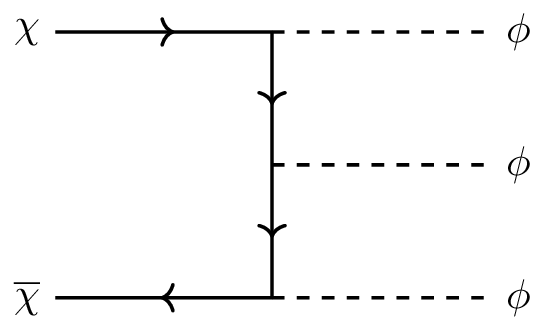 Figure 1
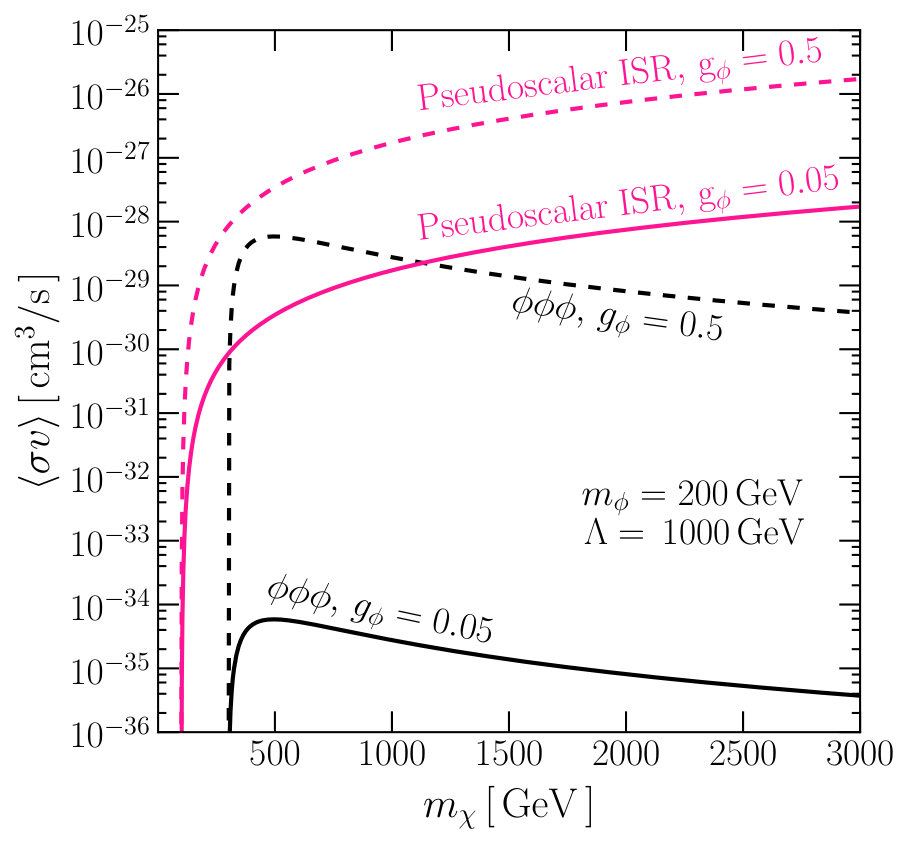 Figure 2
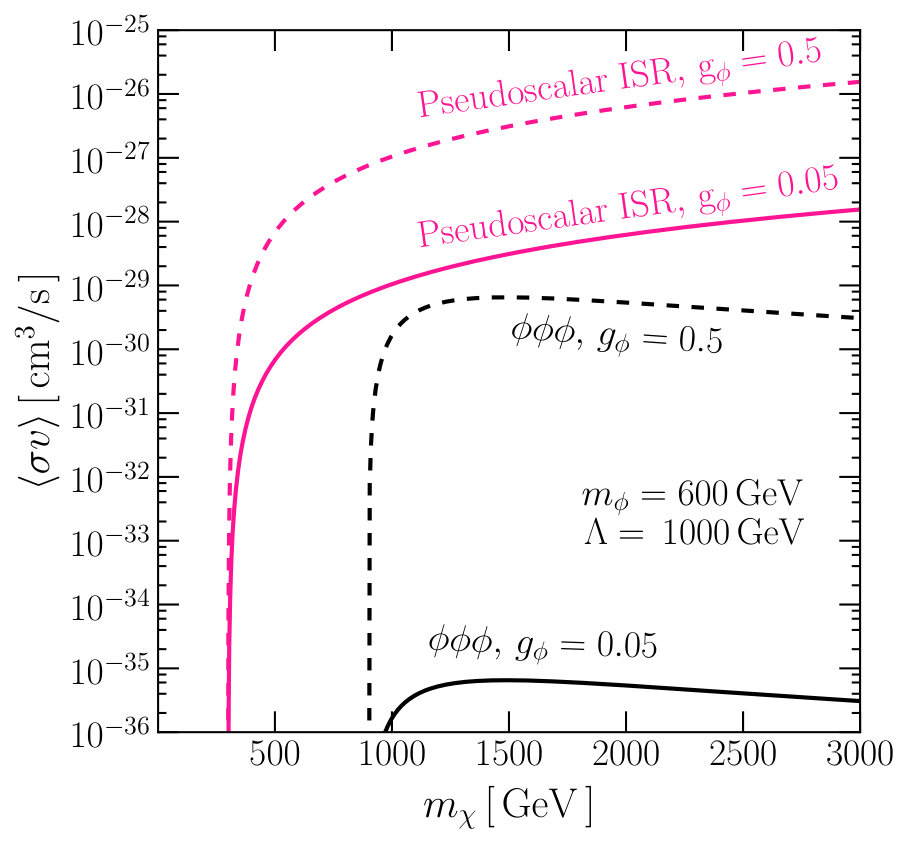 Figure 3
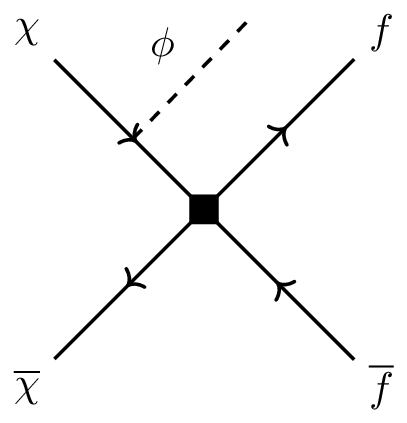 Figure 4
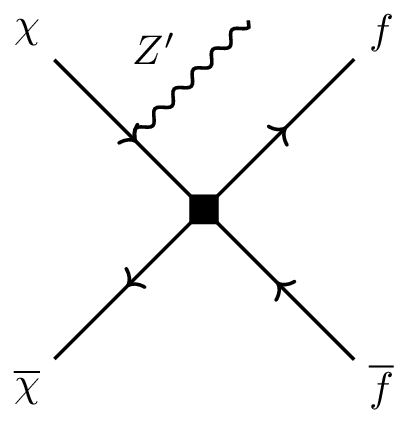 Figure 5
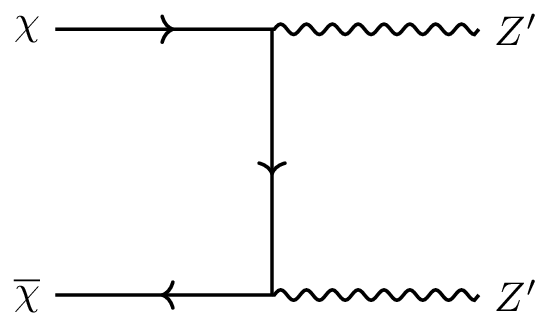 Figure 6
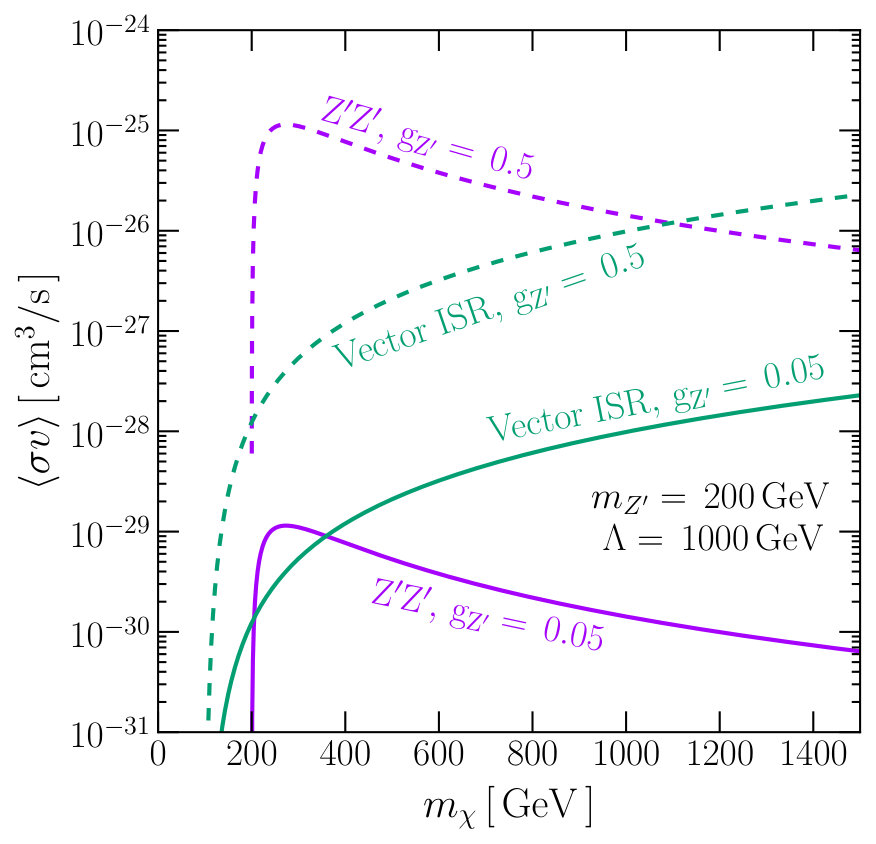 Figure 7
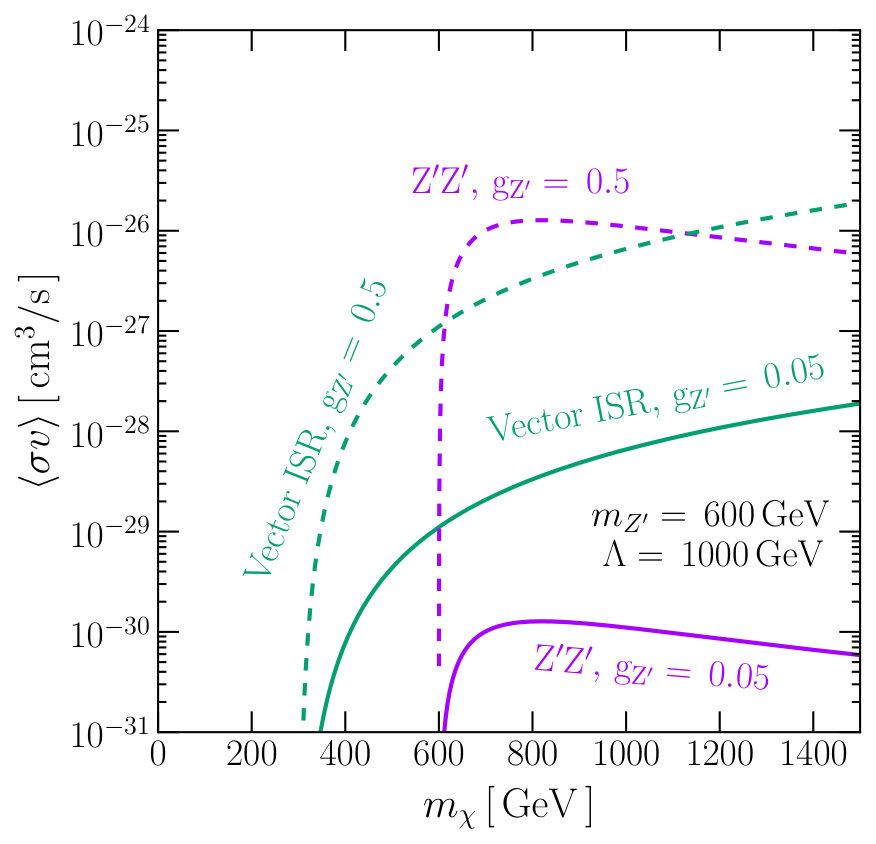 Figure 8
| 1 | 1 | 1 | 1 | 1 | 1 |
| 1 | 1 | 1 | 1 | 1 | |
| 1 | 1 | ||||
| 1 | 1 | 1 | 1 | 1 | |
| 1 | 1 | ||||
| 1 | 1 | ||||
| 1 | 1 | ||||
| 1 | |||||
| 1 | 1 | 1 | |||
Peer Reviews
No public reviews on file for this paper yet. If you reviewed it on a platform where reviews are public (OpenReview, ICLR, NeurIPS, ICML), you can paste yours below so the community can read it here.
Videos
No videos yet. Explain this paper in a talk, walkthrough, or lecture? Add one.
Enhancing Dark Matter Annihilation Rates with Dark Bremsstrahlung
Nicole F. Bell
ARC Centre of Excellence for Particle Physics at the Terascale
School of Physics, The University of Melbourne, Victoria 3010, Australia
Yi Cai
ARC Centre of Excellence for Particle Physics at the Terascale
School of Physics, The University of Melbourne, Victoria 3010, Australia
James B. Dent
Department of Physics, University of Louisiana at Lafayette, Lafayette, LA 70504-4210, USA
Rebecca K. Leane
ARC Centre of Excellence for Particle Physics at the Terascale
School of Physics, The University of Melbourne, Victoria 3010, Australia
Thomas J. Weiler
Department of Physics and Astronomy, Vanderbilt University, Nashville, TN 37235, USA
Abstract
Many dark matter interaction types lead to annihilation processes which suffer from -wave suppression or helicity suppression, rendering them subdominant to unsuppressed -wave processes. We demonstrate that the natural inclusion of dark initial state radiation can open an unsuppressed -wave annihilation channel, and thus provide the dominant dark matter annihilation process for particular interaction types. We illustrate this effect with the bremsstrahlung of a dark spin-0 or dark spin-1 particle from fermionic dark matter, or . The dark initial state radiation process, despite having a 3-body final state, proceeds at the same order in the new physics scale as the annihilation to the 2-body final state . This opens an unsuppressed -wave at lower order in than the well-studied lifting of helicity suppression via Standard Model final state radiation, or virtual internal bremsstrahlung. This dark bremsstrahlung process should influence LHC and indirect detection searches for dark matter.
I Introduction
The particle nature of dark matter (DM) remains unknown. In order to significantly probe its properties in indirect detection experiments, large or unsuppressed annihilation rates are desirable. The DM annihilation rate will generally be largest if it proceeds via an unsuppressed -wave process. Unfortunately, there are a number of well-motivated DM models in which the -wave annihilation to Standard Model (SM) products, , is absent or helicity suppressed. This renders indirect detection very unlikely, as the -wave term is suppressed by a factor of the DM velocity squared (with in the present universe) while a helicity suppression factor of can be significant for annihilation to light fermions. These suppressions are well-known features of neutralino annihilation in supersymmetric theories, but in fact are more general.
It is well known that such suppressions can be lifted via the bremsstrahlung of a SM particle. For example, an unsuppressed -wave can be opened via the radiation of a photon Bergstrom (1989); Flores et al. (1989); Baltz and Bergstrom (2003); Bringmann et al. (2008); Bergstrom et al. (2008); Barger et al. (2009) or electroweak gauge boson Bell et al. (2011a, b, c); Ciafaloni et al. (2011a); Garny et al. (2011); Bell et al. (2012a); De Simone et al. (2013); Ciafaloni et al. (2013) during the DM annihilation processes. This has led to much recent work on the importance of SM radiative corrections in dark matter annihilation Bergstrom (1989); Flores et al. (1989); Baltz and Bergstrom (2003); Bringmann et al. (2008); Bergstrom et al. (2008); Barger et al. (2009); Bell et al. (2011a, b, c); Ciafaloni et al. (2011a); Garny et al. (2011); Bell et al. (2012a); De Simone et al. (2013); Ciafaloni et al. (2013); Berezinsky et al. (2002); Kachelriess et al. (2009); Kachelriess and Serpico (2007); Bell et al. (2008); Dent et al. (2008); Ciafaloni and Urbano (2010); Ciafaloni et al. (2011b); Barger et al. (2012); Fukushima et al. (2012); Giacchino et al. (2013); Toma (2013); Garny et al. (2013); Bringmann and Calore (2014); Bringmann et al. (2016); Bambhaniya et al. (2017, 2017); Kumar et al. (2016a, b); Luo and You (2013); Chen and Kamionkowski (1998). Despite the bremsstrahlung annihilation process having a 3-body final state, it can be the dominant annihilation channel in the universe today (if not at freeze out) because the suppression from additional coupling and phase space factors is small compared to the suppression of the -wave contributions. Past work has primarily used final state radiation (FSR) or virtual internal bremsstrahlung (VIB) to lift the suppression. If the DM is a SM gauge singlet, initial state radiation (ISR) of a SM particle is obviously not possible, however ISR of a or boson from charged DM is possible, and has been considered in Ciafaloni et al. (2011c); Garny et al. (2012); Ciafaloni et al. (2012).
An interesting possibility is that helicity or -wave suppressions can instead be lifted by the ISR of a dark sector field. In this scenario, an initial state dark bremsstrahlung process can dominate over other suppressed channels. This will require that the dark sector contains more particles than just the DM candidate itself which, in fact, is very well motivated: the visible sector itself comprises more than one particle species, and likewise multiple dark sector fields are a common feature of many self-consistent, gauge-invariant, and renormalizable models. For example, mass generation in the dark sector can require the introduction of new fields, such as a dark Higgs, while DM stability may arise from a charge under a new dark sector gauge group, requiring the introduction of dark photons. More generally, models in which DM interactions are mediated by the exchange of only an axial-vector mediator are not gauge invariant. They require the addition of a dark Higgs to unitarize the longitudinal component of the gauge boson, and to give mass to both the gauge boson and DM Cline et al. (2014); Kahlhoefer et al. (2016); Bell et al. (2016a); Duerr et al. (2016); Bell et al. (2017a); Duerr et al. (2017). Indeed, the simultaneous presence of both spin-1 and spin-0 mediators lead to new indirect detection phenomenology that does not arise in single mediator models Bell et al. (2016a); Duerr et al. (2016); Bell et al. (2017a). Similarly, both scalar and pseudoscalar mediators can naturally appear together in complete theories Goncalves et al. (2017); Bell et al. (2017b); Bauer et al. (2017); Baek et al. (2017).
In this paper, for the first time, we explore the possibility that helicity or -wave suppressions of the DM annihilation process are lifted by dark bremsstrahlung from the initial state. We investigate the case where fermionic DM, , radiates either a dark spin-1 field, , or spin-0 field, , to give the ISR processes or , respectively, as shown in Fig. 1.
Bremsstrahlung annihilation processes are very closely related to the mono- processes utilized in collider DM searches Aaboud et al. (2016a, b, c); ATL (2016a, b); Collaboration (2016a, b, c, d, e, f, g, h); Carpenter et al. (2013); Bell et al. (2012b); Carpenter et al. (2014); Petrov and Shepherd (2014); Berlin et al. (2014); Bell et al. (2016b, 2015); Haisch et al. (2016); Birkedal et al. (2004); Gershtein et al. (2008); Goodman et al. (2010, 2011); Crivellin et al. (2015); Petriello et al. (2008); Berlin et al. (2014); Lin et al. (2013); Fox et al. (2012); No (2016); Ghorbani and Khalkhali (2016); Brennan et al. (2016); Liew et al. (2016), as they are controlled by the same matrix element. For example, the radiation of photons from fermions in the FSR annihilation process is the analogue of the collider ISR mono-photon process . Likewise, the ISR of a dark spin-0 or spin-1 field from the initial state in the or annihilation processes are then the analogue of the FSR mono- Bai et al. (2015); Gupta et al. (2015); Autran et al. (2015); Buschmann et al. (2015); Zhang et al. (2016) or mono-dark Higgs Duerr et al. (2017) collider processes, respectively.
For the purpose of illustration, we shall assume the process is adequately described by an effective field theory (EFT operator) of the form . We will see that the -wave contribution to the ISR process scales as , i.e., the same order in as the 2-body annihilation . In comparison, the well-studied lifting of helicity suppressions via FSR or VIB radiation can only produce unsuppressed -wave cross sections at higher order in , with cross sections scaling as 111This observation was also made in the case of ISR of a boson from doublet DM Ciafaloni et al. (2011c); Garny et al. (2012); Ciafaloni et al. (2012)..
In Section II, we provide an overview of suppressions to fermionic DM annihilation cross sections, and discuss annihilation both directly to SM particles, and to dark mediators. In Section III we outline possible dark ISR annihilation processes, and investigate two interesting cases in more detail in Sections V and IV. We present our conclusions in Section VI.
II Overview of Fermionic Dark Matter Annihilation
II.1 Direct annihilation to SM particles
If DM is a Majorana fermion, the possible interactions which can mediate a annihilation process are:
- •
-channel exchange of an axial-vector: helicity suppressed -wave,
- •
-channel exchange of a scalar: no -wave,
- •
-channel exchange of a pseudoscalar: unsuppressed -wave, or
- •
-channel exchange of a sfermion-like scalar: helicity suppressed -wave.
In the -channel case, Fierz rearrangement to -channel form gives and structures. The has a helicity suppressed -wave, while the has no -wave. For Majorana DM, we thus see that the -channel exchange of a pseudoscalar is the only case of an unsuppressed -wave. All other possibilities feature either helicity or suppressions.
For Dirac DM, there are additional possibilities because vector couplings, which vanish for Majorana particles, are also allowed. Note, however, that while the exchange of a vector results in an unsuppressed -wave annihilation cross section, these models are also well constrained because they lead to unsuppressed spin-independent scattering in direct detection experiments.
A summary of the cross section suppression factors, for both annihilation and scattering, for all possible Lorentz structures for , is given in Ref. Kumar and Marfatia (2013).
II.2 Direct annihilation to dark mediators
Table 1 details whether fermionic DM annihilation to two different mediators () is - or -wave, depending on the Lorentz structures of the DM-mediator interactions. For annihilation to any two spin-1 mediators, the rate is -wave. For any two spin-0 mediators, the rate is -wave unless one scalar and one pseudoscalar are both present. For a mixed spin-0 and spin-1 final state, if the spin-1 is a vector, the processes are -wave, while if the spin-1 is an axial-vector, the processes are -wave222If there exist direct couplings between the dark mediators themselves, it is possible to have an -wave process with a spin-0 plus spin-1 final state where the spin-1 is an axial-vector Bell et al. (2016a, 2017a). Details of such couplings are model dependent, and we do not consider such processes in this work..
If one of these mediators is off-shell while the other is on-shell, it is equivalent to the dark ISR process discussed in the following section — where the on-shell mediator corresponds to the dark ISR, and the off-shell mediator has been integrated out to give the EFT vertex. As such, the annihilation type for dark ISR is related to the underlying Lorentz structures of the mediators. We now discuss the dark ISR processes in detail.
III Dark Initial State Radiation
In this section, we consider the scenario where the ISR of a dark sector particle lifts helicity or -wave suppression in fermionic DM annihilation processes.
Figure 1 demonstrates the dark sector ISR in DM annihilation. For the sake of illustration, we use an EFT to describe the interactions between DM and SM fermions. The qualitative effects we discuss are relevant for UV completions which map to the relevant cases. We assume one mediator is sufficiently heavy, such that the EFT description can safely be used without unitarity issues.
Table 2 details the annihilation type and relative suppression of all processes (whether they are -wave, -wave, or helicity suppressed). This reveals which Lorentz structures for particular dark ISR will lift suppression in DM annihilation.
We see, for example, that the radiation of a dark vector is a promising ISR scenario which lifts the suppression of DM annihilation for several Lorentz structures: , , , and . Radiating an axial-vector lifts suppression in and annihilation processes. Radiating a scalar fails to lift any suppression of the annihilation cross section. Radiating a pseudoscalar, however, makes a process with a or structure -wave. In the case of or , any scalar with such a structure will not have well-defined CP properties. Thus the mixing between the heavy scalar and the pseudoscalar is inevitable, and a -wave contribution, will be induced, where is a scalar and is a pseudoscalar.
It is also important to note that once an additional dark sector field is included to allow dark ISR, there can also be -wave annihilations of DM into the dark radiation. For spin-1 ISR, the direct annihilation to mediators is -wave for both vector and axial-vector couplings, and can dominate the total DM annihilation rate for some choices of the coupling strength or masses. In the case that the dark radiation is a spin-0 field, the -channel annihilation process is -wave suppressed for both scalar and pseudoscalar couplings, and so can very naturally be subdominant to the suppression-lifting ISR process. Also note that for sufficiently light dark radiation, Sommerfeld effects can be important.
To avoid the “dark radiation” contributing to the relic density, it must eventually decay to SM states. This can easily be arranged without introducing other consequences, e.g., via a gauge or Higgs portal to the SM, which can naturally appear for inclusion of a gauge boson or scalar, respectively. Such SM states can be a signal for indirect detection experiments (see, i.e., Refs. Bell et al. (2016a); Berlin et al. (2015)). We will assume that the couplings of the dark radiation to the SM are small, such that the exchange of dark radiation will be subdominant.
We now study in detail two particular cases of the lifting helicity or -wave suppression: with dark pseudoscalar ISR and with dark vector ISR. We choose the former as it is the only scenario where introducing dark ISR to lift a -wave cross section does not induce an additional competing -wave process. We choose the latter as an example of lifting helicity suppression. Other scenarios and Lorentz structures can dominate in particular regions of parameter space. Note also that in all the scenarios discussed, UV completions with the same Lorentz structures would map to the same results we present. Our results are not specific to EFTs, but rather to the underlying Lorentz structures.
IV Lifting P-wave suppression in interactions
In this section, we demonstrate how -wave suppression can be lifted through dark pseudoscalar ISR, in the case of the Lorentz structure . Such a structure is possible for both Majorana and Dirac DM, with the Majorana interaction terms differing by a factor of 1/2. We will also discuss any new competing annihilation processes.
IV.1 -wave suppressed
For the Lorentz structure , the DM interactions with SM fermions are described by the four-Fermi operator
[TABLE]
where is a Dirac DM candidate, are SM fermions and is the cutoff scale for new physics, representing a heavy field which has been integrated out.
The operator in Eq. (1) yields a -wave suppressed DM annihilation cross section for given by
[TABLE]
where is the mass of the SM fermion and is the DM mass. here denotes relative velocity. The prefactor shows that this is clearly a -wave suppressed process. We now explicitly show that, for such an operator, including dark pseudoscalar radiation lifts this suppression, and the dominant -wave process can be .
IV.2 Dark pseudoscalar ISR,
We consider a minimal setup in which the EFT operator of Eq. (1) is augmented by a coupling of the DM to a new pseudoscalar ,
[TABLE]
where is the coupling constant. While some complete model may have relations between the couplings and masses of the dark sector particles, for the sake of illustration we take all masses and couplings to be independent parameters. The annihilation cross section for the dark pseudoscalar ISR process is given (in the limit) by
[TABLE]
where . Clearly this process is no longer velocity suppressed term, and so is -wave. Furthermore, it scales , i.e., the same order in as the annihilation to which scales as . In contrast, FSR or VIB of a SM particle, e.g. , only allows unsuppressed -wave annihilation at higher order in , with a cross section scaling .
IV.3 Competition with
Unlike the dark vector radiation case which will be discussed in the next section, there is no additional -wave process induced for spin-0 fields because the final state is -wave suppressed. In the limit , the -wave suppressed cross section for is
[TABLE]
Instead, the -wave annihilation to 3 pseudoscalars Abdullah et al. (2014) shown in Fig. 2 will compete with the ISR channel. Note that both these process suffer the same 3-body phase space suppression. In the limit , the -wave cross section for is
[TABLE]
The full cross section is described in Appendix A.
Figure 3 displays the annihilation cross sections for the pseudoscalar ISR and annihilation processes, illustrating potential regions of parameter space where either process is the dominant annihilation channel, depending on values of the couplings, DM and pseudoscalar masses. Other than providing kinematic thresholds for when the annihilations are allowed, the rates are effectively independent of the pseudoscalar mass. The pseudoscalar ISR process dominates over the three-body pseudoscalar process for much of the parameter space.
V Lifting Helicity Suppression in Interactions
In this section, we demonstrate how helicity suppression can be lifted through dark vector ISR, in the case of the Lorentz structure . Such a structure is very natural for Majorana DM, but is also possible with Dirac DM. We will also discuss any new competing annihilation processes.
V.1 Helicity suppressed
For the Lorentz structure , the DM interactions with SM fermions are described by the four-Fermi operator
[TABLE]
where we shall again assume that the DM candidate is a Dirac fermion.
The operator in Eq. (7) yields a helicity suppressed DM annihilation cross section for ,
[TABLE]
In the limit that , this process is vanishing. We now explicitly show that including dark vector radiation of a lifts this helicity suppression, such that the dominant -wave process can be .
V.2 Dark vector ISR,
We again consider a minimal scenario where, in addition to the EFT interaction of Eq. (7), we include a coupling of the DM to a new spin-1 field, ,
[TABLE]
where is the coupling constant. For the sake of illustration, we have chosen a coupling of vector form to Dirac DM. Alternatively, an axial-vector could be chosen (for either Dirac and Majorana DM) which would also open an unsuppressed -wave, as shown in Table 2.
The annihilation cross section for the dark vector ISR process is given (in the limit) by
[TABLE]
where . As the cross section does not vanish in the limit , this process no longer has the helicity suppressed dependence. It also has no velocity suppression, and so is -wave. Again, we see the dark ISR cross section scales , i.e., the same order in as the annihilation to which scales .
V.3 Competition with
The inclusion of the vector induces an additional two-body annihilation process, , as shown in Fig. 4. This process is also -wave (irrespective of whether the couplings are of vector or axial-vector form). Therefore, the dominant annihilation channel will be or , either of which may dominate depending on the region of parameter space. The cross section for the annihilation of Dirac DM to a pair of is given by
[TABLE]
where again .
Figure 5 displays the annihilation cross sections for Dirac DM for both processes, illustrating regions of parameter space where either process may be the dominant annihilation channel. As the annihilation cross section to contains two powers of while that for contains fours powers of this coupling, the dark ISR process can easily dominate when is small. As the coupling becomes larger, dominates for more of the parameter space. If the is particularly heavy, the dark ISR process can also dominate over due to kinematic constraints.
VI Conclusion
The observation of an unexplained flux of SM particles in the astrophysical sky can be interpreted as a DM signal. To probe the nature of DM via such an indirect detection signal, it is important to know which processes may provide the dominant contributions or strongest constraints. In this paper, for the first time, we have explored the possibility that dark ISR can open an unsuppressed -wave annihilation channel. This can be the dominant DM annihilation mode in models where the lowest order processes are helicity or -wave suppressed.
We found that dark ISR from the initial state can lift such suppressions for several different types of dark radiation and DM interaction structures. For four-Fermi type interactions of DM with SM fermions, several Lorentz structures suffer suppressed annihilation processes — , , , and . The ISR of a dark vector opens an unsuppressed -wave in all these cases. Radiating an axial-vector lifts the suppression of the and annihilation processes, while radiating a pseudoscalar opens an -wave for the or interaction types.
An important feature of dark ISR is that the bremsstrahlung annihilation rate scales as , i.e., the same order in as the 2-body annihilation . In comparison, the opening of an unsuppressed -wave via FSR or VIB of a SM particle (e.g. as in the well-studied process) occurs only at higher order in , with a cross section scaling as .
When introducing a new field for dark ISR, additional competing annihilation processes are induced. For the ISR of a dark vector or axial-vector, a competing -wave annihilation process is . For the case of scalar or pseudoscalar ISR, there is no equivalent -wave process. However, the annihilation to three pseudoscalars, , is -wave and can dominate in some regions of parameter space. As such, the interplay of several annihilation processes must always be considered.
The introduction of dark radiation should not be viewed as an additional or unnecessary complication to dark sector theories. It is highly likely that the dark sector, like the visible sector, has multiple field content. Dark vectors arise naturally when the DM stability is due to a charge under a new gauge group, while dark scalars are well motivated when considering mass generation in the dark sector. Indeed, self-consistent, gauge invariant models frequently contain such features. We have shown that it is important to include dark radiative corrections in these scenarios, as they can be the dominant annihilation channel.
Acknowledgments
RKL thanks the Niels Bohr International Academy for their hospitality during the completion of this work. NFB, YC and RKL were supported in part by the Australian Research Council. TJW is supported in part by the Department of Energy (DoE) Grant No. DESC-0011981. Feynman diagrams are drawn using TikZ-Feynman Ellis (2017).
Appendix
Appendix A Three pseudoscalar cross section
The cross section for DM annihilation into three pseudoscalars, , is given by
[TABLE]
with where is the energy of two of the three pseudoscalars in the center of mass frame of the DM pair. The integrand is clearly symmetric with respect to and , as expected. The integration limits are functions of and expressed as
[TABLE]
where
[TABLE]
In the limit , this produces the -wave cross section shown in Eq. (6).
The reference list from the paper itself. Each links out to its DOI / PubMed record.
- 1Bergstrom (1989) Lars Bergstrom, “Radiative Processes in Dark Matter Photino Annihilation,” Phys. Lett. B 225 , 372–380 (1989) . · doi ↗
- 2Flores et al. (1989) Ricardo Flores, Keith A. Olive, and Serge Rudaz, “Radiative Processes in Lsp Annihilation,” Phys. Lett. B 232 , 377–382 (1989) . · doi ↗
- 3Baltz and Bergstrom (2003) E. A. Baltz and L. Bergstrom, “Detection of leptonic dark matter,” Phys. Rev. D 67 , 043516 (2003) , ar Xiv:hep-ph/0211325 [hep-ph] . · doi ↗
- 4Bringmann et al. (2008) Torsten Bringmann, Lars Bergstrom, and Joakim Edsjo, “New Gamma-Ray Contributions to Supersymmetric Dark Matter Annihilation,” JHEP 01 , 049 (2008) , ar Xiv:0710.3169 [hep-ph] . · doi ↗
- 5Bergstrom et al. (2008) Lars Bergstrom, Torsten Bringmann, and Joakim Edsjo, “New Positron Spectral Features from Supersymmetric Dark Matter - a Way to Explain the PAMELA Data?” Phys. Rev. D 78 , 103520 (2008) , ar Xiv:0808.3725 [astro-ph] . · doi ↗
- 6Barger et al. (2009) V. Barger, Y. Gao, Wai Yee Keung, and D. Marfatia, “Generic dark matter signature for gamma-ray telescopes,” Phys. Rev. D 80 , 063537 (2009) , ar Xiv:0906.3009 [hep-ph] . · doi ↗
- 7Bell et al. (2011 a) Nicole F. Bell, James B. Dent, Thomas D. Jacques, and Thomas J. Weiler, “W/Z Bremsstrahlung as the Dominant Annihilation Channel for Dark Matter,” Phys. Rev. D 83 , 013001 (2011 a) , ar Xiv:1009.2584 [hep-ph] . · doi ↗
- 8Bell et al. (2011 b) Nicole F. Bell, James B. Dent, Ahmad J. Galea, Thomas D. Jacques, Lawrence M. Krauss, and Thomas J. Weiler, “W/Z Bremsstrahlung as the Dominant Annihilation Channel for Dark Matter, Revisited,” Phys. Lett. B 706 , 6–12 (2011 b) , ar Xiv:1104.3823 [hep-ph] . · doi ↗