Gaia Data Release 1. Testing the parallaxes with local Cepheids and RR Lyrae stars
Gaia Collaboration: G. Clementini, L. Eyer, V. Ripepi, M. Marconi, T., Muraveva, A. Garofalo, L.M. Sarro, M. Palmer, X. Luri, R. Molinaro, L., Rimoldini, L. Szabados, I. Musella, R.I. Anderson, T. Prusti, J.H.J. de, Bruijne, A.G.A. Brown, A. Vallenari, C. Babusiaux

TL;DR
This paper tests Gaia DR1 parallaxes against classical and Type II Cepheids and RR Lyrae stars, deriving new period-luminosity and metallicity relations to improve the cosmic distance scale calibration.
Contribution
It provides the first Gaia-calibrated relations for standard candles, enhancing the accuracy of distance measurements and setting a foundation for future Gaia data releases.
Findings
Gaia parallaxes improve upon Hipparcos estimates.
New period-luminosity and metallicity relations derived.
Methodologies include linear, astrometric, and Bayesian fitting.
Abstract
Parallaxes for 331 classical Cepheids, 31 Type II Cepheids and 364 RR Lyrae stars in common between Gaia and the Hipparcos and Tycho-2 catalogues are published in Gaia Data Release 1 (DR1) as part of the Tycho-Gaia Astrometric Solution (TGAS). In order to test these first parallax measurements of the primary standard candles of the cosmological distance ladder, that involve astrometry collected by Gaia during the initial 14 months of science operation, we compared them with literature estimates and derived new period-luminosity (), period-Wesenheit () relations for classical and Type II Cepheids and infrared , -metallicity () and optical luminosity-metallicity (-[Fe/H]) relations for the RR Lyrae stars, with zero points based on TGAS. The new relations were computed using multi-band () photometry and spectroscopic metal abundances…
Click any figure to enlarge with its caption.
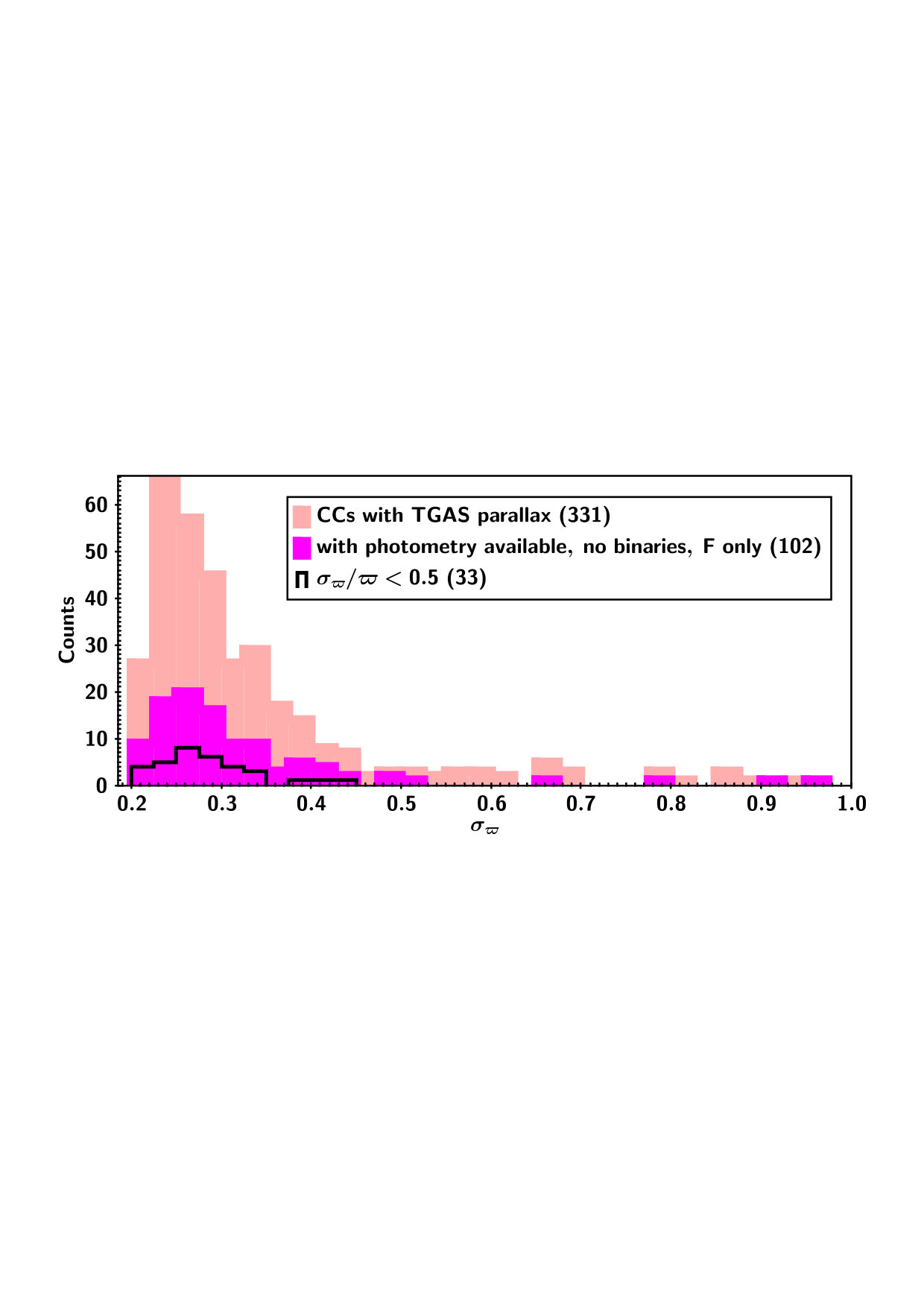 Figure 1
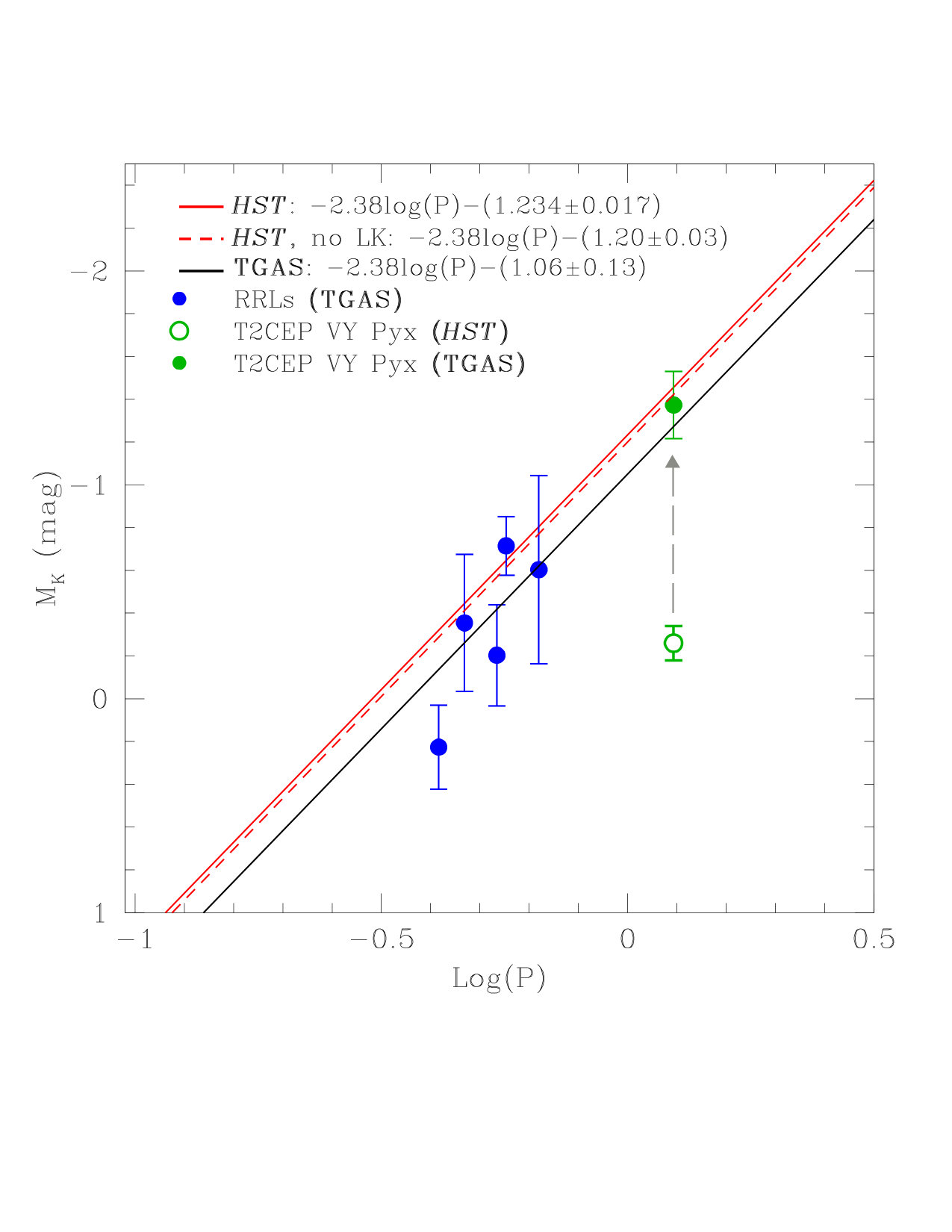 Figure 10
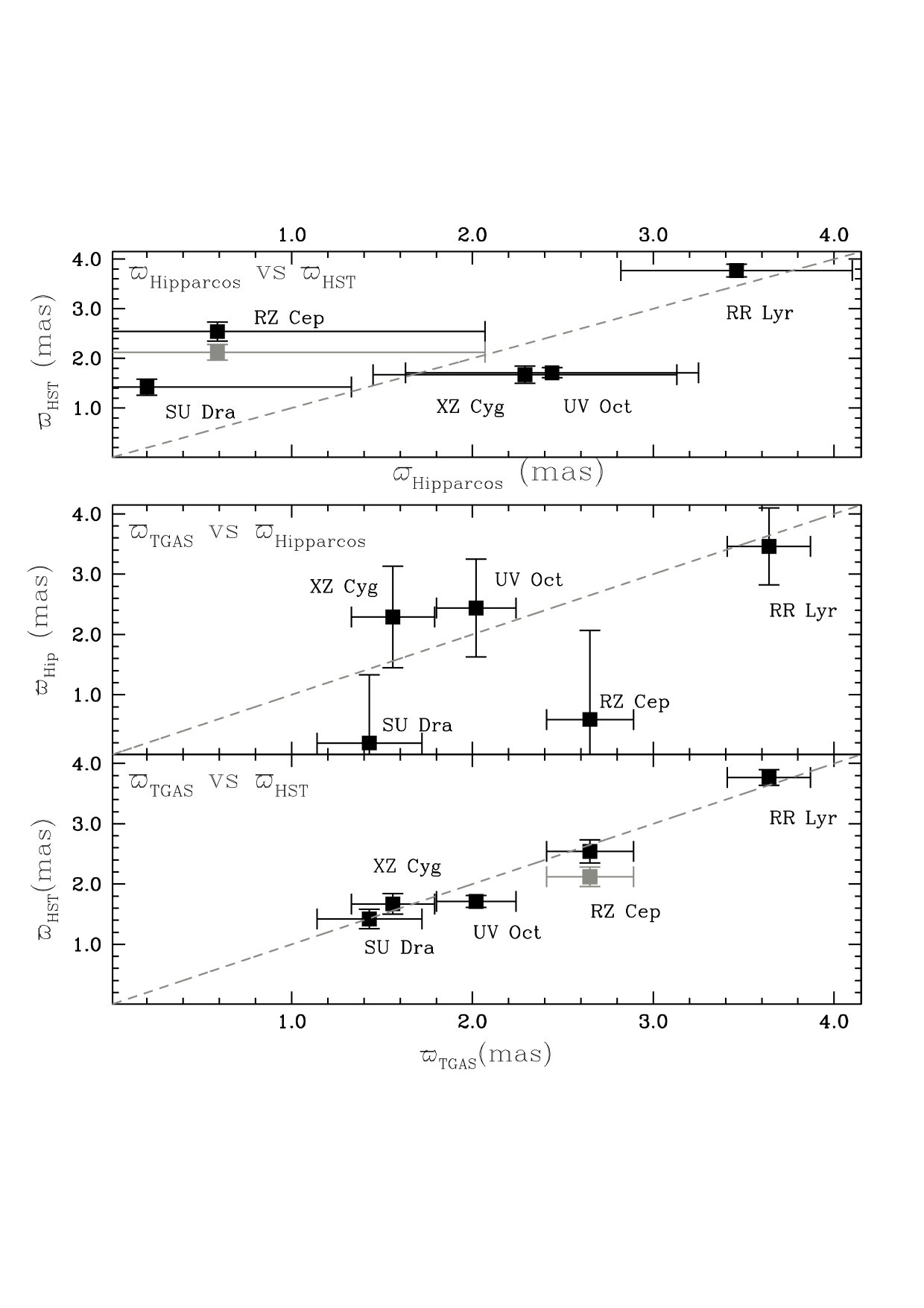 Figure 11
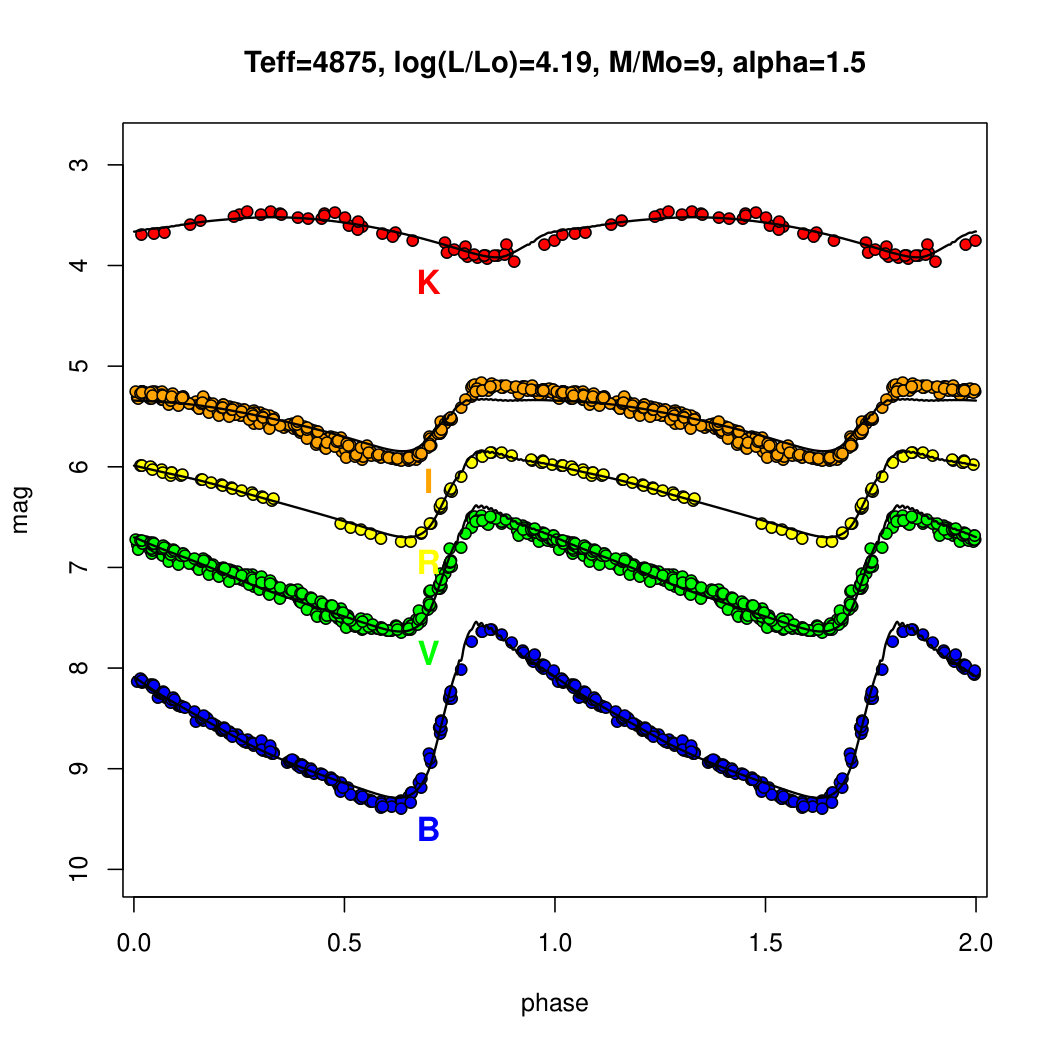 Figure 12
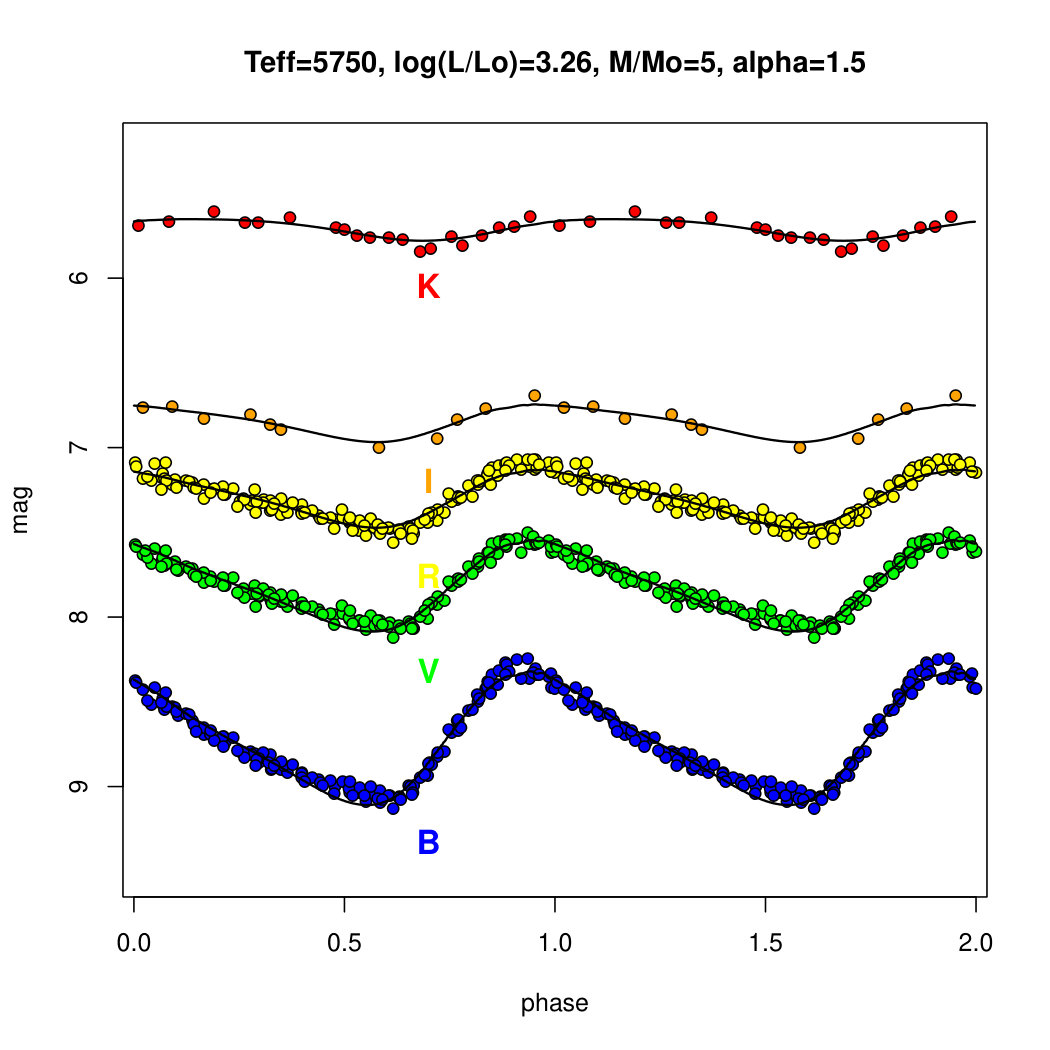 Figure 13
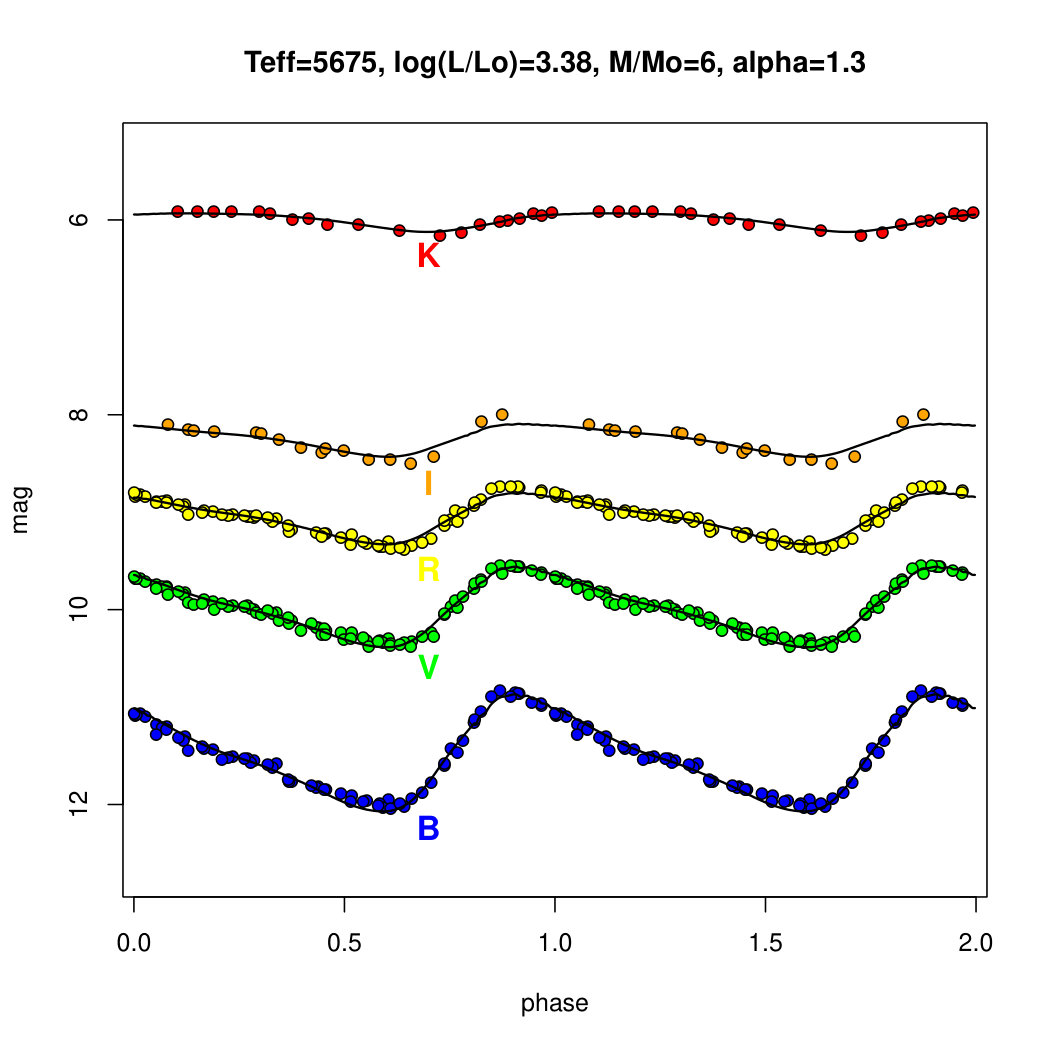 Figure 14
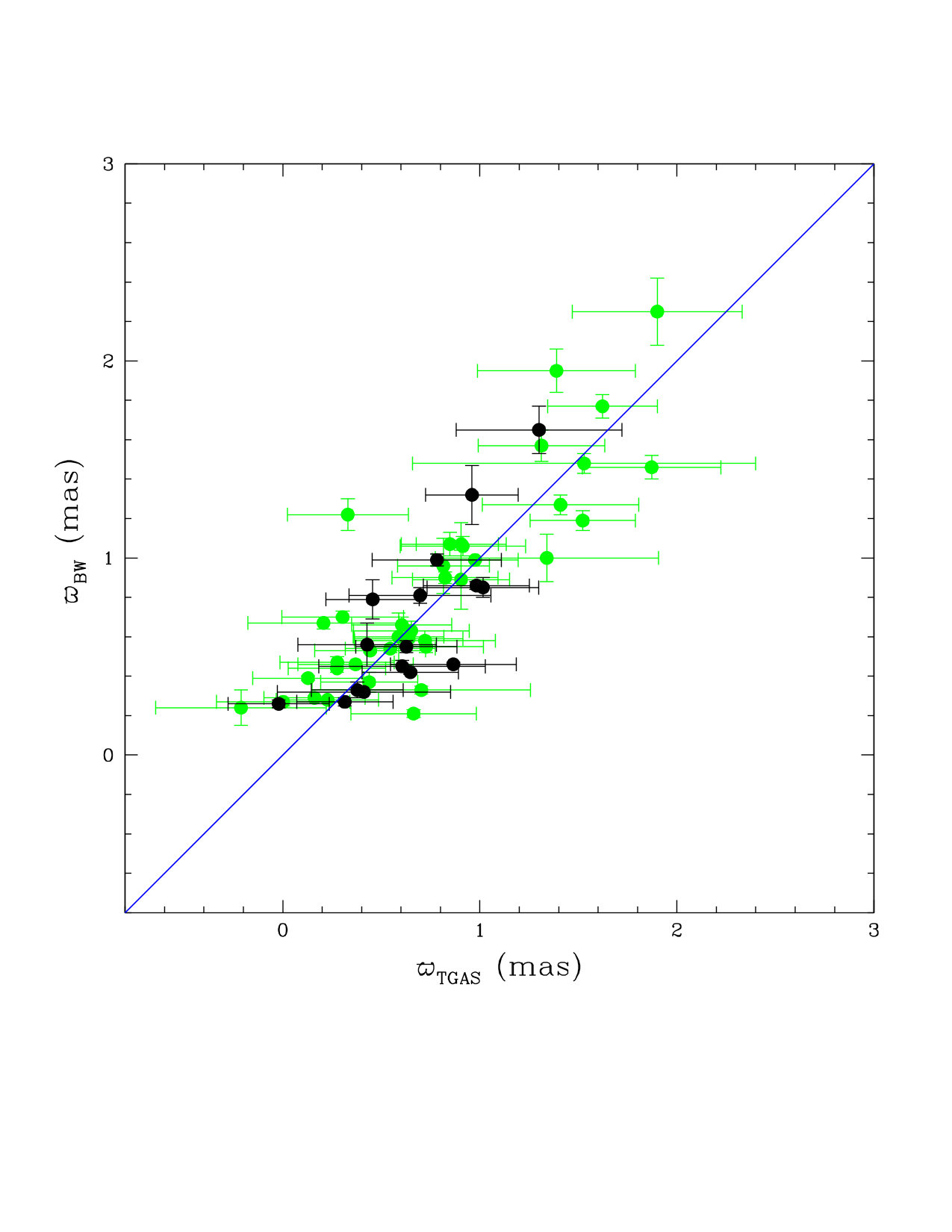 Figure 15
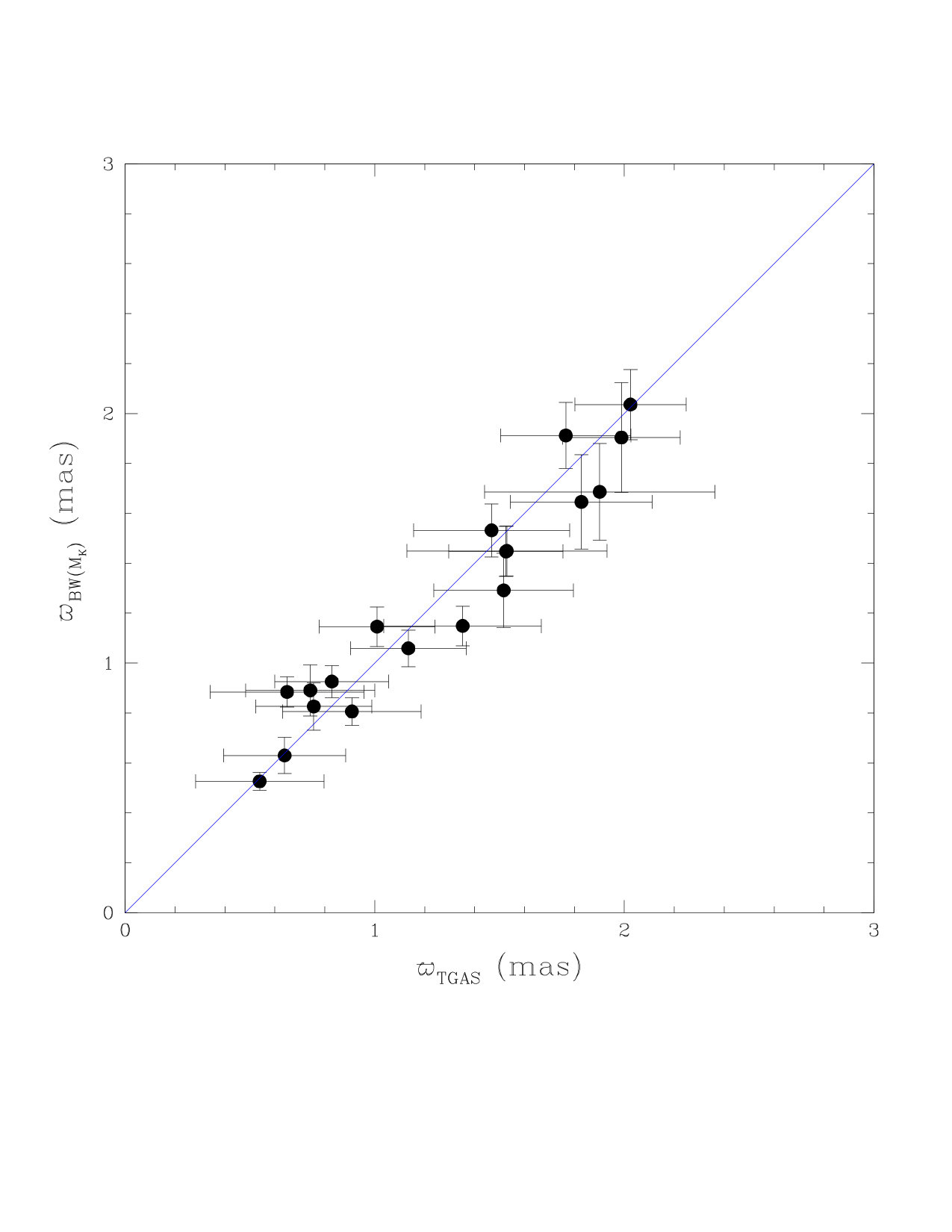 Figure 16
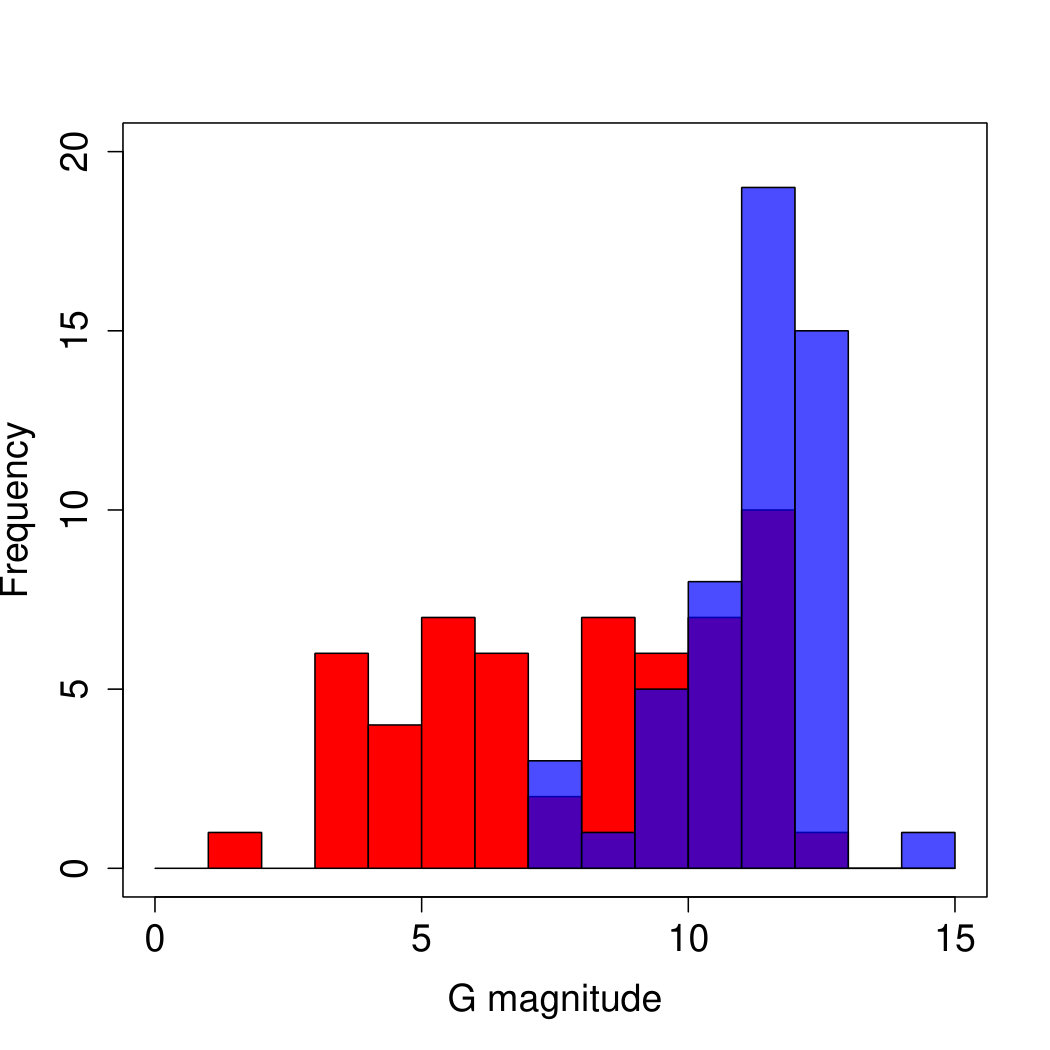 Figure 17
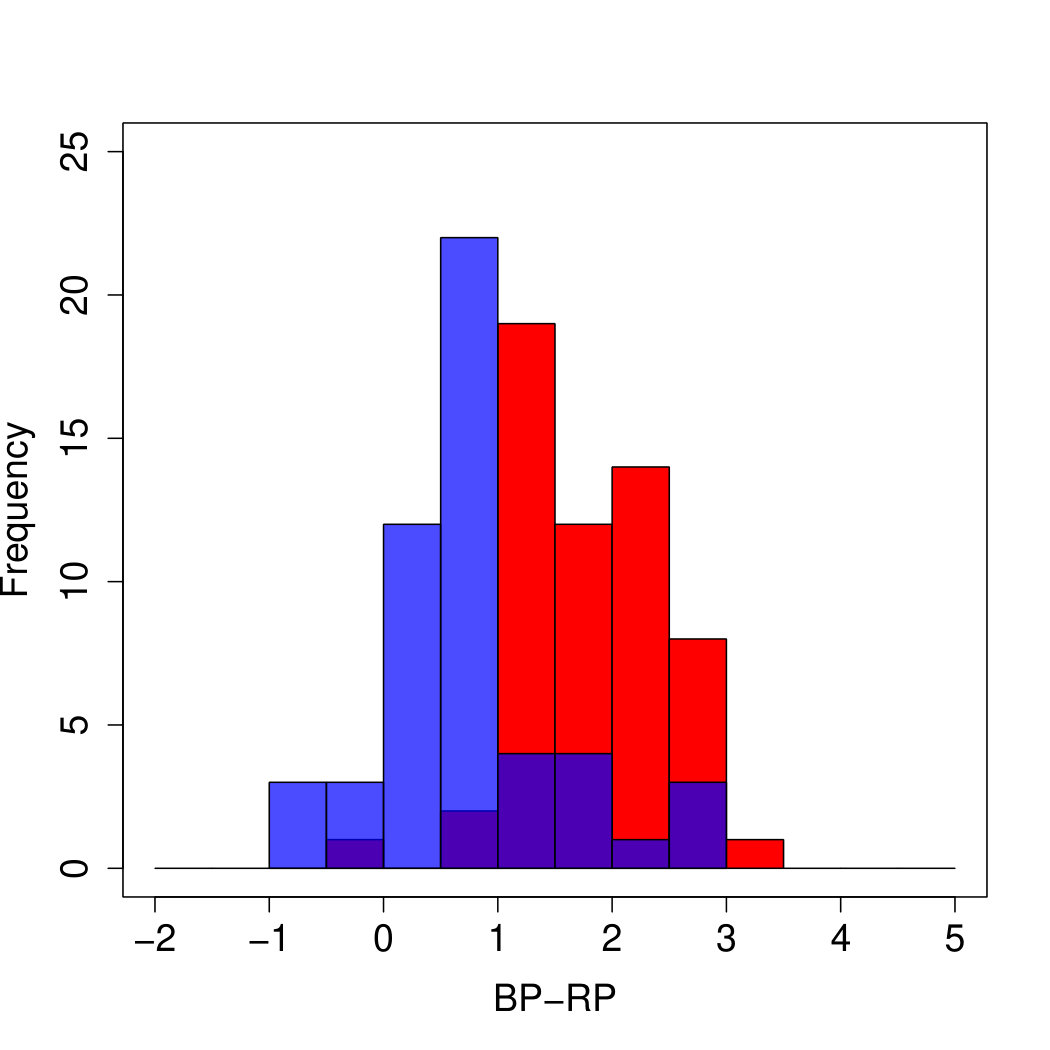 Figure 18
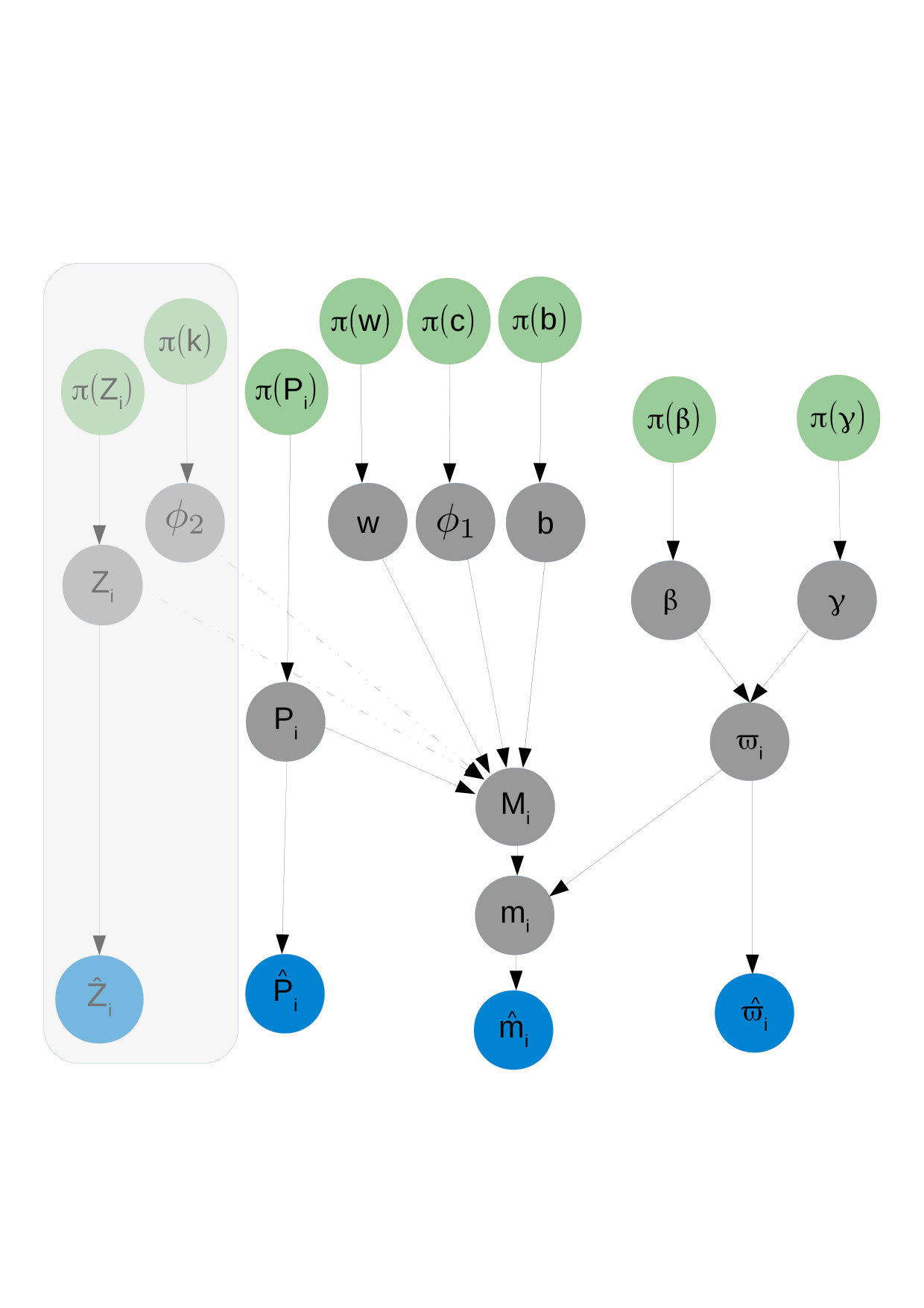 Figure 19
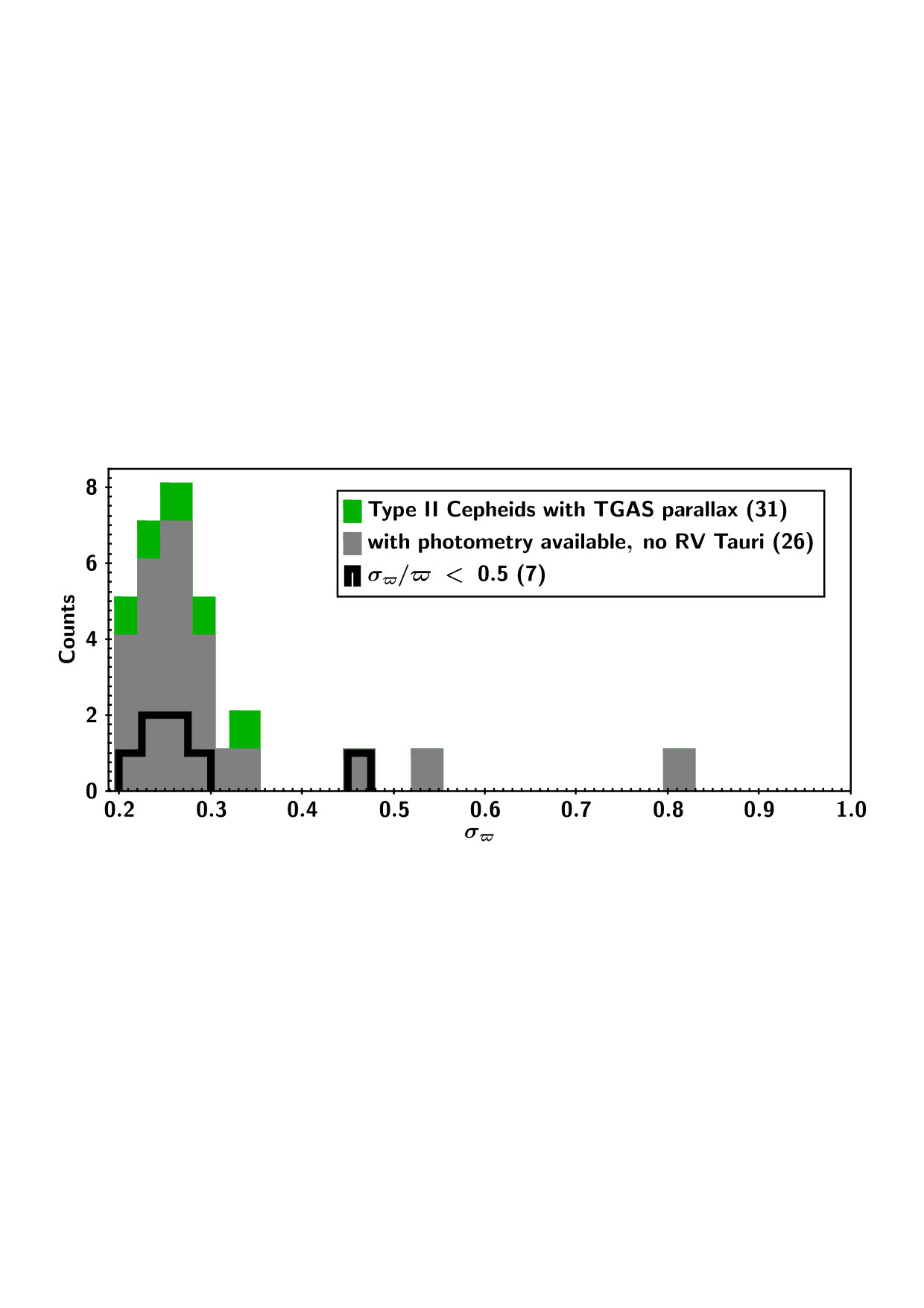 Figure 2
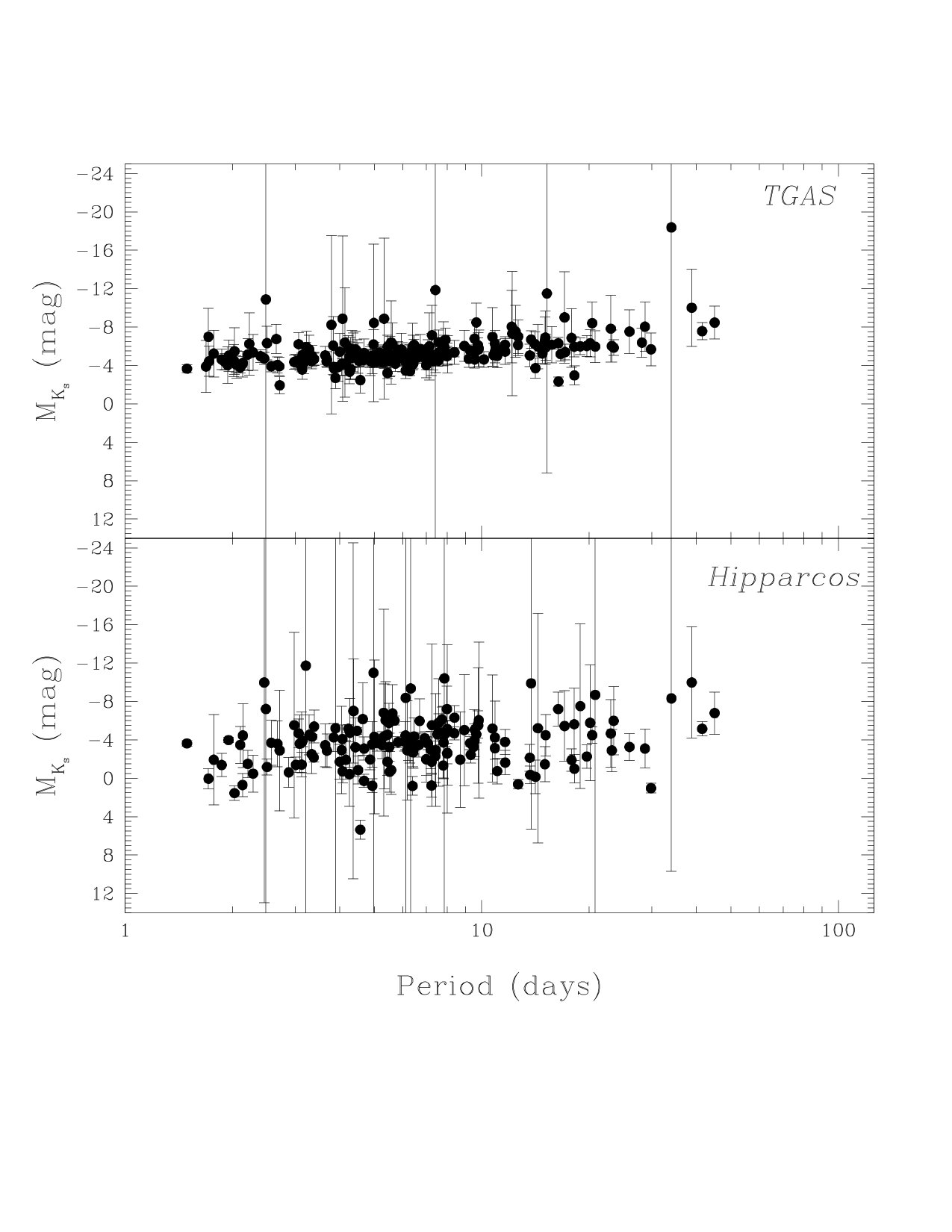 Figure 20
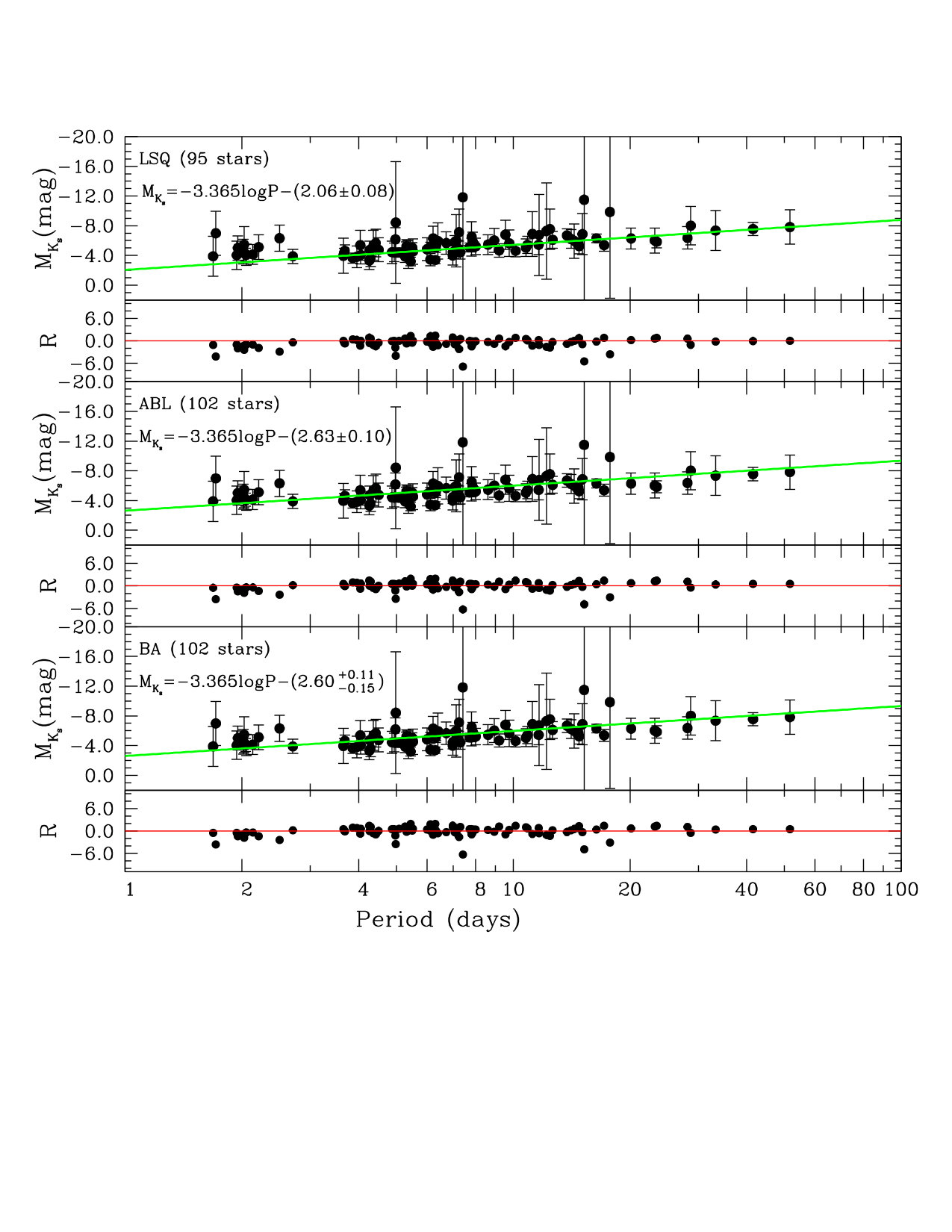 Figure 21
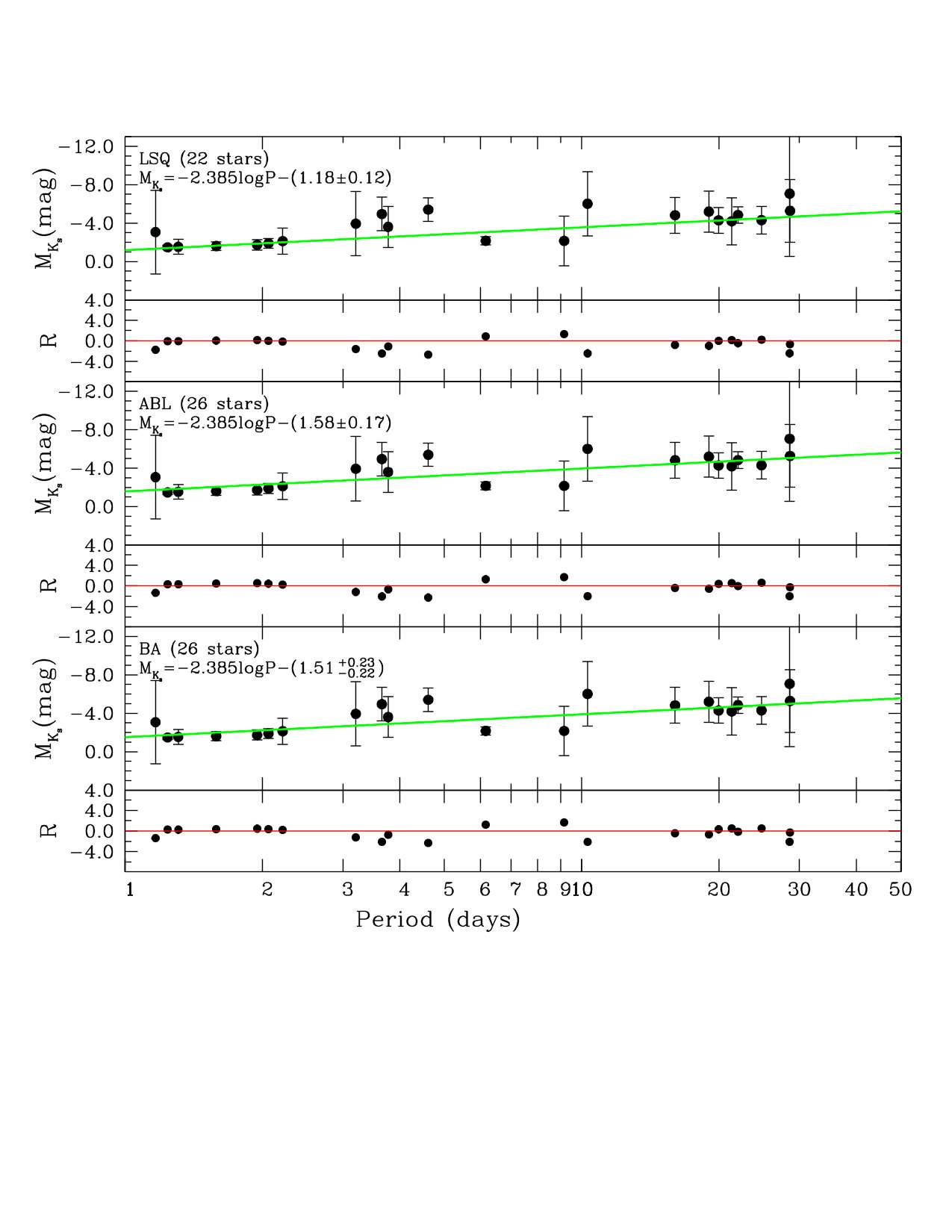 Figure 22
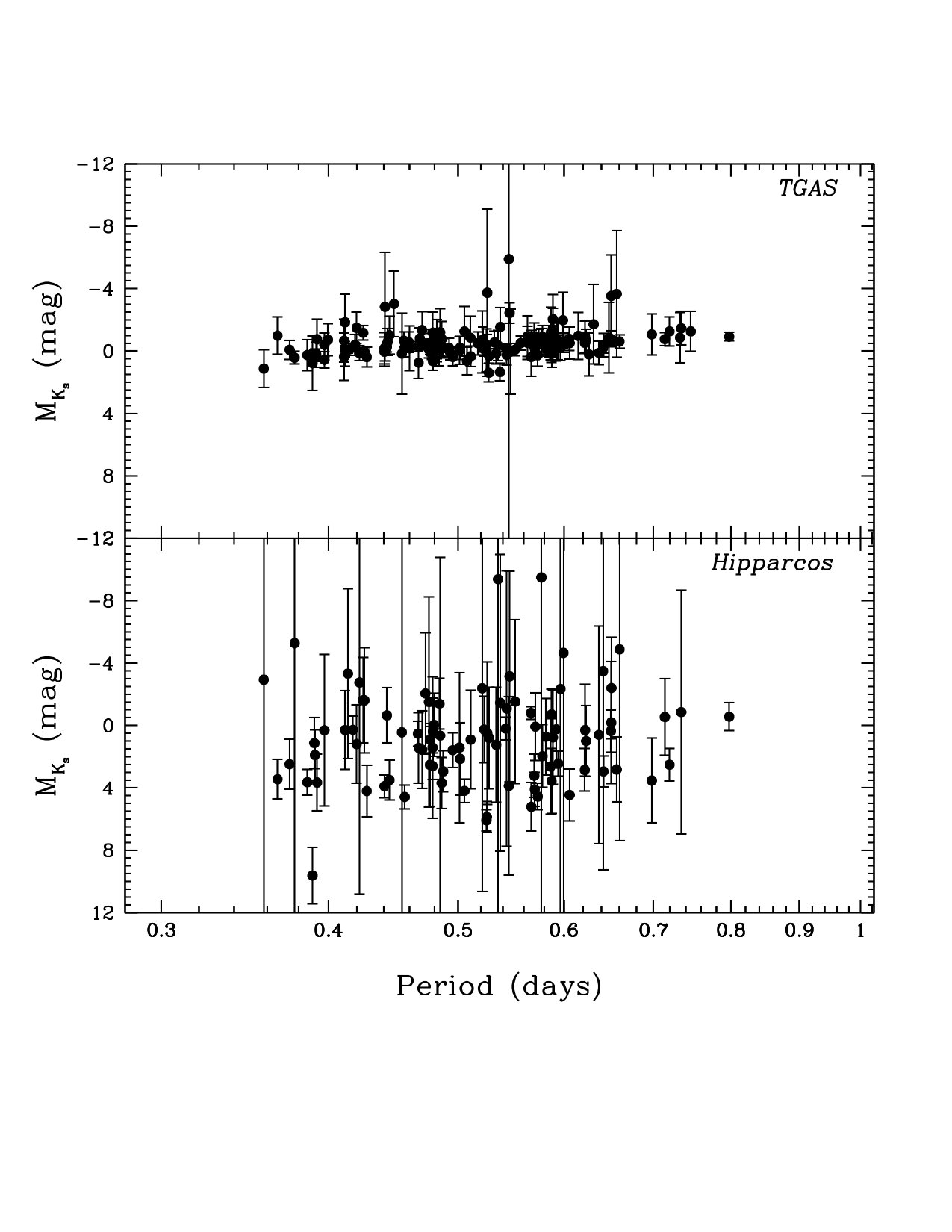 Figure 23
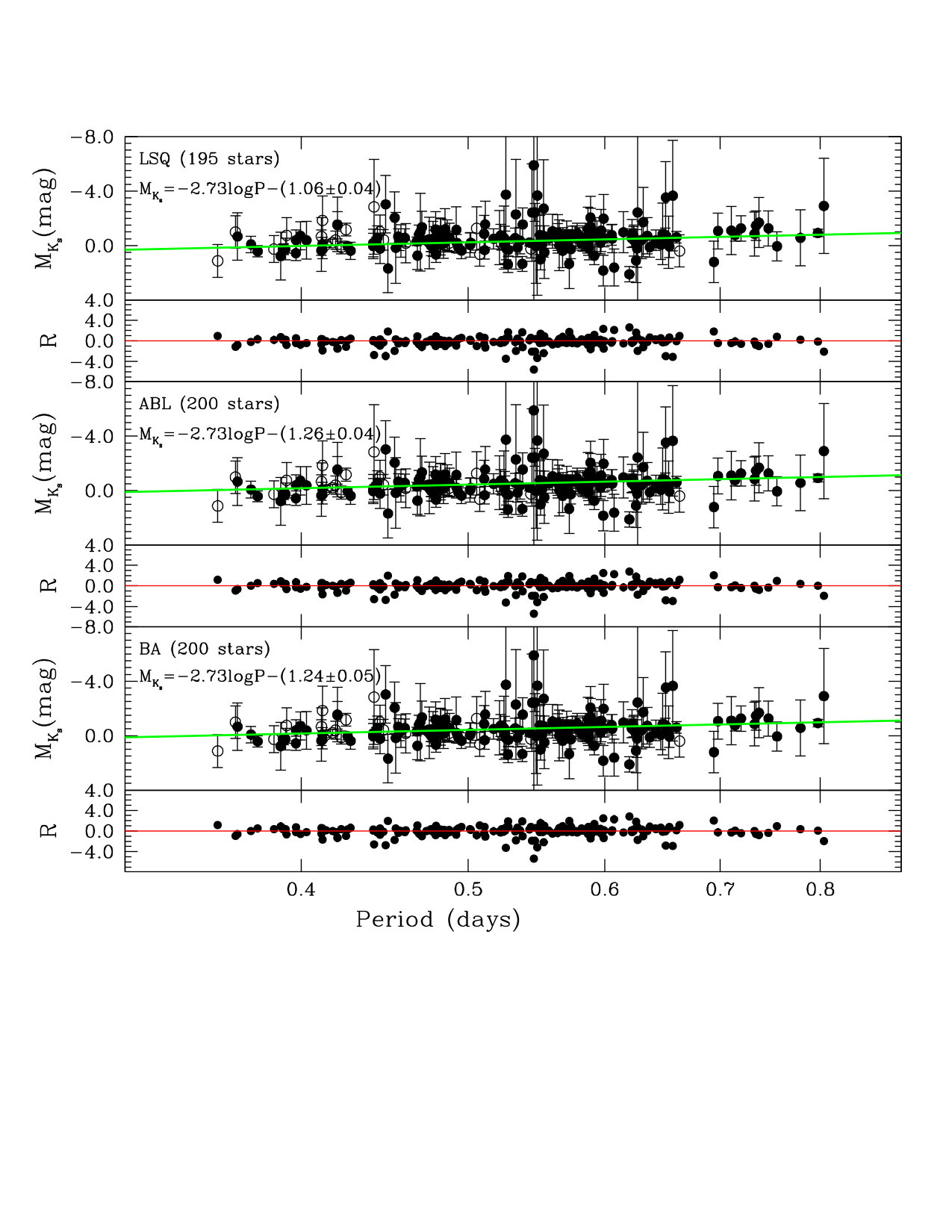 Figure 24
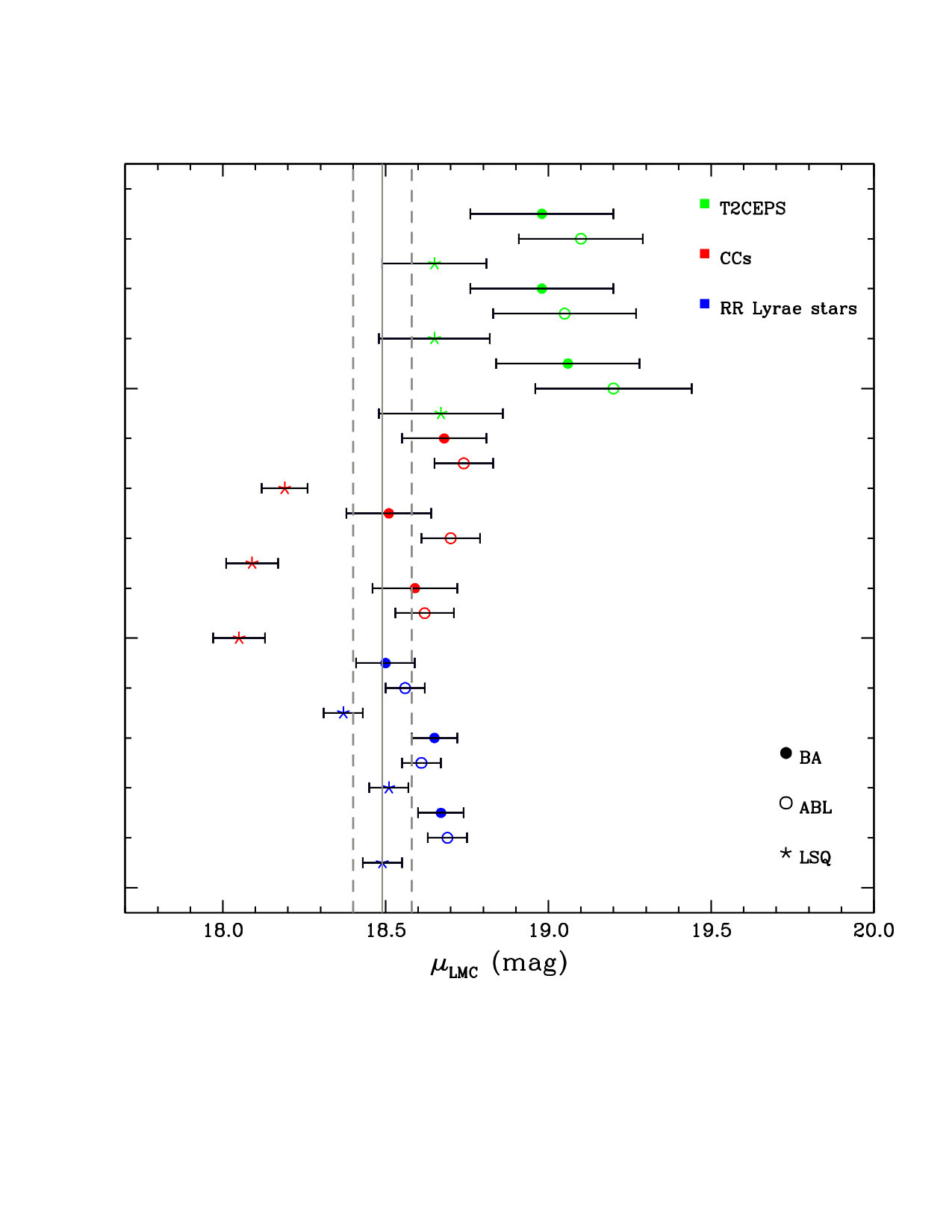 Figure 25
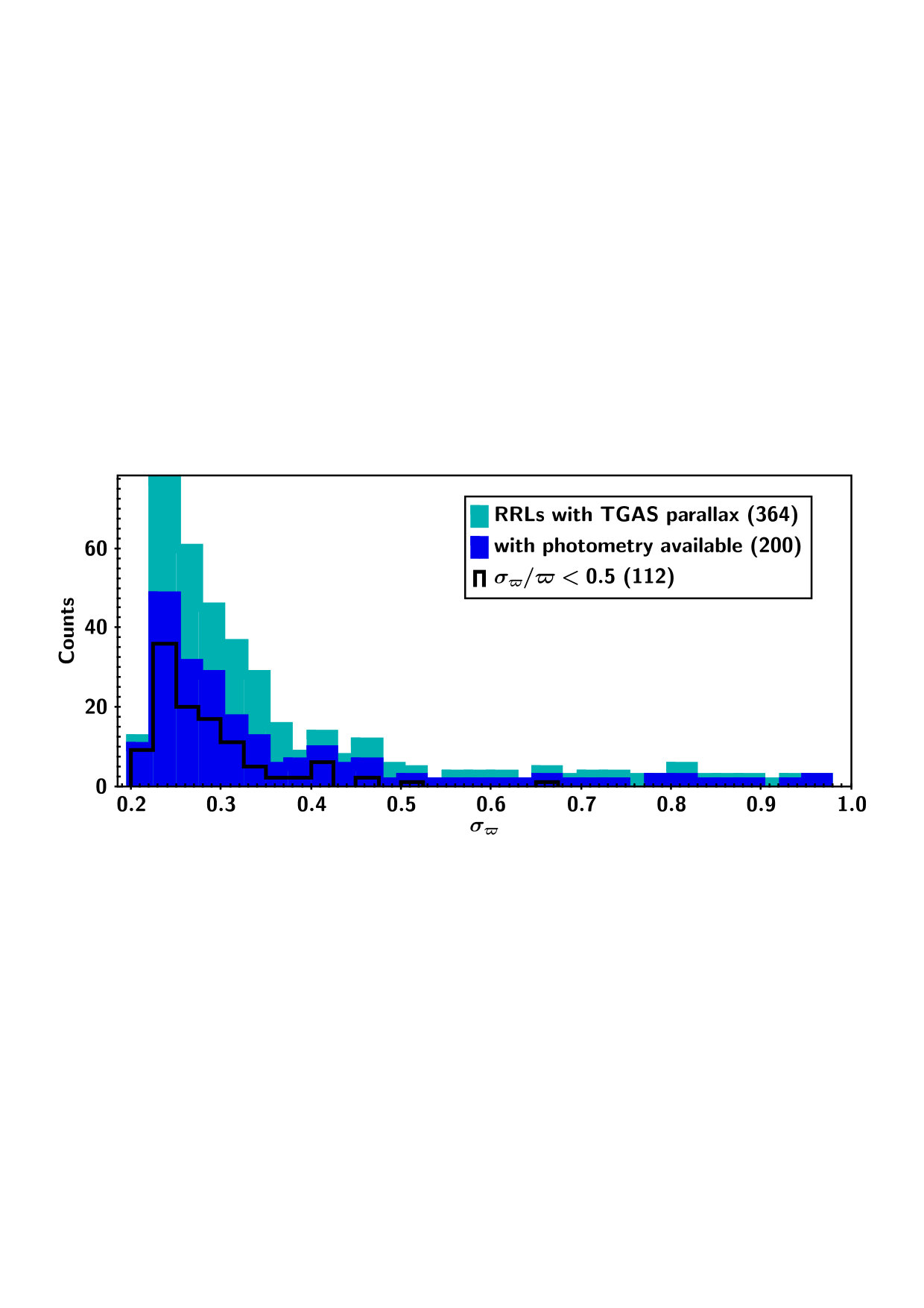 Figure 3
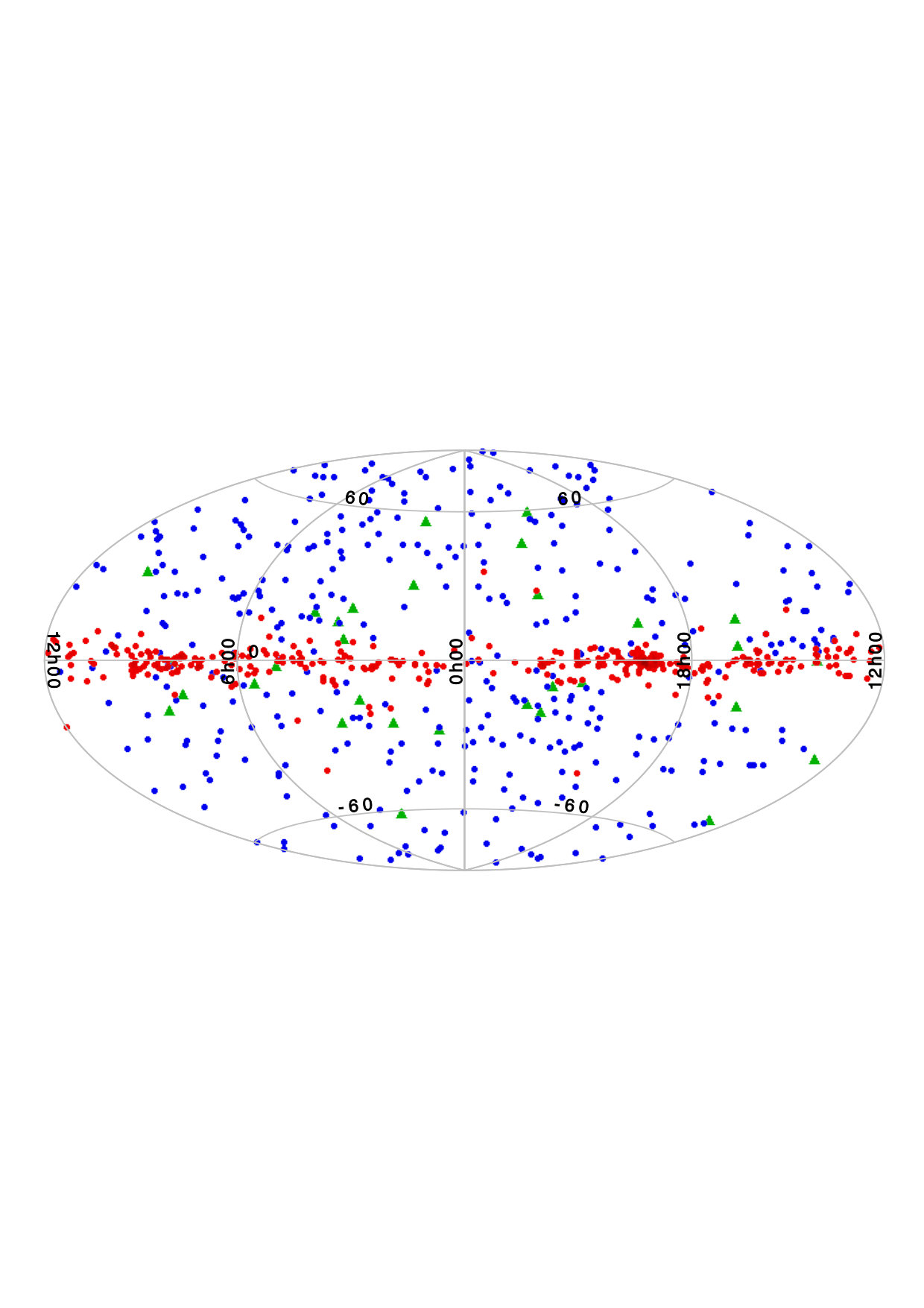 Figure 4
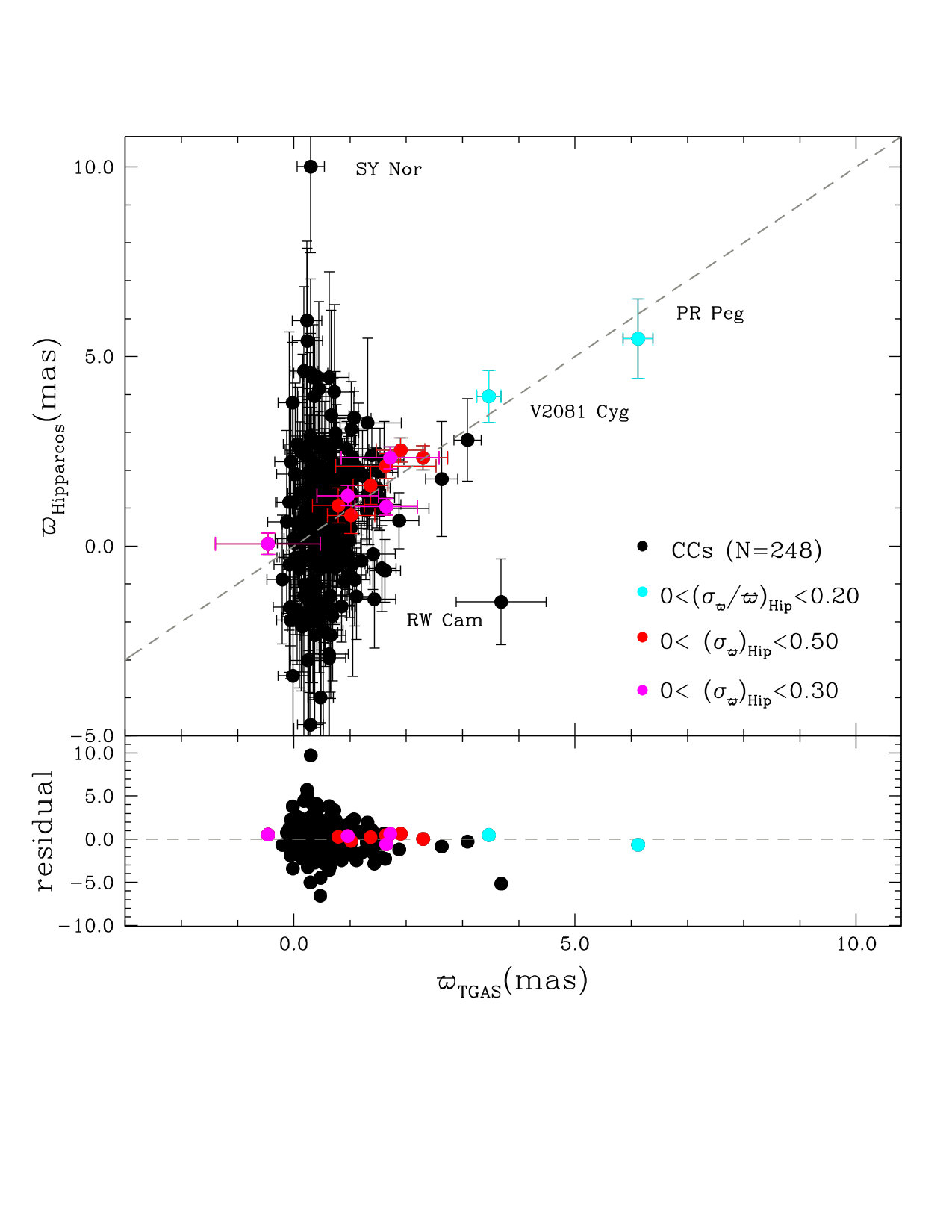 Figure 5
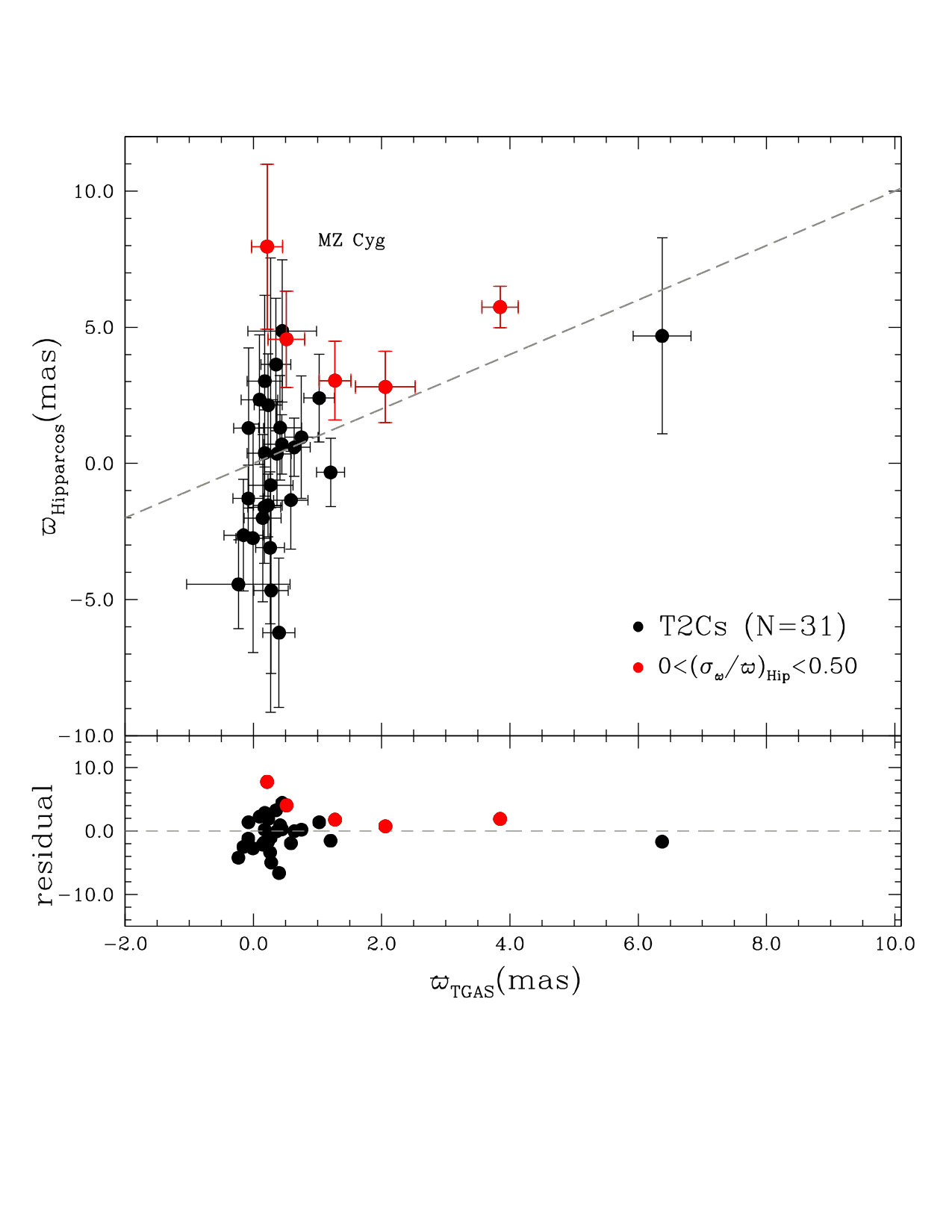 Figure 6
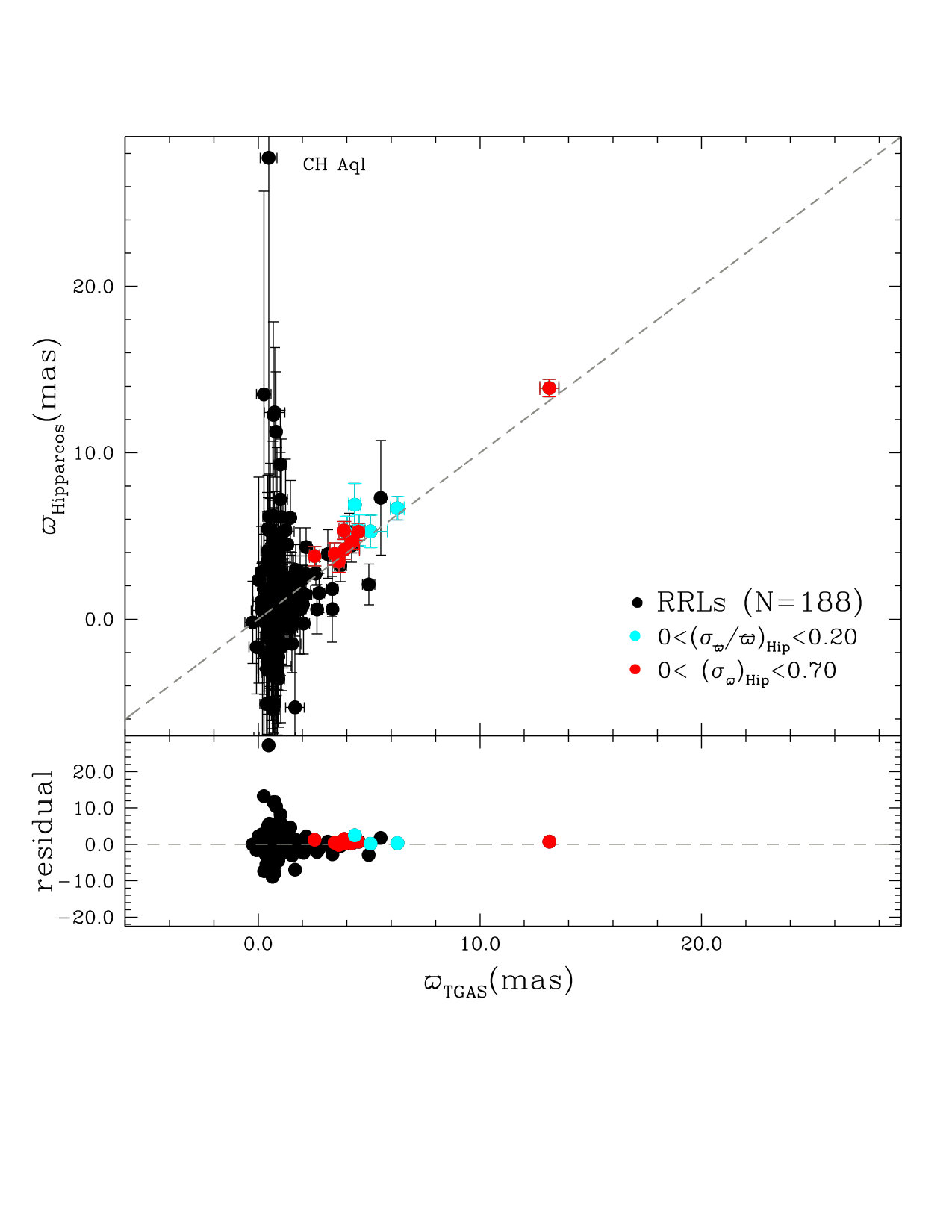 Figure 7
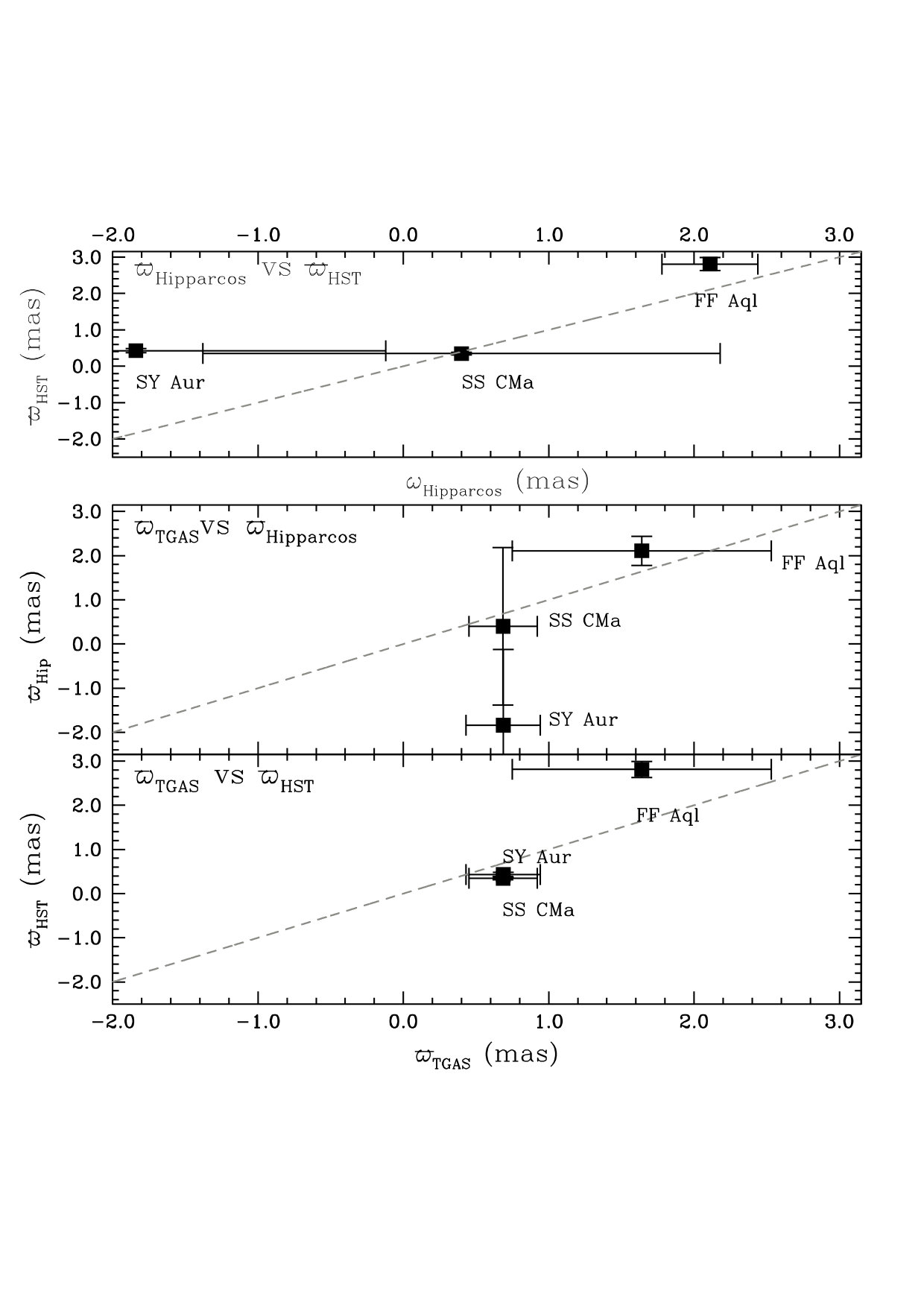 Figure 8
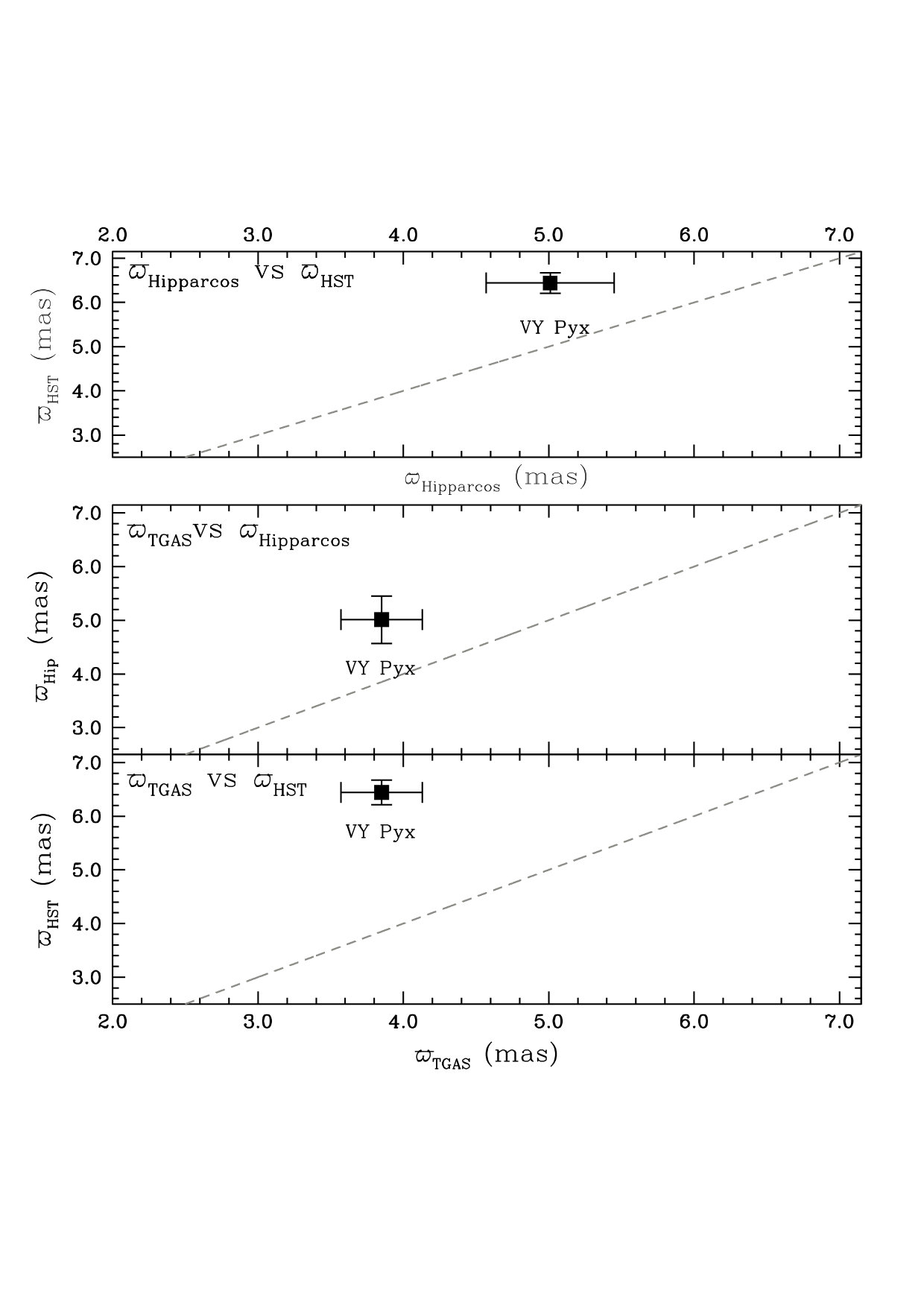 Figure 9
| Name | IDHipparcos* | HST Reference | ||||||
| (mas) | (mas) | (mas) | (mas) | (mas) | (mas) | |||
| Classical Cepheids | ||||||||
| FF Aql** | 93124 | 2.110 | 0.330 | 1.640 | 0.89 | 2.810 | 0.180 | Benedict et al. (2007) |
| SS CMa | 36088 | 0.400 | 1.780 | 0.686 | 0.234 | 0.348 | 0.038 | Casertano et al. (2016) |
| SY Aur | 24281 | -1.840 | 1.720 | 0.687 | 0.255 | 0.428 | 0.054 | Riess et al. (2014) |
| Type II Cepheids | ||||||||
| VY Pyx | 434736 | 5.00 | 0.44 | 3.85 | 0.28 | 6.44 | 0.23 | Benedict et al. (2007) |
| RR Lyrae stars | ||||||||
| RR Lyr | 95497 | 3.46 | 0.64 | 3.64 | 0.23 | 3.77 | 0.13 | Benedict et al. (2011) |
| RZ Cep | 111839 | 0.59 | 1.48 | 2.65 | 0.24 | 2.12 (2.54)*** | 0.16 | Benedict et al. (2011) |
| SU Dra | 56734 | 0.20 | 1.13 | 1.43 | 0.29 | 1.42 | 0.16 | Benedict et al. (2011) |
| UV Oct | 80990 | 2.44 | 0.81 | 2.02 | 0.22 | 1.71 | 0.10 | Benedict et al. (2011) |
| XZ Cyg | 96112 | 2.29 | 0.84 | 1.56 | 0.23 | 1.67 | 0.17 | Benedict et al. (2011) |
| Relation | RMS | |
| (mag) | ||
| 95 objects (LSQ) | ) | 0.74 |
| 102 objects (ABL) | 0.85 | |
| 102 objects (BA) | 1.31 | |
| 95 objects (LSQ) | 0.78 | |
| 102 objects (ABL) | 0.87 | |
| 102 stars (BA) | 1.33 | |
| 95 objects (LSQ) | 0.74 | |
| 102 objects (ABL) | 0.88 | |
| 102 stars (BA) | 1.33 | |
| 95 objects (LSQ) | 0.77 | |
| 102 objects (ABL) | 0.90 | |
| 102 stars (BA) | 1.36 | |
| 95 objects (LSQ) | 0.73 | |
| 102 objects (ABL) | 0.87 | |
| 102 stars (BA) | 1.33 |
| Relation | RMS | ||
|---|---|---|---|
| (mag) | |||
| 22 objects (LSQ) | ) | 0.88 | |
| 26 objects (ABL) | 1.25 | ||
| 26 objects (BA) | 1.15 | ||
| 22 objects (LSQ) | 0.81 | ||
| 26 objects (ABL) | 1.10 | ||
| 26 objects (BA) | 1.14 | ||
| 22 objects (LSQ) | 0.80 | ||
| 26 objects (ABL) | 1.04 | ||
| 26 objects (BA) | 1.13 |
| Relation | RMS | ||
|---|---|---|---|
| (mag) | |||
| 195 stars (LSQ) | 0.84 | ||
| 200 stars (ABL) | 0.90 | ||
| 200 stars (BA) | 1.02 | ||
| 195 stars (LSQ) | 0.84 | ||
| 200 stars (ABL) | 0.89 | ||
| 200 stars (BA) | 1.02 | ||
| 193 stars (LSQ) | 0.82 | ||
| 198 stars (ABL) | 0.87 | ||
| 198 stars (BA) | 1.02 | ||
| 195 stars (LSQ) | 0.82 | ||
| 200 stars (ABL) | 0.87 | ||
| 200 stars (BA) | 1.21 |
| Relation | (LSQ) | (ABL method) | (Bayesian method) |
|---|---|---|---|
| (mag) | (mag) | (mag) | |
| Classical Cepheids | |||
| for 95 (102) objects | |||
| for 95 (102) objects | |||
| for 95 (102) objects | |||
| Type II Cepheids | |||
| for 22 (26) objects | |||
| for 22 (26) objects | |||
| for 22 (26) objects | |||
| RR Lyrae stars | |||
| for 195 (200) objects | |||
| for 195 (200) objects | |||
| for 195 (200) objects | |||
| Name | IDGaia | IDHipparcos | IDTycho2 | P | E(-) | Ref | ||||||||||
|---|---|---|---|---|---|---|---|---|---|---|---|---|---|---|---|---|
| (mas) | (mas) | (mas) | (mas) | (days) | (mag) | (mag) | (mag) | (mag) | (mag) | (mag) | (dex) | |||||
| AY Cen | 5334506130758436352 | 55726 | 1.29 | 0.38 | 0.05 | 1,2,3,8,9 | ||||||||||
| BE Mon | 3133819107955689984 | 31905 | 2.44 | 0.565 | 0.05 | 1,2,3,9,10,11 | ||||||||||
| BR Vul | 1827869808377481216 | 97309 | 1.67 | 0.911 | - | 1,3 | ||||||||||
| CR Cep | 2008504450538203776 | 112430 | 1.04 | 0.709 | 0.0 | 1,2,3,7,9,10,11 | ||||||||||
| CR Ser | 4147381362033178624 | 89013 | 2.27 | 0.961 | - | 1,3,9,10,11 |
| Name | IDGaia | IDHipparcos | IDTycho2 | P | E(-) | |||||||
|---|---|---|---|---|---|---|---|---|---|---|---|---|
| (mas) | (mas) | (mas) | (mas) | (days) | (mag) | (mag) | (mag) | (mag) | ||||
| BL Her | 4527596846604488448 | 88242 | 1562-1255-1 | 2.23 | 0.07 | |||||||
| RT Tra | 5828480455598115584 | 81157 | 9042-226-1 | 1.5 | 0.43 | |||||||
| RU Cam | 1108841774211669504 | 35681 | 4364-97-1 | 0.8 | 0.08 | |||||||
| SW Tau | 3283721025728185728 | 20587 | 78-1341-1 | 1.44 | 0.282 | |||||||
| TX Del | 1734124244402708608 | 102853 | 516-1779-1 | 1.69 | 0.1 |
| Name | IDGaia | IDHipparcos | IDTycho2 | P | Mode | AV | |||||||||
|---|---|---|---|---|---|---|---|---|---|---|---|---|---|---|---|
| (mas) | (mas) | (mas) | (mas) | (days) | (mag) | (mag) | (mag) | (mag) | (mag) | (dex) | |||||
| AA CMi | 3111925220109675136 | 35281 | 164-182-1 | 3.47 | AB | 0.257 | 0.55 | ||||||||
| AB UMa | 1546016668386865792 | 59411 | 3455-362-1 | 1.94 | AB | 0.068 | 0.72 | ||||||||
| AE Boo | 1234729395962169216 | 72342 | 1478-225-1 | 2.00 | C | 0.07 | 1.47 | ||||||||
| AF Vel | 5360400626025377536 | 53213 | 8207-1400-1 | 2.18 | AB | 0.407 | -1.64 | ||||||||
| AL CMi | 3143813565573130880 | 192-43-1 | - | - | AB | 0.024 | -0.85 |
Peer Reviews
No public reviews on file for this paper yet. If you reviewed it on a platform where reviews are public (OpenReview, ICLR, NeurIPS, ICML), you can paste yours below so the community can read it here.
Videos
No videos yet. Explain this paper in a talk, walkthrough, or lecture? Add one.
11institutetext: INAF - Osservatorio Astronomico di Bologna, via Piero Gobetti 93/3, 40129 Bologna, Italy 22institutetext: Department of Astronomy, University of Geneva, Chemin des Maillettes 51, CH-1290 Versoix, Switzerland 33institutetext: INAF - Osservatorio Astronomico di Capodimonte, Via Moiariello 16, 80131, Napoli, Italy 44institutetext: Dipartimento di Fisica e Astronomia, Università di Bologna, Via Piero Gobetti 93/2, 40129 Bologna, Italy 55institutetext: Dpto. de Inteligencia Artificial, UNED, c/ Juan del Rosal 16, 28040 Madrid, Spain 66institutetext: Institut de Ciències del Cosmos, Universitat de Barcelona (IEEC-UB), Martí Franquès 1, E-08028 Barcelona, Spain 77institutetext: Department of Astronomy, University of Geneva, Chemin d’Ecogia 16, CH-1290 Versoix, Switzerland 88institutetext: Konkoly Observatory, Research Centre for Astronomy and Earth Sciences, Hungarian Academy of Sciences, Konkoly Thege Miklós út 15-17, 1121 Budapest, Hungary 99institutetext: Department of Physics and Astronomy, The Johns Hopkins University, 3400 N Charles St, Baltimore, MD 21218, USA 1010institutetext: Scientific Support Office, Directorate of Science, European Space Research and Technology Centre (ESA/ESTEC), Keplerlaan 1, 2201AZ, Noordwijk, The Netherlands 1111institutetext: Leiden Observatory, Leiden University, Niels Bohrweg 2, 2333 CA Leiden, The Netherlands 1212institutetext: INAF - Osservatorio astronomico di Padova, Vicolo Osservatorio 5, 35122 Padova, Italy 1313institutetext: GEPI, Observatoire de Paris, PSL Research University, CNRS, 5 Place Jules Janssen, 92190 Meudon, France 1414institutetext: Max Planck Institute for Astronomy, K ̈onigstuhl 17, 69117 Heidelberg, Germany 1515institutetext: Astronomisches Rechen-Institut, Zentrum f ̈ur Astronomie der Universit ̈at Heidelberg, M ̈onchhofstr. 12-14, D-69120 Heidelberg, Germany 1616institutetext: Institute of Astronomy, University of Cambridge, Madingley Road, Cambridge CB3 0HA, United Kingdom 1717institutetext: Mission Operations Division, Operations Department, Directorate of Science, European Space Research and Technology Centre (ESA/ESTEC), Keplerlaan 1, 2201 AZ, Noordwijk, The Netherlands 1818institutetext: Lohrmann Observatory, Technische Universit ̈at Dresden, Mommsenstraße 13, 01062 Dresden, Germany 1919institutetext: European Space Astronomy Centre (ESA/ESAC), Camino bajo del Castillo, s/n, Urbanizacion Villafranca del Castillo, Villanueva de la Cañada, E-28692 Madrid, Spain 2020institutetext: Lund Observatory, Department of Astronomy and Theoretical Physics, Lund University, Box 43, SE-22100 Lund, Sweden 2121institutetext: Laboratoire Lagrange, Université Nice Sophia-Antipolis, Observatoire de la Côte d’Azur, CNRS, CS 34229, F-06304 Nice Cedex, France 2222institutetext: CNES Centre Spatial de Toulouse, 18 avenue Edouard Belin, 31401 Toulouse Cedex 9, France 2323institutetext: Institut d’Astronomie et d’Astrophysique, Université Libre de Bruxelles CP 226, Boulevard du Triomphe, 1050 Brussels, Belgium 2424institutetext: F.R.S.-FNRS, Rue d’Egmont 5, 1000 Brussels, Belgium 2525institutetext: INAF - Osservatorio Astrofisico di Arcetri, Largo Enrico Fermi 5, I-50125 Firenze, Italy 2626institutetext: Telespazio Vega UK Ltd for ESA/ESAC, Camino bajo del Castillo, s/n, Urbanizacion Villafranca del Castillo, Villanueva de la Cañada, E-28692 Madrid, Spain 2727institutetext: Laboratoire d’astrophysique de Bordeaux, Université de Bordeaux, CNRS, B18N, allée Geoffroy Saint-Hilaire, 33615 Pessac, France 2828institutetext: Instituut voor Sterrenkunde, KU Leuven, Celestijnenlaan 200D, 3001 Leuven, Belgium 2929institutetext: Department of Astrophysics/IMAPP, Radboud University Nijmegen, P.O.Box 9010, 6500 GL Nijmegen, The Netherlands 3030institutetext: Mullard Space Science Laboratory, University College London, Holmbury St Mary, Dorking, Surrey RH5 6NT, United Kingdom 3131institutetext: INAF - Osservatorio Astrofisico di Torino, via Osservatorio 20, 10025 Pino Torinese (TO), Italy 3232institutetext: Niels Bohr Institute, University of Copenhagen, Juliane Maries Vej 30, 2100 Copenhagen Ø, Denmark 3333institutetext: Centre for Electronic Imaging, Department of Physical Sciences, The Open University, Walton Hall MK7 6AA Milton Keynes, United Kingdom 3434institutetext: ALTEC S.p.a, Corso Marche, 79,10146 Torino, Italy 3535institutetext: Serco Gestión de Negocios for ESA/ESAC, Camino bajo del Castillo, s/n, Urbanizacion Villafranca del Castillo, Villanueva de la Cañada, E-28692 Madrid, Spain 3636institutetext: STFC, Rutherford Appleton Laboratory, Harwell, Didcot, OX11 0QX, United Kingdom 3737institutetext: Gaia DPAC Project Office, ESAC, Camino bajo del Castillo, s/n, Urbanizacion Villafranca del Castillo, Villanueva de la Cañada, E-28692 Madrid, Spain 3838institutetext: SYRTE, Observatoire de Paris, PSL Research University, CNRS, Sorbonne Universités, UPMC Univ. Paris 06, LNE, 61 avenue de l’Observatoire, 75014 Paris, France 3939institutetext: National Observatory of Athens, I. Metaxa and Vas. Pavlou, Palaia Penteli, 15236 Athens, Greece 4040institutetext: IMCCE, Observatoire de Paris, PSL Research University, CNRS, Sorbonne Universités, UPMC Univ. Paris 06, Univ. Lille, 77 av. Denfert-Rochereau, 75014 Paris, France 4141institutetext: Royal Observatory of Belgium, Ringlaan 3, 1180 Brussels, Belgium 4242institutetext: Institut d’Astrophysique Spatiale, Université Paris XI, UMR 8617, CNRS, Bâtiment 121, 91405, Orsay Cedex, France 4343institutetext: Institute for Astronomy, Royal Observatory, University of Edinburgh, Blackford Hill, Edinburgh EH9 3HJ, United Kingdom 4444institutetext: HE Space Operations BV for ESA/ESAC, Camino bajo del Castillo, s/n, Urbanizacion Villafranca del Castillo, Villanueva de la Cañada, E-28692 Madrid, Spain 4545institutetext: Institut d’Astrophysique et de Géophysique, Université de Liège, 19c, Allée du 6 Août, B-4000 Liège, Belgium 4646institutetext: Área de Lenguajes y Sistemas Informáticos, Universidad Pablo de Olavide, Ctra. de Utrera, km 1. 41013, Sevilla, Spain 4747institutetext: Observatoire Astronomique de Strasbourg, Université de Strasbourg, CNRS, UMR 7550, 11 rue de l’Université, 67000 Strasbourg, France 4848institutetext: Kavli Institute for Cosmology, University of Cambridge, Madingley Road, Cambride CB3 0HA, United Kingdom 4949institutetext: Aurora Technology for ESA/ESAC, Camino bajo del Castillo, s/n, Urbanizacion Villafranca del Castillo, Villanueva de la Cañada, E-28692 Madrid, Spain 5050institutetext: Laboratoire Univers et Particules de Montpellier, Université Montpellier, Place Eugène Bataillon, CC72, 34095 Montpellier Cedex 05, France 5151institutetext: Department of Astrophysics, Astronomy and Mechanics, National and Kapodistrian University of Athens, Panepistimiopolis, Zografos, 15783 Athens, Greece 5252institutetext: Department of Physics and Astronomy, Division of Astronomy and Space Physics, Uppsala University, Box 516, 75120 Uppsala, Sweden 5353institutetext: Università di Catania, Dipartimento di Fisica e Astronomia, Sezione Astrofisica, Via S. Sofia 78, I-95123 Catania, Italy 5454institutetext: INAF - Osservatorio Astrofisico di Catania, via S. Sofia 78, 95123 Catania, Italy 5555institutetext: Universidade da Coruña, Facultade de Informática, Campus de Elviña S/N, 15071, A Coruña, Spain 5656institutetext: CENTRA, Universidade de Lisboa, FCUL, Campo Grande, Edif. C8, 1749-016 Lisboa, Portugal 5757institutetext: University of Helsinki, Department of Physics, P.O. Box 64, FI-00014 University of Helsinki, Finland 5858institutetext: Finnish Geospatial Research Institute FGI, Geodeetinrinne 2, FI-02430 Masala, Finland 5959institutetext: Isdefe for ESA/ESAC, Camino bajo del Castillo, s/n, Urbanizacion Villafranca del Castillo, Villanueva de la Cañada, E-28692 Madrid, Spain 6060institutetext: ASI Science Data Center, via del Politecnico SNC, 00133 Roma, Italy 6161institutetext: Institut UTINAM UMR6213, CNRS, OSU THETA Franche-Comté Bourgogne, Université Bourgogne Franche-Comté, F-25000 Besançon, France 6262institutetext: Elecnor Deimos Space for ESA/ESAC, Camino bajo del Castillo, s/n, Urbanizacion Villafranca del Castillo, Villanueva de la Cañada, E-28692 Madrid, Spain 6363institutetext: Thales Services for CNES Centre Spatial de Toulouse, 18 avenue Edouard Belin, 31401 Toulouse Cedex 9, France 6464institutetext: EURIX S.r.l., via Carcano 26, 10153, Torino, Italy
6565institutetext: University of Vienna, Department of Astrophysics, T ̈urkenschanzstraße 17, A1180 Vienna, Austria 6666institutetext: ON/MCTI-BR, Rua Gal. José Cristino 77, Rio de Janeiro, CEP 20921-400, RJ, Brazil 6767institutetext: OV/UFRJ-BR, Ladeira Pedro Antônio 43, Rio de Janeiro, CEP 20080-090, RJ, Brazil 6868institutetext: Faculdade Ciencias, Universidade do Porto, Departamento Matematica Aplicada, Rua do Campo Alegre, 687 4169-007 Porto, Portugal 6969institutetext: Instituto de Astrofísica e Ciências do Espa co, Universidade de Lisboa Faculdade de Ciências, Campo Grande, PT1749-016 Lisboa, Portugal 7070institutetext: Departamento de Astrofísica, Centro de Astrobiología (CSIC-INTA), ESA-ESAC. Camino Bajo del Castillo s/n. 28692 Villanueva de la Cañada, Madrid, Spain 7171institutetext: Department of Physics and Astronomy, University of Leicester, University Road, Leicester LE1 7RH, United Kingdom 7272institutetext: University of Oviedo, Campus Universitario, 33203 Gijón, Spain 7373institutetext: University of Cádiz, Avd. De la universidad, Jerez de la Frontera, Cádiz, Spain 7474institutetext: Kapteyn Astronomical Institute, University of Groningen, Landleven 12, 9747 AD Groningen, The Netherlands 7575institutetext: Consorci de Serveis Universitaris de Catalunya, C/ Gran Capità, 2-4 3rd floor, 08034 Barcelona, Spain 7676institutetext: University of Turin, Department of Computer Sciences, Corso Svizzera 185, 10149 Torino, Italy 7777institutetext: INAF - Osservatorio Astronomico di Roma, Via di Frascati 33, 00078 Monte Porzio Catone (Roma), Italy 7878institutetext: CRAAG - Centre de Recherche en Astronomie, Astrophysique et Géophysique, Route de l’Observatoire Bp 63 Bouzareah 16340 Algiers, Algeria 7979institutetext: Universiteit Antwerpen, Onderzoeksgroep Toegepaste Wiskunde, Middelheimlaan 1, 2020 Antwerpen, Belgium 8080institutetext: Department of Physics and Astronomy, University of Padova, Via Marzolo 8, I-35131 Padova, Italy 8181institutetext: INAF - Osservatorio Astronomico di Teramo, Via Mentore Maggini, 64100 Teramo, Italy 8282institutetext: Instituto de Astronomia, Geofìsica e Ciências Atmosféricas, Universidade de São Paulo, Rua do Matão, 1226, Cidade Universitaria, 05508-900 São Paulo, SP, Brazil 8383institutetext: Department of Geosciences, Tel Aviv University, Tel Aviv 6997801, Israel 8484institutetext: Astronomical Institute Anton Pannekoek, University of Amsterdam, PO Box 94249, 1090 GE, Amsterdam, The Netherlands 8585institutetext: Leibniz Institute for Astrophysics Potsdam (AIP), An der Sternwarte 16, 14482 Potsdam, Germany 8686institutetext: ATOS for CNES Centre Spatial de Toulouse, 18 avenue Edouard Belin, 31401 Toulouse Cedex 9, France 8787institutetext: UNINOVA - CTS, Campus FCT-UNL, Monte da Caparica, 2829-516 Caparica, Portugal 8888institutetext: Laboratoire Géoazur, Université Nice Sophia-Antipolis, UMR 7329, CNRS, Observatoire de la Côte d’Azur, 250 rue A. Einstein, F-06560 Valbonne, France 8989institutetext: RHEA for ESA/ESAC, Camino bajo del Castillo, s/n, Urbanizacion Villafranca del Castillo, Villanueva de la Cañada, E-28692 Madrid, Spain 9090institutetext: Astronomical Institute, Academy of Sciences of the Czech Republic, Fričova 298, 25165 Ondřejov, Czech Republic 9191institutetext: Barcelona Supercomputing Center - Centro Nacional de Supercomputación, c/ Jordi Girona 29, Ed. Nexus II, 08034 Barcelona, Spain 9292institutetext: Department of Mechanical Engineering, University of La Rioja, c/ San José de Calasanz, 31, 26004 Logroño, La Rioja, Spain 9393institutetext: ETSE Telecomunicación, Universidade de Vigo, Campus Lagoas-Marcosende, 36310 Vigo, Galicia, Spain 9494institutetext: SRON, Netherlands Institute for Space Research, Sorbonnelaan 2, 3584CA, Utrecht, The Netherlands 9595institutetext: Faculty of Mathematics and Physics, University of Ljubljana, Jadranska ulica 19, 1000 Ljubljana, Slovenia 9696institutetext: Physics Department, University of Antwerp, Groenenborgerlaan 171, 2020 Antwerp, Belgium 9797institutetext: Harvard-Smithsonian Center for Astrophysics, 60 Garden Street, Cambridge MA 02138, USA 9898institutetext: Institut de Physique de Rennes, Université de Rennes 1, F-35042 Rennes, France 9999institutetext: Shanghai Astronomical Observatory, Chinese Academy of Sciences, 80 Nandan Rd, 200030 Shanghai, China 100100institutetext: CSC Danmark A/S, Retortvej 8, 2500 Valby, Denmark 101101institutetext: Las Cumbres Observatory Global Telescope Network, Inc., 6740 Cortona Drive, Suite 102, Goleta, CA 93117, USA 102102institutetext: Astrophysics Research Institute, Liverpool John Moores University, L3 5RF, United Kingdom 103103institutetext: Baja Observatory of University of Szeged, Szegedi út III/70, 6500 Baja, Hungary 104104institutetext: Laboratoire AIM, IRFU/Service d’Astrophysique - CEA/DSM - CNRS - Université Paris Diderot, Bât 709, CEA-Saclay, F-91191 Gif-sur-Yvette Cedex, France 105105institutetext: INAF - Osservatorio Astronomico di Trieste, Via G.B. Tiepolo 11, 34143, Trieste, Italy 106106institutetext: Laboratoire de l’Accélérateur Linéaire, Université Paris-Sud, CNRS/IN2P3, Université Paris-Saclay, 91898 Orsay Cedex, France 107107institutetext: École polytechnique fédérale de Lausanne, SB MATHAA STAP, MA B1 473 (Bâtiment MA), Station 8, CH-1015 Lausanne, Switzerland 108108institutetext: INAF - Istituto di Astrofisica Spaziale e Fisica Cosmica di Bologna, Via Piero Gobetti 101, 40129 Bologna, Italy 109109institutetext: Technical University of Madrid, José Gutiérrez Abascal 2, 28006 Madrid, Spain 110110institutetext: EQUERT International for CNES Centre Spatial de Toulouse, 18 avenue Edouard Belin, 31401 Toulouse Cedex 9, France 111111institutetext: AKKA for CNES Centre Spatial de Toulouse, 18 avenue Edouard Belin, 31401 Toulouse Cedex 9, France 112112institutetext: Villanova University, Dept. of Astrophysics and Planetary Science, 800 E Lancaster Ave, Villanova PA 19085, USA 113113institutetext: Vitrociset Belgium for ESA/ESAC, Camino bajo del Castillo, s/n, Urbanizacion Villafranca del Castillo, Villanueva de la Cañada, E-28692 Madrid, Spain 114114institutetext: Fork Research, Rua do Cruzado Osberno, Lt. 1, 9 esq., Lisboa, Portugal 115115institutetext: APAVE SUDEUROPE SAS for CNES Centre Spatial de Toulouse, 18 avenue Edouard Belin, 31401 Toulouse Cedex 9, France 116116institutetext: Spanish Virtual Observatory 117117institutetext: Fundación Galileo Galilei - INAF, Rambla José Ana Fernández Pérez 7, E-38712 Breña Baja, Santa Cruz de Tenerife, Spain 118118institutetext: INSA for ESA/ESAC, Camino bajo del Castillo, s/n, Urbanizacion Villafranca del Castillo, Villanueva de la Cañada, E-28692 Madrid, Spain 119119institutetext: Dpto. Arquitectura de Computadores y Automática, Facultad de Informática, Universidad Complutense de Madrid, C/ Prof. José García Santesmases s/n, 28040 Madrid, Spain
120120institutetext: H H Wills Physics Laboratory, University of Bristol, Tyndall Avenue, Bristol BS8 1TL, United Kingdom 121121institutetext: Stellar Astrophysics Centre, Aarhus University, Department of Physics and Astronomy, 120 Ny Munkegade, Building 1520, DK-8000 Aarhus C, Denmark 122122institutetext: Applied Physics Department, University of Vigo, E-36310 Vigo, Spain 123123institutetext: HE Space Operations BV for ESA/ESTEC, Keplerlaan 1, 2201AZ, Noordwijk, The Netherlands 124124institutetext: Warsaw University Observatory, Al. Ujazdowskie 4, 00-478 Warszawa, Poland 125125institutetext: Instituto de Astrofísica de Canarias, E-38205 La Laguna, Tenerife, Spain 126126institutetext: Universidad de La Laguna, Departamento de Astrofísica, E-38206 La Laguna, Tenerife, Spain 127127institutetext: RHEA for ESA/ESTEC, Keplerlaan 1, 2201AZ, Noordwijk, The Netherlands 128128institutetext: Max Planck Institute for Solar System Research, Justus-von-Liebig-Weg 3, 37077 G ̈ottingen, Germany 129129institutetext: SISSA (Scuola Internazionale Superiore di Studi Avanzati), via Bonomea 265, 34136 Trieste, Italy 130130institutetext: Instituto Nacional de Pesquisas Espaciais/Ministério da Ciencia Tecnologia, Avenida dos Astronautas 1758, São José Dos Campos, SP 12227-010, Brazil 131131institutetext: Argelander Institut f ̈ur Astronomie der Universit ̈at Bonn, Auf dem H ̈ugel 71, 53121 Bonn, Germany 132132institutetext: European Southern Observatory (ESO), Karl-Schwarzschild-Straße 2, 85748 Garching bei M ̈unchen, Germany 133133institutetext: Laboratory of Optics, Lasers and Systems, Faculty of Sciences, University of Lisbon, Campus do Lumiar, Estrada do Paço do Lumiar, 22, 1649-038 Lisboa, Portugal 134134institutetext: Department of Physics and Astronomy, Notre Dame University, Louaize, PO Box 72, Zouk Mika ̈el, Lebanon 135135institutetext: University of Nova Gorica, Vipavska 13, 5000 Nova Gorica, Slovenia 136136institutetext: Max Planck Institute for Extraterrestrial Physics, OPINAS, Gießenbachstraße, 85741 Garching, Germany 137137institutetext: NASA/IPAC Infrared Science Archive, California Institute of Technology, Mail Code 100-22, 770 South Wilson Avenue, Pasadena, CA, 91125, USA 138138institutetext: Center of Applied Space Technology and Microgravity (ZARM), c/o Universit ̈at Bremen, Am Fallturm 1, 28359 Bremen, Germany 139139institutetext: RHEA System for ESA/ESOC, Robert Bosch Straße 5, 64293 Darmstadt, Germany 140140institutetext: Tartu Observatory, 61602 Tõravere, Estonia 141141institutetext: Sydney Institute for Astronomy, School of Physics A28, The University of Sydney, NSW 2006, Australia 142142institutetext: Slovak Organisation for Space Activities, Zamocka 18, 85101 Bratislava, Slovak Republic 143143institutetext: National Astronomical Observatories, CAS, 100012 Beijing, China 144144institutetext: US Naval Observatory, Astrometry Department, 3450 Massachusetts Ave. NW, Washington DC 20392-5420 D.C., USA 145145institutetext: European Southern Observatory (ESO), Alonso de Córdova 3107, Vitacura, Casilla 19001, Santiago de Chile, Chile 146146institutetext: Airbus Defence and Space SAS, 31 Rue des Cosmonautes, 31402 Toulouse Cedex 4, France 147147institutetext: EJR-Quartz BV for ESA/ESTEC, Keplerlaan 1, 2201AZ, Noordwijk, The Netherlands 148148institutetext: The Server Labs for ESA/ESAC, Camino bajo del Castillo, s/n, Urbanizacion Villafranca del Castillo, Villanueva de la Cañada, E-28692 Madrid, Spain 149149institutetext: Astronomical Observatory Institute, Faculty of Physics, A. Mickiewicz University, ul. Słoneczna 36, 60-286 Poznań, Poland 150150institutetext: CS Systèmes d’Information for CNES Centre Spatial de Toulouse, 18 avenue Edouard Belin, 31401 Toulouse Cedex 9, France 151151institutetext: Directorate of Science, European Space Research and Technology Centre (ESA/ESTEC), Keplerlaan 1, 2201AZ, Noordwijk, The Netherlands 152152institutetext: Praesepe BV for ESA/ESAC, Camino bajo del Castillo, s/n, Urbanizacion Villafranca del Castillo, Villanueva de la Cañada, E-28692 Madrid, Spain 153153institutetext: Sorbonne Universités UPMC et CNRS, UMR7095, Institut d’Astrophysique de Paris, F75014, Paris, France 154154institutetext: GMV for ESA/ESAC, Camino bajo del Castillo, s/n, Urbanizacion Villafranca del Castillo, Villanueva de la Cañada, E-28692 Madrid, Spain 155155institutetext: Institute of Theoretical Physics and Astronomy, Vilnius University, Sauletekio al. 3, Vilnius, LT-10222, Lithuania 156156institutetext: S[&]T Corporation, PO Box 608, 2600 AP, Delft, The Netherlands 157157institutetext: Department of Space Studies, Southwest Research Institute (SwRI), 1050 Walnut Street, Suite 300, Boulder, Colorado 80302, USA 158158institutetext: Deutsches Zentrum f ̈ur Luft- und Raumfahrt, Institute of Space Systems, Am Fallturm 1, D-28359 Bremen, Germany 159159institutetext: University of Applied Sciences Munich, Karlstr. 6, 80333 Munich, Germany 160160institutetext: Dipartimento di Fisica, Università di Roma Tor Vergata, via della Ricerca Scientifica 1, 00133 Rome, Italy 161161institutetext: Department of Physics and Astronomy, University of the Western Cape, Robert Sobukwe Road, 7535 Bellville, Cape Town, South Africa 162162institutetext: INAF - Istituto di Radioastronomia, via Piero Gobetti 101, 40129 Bologna, Italy 163163institutetext: Department of Physics, Florida International University, 11200 SW 8th Street, Miami, FL 33199, USA 164164institutetext: Hamburger Sternwarte, Gojenbergsweg 112, D-21029 Hamburg, Germany
Gaia Data Release 1
Testing the parallaxes with local Cepheids and RR Lyrae stars
Gaia Collaboration
G. Clementini Gaia Data Release 1Gaia Data Release 1
L. Eyer Gaia Data Release 1Gaia Data Release 1
V. Ripepi Gaia Data Release 1Gaia Data Release 1
M. Marconi Gaia Data Release 1Gaia Data Release 1
T. Muraveva Gaia Data Release 1Gaia Data Release 1
A. Garofalo Gaia Data Release 1Gaia Data Release 1Gaia Data Release 1Gaia Data Release 1
L.M. Sarro Gaia Data Release 1Gaia Data Release 1
M. Palmer Gaia Data Release 1Gaia Data Release 1
X. Luri Gaia Data Release 1Gaia Data Release 1
R. Molinaro Gaia Data Release 1Gaia Data Release 1
L. Rimoldini Gaia Data Release 1Gaia Data Release 1
L. Szabados Gaia Data Release 1Gaia Data Release 1
I. Musella Gaia Data Release 1Gaia Data Release 1
R.I. Anderson Gaia Data Release 1Gaia Data Release 1Gaia Data Release 1Gaia Data Release 1
T. Prusti Gaia Data Release 1Gaia Data Release 1
J.H.J. de Bruijne Gaia Data Release 1Gaia Data Release 1
A.G.A. Brown Gaia Data Release 1Gaia Data Release 1
A. Vallenari Gaia Data Release 1Gaia Data Release 1
C. Babusiaux Gaia Data Release 1Gaia Data Release 1
C.A.L. Bailer-Jones Gaia Data Release 1Gaia Data Release 1
U. Bastian Gaia Data Release 1Gaia Data Release 1
M. Biermann Gaia Data Release 1Gaia Data Release 1
D.W. Evans Gaia Data Release 1Gaia Data Release 1
F. Jansen Gaia Data Release 1Gaia Data Release 1
C. Jordi Gaia Data Release 1Gaia Data Release 1
S.A. Klioner Gaia Data Release 1Gaia Data Release 1
U. Lammers Gaia Data Release 1Gaia Data Release 1
L. Lindegren Gaia Data Release 1Gaia Data Release 1
F. Mignard Gaia Data Release 1Gaia Data Release 1
C. Panem Gaia Data Release 1Gaia Data Release 1
D. Pourbaix Gaia Data Release 1Gaia Data Release 1Gaia Data Release 1Gaia Data Release 1
S. Randich Gaia Data Release 1Gaia Data Release 1
P. Sartoretti Gaia Data Release 1Gaia Data Release 1
H.I. Siddiqui Gaia Data Release 1Gaia Data Release 1
C. Soubiran Gaia Data Release 1Gaia Data Release 1
V. Valette Gaia Data Release 1Gaia Data Release 1
F. van Leeuwen Gaia Data Release 1Gaia Data Release 1
N.A. Walton Gaia Data Release 1Gaia Data Release 1
C. Aerts Gaia Data Release 1Gaia Data Release 1Gaia Data Release 1Gaia Data Release 1
F. Arenou Gaia Data Release 1Gaia Data Release 1
M. Cropper Gaia Data Release 1Gaia Data Release 1
R. Drimmel Gaia Data Release 1Gaia Data Release 1
E. Høg Gaia Data Release 1Gaia Data Release 1
D. Katz Gaia Data Release 1Gaia Data Release 1
M.G. Lattanzi Gaia Data Release 1Gaia Data Release 1
W. O’Mullane Gaia Data Release 1Gaia Data Release 1
E.K. Grebel Gaia Data Release 1Gaia Data Release 1
A.D. Holland Gaia Data Release 1Gaia Data Release 1
C. Huc Gaia Data Release 1Gaia Data Release 1
X. Passot Gaia Data Release 1Gaia Data Release 1
M. Perryman Gaia Data Release 1Gaia Data Release 1
L. Bramante Gaia Data Release 1Gaia Data Release 1
C. Cacciari Gaia Data Release 1Gaia Data Release 1
J. Castañeda Gaia Data Release 1Gaia Data Release 1
L. Chaoul Gaia Data Release 1Gaia Data Release 1
N. Cheek Gaia Data Release 1Gaia Data Release 1
F. De Angeli Gaia Data Release 1Gaia Data Release 1
C. Fabricius Gaia Data Release 1Gaia Data Release 1
R. Guerra Gaia Data Release 1Gaia Data Release 1
J. Hernández Gaia Data Release 1Gaia Data Release 1
A. Jean-Antoine-Piccolo Gaia Data Release 1Gaia Data Release 1
E. Masana Gaia Data Release 1Gaia Data Release 1
R. Messineo Gaia Data Release 1Gaia Data Release 1
N. Mowlavi Gaia Data Release 1Gaia Data Release 1
K. Nienartowicz Gaia Data Release 1Gaia Data Release 1
D. Ordóñez-Blanco Gaia Data Release 1Gaia Data Release 1
P. Panuzzo Gaia Data Release 1Gaia Data Release 1
J. Portell Gaia Data Release 1Gaia Data Release 1
P.J. Richards Gaia Data Release 1Gaia Data Release 1
M. Riello Gaia Data Release 1Gaia Data Release 1
G.M. Seabroke Gaia Data Release 1Gaia Data Release 1
P. Tanga Gaia Data Release 1Gaia Data Release 1
F. Thévenin Gaia Data Release 1Gaia Data Release 1
J. Torra Gaia Data Release 1Gaia Data Release 1
S.G. Els Gaia Data Release 1Gaia Data Release 1Gaia Data Release 1Gaia Data Release 1
G. Gracia-Abril Gaia Data Release 1Gaia Data Release 1Gaia Data Release 1Gaia Data Release 1
G. Comoretto Gaia Data Release 1Gaia Data Release 1
M. Garcia-Reinaldos Gaia Data Release 1Gaia Data Release 1
T. Lock Gaia Data Release 1Gaia Data Release 1
E. Mercier Gaia Data Release 1Gaia Data Release 1Gaia Data Release 1Gaia Data Release 1
M. Altmann Gaia Data Release 1Gaia Data Release 1Gaia Data Release 1Gaia Data Release 1
R. Andrae Gaia Data Release 1Gaia Data Release 1
T.L. Astraatmadja Gaia Data Release 1Gaia Data Release 1
I. Bellas-Velidis Gaia Data Release 1Gaia Data Release 1
K. Benson Gaia Data Release 1Gaia Data Release 1
J. Berthier Gaia Data Release 1Gaia Data Release 1
R. Blomme Gaia Data Release 1Gaia Data Release 1
G. Busso Gaia Data Release 1Gaia Data Release 1
B. Carry Gaia Data Release 1Gaia Data Release 1Gaia Data Release 1Gaia Data Release 1
A. Cellino Gaia Data Release 1Gaia Data Release 1
S. Cowell Gaia Data Release 1Gaia Data Release 1
O. Creevey Gaia Data Release 1Gaia Data Release 1Gaia Data Release 1Gaia Data Release 1
J. Cuypers† Gaia Data Release 1Gaia Data Release 1
M. Davidson Gaia Data Release 1Gaia Data Release 1
J. De Ridder Gaia Data Release 1Gaia Data Release 1
A. de Torres Gaia Data Release 1Gaia Data Release 1
L. Delchambre Gaia Data Release 1Gaia Data Release 1
A. Dell’Oro Gaia Data Release 1Gaia Data Release 1
C. Ducourant Gaia Data Release 1Gaia Data Release 1
Y. Frémat Gaia Data Release 1Gaia Data Release 1
M. García-Torres Gaia Data Release 1Gaia Data Release 1
E. Gosset Gaia Data Release 1Gaia Data Release 1Gaia Data Release 1Gaia Data Release 1
J.-L. Halbwachs Gaia Data Release 1Gaia Data Release 1
N.C. Hambly Gaia Data Release 1Gaia Data Release 1
D.L. Harrison Gaia Data Release 1Gaia Data Release 1Gaia Data Release 1Gaia Data Release 1
M. Hauser Gaia Data Release 1Gaia Data Release 1
D. Hestroffer Gaia Data Release 1Gaia Data Release 1
S.T. Hodgkin Gaia Data Release 1Gaia Data Release 1
H.E. Huckle Gaia Data Release 1Gaia Data Release 1
A. Hutton Gaia Data Release 1Gaia Data Release 1
G. Jasniewicz Gaia Data Release 1Gaia Data Release 1
S. Jordan Gaia Data Release 1Gaia Data Release 1
M. Kontizas Gaia Data Release 1Gaia Data Release 1
A.J. Korn Gaia Data Release 1Gaia Data Release 1
A.C. Lanzafame Gaia Data Release 1Gaia Data Release 1Gaia Data Release 1Gaia Data Release 1
M. Manteiga Gaia Data Release 1Gaia Data Release 1
A. Moitinho Gaia Data Release 1Gaia Data Release 1
K. Muinonen Gaia Data Release 1Gaia Data Release 1Gaia Data Release 1Gaia Data Release 1
J. Osinde Gaia Data Release 1Gaia Data Release 1
E. Pancino Gaia Data Release 1Gaia Data Release 1Gaia Data Release 1Gaia Data Release 1
T. Pauwels Gaia Data Release 1Gaia Data Release 1
J.-M. Petit Gaia Data Release 1Gaia Data Release 1
A. Recio-Blanco Gaia Data Release 1Gaia Data Release 1
A.C. Robin Gaia Data Release 1Gaia Data Release 1
C. Siopis Gaia Data Release 1Gaia Data Release 1
M. Smith Gaia Data Release 1Gaia Data Release 1
K.W. Smith Gaia Data Release 1Gaia Data Release 1
A. Sozzetti Gaia Data Release 1Gaia Data Release 1
W. Thuillot Gaia Data Release 1Gaia Data Release 1
W. van Reeven Gaia Data Release 1Gaia Data Release 1
Y. Viala Gaia Data Release 1Gaia Data Release 1
U. Abbas Gaia Data Release 1Gaia Data Release 1
A. Abreu Aramburu Gaia Data Release 1Gaia Data Release 1
S. Accart Gaia Data Release 1Gaia Data Release 1
J.J. Aguado Gaia Data Release 1Gaia Data Release 1
P.M. Allan Gaia Data Release 1Gaia Data Release 1
W. Allasia Gaia Data Release 1Gaia Data Release 1
G. Altavilla Gaia Data Release 1Gaia Data Release 1
M.A. Álvarez Gaia Data Release 1Gaia Data Release 1
J. Alves Gaia Data Release 1Gaia Data Release 1
A.H. Andrei Gaia Data Release 1Gaia Data Release 1Gaia Data Release 1Gaia Data Release 1Gaia Data Release 1Gaia Data Release 1
E. Anglada Varela Gaia Data Release 1Gaia Data Release 1Gaia Data Release 1Gaia Data Release 1
E. Antiche Gaia Data Release 1Gaia Data Release 1
T. Antoja Gaia Data Release 1Gaia Data Release 1
S. Antón Gaia Data Release 1Gaia Data Release 1Gaia Data Release 1Gaia Data Release 1
B. Arcay Gaia Data Release 1Gaia Data Release 1
N. Bach Gaia Data Release 1Gaia Data Release 1
S.G. Baker Gaia Data Release 1Gaia Data Release 1
L. Balaguer-Núñez Gaia Data Release 1Gaia Data Release 1
C. Barache Gaia Data Release 1Gaia Data Release 1
C. Barata Gaia Data Release 1Gaia Data Release 1
A. Barbier Gaia Data Release 1Gaia Data Release 1
F. Barblan Gaia Data Release 1Gaia Data Release 1
D. Barrado y Navascués Gaia Data Release 1Gaia Data Release 1
M. Barros Gaia Data Release 1Gaia Data Release 1
M.A. Barstow Gaia Data Release 1Gaia Data Release 1
U. Becciani Gaia Data Release 1Gaia Data Release 1
M. Bellazzini Gaia Data Release 1Gaia Data Release 1
A. Bello García Gaia Data Release 1Gaia Data Release 1
V. Belokurov Gaia Data Release 1Gaia Data Release 1
P. Bendjoya Gaia Data Release 1Gaia Data Release 1
A. Berihuete Gaia Data Release 1Gaia Data Release 1
L. Bianchi Gaia Data Release 1Gaia Data Release 1
O. Bienaymé Gaia Data Release 1Gaia Data Release 1
F. Billebaud Gaia Data Release 1Gaia Data Release 1
N. Blagorodnova Gaia Data Release 1Gaia Data Release 1
S. Blanco-Cuaresma Gaia Data Release 1Gaia Data Release 1Gaia Data Release 1Gaia Data Release 1
T. Boch Gaia Data Release 1Gaia Data Release 1
A. Bombrun Gaia Data Release 1Gaia Data Release 1
R. Borrachero Gaia Data Release 1Gaia Data Release 1
S. Bouquillon Gaia Data Release 1Gaia Data Release 1
G. Bourda Gaia Data Release 1Gaia Data Release 1
A. Bragaglia Gaia Data Release 1Gaia Data Release 1
M.A. Breddels Gaia Data Release 1Gaia Data Release 1
N. Brouillet Gaia Data Release 1Gaia Data Release 1
T. Br ̈usemeister Gaia Data Release 1Gaia Data Release 1
B. Bucciarelli Gaia Data Release 1Gaia Data Release 1
P. Burgess Gaia Data Release 1Gaia Data Release 1
R. Burgon Gaia Data Release 1Gaia Data Release 1
A. Burlacu Gaia Data Release 1Gaia Data Release 1
D. Busonero Gaia Data Release 1Gaia Data Release 1
R. Buzzi Gaia Data Release 1Gaia Data Release 1
E. Caffau Gaia Data Release 1Gaia Data Release 1
J. Cambras Gaia Data Release 1Gaia Data Release 1
H. Campbell Gaia Data Release 1Gaia Data Release 1
R. Cancelliere Gaia Data Release 1Gaia Data Release 1
T. Cantat-Gaudin Gaia Data Release 1Gaia Data Release 1
T. Carlucci Gaia Data Release 1Gaia Data Release 1
J.M. Carrasco Gaia Data Release 1Gaia Data Release 1
M. Castellani Gaia Data Release 1Gaia Data Release 1
P. Charlot Gaia Data Release 1Gaia Data Release 1
J. Charnas Gaia Data Release 1Gaia Data Release 1
A. Chiavassa Gaia Data Release 1Gaia Data Release 1
M. Clotet Gaia Data Release 1Gaia Data Release 1
G. Cocozza Gaia Data Release 1Gaia Data Release 1
R.S. Collins Gaia Data Release 1Gaia Data Release 1
G. Costigan Gaia Data Release 1Gaia Data Release 1
F. Crifo Gaia Data Release 1Gaia Data Release 1
N.J.G. Cross Gaia Data Release 1Gaia Data Release 1
M. Crosta Gaia Data Release 1Gaia Data Release 1
C. Crowley Gaia Data Release 1Gaia Data Release 1
C. Dafonte Gaia Data Release 1Gaia Data Release 1
Y. Damerdji Gaia Data Release 1Gaia Data Release 1Gaia Data Release 1Gaia Data Release 1
A. Dapergolas Gaia Data Release 1Gaia Data Release 1
P. David Gaia Data Release 1Gaia Data Release 1
M. David Gaia Data Release 1Gaia Data Release 1
P. De Cat Gaia Data Release 1Gaia Data Release 1
F. de Felice Gaia Data Release 1Gaia Data Release 1
P. de Laverny Gaia Data Release 1Gaia Data Release 1
F. De Luise Gaia Data Release 1Gaia Data Release 1
R. De March Gaia Data Release 1Gaia Data Release 1
R. de Souza Gaia Data Release 1Gaia Data Release 1
J. Debosscher Gaia Data Release 1Gaia Data Release 1
E. del Pozo Gaia Data Release 1Gaia Data Release 1
M. Delbo Gaia Data Release 1Gaia Data Release 1
A. Delgado Gaia Data Release 1Gaia Data Release 1
H.E. Delgado Gaia Data Release 1Gaia Data Release 1
P. Di Matteo Gaia Data Release 1Gaia Data Release 1
S. Diakite Gaia Data Release 1Gaia Data Release 1
E. Distefano Gaia Data Release 1Gaia Data Release 1
C. Dolding Gaia Data Release 1Gaia Data Release 1
S. Dos Anjos Gaia Data Release 1Gaia Data Release 1
P. Drazinos Gaia Data Release 1Gaia Data Release 1
J. Durán Gaia Data Release 1Gaia Data Release 1
Y. Dzigan Gaia Data Release 1Gaia Data Release 1Gaia Data Release 1Gaia Data Release 1
B. Edvardsson Gaia Data Release 1Gaia Data Release 1
H. Enke Gaia Data Release 1Gaia Data Release 1
N.W. Evans Gaia Data Release 1Gaia Data Release 1
G. Eynard Bontemps Gaia Data Release 1Gaia Data Release 1
C. Fabre Gaia Data Release 1Gaia Data Release 1
M. Fabrizio Gaia Data Release 1Gaia Data Release 1Gaia Data Release 1Gaia Data Release 1
A.J. Falcão Gaia Data Release 1Gaia Data Release 1
M. Farràs Casas Gaia Data Release 1Gaia Data Release 1
L. Federici Gaia Data Release 1Gaia Data Release 1
G. Fedorets Gaia Data Release 1Gaia Data Release 1
J. Fernández-Hernández Gaia Data Release 1Gaia Data Release 1
P. Fernique Gaia Data Release 1Gaia Data Release 1
A. Fienga Gaia Data Release 1Gaia Data Release 1
F. Figueras Gaia Data Release 1Gaia Data Release 1
F. Filippi Gaia Data Release 1Gaia Data Release 1
K. Findeisen Gaia Data Release 1Gaia Data Release 1
A. Fonti Gaia Data Release 1Gaia Data Release 1
M. Fouesneau Gaia Data Release 1Gaia Data Release 1
E. Fraile Gaia Data Release 1Gaia Data Release 1
M. Fraser Gaia Data Release 1Gaia Data Release 1
J. Fuchs Gaia Data Release 1Gaia Data Release 1
M. Gai Gaia Data Release 1Gaia Data Release 1
S. Galleti Gaia Data Release 1Gaia Data Release 1
L. Galluccio Gaia Data Release 1Gaia Data Release 1
D. Garabato Gaia Data Release 1Gaia Data Release 1
F. García-Sedano Gaia Data Release 1Gaia Data Release 1
N. Garralda Gaia Data Release 1Gaia Data Release 1
P. Gavras Gaia Data Release 1Gaia Data Release 1Gaia Data Release 1Gaia Data Release 1Gaia Data Release 1Gaia Data Release 1
J. Gerssen Gaia Data Release 1Gaia Data Release 1
R. Geyer Gaia Data Release 1Gaia Data Release 1
G. Gilmore Gaia Data Release 1Gaia Data Release 1
S. Girona Gaia Data Release 1Gaia Data Release 1
G. Giuffrida Gaia Data Release 1Gaia Data Release 1
M. Gomes Gaia Data Release 1Gaia Data Release 1
A. González-Marcos Gaia Data Release 1Gaia Data Release 1
J. González-Núñez Gaia Data Release 1Gaia Data Release 1Gaia Data Release 1Gaia Data Release 1
J.J. González-Vidal Gaia Data Release 1Gaia Data Release 1
M. Granvik Gaia Data Release 1Gaia Data Release 1
A. Guerrier Gaia Data Release 1Gaia Data Release 1
P. Guillout Gaia Data Release 1Gaia Data Release 1
J. Guiraud Gaia Data Release 1Gaia Data Release 1
A. Gúrpide Gaia Data Release 1Gaia Data Release 1
R. Gutiérrez-Sánchez Gaia Data Release 1Gaia Data Release 1
L.P. Guy Gaia Data Release 1Gaia Data Release 1
R. Haigron Gaia Data Release 1Gaia Data Release 1
D. Hatzidimitriou Gaia Data Release 1Gaia Data Release 1Gaia Data Release 1Gaia Data Release 1
M. Haywood Gaia Data Release 1Gaia Data Release 1
U. Heiter Gaia Data Release 1Gaia Data Release 1
A. Helmi Gaia Data Release 1Gaia Data Release 1
D. Hobbs Gaia Data Release 1Gaia Data Release 1
W. Hofmann Gaia Data Release 1Gaia Data Release 1
B. Holl Gaia Data Release 1Gaia Data Release 1
G. Holland Gaia Data Release 1Gaia Data Release 1
J.A.S. Hunt Gaia Data Release 1Gaia Data Release 1
A. Hypki Gaia Data Release 1Gaia Data Release 1
V. Icardi Gaia Data Release 1Gaia Data Release 1
M. Irwin Gaia Data Release 1Gaia Data Release 1
G. Jevardat de Fombelle Gaia Data Release 1Gaia Data Release 1
P. Jofré Gaia Data Release 1Gaia Data Release 1Gaia Data Release 1Gaia Data Release 1
P.G. Jonker Gaia Data Release 1Gaia Data Release 1Gaia Data Release 1Gaia Data Release 1
A. Jorissen Gaia Data Release 1Gaia Data Release 1
F. Julbe Gaia Data Release 1Gaia Data Release 1
A. Karampelas Gaia Data Release 1Gaia Data Release 1Gaia Data Release 1Gaia Data Release 1
A. Kochoska Gaia Data Release 1Gaia Data Release 1
R. Kohley Gaia Data Release 1Gaia Data Release 1
K. Kolenberg Gaia Data Release 1Gaia Data Release 1Gaia Data Release 1Gaia Data Release 1Gaia Data Release 1Gaia Data Release 1
E. Kontizas Gaia Data Release 1Gaia Data Release 1
S.E. Koposov Gaia Data Release 1Gaia Data Release 1
G. Kordopatis Gaia Data Release 1Gaia Data Release 1Gaia Data Release 1Gaia Data Release 1
P. Koubsky Gaia Data Release 1Gaia Data Release 1
A. Krone-Martins Gaia Data Release 1Gaia Data Release 1
M. Kudryashova Gaia Data Release 1Gaia Data Release 1
R.K. Bachchan Gaia Data Release 1Gaia Data Release 1
F. Lacoste-Seris Gaia Data Release 1Gaia Data Release 1
A.F. Lanza Gaia Data Release 1Gaia Data Release 1
J.-B. Lavigne Gaia Data Release 1Gaia Data Release 1
C. Le Poncin-Lafitte Gaia Data Release 1Gaia Data Release 1
Y. Lebreton Gaia Data Release 1Gaia Data Release 1Gaia Data Release 1Gaia Data Release 1
T. Lebzelter Gaia Data Release 1Gaia Data Release 1
S. Leccia Gaia Data Release 1Gaia Data Release 1
N. Leclerc Gaia Data Release 1Gaia Data Release 1
I. Lecoeur-Taibi Gaia Data Release 1Gaia Data Release 1
V. Lemaitre Gaia Data Release 1Gaia Data Release 1
H. Lenhardt Gaia Data Release 1Gaia Data Release 1
F. Leroux Gaia Data Release 1Gaia Data Release 1
S. Liao Gaia Data Release 1Gaia Data Release 1Gaia Data Release 1Gaia Data Release 1
E. Licata Gaia Data Release 1Gaia Data Release 1
H.E.P. Lindstrøm Gaia Data Release 1Gaia Data Release 1Gaia Data Release 1Gaia Data Release 1
T.A. Lister Gaia Data Release 1Gaia Data Release 1
E. Livanou Gaia Data Release 1Gaia Data Release 1
A. Lobel Gaia Data Release 1Gaia Data Release 1
W. L ̈offler Gaia Data Release 1Gaia Data Release 1
M. López Gaia Data Release 1Gaia Data Release 1
D. Lorenz Gaia Data Release 1Gaia Data Release 1
I. MacDonald Gaia Data Release 1Gaia Data Release 1
T. Magalhães Fernandes Gaia Data Release 1Gaia Data Release 1
S. Managau Gaia Data Release 1Gaia Data Release 1
R.G. Mann Gaia Data Release 1Gaia Data Release 1
G. Mantelet Gaia Data Release 1Gaia Data Release 1
O. Marchal Gaia Data Release 1Gaia Data Release 1
J.M. Marchant Gaia Data Release 1Gaia Data Release 1
S. Marinoni Gaia Data Release 1Gaia Data Release 1Gaia Data Release 1Gaia Data Release 1
P.M. Marrese Gaia Data Release 1Gaia Data Release 1Gaia Data Release 1Gaia Data Release 1
G. Marschalkó Gaia Data Release 1Gaia Data Release 1Gaia Data Release 1Gaia Data Release 1
D.J. Marshall Gaia Data Release 1Gaia Data Release 1
J.M. Martín-Fleitas Gaia Data Release 1Gaia Data Release 1
M. Martino Gaia Data Release 1Gaia Data Release 1
N. Mary Gaia Data Release 1Gaia Data Release 1
G. Matijevič Gaia Data Release 1Gaia Data Release 1
P.J. McMillan Gaia Data Release 1Gaia Data Release 1
S. Messina Gaia Data Release 1Gaia Data Release 1
D. Michalik Gaia Data Release 1Gaia Data Release 1
N.R. Millar Gaia Data Release 1Gaia Data Release 1
B.M.H. Miranda Gaia Data Release 1Gaia Data Release 1
D. Molina Gaia Data Release 1Gaia Data Release 1
M. Molinaro Gaia Data Release 1Gaia Data Release 1
L. Molnár Gaia Data Release 1Gaia Data Release 1
M. Moniez Gaia Data Release 1Gaia Data Release 1
P. Montegriffo Gaia Data Release 1Gaia Data Release 1
R. Mor Gaia Data Release 1Gaia Data Release 1
A. Mora Gaia Data Release 1Gaia Data Release 1
R. Morbidelli Gaia Data Release 1Gaia Data Release 1
T. Morel Gaia Data Release 1Gaia Data Release 1
S. Morgenthaler Gaia Data Release 1Gaia Data Release 1
D. Morris Gaia Data Release 1Gaia Data Release 1
A.F. Mulone Gaia Data Release 1Gaia Data Release 1
J. Narbonne Gaia Data Release 1Gaia Data Release 1
G. Nelemans Gaia Data Release 1Gaia Data Release 1Gaia Data Release 1Gaia Data Release 1
L. Nicastro Gaia Data Release 1Gaia Data Release 1
L. Noval Gaia Data Release 1Gaia Data Release 1
C. Ordénovic Gaia Data Release 1Gaia Data Release 1
J. Ordieres-Meré Gaia Data Release 1Gaia Data Release 1
P. Osborne Gaia Data Release 1Gaia Data Release 1
C. Pagani Gaia Data Release 1Gaia Data Release 1
I. Pagano Gaia Data Release 1Gaia Data Release 1
F. Pailler Gaia Data Release 1Gaia Data Release 1
H. Palacin Gaia Data Release 1Gaia Data Release 1
L. Palaversa Gaia Data Release 1Gaia Data Release 1
P. Parsons Gaia Data Release 1Gaia Data Release 1
M. Pecoraro Gaia Data Release 1Gaia Data Release 1
R. Pedrosa Gaia Data Release 1Gaia Data Release 1
H. Pentik ̈ainen Gaia Data Release 1Gaia Data Release 1
B. Pichon Gaia Data Release 1Gaia Data Release 1
A.M. Piersimoni Gaia Data Release 1Gaia Data Release 1
F.-X. Pineau Gaia Data Release 1Gaia Data Release 1
E. Plachy Gaia Data Release 1Gaia Data Release 1
G. Plum Gaia Data Release 1Gaia Data Release 1
E. Poujoulet Gaia Data Release 1Gaia Data Release 1
A. Prša Gaia Data Release 1Gaia Data Release 1
L. Pulone Gaia Data Release 1Gaia Data Release 1
S. Ragaini Gaia Data Release 1Gaia Data Release 1
S. Rago Gaia Data Release 1Gaia Data Release 1
N. Rambaux Gaia Data Release 1Gaia Data Release 1
M. Ramos-Lerate Gaia Data Release 1Gaia Data Release 1
P. Ranalli Gaia Data Release 1Gaia Data Release 1
G. Rauw Gaia Data Release 1Gaia Data Release 1
A. Read Gaia Data Release 1Gaia Data Release 1
S. Regibo Gaia Data Release 1Gaia Data Release 1
C. Reylé Gaia Data Release 1Gaia Data Release 1
R.A. Ribeiro Gaia Data Release 1Gaia Data Release 1
A. Riva Gaia Data Release 1Gaia Data Release 1
G. Rixon Gaia Data Release 1Gaia Data Release 1
M. Roelens Gaia Data Release 1Gaia Data Release 1
M. Romero-Gómez Gaia Data Release 1Gaia Data Release 1
N. Rowell Gaia Data Release 1Gaia Data Release 1
F. Royer Gaia Data Release 1Gaia Data Release 1
L. Ruiz-Dern Gaia Data Release 1Gaia Data Release 1
G. Sadowski Gaia Data Release 1Gaia Data Release 1
T. Sagristà Sellés Gaia Data Release 1Gaia Data Release 1
J. Sahlmann Gaia Data Release 1Gaia Data Release 1
J. Salgado Gaia Data Release 1Gaia Data Release 1
E. Salguero Gaia Data Release 1Gaia Data Release 1
M. Sarasso Gaia Data Release 1Gaia Data Release 1
H. Savietto Gaia Data Release 1Gaia Data Release 1
M. Schultheis Gaia Data Release 1Gaia Data Release 1
E. Sciacca Gaia Data Release 1Gaia Data Release 1
M. Segol Gaia Data Release 1Gaia Data Release 1
J.C. Segovia Gaia Data Release 1Gaia Data Release 1
D. Segransan Gaia Data Release 1Gaia Data Release 1
I-C. Shih Gaia Data Release 1Gaia Data Release 1
R. Smareglia Gaia Data Release 1Gaia Data Release 1
R.L. Smart Gaia Data Release 1Gaia Data Release 1
E. Solano Gaia Data Release 1Gaia Data Release 1Gaia Data Release 1Gaia Data Release 1
F. Solitro Gaia Data Release 1Gaia Data Release 1
R. Sordo Gaia Data Release 1Gaia Data Release 1
S. Soria Nieto Gaia Data Release 1Gaia Data Release 1
J. Souchay Gaia Data Release 1Gaia Data Release 1
A. Spagna Gaia Data Release 1Gaia Data Release 1
F. Spoto Gaia Data Release 1Gaia Data Release 1
U. Stampa Gaia Data Release 1Gaia Data Release 1
I.A. Steele Gaia Data Release 1Gaia Data Release 1
H. Steidelm ̈uller Gaia Data Release 1Gaia Data Release 1
C.A. Stephenson Gaia Data Release 1Gaia Data Release 1
H. Stoev Gaia Data Release 1Gaia Data Release 1
F.F. Suess Gaia Data Release 1Gaia Data Release 1
M. S ̈uveges Gaia Data Release 1Gaia Data Release 1
J. Surdej Gaia Data Release 1Gaia Data Release 1
E. Szegedi-Elek Gaia Data Release 1Gaia Data Release 1
D. Tapiador Gaia Data Release 1Gaia Data Release 1Gaia Data Release 1Gaia Data Release 1
F. Taris Gaia Data Release 1Gaia Data Release 1
G. Tauran Gaia Data Release 1Gaia Data Release 1
M.B. Taylor Gaia Data Release 1Gaia Data Release 1
R. Teixeira Gaia Data Release 1Gaia Data Release 1
D. Terrett Gaia Data Release 1Gaia Data Release 1
B. Tingley Gaia Data Release 1Gaia Data Release 1
S.C. Trager Gaia Data Release 1Gaia Data Release 1
C. Turon Gaia Data Release 1Gaia Data Release 1
A. Ulla Gaia Data Release 1Gaia Data Release 1
E. Utrilla Gaia Data Release 1Gaia Data Release 1
G. Valentini Gaia Data Release 1Gaia Data Release 1
A. van Elteren Gaia Data Release 1Gaia Data Release 1
E. Van Hemelryck Gaia Data Release 1Gaia Data Release 1
M. van Leeuwen Gaia Data Release 1Gaia Data Release 1
M. Varadi Gaia Data Release 1Gaia Data Release 1Gaia Data Release 1Gaia Data Release 1
A. Vecchiato Gaia Data Release 1Gaia Data Release 1
J. Veljanoski Gaia Data Release 1Gaia Data Release 1
T. Via Gaia Data Release 1Gaia Data Release 1
D. Vicente Gaia Data Release 1Gaia Data Release 1
S. Vogt Gaia Data Release 1Gaia Data Release 1
H. Voss Gaia Data Release 1Gaia Data Release 1
V. Votruba Gaia Data Release 1Gaia Data Release 1
S. Voutsinas Gaia Data Release 1Gaia Data Release 1
G. Walmsley Gaia Data Release 1Gaia Data Release 1
M. Weiler Gaia Data Release 1Gaia Data Release 1
K. Weingrill Gaia Data Release 1Gaia Data Release 1
T. Wevers Gaia Data Release 1Gaia Data Release 1
Ł. Wyrzykowski Gaia Data Release 1Gaia Data Release 1Gaia Data Release 1Gaia Data Release 1
A. Yoldas Gaia Data Release 1Gaia Data Release 1
M. Žerjal Gaia Data Release 1Gaia Data Release 1
S. Zucker Gaia Data Release 1Gaia Data Release 1
C. Zurbach Gaia Data Release 1Gaia Data Release 1
T. Zwitter Gaia Data Release 1Gaia Data Release 1
A. Alecu Gaia Data Release 1Gaia Data Release 1
M. Allen Gaia Data Release 1Gaia Data Release 1
C. Allende Prieto Gaia Data Release 1Gaia Data Release 1Gaia Data Release 1Gaia Data Release 1Gaia Data Release 1Gaia Data Release 1
A. Amorim Gaia Data Release 1Gaia Data Release 1
G. Anglada-Escudé Gaia Data Release 1Gaia Data Release 1
V. Arsenijevic Gaia Data Release 1Gaia Data Release 1
S. Azaz Gaia Data Release 1Gaia Data Release 1
P. Balm Gaia Data Release 1Gaia Data Release 1
M. Beck Gaia Data Release 1Gaia Data Release 1
H.-H. Bernstein† Gaia Data Release 1Gaia Data Release 1
L. Bigot Gaia Data Release 1Gaia Data Release 1
A. Bijaoui Gaia Data Release 1Gaia Data Release 1
C. Blasco Gaia Data Release 1Gaia Data Release 1
M. Bonfigli Gaia Data Release 1Gaia Data Release 1
G. Bono Gaia Data Release 1Gaia Data Release 1
S. Boudreault Gaia Data Release 1Gaia Data Release 1Gaia Data Release 1Gaia Data Release 1
A. Bressan Gaia Data Release 1Gaia Data Release 1
S. Brown Gaia Data Release 1Gaia Data Release 1
P.-M. Brunet Gaia Data Release 1Gaia Data Release 1
P. Bunclark† Gaia Data Release 1Gaia Data Release 1
R. Buonanno Gaia Data Release 1Gaia Data Release 1
A.G. Butkevich Gaia Data Release 1Gaia Data Release 1
C. Carret Gaia Data Release 1Gaia Data Release 1
C. Carrion Gaia Data Release 1Gaia Data Release 1
L. Chemin Gaia Data Release 1Gaia Data Release 1Gaia Data Release 1Gaia Data Release 1
F. Chéreau Gaia Data Release 1Gaia Data Release 1
L. Corcione Gaia Data Release 1Gaia Data Release 1
E. Darmigny Gaia Data Release 1Gaia Data Release 1
K.S. de Boer Gaia Data Release 1Gaia Data Release 1
P. de Teodoro Gaia Data Release 1Gaia Data Release 1
P.T. de Zeeuw Gaia Data Release 1Gaia Data Release 1Gaia Data Release 1Gaia Data Release 1
C. Delle Luche Gaia Data Release 1Gaia Data Release 1Gaia Data Release 1Gaia Data Release 1
C.D. Domingues Gaia Data Release 1Gaia Data Release 1
P. Dubath Gaia Data Release 1Gaia Data Release 1
F. Fodor Gaia Data Release 1Gaia Data Release 1
B. Frézouls Gaia Data Release 1Gaia Data Release 1
A. Fries Gaia Data Release 1Gaia Data Release 1
D. Fustes Gaia Data Release 1Gaia Data Release 1
D. Fyfe Gaia Data Release 1Gaia Data Release 1
E. Gallardo Gaia Data Release 1Gaia Data Release 1
J. Gallegos Gaia Data Release 1Gaia Data Release 1
D. Gardiol Gaia Data Release 1Gaia Data Release 1
M. Gebran Gaia Data Release 1Gaia Data Release 1Gaia Data Release 1Gaia Data Release 1
A. Gomboc Gaia Data Release 1Gaia Data Release 1Gaia Data Release 1Gaia Data Release 1
A. Gómez Gaia Data Release 1Gaia Data Release 1
E. Grux Gaia Data Release 1Gaia Data Release 1
A. Gueguen Gaia Data Release 1Gaia Data Release 1Gaia Data Release 1Gaia Data Release 1
A. Heyrovsky Gaia Data Release 1Gaia Data Release 1
J. Hoar Gaia Data Release 1Gaia Data Release 1
G. Iannicola Gaia Data Release 1Gaia Data Release 1
Y. Isasi Parache Gaia Data Release 1Gaia Data Release 1
A.-M. Janotto Gaia Data Release 1Gaia Data Release 1
E. Joliet Gaia Data Release 1Gaia Data Release 1Gaia Data Release 1Gaia Data Release 1
A. Jonckheere Gaia Data Release 1Gaia Data Release 1
R. Keil Gaia Data Release 1Gaia Data Release 1Gaia Data Release 1Gaia Data Release 1
D.-W. Kim Gaia Data Release 1Gaia Data Release 1
P. Klagyivik Gaia Data Release 1Gaia Data Release 1
J. Klar Gaia Data Release 1Gaia Data Release 1
J. Knude Gaia Data Release 1Gaia Data Release 1
O. Kochukhov Gaia Data Release 1Gaia Data Release 1
I. Kolka Gaia Data Release 1Gaia Data Release 1
J. Kos Gaia Data Release 1Gaia Data Release 1Gaia Data Release 1Gaia Data Release 1
A. Kutka Gaia Data Release 1Gaia Data Release 1Gaia Data Release 1Gaia Data Release 1
V. Lainey Gaia Data Release 1Gaia Data Release 1
D. LeBouquin Gaia Data Release 1Gaia Data Release 1
C. Liu Gaia Data Release 1Gaia Data Release 1Gaia Data Release 1Gaia Data Release 1
D. Loreggia Gaia Data Release 1Gaia Data Release 1
V.V. Makarov Gaia Data Release 1Gaia Data Release 1
M.G. Marseille Gaia Data Release 1Gaia Data Release 1
C. Martayan Gaia Data Release 1Gaia Data Release 1Gaia Data Release 1Gaia Data Release 1
O. Martinez-Rubi Gaia Data Release 1Gaia Data Release 1
B. Massart Gaia Data Release 1Gaia Data Release 1Gaia Data Release 1Gaia Data Release 1Gaia Data Release 1Gaia Data Release 1
F. Meynadier Gaia Data Release 1Gaia Data Release 1Gaia Data Release 1Gaia Data Release 1
S. Mignot Gaia Data Release 1Gaia Data Release 1
U. Munari Gaia Data Release 1Gaia Data Release 1
A.-T. Nguyen Gaia Data Release 1Gaia Data Release 1
T. Nordlander Gaia Data Release 1Gaia Data Release 1
K.S. O’Flaherty Gaia Data Release 1Gaia Data Release 1
P. Ocvirk Gaia Data Release 1Gaia Data Release 1Gaia Data Release 1Gaia Data Release 1
A. Olias Sanz Gaia Data Release 1Gaia Data Release 1
P. Ortiz Gaia Data Release 1Gaia Data Release 1
J. Osorio Gaia Data Release 1Gaia Data Release 1
D. Oszkiewicz Gaia Data Release 1Gaia Data Release 1Gaia Data Release 1Gaia Data Release 1
A. Ouzounis Gaia Data Release 1Gaia Data Release 1
P. Park Gaia Data Release 1Gaia Data Release 1
E. Pasquato Gaia Data Release 1Gaia Data Release 1
C. Peltzer Gaia Data Release 1Gaia Data Release 1
J. Peralta Gaia Data Release 1Gaia Data Release 1
F. Péturaud Gaia Data Release 1Gaia Data Release 1
T. Pieniluoma Gaia Data Release 1Gaia Data Release 1
E. Pigozzi Gaia Data Release 1Gaia Data Release 1
J. Poels† Gaia Data Release 1Gaia Data Release 1
G. Prat Gaia Data Release 1Gaia Data Release 1
T. Prod’homme Gaia Data Release 1Gaia Data Release 1Gaia Data Release 1Gaia Data Release 1
F. Raison Gaia Data Release 1Gaia Data Release 1Gaia Data Release 1Gaia Data Release 1
J.M. Rebordao Gaia Data Release 1Gaia Data Release 1
D. Risquez Gaia Data Release 1Gaia Data Release 1
B. Rocca-Volmerange Gaia Data Release 1Gaia Data Release 1
S. Rosen Gaia Data Release 1Gaia Data Release 1Gaia Data Release 1Gaia Data Release 1
M.I. Ruiz-Fuertes Gaia Data Release 1Gaia Data Release 1
F. Russo Gaia Data Release 1Gaia Data Release 1
I. Serraller Vizcaino Gaia Data Release 1Gaia Data Release 1
A. Short Gaia Data Release 1Gaia Data Release 1
A. Siebert Gaia Data Release 1Gaia Data Release 1Gaia Data Release 1Gaia Data Release 1
H. Silva Gaia Data Release 1Gaia Data Release 1
D. Sinachopoulos Gaia Data Release 1Gaia Data Release 1
E. Slezak Gaia Data Release 1Gaia Data Release 1
M. Soffel Gaia Data Release 1Gaia Data Release 1
D. Sosnowska Gaia Data Release 1Gaia Data Release 1
V. Straižys Gaia Data Release 1Gaia Data Release 1
M. ter Linden Gaia Data Release 1Gaia Data Release 1Gaia Data Release 1Gaia Data Release 1
D. Terrell Gaia Data Release 1Gaia Data Release 1
S. Theil Gaia Data Release 1Gaia Data Release 1
C. Tiede Gaia Data Release 1Gaia Data Release 1Gaia Data Release 1Gaia Data Release 1
L. Troisi Gaia Data Release 1Gaia Data Release 1Gaia Data Release 1Gaia Data Release 1
P. Tsalmantza Gaia Data Release 1Gaia Data Release 1
D. Tur Gaia Data Release 1Gaia Data Release 1
M. Vaccari Gaia Data Release 1Gaia Data Release 1Gaia Data Release 1Gaia Data Release 1
F. Vachier Gaia Data Release 1Gaia Data Release 1
P. Valles Gaia Data Release 1Gaia Data Release 1
W. Van Hamme Gaia Data Release 1Gaia Data Release 1
L. Veltz Gaia Data Release 1Gaia Data Release 1Gaia Data Release 1Gaia Data Release 1
J. Virtanen Gaia Data Release 1Gaia Data Release 1Gaia Data Release 1Gaia Data Release 1
J.-M. Wallut Gaia Data Release 1Gaia Data Release 1
R. Wichmann Gaia Data Release 1Gaia Data Release 1
M.I. Wilkinson Gaia Data Release 1Gaia Data Release 1Gaia Data Release 1Gaia Data Release 1
H. Ziaeepour Gaia Data Release 1Gaia Data Release 1
S. Zschocke Gaia Data Release 1Gaia Data Release 1
(Received … ; accepted …..)
Abstract
*Context. *Parallaxes for 331 classical Cepheids, 31 Type II Cepheids and 364 RR Lyrae stars in common between Gaia and the Hipparcos and Tycho-2 catalogues are published in Gaia Data Release 1 (DR1) as part of the Tycho-Gaia Astrometric Solution (TGAS, Lindegren et al. 2016).
*Aims. *In order to test these first parallax measurements of the primary standard candles of the cosmological distance ladder, that involve astrometry collected by Gaia during the initial 14 months of science operation, we compared them with literature estimates and derived new period-luminosity (), period-Wesenheit () relations for classical and Type II Cepheids and infrared , -metallicity () and optical luminosity-metallicity (-[Fe/H]) relations for the RR Lyrae stars, with zero points based on TGAS.
*Methods. *Classical Cepheids were carefully selected in order to discard known or suspected binary systems. The final sample comprises 102 fundamental mode pulsators, with periods ranging from 1.68 to 51.66 days (of which 33 with 0.5). The Type II Cepheids include a total of 26 W Virginis and BL Herculis stars spanning the period range from 1.16 to 30.00 days (of which only 7 with 0.5). The RR Lyrae stars include 200 sources with pulsation period ranging from 0.27 to 0.80 days (of which 112 with 0.5). The new relations were computed using multi-band () photometry and spectroscopic metal abundances available in the literature, and applying three alternative approaches: (i) by linear least squares fitting the absolute magnitudes inferred from direct transformation of the TGAS parallaxes; (ii) by adopting astrometric-based luminosities, and (iii) using a Bayesian fitting approach. The latter two methods work in parallax space where parallaxes are used directly, thus maintaining symmetrical errors and allowing negative parallaxes to be used. The TGAS-based and relations are confronted by comparing the distance to the Large Magellanic Cloud provided by different types of pulsating stars and alternative fitting methods.
*Results. *Good agreement is found from direct comparison of the parallaxes of RR Lyrae stars for which both TGAS and HST measurements (Benedict et al. 2011) are available. Similarly, very good agreement is found between the TGAS values and the parallaxes inferred from the absolute magnitudes of Cepheids and RR Lyrae stars analysed with the Baade-Wesselink method. TGAS values also compare favourably with the parallaxes inferred by theoretical model fitting of the multi-band light curves for two (out of three) classical Cepheids and one RR Lyrae star in our samples. The -band relations show the significant improvement of the TGAS parallaxes for Cepheids and RR Lyrae stars with respect to the Hipparcos measurements. This is particularly true for the RR Lyrae stars for which improvement in quality and statistics is impressive.
*Conclusions. *TGAS parallaxes bring a significant added value to the previous Hipparcos estimates. The relations presented in this paper represent first Gaia-calibrated relations and form a “work-in-progress” milestone report in the wait for Gaia-only parallaxes of which a first solution will become available with Gaia’s Data Release 2 (DR2) in 2018.
Key Words.:
Astrometry – Parallaxes – Stars: distances – Stars: variables: Cepheids – Stars: variables: RR Lyrae – Methods: data analysis
1 Introduction
On 14 September 2016, photometry and astrometry data collected by the Gaia mission during the first 14 months of science operation have been released to the public with Gaia first data release (hereinafter Gaia DR1; Gaia Collaboration et al. 2016b, a). In particular, Gaia DR1 catalogue includes positions, proper motions and parallaxes for about 2 million stars in common between Gaia and the Hipparcos and Tycho-2 catalogues, computed as part of the Tycho-Gaia Astrometric Solution (TGAS), of which the principles are discussed in Michalik et al. (2015) and results published in Gaia DR1 are described in detail in Lindegren et al. (2016). Among the TGAS sources is a sample of Galactic pulsating stars that includes 331 classical Cepheids, 31 Type II Cepheids and 364 RR Lyrae stars. As part of a number of checks performed within the Gaia Data Processing and Analysis Consortium (DPAC) we have tested TGAS parallaxes for Cepheids and RR Lyrae stars by building canonical relations followed by these variable stars, such as the period-luminosity () and period-Wesenheit () relations for classical and Type II Cepheids and the infrared , -metallicity () and optical luminosity-metallicity (-[Fe/H]) relations for RR Lyrae stars, with zero points based on TGAS parallaxes. Results of these tests are presented in this paper.
Thanks to the characteristic relation discovered at the beginning of the last century by Mrs Henrietta Swan Leavitt (1868 - 1921), classical Cepheids have become the basis of an absolute calibration of the extragalactic distance scale (see e.g. Freedman et al., 2001; Saha et al., 2006; Fiorentino et al., 2013; Riess et al., 2011, 2016, and references therein). The is a statistical relation with an intrinsic dispersion caused by the finite width of the instability strip for pulsating stars. This dispersion is particularly significant in the optical bands (e.g. ), where it is of the order of 0.25 mag, but decreases moving towards longer wavelengths becoming less than 0.1 mag in the near and mid-infrared (NIR and MIR) filters (see e.g. Madore & Freedman, 1991; Caputo et al., 2000a; Marconi et al., 2005; Ngeow et al., 2012; Ripepi et al., 2012; Inno et al., 2013; Gieren et al., 2013, and references therein). Main open issues concerning the use of the Cepheid for extragalactic distance determinations are: (i) the dependence of the relation on chemical composition, on which no general consensus has been reached yet in the literature and, (ii) the possible nonlinearity of the Cepheid relations at the longest periods, for which some authors find evidence in the form of a break around 10 days, with a clear corresponding change of the slope in and (see e.g. Ngeow & Kanbur, 2006; Tammann et al., 2003). Both metallicity (and helium) dependence and nonlinearity effect, besides the effect of the finite intrinsic width of the instability strip mentioned above, decrease when moving from optical to NIR and MIR passbands (see e.g. Madore & Freedman, 1991; Caputo et al., 2000a; Marconi et al., 2005; Ripepi et al., 2012, 2016; Inno et al., 2013; Gieren et al., 2013, and references therein).
When optical bands are used great advantages are obtained by adopting reddening-free formulations of the relation, called Wesenheit functions () (see Madore, 1982; Caputo et al., 2000a; Ripepi et al., 2012). These relations include a colour term, thus partially correcting for the intrinsic width of the instability strip, whose coefficient is given by the ratio of total to selective extinction. The Wesenheit relation in the bands, , is often adopted to derive accurate extragalactic distances as it is widely recognized to be little dependent on metallicity (see e.g. Bono et al., 2010, and references therein). Other filter combinations, extending to the NIR, are also commonly used in the literature (see e.g. Riess et al., 2011, 2016; Fiorentino et al., 2013; Ripepi et al., 2012, 2016). However, all these relations need an accurate calibration of their zero points and a quantitative assessment of the dependence of slope and zero point on the chemical composition, as any systematic effects on the coefficients of both and relations directly propagates in the calibration of the secondary distance indicators and the estimate of the Hubble constant, H0. Gaia will play a crucial role to definitely address all these issues of the Cepheid-based distance ladder.
On the other hand, an alternative and independent route to H0 using the cosmic “distance ladder” method is provided by Population II pulsating stars such as the RR Lyrae stars, (see, e.g. Beaton et al. 2016, and references therein), the Type II Cepheids and the SX Phoenicis variables, old ( Gyr), sub-solar mass variables, that typically populate globular clusters and galactic halos. While Type II Cepheids and SX Phoenicis stars follow relations, the standard candle commonly associated with RR Lyrae stars is the relation existing between the mean absolute visual magnitude and the iron content [Fe/H], usually assumed in a linear form: . Current determinations of the slope and zero point of this relation span a wide range of values (see e.g. Clementini et al., 2003; Cacciari & Clementini, 2003; Marconi, 2015, and references therein) and theoretical investigations based on evolutionary and pulsation models also suggest a change in the slope at [Fe/H] dex (see e.g. Caputo et al., 2000b; Cassisi et al., 1998; Lee et al., 1990). The other characteristic relation that makes RR Lyrae stars fundamental primary distance indicators for systems mainly composed by Population II stars is the relation they conform to at infrared wavelengths and in the (2.2 m) band in particular, as first pointed out in the pioneering investigations of Longmore et al. (1986, 1990). Due to the strict relation between the colour and the effective temperature and between the latter quantity and the pulsation period the nearly horizontal distribution of the RR Lyrae stars in the versus plane evolves into a strict relation in the versus plane (see e.g. fig. 2 of Catelan et al. 2004), by which longer periods correspond to brighter pulsators in the band. It has also been demonstrated (Bono et al., 2001) that the intrinsic dispersion of the relation drastically decreases when metallicity differences and evolutionary effects are taken into account. However, coefficients and zero point of the relation (hereinafter, ) are still matter of debate in the literature and may differ significantly from one study to the other (see e.g. Marconi, 2015). Bono et al. (2003) and Catelan et al. (2004) analysed the from the semi-theoretical and theoretical point of view and found a non-negligible dependence of the RR Lyrae -band absolute magnitude, , on metallicity: and , respectively. Conversely, the dependence of the -band luminosity on metallicity derived in empirical studies is generally much shallower (Del Principe et al., 2006) or even negligible (Sollima et al. 2006, 2008, Borissova et al. 2009, Muraveva et al. 2015). As for the dependence of on period, values in the literature vary from (Bono et al., 2003) to (Muraveva et al., 2015).
In this paper we use TGAS parallaxes of local Cepheids and RR Lyrae stars along with literature photometry to compute new , and - [Fe/H] relations through a variety of methods and compare their results. This enables us to test TGAS parallaxes for these primary standard candles. Estimation of distances from trigonometric parallaxes is not straightforward and still matter of debate. The direct transformation to distance (and then absolute magnitude) by parallax inversion is not often advisable if errors are large, since it causes asymmetric errors in the magnitudes and does not allow the use of negative parallaxes. Methods that operate in parallax space such as the Astrometric Based Luminosity (ABL, Arenou & Luri 1999) and Bayesian approaches are to be preferred. In this paper we adopt the least squares fit of the absolute magnitudes obtained from direct transformation of the parallaxes, the ABL method and a Bayesian approach to fit the various relations that Cepheids and RR Lyrae stars conform to, then compare the results that different types of variables and different fitting methods provide for the distance to the Large Magellanic Cloud (LMC). Far from seeking results on the cosmic distance ladder as re-designed by these first Gaia measurements, the exercise presented in this paper is meant to assess limitations and potential of this first astrometry solution and to compare different methods of handling parallaxes. The present approach partially differs from the photometric parallax approach adopted in Lindegren et al. (2016) and Casertano et al. (2017), where literature Cepheid relations (whether in the visual or the near-infrared) are assumed to probe TGAS parallaxes of classical Cepheids, and, hopefully, it is less prone to shortcomings arising from the intrinsic width of the Cepheid instability strip and the poor knowledge about universality, linearity and metallicity-dependence of the reference relations used in the aforementioned studies.
The paper is organized as follows: in Section 2 we present the samples of Cepheids (both classical and Type II) and RR Lyrae stars we have analysed, describe how they were selected and compare their TGAS parallaxes with parallax values (Hipparcos and/or HST) available in the literature for some of them, with the parallaxes inferred from the theoretical modelling of the light curves and from Baade-Wesselink studies. In Section 3 we analyse possible biases that affect the Cepheid and RR Lyrae samples and describe the methods we used to fit the various relations of these variable stars. In Section 4 we present the photometric dataset used for the classical Cepheids and the derivation of the corresponding and relations. Section 5 is devoted to the Type II Cepheids, and Section 6 to the RR Lyrae stars. In Section 7, we discuss the TGAS-based relations derived in the previous sections by comparing the distance to the Large Magellanic Cloud they provided and present a few concluding remarks.
2 Cepheid and RR Lyrae samples
2.1 Sample selection
The magnitude distribution of the sources for which a parallax measurement is available in Gaia DR1 is shown in fig. 1 of Gaia Collaboration et al. (2016a) and includes sources with a mean -band apparent magnitude between 5 and 13.5 mag (but only very few with 7 mag). The typical uncertainty of the TGAS parallaxes is 0.3 milliarcsecond (mas), to which a systematic component of 0.3 mas should be added, arising from model assumptions and simplifications of data processing for DR1, among which, mainly, position and colour of the sources, as widely discussed in Lindegren et al. (2016) and also summarised in section 6 of Gaia Collaboration et al. (2016a). Since TGAS parallaxes are available for sources observed by Tycho-2 (Høg et al., 2000), of which only a fraction are also in the Hipparcos catalogue (ESA 1997; van Leeuwen 2007a), to build the largest possible samples we used the list of Cepheids and RR Lyrae stars in the Tycho-2 catalogue as reference. To create this list we cross-identified the Tycho-2 whole catalogue with the General Catalog of Variable Stars (GCVS database; Samus et al. 2007-2015) that contains a total of 1100 between classical and Type II Cepheids and with the David Dunlap Observatory Database of Galactic Classical Cepheids (DDO111 http://www.astro.utoronto.ca/DDO/research/cepheids/; Fernie et al. 1995) that contains over 500 classical Cepheids. In particular, according to the variability types in the GCVS, in these selections we included, under the definition of Classical Cepheids, the following types: Cepheids and classical Cepheids or Delta Cephei-type variables (CEP and CEP(B), DCEP, DCEPS and DCEPS(B), as labelled in the GCVS) and under Type II Cepheids, the following types: CW, CWA, CWB, RV, RVA and RVB. Crossmatching these databases with the Tycho-2 general catalogue ( 2.5 billion sources) and following supplements ( 18 thousand sources) we found final samples of 388 classical and 33 Type II Cepheids222The cross-match between Tycho-2 and GCVS sources was done using equatorial J2000 RA, DEC coordinates and assuming an astrometric error of 1 arcsec between catalogues. Conversely, we converted the DDO database equatorial B1950 coordinates to J2000 before matching the Tycho-2 and DDO catalogues and assumed 1-5 arcsec as maximum difference of the two sets of coordinates.. We then queried the tgas_source table in the Gaia Archive Core Systems (GACS)333http://Gaia.esac.esa.int/archive/ to retrieve TGAS parallaxes and Gaia -band apparent magnitudes for the samples of 388 classical and 33 Type II Cepheids. Only for 331 of the classical Cepheids in our list TGAS parallaxes and Gaia magnitudes are actually available in GACS. They span -band apparent magnitudes in the range 4.68 12.54 mag. Their parallaxes span the range from 1.610 to 6.214 mas, with parallax errors in the range from 0.215 and 0.958 mas, and with 29 sources having TGAS negative parallax. The error distribution of TGAS parallaxes for the 331 classical Cepheids is shown by the pink histogram in Fig. 1. Of the 33 Type II Cepheids only 31 have magnitude and TGAS parallax available. They span -band apparent magnitudes in the range 6.89 12.10 mag. Their parallaxes span the range from 0.234 to 3.847 mas, with parallax errors from 0.219 mas to 0.808 mas, and with negative parallax for 5 of them. The error distribution of the TGAS parallax for the 31 Type II Cepheids is shown by the green histogram in Fig. 2.
Concerning the RR Lyrae stars, the GCVS (Samus et al., 2007-2015) contains information on 7954 such variables which are labelled as RR, RR(B), RR:, RRA, RRAB, RRAB:, RRC, RRC:, where ”:” means uncertain classification. We crossmatched the GCVS RR Lyrae star sample against the Tycho-2 general catalogue and its supplements, and found 421 sources in common. Three sources, (namely, S Eri, V2121 Cyg and NZ Peg) have uncertain classification according to “The SIMBAD astronomical database” (Wenger et al. 2000) and were removed. We then crossmatched the remaining 418 sources against the tgas_source table in GACS and found a TGAS parallax for 364 of them. Values of the -band apparent magnitude for these 364 RR Lyrae stars are in the range 7.03 13.56 mag. Their parallaxes are in the range from 0.837 to 13.131 mas with parallax errors spanning the range from 0.209 to 0.967 mas and six stars having negative parallaxes. The error distribution of TGAS parallax for the 364 RR Lyrae stars is shown by the cyan histogram in Fig. 3.
Finally, the distribution on sky of the 331 classical Cepheids, 31 Type II Cepheids and 364 RR Lyrae stars considered in this paper is shown in Fig. 4, where red filled circles mark the classical Cepheids that, as expected, mainly concentrate in the Milky Way (MW) disk. Type II Cepheids and RR Lyrae stars are shown by green filled triangles and blue filled circles, respectively, and nicely outline the MW halo. We note that by combining results from these three different standard candles and the improved census of such variables that Gaia is expected to provide, it will be possible to further probe the MW 3D structure and the all sky extension of the Galactic halo, a topic in which Gaia already demonstrated its potential through discovery of over 300 new RR Lyrae stars in the far, still unexplored outskirts of one of our closest neighbours, the LMC (Clementini et al. 2016).
2.2 Comparison with other parallax measurements
Parallaxes obtained with the TGAS for classical and Type II Cepheids and for the RR Lyrae stars published in Gaia DR1 are listed in Tables 7, 8 and 9, where we also provide -band magnitudes and other relevant photometric and spectroscopic information for these stars. In order to assess qualitatively the goodness of the TGAS parallaxes for Cepheids and RR Lyrae stars we compared the parallax values for variables having both TGAS and Hipparcos measurements (248 classical Cepheids, 31 Type II Cepheids and 188 RR Lyrae stars). The comparison TGAS versus Hipparcos for the classical Cepheids is shown in Fig. 5, using black filled circles to mark the whole sample. We have labelled in the figure two stars, RW Cam and SY Nor, for which a significant discrepancy exists between Hipparcos and TGAS parallax values. Both stars are known to have very bright close-by companions (Evans 1994; Fernie 2000). We also do not plot the three sources with largest differences, namely, V1477 Aql, UX Per and AQ Pup. The TGAS-Hipparcos comparison for classical Cepheids shows comforting results, the number of negative parallaxes has reduced from 32% in Hipparcos to only 4% in TGAS: of the 248 classical Cepheids 79 have a negative Hipparcos parallax to compare with only 5 of them still having negative parallax and an additional 6 stars for a total of 11 sources in TGAS. This is not surprising, since the fraction of negative parallaxes is expected to decrease when uncertainties get smaller. We have created different sub-samples based on absolute and relative errors of the Hipparcos parallaxes, in order to highlight the samples with most reliable parallaxes. Classical Cepheids with are marked in Fig. 5 by cyan filled circles, they are V2081 Cyg and PR Peg444Following the referee’s comment that considering their periods and absolute magnitudes these two stars are maybe not classical Cepheids, we double-checked the literature and found that both stars are still classified as Cepheids in the latest version of the General catalogue of variable stars: Version GCVS 5.1 (Samus et al. 2017).. Red and magenta filled circles highlight stars with 0.50 and 0.30 mas, respectively. Increasing agreement between the TGAS and Hipparcos results is found if we consider only sources with precise Hipparcos values, suggesting that more precise Hipparcos measures correspond to more precise TGAS measures. Figures 6 and 7 show the same test but for Type II Cepheids and RR Lyrae stars, respectively. Red filled circles in Fig. 6 indicate Type II Cepheids with . Of the 31 Type II Cepheids with both Hipparcos and TGAS parallaxes, 13 had a negative Hipparcos parallax (42% of the sample), to compare with only 4 of them still having negative parallax and an additional 1 for a total of 5 sources (16%) in TGAS. MZ Cyg is the source with largest discrepancy between Hipparcos and TGAS among the Type II Cepheids with a positive parallax value. Red filled circles in Fig. 7 are RR Lyrae stars with while cyan filled circles are a few RR Lyrae stars with . Of the 188 RR Lyrae stars with both Hipparcos and TGAS parallax, 59 had a negative Hipparcos parallax (31% of the sample) to compare with only 2 of them still having a negative parallax (1%) in TGAS. CH Aql is the source with largest discrepancy between Hipparcos and TGAS among the RR Lyrae stars with positive parallax values. From these first global comparisons the improvement of Gaia with respect to Hipparcos is straighforward and is even more so for the Population II standard candles, that is for RR Lyrae stars and Type II Cepheids.
Considering now the most accurate astrometric parallaxes available in the literature, we note that 3 classical Cepheids in our sample, namely, FF Aquilae (FF Aql), SY Aurigae (SY Aur) and SS Canis Majoris (SS CMa), have their parallax measured with the Hubble Space Telescope (HST) by Benedict et al. (2007), Riess et al. (2014) and Casertano et al. (2016), respectively. The parallax of FF Aql was determined with the HST Fine Guidance Sensor, reaching a precision of 6. The astrometric measurements of SY Aur and SS CMa were obtained with the Wide Field Camera 3 (WFC3) by spatial scanning that improved the precision of the source position determination allowing to derive parallaxes with uncertainties in the range of 0.3-0.5 mas ( 11-12). Parallax measurements available for these three stars are summarised in the upper portion of Table 1. Taking into account the rather small sample and the much larger errors, as expected for these first Gaia parallaxes, agreement between TGAS and HST is within 2 for FF Aql and SS CMa, and within 1 for SY Aur. We also note that FF Aql is known to be in a binary system and this may have affected the measure of its parallax (see Section 4.1). Figure 8 shows for these 3 classical Cepheids the comparison between the TGAS and HST parallax values (lower panel), between TGAS and Hipparcos (middle panel) and between Hipparcos and the HST (upper panel). Going from top to bottom the agreement between different parallax values increases, the best agreement existing between the TGAS and HST values, thus confirming that TGAS, although less precise than HST, provides more reliable parallax measurements and an improvement with respect to Hipparcos.
The parallax has been measured with the HST only for one of the Type II Cepheids in our sample, VY Pyx (Benedict et al. 2011). Results of the comparison between the TGAS, Hipparcos and HST parallaxes for this star are summarised in the mid portion of Table 1 and shown in Fig. 9. The TGAS parallax for VY Pyx differs significantly from the HST and Hipparcos values, which, on the other hand seem to be in reasonable agreement to each other. However, as discussed in Benedict et al. (2011) the -band absolute magnitude of VY Pyx inferred from the HST parallax places the star 1.19 mag below the relation defined by five RR Lyrae stars with parallax also measured by the HST (see fig. 6 in Benedict et al. 2011 and the discussion below), in contrast with the Type II Cepheids being expected to lay on the extrapolation to longer periods of the RR Lyrae star relation (see e.g. Ripepi et al. 2015 and references therein). Benedict et al. (2011) explain this discrepancy either as due to the wide range in absolute magnitude spanned by the short-period Type II Cepheids or as caused by some anomaly in VY Pyx itself. We have reproduced Benedict et al. (2011)’s fig. 6 in our Fig. 10 using for the 5 RR Lyrae stars in Benedict et al.’s sample the magnitudes calculated on the basis of their TGAS parallaxes (blue filled circles) and plotting with red lines the relations obtained using instead Benedict et al.’s HST parallaxes for the five RR Lyrae stars with (solid red line) and without (dashed red line) Lutz-Kelker corrections (Lutz & Kelker, 1973). Green circles represent star VY Pyx with the magnitude calculated on the basis of Benedict et al. HST parallax (open circle) and TGAS parallax (filled circles), respectively. The TGAS parallax makes VY Pyx nicely follow the relation defined by the 5 RR Lyrae stars, both in the formulation based on their TGAS parallaxes (black solid line) and that based on the Benedict et al.’s parallaxes (red solid lines).
As anticipated in the discussion of VY Pyx, HST parallaxes have been measured by Benedict et al. (2011) for five RR Lyrae stars. The comparison between Hipparcos, TGAS and Benedict et al. (2011) for these five variables is summarised in the lower portion of Table 1 and graphically shown in Fig. 11 for Hipparcos versus HST (upper panel), TGAS versus Hipparcos (middle panel) and TGAS versus HST (lower panel), respectively. Errors of the Hipparcos parallaxes are much larger than those of the HST and TGAS measures and, except for RR Lyrae itself, the Hipparcos parallaxes differ significantly from the HST values, whereas the TGAS and HST parallaxes agree within 1 for RR Lyr, SU Dra, UV Oct, and XZ Cyg. On the other hand, the 1 agreement of Hipparcos, TGAS and HST parallax values for RR Lyrae itself is particularly satisfactory, also in light of the much reduced error bar in the TGAS value: 0.23 mas, to compare with 0.64 mas in Hipparcos. For the remaining star, RZ Cep, Benedict et al. (2011) provide two different parallax values, 2.12 and 2.54 mas (Neeley et al., 2015). We show both values in Fig. 11. Although Benedict et al. (2011) preferred value for this star is 2.12 mas (corresponding to the grey filled circle in Fig. 11) the alternative value of 2.54 mas is in much better agreement with the TGAS parallax of RZ Cep and nicely places the star on the bisector of the HST and TGAS parallaxes. To conclude, as already noted for the classical Cepheids (see Fig. 8), best agreement is found between the TGAS and the HST parallaxes confirming once again the higher reliability of the TGAS parallaxes and the improvement with respect to Hipparcos.
Fig. 10 deserves further comments. There is a systematic zero-point offset of about 0.14 mag between the relation inferred from the HST parallaxes of Benedict et al. (2011) for the 5 RR Lyrae stars without applying any Lutz-Kelker correction (red dashed line) and the relation (black solid line) obtained with the magnitudes inferred from the TGAS parallaxes (blue filled circles). The latter was obtained by linear least squares fit of the magnitudes based on the TGAS parallaxes, adopting the same slope as in Benedict et al. (2011), that is 2.38 from Sollima et al. (2008) and without applying Lutz-Kelker corrections. Since there is good agreement between the TGAS and HST parallaxes of these 5 RR Lyrae stars, the observed zero point offset between relations might hint to some systematic effect in the method used to compute these relations. Indeed, as discussed in detail in Section 3.2, direct transformation of parallaxes to absolute magnitudes and linear least squares fit is not advisable in presence of large errors as those affecting the parallaxes of these stars and this might have induced systematic effects.
We remind the reader that although globally the possible systematic errors in the TGAS parallaxes are well below their formal errors555We remind that Casertano et al. (2017) claim that also formal errors of TGAS parallaxes may be overestimated., there could still be some systematic effects at a typical level of mas depending on the sky position and the colour of the source (Lindegren et al. 2016). However, the question of these additional systematic errors is still under very much debate within DPAC and its value has often been recognized as an overestimate, which is why uncertainties smaller than 0.3 mas can be found in the TGAS catalog. In principle, the nominal uncertainties quoted in the TGAS catalog already contemplate all sources of variance including the systematic uncertainties and a safety margin. Therefore, there should be no need to add the 0.3 mas extra-variance. Furthermore, the zero point error in the parallaxes is of the order of 0.04 mas (Arenou et al. 2017), hence, does not seem to support the need for the extra-variance. Additionally, while the analysis of regional/zonal effects (for example in quasars) shows differences across various regions of the sky, these systematic effects are spatially correlated and not totally random over the celestial sphere. Hence, they become an important issue only if analysing a particular region of the sky, like star clusters. However, in all-sky studies like those presented in this paper, and particularly for the RR Lyrae stars, which are not concentrated in any specific part of the sky (see Fig. 4) this systematic effect does not influence the global zero-point of the derived , and relations.
Arenou et al. (2017) report systematic zero-points respectively of mas and mas in the TGAS parallaxes of 207 classical Cepheids and 130 RR Lyrae stars they have analysed, and an average shift of mas when combining the two samples. We have not found in the literature information about systematic effects affecting the HST parallaxes. Nevetheless, the direct star-by-star comparison of the parallaxes in Table 1 and Fig. 11 does not seem to show evidence for the presence of a systematic difference between the TGAS and HST parallaxes of the fairly small sample (3 classical Cepheids, 1 Type II Cepheid and 5 RR Lyrae stars) for which a direct comparison with the HST is possible.
2.3 Comparison with parallaxes inferred by theoretical model fitting of the light curves
An independent method to infer the distance (hence the parallax) of a pulsating star is the “model fitting” of the multi-wavelength star light curves through nonlinear convective pulsation models (see e.g. Marconi & Clementini, 2005; Keller & Wood, 2006; Marconi et al., 2013a, b, and references therein). Indeed, one of the advantages of nonlinear hydrodynamical codes that involve a detailed treatment of the coupling between pulsation and convection is that they are able to predict the variation of any relevant quantity along the pulsation cycle. The direct comparison between observed and predicted light curve as based on an extensive set of models with the period fixed to the observed value but varying the mass, the luminosity, the effective temperature and the chemical composition, allows us to obtain a best fit model and in turn to constrain not only the distance but also the intrinsic stellar properties of the pulsating star under study. This approach was first applied to a Magellanic Classical Cepheid (Wood et al., 1997) and a field RR Lyrae (Bono et al., 2000) and later extended to cluster members (Marconi & Degl’Innocenti, 2007; Marconi et al., 2013b) and variables for which radial velocity curves were also available (see e.g. Di Fabrizio et al., 2002; Natale et al., 2008; Marconi et al., 2013a, b, and references therein). Furthermore, the method was successfully applied to a number of different classes of pulsating stars in the LMC (see e.g. Bono et al., 2002; Marconi & Clementini, 2005; McNamara et al., 2007; Marconi et al., 2013a, b, and references therein), also by different teams (see also Wood et al., 1997; Keller & Wood, 2002, 2006), always obtaining consistent results. Because of the significant amount of time and computing resources required by the model fitting technique, here we applied this method only to three classical Cepheids, for which multi-band light curves are available in the literature, that we selected among the sample of classical Cepheids we use to derive the relations in Sec. 4.2. The first case is RS Pup, pulsating in the fundamental mode with a period of 41.528 days. The photometric data for this star and for the other two analysed in this section, are taken from a number of papers (Welch et al., 1984; Laney & Stobie, 1992; Berdnikov, 2008; Monson & Pierce, 2011) and well sample the light variations in the different filters. Fig. 12 shows the results of model fitting the star light curves in the bands. RS Pup is the second longest period classical Cepheids in our sample and is known to be surrounded by a nebula reflecting the light from the central star (see e.g. Kervella et al., 2008, 2014), thus allowing an independent geometric evaluation of the distance to be obtained from the light echoes propagating in the star circumstellar nebula, corresponding to a parallax = 0.524 0.022 mas (see Kervella et al., 2014, for details). This value is consistent within the errors with the TGAS value = 0.63 0.26 mas. The pulsation model best reproducing RS Pup multi-filter light curve corresponds to a 9 star with an intrinsic luminosity =4.19. From the apparent distance moduli obtained with the best fit in the various bands we were able to estimate the extinction correction and the intrinsic distance modulus mag. This provides a model fitting parallax = 0.58 0.03 mas, which is in excellent agreement with the TGAS parallax for the star.
Similarly, we performed the model fitting of V1162 Aql light curves, a Galactic fundamental mode Cepheid of much shorter period (5.376 days), as shown in Fig. 13. In this case, the pulsation model best reproducing the multi-filter light curve corresponds to a 5 star with an intrinsic luminosity . The inferred model fitting intrinsic distance modulus is =10.5, corresponding to a parallax = 0.79 0.04 mas, in agreement with the TGAS value ( = 1.01 0.29 mas), within the errors.
The third classical Cepheid analysed with the model fitting technique is RS Cas, a Galactic fundamental mode Cepheid with a period of about 6.296 days. When applying our model fitting approach, we obtain the best fit model shown in Fig. 14, corresponding to a 6 star with an intrinsic luminosity . This implies an intrinsic distance modulus =11.1 and a pulsation parallax = 0.60 0.03 mas, much smaller than the TGAS parallax = 1.53 0.32 mas. Consequently, the predicted distance modulus is about 2 mag longer than the TGAS-based value and the absolute magnitude is brighter by the same amount. It is interesting to note that an upward shift of approximately 1.5-2 mag would allow RS Cas to match the relations in Fig. 21. This seems to suggest that the TGAS parallax for RS Cas is incorrect. We wonder whether the discrepancy observed for this star may be caused by a companion such as e.g. a white dwarf, which might affect the TGAS measurement.
Finally, we note that the theoretical model fitting technique has been often applied also to RR Lyrae stars both in and outside the MW (e.g. Bono et al. 2000, Di Fabrizio et al. 2002, Marconi & Clementini 2005). For one of the RR Lyrae star with TGAS parallax, U Com, Bono et al. (2000) measured the parallax by fitting the star multi-band light curves with nonlinear convective pulsation models: = 0.63 0.02 mas. This value agrees within the errors with TGAS parallax for U Com: = 0.46 0.28 mas.
The results presented in this section confirm the predictive capability of the adopted theoretical scenario and the potential of the light curve model fitting technique to test and constrain the accuracy of empirical distance determinations.
2.4 Comparison with Baade-Wesselink studies.
Photometric parallaxes of classical Cepheids and RR Lyrae stars have been often estimated with the Baade-Wesselink (B-W) method in various different implementations (e.g. the Infrared Surface Brightness technique or the Spectro-Photo-Interferometric modeling approach of Mérand et al. 2015 and Breitfelder et al. 2016).
Fouqué et al. (2007) list in their Table 6, photometric parallaxes inferred from the application of the Infrared Surface Brightness version of the B-W technique to 62 classical Cepheids, among which 54 have a TGAS parallax estimate. The comparison between the TGAS and the B-W parallaxes for these 54 Cepheids is shown in Fig. 15. The sample of 54 classical Cepheids contains a large fraction (38) of binary systems. The phenomenon of binarity/multiplicity is rather common among classical Cepheids, as it will be discussed in more detail in Sec. 4.1. The presence of a binary companion may prevent an accurate estimate of parallax. Cepheids known to be in binary systems are shown as green circles in Fig. 15, they are more scattered around the bisector line. The r.m.s scatter from the bisector line is 0.28 mag for binary classical Cepheids and reduces to 0.23 mag when the 16 non binary Cepheids are considered. A weighted least squares fit of the relation returns a slope value of for the sample of 16 classical Cepheids which are not in binary systems.
A similar comparison was also done for the RR Lyrae stars. We considered 19 MW RR Lyrae variables with TGAS parallaxes and absolute visual () and -band () magnitudes available in the literature from B-W studies (see Table 2 in Muraveva et al. 2015). The B-W absolute magnitudes were taken from the compilations in Table 11 of Cacciari et al. (1992) and Table 16 of Skillen et al. (1993) and revised: (i) assuming for the p factor used to transform the observed radial velocity to true pulsation velocity the value p = 1.38 proposed by Fernley (1994)666According to table 1 in Fernley (1994) this change in the p factor makes the B-W absolute magnitudes to become systematically brighter by 0.1 mag, on average., and (ii) averaging multiple determinations of individual stars. We note that the -band magnitudes of RR Lyrae stars analyzed with the B-W method are in the Johnson photometric system, however, the difference between 2MASS and Johnson is small, of about 0.03 mag on average, for the typical colour of RR Lyrae stars (Muraveva et al. 2015) and, anyway, much smaller than individual errors in the B-W magnitudes. We have transformed the B-W absolute magnitudes to photometric parallaxes. The direct transformation of parallaxes to absolute magnitudes and vice-versa should be avoided when parallax uncertainties are large because of the resulting asymmetric errors (see Sec. 3.2). However, given the small relative errors in distance moduli (less than 3%) of the 19 RR Lyrae stars analysed with the B-W technique, the uncertainties in the inferred parallaxes are symmetric and would not be affected by any reasonable prior distribution. Comparison of the photometric parallaxes inferred from the absolute magnitudes of the 19 RR Lyrae stars with the corresponding TGAS parallaxes is shown in Fig. 16. The two independent parallax estimates appear to be in very good agreement within the errors. We performed also the comparison with the parallaxes inferred from the -band absolute magnitudes. A weighted least squares fit of the relations and returns slopes of 0.97 and 0.98, respectively, which are both very close to the bisector slope . To conclude, TGAS parallaxes are in general good agreement with the photometric parallaxes obtained in B-W studies of classical Cepheids and RR Lyrae stars. The agreement is particularly good for the RR Lyrae stars and seems to support the adoption of the larger p factor proposed by Fernley (1994).
3 Selection biases and methods
3.1 Biases
When determining a luminosity calibration (e.g. a , or , or or relation in our case) from astrometric data, we have to be very careful in taking into account possible sources of bias that can affect it, lest the results contain systematic errors. A first source of such biases is the way the sample has been obtained, due to either censorship (missing data) or to truncation (some selection process done on purpose for the study). Selection criteria that directly or indirectly favour brighter or fainter stars can affect the , , or relations derived from the sample. Specifically, the so-called Malmquist bias (Malmquist, 1936) caused by the limitation in apparent magnitude of the TGAS subset has to be taken into account. In this Section we attempt to discuss qualitatively the effects of the different selection filters that result in the samples used in this work to infer the luminosity calibration. It is well known that biased samples may result in biased estimates of the (linear) model parameters. Our samples are the result of several processing stages each with a different impact on the resulting sample. As it turns out, the very limited size of our samples, and the magnitude of the uncertainties mask all of these effects.
3.1.1 Trucations/censorships in the generation of the TGAS catalog
We first discuss the truncation of the samples at the bright end. Stars brighter than or mag were excluded from the Tycho-2 catalog. In particular, 17588 stars included in the Hipparcos catalog were not included in Tycho-2. Some of these were actually included in TGAS, but TGAS is itself affected by removal of many (but not all) sources brighter than 7 mag, so the effects of the truncation are subtle and difficult to assess. We have checked the existing catalogs to identify known Tycho-2 classical Cepheids and RR Lyrae stars missing from the TGAS catalog. It turns out that 54 known RR Lyrae stars and 57 classical Cepheids in Tycho-2 are missing from the TGAS catalog. Only two Type II Cepheids are missing in the TGAS catalogue, hence in the following we focus on RR Lyrae star and classical Cepheids samples and do not discuss Type II Cepheids any further. The distributions in apparent magnitude of the missing RR Lyrae stars and Cepheids are shown in Fig. 17. We see that the truncation at the bright end of the Tycho-2 sample does not affect the RR Lyrae sample, while it results in the loss of 24 classical Cepheids. This represents a major loss that can seriously affect the inferences of the and relations for classical Cepheids. Fortunately, 21 of these 24 sources are also in the Hipparcos catalog and we can gauge its impact in the inference. It turns out that the Hipparcos parallaxes and periods are fully consistent with the distributions from our TGAS sample both in the 2D plane and in their marginal distributions. We can therefore conclude that this loss did not bias our sample in any respect.
High proper motion ( arcsec/yr) Tycho-2 stars are also missing from the TGAS catalog, although this selection has no effect on our samples, at least to the level that can be checked with Tycho-2 proper motions (that is, the Tycho-2 proper motions of the known RR Lyrae and classical Cepheids missing from TGAS are well below the limit of 3.5 arcsec/yr). So we can discard this trucation as a potential source of biases.
As discussed in Gaia Collaboration et al. (2016a), the Gaia DR1 has completeness issues in dense areas of the sky, where the limiting magnitude of the catalog can be brighter by several magnitudes. This could result in a potential loss of Cepheids in dense regions of the disk, were it not for the bright limiting magnitude of the Tycho-2 catalog. RR Lyrae stars are not concentrated in the disk (see Fig. 4) and therefore are even less likely to be affected.
Another truncation/censorship of the Tycho-2 sample comes from the rejection by the photometric processing of sources with less than 5 transits or extreme red or blue colour indices. The cut in the number of transits results in a loss of sources with projected positions near the ecliptic that should not bias our samples in any respect. Biases will appear if there is a correlation between the position in the celestial sphere and the brightness of the sources, such that the sources missed due to an insufficient number of transits were predominantly bright or faint (we discard direct correlations with the period). In principle, the number of transits depends on the scanning law and hence, any correlation if present should be negligible.
The selection of sources based on the estimated GBP-GRP can be very simplistically reduced to rejection of sources outside the range [0.5,3.5] mag (but see Gaia Collaboration et al., 2016a, for details). This may result in a loss of stars in the highest extinction regions of the disk. If periods are not taken into account and only the instability strip is considered, the brighter stars will be redder and thus, more prone to be rejected by the photometric reduction pipeline due to interstellar reddening beyond the 3.5 mag limit. In principle, this should only affect significantly the sample of Cepheids (because RR Lyrae stars are not concentrated in the disk where most of the extinction occurs). For these samples of brightest sources and a fixed period however, the brighter sources are at the blue edge of the instability strip, so at any given period in the , or relations, we are more likely to lose the fainter stars. In summary, we may expect a bias present in the bright part of the relations in the sense of an underrepresentation of the fainter pulsators.
We have estimated the , and magnitudes for Tycho-2 sources missing from TGAS using the photometric relations by Jordi et al. (2010). Figure 18 shows the distribution of estimated colour indices for the samples of classical Cepheids (red) and RR Lyrae stars (blue). As expected, all values are bluer than the 3.5 mag limit and hence, reddening is not responsible for the exclusion of this sources from the catalog. On the opposite side, however, the TGAS catalog misses at least 16 RR Lyrae (but only one Cepheid) type pulsators with colour indices bluer than 0.5. This should affect more strongly the fainter members of the instability strip that are, on average, bluer.
Finally, sources with astrometric uncertainties beyond 1 mas/yr in proper motion, 20 mas in position, or 1 mas in parallax are also excluded from the TGAS catalog. All these uncertainties depend on the source colour and apparent magnitude, and the complex TDI-gating scheme makes a more detailed quantification of the effects very difficult. In general, the fainter and/or redder the star, the larger the uncertainty, with the apparent magnitude having a much stronger effect on the uncertainties (see e.g. de Bruijne et al., 2005). We see from simulations that the net effect is a bias that affects predominantly the long period end of the , or distributions in the sense of shifting the average absolute magnitude for a fixed period towards brighter (more negative) values. Hence, it has the opposite effect of the Malmquist bias which tends to flatten the slope of the relations. Indeed, we see from these simulations that in some cases, the two biases cancel their effects on the slope and only a zero point shift remains as the net result of the two biases.
3.1.2 Selections caused by availability of external data
So far, we have analysed the effects of the Malmquist bias already present in the Tycho-2 sample, and those emerging from the various truncations/censorships of the Tycho-2 sample carried out in the generation of the TGAS catalog. In this work we apply a last filter to retain only sources in TGAS with , , , or magnitudes and periods available (hereafter, external data, see Sections 4, 5, 6). Therefore, the effect of this last filter remains to be discussed. If the filter left the distribution of TGAS pulsators unchanged, then no further bias would be introduced in the analyses. In the following paragraphs we study the differences under the light of the available data.
We have compared the one-dimensional empirical distributions in parallax, absolute magnitudes, and periods (with respect to OGLE distributions of the LMC fundamental mode classical Cepheids and the LMC and Galactic bulge RR Lyrae stars). In the following, we will apply the Anderson-Darling test (Anderson & Darling, 1952) which is a frequentist approach to a problem that would be better approached using Bayesian methods. Unfortunately, the frequentist approach (with all its limitations) will have to suffice until we can put forward a reasonable parametric model of the biases.
For the RR Lyrae parallaxes, the Anderson-Darling test yields a p-value of 0.00008, well below any reasonable significance level. The main difference between the two distributions is a clear excess of parallaxes greater than 2 mas in the sample of TGAS sources without external data. When the uncertainties are taken into account using bootstrapping, the net result is that 42% (80%) of the experiments falls below the common 0.01 (0.05) significance level.
If we remove sources with negative parallaxes, we can apply the Anderson-Darling test to check if the two samples of absolute magnitudes could have been drawn from the same distribution. The result is a p-value equal to , with the set of stars without external data showing a median absolute G magnitude (1.2 with the uncertainties quoting the first to third quantile range) fainter than the sample used for the relations (0.7). The bootstrapping experiment performed to include the uncertainties into the analysis yields a 38% (68%) of experiments with values below the 0.01 (0.05) significance level.
In both cases (parallaxes and absolute magnitudes), the evidence for a difference seems inconclusive when the uncertainties are taken into account, but there are very significant hints that indicate an underrepresentation of faint sources in the TGAS sample. This evidence is made more robust if we re-estimate the p-values using absolute magnitudes derived from distance estimates obtained along the lines suggested by Bailer-Jones (2015). In this latter case we use the prior for the distance derived from the Bayesian models of the PL relationships (in the hierarchical model, this prior is inferred as part of the model as explained in Section 3.2). The final p-value obtained with these absolute magnitudes is 0.003, again below the two significance levels quoted above.
For the parallaxes of classical Cepheids, the Anderson-Darling test yields a p-value of 0.01. In this case again, the difference is the excess of large parallaxes in the sample of sources without external data with respect to the TGAS sample. The excess is much smaller than in the RR Lyrae case. When the uncertainties are taken into account, the result is that 11% (45%) of the experiments fall below the 0.01 (0.05) significance level.
For absolute magnitudes (and again, removing stars with negative parallaxes) we obtain a p-value of 0.22 (without bootstrapping the uncertainties) and 0.02% (0.002%) of bootstrap samples below the 0.01 (0.05) significance level. Hence, if the difference is real, we do not expect it to bias our inferences significantly.
Overall, the complexity in the censorships of the samples available this paper is not easy to interpret and makes it difficult to produce a reliable estimation of all possible biases introduced by them. We identified at least three clear sources of biases: (i) the loss of the bluest RR Lyrae stars, (ii) the absence in the Gaia DR1 of the sources with largest astrometric uncertainties (that is, the exclusion from the TGAS catalog of sources with uncertainties larger than 1 mas/yr in proper motion, 20 mas in position or 1 mas in parallax), and (iii) the selection of sources with external data available. Although we have assumed that the local systematic correlations described in Section 2.2 average out for the two stellar types discussed, the lack of a detailed description of these correlations prevents us from completely discarding potential biases in the case of classical Cepheids which are not distributed uniformly in the celestial sphere. The results presented in this paper have then to be considered as preliminary, and to be superseded by results from further releases of Gaia data allowing the use of samples less affected by uncontrolled censorship effects.
3.2 Methods
An often, commonly used way to obtain the luminosity calibration (e.g. a , , or relation) is the direct transformation to distance (and then absolute magnitude) by parallax inversion and then the least squares fit of the derived parameters. However, in the presence of parallaxes with errors larger than 10% this method has significant disadvantages that we discuss in the following.
The absolute magnitude of a star is calculated from its parallax by using the following relation:
[TABLE]
where is the absolute magnitude, is the apparent dereddened magnitude of the star, and is the parallax in mas. Notice that although the errors in the Gaia parallaxes are well behaved, approximately Gaussian and thus symmetrical, the errors in these derived magnitudes will not be so. The logarithm in the expression makes the derived error in asymmetrical and can thus lead to biases. In particular, the application of the least squares method to a fit using these values is generally not advisable, since this method relies on the errors of the fitted values being Gaussian or at least symmetrical. Furthermore, negative parallaxes cannot be used in such fitting processes.
In order to include stars with negative parallax measurements and to avoid non-linear transformations when fitting the , , or relations, we follow the prescription of Arenou & Luri (1999), who define an astrometric based luminosity (ABL) as
[TABLE]
where is the absolute magnitude, the parallax in mas, and the extinction corrected apparent magnitude. Using the ABL instead of the absolute magnitude is preferable, as the parallax is used linearly, leading to symmetrical error bars as the parallax errors themselves. Additionally, there is no additional Lutz-Kelker bias due to sample truncation, as stars with negative parallax can be included (though biases due to earlier sample selection will remain present, see Sec. 3.1). For example, assuming that the stars follow a relation between period and absolute magnitude of the form:
[TABLE]
where is the period and and are the slope and zero point of the and relations, we fit
[TABLE]
using the weighted non-linear least squares. The same approach could be used to fit the and relations of RR Lyrae stars. We just apply the non-linear least squares fit to the equations:
[TABLE]
and
[TABLE]
Finally, the use of a Bayesian approach to fit the , , or relations followed by the variable stars, provides an excellent alternative option. The Bayesian estimate of the relationships is accomplished by means of a hierarchical model (that will be described elsewhere, but see Sesar et al., 2016, for a similar approach) encoded in the directed acyclic graph shown in Fig. 19. It shows the measurements at the bottom level: periods (), apparent magnitudes (), metallicities (when appropriate, ) and parallaxes (). The subindex runs from 1 to the total number of stars in each sample. Our model assumes that the measurements (denoted by ) are realizations from normal distributions centred at the true (unknown) values (denoted as , and ) and with standard deviations given by the measurement uncertainties. We express the most general relation as
[TABLE]
where is a Gaussian distributed random variable
[TABLE]
that represents the intrinsic dispersion of the relation (not due to measurement uncertainties).
The parallaxes are assumed to be drawn from a log-normal prior of parameters and . The model is hierarchical in the sense that this prior is inferred as part of the model, and and are themselves prescribed by their own priors (see Table 2 for a full list of priors).
We have tried several prior definitions and the results are insensitive to the prior choice except for unreasonable setups.
In the following analysis we apply all three methods: (i) the direct transformation of the parallaxes to absolute magnitudes (Eq. 1) and the weighted linear least squares fitting (LSQ) in the period-absolute magnitude plane (, , relations) and the absolute magnitude-metallicity plane ( relation); (ii) the use of the ABL to perform the non-linear weighted least squares fit of Eqs. 4-6; (iii) the realization of the Bayesian fitting approach. The Bayesian solution corresponds to the maximum a posteriori (MAP) values, and the r.m.s. represents the dispersion of the unweighted residuals with respect to this MAP solution. The ABL and Bayesian methods are preferred to avoid biases and we include the LSQ fitting for comparison purposes and to also allow comparison with published results using this method.
4 Classical Cepheids
TGAS parallaxes are available in Gaia DR1 for 331 Galactic classical Cepheids. We have collected from the literature , and 2MASS photometry, reddening values, period and classification for the whole sample, making an effort to assemble an as much as possible uniform and homogeneous catalogue. For the mean magnitudes whenever available we collected intensity-averaged mean magnitudes based on a complete sampling of the light curves, in several cases we computed ourselves the intensity-averaged mean values from the light curves published in the literature. Period and photometry values have been taken from different sources, among which primarily Groenewegen (1999), Berdnikov et al. (2000), Fernie et al. (1995, DDO Database of Galactic Classical Cepheids), Ngeow (2012), the GCVS (Samus et al. 2007-2015) and the ASAS3 catalogue (Pojmanski 2002). reddening values and related errors were taken from Fernie et al. (1995), Groenewegen (1999), Turner et al. (2001), Fouqué et al. (2007) and Pejcha & Kochanek (2012). In a few cases we specifically estimated the reddening for this study from the available photometry. Metal abundances were mainly taken from Genovali et al. (2014) and for a few stars from Ngeow (2012). Information about duplicity is from Klagyivik & Szabados (2009) and Anderson et al. (2016).
We found in the literature period values for 312 classical Cepheids (94%) of our sample, reddening values for 276 stars (83%), photometry in the , and bands for 297 (90%), 250 (76%) and 292 (88%) classical Cepheids, respectively. We provide the complete dataset of the 331 Galactic classical Cepheids in Table 7. Hipparcos parallaxes are available for 248 of them. Among the 248 classical Cepheids with parallax measured by both Hipparcos and Gaia we selected 228 with magnitude, reddening and period available in the literature. To correct the magnitudes for extinction we used the extinction law of Cardelli et al. (1989) and adopted for the ratio of total to selective extinction the value , thus deriving . We then transformed the TGAS and Hipparcos parallaxes to absolute magnitudes applying Eq. 1. This transformation was possible only for stars with positive parallax values, namely, 221 out of 228 stars with TGAS parallax and only 156 out of 228 for Hipparcos. The corresponding relations are shown in the upper and lower panels of Fig. 20 for the TGAS and Hipparcos parallaxes, respectively. The improvement produced by the TGAS parallaxes is impressive. The scatter is very much reduced, the sample is about 30% larger and, although error bars are still very large, a clear relation can now be seen in the data. Since other factors (e.g. multiplicity, see Sec. 4.1), besides errors in the parallax measurements, may contribute to the large dispersion seen in the upper panel of Fig. 20, we cleaned the sample from binary systems and retained for analysis only single, fundamental mode, classical Cepheids.
4.1 Binarity-mutiplicity among Cepheids
Classical Cepheids are Population I stars, therefore occurrence of binaries among them is a common phenomenon. However, it is not easy to detect the presence of a companion because it is the supergiant Cepheid that dominates the system. For brightest (naked-eye) Cepheids, the frequency of binaries (including systems consisting of more than two stars) exceeds 50%, and there is a selection effect towards fainter visual magnitudes that results in a deficit in known binaries (Szabados 2003). For classical Cepheids in the MW, there exists an on-line data base developed and mantained at the Konkoly Observatory777http://www.konkoly.hu/CEP/intro.html in which one can find the actual list of known binaries involving a Cepheid component. A few further binary Cepheids are known from Anderson et al. (2016). When performing astrometric reduction of the Gaia data, these stars have to be treated as binary systems because the orbital motion (if not taken into account) falsifies the resulting trigonometric parallax (Szabados 1997). Moreover, the brightness of the Cepheid (, , and magnitudes) has to be corrected for the photometric contribution of the companion star. If the available photometric, spectroscopic, and astrometric data are insufficient to characterize the binary system or get reliable apparent and absolute magnitudes of the Cepheid component, that particular Cepheid cannot be used as a calibrator in determining the zero point of the relationship. Combining information from the on-line data base of the Konkoly Observatory, Klagyivik & Szabados (2009) and Anderson et al. (2016) we find that 198 (60%) of the 331 classical Cepheids in our sample are binaries. They were not used to compute the relations. Once known binaries are discarded our sample reduces to 133 non-binary classical Cepheids. The selection for binarity we have operated may sound very strict, however, the reduced scatter of the comparison with photometric parallaxes obtained with the Baade-Wesselink technique (see Fig. 15) when binary Cepheids are discarded indicates that ours is a safe approach.
4.2 Derivation of the classical Cepheid and relations
We found information on the period, , , photometry and reddening only for 125 of the 133 non-binary classical Cepheids. Furthermore, three of them, namely, BB Her, EV Aql and V733 Aql are classified as Type II Cepheids in the McMaster Cepheid Photometry and Radial Velocity Data Archive888http://crocus.physics.mcmaster.ca/Cepheid/. We discarded them from the sample of classical Cepheids but did not include them in the list of Type II Cepheids since their classification is uncertain. After this additional cleaning we are left with a sample of 122 bona-fide classical Cepheids.
Fundamental mode (F) and first-overtone (FO) classical Cepheids follow different relations. Information on the pulsation mode of the 122 classical Cepheids in the clean sample is available from the studies by Udalski et al. (1999), Sziládi et al. (2007), Klagyivik & Szabados (2009), Molnár & Szabados (2014) and Inno et al. (2015), by which it turns out that our sample contains 102 fundamental mode classical Cepheids. In order to remove any scatter caused by mixing multiple relations and given the small number of FO pulsators (20), in the following analysis we have considered only the F classical Cepheids. The error distribution of the TGAS parallaxes for the 102 F classical Cepheids is shown by the magenta histogram in Fig. 1. Relevant information (Gaia/Hipparcos/Tycho-2 Ids, magnitudes, period, reddening, metallicity, parallax and parallax errors) for them is summarised in the first 102 rows of Table 7. Typical errors of the apparent mean magnitudes are estimated to be of about 0.02 mag.
We note that -band magnitudes are available for all the classical Cepheids in our sample, however, we decide to not compute -band s primarily because Gaia -band has a too large throughput (330 - 1050 nm) encompassing roughly from the to the spectral ranges. The intrinsic width of the classical Cepheids instability strip varies significantly going from to passbands and the dispersion of the Cepheids varies accordingly, being tightest in the NIR (Sec. 1 and, e.g. fig. 4 of Madore & Freedman 1991) in this making the -band the best choice for testing TGAS parallaxes with the classical Cepheid relations. Furthermore, the -band magnitudes available for TGAS classical Cepheids in Gaia DR1 are the straight average of, often, only a few measurements unevenly sampling the cyclic light variation of these stars, hence further enhancing the scatter of the -band . The situation will improve significantly with Gaia DR2 because both better sampled -band light curves will be released for the TGAS Cepheids and, more importantly, because magnitudes (640 - 1050 nm) will become available, allowing the Gaia relation to be built for classical Cepheids.
We computed relations in the , and bands (hereinafter, , , and , relations [, ] relations for the 102 F classical Cepheids in our sample. To correct for extinction the , and magnitudes we adopted the extinction relations from Cardelli et al. (1989) and , thus obtaining: , and . The Wesenheit magnitudes used in this paper are defined as follows: (Fouqué et al., 2007) and = (Ripepi et al., 2012). As pointed out in Sec. 1, the relations have several advantages with respect to normal relations, because the effect of errors on the reddening estimates is in principle removed, in practice greatly mitigated, and because the colour term in the magnitude definition takes into account and partially corrects for the finite colour width of the instability strip, thus reducing the associated uncertainty on the distance determinations. It is also worth noticing that in the case of the , the is equivalent to the relation in the same filters (see, e.g. Ripepi et al. 2012). Since errors of the TGAS parallax are large we did not attempt to derive both slope and zero point but fixed the slope of the and relations and used the TGAS parallaxes just to estimate the zero points. We adopted the slopes from Fouqué et al. (2007) for the , , and relations and from Ripepi et al. (2012) for the relation.
The and relations obtained applying the three different approaches described in Sec. 3.2 to the various passbands considered in this paper (, and ) are reported in Table 3 and shown in Fig. 21 for the case of the relations. Specifically, the upper panel of Fig. 21 shows the weighted least squares fit of the absolute magnitudes obtained by direct transformation of the parallaxes (Eq. 1, hereinafter referred to as LSQ). The fit was possible only for 95 classical Cepheids in the sample for which TGAS parallaxes have positive values. The , , , and relations were then computed using the ABL method and a weighted non-linear least squares fit in the form of Eq. 4. Using the ABL approach the whole sample of 102 classical Cepheids, without discarding stars with negative parallaxes, could be used. The relation derived with the ABL method is shown in the middle panel of Fig. 21. Finally, we used our Bayesian approach to fit the and relations of the whole sample of 102 classical Cepheids, the resulting relation is presented in the bottom panel of Fig. 21. Comparison of the results in Table 3 shows that the ABL and Bayesian approaches are generally in good agreement to each other and provide brighter absolute magnitudes (hence longer distances) than the direct transformation of parallaxes and the LSQ fit which absolute magnitudes are about 0.5 mag systematically fainter. However, we also note that the r.m.s. scatter of all relations is very large, due to the large parallax uncertainties. The r.m.s. of the Bayesian solution is particularly large as it represents the unweighted residuals with respect to the maximum a posteriori solution.
5 Type II Cepheids
Type II Cepheids are pulsating variables that belong to the Population II star family. They have been studied by several authors (Wallerstein & Cox 1984, Gingold 1985, Harris 1985, Bono, Caputo & Santolamazza 1997, Wallerstein 2002, Feast et al. 2008, Matsunaga et al. 2011, Soszyński et al. 2008, Ripepi et al. 2015) and are usually divided in three classes: BL Herculis (BL Her) with periods between 1 and 4 days, W Virginis (W Vir) with period from 4 to 20 days and RV Tauri (RV Tau) with periods from 20 to 150 days. The light curves of BL Her and W Vir stars can be almost sinusoidal or highly non-sinusoidal, those of RV Tauri have alternating minima. It is believed that BL Her variables are low-mass stars (0.5-0.6 ) that start the central He burning on the blue side of the RR Lyrae star gap and crossing the instability strip at about 0.5-1.5 mag brighter than the RR Lyrae stars (hence the longer periods). Hydrodynamic models indicate that they pulsate in the fundamental radial mode (see e.g. Marconi & Di Criscienzo, 2007, and references therein). The W Vir variables, instead, cross the instability strip during their blue-loop excursions (“blue-nose”) from the asymptotic giant branch (AGB) during helium-shell flashes. They are 2-4 mag brighter than the RR Lyrae stars. As the BL Her, also the W Vir stars are thought to pulsate in the radial fundamental mode (see, e.g. Lemasle et al. 2015, and references therein).
The RV Tau are post-AGB stars that cross the instability strip at high luminosity during their path to the white dwarf cooling sequence. It is still unclear whether it is appropriate to include them in the same class as the BL Her and W Vir stars, since they have different evolutionary histories (Wallerstein 2002). In addition to the three above types, Soszyński et al. (2008) suggested the existence of the so-called peculiar W Vir (pW Vir) stars. They exhibit peculiar light curves and, at constant period, are generally brighter than normal Type II Cepheids. Although their true nature remains uncertain, it is likely that the pW Vir are part of binary systems.
It has been known since a long time that the Type II Cepheids follow a relation (Nemec et al., 1994) in the optical. Kubiak & Udalski (2003) later found that all Type II Cepheids with periods in the range of 0.7 to about 10 days in the OGLE II (Udalski et al., 1992) sample follow the same relation as then also confirmed by Pritzl et al. (2003) and Matsunaga et al. (2006) for Type II Cepheids in Galactic globular clusters, by Groenewegen et al. (2008) for Type II Cepheids in the Galactic bulge, and by Soszyński et al. (2008) for the LMC sample, on the basis of OGLE III data. Matsunaga et al. (2011) using single-epoch data showed that the Type II Cepheids follow tight relations in the passbands. This result has been confirmed by Ripepi et al. (2015) based on multi-epoch photometry for 130 Type II Cepheids observed in the LMC by the VISTA survey of the Magellanic Clouds system, VMC (Cioni et al., 2011). These authors found that unique and relations holds both for BL Her and W Vir variables, whereas RV Tau stars follow different and more dispersed relationships. In light of this and the different evolutionary history we have not considered the RV Tau stars in our analysis. Ripepi et al. (2015) also found that the metallicity dependence of the Type II Cepheid and relations is small, if any. Therefore, the metallicity was neglected in our analysis.
The sample of 31 Type II Cepheids that have TGAS parallax (see Section 2) contains 12 BL Her, 14 W Vir and 5 RV Tau stars. Excluding the RV Tau variables we are left with a sample of 26 stars spanning the period range from 1.16 to 30.0 d. The error distribution of the TGAS parallaxes for these 26 Type II Cepheids is shown by the grey histogram in Fig. 2. and photometry for them was taken from the 2MASS catalogue (Cutri et al., 2003), pulsation periods from the GCVS (Samus et al., 2007-2015), reddening values and related errors were taken from the NASA/IPAC Infrared Science Archive999http://irsa.ipac.caltech.edu/applications/DUST/, which is based on the reddening maps of Schlafly & Finkbeiner (2011). To de-redden the and magnitudes we applied the extinction laws and from Cardelli et al. (1989), adopting . We also calculated the Wesenheit magnitude and fitted the , and relations adopting the slopes derived by Ripepi et al. (2015) for BL Her and W Wir stars in the LMC. For the Type II Cepheids we only have single-phase 2MASS and magnitudes instead of magnitudes averaged over the whole pulsation cycle, which introduced additional uncertainty. The typical amplitude of the Type II Cepheids in these bands is mag, hence, we adopted mean errors of the apparent and magnitudes of 0.15 mag. The sample of 26 Type II Cepheids contains four stars with negative parallaxes. Hence, we performed the linear least squares fitting of the absolute magnitudes only for the 22 Type II Cepheids with a positive parallax, while the ABL and Bayesian methods were applied to the whole sample of 26 Type II Cepheids. As with the classical Cepheids, we show graphically in Fig. 22 only the relation and summarise in Table 4 the relations obtained in all various bands considered in the paper. Similarly to what we found for classical Cepheids, the r.m.s. of all relations is fairly large, the ABL and Bayesian approaches are generally in good agreement to each other and, on average, about 0.4 mag brighter than found with the LSQ fit.
6 RR Lyrae stars
TGAS parallaxes are published in Gaia DR1 for 364 MW RR Lyrae stars. Photometry and metallicity for most of these stars is available in the literature, although sparse through many different papers and catalogues. Dambis et al. (2013) have collected and homogenised the literature data of 403 MW RR Lyrae stars for which they publish period, pulsation mode, interstellar visual absorption (), iron abundance ([Fe/H]) on the Zinn & West (1984) metallicity scale (for 402 stars), and intensity-averaged mean magnitudes in the Johnson V, 2MASS and Wide-field Infrared Survey Explorer (WISE) W1 (3.4 m) passbands for 384, 403 and 398 stars, respectively. The pulsation periods are taken from the ASAS3 (Pojmanski 2002, Maintz 2005) and GCVS (Samus et al., 2007-2015) catalogues. The interstellar extinction values are estimated from the three-dimensional model by Drimmel et al. (2003). These authors do not provide individual errors for the extinction values but compared their extinction estimates with those derived from near-infrared colour-magnitude diagrams of different MW fields based on 2MASS data, finding differences smaller than 0.05 mag. We adopt this value as the mean uncertainty of the extinction. The mean magnitudes were calculated from nine overlapping sets of observations (see details in Dambis et al. 2013 and references therein); the -band mean magnitudes from 2MASS single-epoch observations of Cutri et al. (2003) and applying the phase-correction procedure described in Feast et al. (2008)101010For 32 RR Lyrae stars in Dambis et al. (2013) sample the 2MASS magnitudes do not have phase correction, however, only one of them falls in our sample of 364.. Mean magnitudes in the mid-infrared passband are calculated from the WISE single-exposure database. We cross-matched our sample of 364 RR Lyrae stars with TGAS parallaxes against the catalogue of Dambis et al. (2013) and found 200 sources in common. They span the period range from 0.27 to 0.80 d. The error distribution of the TGAS parallaxes for these 200 RR Lyrae stars is shown by the blue histogram in Fig. 3. The complete dataset (Gaia/Hipparcos/Tycho-2 Ids, period, pulsation mode, , , , magnitudes, and [Fe/H] values) along with TGAS parallaxes and errors for the total sample of 364 RR Lyrae stars is presented in Table 9. For the first 200 entries in the table, the literature values are from Dambis et al. (2013), for the remaining 164 sources the literature information is mainly taken from the GCVS (Samus et al., 2007-2015).
Both Hipparcos and TGAS parallaxes are available for 145 RR Lyrae stars out of 200. As for the classical Cepheids we transformed the TGAS and Hipparcos parallaxes to absolute magnitudes applying Eq. 1. This transformation was possible only for stars with positive parallax values, namely, 143 out of 145 stars with TGAS parallax and only 91 out of 145 for Hipparcos. We “fundamentalized” the periods of the RRc stars by adding 0.127 to the . The corresponding relations are shown in the upper and lower panels of Fig. 23 for TGAS and Hipparcos parallaxes, respectively. The former shows the significant improvement of the TGAS parallaxes for RR Lyrae stars. This is much more impressive than for classical Cepheids and reveals a relation which becomes markedly visible if compared to Hipparcos’.
Since Dambis et al. (2013) provide a homogeneous dataset for a fairly large sample of RR Lyrae stars we used their sample to study the relations in the and passbands, the relation in the band and the optical relation adopting the three different approaches described in Sec. 3.2. The occurence of RR Lyrae stars in binary systems is an extremely rare event. Only one RR Lyrae star, TU UMa, is confirmed to be a member of a binary star system with an orbital period of approximately 23 yr (Wade et al. 1999). Hence, we do not expect extra-scatter in the RR Lyrae relations due to this effect. Indeed, TU UMa is in the sample of 200 RR Lyrae stars that we used to derive the relations for the RR Lyrae stars described in the following sections and it is found to fall very nicely on the best fit line of the various relations.
We note that we did not use the -band magnitudes to compute the , or the relations of the RR Lyrae stars, the reason being the same as discussed for classical Cepheids in Sec. 4.2 and even more so for the RR Lyrae stars. In fact, as clearly shown by fig. 2 in Catelan et al. (2004), the slope of the RR Lyrae relation changes from positive to negative values moving from the blue to the red edges of Gaia passband, being roughly zero at its center. Hence, such a large passband should not be used to derive the RR Lyrae and relations.
6.1 Derivation of the RR Lyrae stars and relations in the passband
The near-infrared relation of RR Lyrae stars has been studied by many different authors and, as summarised in Section 1, coefficients and zero point of the relation differ significantly from one study to the other, with the literature values for the dependence of on period ranging from (Bono et al., 2003) to (Muraveva et al., 2015) and the dependence on metallicity ranging from 0.03 (Muraveva et al., 2015) to 0.231 (Bono et al., 2003). We used the sample of 200 RR Lyrae stars with TGAS parallaxes along with magnitudes, period and metallicity values from Dambis et al. (2013) to fit the and relations. The magnitudes were dereddened using the -band absorption values () in Dambis et al. (2013) and Cardelli et al. (1989)’s = 0.114 extinction law for the band. The periods of the first overtone RR Lyrae stars (RRc) were “fundamentalized” as described in the previous section. As with the Cepheids we did not attempt to derive both slope and zero point of the RR Lyrae relations but used the TGAS parallaxes only to estimate the zero points. Specifically, we adopted the slope of the relation from Muraveva et al. (2015), who studied RR Lyrae stars in the LMC. The upper panel of Fig. 24 shows the linear least squares fit of the absolute magnitudes inferred from the direct transformation of the TGAS parallaxes. Five RR Lyrae stars in the sample have a negative parallax value, hence, the least squares fit could be applied only to 195 RR Lyrae stars. Middle and bottom panels of Fig. 24 show the relations obtained with the ABL and the Bayesian approaches, respectively. The whole sample of 200 RR Lyrae stars was used with these two methods. The relations obtained with the three different approaches are summarised in the first three rows of Table 5. Once again, the r.m.s of all relations is significantly large, the zero-points obtained with the ABL and Bayesian approaches are in good agreement to each other and, on average, about 0.2 mag brighter than found with the LSQ fit. We also note that the zero-points obtained with the ABL and Bayesian approaches are in perfect agreement with the zero-point of the relation obtained in Muraveva et al. (2015) using the HST parallaxes of four RR Lyrae stars from Benedict et al. (2011), (eq. 6 in Muraveva et al. 2015).
To fit the RR Lyrae near-infrared relation we used the metallicities in Dambis et al. (2013), which are on the Zinn & West metallicity scale, and took the slope of the period term from Muraveva et al. (2015), who used the metallicity scale defined in Gratton et al. (2004). This is 0.06 dex systematically higher than the Zinn & West scale, hence, we transformed Dambis et al. (2013)’s metallicities accordingly. Furthermore, Dambis et al. (2013) do not provide errors for the metallicities. We assumed them to be of 0.2 dex for all stars, as an average between spectroscopic determinations, which uncertainties generally are of the order of 0.1 dex and photometric metallicities whose typical errors can be as large as 0.3 dex. The relations obtained with the three different approaches are provided in rows 4 to 6 of Table 5. The zero-points obtained with the ABL and Bayesian approaches are in good agreement to each other and, on average, about 0.1 mag brighter than found with the LSQ fit. The dependence of the magnitude on metallicity is always found to be negligible considering the current uncertainties.
6.2 Derivation of the RR Lyrae stars relation in the passband.
The mid-infrared relation of RR Lyrae variables has been studied by Madore et al. (2013), Dambis et al. (2014), Klein et al. (2014) and Neeley et al. (2015), who found the slope of the dependence on period to range from 2.332 (Neeley et al. 2015 for the Spitzer 3.6 m passband) to 2.44 (Madore et al. 2013, for the WISE passbands). The metallicity dependence of the RR Lyrae relations is known to decrease with increasing the wavelength from near to mid infrared (see Section 1). Since in this paper the dependence on metallicity of the magnitudes was found to be consistent with zero (see Section 6.1) we do not expect any dependence on metallicity of the relation to be detectable, given the current, large uncertainties. Hence to compute the relation in the passband we adopt the slope of the relation from Madore et al. (2013) who neglect the metallicity term. Apparent magnitudes are available, from Dambis et al. (2013), for 198 of the 200 RR Lyrae stars in our sample. Five of them have negative parallaxes, hence, when deriving the relation with the LSQ fit we could use only 193 stars. ABL and Bayesian approaches were applied instead to the whole sample of 198 stars. To correct for the extinction we used the relation = 0.065 from Madore et al. (2013). The relations obtained with the three different approaches are summarised in rows 7 to 9 of Table 5. The zero-point of the derived from the LSQ fit is 0.24 mag fainter than the zero-point in Madore et al. (2013) () which is based on the HST parallaxes of four RR Lyrae stars from Benedict et al. (2011), while the zero-points obtained with the ABL and Bayesian methods are about 0.2 mag brighter and well in agreement, within the errors, with Madore et al. (2013).
6.3 Derivation of the optical relation of RR Lyrae stars
Finally, we used our sample of 200 RR Lyrae stars to compute the luminosity-metallicity relation, that RR Lyrae stars conform to in the optical. Results are summarised in the bottom three rows of Table 5 for the LSQ fit, ABL method and Bayesian approach, separately. The direct transformation of the parallaxes to absolute magnitudes was possible only for 195 stars with positive parallaxes, while, the ABL and Bayesian approaches were applied to the whole sample of 200 RR Lyrae stars. We corrected the apparent magnitudes for extinction using (Cardelli et al., 1989). We adopted the slope of Clementini et al. (2003) and Gratton et al. (2004) who studied the luminosity-metallicity relation of RR Lyrae stars in the LMC. As in Sec. 6.1, we transformed Dambis et al. (2013) metallicities to the scale adopted in Clementini et al. (2003) and Gratton et al. (2004). The relation derived by the direct transformation of the TGAS parallaxes provides an absolute magnitude of mag for RR Lyrae stars with metallicity [Fe/H]=1.5 dex. This is significantly fainter than mag obtained for the same metallicity by Benedict et al. (2011) using HST parallaxes, while agrees, within the errors, with the value of mag derived by Catelan & Cortes (2008) for RR Lyrae itself ([Fe/H]=1.48 dex).
The relations obtained by applying the ABL and Bayesian approaches lead to mag and mag at [Fe/H]=1.5 dex, respectively, which is marginally consistent within the relative errors with the absolute magnitude derived by Benedict et al. (2011).
7 Comparison of results from different relations and conclusions
In this section we use the TGAS-based and relations of classical Cepheids, Type II Cepheids and RR Lyrae stars derived with the three alternative fitting approaches presented in the previous sections to infer the distance to the LMC. We considered only the , , relations for the classical Cepheids and for the RR Lyrae stars only the , and relations, because they are the most relevant in distance scale studies. This comparison may allow the user to apprehend potential and expected level of systematics of the TGAS parallaxes for these primary standard candles of the cosmological distance ladder. It also gives some perspective on the effects of handling parallaxes in parallax or distance (absolute magnitude) space.
The LMC is a fundamental anchor of the extragalactic distance ladder and its first step. Over the last couple of decades the distance modulus of the LMC has been measured countless times using different Population I and II distance indicators and many independent techniques (see e.g. Gibson 2000, Benedict et al. 2002, Clementini et al. 2003, Schaefer 2008 and a recent compilation of literature values by de Grijs et al. 2014), most of which are now converging on a median value of mag, that is well in agreement with the value of = 18.493 0.008 (stat) 0.047 (syst) mag derived by Pietrzynski et al. (2013) using 8 eclipsing binaries in the LMC bar.
The distance moduli derived for the LMC from some of the various relations obtained in this paper are summarised in Table 6, with results for classical Cepheids, Type II Cepheids and RR Lyrae stars shown in the upper, middle and lower portions of the table, respectively. They were calculated according to the following procedure: for the classical Cepheids we adopted the and relations derived for the LMC variables by Fouqué et al. (2007) (raws 4 and 2 from the bottom of their table 8) and the relation by Ripepi et al. (2012) (their table 4). For the Type II Cepheids we used the LMC relations in table 5 of Ripepi et al. (2015). Finally, for the RR Lyrae stars we applied the relations from Muraveva et al. (2015) and Clementini et al. (2003). We then subtracted from the zero points of these relations, which are in apparent magnitude, our corresponding TGAS-based zero points. Finally, errors in the distance moduli were calculated as the r.m.s of our relations divided by the square root of the number of sources used in the fit. Different values are graphically compared in Fig. 25 where we adopt as a reference value the LMC distance modulus from Pietrzynski et al. (2013).
We find that there is a good consistency, within the errors, between results obtained with the ABL and Bayesian approaches for all three types of variables. On the other hand, the LSQ fit provides systematically shorter moduli. This discrepancy is larger (about 0.5-0.6 mag, on average) for the classical Cepheids, reduces to 0.4-0.5 mag for the Type II Cepheids, and is the smallest one, 0.2 mag, for the RR Lyrae stars. When compared with the LMC distance modulus of Pietrzynski et al. (2013), results from the Bayesian approach applied to classical Cepheids are always well consistent within the errors with the canonical value, the ABL results infer slightly longer distances than Pietrzynski et al. (2013), whereas results from the LSQ fit are 0.2-0.4 mag shorter than currently accepted in the literature. For the Type II Cepheids, all three methods provide longer moduli than the canonical value, by 0.3-0.5 mag the ABL and Bayesian approaches and by 0.2 mag the LSQ fit, hence being still consistent, within the errors, with Pietrzynski et al. (2013) estimate. The RR Lyrae stars used in this exercise are twice in number the classical Cepheids and more than 7 times the Type II Cepheids. The results obtained for the RR Lyrae stars show a much better agreement among the three methods and also a reasonably good agreement with the literature, once again confirming the impressive improvement in quality and statistics of the TGAS parallaxes for RR Lyrae stars compared to Hipparcos.
However, taken at face value the results summarised in Table 6 and Fig. 25 span an uncomfortable, large range of over one magnitude around the commonly accepted value of 18.5 mag for the distance modulus of the LMC. Because errors are still fairly large, it is not clear, at this stage, whether this hints to some systematics in the parallax derivation that may affect in different way the different types of variables used in this paper. For instance, since no chromatic corrections were applied to derive the TGAS parallaxes, a colour effect could affect more classical Cepheids, which are both intrinsically redder and more reddened, than RR Lyrae stars or Type II Cepheids. Nevertheless, it is not easy to interpret these results unless in light of the still very large uncertainties affecting the TGAS parallaxes and, perhaps, the relatively small sample of variable stars that could be used, for instance in the analysis of the Type II Cepheids. We also remind the reader that the complexity in the censorships of the samples available prevented us from producing a more reliable estimation of the possible biases introduced by them. As such the results presented in this paper have to be considered as preliminary, and to be superseded by results from further releases of Gaia data allowing the use of samples with more accurate parallaxes and less affected by uncontrolled censorship effects.
Acknowledgements.
This work has made use of results from the European Space Agency (ESA) space mission Gaia, the data from which were processed by the Gaia Data Processing and Analysis Consortium (DPAC). Funding for the DPAC has been provided by national institutions, in particular the institutions participating in the Gaia Multilateral Agreement. The Gaia mission website is http://www.cosmos.esa.int/gaia. The authors are current or past members of the ESA and Airbus DS Gaia mission teams and of the Gaia DPAC. This research has made use of the SIMBAD database, operated at CDS, Strasbourg, France. We thank the referee, Pierre Kervella, for his detailed comments and suggestions that have helped to improve the paper analysis and presentation. This work has financially been supported by: the Agenzia Spaziale Italiana (ASI) through grants I/037/08/0, I/058/10/0, 2014-025-R.0, and 2014-025-R.1.2015 to INAF and contracts I/008/10/0 and 2013/030/I.0 to ALTEC S.p.A.; the Algerian Centre de Recherche en Astronomie, Astrophysique et Géophysique of Bouzareah Observatory; the Austrian FWF Hertha Firnberg Programme through grants T359, P20046, and P23737; the BELgian federal Science Policy Office (BELSPO) through various PROgramme de Développement d’Expériences scientifiques (PRODEX) grants; the Brazil-France exchange programmes FAPESP-COFECUB and CAPES-COFECUB; the Chinese National Science Foundation through grant NSFC 11573054; the Czech-Republic Ministry of Education, Youth, and Sports through grant LG 15010; the Danish Ministry of Science; the Estonian Ministry of Education and Research through grant IUT40-1; the European Commissions Sixth Framework Programme through the European Leadership in Space Astrometry (ELSA) Marie Curie Research Training Network (MRTN-CT-2006-033481), through Marie Curie project PIOF-GA-2009-255267 (SAS-RRL), and through a Marie Curie Transfer-of-Knowledge (ToK) fellowship (MTKD-CT-2004-014188); the European Commission’s Seventh Framework Programme through grant FP7-606740 (FP7-SPACE-2013-1) for the Gaia European Network for Improved data User Services (GENIUS) and through grant 264895 for the Gaia Research for European Astronomy Training (GREAT-ITN) network; the European Research Council (ERC) through grant 320360 and through the European Unions Horizon 2020 research and innovation programme through grant agreement 670519 (Mixing and Angular Momentum tranSport of massIvE stars – MAMSIE); the European Science Foundation (ESF), in the framework of the Gaia Research for European Astronomy Training Research Network Programme (GREAT-ESF); the European Space Agency in the framework of the Gaia project; the European Space Agency Plan for European Cooperating States (PECS) programme through grants for Slovenia; the Czech Space Office through ESA PECS contract 98058; the Academy of Finland; the Magnus Ehrnrooth Foundation; the French Centre National de la Recherche Scientifique (CNRS) through action ‘Défi MASTODONS’; the French Centre National d’Etudes Spatiales (CNES); the French L’Agence Nationale de la Recherche (ANR) ‘investissements d’avenir’ Initiatives DEXcellence (IDEX) programme PSL through grant ANR-10-IDEX-0001-02; the Région Aquitaine; the Université de Bordeaux; the French Utinam Institute of the Université de Franche-Comté, supported by the Région de Franche-Comté and the Institut des Sciences de l’Univers (INSU); the German Aerospace Agency (Deutsches Zentrum für Luft- und Raumfahrt e.V., DLR) through grants 50QG0501, 50QG0601, 50QG0602, 50QG0701, 50QG0901, 50QG1001, 50QG1101, 50QG140, 50QG1401, 50QG1402, and 50QG1404; the Hungarian Academy of Sciences through Lendület Programme LP2014-17; the Hungarian National Research, Development, and Innovation Office through grants NKFIH K-115709, K-119517 and PD-116175; the Israel Ministry of Science and Technology through grant 3-9082; the Italian Istituto Nazionale di Astrofisica (INAF); the Netherlands Organisation for Scientific Research (NWO) through grant NWO-M-614.061.414 and through a VICI grant to A. Helmi; the Netherlands Research School for Astronomy (NOVA); the Polish National Science Centre through HARMONIA grant 2015/18/M/ST9/00544; the Portugese Fundação para a Ciência e a Tecnologia (FCT) through grants PTDC/CTE-SPA/118692/2010, PDCTE/CTE-AST/81711/2003, and SFRH/BPD/74697/2010; the Strategic Programmes PEst-OE/AMB/UI4006/2011 for SIM, UID/FIS/00099/2013 for CENTRA, and UID/EEA/00066/2013 for UNINOVA; the Slovenian Research Agency; the Spanish Ministry of Economy MINECO-FEDER through grants AyA2014-55216, AyA2011-24052, ESP2013-48318-C2-R, and ESP2014-55996-C2-R and MDM-2014-0369 of ICCUB (Unidad de Excelencia ‘María de Maeztu); the Swedish National Space Board (SNSB/Rymdstyrelsen); the Swiss State Secretariat for Education, Research, and Innovation through the ESA PRODEX programme; the Swiss Mesures dAccompagnement; the Swiss Activités Nationales Complémentaires; the Swiss National Science Foundation, including an Early Postdoc.Mobility fellowship; the United Kingdom Rutherford Appleton Laboratory; the United Kingdom Science and Technology Facilities Council (STFC) through grants PP/C506756/1 and ST/I00047X/1; and the United Kingdom Space Agency (UKSA) through grants ST/K000578/1 and ST/N000978/1.
The reference list from the paper itself. Each links out to its DOI / PubMed record.
- 1Anderson & Darling (1952) Anderson, T. W. & Darling, D. A., 1952, Ann. Math. Statist., 2, 193
- 2Anderson et al. (2016) Anderson, R.I., Casertano, S., Riess, A.G., et al. 2016, Ap JS, 226, 18
- 3Arenou & Luri (1999) Arenou, F., & Luri, X. 1999, ASPC, 167, 13
- 4Arenou et al. (2017) Arenou, F., Luri, X., Babusiaux, S., et al. 2017, A&A, 599, A 50
- 5Bailer-Jones (2015) Bailer-Jones, C. A. L. 2015, PASP, 129, 994
- 6Beaton et al. (2016) Beaton, R. L., Freedman, W. L., Madore, B. F., et al. 2016, Ap J, 832, 210
- 7Benedict et al. (2002) Benedict, G. F., Mc Arthur, B. E., Fredrick, L. W., et al. 2002, AJ, 123, 473
- 8Benedict et al. (2007) Benedict, G. F., Mc Arthur, B. E., Feast, M. W., et al. 2007, AJ, 133, 1810