Predictions for the neutrino parameters in the minimal gauged U(1)$_{L_\mu-L_\tau}$ model
Kento Asai, Koichi Hamaguchi, Natsumi Nagata

TL;DR
This paper analyzes the neutrino mass matrix structure in a minimal gauged U(1)$_{L_ _ _ au}$ model, predicting specific CP phases, neutrino masses, and neutrinoless double beta decay parameters consistent with current experiments.
Contribution
It provides a unique, symmetry-based prediction of neutrino parameters within the minimal gauged U(1)$_{L_ _ _ au}$ model, linking mass matrix structure to observable quantities.
Findings
Predicts Dirac CP phase around 1.59π-1.70π.
Estimates sum of neutrino masses between 0.12-0.40 eV.
Forecasts neutrinoless double beta decay effective mass 0.017-0.12 eV.
Abstract
We study the structure of the neutrino mass matrix in the minimal gauged U(1) model, where three right-handed neutrinos are added to the Standard Model in order to obtain non-zero masses for active neutrinos. Because of the U(1) gauge symmetry, the structure of both Dirac and Majorana mass terms of neutrinos is tightly restricted. In particular, the inverse of the neutrino mass matrix has zeros in the and components, namely, this model offers a symmetric realization of the so-called two-zero-minor structure in the neutrino mass matrix. Due to these constraints, all the CP phases-the Dirac CP phase and the Majorana CP phases and -as well as the mass eigenvalues of the light neutrinos are uniquely determined as functions of the neutrino mixing angles , , and…
Click any figure to enlarge with its caption.
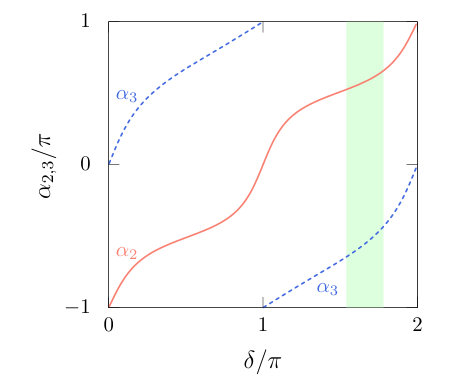 Figure 1
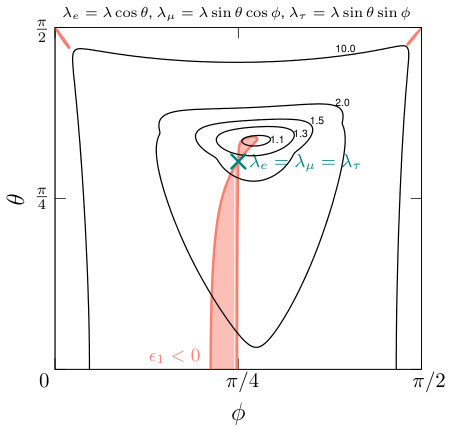 Figure 2
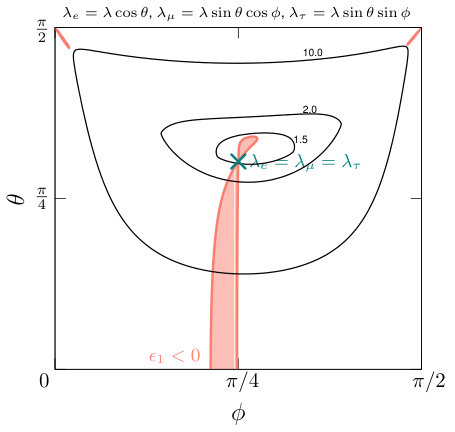 Figure 3
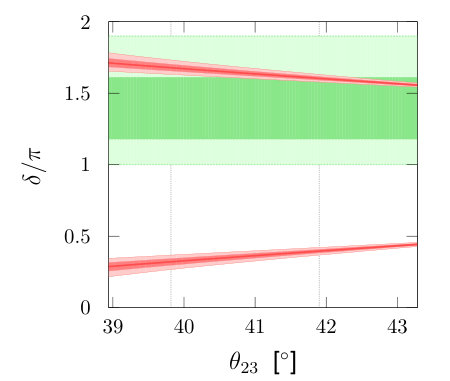 Figure 4
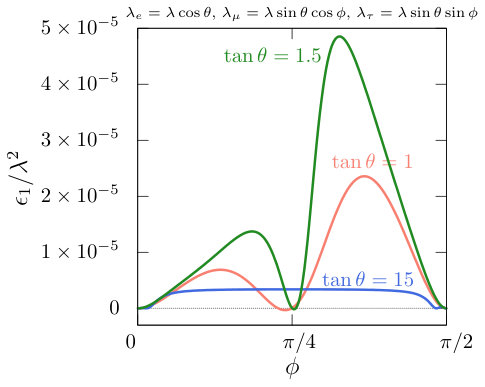 Figure 5
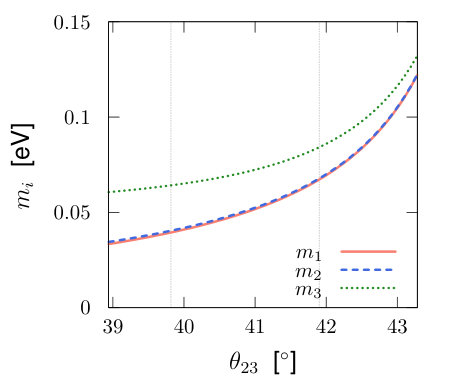 Figure 6
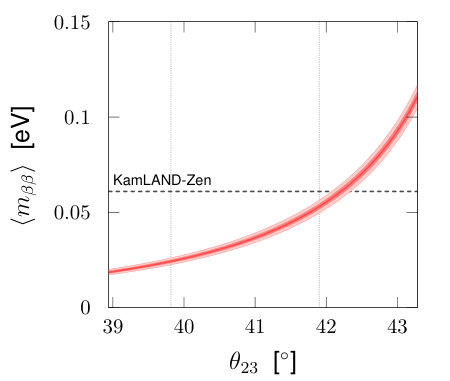 Figure 7
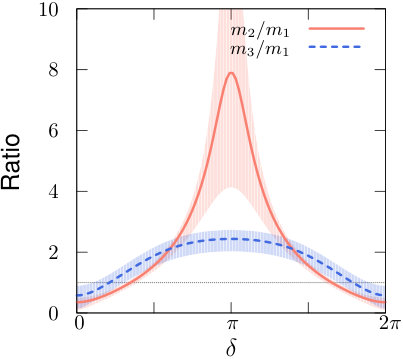 Figure 8
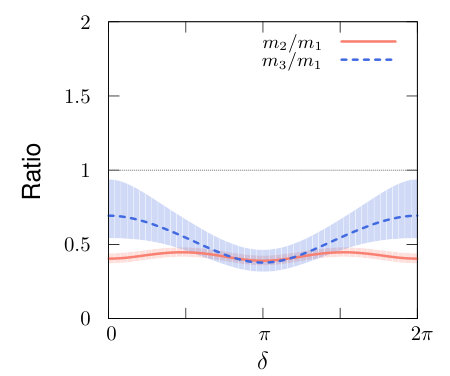 Figure 9
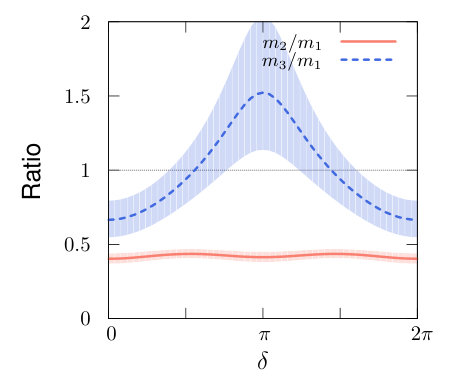 Figure 10
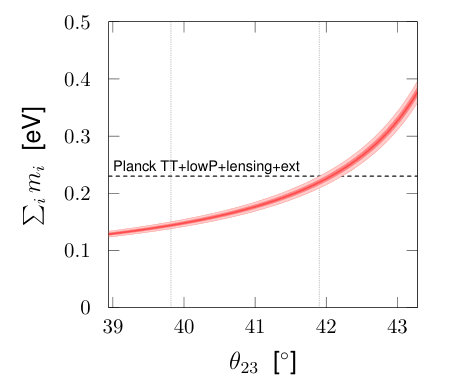 Figure 11
| Parameter | Best fit | 1 range | 2 range |
|---|---|---|---|
| 7.37 | 7.21–7.54 | 7.07–7.73 | |
| 2.525 | 2.495–2.567 | 2.454–2.606 | |
| 2.97 | 2.81–3.14 | 2.65–3.34 | |
| 4.25 | 4.10–4.46 | 3.95–4.70 | |
| 2.15 | 2.08–2.22 | 1.99–2.31 | |
| 1.38 | 1.18–1.61 | 1.00–1.90 |
Peer Reviews
No public reviews on file for this paper yet. If you reviewed it on a platform where reviews are public (OpenReview, ICLR, NeurIPS, ICML), you can paste yours below so the community can read it here.
Videos
No videos yet. Explain this paper in a talk, walkthrough, or lecture? Add one.
UT-17-17
IPMU-17-0072
**Predictions for the neutrino parameters
in the minimal gauged U(1) model
**
Kento Asai1, Koichi Hamaguchi1,2, Natsumi Nagata1
1Department of Physics, University of Tokyo, Bunkyo-ku, Tokyo 133–0033, Japan
2Kavli Institute for the Physics and Mathematics of the Universe (Kavli IPMU), University of Tokyo, Kashiwa 277–8583, Japan
We study the structure of the neutrino mass matrix in the minimal gauged U(1) model, where three right-handed neutrinos are added to the Standard Model in order to obtain non-zero masses for active neutrinos. Because of the U(1) gauge symmetry, the structure of both Dirac and Majorana mass terms of neutrinos is tightly restricted. In particular, the inverse of the neutrino mass matrix has zeros in the and components, namely, this model offers a symmetric realization of the so-called two-zero-minor structure in the neutrino mass matrix. Due to these constraints, all the CP phases—the Dirac CP phase and the Majorana CP phases and —as well as the mass eigenvalues of the light neutrinos are uniquely determined as functions of the neutrino mixing angles , , and , and the squared mass differences and . We find that this model predicts the Dirac CP phase to be – (–), the sum of the neutrino masses to be –0.22 eV (–0.40 eV), and the effective mass for the neutrinoless double beta decay to be –0.055 eV (–0.12 eV) at () level, which are totally consistent with the current experimental limits. These predictions can soon be tested in future neutrino experiments. Implications for leptogenesis are also discussed.
1 Introduction
A gauged U(1) symmetric extension of the Standard Model (SM), where and stand for the and numbers, respectively, has widely been considered so far, as it is one of the several possibilities of gauging an accidental U(1) symmetry in the SM [1, 2, 3, 4]. An attractive feature of this class of models is that the muon anomaly [5, 6, 7, 8] may be explained by the loop contribution of the U(1) gauge boson if its mass lies around the weak scale or lower [9, 10, 11, 12], though this possibility is severely restricted by the searches of the neutrino trident production process [13, 14, 15, 16]. These models may also explain anomalies in flavor physics [15, 17] and offer promising candidates for dark matter in the Universe [18, 19, 20, 21, 22]. For other recent studies on gauged U(1) models, see Refs. [23, 24, 25, 26, 27, 28, 29, 30, 31, 32, 33, 34, 35].
On the other hand, neutrino oscillation data show that at least two of the active neutrinos have non-zero masses and there is sizable mixing among these neutrinos. This can be accounted for if we add right-handed neutrinos to the theory and couple them to the SM lepton and Higgs fields through the Yukawa couplings. After the Higgs field acquires a vacuum expectation value (VEV), these terms lead to the Dirac mass terms for the neutrinos. In addition, the right-handed neutrinos can have Majorana mass terms, and if these masses are much larger than the electroweak scale, then the smallness of the neutrino masses can naturally be explained by the seesaw mechanism [36, 37, 38, 39].
In gauged U(1) models, however, the neutrino mass structure is tightly restricted since the second and third generation leptons are charged under the U(1) gauge symmetry [40, 41, 42, 43, 44]. In fact, in the U(1) preserving limit, the Dirac mass matrix is diagonal, while in the Majorana mass matrix only the , , and components can be non-zero. Such a simple structure cannot explain neutrino oscillation data, and therefore we need to break the U(1) symmetry. To that end, one usually introduces a SM singlet scalar that has a non-zero U(1) charge such that its VEV spontaneously breaks the U(1) gauge symmetry and gives a mass to the U(1) gauge boson. We however note that even though the U(1) gauge symmetry is spontaneously broken, the structure of the neutrino mass matrix is still highly constrained if we introduce just one U(1)-breaking scalar field and consider only renormalizable interactions. Therefore, it is interesting to study if this minimal setup can accommodate the neutrino mass structure that is consistent with the present neutrino oscillation data.
In this paper, we consider this “minimal” gauged U(1) model where three right-handed neutrinos and one U(1)-charged SM singlet scalar field are added to the SM. Then, it turns out that the observed neutrino mixing structure can be obtained only when the U(1)-breaking scalar field has the U(1) charge . In this case, the and components of the Majorana mass matrix for the right-handed neutrinos remain zero even after the U(1) symmetry is spontaneously broken. Because of this structure of the Majorana mass matrix together with the diagonal Dirac mass matrix, the inverse of the neutrino mass matrix also has zeros in the and components [42, 45]. The minimal gauged U(1) model thus gives a concrete realization of a two-zero-minor model [46, 47]. Intriguingly, due to the condition that the and components in the inverse of the neutrino mass matrix vanish, all the CP phases in the neutrino mixing matrix—the Dirac CP phase and the Majorana CP phases and —as well as the mass eigenvalues of the light neutrinos are uniquely determined as functions of the neutrino mixing angles , , and , and the squared mass differences and . As we see below, this prediction is independent of the U(1)-symmetry breaking scale, and thus can be regarded as a generic prediction in the minimal gauged U(1) model. We find that the predicted values of the neutrino parameters are consistent with the present neutrino data and can be tested in future neutrino experiments. We also discuss the implications of our results for leptogenesis.
This paper is organized as follows. In Sec. 2, we introduce the minimal gauged U(1) model and examine the neutrino mass structure in this model. We then show in Sec. 3 the predicted values of the Dirac CP phase , the sum of the neutrino masses , and the effective mass for the neutrinoless double beta decay using the neutrino mixing angles and the squared mass differences obtained in neutrino oscillation experiments. In Sec. 4, we discuss the implications for the leptogenesis. Finally, our conclusions are summarized in Sec. 5. This paper ends with two Appendices which give further details of our analysis. In Appendix A, we present some miscellaneous formulae which are useful to study the neutrino structure in the minimal gauged U(1) model. In Appendix B, we perform similar analyses for the minimal gauged U(1) and U(1) models, and show that these minimal models fail to explain the observed neutrino oscillation data.
2 Neutrino mass structure in the minimal gauged
U(1) model
To begin with, we describe the minimal U(1) model which we discuss in this paper. The model possesses a new U(1) gauge symmetry U(1). Under this gauge symmetry, and have the U(1) charge , and have the U(1) charge , and the other SM fields have the zero U(1) charge. We also introduce three right-handed neutrinos , , and to obtain non-zero neutrino masses. The U(1) charges of these fields are [math], , and , respectively.111Generically speaking, the U(1) charges of the right-handed neutrinos can be without spoiling anomaly cancellation conditions. We however find that only the case gives a neutrino mass structure that can explain the neutrino oscillations. Then we can define the right-handed neutrinos with the U(1) charge 0, , and , as , , and , respectively, without loss of generality. We also note that the introduction of two right-handed neutrinos is insufficient since the observed neutrino mixing angles cannot be reproduced in this case.
In the basis, the U(1) charges of the Dirac Yukawa terms are
[TABLE]
where the entry in the above matrix represents the U(1) charge of the fermion bilinear term , with the flavor indices. For the Majorana mass terms of the right-handed neutrinos, on the other hand, we have
[TABLE]
where the component indicates the U(1) charge of the fermion bilinear term . From Eq. (1), we find that the Dirac Yukawa matrix is always diagonal in the gauged U(1) models—for the same reason, the charged lepton Yukawa matrix is also diagonal. As long as renormalizable interactions are considered, this structure is not violated even if we introduce a U(1)-breaking scalar field. On the other hand, the charges of the Majorana mass matrix in Eq. (2) show that only the , , and components can have non-zero values in the U(1)-symmetric limit. As we mentioned above, with this simple structure, we cannot explain the required values of the neutrino mixing angles. We therefore introduce a scalar boson which has a non-zero U(1) charge, and couple it to right-handed neutrinos. After this scalar field develops a VEV, these couplings lead to Majorana mass terms of the right-handed neutrinos. If the scalar field has the U(1) charge , then the , , , and components in Eq. (2) can be induced after the scalar field acquires a VEV, while the and can be generated if the scalar has the U(1) charge . In the latter case, however, the Majorana mass matrix becomes block-diagonal, which makes it unable to explain the observed neutrino mixing angles. We are thus left with the case where the scalar field has the U(1) charge , and we take it to be in the following discussion. We refer to this model as the minimal gauged U(1) model.
The interaction terms relevant to neutrino masses are then given by
[TABLE]
where the dots indicate the contraction of the SU(2)L indices. After the Higgs field and the singlet scalar acquire VEVs and ,222We can always take the VEV of to be real by using U(1) transformations. respectively, these interaction terms lead to the neutrino mass terms:
[TABLE]
where
[TABLE]
The mass matrix for the light neutrinos is then given by [36, 37, 38, 39]
[TABLE]
An explicit expression for can be found in Appendix A.1. We can diagonalize this mass matrix by using a unitary matrix (PMNS matrix [48]):
[TABLE]
which can be parametrized as
[TABLE]
where and for , , and we have ordered without loss of generality. We follow the convention of the Particle Data Group [48], where and (Normal Ordering, NO) or (Inverted Ordering, IO).
If ( or 3), then . As shown in Appendix A.1, in this case we cannot have desired mixing angles since becomes block-diagonal. Thus, we focus on the case, where we obtain from Eqs. (6) and (7)
[TABLE]
We then notice that the and components of these terms vanish since is diagonal and has zeros in these components. This structure is sometimes called two-zero minor [46, 47]. For other previous studies of the two-zero minor structure, see Refs. [49, 50]. These two vanishing conditions then lead to
[TABLE]
where the matrix is defined by . Notice that neither the U(1)-breaking singlet VEV nor Majorana masses and appear in these conditions explicitly. For this reason, the following discussions based on these equations have little dependence on the U(1)-symmetry breaking scale; it may be around the electroweak scale, or as large as GeV, which is a prime scale for the masses of right-handed neutrinos since small neutrino masses are explained with Yukawa couplings via the seesaw mechanism [36, 37, 38, 39]. It follows from Eqs. (10) and (11) that
[TABLE]
with333These expressions are consistent with the results presented in Ref. [50]. We also find from the explicit expressions (A.3) and (A.4) that the corresponding equations in Ref. [49] disagree with ours.
[TABLE]
where we have used and with being the cofactor matrix of .444The cofactor of a matrix is given by the determinant of the submatrix formed by removing the -th row and -th column of the matrix , multiplied by a factor of . The cofactor matrix of , , is defined by . We then have . In Appendix A.2, we give explicit expressions for and in terms of neutrino oscillation parameters. By taking the absolute values of the equations in (12), we find
[TABLE]
Therefore, these mass ratios are given as functions of the Dirac CP phase . Notice that since contains a single CP phase . As a consequence, are symmetric under the reflection (and ) as we see below.
In Fig. 1, we plot the mass ratios and against the Dirac CP phase using Eq. (15). The bands show uncertainty coming from the 1 error in the neutrino mixing parameters. For input parameters of the neutrino mixing angles, we use , , and [51] (see Table 1).555See also Refs.[52, 53]. It is found that the resultant uncertainty mainly comes from the error in . From this figure, we find that when the observed neutrino mixing angles are incompatible with the condition , and thus these regions are excluded. Moreover, around we have , which disagrees with the possible neutrino mass ordering: either or [48]. As a consequence, in the region where a consistent neutrino mass ordering is obtained, the neutrino mass ordering is always Quasi-Degenerate Normal Ordering with , which is realized around and .
According to the recent global-fit analysis in Ref. [51], the NO is somewhat favored over IO at level. There are quite a few proposed experiments that may determine the neutrino mass ordering at more than 3 level within a decade [54, 55], such as PINGU [56], ORCA [57], and JUNO [58, 59]. To confirm NO in these future experiments would be a first consistency check of our model.
Now that the mass ordering has been fixed, we determine and by using the above results. From the neutrino oscillation experiments, we can measure666 In terms of the squared mass differences and , and are expressed as
(16)
[TABLE]
These quantities are related to the neutrino mass ratios as
[TABLE]
By solving these equations, we can determine and . The observed values of and are given by and , respectively [51]. This means that the right-hand side of Eq. (19) is much smaller than that in Eq. (20). From Fig. 1, we see that such a hierarchy can be realized only when , i.e., . With the explicit formula of in Eq. (A.3), this leads to
[TABLE]
When the best-fit values of the mixing angles are used, this leads to , which corresponds to or . In Eq. (A.6) in Appendix A.3, we give a cubic equation whose solution gives an exact value of as a function of the mixing angles and the squared mass differences and . As discussed there, the solution (21) approximates the real solution of the cubic equation (A.6) at level. By solving Eq. (A.6) numerically, we find for the best-fit values of , , and , which means or , and justifies the expected accuracy of the approximated formula (21).777This result disagrees with the observation in Ref. [21], where it was observed that is predicted in the minimal gauged model. In the analysis of Ref. [21], the Dirac Yukawa terms of neutrinos are supposed to be real in the basis where has only one CP phase, though it is not the generic case. In addition, we find disagreement between the neutrino mass matrix shown in Ref. [21] and ours, as pointed out in Appendix A.1.
From Eqs. (13) and (19), we obtain as a function of . An explicit expression for is given in Appendix A.2. As noted above, are symmetric with respect to the reflection . This implies that is also symmetric under this reflection and thus depends only on (not ). As a result, even though there are two solutions for , (and thus as well) is uniquely determined. Finally, by substituting the above results into Eq. (12), we determine the Majorana CP phases and . Again, since , we have , as seen in Fig. 7 in Appendix A.2.
In the next section, we discuss the predictions of the minimal gauged U(1) model with the recent oscillation data. Before closing this section, let us give some general remarks.
- •
If the U(1) symmetry breaking scale is much higher than the electroweak scale, we expect sizable quantum corrections to the neutrino mass matrix. Such quantum corrections can be taken into account by using renormalization group equations. Remarkably, it is found that the two-zero minor structure of is preserved throughout the renormalization group flow [46, 47]. To see this, we first note that below the right-handed neutrino mass scale, which is around the U(1) symmetry breaking scale in this model, right-handed neutrinos are integrated out to give the following dimension-five effective operator:
[TABLE]
where has the two-zero minor structure at the right-handed neutrino mass scale. The renormalization group equation of the Wilson coefficient at one-loop level is [60]
[TABLE]
with
[TABLE]
where , , and denote the up-type, down-type, and charged-lepton Yukawa matrices, respectively, is the SU(2)L gauge coupling, and is the Higgs quartic coupling: . Now recall that the charged lepton Yukawa matrix is diagonal in our model. In this case, the above equation can readily be solved as follows [61]:
[TABLE]
where with being the initial scale, and
[TABLE]
Note that is a diagonal matrix. Therefore, if , then , which proves that the two-zero minor structure of the Wilson coefficient remains at low energies. As a result, the two-zero minor neutrino-mass structure in our model is robust against quantum corrections, even if the U(1) symmetry breaking scale is much higher than the electroweak scale.
- •
By performing a similar analysis, we can study the minimal gauged U(1) and U(1) models. We again obtain two conditions similar to Eqs. (10) and (11), which follow from the zero components in the inverse of the neutrino mass matrix in each model. We however find that in these cases it is unable to find parameter space consistent with the observed values of the neutrino oscillation parameters, as demonstrated in Appendix B. We thus conclude that within the minimal approach discussed in this paper, the U(1) case is the only possibility that offers a desirable neutrino mass structure.
- •
If we go beyond the minimal model, we may obtain a different neutrino-mass structure in the presence of the U(1) gauge symmetry. For example, Refs. [25, 33] discuss gauged U(1) models where neutrino masses are radiatively induced at one-loop level. It turns out that the neutrino mass matrices in these models have the form of the two-zero texture [62, 63, 64, 65, 66], which predicts IO for neutrino mass spectrum. Thus, the determination of neutrino mass hierarchy in future neutrino experiments allows us to distinguish this class of models from the minimal model, where NO is predicted as we have seen above.
3 Predictions for the neutrino parameters
Using the results obtained above, we now compute quantities relevant to neutrino experiments with the errors in the neutrino oscillation parameters taken into account. For input values, we use the values given in Ref. [51], which are summarized in Table 1. In particular, we take the three mixing angles and the two mass squared differences ,
[TABLE]
as input parameters, and evaluate the predicted values of the other parameters, including Dirac CP phase , the absolute masses , their sum , and the effective Majorana neutrino mass . The prediction for the Majorana phases and is also presented in Appendix A.2.
In Fig. 2, we plot the Dirac CP phase as functions of in the red lines. We vary in the 2 renege, where the 1 range is in between the vertical thin dotted lines. The dark (light) red bands show the uncertainty coming from the 1 () errors in the other parameters , , , and . We find that this uncertainty is dominated by the error in . We also show the 1 (2) favored region of in the dark (light) horizontal green bands. As we discussed in the previous section, there are two solutions for for each value of . Intriguingly, the upper line is right in the middle of the favored range of ; in particular, gives , both of which are within the allowed region. Consequently, this model predicts – (–) within (). Future neutrino experiments can test this prediction through precision measurements of and [67].
Next, we evaluate the neutrino masses , which are shown in Fig. 3(a) as functions of . Here, the other parameters are fixed to be their best-fit values. We see that all of these masses are predicted to be eV. We also plot the sum of these neutrino masses as a function of in Fig. 3(b), where the dark (light) red band shows the uncertainty coming from the 1 () errors in the parameters other than . In this case, it turns out that the dominant contribution to the uncertainty (except for that from the error in ) comes from the error in , though the error in also gives a sizable contribution. We also show in the black dashed line the present limit imposed by the Planck experiment: eV (Planck TT+lowP+lensing+ext) [68].888If we exclude the Planck lensing data, we obtain a slightly stringent bound: eV [68]. From this figure, we find that a wide range of the parameter region predicts a value of which is below the present limit, though a part of the parameter region has already been disfavored by the Planck limit. We however note that this bound relies on the standard cosmological history, and thus if some new physics effects modify the cosmological evolution, then this bound may significantly be relaxed. In any case, our model predicts a rather large value of the sum of the neutrino masses, –0.22 eV (0.12–0.40 eV) at (), which may be probed in future cosmological observations.
These relatively large values of open up a possibility of testing this model in neutrinoless double-beta decay experiments. The rate of neutrinoless double-beta decay is proportional to the square of the effective Majorana neutrino mass , which is given by
[TABLE]
It should be emphasized that, in the minimal gauged U(1) model, not only the neutrino masses but also the Majorana phases are uniquely determined as functions of the other neutrino oscillation parameters. Thus, the value of the effective mass is also predicted unambiguously. Note also that this quantity has reflection symmetry with respect to and thus depends only on . In Fig. 4, we show as a function of , where the dark (light) red band shows the uncertainty coming from the 1 () errors in the parameters other than . Currently, the KamLAND-Zen experiment gives the strongest bound on : –0.165 eV [69] where the uncertainty stems from the estimation of the nuclear matrix element for 136Xe. We also show in Fig. 4 the most severe bound from KamLAND-Zen, eV, in the black dashed line [69]. As can be seen, most parameter region predicts a value of lower than the strongest bound. At () level, this model predicts eV (0.017 eV)—this can be within the reach of future neutrinoless double-beta decay experiments [70].
4 Implications for Leptogenesis
In this section, we discuss the implications of our results for the leptogenesis scenario [71], which is one of the most attractive mechanisms to explain the origin of the baryon asymmetry of the Universe. The minimal gauged U(1) model has three right-handed neutrinos coupled to the Standard Model leptons, and therefore it contains enough ingredients for the leptogenesis: the CP-violating decay of the right-handed neutrino in the early universe can generate the lepton asymmetry, which is converted to the baryon asymmetry via the sphaleron process [72].
As we have seen in the previous sections, the light neutrino mass matrix in the minimal gauged U(1) model is uniquely determined for a given set of neutrino oscillation parameters , and . Therefore, the mass matrix of the right-handed neutrino, , is also tightly constrained, having only three additional free parameters, , and . Note that these neutrino Yukawa couplings can be taken to be real and positive by field redefinitions. Therefore, there is no additional phase parameter in the model. By diagonalizing the masses of the right-handed neutrinos, we can rewrite the Lagrangian (3) as
[TABLE]
where are the right-handed neutrino fields in the basis where the masses are diagonalized, are the neutrino Yukawa couplings in that basis, and are the masses which are taken to be real and positive. Explicitly, they are given by
[TABLE]
We emphasize again that both masses and the couplings are completely determined by the three real parameters and the oscillation parameters , .
One of the most important parameters in the leptogenesis scenario is the asymmetry parameter , which represents the lepton asymmetry generated by the decay of the lightest right-handed neutrino. At the leading order, it is given by [73, 74, 75]
[TABLE]
Here, one can see that there is a correlation between the sign of the Dirac phase and the baryon asymmetry of the Universe. Suppose that the sign of the Dirac phase is flipped, , while the other input oscillation parameters as well as the neutrino Yukawa couplings are fixed. As discussed in the previous sections, the Majorana phases then flip the sign, , while the absolute masses of light neutrinos do not change, . Thus, the PMNS matrix transforms as . This then results in , leading to , , , and eventually . This means that, for a given input oscillation parameters and the neutrino Yukawa couplings , there is one-to-one correspondence between the sign of the Dirac phase and the sign of the baryon asymmetry of the Universe.
In Fig. 5, we show the asymmetry parameter as a function of the neutrino Yukawa couplings, which are parametrized as .999We can take account of the one-loop renormalization-group effects by instead regarding () as input parameters (see Eqs. (25) and (26)). Thus, our consequence here is robust against one-loop quantum corrections. Note that the parameter scales as in this parametrization, as shown in Eq. (33). The oscillation parameters are taken to be their best-fit values in Table 1. The sign of the Dirac phase is taken to be negative, (or ), as it is favored at 2 level. Note that the observed baryon asymmetry of the Universe requires , because the sphaleron process predicts [76]. Surprisingly, negative is realized only in the limited regions of the parameter space. This is more clearly seen in Figs. 6, where we show the regions of in the plane as red shaded areas. We also show the contours of the right-handed neutrino mass ratios and in the left and right panels, respectively. As we see, the asymmetry parameter can be negative when some of the right-handed neutrinos are degenerate in mass— in the negative region around while for and . In the latter regions, and , the lightest right-handed neutrino mass is much smaller than the other ones, and () for (). In these cases, the absolute value of the asymmetry parameter is found to be quite suppressed, and thus it is rather difficult to obtain a sizable value, say .101010Note that the function in Eq. (34) goes as for . Similarly, gets small for and . These observations further restrict the promising parameter region for leptogenesis to be .
The final baryon asymmetry depends on the production mechanism of the right-handed neutrino. In the case of thermal leptogenesis, the predicted range of the lightest neutrino mass in the present model, , corresponds to the so-called strong wash-out region (see, e.g., [77]). Moreover, as we see from Fig. 6, around , right-handed neutrino masses are close to each other. In this case, to properly estimate the net baryon asymmetry generated via the decay of right-handed neutrinos, we may need to include not only the contribution of the lightest right-handed neutrino but those of the other ones. Flavor effects [78, 79, 80] may also become important. A more detailed study will be given elsewhere [81].
5 Conclusions
We have studied the structure of the neutrino mass matrix in the minimal gauged U(1) model. Because of the U(1) gauge symmetry, the structure of both Dirac and Majorana mass terms of neutrinos is tightly restricted, which results in a two-zero minor structure of the neutrino mass matrix. Because of this restriction, all the CP phases and the neutrino masses are uniquely determined. We find that this model gives the following prediction at () level:
- •
Dirac CP phase: – (–),
- •
the sum of the neutrino masses: –0.22 eV (– eV),
- •
the effective mass for the neutrinoless double beta decay: –0.055 eV (0.017–0.12 eV).
They are totally consistent with the current experimental limits, and hold independently of the U(1) breaking scale and the Majorana mass scale. In this sense, the above predictions are the generic features of the minimal gauged U(1) model. Remarkably, these predictions can be tested in various neutrino experiments in the near future—regardless of the scale of the U(1) symmetry breaking—which we believe sheds light on the gauge structure of physics beyond the Standard Model.
We have also discussed the implications of the minimal gauged U(1) model for the leptogenesis scenario, and found that the correct sign of the baryon asymmetry of the Universe can be obtained only in the limited regions of the parameter space, as the right-handed neutrino mass structure is also severely restricted in this model. In particular, the observed value of baryon asymmetry can be realized when right-handed neutrinos are degenerate in mass, which requires a further detailed study to assess the viability of leptogenesis in this model [81].
Acknowledgments
This work is supported by the Grant-in-Aid for Scientific Research (No.26104001 [KH], No.26104009 [KH], No.26247038 [KH], No.26800123 [KH], No.16H02189 [KH], No.17K14270 [NN]), and by World Premier International Research Center Initiative (WPI Initiative), MEXT, Japan. The work of KA is supported by the Program for Leading Graduate Schools, MEXT, Japan.
Appendix
Appendix A Miscellaneous formulae
Here we give formulae that are useful for the study of the neutrino mass structure in the minimal gauged U(1) model.
A.1 Neutrino mass matrix
The light neutrino mass matrix in Eq. (6) can be expressed in terms of the Lagrangian parameters in Eq. (3) as111111We obtain a different result from that given in Ref. [21].
[TABLE]
The determinant of this mass matrix is given by
[TABLE]
We find that this determinant vanishes if and only if (, , or ). In this case, the mass matrix is block-diagonal, and thus cannot reproduce the required neutrino mixing angles.
A.2 and
The functions and defined in Eqs. (13) and (14), respectively, are expressed in terms of neutrino oscillation parameters as
[TABLE]
Using Eq. (19) together with Eq. (A.3), we find
[TABLE]
This expression shows that depends only on (not ), as we have argued in Sec. 2.
Using Eqs. (12), (A.3), and (A.4), we determine the Majorana CP phases as functions of , and show them in Fig. 7. Here, we fix the other neutrino oscillation parameters to be their best-fit values. The green band depicts the 2 favored region of predicted in the minimal gauged U(1) model. As can be seen, sizable Majorana CP phases are predicted in this model. In addition, we find (or ), as discussed in Sec. 2.
A.3 Cubic equation for
Here, we show a cubic equation whose real solution in terms of gives :
[TABLE]
where
[TABLE]
In the limit of , the above equation leads to
[TABLE]
or
[TABLE]
The discriminant of the quadratic equation (A.8) is given by
[TABLE]
which is negative as . Thus, Eq. (A.8) does not give a real solution. On the other hand, Eq. (A.9) gives
[TABLE]
which agrees to Eq. (21). From the above derivation, we see that the solution (A.11) approximates the real solution of the cubic equation (A.6) with an accuracy of .
Appendix B U(1) and U(1)
In this section, we examine the neutrino mass structure in the minimal gauged U(1) and U(1) models and show that it is unable to obtain a solution that is consistent with the observed values of the neutrino oscillation parameters.121212A similar conclusion was also reached in Ref. [50].
B.1 U(1)
Following an analysis similar to that in Sec. 2, we find that the and components in the inverse of the neutrino mass matrix vanish in the minimal gauged U(1) model. The corresponding two vanishing conditions are
[TABLE]
Solving these equations, we have
[TABLE]
with
[TABLE]
In Fig. 8(a), we plot the mass ratios and as functions of . As we see from this figure, is predicted for any value of , and thus there is no solution which gives an allowed pattern of neutrino mass spectrum.
B.2 U(1)
In this case, the and components in are zero, which leads to
[TABLE]
These equations read
[TABLE]
with
[TABLE]
Using these equations, we plot the mass ratios and as functions of in Fig. 8(b). Again, over the whole range of , and thus this model cannot provide a desirable neutrino mass ordering.
The reference list from the paper itself. Each links out to its DOI / PubMed record.
- 1[1] R. Foot, New Physics From Electric Charge Quantization? , Mod. Phys. Lett. A 6 (1991) 527–530 . · doi ↗
- 2[2] X. G. He, G. C. Joshi, H. Lew and R. R. Volkas, NEW Z-prime PHENOMENOLOGY , Phys. Rev. D 43 (1991) 22–24 . · doi ↗
- 3[3] X.-G. He, G. C. Joshi, H. Lew and R. R. Volkas, Simplest Z-prime model , Phys. Rev. D 44 (1991) 2118–2132 . · doi ↗
- 4[4] R. Foot, X. G. He, H. Lew and R. R. Volkas, Model for a light Z-prime boson , Phys. Rev. D 50 (1994) 4571–4580 , [ hep-ph/9401250 ]. · doi ↗
- 5[5] Muon g-2 collaboration, G. W. Bennett et al., Final Report of the Muon E 821 Anomalous Magnetic Moment Measurement at BNL , Phys. Rev. D 73 (2006) 072003 , [ hep-ex/0602035 ]. · doi ↗
- 6[6] F. Jegerlehner and A. Nyffeler, The Muon g-2 , Phys. Rept. 477 (2009) 1–110 , [ 0902.3360 ]. · doi ↗
- 7[7] M. Davier, A. Hoecker, B. Malaescu and Z. Zhang, Reevaluation of the Hadronic Contributions to the Muon g-2 and to alpha(MZ) , Eur. Phys. J. C 71 (2011) 1515 , [ 1010.4180 ]. · doi ↗
- 8[8] K. Hagiwara, R. Liao, A. D. Martin, D. Nomura and T. Teubner, ( g − 2 ) μ subscript 𝑔 2 𝜇 (g-2)_{\mu} and α ( M Z 2 \alpha(M_{Z}^{2} ) re-evaluated using new precise data , J. Phys. G 38 (2011) 085003 , [ 1105.3149 ]. · doi ↗