On the Sub-optimality of Single-Letter Coding over Networks
Farhad Shirani, S. Sandeep Pradhan

TL;DR
This paper introduces a new bound linking effective length and maximum correlation of Boolean functions on correlated sequences, revealing the sub-optimality of single-letter coding schemes in multi-terminal communications.
Contribution
It derives a novel correlation bound considering effective length, and demonstrates the sub-optimality of single-letter coding in multi-terminal communication problems.
Findings
New correlation bound involving effective length
Single-letter coding schemes are sub-optimal in certain settings
Characterization of dependency spectrums of binary block-codes
Abstract
In this paper, we establish a new bound tying together the effective length and the maximum correlation between the outputs of an arbitrary pair of Boolean functions which operate on two sequences of correlated random variables. We derive a new upper bound on the correlation between the outputs of these functions. The upper bound may find applications in problems in many areas which deal with common information. We build upon Witsenhausen's result on maximum correlation. The present upper bound takes into account the effective length of the Boolean functions in characterizing the correlation. We use the new bound to characterize the communication-cooperation tradeoff in multi-terminal communications. We investigate binary block-codes (BBC). A BBC is defined as a vector of Boolean functions. We consider an ensemble of BBCs which is randomly generated using single-letter distributions.…
Click any figure to enlarge with its caption.
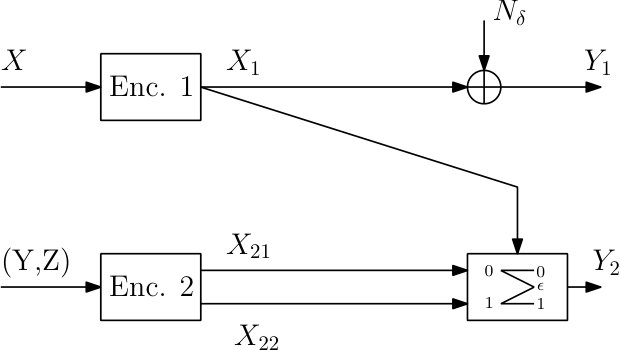 Figure 1
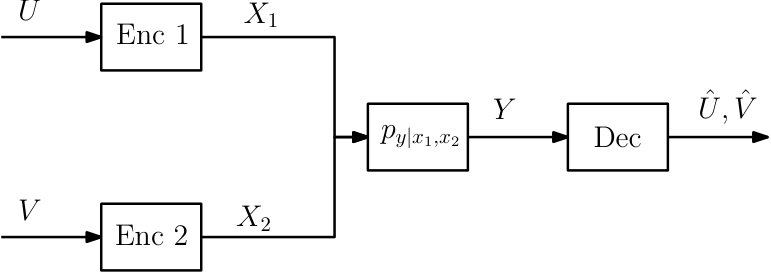 Figure 2
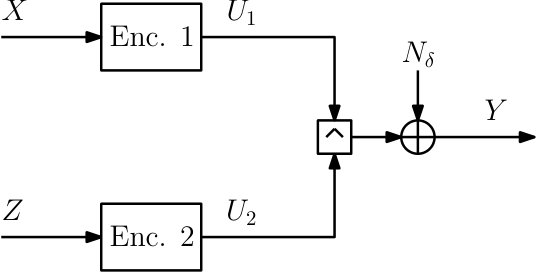 Figure 3
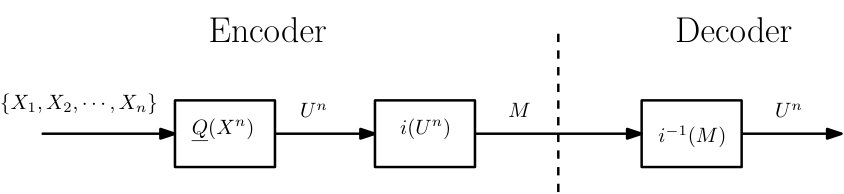 Figure 4
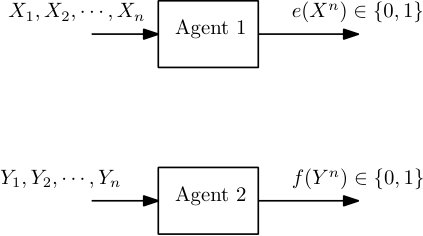 Figure 5
 Figure 6
Peer Reviews
No public reviews on file for this paper yet. If you reviewed it on a platform where reviews are public (OpenReview, ICLR, NeurIPS, ICML), you can paste yours below so the community can read it here.
Videos
No videos yet. Explain this paper in a talk, walkthrough, or lecture? Add one.