Semiclassical cosmology with polymer matter
Syed Moeez Hassan, Viqar Husain

TL;DR
This paper explores the effects of applying polymer quantization to matter in semiclassical cosmology, revealing inflationary behavior and the importance of quantizing both gravity and matter for a complete cosmological model.
Contribution
It introduces a semiclassical cosmological model with polymer quantized matter while keeping gravity classical, highlighting the significance of matter quantization.
Findings
Demonstrates inflationary dynamics with polymer matter
Shows classical universe emergence at late times
Indicates singularity remains unresolved without quantum gravity
Abstract
In loop quantum cosmology, polymer quantization is applied to gravity and Schrodinger quantization to matter. This approach misses interesting cosmological dynamics coming from the polymer quantization of matter. We demonstrate this in semiclassical cosmology with a scalar field and pressureless dust: gravity is kept classical, dust is used to fix the time gauge, and polymer quantization effects are isolated in the scalar field. The resulting dynamics shows a period of inflation, both with and without a scalar potential, and the emergence of a classical universe at late times. Since gravity is not quantized, the cosmological singularity is not resolved, but our results suggest that polymer quantization of both gravity and matter are important for a complete picture.
Click any figure to enlarge with its caption.
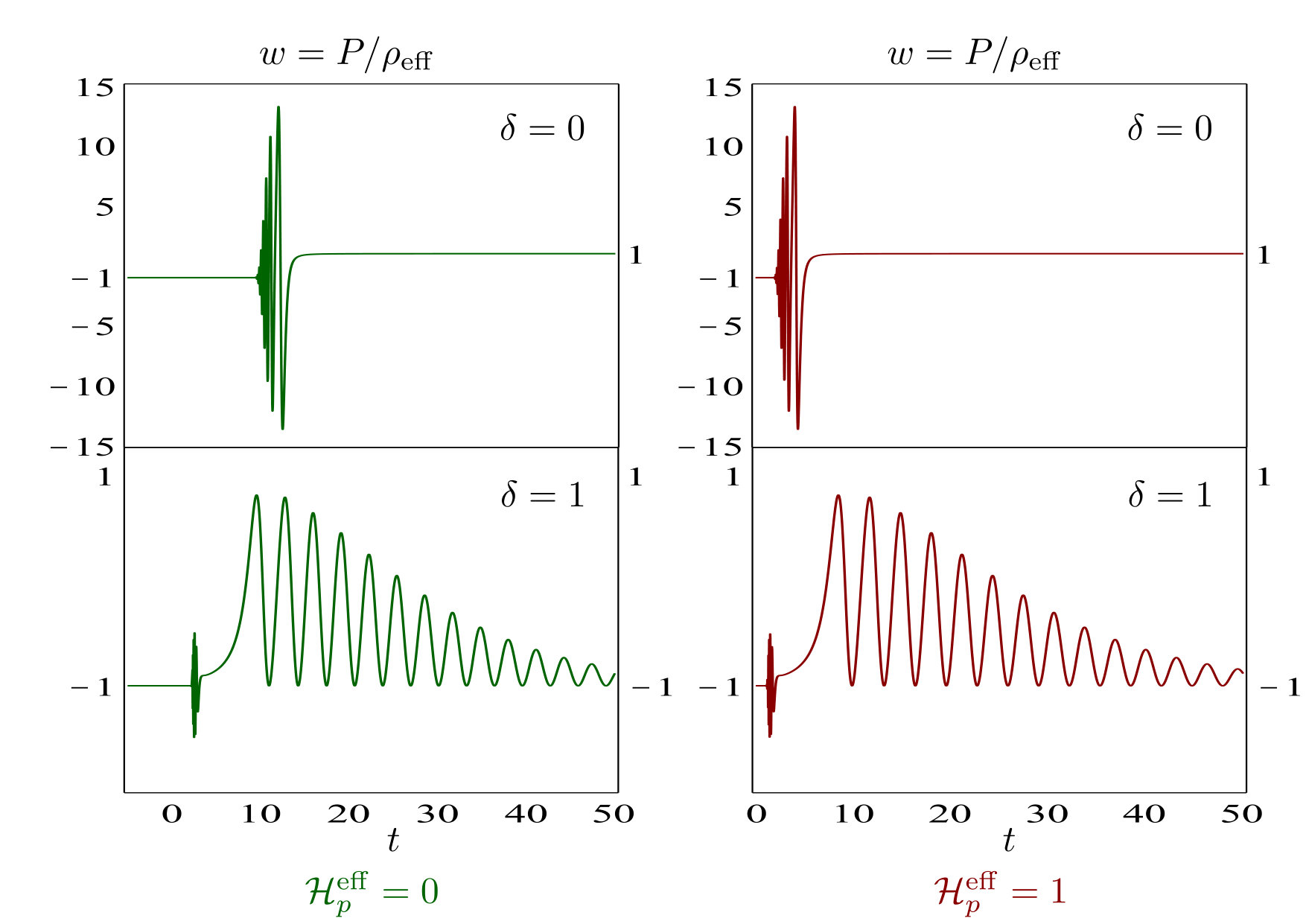 Figure 1
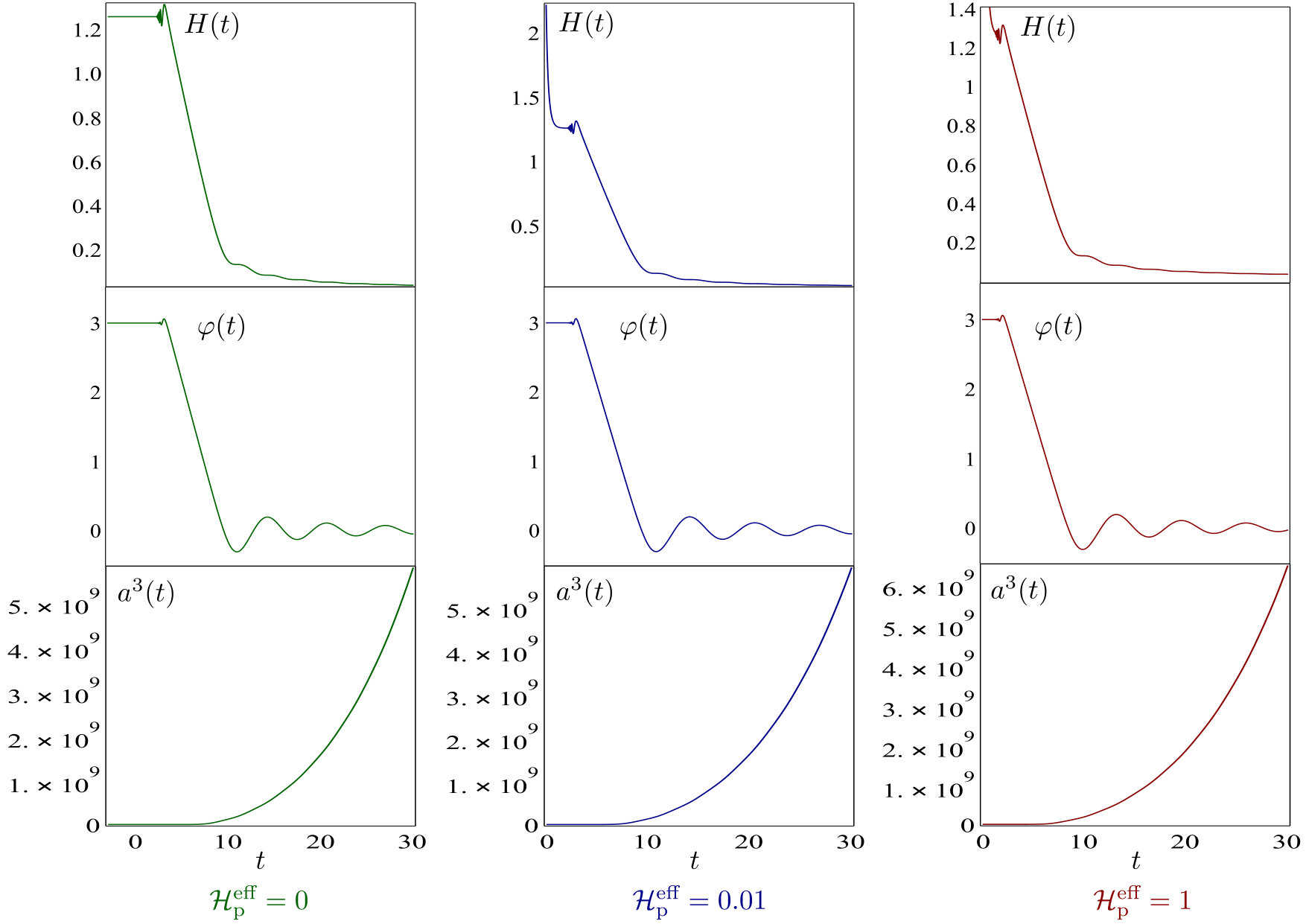 Figure 2
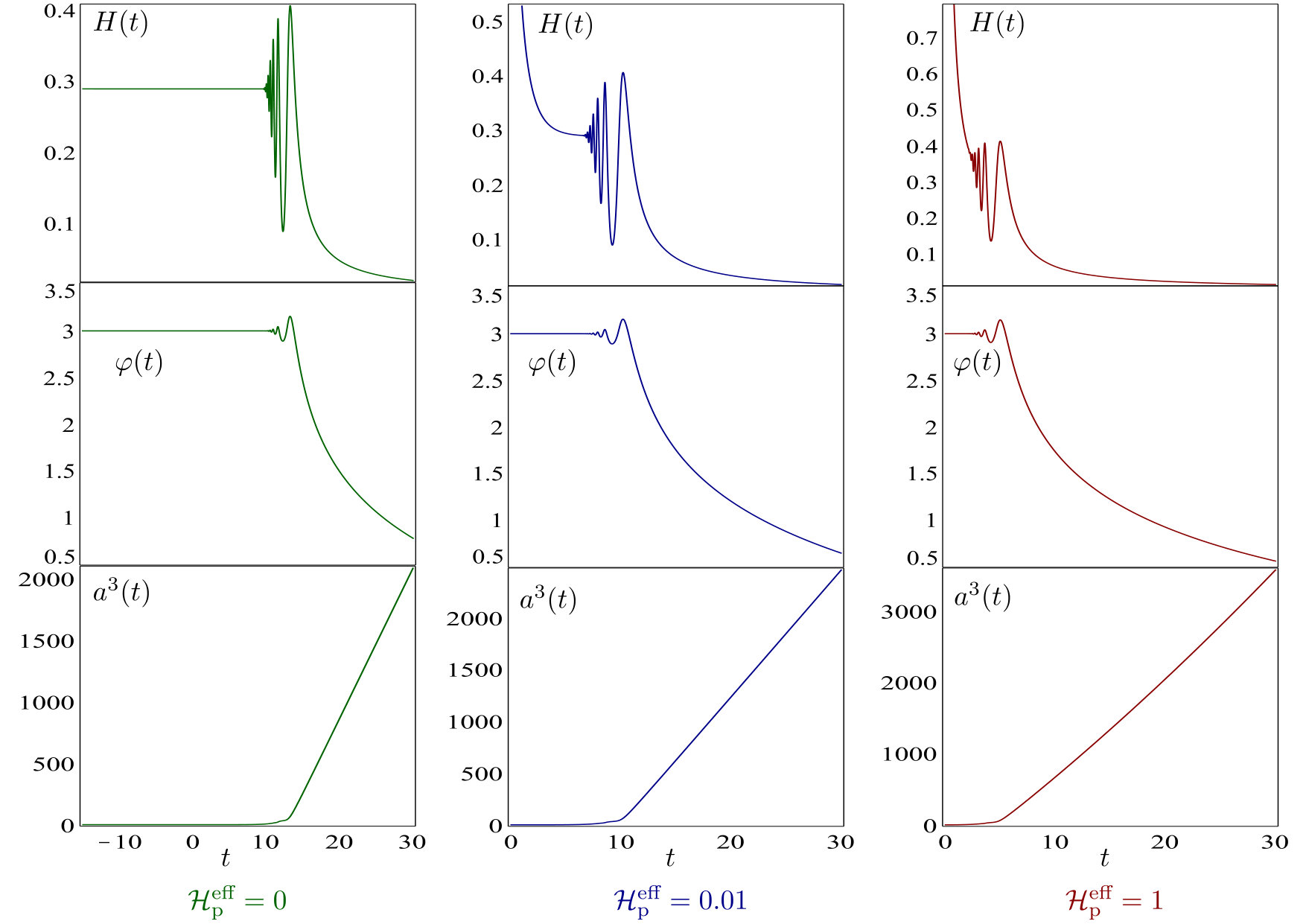 Figure 3
Peer Reviews
No public reviews on file for this paper yet. If you reviewed it on a platform where reviews are public (OpenReview, ICLR, NeurIPS, ICML), you can paste yours below so the community can read it here.
Videos
No videos yet. Explain this paper in a talk, walkthrough, or lecture? Add one.
Semiclassical cosmology with polymer matter
Syed Moeez Hassan
Department of Mathematics and Statistics, University of New Brunswick, Fredericton, NB, Canada E3B 5A3
Viqar Husain
Department of Mathematics and Statistics, University of New Brunswick, Fredericton, NB, Canada E3B 5A3
Abstract
In loop quantum cosmology, polymer quantization is applied to gravity and Schrodinger quantization to matter. This approach misses interesting cosmological dynamics coming from the polymer quantization of matter. We demonstrate this in semiclassical cosmology with a scalar field and pressureless dust: gravity is kept classical, dust is used to fix the time gauge, and polymer quantization effects are isolated in the scalar field. The resulting dynamics shows a period of inflation, both with and without a scalar potential, and the emergence of a classical universe at late times. Since gravity is not quantized, the cosmological singularity is not resolved, but our results suggest that polymer quantization of both gravity and matter are important for a complete picture.
I Introduction
Inflation is a part of the standard model of cosmology Baumann (2011). It explains key observations in our universe including large scale spatial homogeneity and structure formation. It is natural to ask what role, if any, quantum gravity effects play in explaining or modifying the standard inflationary picture, and whether signals of quantum gravity are writ large on the sky Easther et al. (2001); Shankaranarayanan (2003). This question continues to be discussed from various points of view including string theory Antoniadis and Cotsakis (2017), non-commutative geometry Brandenberger and Ho (2002); Marcolli and Pierpaoli (2010), and loop quantum gravity (LQG) Bojowald (2008); Ashtekar and Singh (2011); Ashtekar and Barrau (2015) Of these varied approaches, most of the work related to cosmology is from the first and last.
One of the main lessons emerging from LQG is a method of quantization called polymer quantization. The key feature of this is the use of a non-separable Hilbert space that has a built in notion of fundamental discreteness. Although this method can be used for quantization of any classical system, the most detailed studies have been to cosmological models written in the connection-triad variables for canonical gravity, an area called loop quantum cosmology (LQC). Perhaps the most important result is a general mechanism for singularity resolution in a variety of models Ashtekar et al. (2006, 2008). This comes about from the operator realization of the Hamiltonian constraint on this Hilbert space with the scalar field (with zero potential) used as a clock.
However all models studied to date in LQC use the usual Schrodinger quantization prescription applied to matter, and polymer quantization applied to the gravitational degrees of freedom. This is not natural from the point of view of full LQG, where polymer quantization is taken to be a fundamental ingredient, and is applied to both gravity and matter sectors Thiemann (1998a). Indeed, given this starting point, it is natural to expect that in a semiclassical regime, there will first be an emergence of a “polymer quantum field theory” (PQFT) on curved spacetime, and a subsequent lower energy emergence of usual QFT on curved spacetime. These are open issues, and so far there has been some preliminary investigations of the polymer quantum field theory on flat spacetime with some interesting physical results Husain and Kreienbuehl (2010); Hossain et al. (2010a); Husain and Louko (2016).
In this paper we investigate this intermediate regime as it applies to cosmology. We treat gravity classically and study the semiclassical Hamiltonian theory with polymer quantized matter in a Gaussian state. We do this in the Arnowitt-Deser-Misner (ADM) variables, with the understanding that if gravity is kept classical, there is little difference from connection-triad variables. Our aim is to isolate the effects of polymer quantization of matter on cosmological dynamics as a prelude to a more complete treatment.
This approach has been studied before for homogeneous and isotropic universe with a massless and massive scalar field Hossain et al. (2010b); Hassan et al. (2015). We extend these works by adding a dust field which introduces an extra degree of freedom in the system. The dust is used to fix a time gauge Husain and Pawlowski (2012, 2011), and the corresponding physical Hamiltonian is used to study the dynamics. Without a “solution” to the problem of time, this time gauge provides a potentially useful and relatively simple physical Hamiltonian for studying semiclassical and quantum gravity.
Our main result is that polymer quantization of matter in this model naturally produces a period of inflation followed by a graceful exit into a classical regime. This occurs both with and without a scalar field potential. These results are qualitatively similar in some aspects, but quantitatively quite different from the above works.
In the next section (II) we review the Hamiltonian theory in dust time gauge in a general setting, followed by a description of the polymer quantization for the scalar field in Sec. III. This quantization is different from that employed in LQG, but it captures the main feature that the scalar kinetic operator is written in a manner similar to that for the gravitational kinetic term in LQC. In Section IV we present the results of semiclassical dynamics, followed in Sec. V by a summary of results, and a discussion of possible further developments.
II Hamiltonian theory
The theory we study is general relativity with a minimally coupled scalar field and a pressureless dust field . The dust Lagrangian on a manifold with metric is
[TABLE]
where is the field that enforces the constraint that the dust is timelike. The stress-energy tensor is
[TABLE]
therefore on shell, is the dust energy density.
The Hamiltonian theory is obtained by substituting the Arnowitt-Deser-Misner (ADM) parametrization of metric
[TABLE]
into the Lagrangian. and are the lapse and shift fields and is the spatial metric. The dust momentum is
[TABLE]
where . The dust Hamiltonian density is
[TABLE]
Variation of the canonical from of the action with respect to gives
[TABLE]
Substituting this back gives
[TABLE]
The ADM canonical action of general relativity with massive scalar field and dust is
[TABLE]
where
[TABLE]
and is the spatial metric-compatible covariant derivative.
II.1 Dust time gauge
We study this theory in the dust time, defined by with . In the end we will make one choice, but we keep this freedom for now to interpret physically the corresponding physical Hamiltonian. The requirement that the gauge be preserved in time requires
[TABLE]
The physical Hamiltonian is obtained by substituting the gauge into the dust symplectic term in the canonical action, which identifies . Using (7) and solving the Hamiltonian constraint
[TABLE]
gives
[TABLE]
using (10) for the last equality. It is also useful to note, using (4) and (10), the relation
[TABLE]
which shows that for , and
[TABLE]
We note also that the requirement that the dust Hamiltonian satisfy implies , since . This means that the dust field satisfies the weak energy condition. With this choice (10) gives . In the following we make the choice which gives the manifestly positive physical Hamiltonian density
[TABLE]
II.2 Semiclassical approximation for cosmology
The reduction to flat FRW cosmology is obtained by setting
[TABLE]
where is the flat Euclidean metric. The (dust time) gauge fixed action is
[TABLE]
where the last equation follows from (15), and is a fiducial volume. Eqn. (15) also requires that initial data for this system be chosen such that for some constant : this may be rearranged as the Friedman equation
[TABLE]
indicating positive corresponds to positive dust energy density.
Our goal in the following sections is to study this model in the semiclassical approximation. This is defined using a state of the scalar field of width , peaked at the phase space point . Such a state determines an effective Hamiltonian
[TABLE]
Semiclassical dynamics of the coupled matter gravity equations arises from this effective Hamiltonian by imposing the Poisson bracket , which we henceforth write without the bars. We define in the polymer quantization described below, and compute the expectation value.
III Polymer quantization of the scalar field
Polymer quantization of the scalar field has been studied by several authors both at the formal level and applied to physical systems Ashtekar et al. (2003a, b); Husain et al. (2007a); Kunstatter et al. (2009). There are two distinct versions of it depending on whether momenta or configuration variables are diagonal. Unlike in Schrodinger quantization there is no Fourier transform connecting these. The method we use for polymer quantization on a curved background was introduced in Hossain et al. (2010b).
Let us consider the scalar field on the ADM background metric (3) and the non-canonical phase space variables
[TABLE]
where is a smearing function. The parameter is a spacetime constant with dimensions of . These variables satisfy the Poisson algebra
[TABLE]
Specializing to FRW spacetime with line element
[TABLE]
we can set because of homogeneity, so these variables become
[TABLE]
where is a fiducial volume. Their Poisson bracket is the same as in (21).
Quantization proceeds by realizing the Poisson algebra (21) as a commutator algebra on the space of square integrable functions on the Bohr compactification of . A basis is with the inner product
[TABLE]
where is the generalization of the Kronecker delta to the real numbers. Basis wave functions are and the inner product in explicit form is
[TABLE]
Action of the operators and are defined by
[TABLE]
A consequence of these operators and the above inner product is that the momentum operator does not exist in this quantization because the translation operator is not weakly continuous in . This may be seen by noting that the limit
[TABLE]
which could define the momentum operator using , does not exist. An alternative way to define the momentum operator indirectly is
[TABLE]
a form motivated by the classical expansion of . In particle systems this modifies the kinetic energy operator. In LQG it constitutes the origin of “holonomy corrections.” The usual Schrodinger quantization results are obtained in suitably defined limits Fredenhagen and Reszewski (2006); Husain et al. (2007b); Corichi et al. (2007).
For polymer corrected cosmological dynamics we wish to calculate the scalar field energy density
[TABLE]
for a Gaussian coherent state peaked at the phase space values . Before doing so we fix the polymer energy scale by setting . A suitable choice of state is
[TABLE]
where is an eigenvalue of the scalar field operator, rather than its “integrated” version defined in (26) above.
The effective density was computed for the zero potential case in Hossain et al. (2010b). For completeness we summarize the main steps. The normalization constant is calculated by approximating the sum by an integral,
[TABLE]
and
[TABLE]
where we have used the variables
[TABLE]
These are useful because they are invariant under the scale transformations
[TABLE]
Working with the pair and ensures that there is no spurious dependence of results on . Combining these equations leads to the effective energy density
[TABLE]
This has an interesting limit: for and the oscillatory term is damped out and the first term becomes an effective cosmological constant at the polymer scale.
III.1 Polymer scalar equation of state
It is interesting to note the equation of state of the polymer quantized scalar field. Let us first define the dimensionless variables
[TABLE]
From (37) the scalar field energy density (with zero cosmological constant) becomes
[TABLE]
and the scalar field pressure is
[TABLE]
where is as defined above, and in the dimensionless variables (36) .
In the limit of a small Universe, where , these give
[TABLE]
On the other hand, in the limit of a large Universe where ,
[TABLE]
These are the classical results up to the polymer state width corrections in the variable , and in the potential. The latter term is a cosmological constant-like contribution to the energy density , whereas the model we started with had zero cosmological constant. However this does not generate the vanishingly small observed value without introducing correspondingly small values of and . Similarly, this term may be used to cancel a negative bare cosmological constant, but again this must be finely tuned.
IV Semiclassical dynamics
Using (17b) and (37), the effective Hamiltonian density is
[TABLE]
and the corresponding equations of motion are
[TABLE]
As a standalone unconstrained Hamiltonian system, these equations are valid for all sets of initial data, including data for which . However, given their origin from dust time gauge, it is useful to understand the difference between the trajectories for zero and positive values of . For this purpose only, there is no structural difference in using the classical or semi-classical Hamiltonian, since these differ in only the functional form of . Therefore let us use the classical .
Writing the potential term as , the constant energy surface is then given by
[TABLE]
A convenient set of variables to study this surface is , , , , so the energy surface is
[TABLE]
Since are independent curvilinear coordinates on the phase space, it is clear that the energy surface has a Killing vector field . It is in this sense that the theory with dust “reduces” to the theory without dust in the full phase space. We will see in the numerical solutions below that the cases indeed reproduce the results of the zero dust theory studied earlier in Hossain et al. (2010b); Hassan et al. (2015).
IV.1 Numerical results
We solved this system of ordinary differential equations numerically using standard packages in MAPLE. For initial data such that for massless () and massive () scalars. These cases illustrate the interesting change in dynamics caused by polymer quantization of matter. The results are in Figures 1 and 2. The other parameters for these illustrations are , and the initial data is , . is fixed by requiring the above values for .
This case appears in the left column in Figs 1 and 2. It reproduces the result with no dust () studied in Hossain et al. (2010b); Hassan et al. (2015). Although the above Hamiltonian equations of motion apply for all values of including zero, it is useful to note that this case is degenerate in the sense that the constant energy surface has a Killing vector field for , as discussed above.
These cases have a curvature singularity. For zero scalar field mass, it is evident that after the singularity, there is a period of inflation that depends on the value of . As in the case, this is entirely a consequence of polymer quantization of the scalar field and the unusual equation of state it produces. Larger values of give shorter durations of inflation.
For non-zero scalar mass (), shown in Fig. 2, there is a period of slow roll inflation following the polymer induced inflation. The oscillatory settling down to zero of the scalar field is also evident. As for the massless case, the period of polymer induced inflation decreases with increasing .
Another interesting feature in these plots is that the scalar field does not diverge as , although there is a curvature singularity for . This is clear from the scalar field equations, and has its origin in the semiclassical Friedman equation
[TABLE]
From (37), is bounded above, so the singularity comes from positive values of the constant on the right hand side. If the Hubble parameter too is bounded above, and there is eternal inflation and no singularity in the past.
The numerical results presented are for a relatively small set of initial data parameters. But these are representative: all other values of parameters yield results that are qualitatively similar. The general feature is that larger values of give successively smaller periods of polymer quantization induced inflation. No significant effects occur upon changes to the state width () or mass parameters.
Fig. 3 shows plots of the equations of state computed for the same initial data as that used for Figs. 1 and 2. These demonstrate another aspect of the polymer scaler field: the oscillations between early and late times arise from the damped sinusoidal factors in the effective energy density and pressure. The massive case is qualitatively different due to the fact that there is mass and state width dependent effective cosmological constant at late times, a feature that is clear from eqns. (40) and (41).
V Discussion
We studied homogeneous and isotropic cosmology in a semiclassical setting of polymer quantized matter and classical gravity. The approach is similar to the conventional semiclassical Einstein equation, but it is carried out in the Hamiltonian theory including back reaction. We used the system of gravity coupled to scalar field and pressureless dust, and studied the dynamics using the physical Hamiltonian corresponding to dust time gauge. Our main result is that polymer quantization of the scalar field alone is responsible for a period of inflation after the initial singularity, a result we derived using the dust time gauge. The number of e-folds of polymer quantization induced inflation is determined by the choice of initial data: smaller values of give more e-folds than larger values.
It is useful to compare and contrast our results with those of Refs. Hossain et al. (2010b); Hassan et al. (2015), where the semiclassical equations give an eternal period of inflation in the past. This is the case , which we reproduced. The origin of the eternal inflation in the past is due to the fact that at early times the polymer Hamiltonian tends to a constant determined by the polymer scale, which acts like a cosmological constant. In contrast, in the case , there is an initial singularity followed by a period of inflation which depends on the value of . This is followed by a graceful exit into the classical regime. The reason there is a singularity for the case is of course that gravity is not quantized, and the Friedmann equation (49) contains the divergent term .
A possible method of “resolving” this singularity while not fully quantizing gravity sector is to employ a heuristic semi-classical technique by replacing the factors in the scalar field energy density with a semiclassical expression motivated by the Thiemann identity for defining the inverse triad operator Thiemann (1998b). This has been used in a number of works in cosmology Husain and Winkler (2004); Singh (2005) and in spherically symmetric gravitational collapse Husain (2008); Ziprick and Kunstatter (2010); Husain and Mann (2009). The net effect is that factors are replaced by a bounded function of . In the case of our physical Hamiltonian, these factors appear in the gravitational and scalar momentum parts of the Hamiltonian. This change would lead to a significant modification of the dynamics in the region .
Although our approach is semiclassical in a specifically defined sense, and we use ADM variables, and an alternative polymer quantization not directly coming from LQG, we draw the lesson that polymer quantization of matter in LQC models is likely to lead to interesting new dynamics. Our argument for this is that the main effect of quantizing the gravity sector is to resolve the singularity – this by itself should leave unaffected later time evolution, where the inflationary epoch is seen. But this temporal separation of the singularity resolution time scale from the inflationary one might require distinct choices for the polymer scales for gravity and matter, a question that requires further scrutiny in LQG. This may be studied in the LQC context by adding a scalar field to the gravity with dust model studied in Husain and Pawlowski (2011).
The main technical difference in the LQC version of the model would be in polymer quantization of the matter sector, where the scalar field mass term would be realized through an exponentiated operator Ashtekar et al. (2003b). This of course has no effect in the theory without a potential. But with a mass term it would serve a role similar to that of the kinetic term in our version of quantization: the mass term would be realized as an operator made from the elementary operator .
The role of dust as time may appear unappealing from a fundamental point of view, but it nevertheless provides a simple physical Hamiltonian which produces an inflationary phase in concert with polymer quantization of matter. Furthermore, the quantization method by itself has led to detailed predictions for density fluctuations Seahra et al. (2012), which serves as a concrete potential test of the approach.
Acknowledgements.
We thank Sanjeev Seahra for discussions. This work was supported by the Natural Science and Engineering Research Council of Canada. S.M.H is supported by the Lewis Doctoral Fellowship.
The reference list from the paper itself. Each links out to its DOI / PubMed record.
- 1Baumann (2011) D. Baumann, in Physics of the large and the small, TASI 09, proceedings of the Theoretical Advanced Study Institute in Elementary Particle Physics, Boulder, Colorado, USA, 1-26 June 2009 (2011) pp. 523–686, ar Xiv:0907.5424 [hep-th] . · doi ↗
- 2Easther et al. (2001) R. Easther, B. R. Greene, W. H. Kinney, and G. Shiu, Phys. Rev. D 64 , 103502 (2001) , ar Xiv:hep-th/0104102 . · doi ↗
- 3Shankaranarayanan (2003) S. Shankaranarayanan, Class. Quant. Grav. 20 , 75 (2003) , ar Xiv:gr-qc/0203060 . · doi ↗
- 4Antoniadis and Cotsakis (2017) I. Antoniadis and S. Cotsakis, Int. J. Mod. Phys. D 26 , 1730009 (2017), ar Xiv:1610.01802 [hep-th] .
- 5Brandenberger and Ho (2002) R. Brandenberger and P.-M. Ho, Phys. Rev. D 66 , 023517 (2002) , ar Xiv:hep-th/0203119 . · doi ↗
- 6Marcolli and Pierpaoli (2010) M. Marcolli and E. Pierpaoli, Adv. Theor. Math. Phys. 14 , 1373 (2010), ar Xiv:0908.3683 [hep-th] .
- 7Bojowald (2008) M. Bojowald, Living Rev.Rel. 11 , 4 (2008).
- 8Ashtekar and Singh (2011) A. Ashtekar and P. Singh, Class. Quant. Grav. 28 , 213001 (2011) , ar Xiv:1108.0893 [gr-qc] . · doi ↗