A note on the box dimension of degenerate foci
Domagoj Vlah, Darko Zubrinic, Vesna Zupanovic

TL;DR
This paper investigates the box dimension of spiral trajectories near degenerate foci in polynomial planar systems, linking geometric complexity to system cyclicity and using transformations to analyze focus degeneracy.
Contribution
It introduces a method to compute the box dimension of spirals near degenerate foci and explores their relation to system cyclicity under perturbations.
Findings
Box dimension of spiral trajectories is computed.
Connection established between box dimension and cyclicity.
Transformation techniques for degenerate focus analysis are demonstrated.
Abstract
We study polynomial planar systems with singularity of focus type without characteristic directions. Simple and natural transformation of weak focus has been used to obtain such degenerate focus. We compute the box dimension of a spiral trajectory, and show connection to cyclicity of the system under a perturbation.
Click any figure to enlarge with its caption.
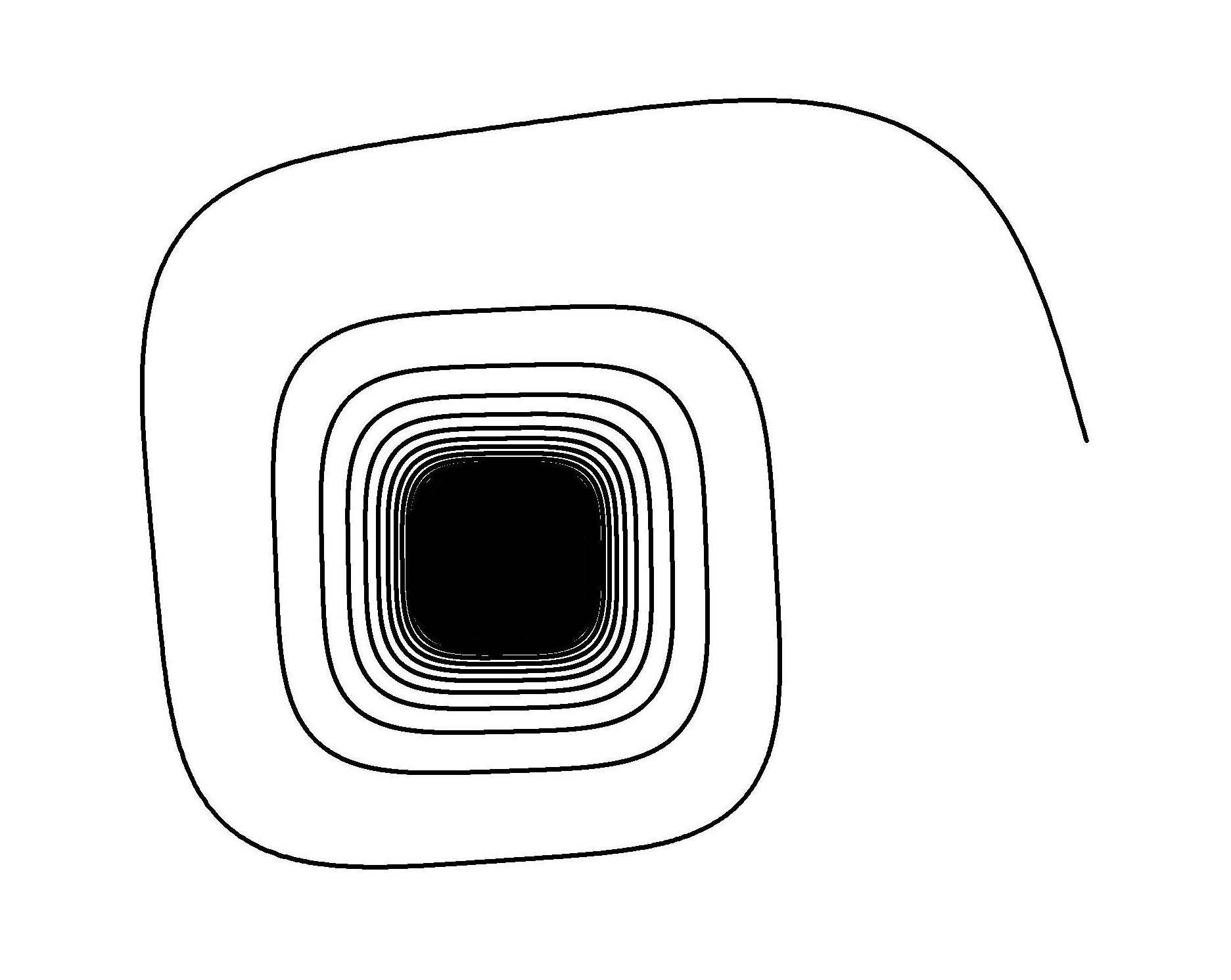 Figure 1
Peer Reviews
No public reviews on file for this paper yet. If you reviewed it on a platform where reviews are public (OpenReview, ICLR, NeurIPS, ICML), you can paste yours below so the community can read it here.
Videos
No videos yet. Explain this paper in a talk, walkthrough, or lecture? Add one.
Taxonomy
TopicsAdvanced Differential Equations and Dynamical Systems · Quantum chaos and dynamical systems · Nonlinear Waves and Solitons
A note on the box dimension of degenerate foci
Domagoj Vlah, Darko Žubrinić and Vesna Županović
Abstract.
We study polynomial planar systems with singularity of focus type without characteristic directions. Simple and natural transformation of weak focus has been used to obtain such degenerate focus. We compute the box dimension of a spiral trajectory, and show connection to cyclicity of the system under a perturbation.
1. Introduction
Analysis of the Poincaré map, or the first return map is a standard approach in the study of monodromic singular points and limit cycles. The Poincaré map and the normal form of a weak focus has been studied in [7] and [8], from the point of view of fractal geometry. Weak focus is a singular point having pure imaginary eigenvalues of the linear part. The box dimension of a spiral trajectory near weak focus, and also near a limit cycle has been computed. Furthermore, the explicit relation between the box dimension and the leading power in the asymptotic expansion of the Poincaré map of the weak focus has been obtained.
Here we announce our results which extend the investigation to certain classes of degenerate foci. Nilpotent focus and focus with no linear part are called degenerate foci. The nilpotent focus is the focus with nilpotent matrix of the linear part. Here we deal with systems having degenerate focus without linear part and without characteristic directions. Characteristic directions can be seen after blowing up of the system.
Here we use results for weak focus from [7] and [8] and apply them to degenerate focus without characteristic directions. Such degenerate focus has the same asymptotic of the Poincaré map in each direction. In general, the Poincaré map of degenerate focus has different asymptotic expansion depending on the direction. That is the reason why the approach to weak focus and to degenerate focus should be different. Nilpotent focus has two asymptotics, on the characteristic curve and elsewhere. Degenerate focus can have more than one characteristic directions. The asymptotic expansion of the Poincaré map near focus has been computed in [5]. The basic technique, method of blowing-up, shows that these characteristic directions are associated to singular points of the obtained polycycle.
2. Definitions
For bounded we define the -neighbourhood of as: . By the lower -dimensional Minkowski content of , for , we mean
[TABLE]
and analogously for the upper -dimensional Minkowski content . If , we call the common value the -dimensional Minkowski content of , and denote it by . The lower and upper box dimensions of are
[TABLE]
and analogously . If these two values coincide, we call it simply the box dimension of , and denote it by . This will be our situation. If for some , then we say that is Minkowski nondegenerate. In this case obviously . In the case when the lower or upper -dimensional Minkowski content of is equal to [math] or , where , we say that is degenerate. If there exists for some and , then we say that is Minkowski measurable.
We shall use the following notation. For any two sequences of positive real numbers and converging to zero we write as if there exist positive real numbers such that for all . Also if are two functions converging to zero as and , we write as . We call such sequences and functions comparable.
Spiral trajectory of weak focus is -power spiral, that is spiral satisfying for , see [7].
3. Transformation of weak focus
We define the map in order to transform trajectories of weak focus to trajectories of degenerate focus. Let be defined by
[TABLE]
We assume that and are positive integers. Since is identity, we also assume that at least one of these integers is . It is clear that is a homeomorphism mapping each quadrant onto itself. Note that it is not diffeomorphism. We defined the map in order to transform trajectories of weak focus to trajectories of degenerate focus. A similar idea is used in e.g. [2], [3], [4] using the quasi-homogeneous polar coordinates in the computation of generalized Lyapunov coefficients.
Theorem 1**.**
Assume that is a trajectory of the system (2),
[TABLE]
Then
[TABLE]
and is Minkowski nondegenerate.
Idea of the proof. Proof is based on application of
[TABLE]
to system
[TABLE]
with weak focus. For weak focus we apply Theorem 9 from [7], as well as the careful study of degenerate focus defined by system (2), obtained via (5).
Remark 1.A bifurcation parametar could be added in system (2), in order to obtain
[TABLE]
For a limit cycle is born from the degenerate focus corresponding to parametar , and having the box dimension (3). For and we have standard Hopf bifurcation where a limit cycle has been born from weak focus with , see [7].
In [8] a flow-sector theorem has been proved for weak focus. The theorem says that weak focus flow in sectors near the singular point is lipeomorphically equivalent to the annulus flow. The flow-sector theorem has been proved for the system with weak focus
[TABLE]
in which functions and are given -functions such that and for some positive constant and for near the origin. We generalize flow-sector theorem for the focus of the system (2).
For a function with , , if and are Lipschitzian we say that is lipeomorphism, and that the sets and are lipeomorphic. Here the annulus flow is defined by
[TABLE]
for .
In the following theorem we claim that the focus flow in sectors near the singular point of (2) is lipeomorphically equivalent to the annulus flow.
Theorem 2**.**
Let be an open sector with the vertex at the origin, such that its opening angle is in , and the boundary of consists of a part of a trajectory and of intervals on two rays emanating from the origin. If the diameter of is sufficiently small, then system (2) restricted to is lipeomorphically equivalent to the system
[TABLE]
defined on the sector .
Idea of the proof. The proof is based on the transformation of a weak focus and application of flow sector theorem from [8].
Remark 2.It is possible to state previous two theorems for a larger class of systems with degenerate focus without characteristic directions.
Characteristic direction for singularity in the origin of a system
[TABLE]
is linear factor in of , where and are homogeneous polynomials of the lowest degree. It is obvious that system (2) has no characteristic directions. If there are no characteristic directions, a singular point is either center or focus. The converse is not true.
Now, we consider a different class of degenerate systems.
Proposition 1**.**
Assume that is a trajectory of the system
[TABLE]
where is a homogeneous polynomial of even degree and , where and are integers. Then
[TABLE]
and is Minkowski nondegenerate.
Idea of the proof. Find explicit solution in polar coordinates.
Example 3.We reveal Example 4 from [4] dealing with system (7). In polar coordinates we obtain
[TABLE]
and the origin is a focus if and only if the following integral is different from zero
[TABLE]
We remark that for odd, the origin is center. In the focus case a spiral trajectory of system (7) is -power spiral with
[TABLE]
Also, box dimension of an orbit generated by the Poincaré map, at any transversal through the origin, is equal to . To system (7) we add analytic perturbation satisfying , for , . Let the corresponding vector field be denoted by . Cyclicity of the origin of the perturbed system will be denoted by . By cyclicity we mean the sharp upper bound for the number of limit cycles which can bifurcate from the origin of the perturbed system. Theorem 1 from [4] says that in this example . For we obtain weak focus with . According to (8), we can express cyclicity by using box dimension of the trajectory.
4. Transformation of weak focus
The case of is more difficult, and by applying transformation (1) to (5), we obtain the following degenerate system, extending (2)
[TABLE]
Theorem 3**.**
Assume that is a trajectory of the system (10) where , . Then
[TABLE]
Idea of the proof. The proof is based on the careful study of the degenerate spiral , where is a spiral trajectory of the system (5) with weak focus, and is transformation defined by (1). Also we use suitable Lipschitz transformations.
Remark 4.We hypothesize that
[TABLE]
5. Acknowledgments
This work has been supported in part by Croatian Science Foundation under the project IP-2014-09-2285.
The reference list from the paper itself. Each links out to its DOI / PubMed record.
- 1[1]
- 2[2] A. Gasull, J. Torregrosa, A new algorithm for the computation of the Lyapunov constants for some degenerated critical points, Nonlinear Analysis 47 (2001), 4479–4490.
- 3[3] A. Gasull, J. Torregrosa, A new approach to the computation of the Lyapunov Constants, Computational and Applied Mathematics, Vol. 20, N. 1-2, (2001), 1-29.
- 4[4] I. Garcia, H. Giacomini, M. Grau, Journal of Dynamics and Differential Equations, 23, 2,(2011), 251-281
- 5[5] N. B. Medvedeva, On the analytic solvability of the problem of distinguishing between center and focus, Proceedings of the Steklov Institute of Mathematics, September 2006, Volume 254, Issue 1, pp 7–93
- 6[6] C. Tricot, Curves and Fractal Dimension , Springer–Verlag, 1995.
- 7[7] D. Žubrinić, V. Županović, Fractal analysis of spiral trajectories of some planar vector fields, Bulletin des Sciences Mathématiques, 129/6 (2005), 457–485.
- 8[8] D. Žubrinić, V. Županović, Poincaré map in fractal analysis of spiral trajectories of planar vector fields, Bulletin of the Belgian Mathematical Society Simon Stevin, 15 (2008), 5; 947-960